Moon Lovers Explained: How King Gwangjong Used Slave Records to Break Goryeo's Powerful Nobles
Theme: Power & Politics
From the research behind Pause the Drama.
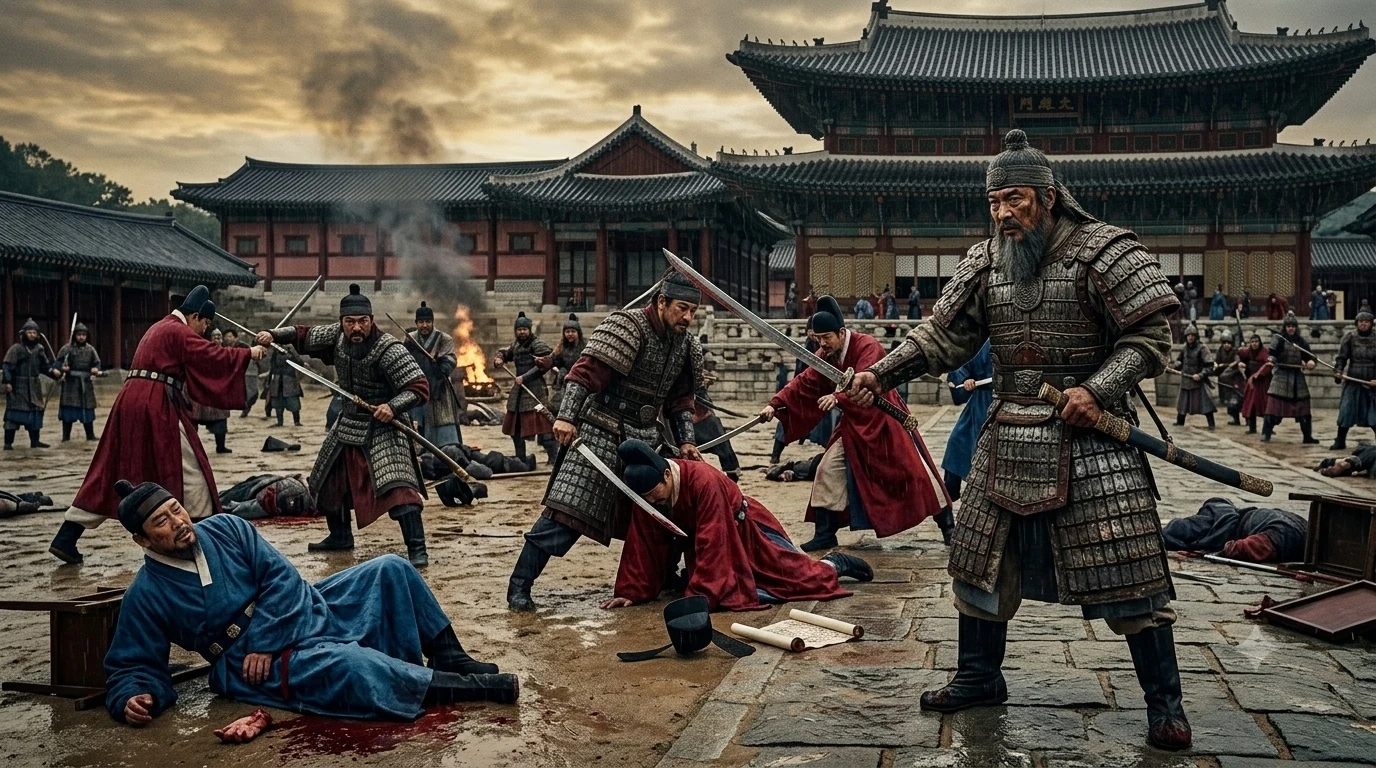
If you’ve watched Moon Lovers: Scarlet Heart Ryeo (달의 연인 - 보보경심 려), SBS’s 2016 time-slip melodrama, you know the ending isn’t really a happy one. Go Ha-jin, a 21st-century woman thrown back into the year 941, spends twenty episodes falling for the quiet, mask-wearing 4th Prince, Wang So — and watches him get pulled, piece by piece, into the bloodiest succession fight of the whole Goryeo founding generation. By the finale, So has the throne. The show all but tells you what history will call him afterward: the king who slaughtered his own brothers to get there.
That line is doing a lot of work, and it’s also not quite fair. Wang So did not kill every brother he had. He did purge his court, savagely, and we’ll get to that. But the blow that actually broke the old nobility landed years earlier and made no noise at all: once he became King Gwangjong, he ordered a kingdom-wide investigation into whether people had been unlawfully reduced to slavery, and he gave Korea its first written exam for government office. Those two administrative reforms weakened the old guard in ways palace violence never could.
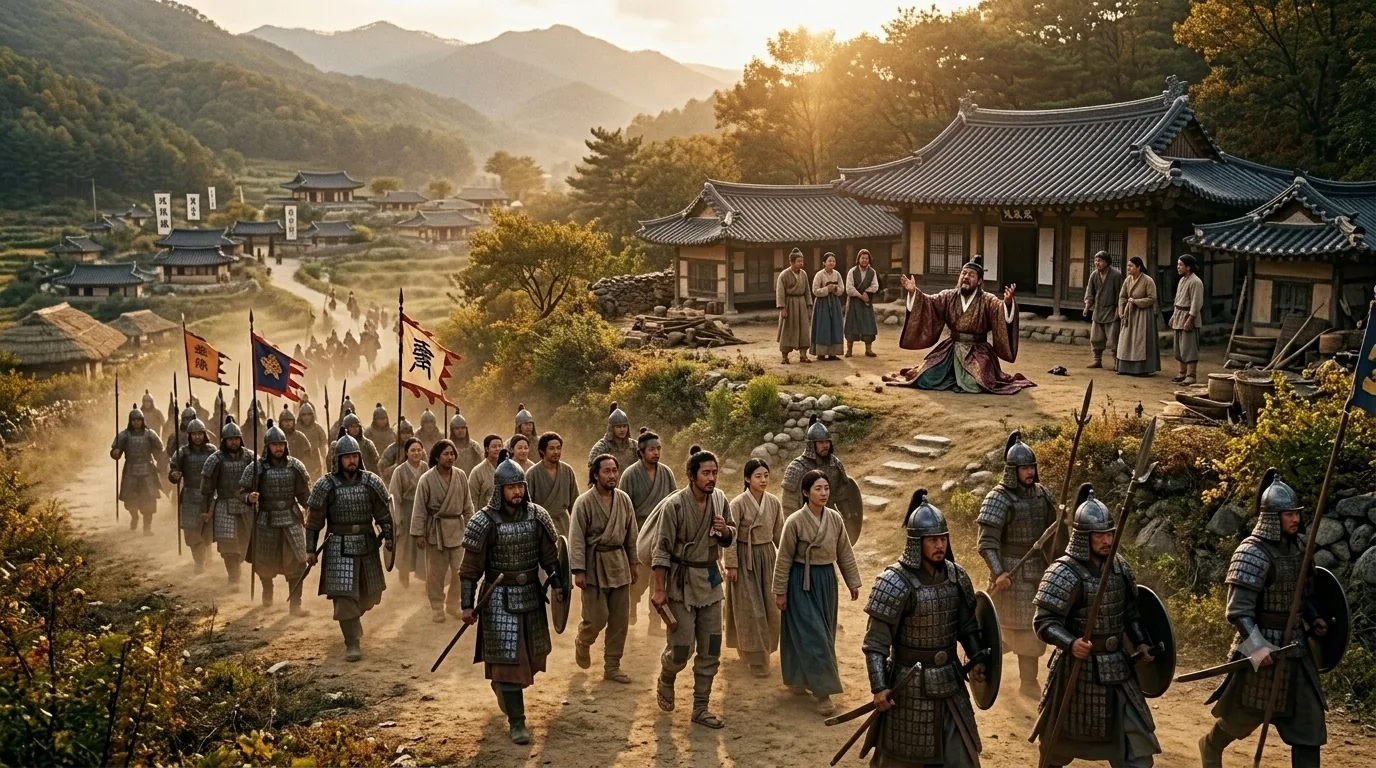 The Slave Review Act didn’t look like a battle. It looked like clerks arriving with a register — and a noble family’s workforce walking out the gate. (AI illustration)
Quick answer: In Moon Lovers: Scarlet Heart Ryeo, Wang So becomes King Gwangjong, remembered as the ruler who turned on his own court. The real history is sharper than that: in 956 Gwangjong’s Slave Review Act freed wrongfully enslaved people, stripping Goryeo’s founding-era nobility (the hojok) of private manpower, and in 958 a Chinese-born official, Ssanggi, helped him launch Korea’s first civil service exam — recruiting officials loyal to the throne instead of to noble bloodlines.
The five facts. 1. Gwangjong was Goryeo’s fourth king, reigning 949–975; he was the full younger brother of his predecessor Jeongjo, not a half-brother. 2. The 956 Slave Review Act (nobi angeom-beop) was an investigation of slave status, not a blanket emancipation — unlawful enslavements were reversed, which drained hojok households of labor. 3. The 958 civil service exam (gwageo) was proposed by Ssanggi, a Later Zhou official who stayed in Goryeo after falling ill on a 956 mission; he served as its first chief examiner. 4. The exam was added alongside hereditary appointment routes, not a replacement — roughly eight sittings in the eighteen years to the end of the reign. 5. The famous claim that only about forty founding subjects survived the purges is not a casualty count: it comes from Choe Seung-no’s memorial to King Seongjong in 982, recalling how many of the old guard remained at Gyeongjong’s accession.
Let’s unpack it.
Who were the hojok, and why did a new king fear them more than any rival prince?
Because Goryeo wasn’t founded by one man — it was founded by a coalition, and the coalition never fully disbanded.
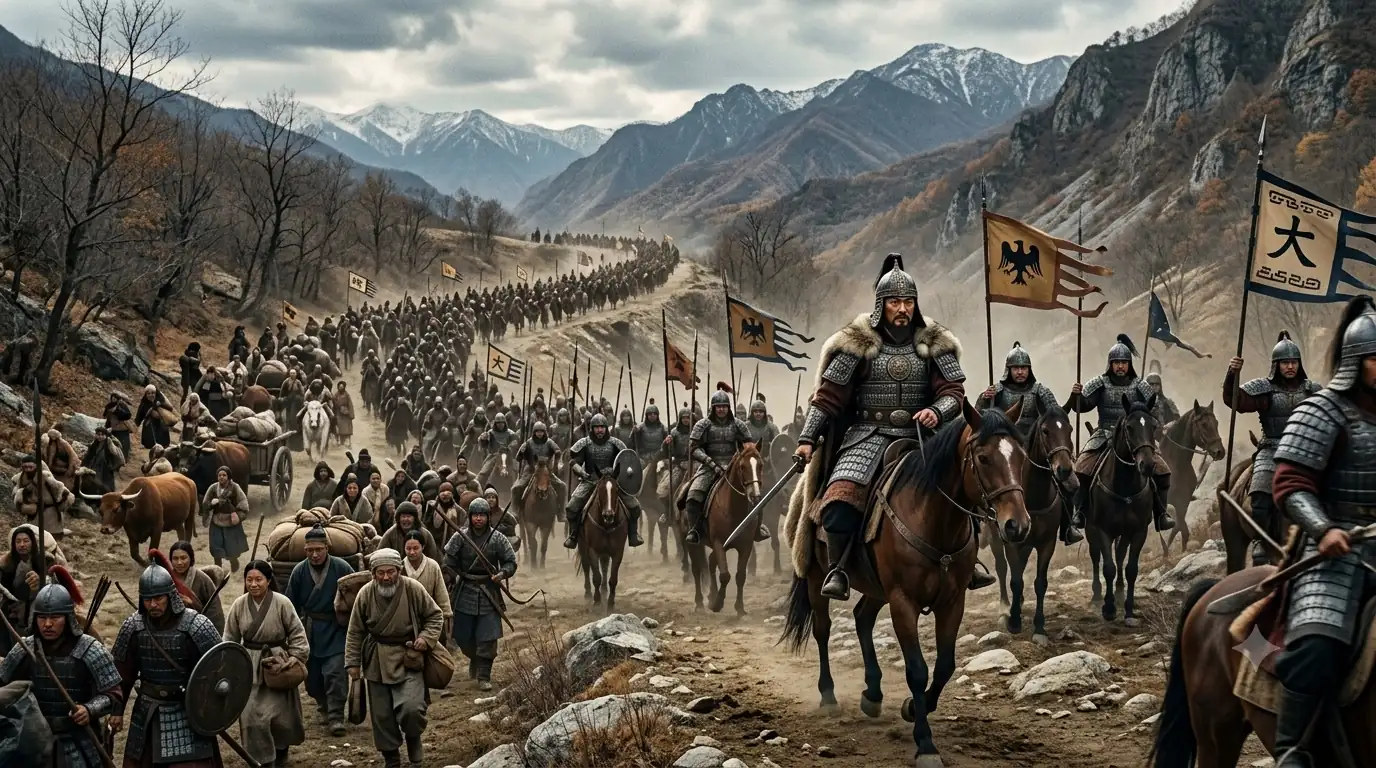
When Gwangjong’s father, Taejo Wang Geon, unified the Later Three Kingdoms in 936, he did it by marrying into and making deals with dozens of regional strongmen — the hojok (호족). These were local magnates with their own land, their own private soldiers, and often their own slaves working that land. Taejo rewarded them as meritorious founding subjects, and by some later accounts, at their peak these clans and their allies numbered in the thousands. That was smart short-term politics and a long-term time bomb: a king surrounded by families who had armies of their own didn’t have a monarchy so much as a standing negotiation.
Gwangjong inherited that negotiation in 949, after the short reign of Jeongjong — not a half-brother but his full elder brother, born to the same mother, Queen Sinmyeongsunseong. He spent his first years doing the safe thing — rewarding subjects, regulating regional tribute. Then, starting around 956, he stopped negotiating.
What was the Slave Review Act, and why was freeing slaves a political weapon?
Because in 10th-century Goryeo, slaves weren’t just household labor — for the hojok, they were the unpaid workforce that made a noble family’s independence from the crown affordable, and the manpower pool those families could draw on when they needed bodies.
In 956 (Gwangjong’s 7th year), Gwangjong ordered a state review of slave status — the nobi angeom-beop (노비안검법), the “Slave Review Act.” This was not a blanket emancipation. Officials investigated how individual people had come to be enslaved — through the unification wars, but also through the ordinary opportunism that follows any social collapse — and where the enslavement turned out to be unlawful, the person was restored to commoner status. On its face, it looks like a humane correction of a wartime injustice — and it may well have been felt that way by the people it freed. But it also did something else: it drained the labor and manpower that hojok households depended on, and it created a new pool of free commoners who owed taxes and service directly to the state rather than to a local lord.
Contemporary court sources on this episode are thin — most of what survives comes from later evaluations by the official Choe Seung-no rather than detailed records from 956 itself — and historians still argue over how much of the policy was principled reform and how much was a calculated strike at noble power. Both readings can be true at once. Either way, the effect was the same: the hojok’s private base shrank, and the throne’s tax base grew.
What the act did not do was end hereditary slavery. The nobi system Gwangjong audited in 956 outlasted him by nine centuries — we traced that long arc, and the runaway-slave hunters it produced, in our piece on Joseon’s 500-year nobi system.
Why did a Chinese-born envoy end up designing Korea’s first civil exam?
Because Gwangjong needed a way to staff his government with people who owed their careers to him, not to their family name — and a naturalized foreign official happened to be sitting in his court with exactly that idea.
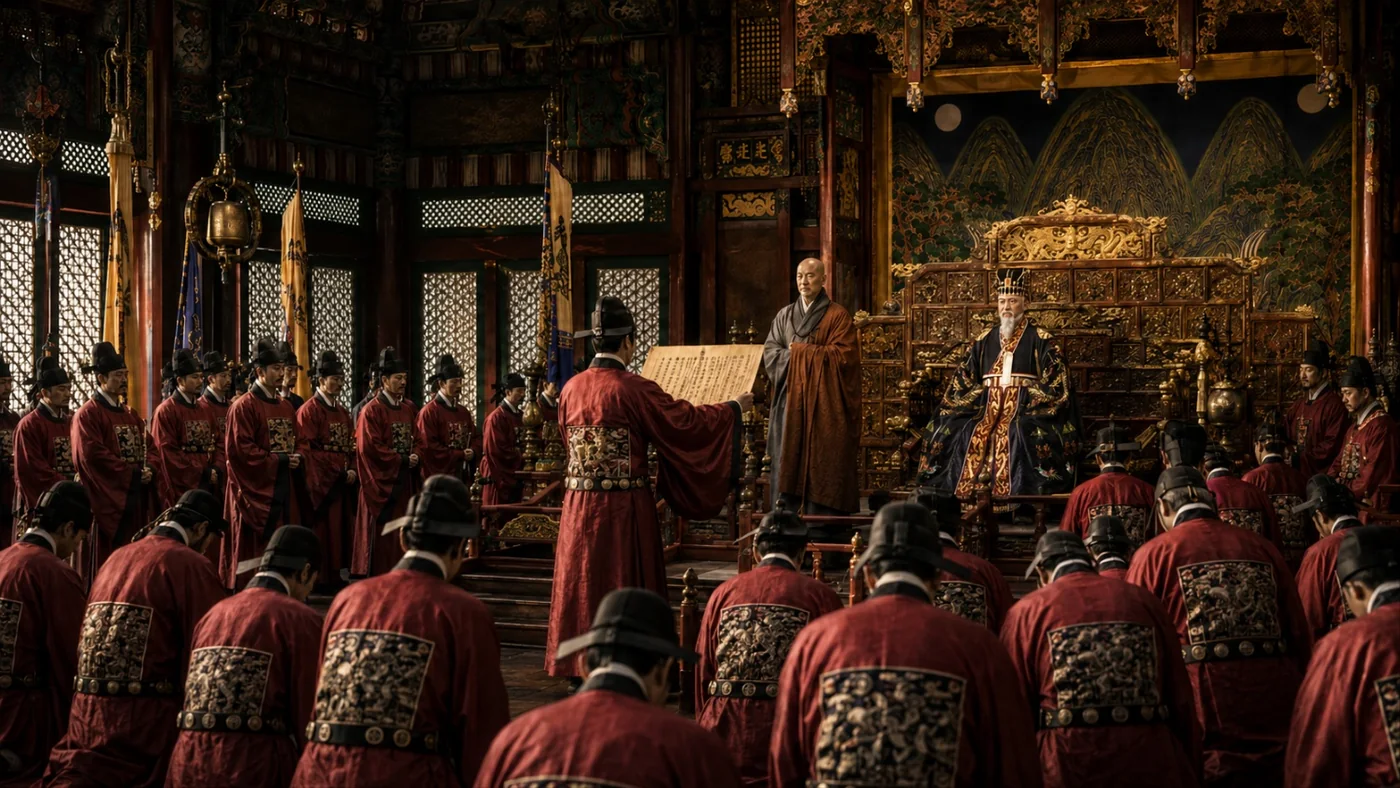
In 956, a Later Zhou diplomatic mission arrived in Goryeo carrying an official named Ssanggi (雙冀). He fell ill during the visit, stayed behind to recover, and impressed Gwangjong enough to be kept on as an adviser. By 958 (Gwangjong’s 9th year), Ssanggi had proposed something Goryeo had never had: a state examination, modeled on Tang China’s system, testing candidates in poetry, rhapsody, eulogy, and policy essays. Gwangjong ran with it immediately, appointing Ssanggi himself as chief examiner for the first sitting that same year.
The gwageo (과거) examination did something the sword couldn’t: it created a new career path into government that ran through literary skill and loyalty to the crown rather than through a family name. It started small — eight exams in the eighteen years between that first sitting in 958 and the end of Gwangjong’s reign, producing a modest number of graduates — but the principle mattered more than the headcount.
That door stayed open for nearly a thousand years — and never opened as wide as its advertising claimed. Five centuries on, in Joseon, the same examination was still being sat by candidates whose families could afford the decades of classical study it demanded; we took that apart in our companion piece on why Joseon’s “fair” exam wasn’t as fair as it looked.
It’s worth being precise about what that principle was, because “Korea’s first meritocracy” oversells it. The exam did not replace the old routes; it was added alongside them. Appointment through family standing, merit-subject status, and recommendation all continued, and social rank still governed who could realistically sit the exam at all. (The formalized hereditary-appointment system Goryeo is known for, eumseo (음서), was institutionalized later, under Seongjong — it is not something Gwangjong’s exam was competing with in 958.) What changed in 958 was that the throne now had a door of its own — one a hojok family couldn’t inherit, and couldn’t close.
Did Gwangjong really turn on almost everyone around him?
This is the part later chronicles are least gentle about — and where historians urge the most caution.
The Goryeosa (고려사, compiled centuries later in the Joseon period) describes a harsher turn from around 960, when two officials — Jun Hong (俊弘), holding the rank of daesang, and Wang Dong (王同), a jwaseung — were denounced for treason. It would be too tidy to call that the single trigger; what the record shows is that accusations and purges widened around and after it, feeding on each other. According to the chronicle, “slaves sued their masters” and “sons accused fathers.” Prisons filled. Innocent people died.
Here is where you have to watch the arithmetic, because a statistic gets quoted about Gwangjong that doesn’t survive contact with its sources. You will read that of the thousands of subjects Taejo honored as meritorious founders, only about forty were left alive by the end — a purge of well over ninety per cent.
That figure is two different records pushed together. The count of founding subjects and the “about forty” come from separate documents, describing different categories of people at different moments, and neither was compiled as a casualty list. The forty comes from Choe Seung-no, recalling how few of the old guard were still standing at King Gyeongjong’s accession. Nobody, at any point, counted the dead in between.
What that leaves is more interesting than the fake number. The most-quoted indictment of Gwangjong is not an execution ledger. It is a passage inside the memorial Choe Seung-no submitted to King Seongjong in 982 — two reigns after Gwangjong’s death — reviewing the recent past to argue how a king should and should not rule. The figure everyone now repeats as a body count was, when it was written, a political argument aimed at a living monarch.
What’s more solidly established is the pattern, not the exact scale: Gwangjong moved from bureaucratic reform to open purges of officials, meritorious subjects, and even people close to the royal family, and it cost him goodwill even among his own descendants. Whether this should be read as a ruthless “reign of terror” or as an unusually blunt (if brutal) response to a genuinely fragmented, coalition-built state is something later historians still debate — the Goryeosa’s own framing, written well after the fact by a different dynasty’s scholars, is not a neutral camera.
Did Gwangjong actually claim to be an emperor?
Not in so many words — but look at what he did with vocabulary, which in the 10th century was policy.
Dating documents by your own era name, instead of by a Chinese emperor’s reign, was the standard way a court announced it answered to no one. Gwangjong used Gwangdeok (광덕) at the start of his reign, then spent a stretch dating by the Chinese era names before adopting Junpung (준풍) in 960. He also renamed his capitals: Gaegyeong became Hwangdo (황도), the “imperial capital,” and Seogyeong became Seodo (서도). A king does not call his own city an imperial capital by accident.
Taken together, that is a court positioning itself as an empire in its own right. What the sources will not support is the flat claim that Gwangjong formally styled himself emperor — and historians still argue whether “Junpung” was a genuinely independent era name or an adaptation of a contemporary Chinese one, which would soften the gesture considerably.
Here’s the drama’s version next to the historical record:
| In Moon Lovers: Scarlet Heart Ryeo | In real Goryeo history |
|---|---|
| Wang So is remembered as “the king who killed his brothers” | Gwangjong’s harshest purges (from c. 960) targeted meritorious officials, court factions, and hojok — not primarily his brothers |
| The threat to So is other princes competing for the throne | The deeper threat was the regional magnate families and founding elites, with private soldiers and slave labor of their own |
| So’s reign begins right where the show ends | Gwangjong’s landmark reforms came years into his real reign — 956 (slaves) and 958 (the exam) |
| The court’s drama plays out through personal rivalries | The real fight was structural: state examinations and slave-status investigations vs. the private power of regional magnates |
| The ending frames So’s transformation as a personal tragedy | Historians frame it as one of Korean history’s most consequential — and most debated — pushes for centralized monarchy |
Key terms. Hojok (호족) — the regional strongmen and founding-era noble families whose private land, soldiers, and slaves rivaled royal authority in early Goryeo. Nobi angeom-beop (노비안검법) — the 956 Slave Review Act that freed wrongfully enslaved commoners, weakening hojok manpower. Gwageo (과거) — the 958 state civil service examination, Korea’s first, recruiting officials by merit rather than birth. Ssanggi (쌍기) — the naturalized Later Zhou official who proposed the gwageo to Gwangjong and served as its first chief examiner.
Why Gwangjong’s purge feels so Korean — but also so Song, so feudal, so Byzantine
Here’s what makes this stretch of Moon Lovers worth pulling out of its own century: almost every major civilization eventually ran into the same problem Gwangjong had — a throne that was, on paper, supreme, but in practice surrounded by families with their own soldiers and their own land. How each civilization solved it says a great deal about how each one actually understood power.
China (Song dynasty) — the exam as an engineering project, done at scale. Just four years after Gwangjong’s slave law, in 960, a general named Zhao Kuangyin founded the Song dynasty as Emperor Taizu. His problem was almost a mirror of Gwangjong’s: powerful military governors who could, and repeatedly had, made or broken emperors. Taizu’s answer was methodical rather than bloody — he pulled military authority back toward the center, stripping his leading generals and provincial military governors of the independent command and revenue that had let them make and unmake emperors, and expanded the civil side of government in their place. In parallel he revived and expanded the civil service examination until it became the main road into the bureaucracy, a change of kind rather than of degree from the Tang, where the exam had been one route among several. By 963 he had gone further, forbidding officials from recommending candidates and barring graduates from treating their examiners as personal patrons, cutting off the informal networks an exam system could otherwise recreate. His successor, Emperor Taizong, pushed the scale up dramatically: where Taizu had admitted just 188 scholars across 15 exams in 16 years, Taizong’s very first exam in 977 admitted 500 candidates in one sitting, and he standardized anonymous grading to blunt favoritism further. The logic was comparable to Gwangjong’s — bypass inherited power by building a parallel ladder into government — though the Song developed it on a far larger and more institutionalized scale, and made it permanent in a way Goryeo’s eight exam sittings did not. The irony, historians note, is that Song’s professionalized bureaucracy eventually grew so entrenched that no single emperor, however forceful, could fully control it either — centralizing power and diffusing it into a new class turned out to be two sides of the same reform.
Medieval Europe — the opposite instinct, and what it left lying around. European kings facing the same problem reached for a different tool. After 1066, William the Conqueror did not route around his nobles the way Gwangjong routed around the hojok; he replaced them. The existing Anglo-Saxon landholding class was dispossessed in stages and its land redistributed to a Norman elite that owed everything to him, with the king placed at the top of the whole tenurial order. That was royal consolidation, not a giveaway — but the instrument he used to do it was the fief, land held in exchange for service, and the fief carried an assumption Gwangjong’s exam did not: that obligation ran both ways between lord and vassal.
That assumption outlived William. When English barons decided King John had broken his side of the bargain — after military failure abroad and a bitter fight over taxation — the language of mutual obligation was already lying there to be picked up, and in 1215 they used it. The result was Magna Carta, which John did not “sign” in the modern sense; he authorized its issue and had it authenticated with his seal. It would be too neat to say 1066 produced 1215 a century and a half later. What is fair to say is that feudal Europe built a hierarchy in which the nobility had standing to push back — and eventually somebody did.
Byzantium — let regional power exist, never let it be inherited. The Byzantine emperor, the Basileus, held authority Gwangjong could only have envied: supreme political and military ruler, believed to reign as God’s chosen representative on earth, with immense influence over the church. Yet no throne room could run an empire that size.
From the mid-seventh century, as territory was lost and armies and provincial administration were reorganized, the theme system gradually emerged — large military-civil provinces under governors called strategoi. It looked like devolution, close in shape to a hojok’s regional grip or a European lord’s fief, with one decisive difference: a strategos reported to the emperor and had no hereditary claim to his post. When some grew too strong, emperors redrew the themes into smaller units, and rulers like Basil II went further, replacing regional strongmen with lesser officials wholly dependent on the throne. Same instinct as Gwangjong’s: regional power is tolerable, inherited power is not.
Four courts, four answers to the same fear: Gwangjong tried to starve the hojok of manpower and build a loyal bureaucracy from scratch; Song China industrialized that exact idea until it outgrew any one emperor; feudal Europe built noble autonomy into the system and then had to legislate the crown back down to size; Byzantium kept regional power on a short, non-hereditary leash. Watch Moon Lovers’ final act again with that in mind, and Wang So’s crown looks a lot less like the end of a love story — and a lot more like the opening move in a very old, very global argument about who gets to hold power without ever being allowed to keep it in the family.
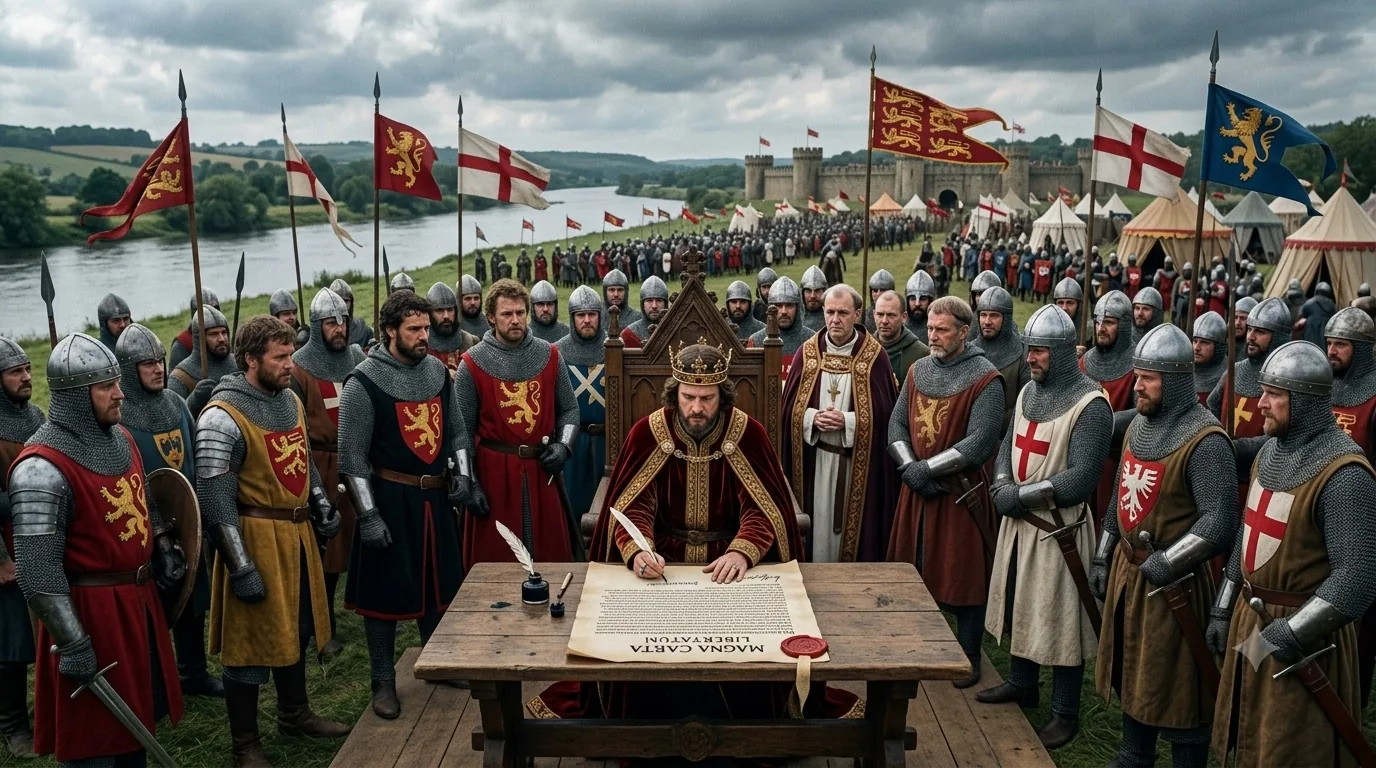 Runnymede, 1215. Gwangjong built a bureaucracy so his nobles couldn’t bargain with him; England’s kings built a hierarchy in which bargaining was the whole point — and this is what that eventually looked like. (AI illustration)
Coming up next
One drama ending, framed as a tragic crown — and underneath it, a slave registry that quietly gutted a noble class, a foreign-born official who designed Korea’s first meritocracy, a Song dynasty running the same play at industrial scale, an English king forced to sign away his own authority, and a Byzantine emperor engineering power so no one beneath him could inherit it. That’s the real reward of watching a historical drama closely: even its epilogue has footnotes.
It is also worth knowing how the story ends. The civil order Gwangjong built — scholars over soldiers, exams over bloodlines — held for two centuries and then broke, violently, when Goryeo’s military officers decided they had been on the wrong side of it long enough: see the coup that ended civil rule in Goryeo. And if you want to see where his 958 exam finally landed, nine hundred years later, it is sitting in a Gangnam apartment hiring a private admissions coordinator — Korea’s 600-year exam obsession. To place Gwangjong’s reign against the rest of Korean history at a glance, use our Korean history timeline.
In the next essay, we’ll take another K-drama scene that looks like pure fiction — and trace the real Korean history hiding underneath it.
Frequently asked questions
Is Moon Lovers: Scarlet Heart Ryeo based on a true story? Not directly. The time-travel premise, the heroine Go Ha-jin, and most of the princes’ romantic entanglements are fiction adapted from a Chinese novel. But the political backdrop is real: Wang So, the drama’s 4th Prince, is built on the historical King Gwangjong (r. 949–975), and the show’s ending gestures at his real reputation as the ruler who purged his own court.
Who was King Gwangjong of Goryeo? Gwangjong was the fourth monarch of Goryeo, reigning from 949 to 975. He is best known for two landmark reforms — the 956 Slave Review Act and the 958 civil service examination — that broke the economic and administrative power of Goryeo’s founding-era nobility and concentrated authority in the throne.
What was the Slave Review Act (nobi angeom-beop)? Enacted in 956, it was a state review of slave status — not a blanket emancipation. Officials investigated how individuals had come to be enslaved, and where the enslavement proved unlawful, restored them to commoner status. It genuinely corrected an injustice, and it simultaneously stripped local strongmen of labor and manpower they depended on. Both things are true; historians disagree over which one Gwangjong was aiming at.
Why did a Chinese official introduce Korea’s first civil service exam? Ssanggi, an official from China’s Later Zhou, arrived with a diplomatic mission in 956, fell ill, stayed on, and entered Gwangjong’s service. In 958 he proposed a Tang-style written examination. Gwangjong adopted it because it let him recruit administrators who owed their careers to the throne rather than to hereditary noble houses — though it supplemented those older routes rather than replacing them.
Did Gwangjong really have almost everyone around him killed? The Goryeosa records purges widening from around 960 that swept up officials, meritorious subjects, and even royal relatives, with overflowing prisons and family members denouncing each other. But the famous claim — that only about forty of Taejo’s founding subjects survived — pushes together figures from separate records describing different groups at different moments. The ‘about forty’ comes from Choe Seung-no’s recollection of how many of the old guard remained at King Gyeongjong’s accession, written into the memorial he submitted to King Seongjong in 982. It was a political argument, not a casualty count.
Sources & further reading
This piece was written from the historical script and fact-check of 사뚱샘의 역사방 (SaDDungSam). Key dates and figures are sourced inline above. For broader reading:
- 광종 (King Gwangjong) — full biographical entry. (Encyclopedia of Korean Culture)
- 쌍기 (Ssanggi) — the official who proposed the gwageo. (Encyclopedia of Korean Culture)
- 노비안검법 (Slave Review Act, 956) — overview and historiographical debate over its intent. (National Institute of Korean History, 우리역사넷)
- Goryeosa (고려사) — the primary chronicle behind Gwangjong’s reign, digitized in full. (Goryeo-era Primary Source Database, National Institute of Korean History)
- Song Taizu and Taizong’s examination and military reforms — for the Chinese comparison. (Britannica, Taizu · World History Encyclopedia, Emperor Taizu of Song)
- 시무 28조 (Choe Seung-no’s Twenty-Eight Point Memorial, submitted to King Seongjong in 982) — the document the “only about forty survivors” figure actually comes from, and the reason it should be read as political argument rather than statistics. (Encyclopedia of Korean Culture, 시무 28조)
- Feudalism — for the European comparison. (World History Encyclopedia)
- Magna Carta — on what King John actually did in 1215, and why “signed” is the wrong verb. (UK Parliament)
- The Byzantine theme system — for the Byzantine comparison. (World History Encyclopedia)
Thanks for reading — see you in the next one.
This article was researched and written by K-Drama History. Source: Moon Lovers Explained: How King Gwangjong Used Slave Records to Break Goryeo's Powerful Nobles — K-Drama History