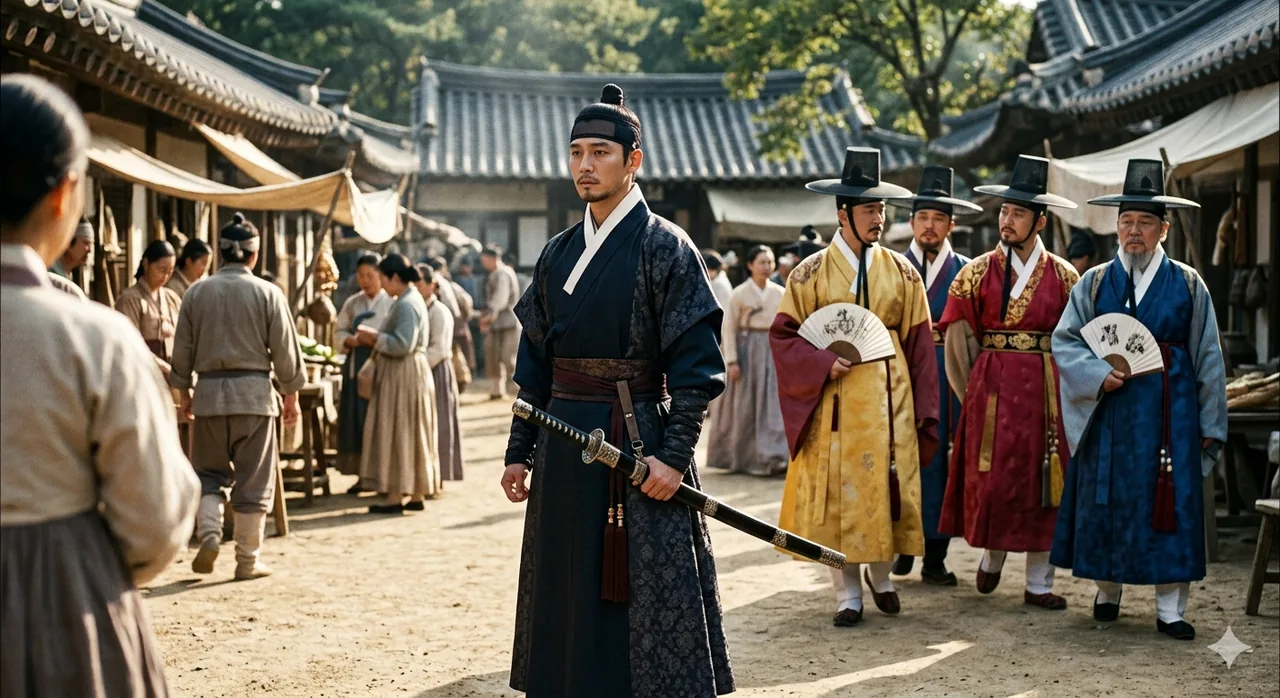
Did Korea Have Slaves? Chuno & the Truth About Joseon's 500-Year Nobi System, Explained
Theme: Status & Class
From the research behind Pause the Drama.
In Chuno (추노) — released internationally as The Slave Hunters, the 2010 KBS historical drama about fugitive nobi and the men hired to recover them — the first thing you notice is the landscape: wide plains, paddy-field margins, the open road. And running across it, a man who has nothing but his legs and his head start. Behind him, closing the distance with professional calm, is Dae-gil — a slave-hunter (chunokkun) whose entire livelihood exists for one purpose: to catch people who have run from their legal owners and bring them back.
For viewers who know Korean history mainly through palace intrigues and dynastic romances, the image is startling. “Korea had slaves?” is a question Chuno draws from international audiences more often than almost any other K-drama. The answer is yes — and the system that produced both the runaway and the hunter lasted, in various forms, across the entire five-hundred-year span of the Joseon dynasty.
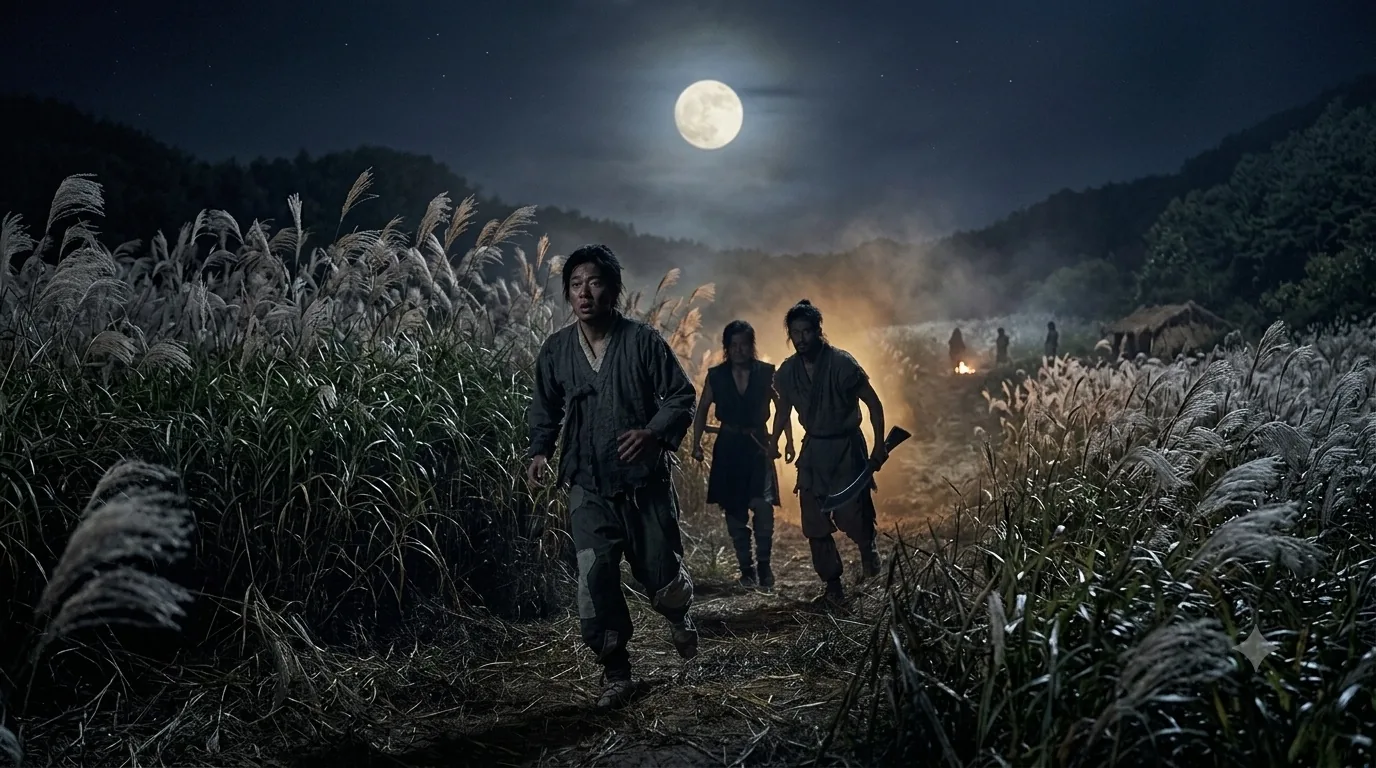 The chase that gives Chuno its name: a runaway nobi and the hunters on his trail. (AI illustration)
Quick answer: Joseon Korea maintained a formal system of bound labor called the nobi (노비) system across the dynasty (1392–1894) — though it did not stay unchanged for five centuries. It peaked in the 15th–17th centuries and was then dismantled in stages: major public-nobi emancipation in 1801, the end of hereditary transmission in 1886, and full abolition of “base” status in the Gabo Reform of 1894. Nobi were legal property: bought, sold, inherited, and recorded in household registries alongside livestock and land. At its height, scholarly estimates place the nobi share of the population at around 30 percent — approaching 40 percent in some regions — though figures vary across sources and localities and are best read as rough indicators, not a fixed national average. Chuno’s hunter-and-hunted structure is rooted directly in this history: the recovery of fugitive nobi was a real and documented practice (its formal name was chuswae; “chunokkun” is the drama’s popular shorthand), and flight was a real and growing phenomenon across the dynasty’s later centuries.
Here is how it worked.
What exactly was a nobi — and how did the system function?
The Joseon social order organized the population into four broad strata. At the top were the yangban (aristocratic scholar-officials) and jungin (technical and middle-status specialists). Below them were sangmin (commoners, primarily farmers and artisans). At the base were the cheonmin — the legally “base” class — and within this category, nobi occupied the position of legal property. (Nobi were not the only group confined to the cheonmin order; the baekjeong outcaste butchers, whose stigma outlasted the nobi system itself, are the subject of a companion piece on Mr. Sunshine.)
The first important distinction is between gongnobi (공노비, state-owned nobi) and sanobi (사노비, privately owned nobi). Gongnobi served central-government offices, royal facilities, and local administrative units. Sanobi served private households and, by most estimates, constituted the majority of the nobi population.
Within privately owned nobi, a further division applied. Solgeono (솔거노비, resident nobi) lived within the owner’s household compound and performed domestic and agricultural labor directly. Oegeo-nobi (외거노비, outside-residence nobi) lived independently, maintained their own households, and paid a form of annual tribute to their legal owner — a fee called singong (신공). The material life of an oegeo-nobi could in some cases be difficult to distinguish from that of a free commoner farmer: they might cultivate their own plots, marry, and raise children, all while remaining another person’s registered property. This spectrum of conditions is part of what makes the Joseon nobi system resistant to simple summary — it was not a monolithic institution but a complex legal framework spanning a wide range of actual living conditions.
Nobi were listed in household registers (hojok) alongside property and assets. They could be bequeathed in wills, transferred as part of a dowry, given as gifts, or sold. Legal disputes over nobi — particularly disputes about the status and ownership of their children — were among the most common civil cases in Joseon courts.
Was Joseon nobi slavery — or serfdom?
This is the question the system raises most often, and the honest answer is that the question itself is the point. Legally, many nobi were closer to slaves: they could be bought, sold, inherited, given as gifts, and recorded as property alongside land and livestock. Socially and economically, though, the system spanned a wide spectrum — from solgeono household laborers under an owner’s direct control to oegeo-nobi who kept their own homes, farmed their own plots, married, and paid an annual tribute much like a tax. Some outside-residence nobi were, in daily life, hard to tell apart from free commoner farmers — yet they remained, on paper, another person’s property and could be sold.
That is why nobi is a word to be explained rather than translated. Force it one-to-one onto American chattel slavery and you erase the spectrum; call it “serfdom” and you erase the fact of outright ownership. The reality sits in between — and Chuno, which shows both brutal bondage and characters with full interior lives, is unusually faithful to that ambiguity.
How did someone become a nobi — and was there any escape?
The nobi system had multiple pathways in. War captives could be enslaved. Freemen who fell into severe debt might enter bondage. Some fell into nobi status through criminal punishment. And, critically, the system reproduced itself through hereditary succession.
The governing principle, codified in the Gyeongguk Daejeon (경국대전, the dynastic law code), was il-cheon-jeuk-cheon (일천즉천, “one base origin, all base status”): if either parent was a nobi, the child was a nobi. This was the engine of the system’s self-reproduction — the bound population could grow through birth alone, without new captives or new debt cases.
A second rule, jong-mo-beop (종모법, “follow the mother’s status”), is often cited here, but its history is more tangled than a simple “children followed the mother,” and it’s worth getting right. In the early dynasty, a competing principle — jong-bu-beop (following the father) — was debated and applied at different moments. And the most consequential late-Joseon version, the maternal-descent law fixed under King Yeongjo in 1731, actually ran the opposite way from what the name suggests: it assigned the children of a nobi father and a commoner mother to the mother’s free status, turning them into commoners rather than nobi. That rule was an instrument of the late state’s drive to enlarge its taxable free population, and it became one of the quiet forces shrinking the nobi class over the dynasty’s final century. In short: hereditary bondage was real and central, but its legal machinery shifted across five hundred years rather than following one fixed maternal rule.
Formal escape from nobi status — myeon-cheon (면천, emancipation) — was legally possible but practically rare. A sympathetic owner might grant an emancipation document voluntarily. A nobi who performed outstanding military service could be freed by royal decree. The state periodically reduced the gongnobi population through administrative policy: the most significant single act was in 1801 (the first year of King Sunjo’s reign), when the central government burned the registers of the naesi nobi — the bound laborers attached to royal estates and central offices — and enrolled them as commoners. The records put the number freed at 66,067 (36,974 from the royal estates and 29,093 from the central offices). It is often described broadly as the “emancipation of public nobi,” but more precisely it was the abolition of the naesi nobi, who made up the bulk of late-Joseon public nobi; privately owned nobi were untouched, and some categories of public nobi persisted.
The alternative to formal emancipation was running. Fugitive nobi — doang-no (도망노) — became an increasing phenomenon as the dynasty aged. By the 17th and 18th centuries, the combination of war disruption (the Japanese invasions of the 1590s and the Manchu invasions of the 1630s scattered slave populations and damaged household registries), growing commercial economy, and declining state capacity to enforce registries made mass flight a viable survival strategy.
A note on the word the drama is named for: the official term in the records is not chuno but chuswae (추쇄, 推刷) — the administrative work of tracking down fugitive or unregistered nobi and reconciling the registers. State-owned nobi were recovered through official channels (local magistrates conducted the chuswae and reported to the provincial governor; a late-Joseon office even dispatched recovery officials, chuswaegwan). For privately owned nobi, owners hired private men to do the catching — and it is these figures the drama crystallizes into Dae-gil. The word chunokkun itself is best understood as a dramatic shorthand for that private recovery work, not as a formal office in the Joseon law code.
There is a quieter horror beneath the chase. A prison holds you only while its door stays shut; a register follows you anywhere. A fugitive could flee to a mountain village, blend into a new town, and live under a new name — and still the name written in an old bond register could reach out years later and pull them back. What the doang-no feared was not only the hunter’s blade, but the fact that somewhere, on paper, they were still listed as another person’s property. In Joseon, what bound a person was sometimes not a chain but a sheet of paper — and the chase in Chuno is, at its root, the violence of a name that would not let go.
How closely does Chuno depict the historical reality?
| In Chuno | In real history |
|---|---|
| Dae-gil is a private slave-hunter hired by a specific owner to recover a specific fugitive | Private chunokkun were documented; official recovery of state nobi was handled separately by government agents |
| The drama’s fugitive nobi risk everything to reach freedom | Flight was common and accelerating in late Joseon; success meant living under a false identity or in a remote area where old registries had no reach |
| A yangban’s fall from status can drag a household into near-bondage | Social mobility was downward as well as upward; ruined yangban families could lose the practical protections of their position |
| Nobi are shown with family bonds and individual agency | Accurate in broad terms: nobi marriages were legally recognized (with complications over the status of children), and individual nobi histories show remarkable range of action within severe constraint |
| The system appears fixed and ancient | Historically, late Joseon was a period of accelerating erosion: registries deteriorated, the commercial economy created new pressures, and enforcement capacity weakened steadily before formal abolition in 1894 |
Chuno is most historically honest in showing the nobi system as something that created human drama on both sides: the fugitive trying to become a person rather than a property, and the hunter whose profession is itself a product of the same social order that confined everyone within it.
Key terms. Nobi (노비) — Joseon’s legal class of bound laborers, divided into state-owned gongnobi and privately owned sanobi. Il-cheon-jeuk-cheon (일천즉천) — “one base origin, all base status”: the principle that one nobi parent made a child legally a nobi. Jong-mo-beop (종모법) — a maternal-status rule whose meaning shifted over time; in its late-Joseon form (fixed in 1731) it tied a child’s status to the mother’s line, which could reduce the nobi population when the mother was a free commoner. Myeon-cheon (면천) — formal emancipation from nobi status; legally possible but rare in practice. Chuswae (추쇄, 推刷) — the official term for tracking down fugitive or unregistered nobi and reconciling the registers; chunokkun (추노꾼), the drama’s word, is a popular shorthand for the private men hired to do the catching, not a formal office in the Joseon law code. Gabo Reform (갑오개혁, 1894) — the comprehensive modernizing reform package, implemented under Japanese political pressure, that legally abolished the nobi system and the formal cheonmin status categories.
How Korea’s bound labor compares with the world’s other systems
Korea was far from alone in keeping large portions of its population in legally defined bondage. What differs across societies is the logic of the system, the mechanism of control, and the path to abolition.
The United States — slavery and the fugitive apparatus. American chattel slavery, beginning in the 17th century, was built on race in a way Joseon’s nobi system was not: nobi status could attach to any Korean through hereditary descent, war capture, or debt regardless of ethnicity. The structural comparison that travels most clearly between the two systems is the fugitive slave framework. The United States had two Fugitive Slave Acts: the first, dated to 1793, established the basic legal mechanism for recovering escaped slaves across state lines; the second and more notorious, dated to 1850, extended these obligations into free states, requiring their residents to assist in capture and denying escaped slaves the right to testify in their own defense. The 1850 act is the relevant parallel here because it addressed precisely the jurisdictional problem — how do you catch someone who has crossed into territory where the original owner has no direct authority? — that the Joseon chunokkun system was also built to solve. American slavery was abolished by the Thirteenth Amendment in 1865; the Joseon nobi system by the Gabo Reform in 1894.
Russia — serfdom and the land bond. Russian serfdom (krepostnoe pravo) in the 17th through 19th centuries bound agricultural laborers to the land of their noble lord. Russian serfs were not typically sold independently of the land — the formal legal principle was that land and serfs transferred together — though this distinction was frequently violated in practice, and serfs could be exchanged, reassigned, and treated in ways that closely resembled outright sale. The Joseon oegeo-nobi — who lived independently, maintained their own economy, and paid annual tribute — bears a structural resemblance to the Russian serf in that both categories represent populations bound by legal status while largely self-managing in daily life. Alexander II’s emancipation decree of 1861 formally ended serfdom; the Joseon system persisted another thirty-three years.
Medieval Western Europe — serfs and the intermediate position. Medieval European serfdom occupied an intermediate legal ground deliberately distinguished from outright slavery: serfs were not property to be bought and sold as individuals, were bound to a specific piece of land rather than to a person, owed labor dues and various fees to their lord, and could not leave the estate without permission. The critical structural difference from the Joseon nobi system is that serfs were bound to place rather than to an owner — a conceptual distinction with significant practical consequences. In Western Europe, the demographic catastrophe of the Black Death (1347–1351) reduced the serf population so drastically that lords could no longer sustain serfdom against the bargaining power of surviving laborers, and the system largely dissolved in the West by the 15th century. In Eastern Europe, the dynamic moved in the opposite direction — serfdom intensified in the same period, a phenomenon historians call the “second serfdom” — and persisted well into the 18th and 19th centuries.
 Medieval European serfs were bound to a lord’s land rather than owned as individuals — a different architecture of bondage from Joseon’s nobi. (AI illustration)
Coming up next
A system that lasted five centuries, reproduced itself through the rule that one enslaved parent meant an enslaved child, and required a professional hunter class to hold the structure together against the constant pressure of flight — and that ended, finally, not from within but under external pressure in 1894. Chuno gives this history its most vivid popular dramatization, and international audiences who ask “Korea had slaves?” leave the drama with something more useful than a simple answer: a question they’ll keep thinking about.
In the next essay, we move from the Joseon aristocratic order to a very different Korea — a post-war society where the stage offered something unusual: a space where women played every role, including the heroes.
Thanks for reading — see you in the next one.
Frequently asked questions
What is Chuno about? Chuno (추노, 2010, KBS2) is a Joseon-era action drama centered on Dae-gil, a professional slave-hunter (chunokkun), and his pursuit of a fugitive who was also his rival for the woman he loved. The drama uses the mechanics of the chase to explore the moral contradictions of the nobi system: the humanity of the fugitive, the ambivalence of the hunter, and the structural violence of a society that turned people into transferable property.
Were Korean nobi the same as American slaves? They shared the fundamental characteristic of legal ownership — nobi were property, recorded alongside land and livestock, and could be bought, sold, and inherited. But there were important structural differences. The Joseon nobi system was not racially defined: Koreans became nobi through hereditary birth, war capture, debt, or criminal punishment regardless of ethnicity. Joseon also distinguished between state-owned and privately owned nobi, and between resident nobi and those who lived independently while paying tribute. These distinctions don’t make the system less severe, but they make direct one-to-one comparison with American chattel slavery inaccurate.
How did someone become a nobi in Joseon Korea? Through four main routes: hereditary birth to a nobi parent (the most common mechanism in the dynasty’s later centuries); capture in war; entry due to debt; and criminal punishment in serious cases. The hereditary mechanism was self-amplifying: the “one base origin, all base status” (il-cheon-jeuk-cheon) principle meant that a child with even one nobi parent was legally a nobi. The rules on which parent’s status governed a mixed-parentage child (jong-mo-beop and its alternatives) shifted across the dynasty — its late form actually freed some such children into commoner status — but the hereditary principle itself kept the bound population reproducing through birth alone.
What was the il-cheon-jeuk-cheon rule? Il-cheon-jeuk-cheon (일천즉천, “one base origin, all base status”) was the governing principle, codified in the Gyeongguk Daejeon law code, that anyone with a nobi parent was legally a nobi — regardless of the other parent’s status, regardless of personal achievement, and with no path of escape through social mobility alone. Which parent’s status governed a mixed-parentage child (the jong-mo-beop question) shifted over the centuries — its late-Joseon form, fixed in 1731, actually freed some such children into commoner status — but the hereditary principle itself created a self-perpetuating nobi population that grew through reproduction without requiring new captives or criminal cases.
Could a nobi ever become free in Joseon Korea? Formal emancipation — myeon-cheon — was legally possible through voluntary owner grant, royal decree for military service, or periodic state policy. In practice, emancipation was rare enough that the more common path to de facto freedom was flight. The increasing numbers of fugitive nobi in late Joseon reflect a system that was losing enforcement capacity even before formal abolition.
What happened to Korea’s public nobi in 1801? In the first year of King Sunjo’s reign (1801), the Joseon government burned the registers of the naesi nobi — those attached to royal estates and central offices — and enrolled them as commoners. The records put the number freed at 66,067 (36,974 from royal estates and 29,093 from central offices), the largest single emancipation event in the dynasty’s history before the Gabo Reform. Strictly speaking it abolished the naesi nobi, who made up most of the late-Joseon public nobi; privately owned nobi were unaffected and some public-nobi categories persisted.
How does the Joseon nobi system compare with American slavery? The closest structural parallel is the fugitive apparatus. America’s Fugitive Slave Act of 1850 — requiring free-state residents to assist in returning escaped slaves — mirrors the Joseon chunokkun system in its core logic: both built legal infrastructure around the problem of flight because both systems produced flight as a rational survival response. Key differences are racial definition (American slavery was racially coded; Joseon nobi status was not) and labor model (American plantation slavery centered on mass agricultural production; Joseon nobi labor ranged from domestic service to semi-independent tribute payment).
When and how did Korea legally abolish the nobi system? The Gabo Reform (갑오개혁) of 1894 formally abolished the hereditary cheonmin status category, ending the legal basis for the nobi system. The reform was implemented under Japanese political pressure during the final decade of the Joseon dynasty. Practical conditions of debt bondage and social stigma persisted beyond 1894, but the formal legal architecture was dismantled at that point.
Sources & further reading
This piece was written from the historical script and fact-check of 사뚱샘의 역사방 (SaDDungSam), drawing on primary records and peer-reviewed scholarship:
- Nobi system structure, classification into gongnobi/sanobi, and the il-cheon-jeuk-cheon / jong-mo-beop principles — Palais, James B., Confucian Statecraft and Korean Institutions: Yu Hyŏngwŏn and the Late Chosŏn Dynasty (University of Washington Press, 1996); Encyclopedia of Korean Culture (한국민족문화대백과사전), Academy of Korean Studies, entries on nobi, gongnobi, and sanobi. (encykorea.aks.ac.kr)
- Nobi population estimates and scholarly debate on those figures — Kim, Bok Rae, “Nobi: A Korean System of Slavery,” in Mechanisms of Slavery, eds. Enrico Dal Lago and Constantina Katsari (Cambridge University Press, 2008); historiographical discussion in Palais (1996).
- Fugitive nobi, the chunokkun institution, and the late Joseon erosion of the system — Joseonwangjo Sillok (Annals of the Joseon Dynasty), National Institute of Korean History digital edition; scholarly discussion in Palais (1996).
- 1801 public nobi emancipation under King Sunjo — Sunjo Sillok (Annals of King Sunjo), Year 1 (1801); Encyclopedia of Korean Culture, entry on gongnobi. (encykorea.aks.ac.kr)
- Gabo Reform of 1894 and formal abolition of the nobi system — Encyclopedia of Korean Culture, entry on Gabo Reform (갑오개혁); Deuchler, Martina, The Confucian Transformation of Korea (Harvard University Press, 1992).
- Fugitive Slave Acts of 1793 and 1850 — U.S. Library of Congress primary-source records on the Fugitive Slave Acts; the 1850 act is the comparatively relevant statute for its extension of recovery obligations across free-state jurisdictions.
- Russian serfdom and the 1861 emancipation decree — Moon, David, The Abolition of Serfdom in Russia (Pearson Longman, 2001).
- Medieval European serfdom and the Black Death’s effect on bound labor — Bloch, Marc, Slavery and Serfdom in the Middle Ages (University of California Press, 1975).
Thanks for reading — see you in the next one.
This article was researched and written by K-Drama History. Source: Did Korea Have Slaves? Chuno & the Truth About Joseon's 500-Year Nobi System, Explained — K-Drama History