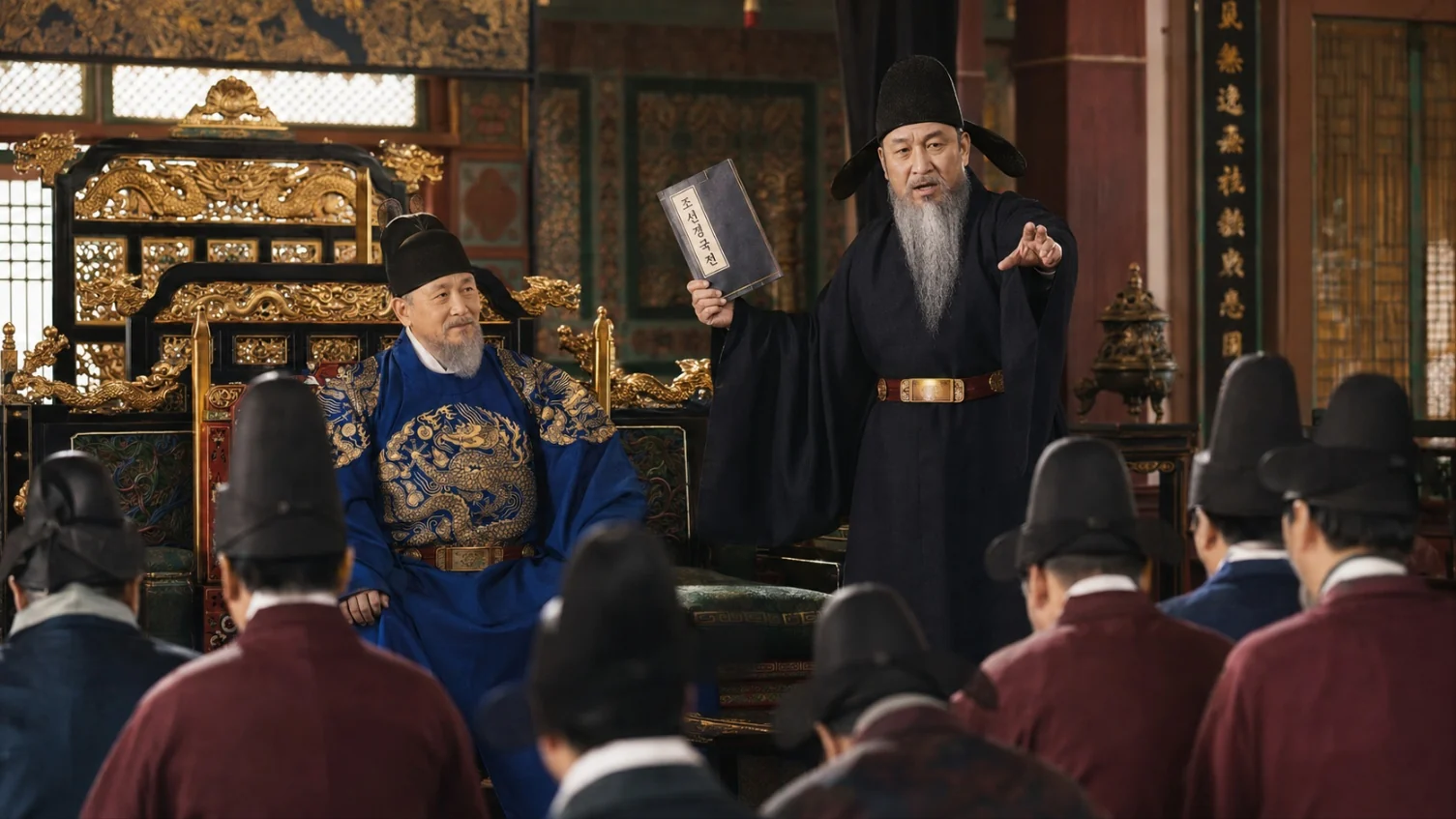
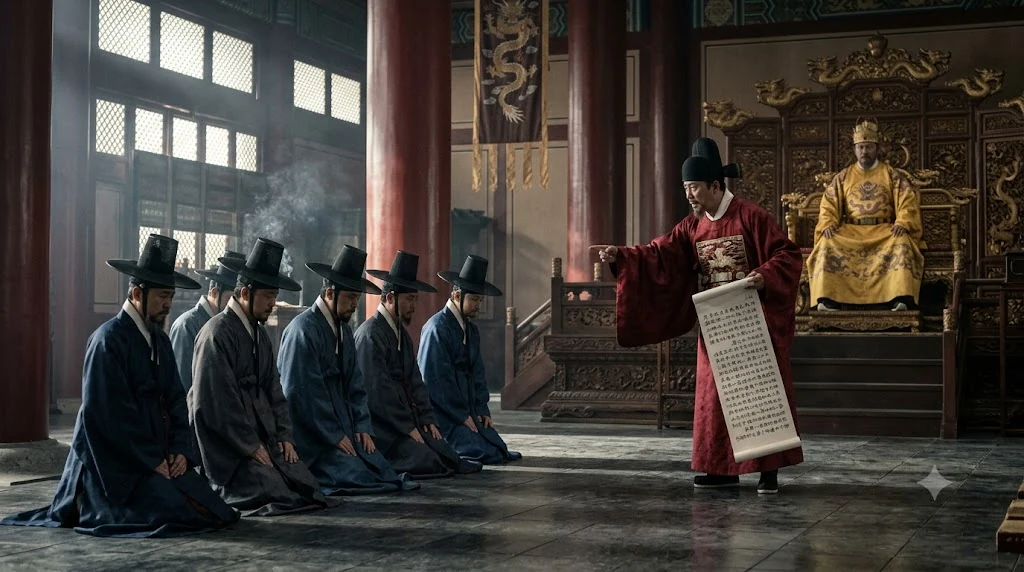
Shin Don, Explained: Why King Gongmin Gave Power to the Monk Who Took On Goryeo's Nobles
Theme: Power & Politics
From the research behind Pause the Drama.
If you’ve come across MBC’s sprawling 2005 historical epic Shin Don (신돈) — 61 episodes tracking the twilight of the Goryeo dynasty — you’ve probably wondered why a king would hand near-absolute power to a Buddhist monk nobody in the royal court had ever heard of. It looks like the kind of implausible twist a screenwriter invents to raise the stakes.
It isn’t invented. King Gongmin really did purge his own aristocracy, break with the Mongol Yuan empire that had dominated Goryeo for a century, and then deliberately elevate an outsider who stood outside the aristocratic clans entirely — because that was exactly the point. It’s one of the strangest and most instructive reform experiments in Korean history, and it ends about as badly as these things usually do.
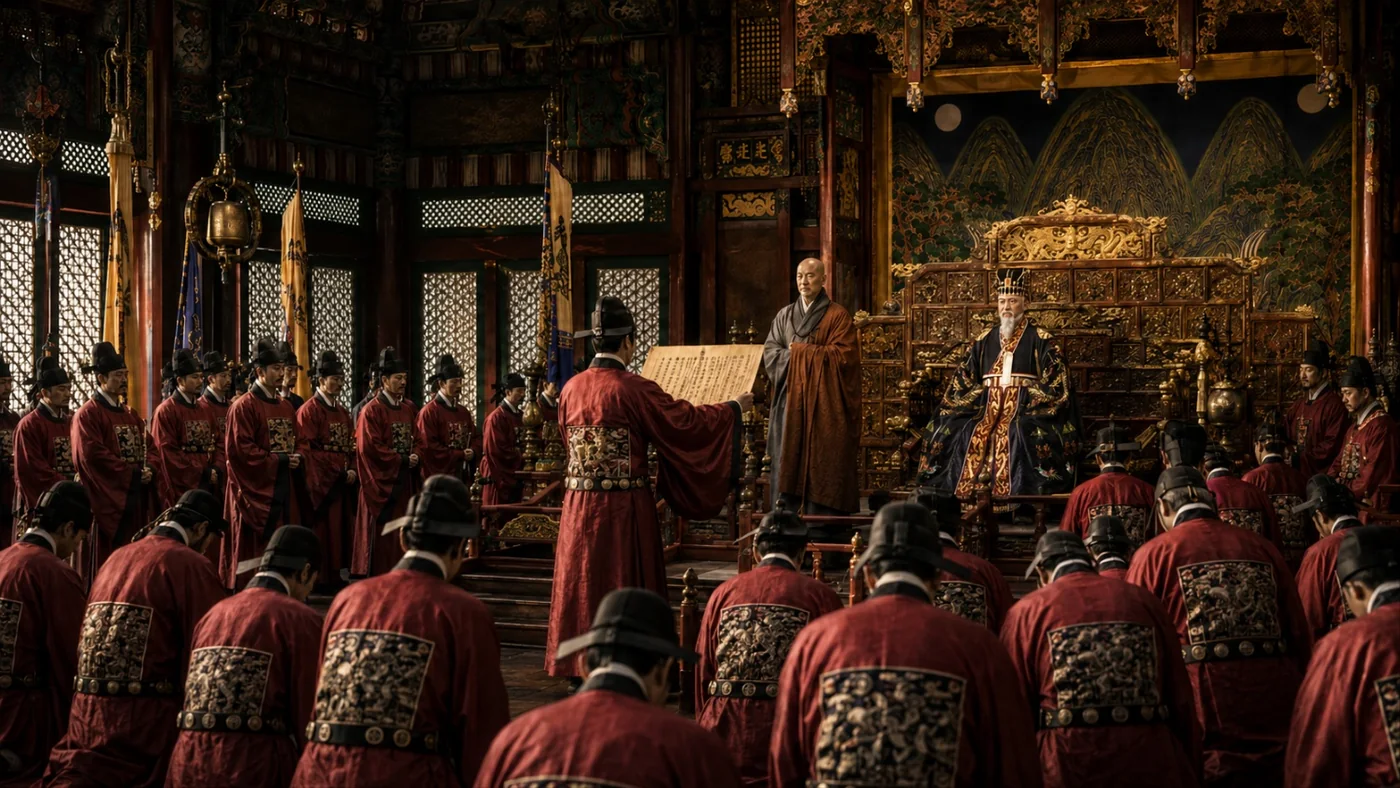 King Gongmin purged his pro-Yuan aristocracy in 1356 — then reached outside the entire noble order, elevating a low-born monk no clan could claim. (AI illustration)
Quick answer: MBC’s Shin Don dramatizes a real 14th-century gamble. As Yuan power crumbled, King Gongmin (r. 1351–1374) purged the pro-Yuan aristocracy in 1356, abolished the Mongol-run Ssangseong Chonggwanbu, and reclaimed lost territory. To attack the noble clans who still controlled land and courts, he elevated Sindon — a monk of humble background who stood outside the aristocratic clans — who ran a land-and-slave reform agency from 1366 that made him beloved by commoners and hated by nobles. Both men fell within three years: Sindon executed in 1371, Gongmin assassinated in 1374.
Let’s unpack it.
Why did a king need an outsider monk to fight his own nobles?
Because after the anti-Yuan purge, Gongmin’s harder problem was no longer Yuan power outside Goryeo — it was the entrenched noble families inside his own government, and none of his officials could be trusted to move against them.
A century of Mongol overlordship had produced a class of Goryeo aristocrats historians call the gwonmun sejok (권문세족) — powerful clans who built fortunes cooperating with Yuan authority through marriage ties, military collaboration, or simply seizing land while the state was too weak to stop them. These families didn’t just hold wealth; many held the very posts meant to check it. An official assigned to investigate illegal landholding was likely related to, indebted to, or afraid of the families under investigation.
Gongmin needed someone standing completely outside that web — no clan to protect, no favor to repay. A monk of humble background, standing outside the central aristocratic marriage-and-faction network — and whatever his exact origins, later hostile histories may well have exaggerated their lowness — was about as far outside that web as a person in 14th-century Goryeo could be. That matches what the historical record says Gongmin himself valued in the man: someone who had “attained the Way, had few desires, and no factional ties,” safe to trust with work no established official would touch.
What actually happened: Gongmin’s anti-Yuan purge of 1356
Gongmin came to the throne in 1351, just as Mongol Yuan dominance over East Asia — enforced through marriage alliances, garrisons, and puppet posts since the 13th century — was visibly cracking under internal rebellion (the Red Turban uprisings that would soon help topple Yuan rule in China itself). He moved fast. In May 1356, he executed the powerful pro-Yuan official Ki Cheol (기철) — brother of Empress Ki, a Goryeo-born woman who had become consort to the Yuan emperor — with his allies Gwon Gyeom and No Chaek, in a purge that killed roughly 25 of the pro-Yuan faction (한국민족문화대백과, 기철; 한국민족문화대백과, 부원세력). Ki Cheol’s faction had spent years exploiting his sister’s status at the Yuan court to seize land and people with impunity.
That same year, Gongmin abolished the Ssangseong Chonggwanbu (쌍성총관부) — a Mongol post governing Goryeo’s northeast since local collaborators surrendered the region in 1258 — and sent troops to reclaim it; by July 1356 the Mongol administration there had been expelled after nearly a century (우리역사넷, 쌍성총관부). He also stopped dating documents by the Yuan calendar on 26 June 1356 and rolled back Mongol-imposed customs — the shaved-front, braided-back hairstyle and dress mandatory at court — restoring the older Goryeo system (한국민족문화대백과, 공민왕; 우리역사넷, 공민왕의 개혁정책과 신돈).
It was a stunning opening move. But purging the pro-Yuan faction at the top didn’t touch the deeper problem: the aristocratic land-and-slave system underneath it, Yuan-backed or not. That needed a second campaign, on entirely different terrain — and a very different ally.
Enter Sindon: the outsider Gongmin trusted
Sindon (신돈) was born in Yeongsan, now Changnyeong, Gyeongsangnam-do. His father’s identity is unrecorded; his mother was reportedly an enslaved woman attached to Okcheon Temple (한국민족문화대백과, 신돈). He became a Buddhist monk and would have remained a minor regional cleric had he not been introduced to Gongmin around 1358. In May 1365 — soon after the death of Gongmin’s beloved Mongol-born queen, Princess Noguk — the king made him his personal spiritual advisor, and by that December had elevated him to one of the highest posts in government, with both inner-palace and outer-court authority converging on him almost overnight.
Sindon’s signature achievement came in May 1366, when he expanded an existing relief office into the Jeonmin Byeonjeong Dogam (전민변정도감) — the Directorate for the Rectification of Land and Slaves — and made himself its presiding judge (한국민족문화대백과, 전민변정도감). Its mission was blunt: strip land and enslaved people that powerful families had illegally seized from commoners, and hand both back, freeing many who could prove prior commoner status. Similar directorates had fizzled before, in 1269, 1288, 1301, and 1352 — but Sindon’s version had something they lacked: a chief with the king’s backing and nothing to lose by making enemies. It worked well enough that people reportedly began calling him a “sage” (성인).
Key terms. Gwonmun sejok (권문세족) — the entrenched clans who dominated Goryeo’s court and economy through Yuan-era collaboration. Ssangseong Chonggwanbu (쌍성총관부) — the Mongol post controlling Goryeo’s northeast from 1258 until Gongmin abolished it in 1356. Jeonmin Byeonjeong Dogam (전민변정도감) — Sindon’s 1366 directorate that stripped illegally held land and people from the aristocracy and returned them to commoners.
Myth-busting: was Sindon just a corrupt schemer?
That’s the popular caricature — conveniently, the version the winning side had every reason to write.
Later Joseon-era historiography, written by scholar-officials who benefited from replacing Goryeo’s old aristocracy, remembers Sindon as a lecherous schemer who manipulated a weak king. Some of that may be fair — he did accumulate real wealth and build several houses in the capital, and Gongmin’s own charges cited exactly those excesses. But the graver charge, that he plotted regicide, looks shakier under scrutiny: it originated from a single informant, Sindon reportedly didn’t learn his allies had already been executed until days later, and his actual death sentence cites only broken promises and the houses — not rebellion (우리역사넷, 신돈). Modern historians treat the rebellion charge as unproven, and possibly a pretext from the faction he’d spent five years dispossessing.
The caricature runs into the next reign, too. Sindon’s household included a woman named Banya (반야); when Gongmin’s successor, King U, was born to her, Gongmin claimed the child as his own. A rumor persisted that U was actually Sindon’s son. It sat dormant until 1389. King U had already been deposed after General Yi Seong-gye’s Wihwado turnaround of 1388; now, under the slogan pyegaipjin (廢假立眞, “remove the false king, enthrone the true one”), Yi’s faction — Joseon’s future founder among them — used the paternity rumor to depose U’s young son King Chang as well in 1389, later executing both on the grounds that U had never legitimately been Gongmin’s heir (한국민족문화대백과, 우왕). Whether the claim was true remains unresolved — but it served Yi Seong-gye’s founding narrative perfectly, which alone is reason for caution.
How did it end?
Sindon’s power did not survive a king who no longer needed him. In October 1370, Gongmin declared chinjeong (親政), direct rule, quietly ending the arrangement. Nine months later, on 9 July 1371, Sindon was exiled to Suwon and executed there two days later on the disputed treason charge, with dozens of associates.
Gongmin did not long outlive him. In September 1374, he was assassinated by the eunuch Choe Mansaeng and attendant Hong Ryun — reportedly after moving to punish Hong Ryun for impregnating a consort (우리역사넷, 공민왕). With king and reformer both dead within three years, their anti-aristocratic project collapsed, and power reverted to the clans it had targeted — setting up the pyegaipjin affair and Goryeo’s own fall less than two decades later.
Why this story echoes far beyond Korea
 Piazza della Signoria, Florence — where the outsider-friar Savonarola rose against the old elite and was executed in 1498. The same arc as Sindon’s, an ocean away. (AI illustration)
Here’s what lifts this out of one country’s court politics: elevating an outsider to attack entrenched power, then watching that power regroup and destroy him, is a pattern history keeps repeating.
A striking, well-documented Western parallel sits in Renaissance Florence. In 1494, when Charles VIII’s invasion of Italy threw the city into crisis, the ruling Medici family was driven out. Into that vacuum stepped Girolamo Savonarola, a Dominican friar with no noble blood and no place in Florence’s ruling oligarchy, who preached against the “worldliness of the clergy and the corruption of the ruling class” to make himself the city’s de facto leader (New World Encyclopedia, Girolamo Savonarola). Like Sindon, he turned his outsider status into his greatest weapon, targeting the wealthy patrons whose art and luxury he condemned in his 1497 “bonfire of the vanities,” where Florentines burned cosmetics, fine clothing, and artworks tied to the old elite (Smithsonian Magazine).
And like Sindon, his power evaporated once the forces he’d attacked regrouped. Pope Alexander VI excommunicated him on 13 May 1497. A year later, after an attack on his convent, he was arrested, tortured, and condemned as a heretic; on 23 May 1498 he was hanged and his body burned in the same square where his bonfires had blazed (New World Encyclopedia).
| Goryeo — Sindon (1365–1371) | Florence — Savonarola (1494–1498) |
|---|---|
| Low-born Buddhist monk with no aristocratic ties | Dominican friar with no place in Florence’s ruling oligarchy |
| Elevated by King Gongmin specifically to attack the entrenched noble clans | Rose to power in the vacuum left by the Medici family’s 1494 expulsion |
| Ran the Jeonmin Byeonjeong Dogam (1366), stripping land and slaves from the aristocracy | Led a moral-political campaign targeting the wealth and art of the old Medici-aligned elite |
| Loved by commoners, loathed by dispossessed nobility | Popular with Florentine crowds, loathed by the old elite and the papacy |
| Executed in 1371 on a treason charge historians consider doubtful | Excommunicated in 1497, tortured and executed in 1498 once his enemies regrouped |
In short: Sindon and Savonarola both rose fast by weaponizing their outsider status against an entrenched elite, and both fell just as fast the moment that elite recovered enough power to strike back.
Coming up next
One king, one monk, and one purge of a century-old Mongol administration — and we’ve traveled from a 1356 execution in the Goryeo court, to a 1366 land reform agency, to a Florentine bonfire in 1497, to the founding of the Joseon dynasty in 1392. That’s the value of taking a historical drama’s premise seriously instead of dismissing it as melodrama: the more implausible the twist looks, the more often there’s a real, documented reason someone made that choice.
In the next essay, we’ll take another K-drama scene that looks like pure invention — and trace the real Korean history hiding underneath it.
Frequently asked questions
Is MBC’s Shin Don based on a true story? Yes, in broad outline. Shin Don (2005–2006, MBC) dramatizes King Gongmin’s reign (1351–1374), his anti-Yuan purge of 1356, and his alliance with the monk Sindon, who ran a land-and-slave reform agency from 1366 until his execution in 1371. Personal relationships are dramatized, but the political arc is historical.
Who was King Gongmin and why did he purge pro-Yuan nobles? Gongmin (r. 1351–1374) came of age as Yuan power was visibly weakening. In May 1356 he executed the pro-Yuan power broker Ki Cheol — brother of a Yuan empress — with about 25 of his faction, abolished the Mongol-run Ssangseong Chonggwanbu and reclaimed its territory, and stopped using Yuan calendar dates, effectively declaring Goryeo’s autonomy.
Who was Sindon and why did Gongmin trust him? Sindon was a Buddhist monk of very low birth — his mother was reportedly an enslaved temple servant — with no ties to Goryeo’s aristocratic clans. Gongmin made him his advisor in 1365 precisely because he had no faction to protect, making him safe to turn loose on vested interests no official would touch.
What was the Directorate for the Rectification of Land and Slaves? Established May 1366 as the Jeonmin Byeonjeong Dogam (전민변정도감), it was an agency Sindon ran that stripped illegally seized land and enslaved people from powerful families and returned them to their original, often commoner, owners — making him beloved by commoners and hated by the nobility.
Why was Sindon executed? On 9 July 1371 he was exiled to Suwon and executed there two days later for plotting rebellion. Historians question the charge: it came from a single informant, Sindon reportedly didn’t know his associates had already been arrested, and his actual sentencing cites only lesser offenses — suggesting a political takedown by the faction he’d attacked.
What happened to King Gongmin? He outlived Sindon by three years. In September 1374 he was assassinated by the eunuch Choe Mansaeng and attendant Hong Ryun, reportedly after moving to punish Hong Ryun for impregnating a consort. His death ended the reform program he and Sindon had built.
Is there a Western historical parallel to Sindon’s rise and fall? A striking documented parallel is Girolamo Savonarola in Renaissance Florence. After the Medici were expelled in 1494, the friar rose to dominate Florentine politics via reform aimed at the old elite. Excommunicated in 1497, he was arrested, tortured, and executed in 1498 once the tide turned — the same rise-by-attacking-power, fall-when-power-regroups pattern.
Did people believe King U was really Sindon’s son? Yes, and it became a political weapon. King U was born to Banya, a servant in Sindon’s household; Gongmin claimed him as his own son, but rumor held otherwise. General Yi Seong-gye’s faction revived the claim in 1389 — U having already been deposed after the 1388 Wihwado turnaround — to justify deposing his young son King Chang under the doctrine “remove the false king, enthrone the true one,” clearing the path to found Joseon.
Sources & further reading
This piece was written from the historical script and fact-check of 사뚱샘의 역사방 (SaDDungSam). The specific dates and figures above are sourced inline, cross-checked against the Encyclopedia of Korean Culture (Academy of Korean Studies) and the National Institute of Korean History’s 우리역사넷. For broader reading:
- King Gongmin’s anti-Yuan reforms and the purge of Ki Cheol. Encyclopedia of Korean Culture, “공민왕” and “기철.” (encykorea.aks.ac.kr)
- Sindon’s rise, the Jeonmin Byeonjeong Dogam, and his execution. Encyclopedia of Korean Culture, “신돈” and “전민변정도감”; 우리역사넷 (National Institute of Korean History), entry on Sindon. (encykorea.aks.ac.kr) (contents.history.go.kr)
- The King U paternity controversy and the pyegaipjin justification for founding Joseon. Encyclopedia of Korean Culture, “우왕.” (encykorea.aks.ac.kr)
- Girolamo Savonarola’s rise and fall in Renaissance Florence. New World Encyclopedia; Smithsonian Magazine. (newworldencyclopedia.org) (smithsonianmag.com)
- Shin Don (MBC, 2005–2006) — official drama page and cast/synopsis. (content.mbc.co.kr)
Thanks for reading — see you in the next one.
This article was researched and written by K-Drama History. Source: Shin Don, Explained: Why King Gongmin Gave Power to the Monk Who Took On Goryeo's Nobles — K-Drama History