Dae Jo-yeong, Explained: How Goguryeo Refugees Founded Balhae, Thirty Years After Their Kingdom Was Erased
Theme: Power & Politics
From the research behind Pause the Drama.
A 134-episode drama in which the hero almost never wins.
That is the strange shape of KBS’s Dae Jo-yeong. The kingdom falls. The protagonist is enslaved. He drifts between Goguryeo refugees, Khitan, and Turks as a soldier of no fixed country. Right up until Balhae is founded, nothing goes right.
For a Western viewer this is structurally odd. A hero story normally gives you the reversal a few acts in. Dae Jo-yeong puts the reversal thirty years later. Goguryeo fell in 668. Balhae was founded in 698. The gap is the story.
And there is one thing the drama shows without ever quite explaining: when these people finally moved, they did not simply flee to the nearest safe territory. They moved east and founded a new state within the former world of Goguryeo.
Let’s open that up.
Quick answer: Dae Jo-yeong founded Jin (진국) — later called Balhae — in 698, after leading Goguryeo refugees and Malgal followers east from Tang-controlled Yingzhou. His forces decisively defeated a pursuing Tang army at Cheonmullyeong and established the new state within former Goguryeo territory; the name Balhae came with Tang’s investiture in 713. Balhae was multi-ethnic, and Dae Jo-yeong’s own ancestry is recorded differently in the two Tang official histories. What is clear is that Balhae governed itself — its own succession, era names, armies and diplomacy — and later presented itself in diplomatic letters as the successor that had recovered Goguryeo’s former domain.
When a country is erased, its people do not scatter. They get moved.
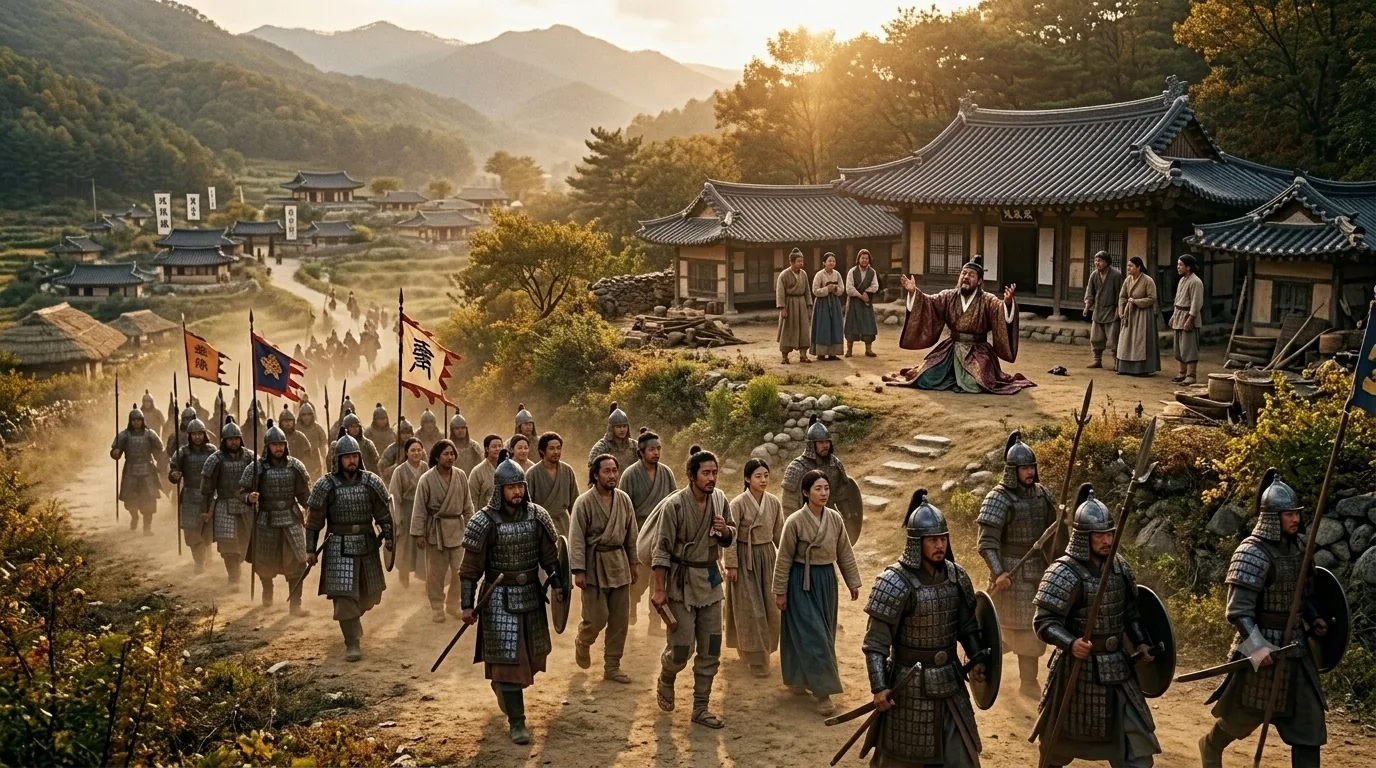
After Goguryeo fell to the Tang–Silla alliance in 668, Tang deported a large part of the ruling class and population into Tang territory. Dae Jo-yeong went with his father, Geolgeol Jungsang (also recorded as Dae Jungsang), to Yingzhou (營州) — modern Chaoyang in Liaoning.
Yingzhou was not a prison and not a refuge. It was the gateway between Liaodong and the Central Plain — a major Tang frontier centre where regular administration intersected with the empire’s jimi system for governing neighbouring and resettled peoples. Khitan, Xi, Shiwei and Malgal lived there in a mix, and Goguryeo deportees formed a substantial part of the population.
The country was gone. The people and the memory were not.
That distinction matters, and it is worth being careful about. There is no direct record of a single unbroken community — the same nobles, the same generals, the same families — holding together intact from 668 to 698. Anyone who tells you the interior life of those thirty years is filling in a blank. What the records do show is what this population looked like at the far end of it: in 696, organised, led, and taken seriously by an empire.
696: what Tang did when this group started moving
In 696 the Khitan chieftain Li Jinzhong (李盡忠) killed the Yingzhou governor Zhao Wenhui, whose rule he considered tyrannical, and revolted. The surveillance apparatus that had held the frontier together came apart.
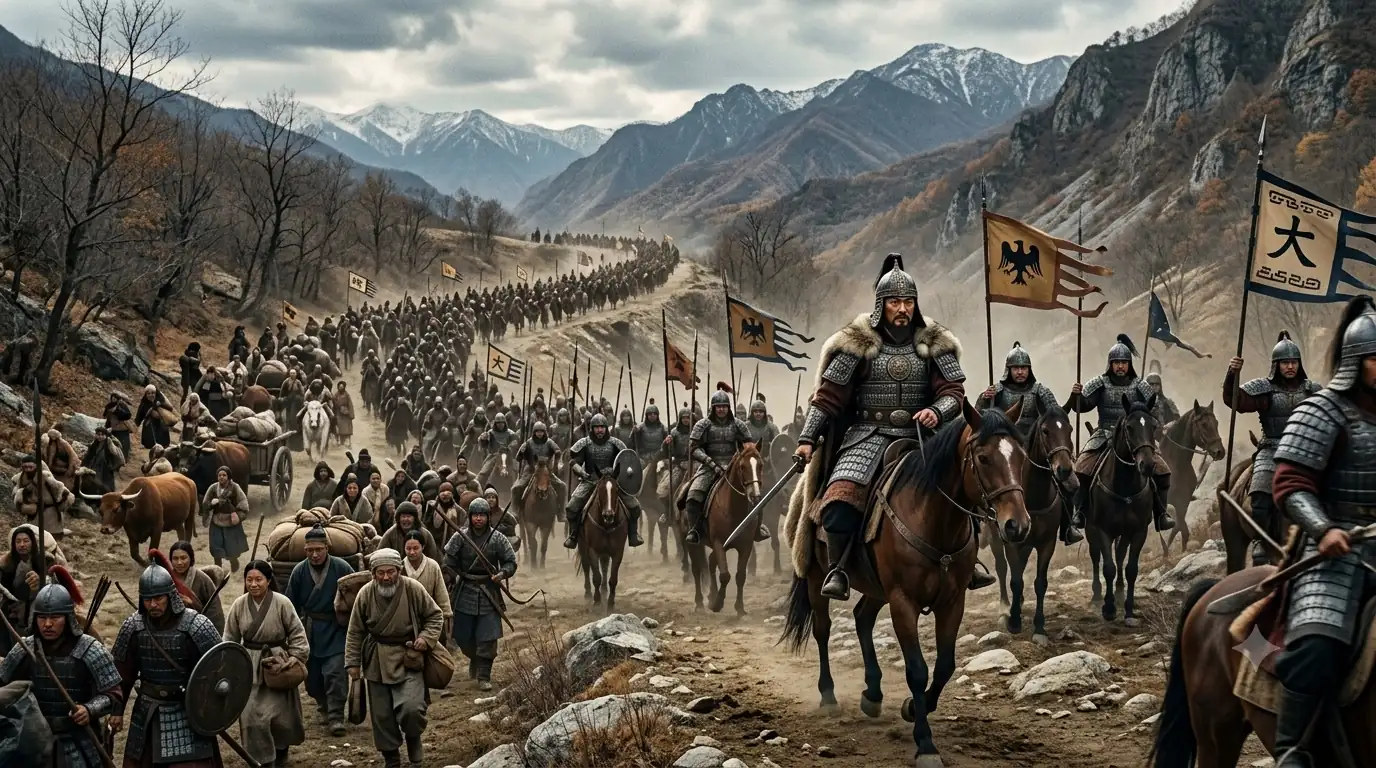
Geolgeol Jungsang and the Malgal chieftain Geolsabiu (乞四比羽) moved east.
Tang’s first move was not military. It was an offer: the title Duke of Jin (震國公) for Geolgeol Jungsang, Duke of Heo (許國公) for Geolsabiu.
That offer is the most informative document in this whole sequence. It shows that Tang regarded the migrating groups as organised forces whose leaders were worth co-opting — entities it would rather negotiate with than fight. Tang was looking at a political unit, not a band of stray refugees.
And the offer was refused.
Then Tang sent an army under the commander Yi Hae-go (李楷固). Geolsabiu was killed in the fighting. Around this same time Geolgeol Jungsang also died — the records note that he was dead, but whether he fell in battle or died of illness is not established, and anyone who tells you which is choosing a version.
Two leaders gone at once. The group did not dissolve. Dae Jo-yeong took over and the people followed him.
Cheonmullyeong: what the sources actually say
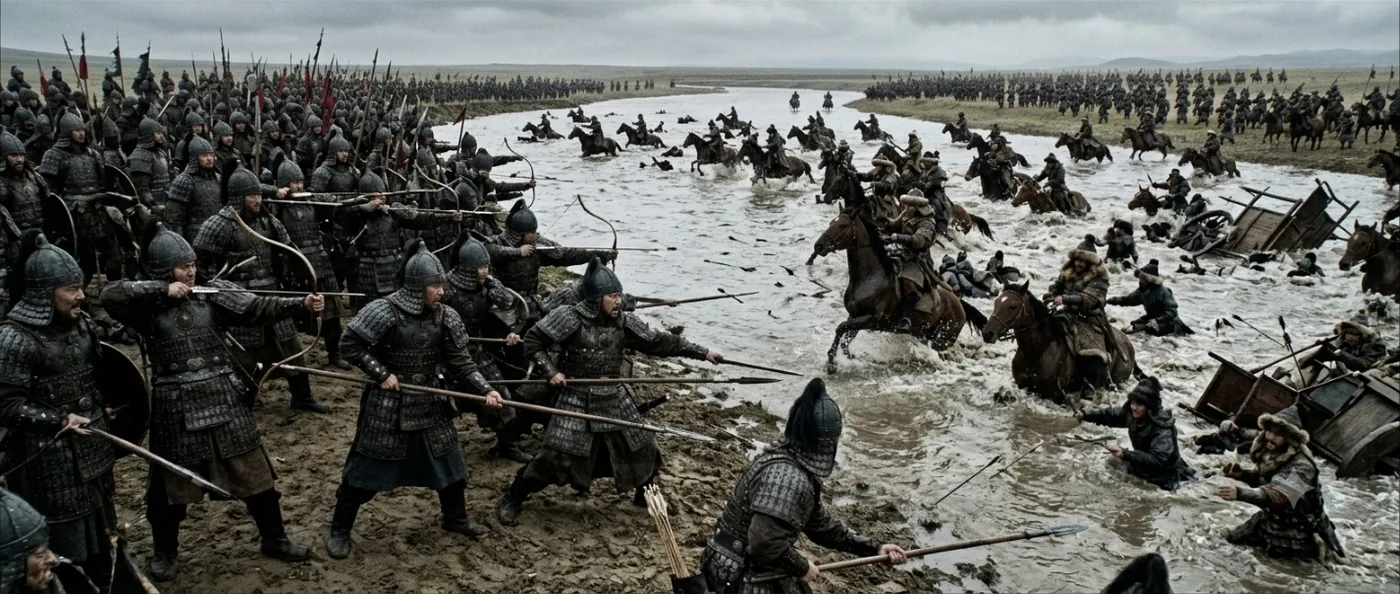
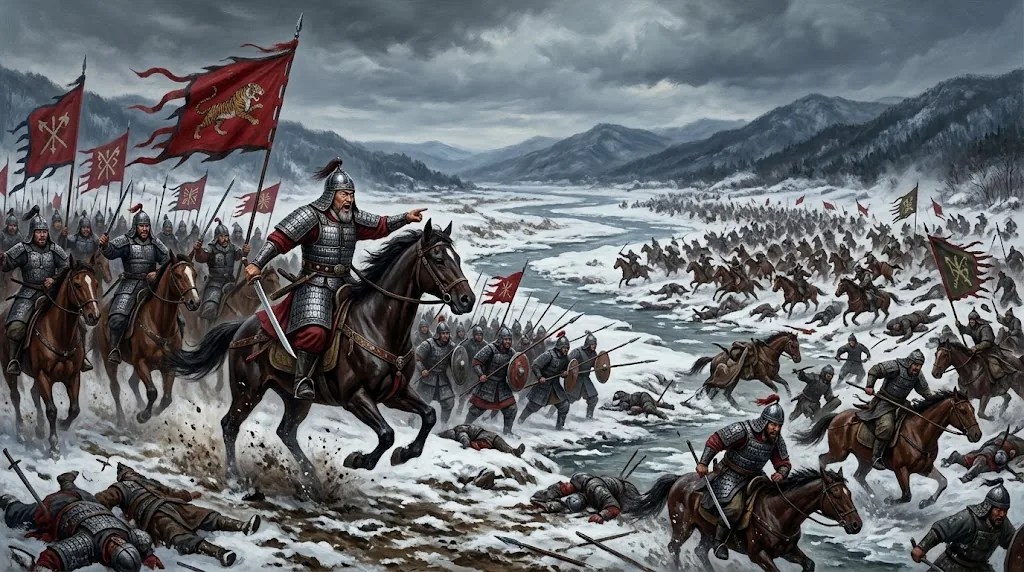
Dae Jo-yeong broke Yi Hae-go’s pursuing army at Cheonmullyeong (天門嶺).
This is a real battle and a real defeat for Tang, and it deserves to be described accurately rather than dramatically. The Old Book of Tang records that the Tang force was badly beaten and that Yi Hae-go extricated himself and got back; the New Book of Tang records that he was defeated and returned. Neither says he was the only survivor, and neither says the Tang army was annihilated. What happened is enough on its own: Dae Jo-yeong decisively defeated a Tang punitive force in the field.
After the victory he continued east with Goguryeo and Malgal followers to Dongmo Mountain (東牟山), and in 698 founded a state called Jin-guk (震國). The histories put Dongmo Mountain two thousand li from Yingzhou. In 713, after Tang invested him as Prince of Balhae Commandery, the state’s name became Balhae.
One correction worth making because it circulates in English-language sources: Dongmo Mountain is sometimes placed “near Datong in Shanxi”. That is simply wrong. It is in eastern Manchuria, identified with the Seongsanja mountain fortress in Dunhua, Jilin.
Which is the point. They did not march toward safety. They marched toward the old Goguryeo heartland.
What Balhae said it was — in writing, to a third country
Everything above is inference about intent. The following is not. These are diplomatic documents.
In 727 King Mu (Dae Mu-ye) sent Balhae’s first embassy to Japan. Twenty-four people set out. Most did not survive the voyage and the landing. Eight of them, led by Go Je-deok (高齊德), reached the Japanese court and delivered the state letter in the first month of 728.
What that letter said, at the very first moment Balhae ever spoke to a foreign court: that Balhae had “recovered the old domain of Goryeo” (復高麗之舊居) and “holds the surviving customs of Buyeo” (有夫餘之遺俗).
Twenty-four people set out. Eight arrived. That was the sentence they had crossed the sea to carry.
It did not stop there. In 759 a Japanese record has King Mun (Dae Heum-mu) styling himself “King of Goryeo”; the Japanese reply addresses him the same way, and the Shoku Nihongi refers to Balhae’s envoys as Goryeo envoys (高麗使). In 771 King Mun described himself as Cheonson (天孫), “grandson of heaven” — the self-definition Goguryeo’s own kings had used.
Be precise about what this proves and when. These are all post-founding documents, and there is no surviving text from before 698 that shows us what this group told itself. What they establish beyond reasonable doubt is that Balhae’s court deliberately and repeatedly presented the kingdom as Goguryeo’s successor in its foreign relations, from its first diplomatic contact onward. How that claim related to the full composition of Balhae’s population is a separate question, answered from archaeology and institutions rather than from letters.
The fleet that attacked Tang
In 732, King Mu gave his general Jang Mun-hyu a naval force and sent it across the Yellow Sea to attack Dengzhou, on the Shandong peninsula. Tang territory. Tang soil.
Sit with the logistics of that for a second. Balhae built a fleet, planned a maritime operation against the empire that had deported its founders’ generation, and executed it — thirty-four years after it had a state at all.
It is very hard to fit this inside any reading of provincial administration. A province does not independently assemble a navy and attack a major coastal prefecture of the state that supposedly governs it.
The city they built
The other thing worth knowing about the people who crossed Cheonmullyeong is what their descendants did once they stopped moving.
Balhae’s Sanggyeong (上京) was a planned city: palaces, government offices, temples, a grid street plan, and a central avenue running from the palace’s south gate to the south gate of the outer wall. A group that had spent a generation as a managed frontier population, then walked back into the mountains it came from, produced one of the great planned capitals of Northeast Asia.
By the ninth century Tang sources were calling Balhae Haedong Seongguk (海東盛國) — “the flourishing country east of the sea”.
“Wasn’t Balhae just a Tang province?”
If you search in English you will meet this claim quickly. It is the position advanced by China’s Northeast Project. It rests on three arguments, and it is worth answering them on the evidence rather than by volume.
“Balhae accepted Tang investiture.” Investiture was the standard grammar of East Asian diplomacy. Silla accepted it; so did Vietnamese dynasties; Japan operated inside the Tang-centred order too, though on different terms. If accepting investiture makes you a province, most of East Asia was a Chinese province. And investiture is difficult to square with the rest of the record: Tang first tried to buy this group off with ducal titles, was refused, sent an army, and lost it — and thirty-six years later was on the receiving end of a Balhae naval raid on Shandong.
“The New Book of Tang calls Dae Jo-yeong Sumo Malgal.” It does. The Old Book of Tang calls him a branch lineage of Goryeo. Two Tang official histories, the same man, different answers. The two histories preserve different traditions, so Dae Jo-yeong’s ancestry cannot be treated as settled on the basis of either passage alone. And the deeper problem is the premise: deciding a state’s identity from its founder’s ancestry. Balhae was not one man. Its leadership included Goguryeo elites — the repeated appearance of envoys surnamed Go (高) in the Japanese records is one piece of circumstantial evidence that Goguryeo-descended figures were active in Balhae’s diplomacy and its ruling class. What a surname cannot do is prove direct descent from the Goguryeo royal house, and it should not be asked to.
“Most of the population was Malgal.” The source here is the Ruijū Kokushi, which records that “the commoners are mostly Malgal and the natives few”. That is a genuinely important document for studying Balhae’s population and should not be waved away. What it cannot be is a census: scholars disagree over what “Malgal” and “native” meant and over how much of the kingdom the observation covers.
But population composition alone cannot determine whether a polity exercised independent rule or claimed succession from an earlier kingdom. Tang was multi-ethnic. Liao was multi-ethnic. Independence is not measured by ethnic homogeneity; it is measured by whether a state runs itself. Balhae had its own royal succession, its own era names, its own administrative structure, its own foreign policy — and its own navy, which it used against Tang.
Above all of this sits a set of facts that any provincial-regime reading must account for. Balhae called itself King of Goryeo. Japan called its envoys Goryeo envoys. When it fell, its royal family went to Goryeo. And Goryeo put Balhae’s crown prince in its own royal genealogy.
The party itself, a third country, and the successor state all gave the same answer.
When Balhae fell, where did its people go?
Not all in one direction — and the honest version is more interesting than the tidy one.
Movement began before the end. In the ninth month of 925, months before the capital fell, the Balhae general Sin Deok crossed into Goryeo with five hundred men. Balhae fell to the Khitan in 926, and after that its people split several ways: many crossed to Goryeo, many stayed in the old territory under Liao rule, many were forcibly resettled, and many joined the restoration movements — Later Balhae, Jeongan-guk, and others that kept surfacing for the better part of two centuries.
The crown prince, Dae Gwang-hyeon, went to Goryeo with a large following. The date of his arrival is disputed — different Goryeo-side records place it in 925, 926, or 934, though recent scholarship has argued for a date around Balhae’s final collapse. The size is imprecise too: the Goryeosa says “a multitude of tens of thousands”, other records give “tens of thousands of households” while sweeping in several separate groups. So both figures are best left as what they are: large, early, and imprecisely counted. What Goryeo did with him is much clearer than precisely when he arrived.
What Goryeo did with him is exact, and it is the best-documented sentence in this entire story.
King Taejo gave Dae Gwang-hyeon the name Wang Gye (王繼). The royal surname, and the character gye — “to continue”. He entered him into the royal clan genealogy, appointed him to office, and set him to guard Baekju and maintain the ancestral rites of the Balhae royal house. His retainers were given posts; his soldiers were given land and houses.
Goryeo did not merely take in refugees. It wrote a dead kingdom’s heir into its own family register and told him to keep the rites going. Goryeo had declared itself Goguryeo’s successor; it was now formally continuing the other one too.
Drama vs. history
| The drama | The record |
|---|---|
| Dae Jo-yeong is enslaved and endures decades of hardship before rising | Nearly nothing survives about his life before Goguryeo’s fall. The childhood, the servitude, the ties to the Yeon family are invention |
| He shatters a great Tang army at Cheonmullyeong | Real, and a serious Tang defeat — the Old and New Books of Tang both record Yi Hae-go beaten and withdrawing. Neither says the army was wiped out or that he alone survived |
| Xue Rengui, Yi Hae-go and others appear as antagonists | Real people. The confrontations and dialogue are dramatised |
| He founds “Balhae” | He founded Jin-guk in 698. The name Balhae came after Tang’s investiture in 713 |
Four kingdoms that came back — and where each one went
Step back and a pattern shows up. Rebuilding a fallen state is not rare in world history. What differs is where the rebuilders went, and what they took with them.
It is tempting to say the other cases were “one bloodline surviving alone”, and that would be wrong. All of them had backing — soldiers, clients, provincial power-holders, nobles. Dynastic blood was a legitimacy resource, not a substitute for an army. The real contrast is geographic.
Abd al-Rahman I (756) — a new land. When the Abbasid revolution destroyed the Umayyad house in 750, a young Umayyad prince escaped and ran: Syria, then North Africa, then across to Iberia. In 756 he founded the Emirate of Córdoba. He had support — Umayyad clients and Syrian troops already in the peninsula were essential to him — but the sequence ran the opposite way from Balhae’s. He arrived, took power, and then the old servants of the dynasty came to him. The man moved first; the state followed; and none of it happened anywhere near Damascus.
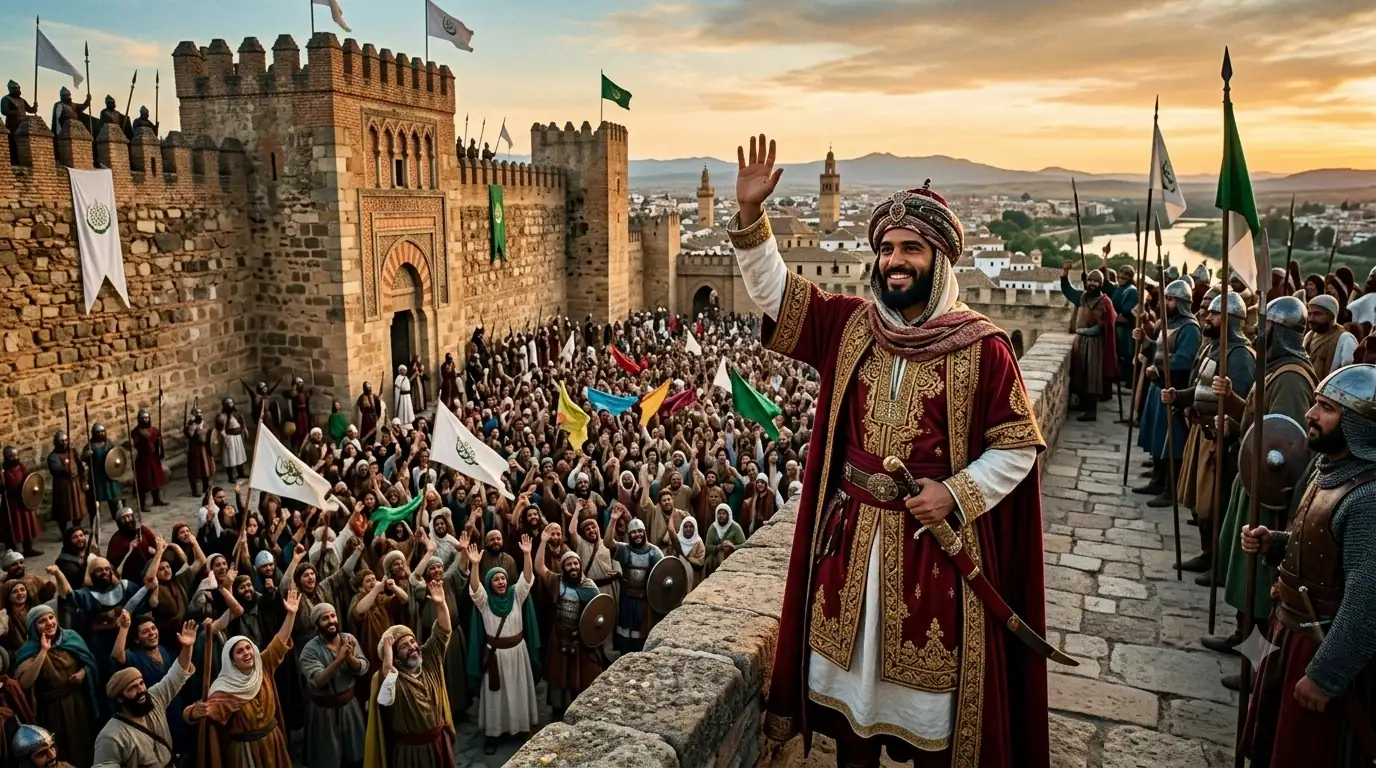
Babur (1526) — a different land entirely. A descendant of Timur, king of Fergana at eleven, he took Samarkand more than once and lost it every time until his base was gone for good. Pushed back to Kabul, he went south instead, broke the Lodi dynasty at Panipat in 1526 and founded the Mughal Empire. He had Timurid begs and a hardened army behind him. What he did not do was go home. He gave up on recovering what he had lost and built somewhere else.
Emperor Guangwu (25) — never left. When Wang Mang toppled the Han, a collateral Liu branch rose, allied with the great provincial families, and established the Later Han. Same dynastic name, same surname, same country. No exile, no march, no return — the easiest reconstruction of the four.
Balhae (698) — back to the same ground. Deported to Yingzhou, organised there, and when the frontier came apart they moved east and rebuilt on Goguryeo’s old territory, then spent two centuries telling Japan in writing which kingdom they were continuing.
One went to a new land. One gave up his land. One never left his. Among these four cases, Balhae is the one whose displaced founders moved back toward the former territory of the state they claimed to continue — and then, when that kingdom fell 228 years later, its heir was written into the family register of the country next door, under a name meaning “to continue”.
Watch it again
Next time you put on Dae Jo-yeong, notice how much of the runtime is spent not fighting. The waiting is not padding. It is the part of the story the records are quietest about and the part that decided everything — and when the moment finally came, the direction they chose to run was backwards, into the country that had beaten them.
Coming up next
A kingdom was erased, and a generation later people walked back into the same mountains and built a capital city there. Next time we take a K-drama scene that looks like pure fantasy and follow it down to the real Korean history sitting underneath it.
This article was researched and written by K-Drama History. Source: Dae Jo-yeong, Explained: How Goguryeo Refugees Founded Balhae, Thirty Years After Their Kingdom Was Erased — K-Drama History