Age of Warriors (무인시대), Explained: The Slap That Didn't Cause Goryeo's Military Coup
Theme: Power & Politics
From the research behind Pause the Drama.
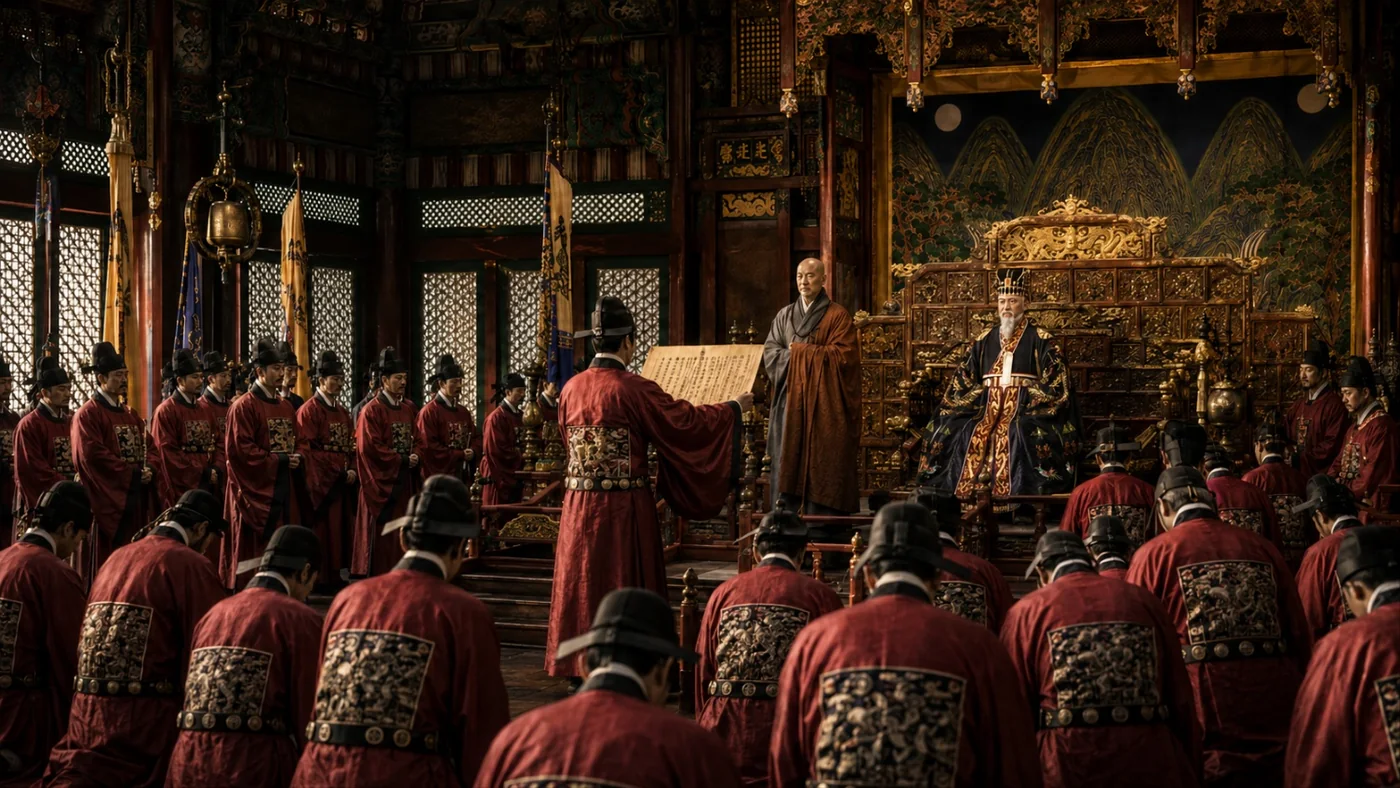
If you’ve ever scrolled through KBS1’s Age of Warriors (무인시대) — 158 episodes, a cast list that reads like a who’s-who of Goryeo strongmen — you know it doesn’t open gently. A court official slaps a veteran general across the face. The general’s colleagues seethe. Within hours the king’s closest ministers are dead in a pond, and a century of military rule has begun.
The slap is real. It is in the record. It is also, as an explanation for the coup, almost entirely beside the point — because the men who did the killing had already decided to do it before that hand came down.
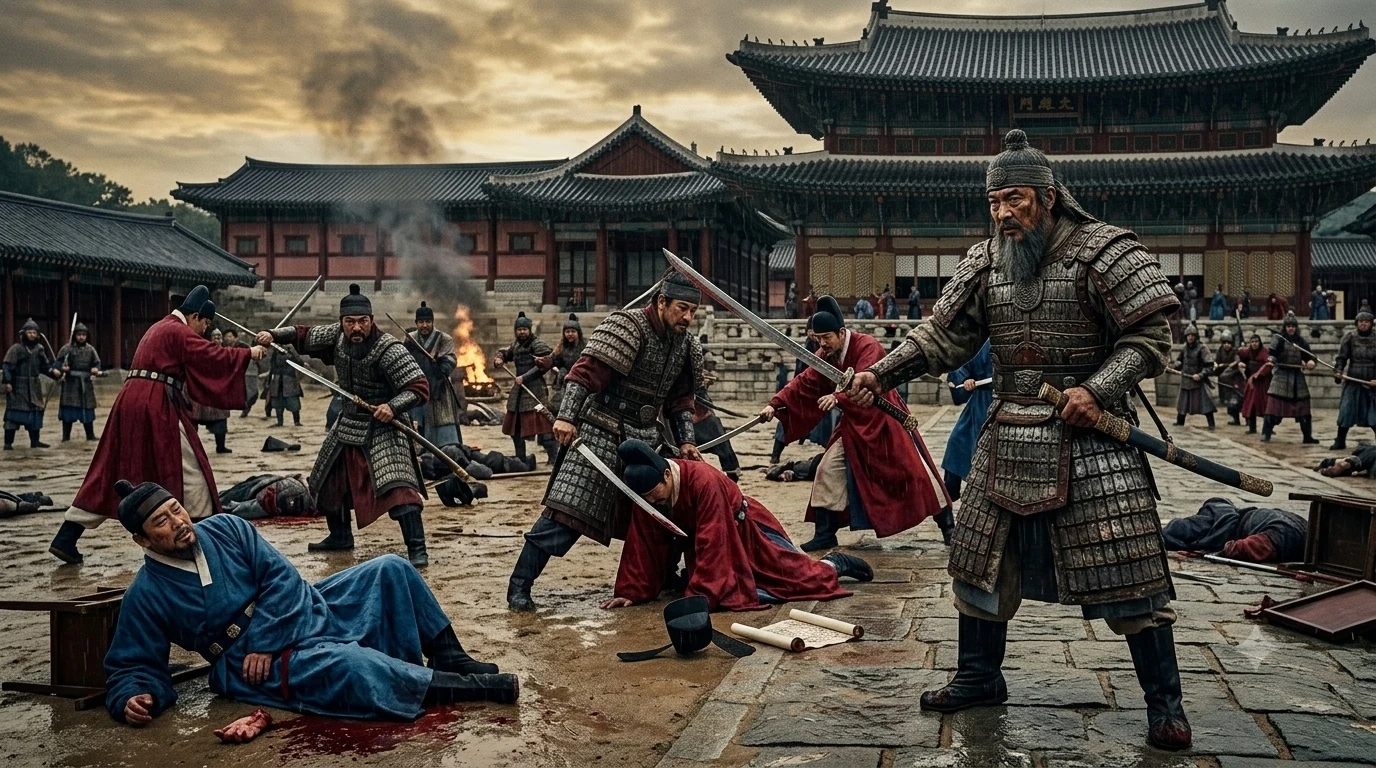
Quick answer: On the 30th day of the 8th lunar month of 1170 — October by the Gregorian calendar — Goryeo’s military officers massacred the king’s ministers during a royal excursion, deposed the king, and took the government. The famous slap that supposedly set it off landed on a plot already in motion. What followed was not stability: across twenty-six years Yi Go, Yi Ui-bang, Jeong Jung-bu, and Yi Ui-min all died by other men’s hands. Only Choe Chung-heon, from 1196, worked out how to make it stop — and what he built kept his family in power for sixty years.
Let’s unpack it.
What actually triggered the 1170 coup?
Nothing that happened that day gave them the idea. But start with what did happen, because the scene is astonishing.
On the thirtieth day of the eighth lunar month — 11 October 1170 — King Uijong (毅宗) was travelling out to Bohyeon-won (普賢院), a retreat outside the capital. The procession paused at the Ogate, and the king called for an obyeong subakhui (五兵手搏戲): soldiers fighting each other for the court’s entertainment.
During it, Han Roe (韓賴) struck the veteran general Yi So-eung (李紹應) across the face, hard enough to send him tumbling down a flight of steps.
Look at who those two men were, because the whole grievance is in their ranks. Yi So-eung held one of the highest posts a military officer could legally reach in Goryeo. Han Roe was a gigeoju (기거주) — the official whose entire job was writing down the king’s words and deeds — and one of Uijong’s personal favorites. The court’s note-taker hit the army’s general, in front of the king, and walked away from it. When Jeong Jung-bu (鄭仲夫) objected, Uijong took the general’s hand and tried to calm him down (National Institute of Korean History, 우리역사넷).
And here is what the scene’s fame hides. Jeong Jung-bu, Yi Ui-bang (李義方), and Yi Go (李高) were already planning to use that very procession for a coup. The slap didn’t give them the idea. It gave them the mood.
So what was the fuse?
Rank — and one unforgettable humiliation.
Under Goryeo’s long-standing civil-first policy, a military officer could climb no higher than sangjanggun, the senior third rank. A civil official could reach the first. And the men who commanded armies in the field were civil officials too. An officer spent his career watching men who had never carried a weapon outrank him, outearn him, and command him in war.
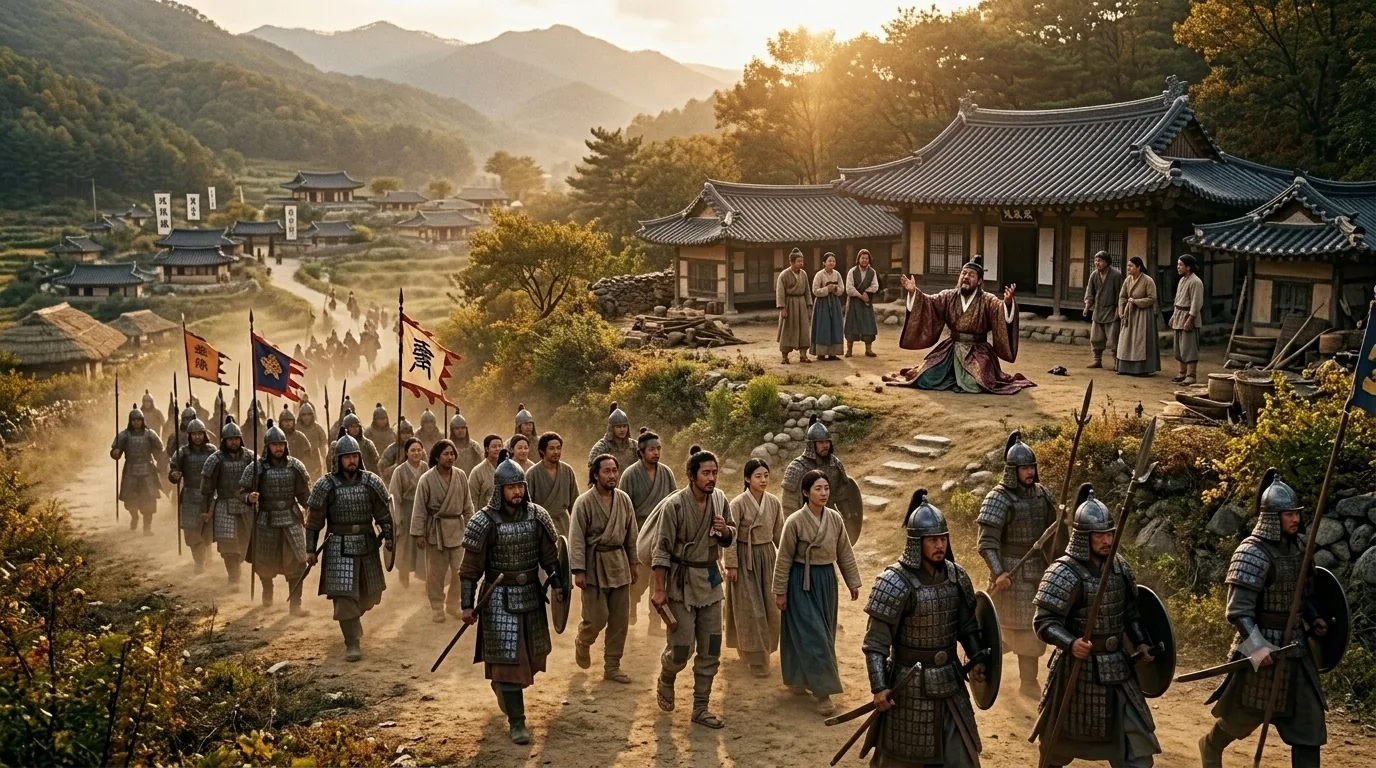
It went past paperwork. Uijong ran his politics through civil officials, eunuchs, and personal favorites, and he kept soldiers busy — hauling stone for palaces and temples, marching in the excursions where the court displayed its splendor. The men who made the coup weren’t those rank-and-file soldiers; they were officers like Jeong Jung-bu. But everyone in uniform knew whose backs the splendor was built on.
Then there’s the beard.
Sometime in the reign of King Injong (인종, r. 1122–1146), at a palace ceremony, a young civil official named Kim Don-jung (金敦中) held a candle to Jeong Jung-bu’s beard and set it on fire. As a joke. Jeong Jung-bu beat him for it. Kim Don-jung’s father then demanded the king punish the general — and Kim Don-jung’s father was Kim Busik, the most eminent scholar-official in the kingdom, the man who compiled the Samguk Sagi. Injong, who liked Jeong Jung-bu, solved it by quietly arranging for the general to slip away before punishment could reach him.
Read that again. A general’s face is set alight by a courtier, and it is the general who has to disappear — because the courtier’s father outranked the entire military establishment. That is the system the coup was aimed at.
(You’ll sometimes see this dated to 1144, with a tidy “twenty-six years of humiliation” attached. The Goryeosa doesn’t date the incident. 1144 is the year Kim Don-jung passed the civil service examination. The grudge was old; nobody knows exactly how old.)
What happened at Bohyeon-won?
By the time the procession reached the retreat, the humiliation at the Ogate had sharpened a plan that was already loaded. As the king passed through the gate, the officers’ men fell on his attendants. The officials Im Jong-sik and Yi Bok-gi died there — and so did Han Roe, whose slap has taken the credit ever since. Their bodies, by tradition, went into a nearby pond.
Then the conspirators rode for Gaegyeong and widened it, killing civil officials and eunuchs across the capital.
King Uijong was deposed and exiled to Geoje Island; his crown prince was sent to Jindo. (In 1173 a restoration attempt moved the ex-king to Gyeongju, where Yi Ui-min killed him.) A new king, Myeongjong (明宗), was installed as a figurehead, and Goryeo’s roughly hundred-year military regime (무신정권, 1170–1270) had begun (Encyclopedia of Korean Culture, 보현원사건; 정중부).
| In Age of Warriors | In real history |
|---|---|
| Han Roe slaps General Yi So-eung | Documented — at the Ogate, during the king’s procession to Bohyeon-won, 30th day of the 8th lunar month, 1170 (11 Oct) |
| The slap causes the coup | It didn’t. Jeong Jung-bu, Yi Ui-bang, and Yi Go were already planning to use that procession |
| Jeong Jung-bu’s men massacre the king’s ministers | The Goryeosa records Im Jong-sik, Yi Bok-gi, and Han Roe killed, then a wider purge in Gaegyeong |
| The drama tracks strongmen turning on each other | Mostly true — Gyeong Dae-seung is the exception. Nobody killed him |
Why didn’t the winners just rule happily ever after?
Because winning a coup is not the same as inventing a way to hand power on.
It’s tempting to say the generals killed each other because the civil officials who used to check them were gone. That’s too neat. The regime did have a center: the Jungbang (중방), the council where the senior generals sat together and ran policy, appointments, and impeachments. What it lacked was a rule for who came next, any mechanism able to restrain whoever stood at the top, and any armed force that wasn’t somebody’s private retinue. Those three absences, together, turned every succession into a murder.
So: Yi Go was clubbed to death outside the palace gate in 1171 by Yi Ui-bang and Chae Won. Yi Ui-bang was assassinated in December 1174 by Jeong Jung-bu’s son. Jeong Jung-bu ran the government until 1179, when a younger officer named Gyeong Dae-seung (慶大升) killed him along with his son and son-in-law. Yi Ui-min (李義旼) — a general of base birth, his mother a slave of Ongnyeong Temple, and the man who had personally killed the deposed King Uijong — dominated the government until 1196, when Choe Chung-heon (崔忠獻) and his brother cornered and killed him at a mountain villa.
Four of those five died by another man’s weapon. The fifth died in his own bed, at thirty — and the chronicle says why.
The one who died in bed
Gyeong Dae-seung took power by killing Jeong Jung-bu, and held it about five years. Then, in the seventh lunar month of 1183, according to the Goryeosa, he had a dream.
In it, Jeong Jung-bu — four years dead, killed by his own hand — was gripping a sword and shouting at him.
He fell ill after that dream and died shortly afterward, aged thirty (우리역사넷, 경대승).
You don’t have to believe a nightmare kills anyone to notice what the chronicle is doing here. The one man in this whole sequence who was never murdered is the one it remembers as haunted — a thirty-year-old who kept a hundred hard men sleeping in his house and still couldn’t keep the dead out of his own head. When he died, that guard, the Dobang (도방), was disbanded and its men were sent into exile (Encyclopedia of Korean Culture, 도방). Whatever protection he’d bought didn’t outlive him by a day.
How did the Choe family break the cycle?
Not by ending Goryeo’s troubles — the country stayed poor and rebellious, and the Mongols were coming. What Choe Chung-heon ended was the revolving door at the top, and he did it by building machinery instead of trusting his own reflexes.
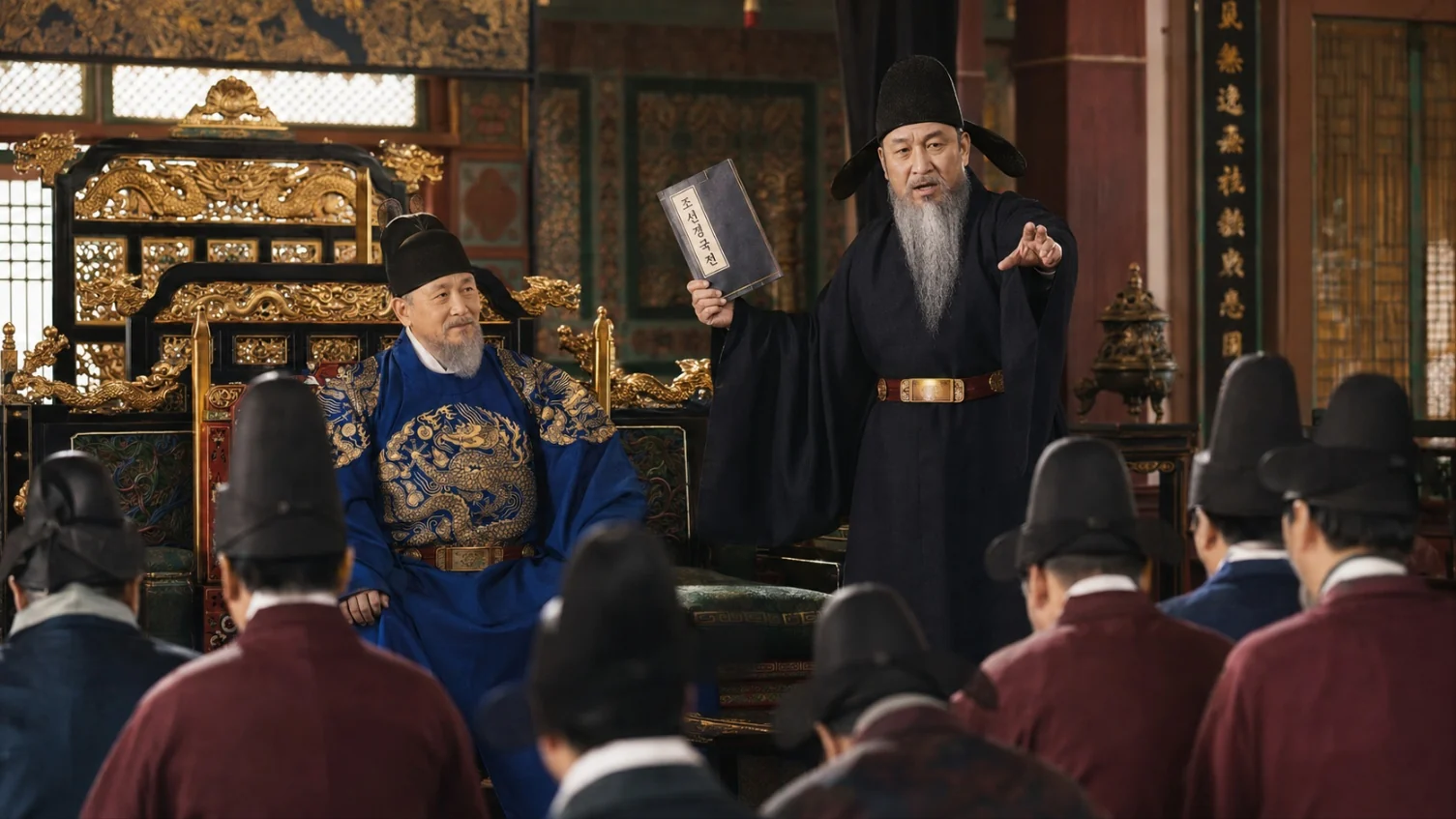
He started with a claim to legitimacy: shortly after taking power in 1196 he submitted the Bongsa Sipjo (封事十條), a ten-point memorial to the throne on corruption, land abuse, and misgovernment (Encyclopedia of Korean Culture, 최충헌). It’s easy to file this under pure theater and easy to be wrong about it: the proposals attacked real abuses. He pressed genuine reforms and used them to manufacture a mandate. Both at once — which is the whole man.
Then he dealt with the problem that had killed everyone before him: staying alive.
In 1200 he re-founded the Dobang — the same institution that had died with Gyeong Dae-seung, dug up and rebuilt bigger. From officials, idlers, and soldiers alike he picked the men who were physically strongest, and split them into six shifts that took turns sleeping at his house. When he went out, he took all six shifts at once (우리역사넷, 도방). Under his grandson Choe Hang it swelled to thirty-six shifts. That is what the most powerful man in Korea thought he needed in order to walk outdoors.
Then the office that ate a government. The Gyojeongdogam (교정도감) didn’t start as a shadow state. He founded it in 1209 for one job: to find and punish the people behind a plot to kill him and his son. A manhunt with a desk. But a body created to investigate the ruler’s enemies has no natural stopping point, and it kept growing — surveillance, then taxation, then provincial administration, then appointments — until it was the regime. His son Choe U later split off a separate bureau, the Jeongbang (정방, 1225), to handle appointments in practice, added the Seobang (서방) for civil advisers, and raised the yabyeolcho that grew into the Sambyeolcho: the family’s own army.
It worked, in the narrow sense that mattered to the family. Choe Chung-heon died ill in 1219, in power since 1196, and passed it to his son Choe U (1219–1249), his grandson Choe Hang (1249–1257), and his great-grandson Choe Ui (1257–1258) — four generations, about sixty years. It ended in 1258, when a coalition including Yu Gyeong, Kim Jun — the same Kim Jun whose rise from slave to strongman anchors MBC’s 2012 drama Musin — Im Yeon, Bak Hui-sil, and Yi Yeon-so overthrew Choe Ui.
That was the end of the Choe, not the end of military rule. Kim Jun, then Im Yeon, then Im Yu-mu held power in turn until 1270, when the court finally returned to Gaegyeong and made its peace with the Mongols — the moment the Sambyeolcho refused to accept, and a story for another essay.
Key terms. Jungbang (중방) — the council where Goryeo’s senior generals sat; the early regime’s political center. Dobang (도방) — a strongman’s private guard: raised by Gyeong Dae-seung in 1179, disbanded at his death, re-founded by Choe Chung-heon in 1200 in six rotating shifts. Gyojeongdogam (교정도감) — founded in 1209 to investigate a plot against Choe Chung-heon; grew into the regime’s supreme organ. Jeongbang (정방) — the appointments bureau Choe U set up in 1225.
Two other places where soldiers took over
Japan — a warrior government built beside the court, not inside it. Almost exactly when Goryeo’s officers were purging civil officials, Japan’s warriors were completing their own takeover. After the Genpei War, Minamoto no Yoritomo built the Kamakura bakufu — dated to 1185, when he won the right to appoint provincial constables and stewards, or to 1192, when he was named sei-i taishōgun (Encyclopaedia Britannica). The emperor and the Kyoto court stayed on, politically curtailed but still supplying legitimacy, ritual, and administration.
The difference from Goryeo isn’t that Japan was legitimate and Goryeo wasn’t — Goryeo’s strongmen held offices granted by their own king and ran the country through his machinery. The difference is structural, and it’s the whole answer to why Goryeo bled for twenty-six years. Japan built a second government, with its own institutions, that outlived the men who made it: even after the Hōjō reduced the shoguns themselves to figureheads and ruled as shikken regents, the system held to 1333. Goryeo’s officers built no parallel state and settled no public rule of succession — so supreme power had nowhere secure to live except in the household and armed following of whoever was strongest — and the only way to move it was to kill him. The Choe answer wasn’t a constitution. It was a family, guarded by the strongest men money could find.
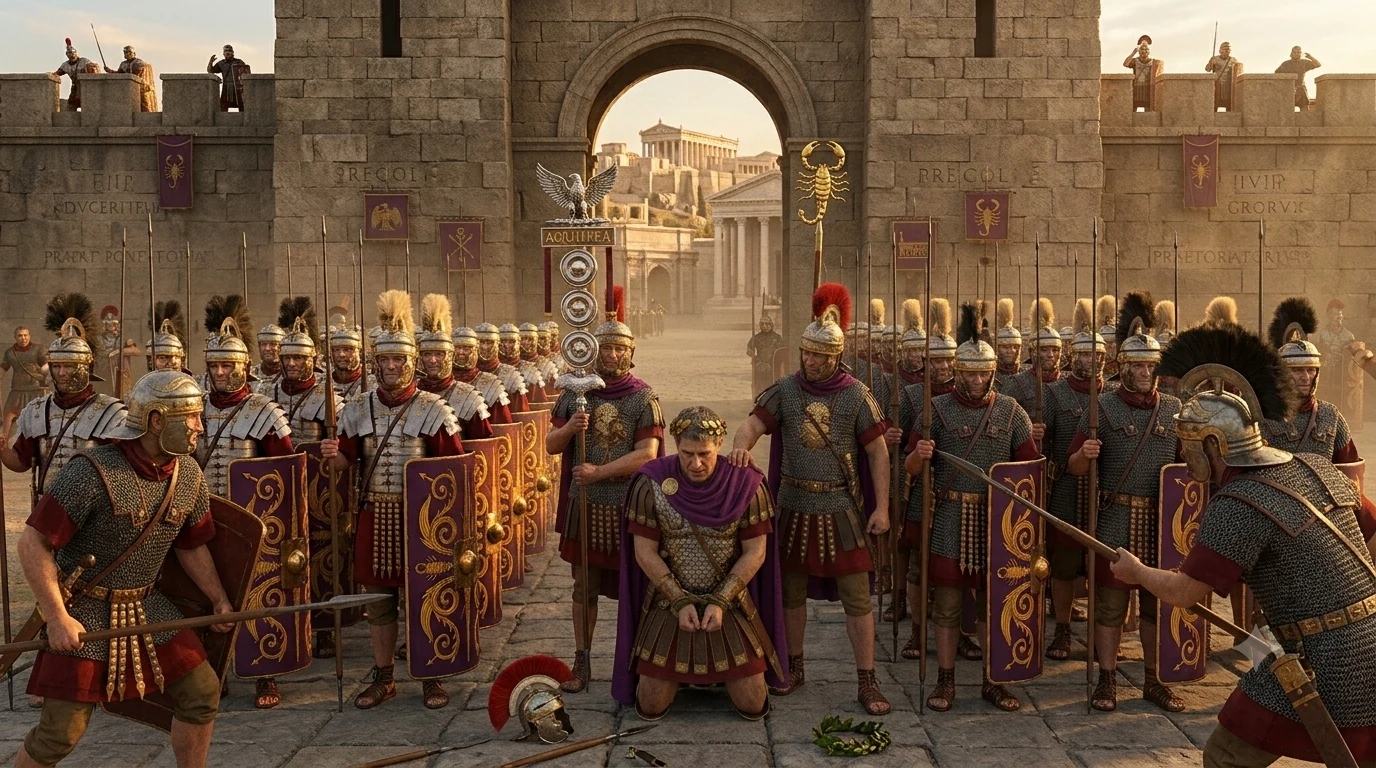
Rome — soldiers who preferred kingmaking to kingship. The Praetorian Guard was created to protect emperors and discovered it could choose them: in AD 41 it assassinated Caligula and installed Claudius over the Senate’s objections; in AD 193 it killed Pertinax and auctioned the throne to the highest bidder (Encyclopaedia Britannica). The mechanism is exactly Jeong Jung-bu’s — an armed body noticing that it, and not the formal government, holds the real power. The difference is appetite. The Praetorians liked standing behind the throne. Goryeo’s officers sat down on it.
Coming up next
One slap during a royal procession — and we’ve gone from a burned beard at Injong’s court to a pond full of dead ministers, to a strongman killed by a dream, to a bodyguard that moved six shifts deep whenever its master stepped outdoors, to an emperor’s throne auctioned off by his own guards in Rome. That’s the quiet gift of a serious historical drama: the coup on screen is only ever the first hour of a much longer story.
In the next essay, we’ll take another K-drama scene that looks like pure fiction — and trace the real Korean history hiding underneath it.
Frequently asked questions
Is Age of Warriors (무인시대) based on a true story? Yes, its political skeleton is. The 158-episode KBS1 epic follows the documented sequence of Goryeo strongmen — Jeong Jung-bu, Gyeong Dae-seung, Yi Ui-min, Choe Chung-heon — from the 1170 coup to Choe Chung-heon’s death in 1219. Dialogue is dramatized; who took power, when, and how they lost it is not.
What actually triggered the 1170 military coup? The famous slap is real — on the 30th day of the 8th lunar month of 1170, at the Ogate during King Uijong’s procession, Han Roe struck the veteran general Yi So-eung down a flight of steps. But it triggered nothing. Jeong Jung-bu, Yi Ui-bang, and Yi Go were already planning to use that same procession for a coup. The slap detonated a charge that was set and waiting.
Why did Goryeo’s military strongmen keep killing each other? Not simply because the civil officials were gone. The regime had a council — the Jungbang, where the senior generals sat — but no settled rule of succession, no way to restrain whoever stood at the top, and no armed force independent of each strongman’s private retainers. Those three absences turned every handover into a murder.
How did Gyeong Dae-seung die? In bed, at thirty. The Goryeosa says that in the seventh lunar month of 1183 he dreamed of Jeong Jung-bu — the man he had killed four years earlier — gripping a sword and shouting at him; he fell ill after the dream and died shortly after. Alone among the early strongmen, he was not murdered.
How did the Choe family break the cycle of coups? By building machinery instead of trusting his own reflexes. Choe Chung-heon re-founded the Dobang guard in 1200 from the strongest men he could find, in six rotating shifts — and took all six with him whenever he left the house. In 1209 he set up the Gyojeongdogam, at first only a tribunal to hunt a plot against his life, which grew into the regime’s supreme organ. That apparatus, plus hereditary succession, held for four generations.
Was Goryeo’s military regime similar to Japan’s Kamakura Shogunate? They are contemporaries, but the shape differs. Japan’s bakufu was a separate warrior government with its own institutions and it outlasted its founders — even after the Hōjō reduced the shoguns to figureheads and ruled as shikken regents, the system held to 1333. Goryeo’s strongmen held royal offices and ruled from inside the existing dynasty’s machinery. They built no parallel state, and never settled who inherited power.
Sources & further reading
This piece was written from the historical script and fact-check of 사뚱샘의 역사방 (SaDDungSam), with the load-bearing claims checked against the primary Korean reference works. For broader reading:
- The Bohyeon-won Incident and the outbreak of military rule. 한국민족문화대백과, “보현원사건” (encykorea.aks.ac.kr) and the primary-source excerpt at 우리역사넷 (contents.history.go.kr)
- The strongman succession. 한국민족문화대백과: “정중부” (encykorea.aks.ac.kr), “이의방” (encykorea.aks.ac.kr), “이의민” (encykorea.aks.ac.kr), “최충헌” (encykorea.aks.ac.kr). Gyeong Dae-seung’s death and the dream of Jeong Jung-bu: 우리역사넷 (contents.history.go.kr)
- The institutions of military rule — Jungbang, Gyojeongdogam, Dobang. 한국민족문화대백과, “무신정권” (encykorea.aks.ac.kr), “교정도감” (encykorea.aks.ac.kr), “도방” (encykorea.aks.ac.kr). The 1200 re-founding and six-shift organization: 우리역사넷 교과서 용어해설 (contents.history.go.kr)
- The Kamakura Shogunate, Japan’s near-contemporaneous warrior government. Encyclopaedia Britannica, “Kamakura shogunate” (britannica.com)
- The Praetorian Guard’s role in making and unmaking Roman emperors. Encyclopaedia Britannica, “Praetorian Guard” (britannica.com)
Thanks for reading — see you in the next one.
This article was researched and written by K-Drama History. Source: Age of Warriors (무인시대), Explained: The Slap That Didn't Cause Goryeo's Military Coup — K-Drama History