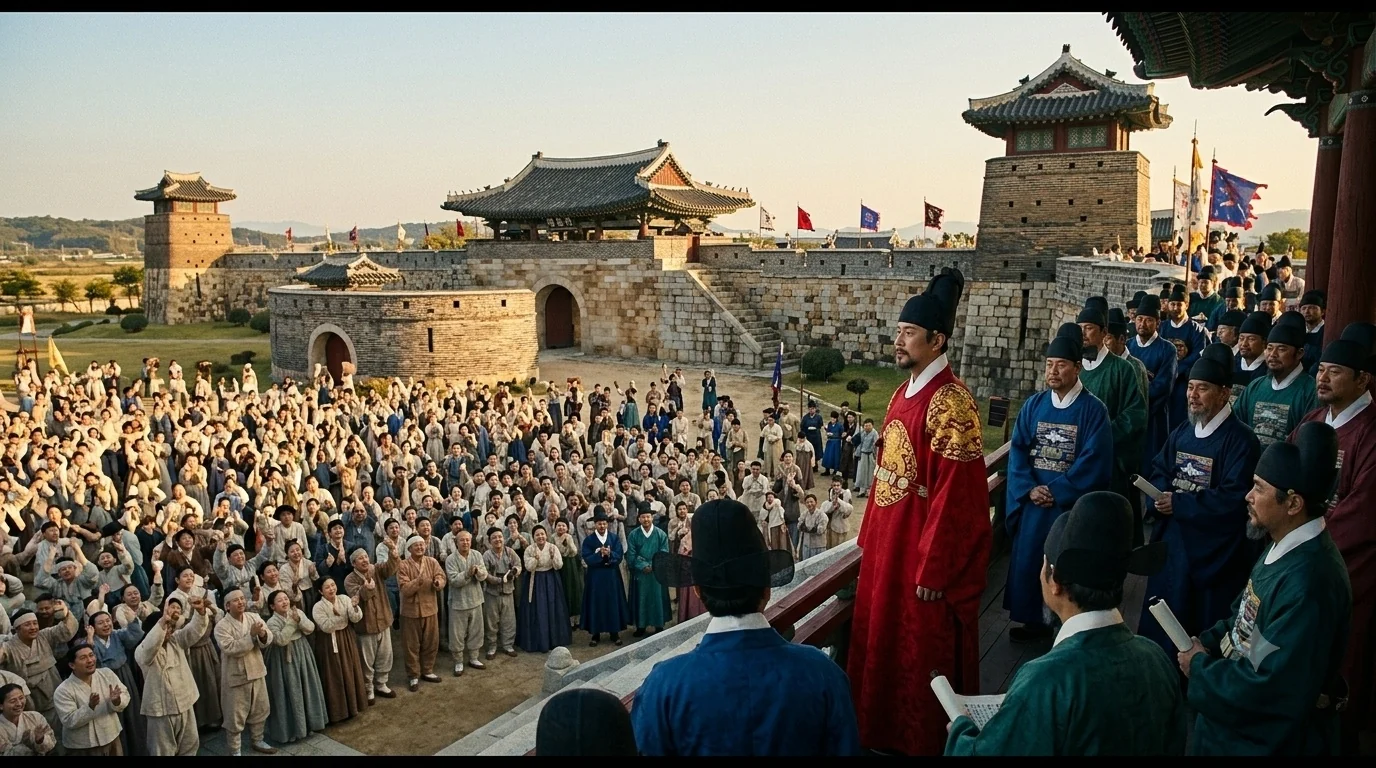
Sungkyunkwan Scandal, Explained: Why Joseon Korea's 'Fair' Exam Wasn't as Fair as It Looked
Theme: Knowledge & Science
From the research behind Pause the Drama.
If you’ve watched the 2010 K-drama Sungkyunkwan Scandal (성균관 스캔들) — the one where a poor young woman named Kim Yoon-hee disguises herself as her ailing brother just to sit a state exam — you remember the sheer audacity of it. She isn’t chasing romance or rebellion, not at first. She’s chasing a single sheet of paper: a passing mark on Joseon Korea’s national civil service examination, the one test that could turn a nobody into a scholar of Sungkyunkwan, the kingdom’s most prestigious academy, virtually overnight.
But here’s what the drama’s international fans often miss: the biggest fantasy in Sungkyunkwan Scandal isn’t the cross-dressing, or the slow-burn romance between four young scholars. The real fantasy is the idea that anyone — a poor kid, a woman in disguise — could simply study hard enough and walk through Sungkyunkwan’s gate on merit alone. The exam was real. The dream it sold was, at best, complicated.
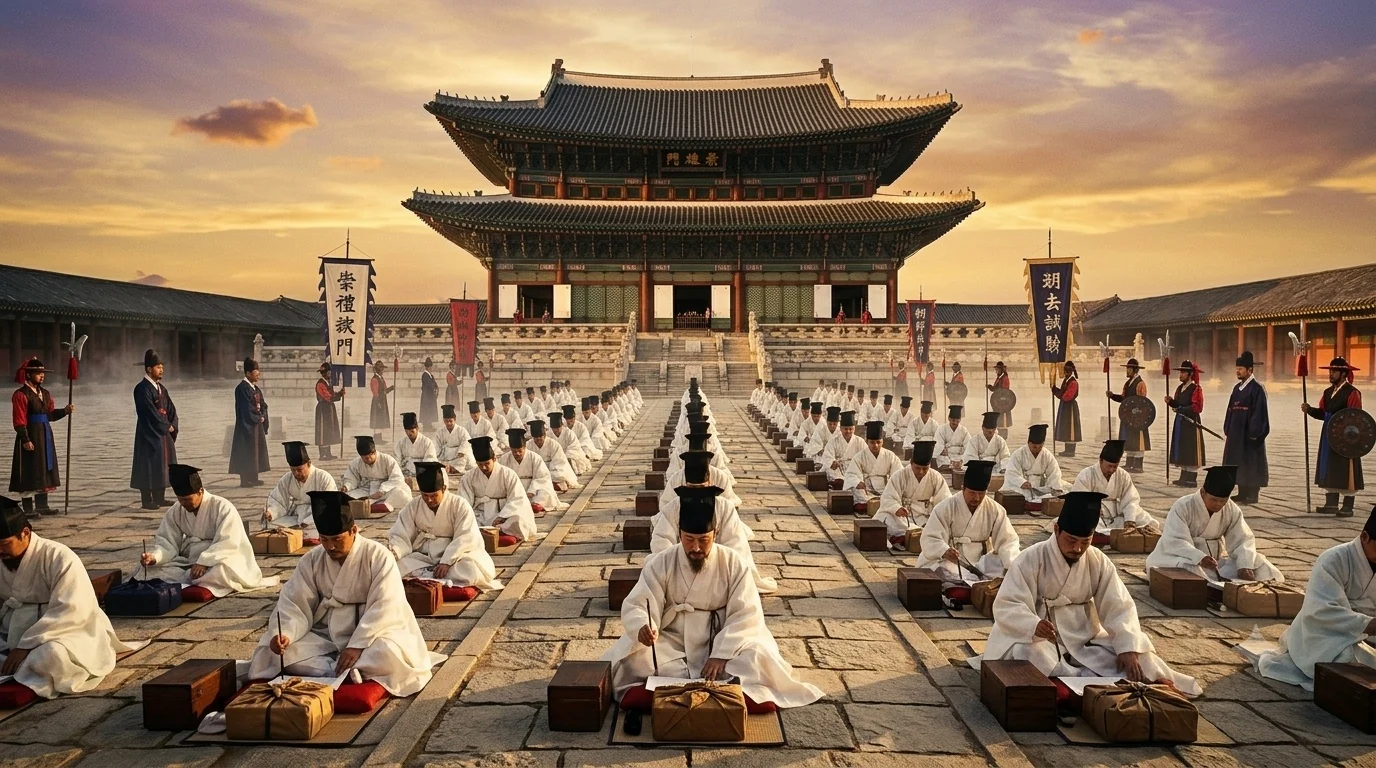 Examination day. Everyone in this courtyard wrote the same paper. The years that led them here were not remotely equal. (AI illustration)
Quick answer: In Sungkyunkwan Scandal, a woman disguises herself as a man to sit Korea’s national exam and enter Sungkyunkwan. That exam was the real gwageo (科擧) — a system that genuinely tested learning, and genuinely selected officials by result. But there was no legal path by which a woman could sit it under her own name, and no legal path by which anyone could sit it under someone else’s. The drama’s premise is invention. So, in a quieter way, is the idea of a level field: preparing for the exam took years of costly classical schooling, and a new Cambridge study of 14,258 passers finds that established lineages fared better — above all in the irregular “special” exams.
Let’s unpack it.
What exam is Kim Yoon-hee actually taking?
She’s sitting for a version of the gwageo (科擧) — Korea’s national civil service examination, and the most prestigious route into political office in Joseon society. (Not the only one: there was also eumseo, appointment on the strength of a father’s or grandfather’s rank, along with recommendation and specialist selection. But the examination’s weight grew over the dynasty, and its prestige was in a class of its own.)
Strictly speaking, Joseon’s examinations were the mun-gwa (文科), the civil track leading to the most powerful posts; the mu-gwa (武科), the military track; the jap-gwa (雜科), technical exams for interpreters, physicians, astronomers-and-geomancers, and legal officials; and — run separately — the saengwon-jinsa-si (생원진사시) (Encyclopedia of Korean Culture, 과거; 잡과).
That last one is where many simplified English accounts go wrong. The saengwon-jinsa-si is often called the sogwa (小科, “minor exam”) and treated as stage one of a tidy two-step ladder — pass the sogwa, then sit the daegwa (大科, the mun-gwa). It wasn’t. The saengwon-jinsa-si was a separate examination, not a compulsory first stage of the mun-gwa. It tested the classics (saengwon) and literary composition (jinsa), conferred the saengwon or jinsa title along with real social standing and eligibility to enroll at Sungkyunkwan — but it did not automatically hand you a post, and you did not need it to sit the mun-gwa. A yuhak (幼學) — a student with neither office nor degree — could reach the mun-gwa’s first stage by other routes (Encyclopedia of Korean Culture, 생원진사시).
Across the dynasty the saengwon-jinsa-si was held 229 times, producing 24,221 saengwon and 23,776 jinsa — 47,997 degree-holders in all. (You’ll also see the figure 47,748. That’s not a contradiction: it comes from Song Jun-ho’s study, which omits the 1891 triennial exam; add its 125 saengwon and 124 jinsa and you get 47,997.) Of those, only 7,438 went on to pass the mun-gwa — the other 40,310 held the degree and never took office through the civil examination.
And most of them never studied at Sungkyunkwan at all. Partly because the academy could only hold so many; partly because its upkeep and administration declined; and partly because there were other routes into the mun-gwa that didn’t require sitting in its halls.
The mun-gwa itself ran in three rounds — chosi, boksi, jeonsi. Under the Gyeongguk Daejeon, the regular triennial exam passed 33 men at the boksi, and the jeonsi then ranked them: 3 in the top grade (gapgwa), 7 in the second, 23 in the third. But the special exams — jeunggwangsi, byeolsi, jeongsi, alseongsi — varied in their stages and in how many they passed. There was no single unchanging “33.”
What was Sungkyunkwan, really?
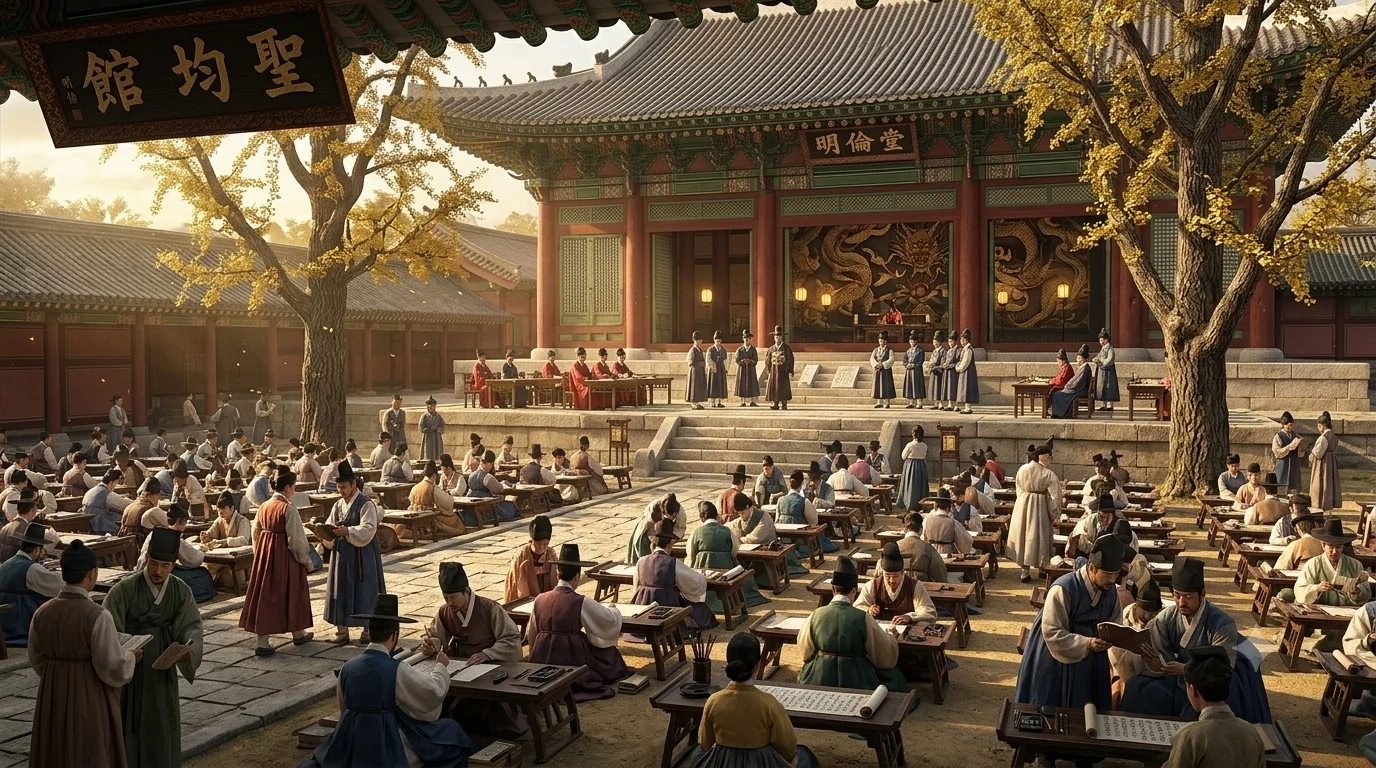 Sungkyunkwan: the state Confucian academy. Not the finish line — the training ground for it. (AI illustration)
Sungkyunkwan (成均館) was Joseon’s state Confucian academy, its highest institution of learning. The name reaches back into Goryeo — the National Academy became Seonggyungam in 1298 and Sungkyunkwan in 1308, reverted to Gukjagam in 1356, and returned to Sungkyunkwan in 1362.
The campus the drama shows us has a harder history than “built in 1398 and there ever since.” Construction in the new capital is dated by some official accounts from 1395; the memorial stele recorded in the Taejong Sillok has the main shrine-and-school complex going up between the third month of 1397 and the seventh month of 1398, which is when it was completed — the Daeseongjeon shrine, the Myeongryundang lecture hall, the eastern and western dormitories, the refectory. Then it burned, in a fire in 1400. Taejong ordered it rebuilt, and the Taejong Sillok records the shrine complete in 1407. It burned again in the Imjin War of 1592, and was rebuilt in stages: work resumed in 1601, the Daeseongjeon was finished in 1602, and the Myeongryundang and the dormitories — the buildings Sungkyunkwan Scandal’s students actually live in — were restored in 1606. The Sungkyunkwan Jeongjo knew was not the one built in 1398. It was a survivor, rebuilt twice.
What did they study? The Four Books and Five Classics, Neo-Confucian compendia like the Jinsirok and Seongni Daejeon, histories, statecraft texts including the Gyeongguk Daejeon, and composition and calligraphy. Not law, medicine, mathematics and archery as a standard curriculum — a claim that circulates widely in English. Those technical fields had been split off from the academy back in early Gongmin’s reign in Goryeo, and were taught in separate offices.
Entry ran mainly through the saengwon and jinsa degree-holders, who formed the sangjaesaeng, the core student body — but there were other doors: students of Seoul’s four district schools who were 15 or older and competent in the Sohak and one classic; legitimate sons of merit subjects and of officials of the third rank or above; those who had passed the first round of the mun-gwa or the saengwon-jinsa-si; serving officials who wished to enroll. Early Joseon set the roll at 200. By 1742 it had been cut to 126 — 106 degree-holders and 20 gijaesaeng — which is the Sungkyunkwan closer to Jeongjo’s own era, and the one the drama is nominally set in.
There’s one more detail the drama would have loved. Students earned attendance points — wonjeom (圓點) — one point for signing the refectory register at both breakfast and supper. Under the Gyeongguk Daejeon, 300 points, meaning roughly 300 days in residence, qualified a student for the gwansi, one route into the mun-gwa’s first round. That applied to the gwansi route, not to every road into the mun-gwa. And the rule loosened: under Yeongjo, when too few students reached 300, those with 50 or more could sit the gwansi, and the relaxation was written into the Sokdaejeon; Jeongjo readjusted the rules again in 1777. Even in the drama’s own period, you cannot say every candidate needed 300 wonjeom.
So was the exam actually fair to everyone?
Let’s be careful here, because both easy answers are wrong.
The gwageo was not a sham. It tested real learning in the classics and in literary Chinese, and it selected officials on results. But it was also not a universal open competition. The bar was legal as well as economic: people classified as cheonmin, including the enslaved, were barred from the mun-gwa; so were descendants of those convicted of treason or grave crimes; sons of concubines — the seoeol — faced legal and customary restrictions on the mun-gwa that eased only slowly; and a man could be stripped of eligibility as a punishment. So it is as wrong to say “only yangban could sit it” as it is to say “anyone could.”
And then there was the invisible entry fee. Preparing meant years of literary-Chinese and classical study, access to books and teachers, money to live on while not working, the means to travel to the exam city, information about schedules and question trends, and — quietly decisive — a family that had done this before. Those resources clustered where you’d expect.
Now the numbers. Donghyeok Choi and ChangHwan Kim’s study “Meritocracy with Multiple Rules,” published in Social Science History (Cambridge University Press, online April 2026), links the mun-gwa rosters — the bangmok (榜目), which record a passer’s lineage — to genealogical data. Their base data covers 14,638 mun-gwa passers; the final analytic sample is 14,258, spanning 1393–1894. What they find:
- In the 17th century, passers of special exams averaged 1.69 mun-gwa-passing ancestors, against 0.82 for passers of regular exams — a raw gap of 0.87. With age, region and exam size controlled, the adjusted gap is 0.44.
- Across the whole period, members of six politically dominant lineages — Andong Kim, Gyeongju Kim, Bannam Park, Pungyang Jo, Yeoheung Min, Namyang Hong — made up 11.7% of special-exam passers versus 7.7% of regular-exam passers. (That 11.7-vs-7.7 is the full-period average, not a 17th-century figure — a distinction commonly muddled.)
- Their advantage in the special exams shows up most sharply in the 19th century, particularly its second half.
Three cautions the authors themselves insist on, and so should we. This is not evidence of cheating on exam day — the study analyzes the family backgrounds of those who passed, not misconduct in the hall. It cannot tell us how much likelier a privileged candidate was to pass, because the data contain no record of those who sat and failed. And “six dominant lineages” is the researchers’ own analytic category, not a Joseon rank.
What survives all that qualification is still striking. The special exams were announced on short notice, with variable stages and quotas — and the authors argue those conditions may have made them more navigable for candidates with strong family and information networks near the capital. Note the shape of the finding: the study does not show the exam was rigged on the day. The advantage it detects sat upstream, in who could afford to arrive prepared at all.
So Kim Yoon-hee’s poverty, played by the drama as a personal obstacle she overcomes through grit, was — for a real commoner in her position — closer to a structural wall. That’s not a knock on the show. It’s exactly why a story like hers needs fiction to work at all.
Why did passing the exam matter so much beyond just a job?
Because in the Confucian framework, your exam result wasn’t only your own. It reflected on your parents.
The Classic of Filial Piety (孝經, Xiaojing) opens with the line every serious student knew: 立身行道,揚名於後世,以顯父母,孝之終也 — “to establish oneself and walk the proper path, to make one’s name known to later generations, and thereby bring glory to one’s father and mother: this is the completion of filial devotion” (Chinese Text Project).
Note what that passage does not say. It never mentions the examination. What it supplies is the frame — ipsin (establishing oneself) and yangmyeong (making one’s name known) — into which Joseon society fitted the gwageo. Reading it as “the Xiaojing declared exam success to be filial piety” would be too quick; the extension to family honor is a historical development in Joseon’s lineage culture, not a line of the text. But it’s why the drama’s characters treat failure like a small death, and why a whole extended family’s fortunes could ride on one son’s brush.
The system backed that up with hard rewards. Under the Gyeongguk Daejeon, the jeonsi ranked the mun-gwa’s 33 passers, and the first among them was the jangwon (壯元):
| Placing | If he held no rank yet — first appointment | If he already held rank — grades advanced |
|---|---|---|
| First place (jangwon) | Post of junior sixth rank | Four grades (sagye) |
| Top grade, 2nd & 3rd places | Post of senior seventh rank | Three grades |
| Second grade (eulgwa) | Senior eighth grade | Two grades |
| Third grade (byeonggwa) | Senior ninth grade | One grade |
Two things to keep straight. The advancement column applies only to men who already held rank — these are Joseon grade adjustments, not the equivalent of four modern promotions. And the jangwon’s junior-sixth-rank appointment was an enormous leap: the line between the sixth rank and the seventh was one of the real thresholds of the Joseon bureaucracy, and he cleared it on his first day. (The appointment and advancement rules sit in the Gyeongguk Daejeon’s “Ijeon” section, not the “Yejeon” section that governs sitting the exam.)
What about the exclusive clubs of jangwon that turn up in popular accounts? The Yongduhoe (龍頭會) is well attested — as a Goryeo institution, a banquet at which a newly minted jangwon hosted his predecessors. Assuming a formal Joseon-wide equivalent goes beyond the evidence. And the bangmok rosters did record lineage — rank, name, birth year, ancestral seat, residence, family relations — but what they recorded varied by exam type and edition. Not every bangmok lists four generations of ancestors and a father-in-law.
Here’s the drama’s central scene, decoded against the real system:
| In the KBS drama | What the historical record shows |
|---|---|
| Kim Yoon-hee, a woman, sits the exam under her brother’s name | There was no legal route by which a woman could sit the gwageo under her own name, and none by which anyone could sit it under another’s. This is invention — which is not the same as saying no woman in Korean history ever attempted a disguise |
| Passing the “minor exam” is stage one; the “major exam” is stage two | The saengwon-jinsa-si was a separate examination, not a compulsory first stage of the mun-gwa. A yuhak with neither degree nor office could reach the mun-gwa by other routes |
| Sungkyunkwan study is the road to the exam | Of nearly 48,000 saengwon and jinsa across the dynasty, most never studied there — the academy’s administration had declined, and other routes into the mun-gwa existed |
| Her poverty is a personal hurdle overcome by talent and grit | Choi and Kim’s study of 14,258 mun-gwa passers finds established lineages fared better — most sharply in the irregular “special” exams, and most sharply of all in the 19th century |
| The students live in the Sungkyunkwan of 1398 | The complex burned in 1400 and again in 1592. The halls of Jeongjo’s day were rebuilt — the Daeseongjeon in 1602, the Myeongryundang and dormitories in 1606 |
Key terms. Gwageo (科擧) — Korea’s state examination system, first held in 958 and abolished in 1894. Mun-gwa (문과) — the civil examination, in three rounds (chosi, boksi, jeonsi), the real gateway to office. Saengwon-jinsa-si (생원진사시) — often called the sogwa; a separate examination conferring the saengwon or jinsa title and eligibility for Sungkyunkwan, not a compulsory first stage of the mun-gwa. Wonjeom (圓點) — Sungkyunkwan attendance points, one per day of signing the refectory register morning and evening. Jangwon (壯元) — first place in the mun-gwa. Yangban (兩班) — the elite scholar-official stratum, reproduced through lineage, education and officeholding; not quite the same thing as a legally fixed European nobility.
Korea, China, Japan and parts of Europe: four routes into government office
Almost every major civilization eventually had to answer the same question: how do you decide who gets to rule? Compare Joseon’s answer to its neighbors and the West, and the show’s world snaps into much sharper focus — because “an exam decides” turns out to be a much rarer answer in world history than it might seem.
Korea — the exam as national ladder (with an entry fee you couldn’t see). Joseon inherited the gwageo from Goryeo, where King Gwangjong first held it in 958 on the advice of Ssang Gi (雙冀). Ssang Gi had been an official of the Later Zhou; he came to Goryeo in 956 in the train of an envoy, fell ill, and stayed. Gwangjong obtained Later Zhou’s leave to keep him, gave him office, and in 958 acted on his proposal — with Ssang Gi himself serving as chief examiner at that first sitting, and again in 960 and 961. Historians generally read the move as part of Gwangjong’s drive to strengthen royal authority against the merit-subject and regional strongman families by recruiting a new class of Confucian officials — though it’s worth saying plainly that no source records Gwangjong announcing “I am doing this to check the strongmen.” That is the historians’ reading of his reign, not a line in the record.
One detail worth pausing on: Korea’s jinsa (進士) is written with the identical characters as China’s jinshi (進士) — and they are not the same thing. In Ming and Qing China, jinshi was the summit: you passed the provincial exam to become a juren, the metropolitan exam to become a gongshi, and only after the palace exam did you hold jinshi. Korea’s jinsa was a degree from the saengwon-jinsa-si. But don’t turn that contrast into “Korea’s was the lowly one.” A Joseon jinsa was a state-recognized scholar who could enter Sungkyunkwan and who carried real standing, especially in his home district. Same two characters; different institutions.
China — the original, at a scale Korea never approached. Korea’s gwageo was modeled on China’s own examination system, the keju (科舉), developed from the Sui and Tang and reaching its most elaborate form under the Ming and Qing. The scale was of a different order: vast pools of preliminary candidates competing through provincial, metropolitan and palace rounds for a small number of degrees. The system shaped Korea’s and Vietnam’s institutions before the Qing abolished it in 1905 amid a broader modernization drive (Encyclopædia Britannica, “Chinese examination system”). And a note on those precise-sounding figures you’ll see quoted — “400,000 candidates a year,” “a 1% pass rate”: they vary enormously by dynasty and by which round you’re counting, so this piece doesn’t lean on a single number.
Japan — the blueprint borrowed, and never load-bearing. Japan experimented with a Tang-style state academy and examinations under the ritsuryō system in the Nara period, in the 8th century. They never displaced hereditary rank and aristocratic networks as the principal route to office: posts in the ministries continued to be filled from a small circle of powerful clans, and birth and connection outweighed examination results (Encyclopædia Britannica, “Ritsuryō”). It’s tempting to narrate this as a deliberate refusal, generation after generation — but that reads intent into a much messier history of clan structure, court rank, and the ritsuryō system’s own transformations. The safer statement: the existing elite structure gave examinations little room to become the dominant mechanism of recruitment.
Parts of early modern Europe — buying the office outright. Premodern Europe filled offices by birth and patronage, and in some kingdoms by purchase. In France especially, venality — the sale of government and judicial posts — was widespread from the sixteenth century, and by the eighteenth some 70,000 offices across the judiciary, the military and the civil administration were routinely bought and sold (Encyclopædia Britannica, “Venality”). It is, in a sense, the mirror image of Joseon’s ideal: not a poor student rising by study, but a rich man’s son buying his way in.
And then Britain, in 1854, reached for the examination. The Northcote–Trevelyan Report, the founding document of the modern British civil service, recommended replacing patronage appointments with open competitive examination — and recent scholarship traces evidence that its architects and supporters, John Stuart Mill among them, knew of and were influenced by China’s examination system, encountered through missionary and diplomatic accounts (Public Money & Management, “Re-investigating the influence of China on the British civil service examination system”). Be precise about what that does and doesn’t say: the influence traced is Chinese, not Korean. Joseon did not shape Whitehall. What the story shows is that the idea Kim Yoon-hee’s Korea took for granted — that a written examination, not birth, should decide who governs — travelled, and arrived in Europe a very long time after it had already reorganized East Asia.
Four routes, four bets on the same problem. Korea’s examination with an entry fee you couldn’t see; China’s at a scale Korea never approached; Japan’s, borrowed and never load-bearing; Europe’s offices sold outright, until Britain reached for the examination after all. Look again at Kim Yoon-hee walking through Sungkyunkwan’s gate, and you’re watching a society that tried, imperfectly, to make paper and ink outrank blood — even as blood kept shaping who reached the examination hall.
Coming up next
One disguised exam candidate — and we’ve traveled from a Joseon exam hall to a Cambridge dataset of 14,258 names, to the imperial examination halls of China, to a Nara-period academy that never took root, to Victorian Britain reaching for the examination a millennium late. That’s the quiet gift of a good historical drama: even a single test can carry nine centuries of paper trail.
In the next essay, we’ll take another K-drama scene that looks like pure fiction — and trace the real Korean history hiding underneath it.
Frequently asked questions
Is Sungkyunkwan Scandal based on a true story? No. Kim Yoon-hee and the plot are invention, set during the real reign of King Jeongjo (1776–1800). The exam, the academy and the status rules are historical; the story is not.
Could a woman really disguise herself and take the gwageo exam? There was no legal route by which a woman could sit the gwageo under her own name, and none by which anyone could sit it under someone else’s identity. So the drama’s central premise could not have happened within Joseon’s legal system. That is not the same as claiming no woman in Korean history ever attempted a disguise — only that the law and the institutions left no path for it.
Was the “minor exam” really stage one of the “major exam”? No, and this is the single most common mistake in English accounts. The saengwon-jinsa-si (often called the sogwa) was a separate examination, not a compulsory first stage of the mun-gwa. It conferred the saengwon or jinsa title, real social standing and eligibility to enter Sungkyunkwan — but it did not automatically lead to office, and a yuhak with no degree at all could still reach the mun-gwa by other routes.
What was the difference between mun-gwa, mu-gwa, and jap-gwa? Mun-gwa (文科) was the civil examination leading to the most powerful posts; mu-gwa (武科) selected military officers; jap-gwa (雜科) selected technical officials — interpreters, physicians, astronomers and geomancers, and legal specialists. The saengwon-jinsa-si ran separately from all three.
Did students really need 300 attendance points at Sungkyunkwan? That was the principle in the Gyeongguk Daejeon: 300 wonjeom — one point per day of signing the refectory register at both breakfast and supper, so roughly 300 days in residence — qualified a student for the gwansi route into the mun-gwa. But it was relaxed. Under Yeongjo, students with 50 or more points could sit the gwansi when too few reached 300, and Jeongjo readjusted the rules again in 1777. Even in the drama’s own era, it was not an absolute requirement.
Was Joseon’s gwageo exam actually a meritocracy? Both easy answers are wrong. It really did test learning and select officials by result — but it was not open to everyone: the enslaved were barred, as were descendants of traitors, and sons of concubines faced restrictions on the mun-gwa. And preparation demanded years of costly classical schooling. Choi and Kim’s study of 14,258 mun-gwa passers (1393–1894) finds established lineages fared better, most sharply in the irregular “special” exams — though the authors caution this shows the family backgrounds of those who passed, not cheating, and cannot measure how much likelier privilege made passing, since the data hold no record of those who failed.
What happened to the gwageo system? It was first held in Goryeo in 958 and abolished in 1894 under the Gabo Reforms — 936 years between those two dates, a system that stood for over nine centuries.
Sources & further reading
This piece was written from the historical script and fact-check of 사뚱샘의 역사방 (SaDDungSam). Key sources are cited inline above. For broader reading:
- “Meritocracy with Multiple Rules” — Donghyeok Choi and ChangHwan Kim’s study of 14,258 mun-gwa passers (1393–1894), which puts numbers to how privilege worked through the special examinations. (Social Science History / Cambridge University Press)
- The examinations, and Sungkyunkwan itself. Encyclopedia of Korean Culture (한국민족문화대백과), “과거,” “생원진사시,” “문과,” “잡과,” “성균관,” “원점” · Gyeongguk Daejeon and Sokdaejeon · Taejong Sillok (the Sungkyunkwan stele; the shrine completed in 1407) · 우리역사넷, National Institute of Korean History.
- China’s keju (科舉) and its regional influence — an overview of how the Chinese exam model shaped Korea, Vietnam, and briefly Japan. (World History Encyclopedia)
- The Northcote–Trevelyan Report and Chinese influence on the British civil service — recent scholarship tracing direct 19th-century British awareness of the Chinese exam model. (Public Money & Management, Taylor & Francis)
Editor’s note, 13 July 2026. This article was substantially fact-checked before publication against the Encyclopedia of Korean Culture, 우리역사넷, the Joseon law codes and the Cambridge study itself. Corrected draft claims included: treating the saengwon-jinsa-si as a compulsory first stage of the mun-gwa; listing law, medicine, mathematics and archery among Sungkyunkwan’s standard subjects; assigning the study’s 11.7%-vs-7.7% clan figure to the 17th century rather than the full period; and describing the yongduhoe as a Joseon institution.
Thanks for reading — see you in the next one.
This article was researched and written by K-Drama History. Source: Sungkyunkwan Scandal, Explained: Why Joseon Korea's 'Fair' Exam Wasn't as Fair as It Looked — K-Drama History