The Book of Fish, Explained: Jeong Yak-jeon, the Jasaneobo, and Korea's Forgotten Naturalist
Theme: Knowledge & Science
From the research behind Pause the Drama.
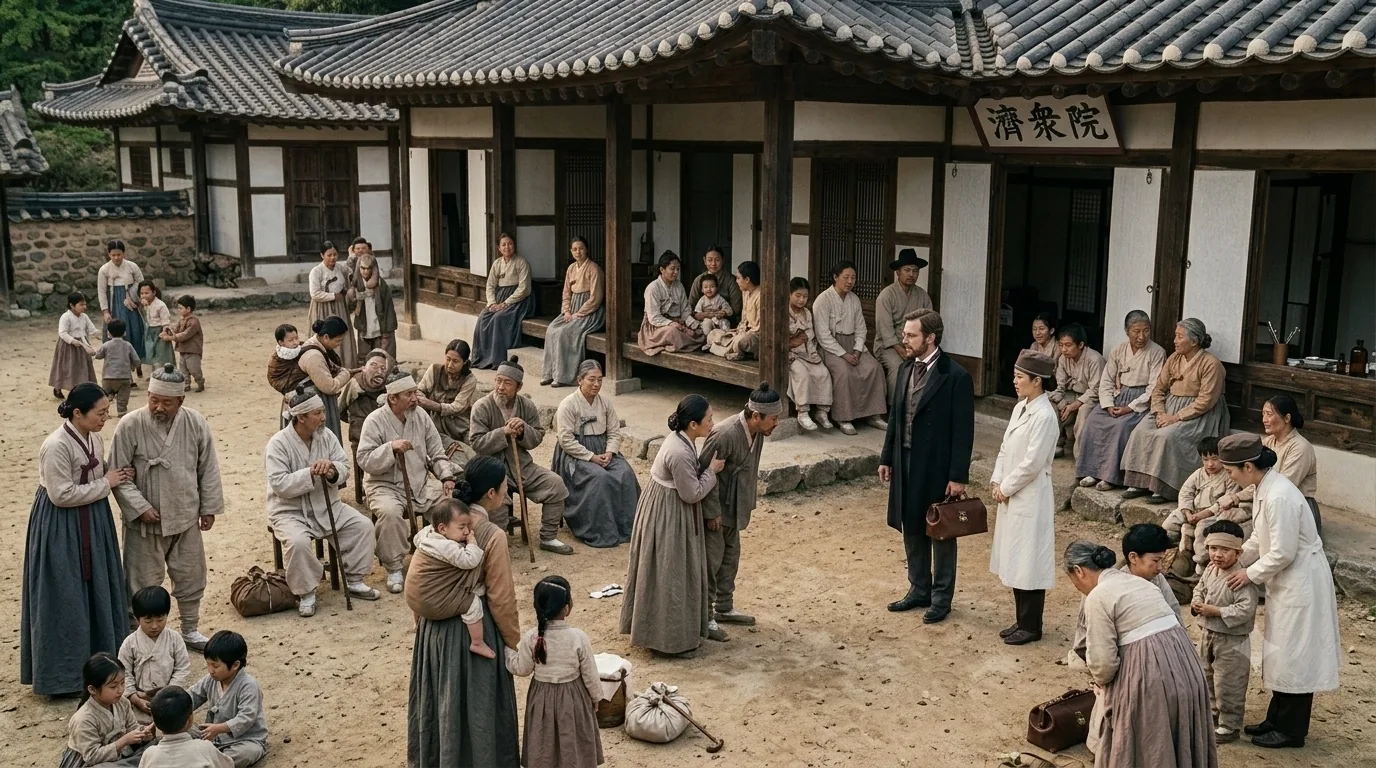
In The Book of Fish (자산어보, released in Korea as Jasan Fish), the scholar arrives by boat, in winter, in what looks like defeat. Jeong Yak-jeon (정약전) has been sentenced to internal exile on Heuksan Island (흑산도, Black Mountain Island) — a remote cluster of islands off Korea’s southwest coast — for the crime of belonging to the Catholic faith. The year is 1801. He is fifty-three years old. He will spend the rest of his life here.
The film is shot in black and white, which suits the material. Jeong Yak-jeon no longer has a government post, a career trajectory, or a return ticket. What he has is time, curiosity, and an island full of sea creatures that no Joseon scholar has ever systematically described. He has, eventually, something more: Jang Deok-sun — known by the name Chang-dae (장덕순, 일명 창대) — a Heuksan islander with the unusual distinction of a classical Chinese education, who knows the sea from the inside.
What these two produce together, over what is believed to have been roughly sixteen years, is the Jasaneobo (자산어보) — a three-volume natural history of the marine life of the Heuksan Island waters, recording the appearance, behavior, flavor, medicinal uses, and local names of the sea creatures around the island, sorted into 55 categories. It is the most detailed marine natural history text produced in Joseon Korea. It was also never published in its author’s lifetime.
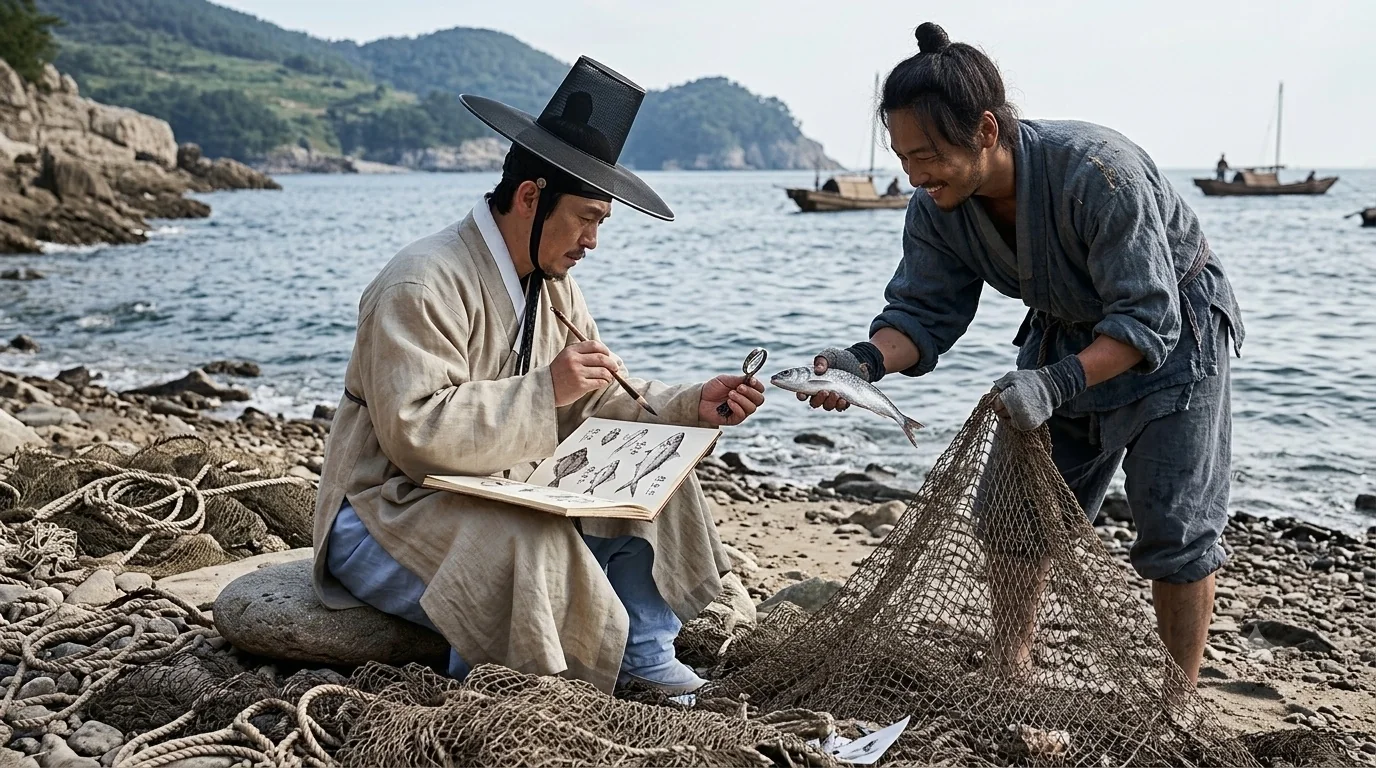 Jeong Yak-jeon compiling the Jasaneobo on the Heuksan shore — a collaboration between an exiled scholar and Chang-dae, the islander who knew the sea from the inside. (AI illustration)
Quick answer: Jasan Fish (자산어보, 2021, Megabox Plus M) is a biographical drama about Jeong Yak-jeon (1758–1816), a Silhak-tradition scholar who spent his exile on Heuksan Island compiling the Jasaneobo — a three-volume catalogue that sorts the Heuksan sea life into 55 categories (marine life broadly, not fish only). His key collaborator was Chang-dae (Jang Deok-sun), a locally educated islander whose field knowledge shaped the book. The text was never printed in Jeong’s lifetime; it circulated in manuscript form. The film asks a quiet but serious question: how did the political and religious repression of 1801 — the Sinyu Persecution — inadvertently produce one of Korea’s most original works of observational science?
The five facts. 1. Jeong Yak-jeon (1758–1816) was exiled after the 1801 Sinyu Persecution — first to Sinji-do, then to Heuksan Island, where he died in 1816 without ever being recalled. 2. The persecution’s stated charge was Catholicism; its political purpose was factional — the hardline Byeokpa striking at Sipa and Namin figures who had risen under King Jeongjo, who died in 1800. 3. The Jasaneobo sorts Heuksan marine life into 55 categories across three volumes — species counts are given variously as 155 to 226, depending on how related organisms are grouped. 4. It is not a fish book: the four classes cover scaled fish, scaleless creatures (octopus, squid, jellyfish), shelled creatures, and a miscellany including seaweed. 5. Chang-dae (Jang Deok-sun), a classically literate Heuksan islander, is acknowledged in the preface as Jeong’s source on field knowledge — the collaboration is documented, not invented by the film.
Let’s unpack it.
How did a heresy charge produce Korea’s most detailed marine natural history?
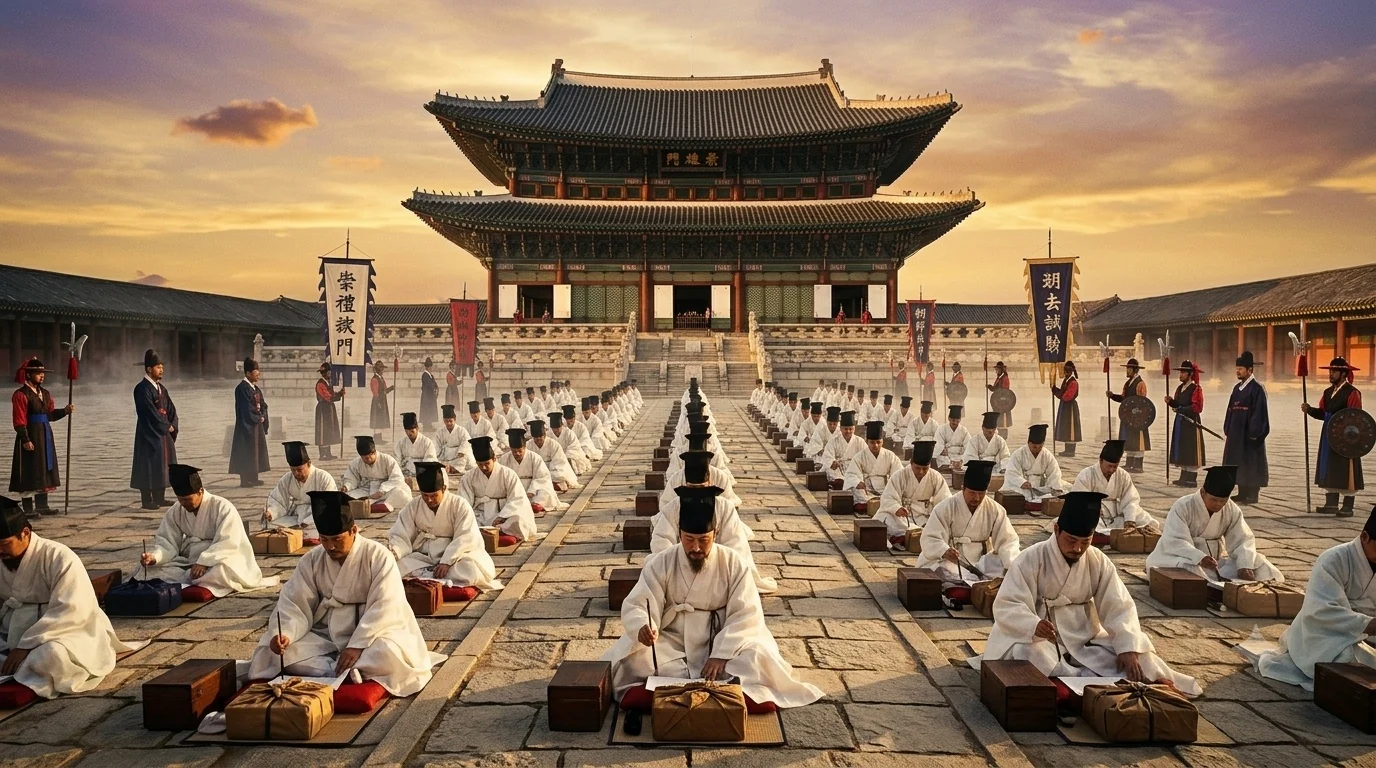
The Sinyu Persecution of 1801 (신유박해) was the first major systematic suppression of Korean Catholicism, and its political context matters. King Jeongjo — who had extended a degree of protection to scholars of the Namin (Southern) faction, many of whom had converted to Catholicism as part of the Silhak intellectual current — died suddenly in 1800. He was succeeded by the eleven-year-old Sunjo, with Queen Dowager Kim of Jeongsun acting as regent. Under her regency the hardline Byeokpa (벽파) faction seized the political initiative and used the occasion to strike at the Catholics and at the Sipa (시파) and Namin-aligned figures who had risen under Jeongjo. Catholicism was the charge; factional realignment was the purpose.
(For what Jeongjo’s protection of that faction actually was — and what it cost him — see our piece on what “I am the son of Crown Prince Sado” really meant.)
Among those executed in 1801 were Yi Seung-hun (이승훈, the first Korean Catholic, baptized in Beijing in 1784) and Jeong Yak-jong (정약종) — Jeong Yak-jeon’s younger brother; Yi Ga-hwan (이가환) died under interrogation. Jeong Yak-jeon narrowly escaped execution. He was banished first to Sinji-do and then to Heuksan Island. A second brother, Jeong Yak-yong (정약용), known by his pen name Dasan and today regarded as Joseon’s greatest reformist thinker, was exiled by way of Janggi to Gangjin on the mainland coast.
Joseon’s exile system (yubae, 유배) was designed as a kind of living administrative death. The exile was physically removed from the capital and placed under surveillance in a designated area. But the state did not confiscate his books or prohibit reading, writing, or teaching. This restriction-without-intellectual-prohibition created an unexpected condition. Scholars severed from court politics and factional rivalries found themselves free to pursue sustained, concentrated inquiry in ways that capital life rarely permitted. Jeong Yak-yong wrote the Mongminsimseo (목민심서) — his landmark treatise on official governance — in his Gangjin exile. Jeong Yak-jeon went to the sea.
What is the Jasaneobo, and who helped create it?
The Jasaneobo (자산어보) takes its name from Jasan — Jeong Yak-jeon’s literary name for Heuksan Island, meaning “Dark Mountain.” Jeong Yak-jeon sorted the marine life of the Heuksan waters into four classes, presented across three volumes:
Inryu (인류, 鱗類) — scaled fish, with descriptions of appearance, seasonal behavior, flavor, and regional dialect names.
Murinryu (무린류, 無鱗類) — scaleless creatures, such as octopus, squid, sea cucumber, and jellyfish.
Gaeryu (개류, 介類) — shelled and armored creatures, including crab, abalone, clam, oyster, and conch.
Jamnyu (잡류, 雜類) — a miscellany covering seaweed and other maritime plants and animals.
For each species, Jeong Yak-jeon records: the classical Chinese character name, the vernacular (dialect) name used by local fishermen, a physical description, notes on behavior and habitat, culinary uses, and — where applicable — medicinal properties. The result is a hybrid document: part scholarly catalogue, part practical field guide, part ethnographic record of a fishing community’s accumulated knowledge.
A crucial word about authorship: the Jasaneobo’s own preface acknowledges that Jeong Yak-jeon’s knowledge was substantially built on the expertise of Jang Deok-sun, known by the name Chang-dae (장덕순, 일명 창대) — also referred to in later popular accounts as Jang Chang-dae. Chang-dae was a Heuksan islander with classical Chinese literacy — enough to serve as Jeong’s informant, interlocutor, and guide to the sea. Rather than a mere fisherman, he is better understood as a local knowledge-holder deeply versed in the island’s waters. Jeong Yak-jeon’s own text states that he learned much from Chang-dae. This was not a noble scholar condescending to record folk knowledge; it was a collaboration between two people who each had something the other lacked. The Silhak tradition’s emphasis on practical, grounded knowledge over pure textual scholarship made this kind of cross-class intellectual partnership ideologically possible in a way it would not have been for an orthodox Neo-Confucian.
Joseon was, in fact, full of people who held expert knowledge the yangban class did not — and who were structurally barred from the status that knowledge would have earned anywhere else. We wrote about the most striking case, the jungin interpreters who were rich, powerful, and never yangban.
A common misconception to correct: The Jasaneobo is often described as a “fish encyclopedia” — and the title’s eobo (어보, 魚譜) does mean “fish catalogue.” But the contents tell a different story. The text covers octopus, jellyfish, sea cucumber, seaweed, abalone, and much more. It is better understood as a general natural history of the Heuksan Island marine environment than as a work limited to fish in any strict zoological sense.
The catalogue is organized into 55 categories; the total number of species is given variously in public records as 155 to 226, with the most detailed listings counting 226 — the difference reflecting whether related organisms are grouped together or counted separately. The manuscript was never printed during Jeong Yak-jeon’s lifetime; he died in 1816 — most precisely recorded at Uibo on Naeheuksan, today’s Ui-do, within the Heuksan exile region — and the text circulated in manuscript copies before its modern printed editions appeared in the twentieth century. The version that survives today, a three-volume manuscript, is understood to combine Jeong Yak-jeon’s original compilation (completed around 1814) with later supplements and re-editing by the scholar Yi Cheong (이청) — though this is best described as a reworked transmission rather than a co-authored book.
Drama vs. real history — what does Jasan Fish reconstruct?
| In Jasan Fish | In the historical record |
|---|---|
| Jeong Yak-jeon arrives at Heuksan Island as a Catholic exile in 1801 | Confirmed: banished in the Sinyu Persecution (1801), by way of Sinji-do; died in exile in 1816 |
| Chang-dae is a Heuksan islander with classical Chinese literacy | Confirmed: Jang Deok-sun, known as Chang-dae, is named in the Jasaneobo preface; his education is noted |
| Jeong acknowledges learning from Chang-dae, not simply teaching him | Confirmed: Jeong Yak-jeon’s own text records this explicitly |
| The two form a genuine intellectual partnership across class lines | Consistent with the text’s internal evidence; the dramatic relationship is the film’s creative filling-in of a documented collaboration |
| Jeong Yak-jeon’s brother Jeong Yak-yong is also in exile | Confirmed: Jeong Yak-yong (Dasan) was exiled to Gangjin, Jeolla Province |
| The Jasaneobo is never published in Jeong’s lifetime | Confirmed: it circulated in manuscript copies only |
In short, the film is historically grounded in the exile, the collaboration with Chang-dae, and the manuscript status of the Jasaneobo, while dramatizing the emotional texture of their relationship.
The film’s most historically important claim is also its most understated: that the Sinyu Persecution, designed to destroy a political faction and purge a religious movement, inadvertently created the conditions for one of the most original works of observational natural history in the Joseon period.
Key terms. Silhak (실학) — “Practical Learning”; the late Joseon intellectual movement (roughly 17th–early 19th centuries) emphasizing empirical observation, social criticism, and economic reform over pure Neo-Confucian textual study; Jeong Yak-jeon and his brother Jeong Yak-yong (Dasan) are among its most prominent figures. Sinyu Persecution (신유박해, 1801) — the first systematic suppression of Korean Catholics, used politically to strike at the Sipa and Namin factions; triggered both Jeong brothers’ exiles. Jasaneobo (자산어보) — Jeong Yak-jeon’s three-volume marine natural history, sorting the Heuksan sea life into 55 categories; compiled on Heuksan Island, never published in the author’s lifetime. Chang-dae (창대) — Jang Deok-sun, the islander-scholar who co-produced the Jasaneobo; acknowledged in the preface as Jeong’s primary source on field knowledge. Yubae (유배) — the Joseon exile system, which isolated political figures from the capital while not prohibiting intellectual activity, inadvertently producing a cluster of major scholarly works from the early 19th century.
Observational science in the 18th and 19th centuries: where does the Jasaneobo fit?
The Jasaneobo reached something close to its current form around the early 1810s — Jeong Yak-jeon’s original compilation is generally dated to around 1814, though the dating relies on internal manuscript evidence and should be treated as approximate. This places it at the heart of what historians of science call the great age of observational natural history, when practitioners across Europe and Asia were producing systematic catalogues of the natural world. Three contemporary figures illuminate what Jeong Yak-jeon shared with his global moment — and what made his situation fundamentally different.
China — Li Shizhen’s Bencao Gangmu (본초강목, 1596). The most direct intellectual ancestor Jeong Yak-jeon might have known is the Chinese encyclopaedist Li Shizhen (이시진), whose Compendium of Materia Medica catalogued 1,892 entries — animals, plants, and minerals — organized according to appearance, properties, medicinal effects, and therapeutic applications. The Bencao Gangmu had circulated in Joseon for roughly two centuries by Jeong’s time. The surviving Jasaneobo shows traces of Chinese sources such as the Bencao Gangmu — though, given the later supplements and re-editing in the transmitted text, it is safest to say these references entered through the compilation and editing of the Jasaneobo rather than to assert that Jeong personally cited the work. As a point of contrast, the scale is radically different: Li commanded state resources and a lifetime of compilation to cover 1,892 categories; the Jasaneobo covers the Heuksan waters in 55 categories, drawn from one islander’s knowledge and whatever texts could be obtained in exile.
Germany/Prussia — Alexander von Humboldt (1769–1859). In 1799, while Jeong Yak-jeon was still a government official in Hanyang (Seoul), Alexander von Humboldt set sail for South America. Over five years, he collected vast plant specimens and field observations, recorded climatic and geological data, and produced the first systematic analysis of the relationships between altitude, climate, and vegetation zones. His multi-volume accounts defined the template for “scientific travel” that shaped nineteenth-century European natural science. Humboldt had the resources of a Prussian noble family, a Spanish imperial travel permit, and a European publishing infrastructure that could print, debate, and distribute his findings across a continent within years of his return. Jeong Yak-jeon had none of these. What they shared was a methodological instinct: go to the field, describe what you actually observe, record the local names, note the practical uses. The difference between them is entirely structural — not in the quality or spirit of their curiosity.
Sweden — Carl Linnaeus (1707–1778). Linnaeus established a decisive standard for botanical classification and naming in Species Plantarum (1753), the first work to apply binomial nomenclature consistently — the framework by which a living organism is assigned a two-part Latin name indicating genus and species, and which became the foundation for how modern biology classifies life. Jeong Yak-jeon did not use this system. It is very unlikely he was aware of it. His classification of marine life was based on practical resemblance (scaled versus scaleless), ecological relationship, and human utility — not morphological lineage. From the standpoint of modern taxonomy, this makes the Jasaneobo non-systematic. From the standpoint of the history of observational science, it places it in a parallel tradition: classification through careful observation, organized for practical human use rather than for universal scientific communication.
The Jasaneobo was not Joseon’s only book built on looking rather than citing, either. Two and a half centuries before Jeong Yak-jeon went to Heuksan, Joseon’s courts were already working from a manual that told officials to read a body for evidence instead of a confession — the Muwonrok, Joseon’s forensic examination handbook.
What these comparisons reveal: The 18th and 19th centuries saw a simultaneous global surge in field-based natural description — in China, in Europe, and in Korea. The decisive difference between the Western tradition and Joseon’s Silhak tradition was not the quality of observation but the presence or absence of institutional amplification. The Royal Society in London, the Linnean Society (founded 1788), and the French Académie des Sciences provided frameworks for publication, peer review, and the accumulation of verified knowledge. Humboldt’s findings became international science within a decade. The Jasaneobo circulated in manuscript copies among a small circle of Korean scholars and remained effectively unknown to the wider world until the twentieth century. The observation was comparable. The infrastructure to carry it outward did not exist.
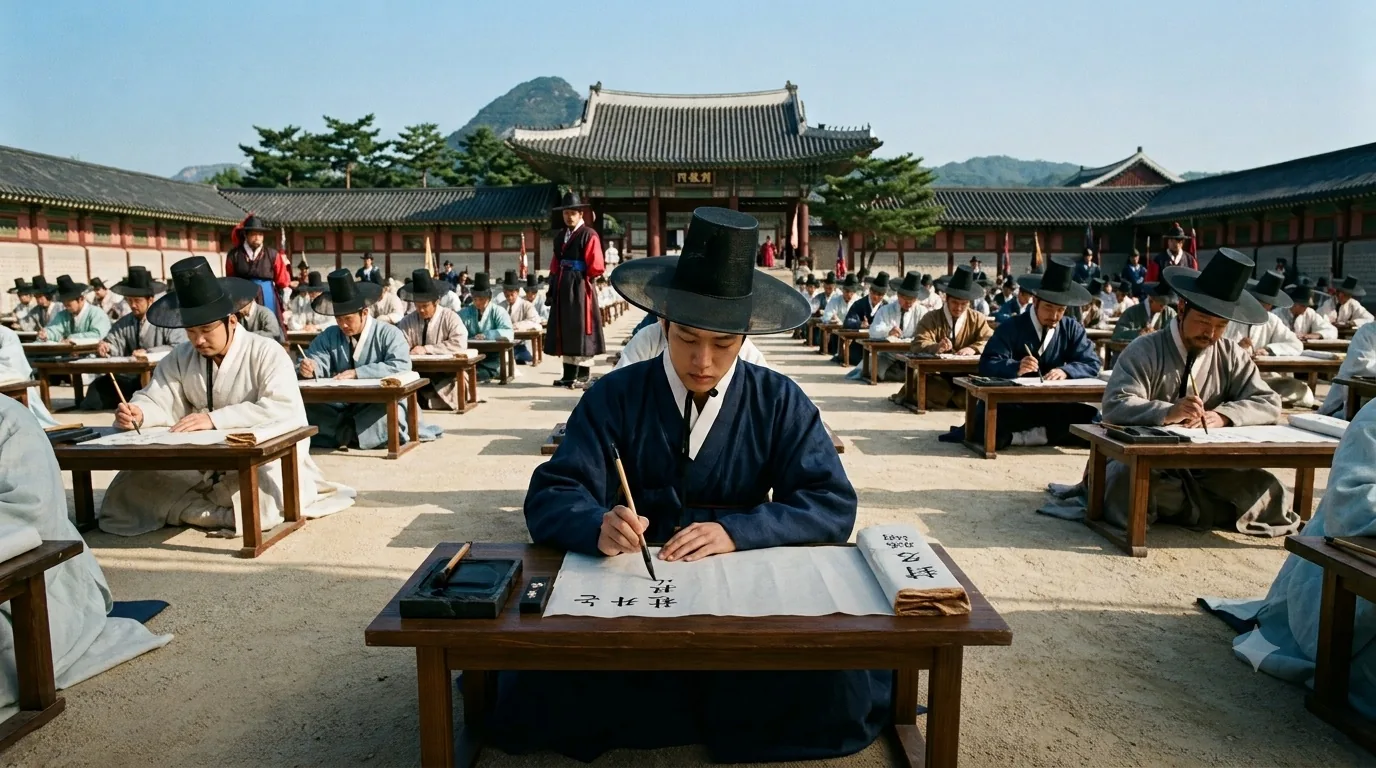
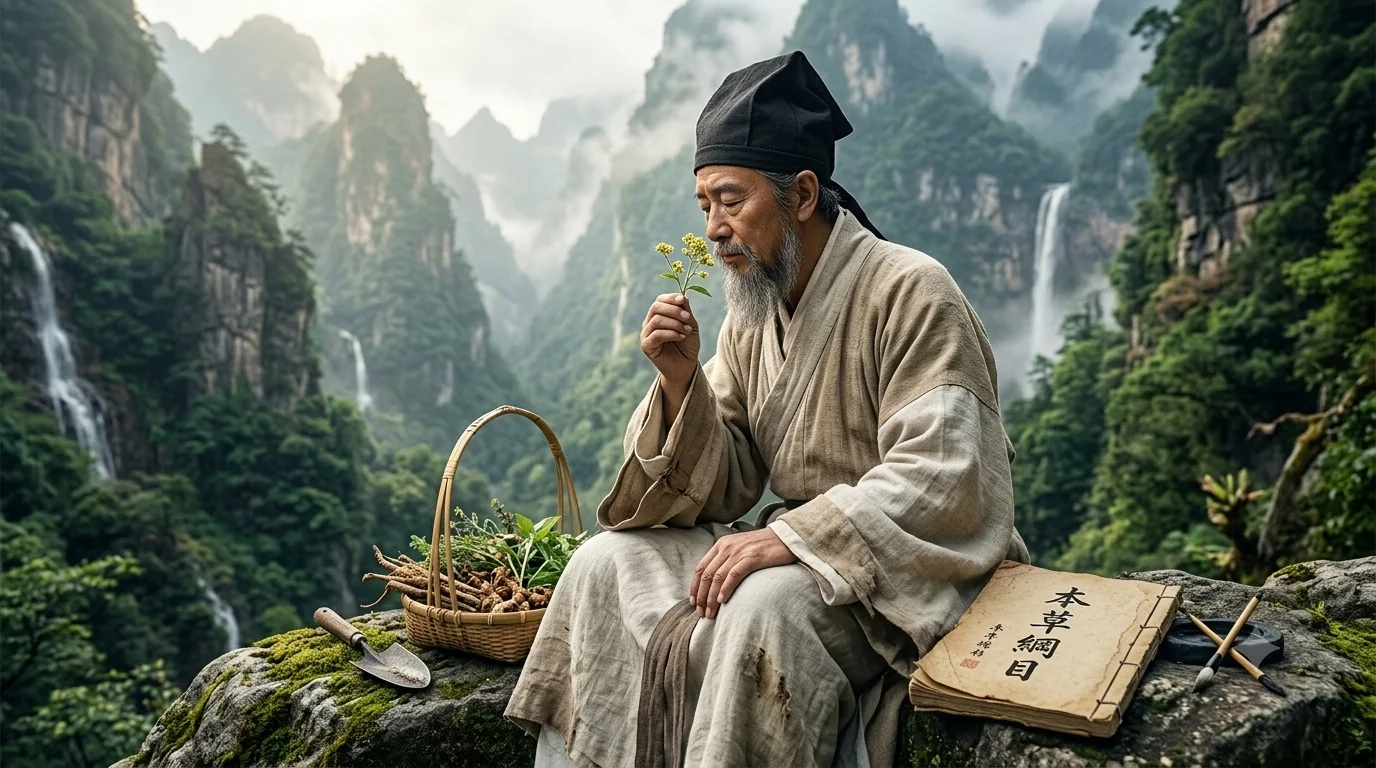 Li Shizhen’s Bencao Gangmu (1596) — the great Chinese materia medica whose traces appear in the transmitted Jasaneobo, though its exact route into the text runs through later compilation and editing. (AI illustration)
Coming up next
A heresy charge, sixteen years on a remote island, one classically educated islander, and a three-volume natural history that no press printed for over a century — the Jasaneobo is one of the clearest illustrations in Korean intellectual history of a mind that the political system tried to eliminate and inadvertently freed.
In the next essay, we’ll look at Jeong Yak-yong (Dasan), Jeong Yak-jeon’s more famous brother, and ask why his Mongminsimseo — a guide for local officials written in exile — remains required reading in Korean public-administration circles two centuries after it was composed.
To place Jeong Yak-jeon’s exile against the rest of Korean history at a glance, use our Korean history timeline.
Thanks for reading — see you in the next one.
Frequently asked questions
What is the film Jasan Fish (자산어보) about? Jasan Fish (자산어보, 2021, Megabox Plus M) is a Korean historical film, shot in black and white, following the Silhak scholar Jeong Yak-jeon during his exile on Heuksan Island after the 1801 Sinyu Persecution. With his political career destroyed, Jeong collaborates with Chang-dae (Jang Deok-sun), a young local islander, to compile the Jasaneobo — a three-volume catalogue of marine life that was never published in his lifetime.
Who was Jeong Yak-jeon, and why was he exiled to Heuksan Island? Jeong Yak-jeon (1758–1816) was a Silhak-tradition Joseon scholar who had converted to Catholicism. He was arrested in the Sinyu Persecution of 1801 — a political campaign framed in religious terms, driven by the hardline Byeokpa faction against Catholics and Sipa/Namin-aligned figures — and banished first to Sinji-do, then to internal exile on Heuksan Island. His younger brother Jeong Yak-jong was executed; his brother Jeong Yak-yong (Dasan) was exiled to Gangjin. Jeong Yak-jeon spent the rest of his life in the Heuksan exile region, dying in 1816.
What is the Jasaneobo, and what does it contain? The Jasaneobo is a three-volume marine natural history sorting the Heuksan sea life into four classes: Inryu (scaled fish); Murinryu (scaleless creatures — octopus, squid, jellyfish, sea cucumber); Gaeryu (shelled and armored creatures — crab, abalone, clam, oyster, conch); and Jamnyu (seaweed and other maritime materials). The catalogue is organized into 55 categories, with the species total given variously as 155 to 226 in public records. Despite its title, the Jasaneobo covers marine life broadly — it is a marine natural history, not a fish-only catalogue.
Was Chang-dae a real person? Yes. Jang Deok-sun, known by the name Chang-dae (장덕순, 일명 창대), is named in the Jasaneobo’s preface, where Jeong Yak-jeon acknowledges learning extensively from him. Chang-dae was a Heuksan islander with classical Chinese literacy — an unusual combination that made him Jeong’s indispensable field collaborator, better described as a local knowledge-holder than a mere fisherman. The film’s intellectual-partnership portrayal is grounded in Jeong’s own written acknowledgment.
What was the Sinyu Persecution of 1801? The Sinyu Persecution (신유박해) was the first major systematic suppression of Korean Catholicism, launched in 1801 under the regency of Queen Dowager Kim of Jeongsun, with the hardline Byeokpa faction using it to strike at the Sipa and Namin factions. Yi Seung-hun (the first Korean Catholic) and Jeong Yak-jong were among those executed; Yi Ga-hwan died under interrogation. Jeong Yak-jeon and Jeong Yak-yong were exiled rather than killed.
Did Jeong Yak-jeon and his brother Jeong Yak-yong stay in contact during their exile? Letters between them survive. Though Heuksan Island and Gangjin are both in Jeolla Province, they are separated by considerable distance and free travel between exiles was difficult. Correspondence between the brothers has been identified in their collected writings, including letters in which Jeong Yak-yong refers to his elder brother’s work.
When was the Jasaneobo first published? It was not published in Jeong Yak-jeon’s lifetime. He died in 1816 in his Heuksan exile — most precisely at Uibo on Naeheuksan, today’s Ui-do — before any printing occurred. The text circulated in manuscript copies until modern printed editions appeared in the twentieth century. The precise year of first publication requires bibliographic confirmation.
How does Jeong Yak-jeon’s work compare with Western natural history of the same era? The closest methodological parallel is Alexander von Humboldt (1769–1859), whose South American expedition (1799–1804) exemplified systematic field observation and description. Both Jeong and Humboldt described what they actually saw, recorded local names, and organized findings by observable characteristics. The critical difference is institutional: Humboldt had European publishing networks and state support; Jeong Yak-jeon worked in exile with manuscript circulation only. The observation was comparable; the amplification infrastructure was not.
Is The Book of Fish historically accurate? The Book of Fish is historically grounded in Jeong Yak-jeon’s 1801 exile, his compilation of the Jasaneobo, and his collaboration with the Heuksan islander Chang-dae (Jang Deok-sun). The emotional relationship between the two men is dramatized, but the core historical claim — that Jeong relied on local maritime knowledge to compile a major marine natural history — is supported by the Jasaneobo’s own preface and the scholarly record. The film’s restraint (it omits popular legends and invented heroics) is part of why it is regarded as unusually faithful.
Sources & further reading
This piece was written from the historical script and fact-check of 사뚱샘의 역사방 (SaDDungSam), drawing on primary records, academic scholarship, and official research:
- The Jasaneobo (자산어보) primary text — Jeong Yak-jeon’s original manuscript and modern printed editions; the four-class structure (Inryu, Murinryu, Gaeryu, Jamnyu), the 55-category organization, and the preface’s acknowledgment of Jang Deok-sun (Chang-dae) are taken from the text itself. The species total (given as 155–226 across public records), precise manuscript dating, and the first printed edition year require bibliographic specialist confirmation.
- The transmitted text and Yi Cheong’s supplement — the surviving three-volume manuscript is understood to combine Jeong Yak-jeon’s original compilation (c. 1814) with later supplements and re-editing by Yi Cheong (이청); see Korea University Library’s bibliographic notes (해제) and related KCI scholarship on the Jasaneobo’s original edition and re-editing.
- The Sinyu Persecution of 1801 and the Jeong brothers’ exile — Joseon Dynasty Annals (조선왕조실록), relevant 1801 entries; confirmed in the Encyclopedia of Korean Culture (한국민족문화대백과사전, encykorea.aks.ac.kr) entries on Jeong Yak-jeon, the Sinyu Persecution, and Silhak, and in Woorihistory.net (우리역사넷).
- Jeong Yak-jeon’s exile route and death — his banishment by way of Sinji-do to Heuksan Island and his death in 1816 at Uibo on Naeheuksan (today’s Ui-do) follow the accounts in Woorihistory.net and the Encyclopedia of Korean Culture.
- Jeong Yak-jeon and Silhak intellectual context — 정민 (Jeong Min), 자산어보를 읽다 (Reading the Jasaneobo), a major Korean scholarly study of the text; 이덕일 (Yi Deok-il), 정약전 (Jeong Yak-jeon).
- Chang-dae’s background and the collaborative authorship — derived from the Jasaneobo preface itself, as discussed in 정민, 자산어보를 읽다. Claims about the specific details of Chang-dae’s education should be confirmed against the preface original.
- Bencao Gangmu and Joseon circulation — the Bencao Gangmu’s availability in Joseon and its possible methodological influence on the Jasaneobo is treated here as a plausible but unconfirmed influence, most safely attributed to the transmitted text’s compilation and editing rather than to Jeong’s personal citation; primary-source confirmation would be required to establish it as direct.
- Comparative natural history (Humboldt, Linnaeus) — standard European scholarly biographies; the comparison is methodological and does not imply any direct knowledge of each other’s work.
- Sociological and historical context — Kim, Sun Joo, Marginality and Subversion in Korea: The Hong Kyongnae Rebellion of 1812 (Seattle: University of Washington Press, 2007), for the broader late-Joseon context of peripheral knowledge production and political exile.
Thanks for reading — see you in the next one.
This article was researched and written by K-Drama History. Source: The Book of Fish, Explained: Jeong Yak-jeon, the Jasaneobo, and Korea's Forgotten Naturalist — K-Drama History