Our Blooming Youth, Explained: Why Joseon Korea Had a Forensics Manual Centuries Before Sherlock Holmes
Theme: Knowledge & Science
From the research behind Pause the Drama.
A woman is dead — poisoned, it seems, though nobody in the room agrees on how. In tvN’s Our Blooming Youth (청춘월담, 2023), this is not a scene played for horror. It’s played almost like a procedure. Someone has to determine, carefully and defensibly, what actually killed this person — because the answer decides who lives and who hangs.
That instinct — evidence over accusation, procedure over rumor — is the engine of the show. Crown Prince Lee Hwan, suspected in his own brother’s poisoning, and Min Jae-yi, a sharp, relentless noblewoman on the run after being framed for murdering her entire household, don’t solve their mysteries by intuition or divine omen. They solve them the way a Joseon magistrate’s office was, on paper, actually supposed to: by examining the body, testing the evidence, and refusing to accept a conclusion nobody can defend.
Here’s the part that tends to surprise viewers outside Korea: that isn’t invented drama logic. Joseon Korea ran an honest-to-goodness forensic bureaucracy, complete with an official manual, a mandated second opinion, and poison tests that were systematic and standardized for their time — even if far from reliable by modern toxicological standards. The show’s mystery is fiction. The method underneath it is not.
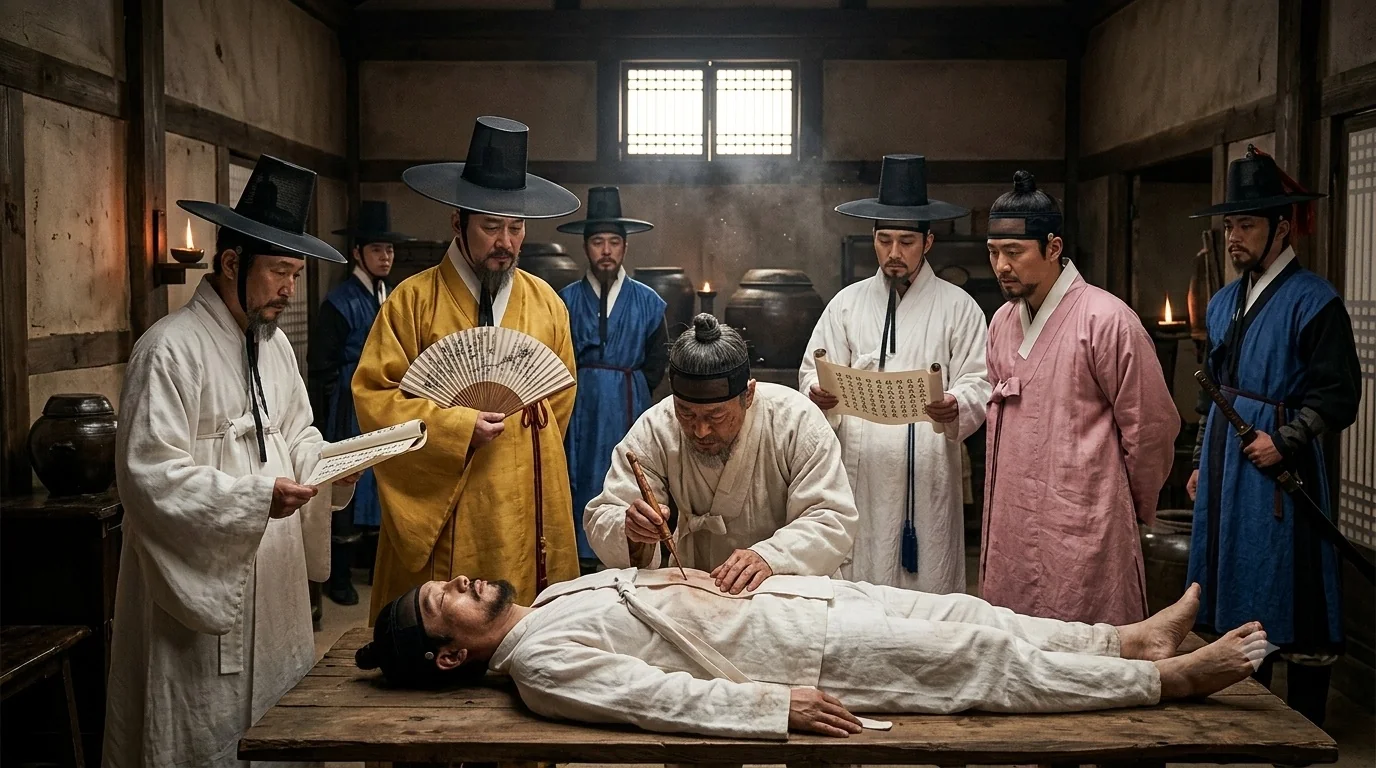 A Joseon death inquest in progress — the magistrate directs and records while the hands-on examination falls to a low-status handler. (AI illustration)
Quick answer: Our Blooming Youth’s evidence-driven death investigations echo something real: Joseon Korea’s official forensic manual, the Muwonrok (無寃錄), rooted in a 13th-century Chinese text and formally adapted for Korean law in 1438. Homicides and suspicious deaths that triggered a formal inquest got two independent examinations, low-status handlers did the physical exam, and examiners tested for poison with methods like a silver hairpin. Centuries before Sherlock Holmes, Joseon had a working CSI manual.
Let’s unpack it.
Why does the death investigation in Our Blooming Youth feel so procedural?
Because the show is drawing, whether casually or deliberately, on a Joseon institution that really did work like a procedure — right down to the paperwork.
Watch how the mysteries in Our Blooming Youth actually get solved. Nobody consults a shaman and calls it settled. Nobody simply believes the person with the most social standing. Wounds get examined. Objects get tested. Conclusions get argued over by more than one person before anybody is punished. Drama commentary has pointed out that at least one specific scene closely tracks the historical record: in episode 4, a character trying to confirm a poisoning fills the corpse’s mouth with rice, lets it sit long enough to absorb residue, then feeds that rice to an animal and watches for a reaction — a poison test of the kind described in the real Sinju Muwonrok, the annotated Joseon forensic manual (PD저널). (That reading comes from a K-drama review essay, not an official source document — a useful pointer to the manual, not a forensic verdict on the scene.)
That single detail is a signal, not a coincidence. It means the writers were reaching for the same well the show’s title implies — a Joseon where death investigation had rules, and the rules could be checked. The real history behind that instinct is more elaborate, more bureaucratic, and honestly more impressive than the show has room to explain.
The real history: a manual built to leave “no injustice”
The Korean name for this system is itself the whole argument: Muwonrok (無寃錄), which reads roughly as “the record that leaves no injustice [unresolved].” Every layer of the system that follows exists to serve that one promise — that a death would not simply be accepted on someone’s say-so.
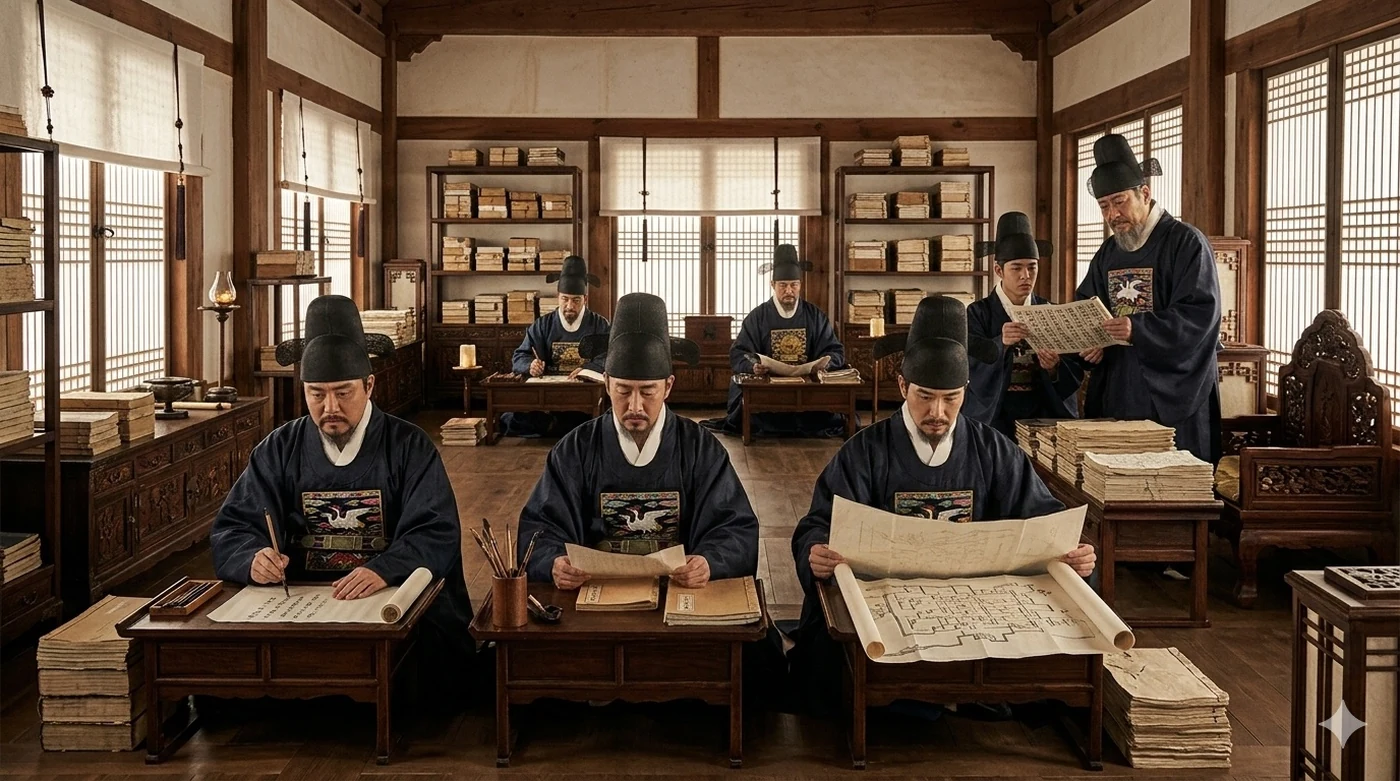
It started in China, three centuries before Joseon inherited it. The foundational text is Xiyuan Jilu (洗寃集錄, “Collected Writings on the Washing Away of Wrongs”), compiled around 1247 by the Song-dynasty official Song Ci (宋慈, 1186–1249). Song Ci had spent years overseeing penal and judicial affairs in several Chinese provinces, and his text — organized across multiple volumes into categories like wound analysis, suspicious-death procedure, and physical examination — is widely regarded by scholars as the world’s earliest systematic treatise on forensic medicine, with Song Ci himself sometimes styled the “father of world legal medicine” (East Asian Science, Technology and Society). A later Yuan-dynasty official, Wang Yu, folded that knowledge and other precedent into a compilation simply called Muwonrok — and it was this Yuan-dynasty text, not Song Ci’s original directly, that made its way to Korea during King Taejong’s reign, with a promulgation on record by 1412 — though 1412 is best read as a date the text was in circulation, not a hard “first arrival,” and the systematic use of forensic inquest in actual death investigations only really took hold a generation later, under King Sejong (우리역사넷).
Joseon made it Korean law. A foreign reference text is not the same as a working legal standard, and King Sejong’s government spent decades closing that gap. Officials were required to log examination dates and times “in the manner of the Muwonrok” as early as 1419; the text was folded into legal-clerk training by 1430 and made an examination subject for civil-service candidates by 1435. The culmination came in 1438 (Sejong 20), when the scholar-official Choe Chi-un (최치운) and colleagues completed the Sinju Muwonrok (新註無寃錄, “the newly annotated Muwonrok”) — an edition annotated and adjusted specifically for Korean legal practice, so magistrates could actually use it rather than merely own a copy (Encyclopedia of Korean Culture). By 1442, inquest procedure across Joseon was required to follow its standards, and a standardized inquest-document format was finalized and distributed to Seoul and the provinces by 1448.
The manual kept getting rewritten for three more centuries. Under King Yeongjo in 1748, the official Gu Taek-gyu produced an expanded, corrected edition called the Jeungsu Muwonrok (增修無寃錄, “the enlarged and revised Muwonrok”), addressing ambiguities in the older text. Under King Jeongjo, from around 1790 a team supervised by Seo Yu-rin verified and re-edited the text and — critically — added a full Korean-script (한글) translation with explanatory glosses, published in 1792 as the Jeungsu Muwonrok Eonhae (증수무원록언해) and reissued in later editions (Encyclopedia of Korean Culture). That translation mattered for a practical reason: the officials who actually ran inquests in the provinces were not always fluent in classical Chinese, and Jeongjo’s stated goal, in the text’s own framing, was that “law enforcement officials accurately understood knowledge related to examination and inspection” — the manual needed to work at the level of a real local clerk, not just a Seoul scholar-official.
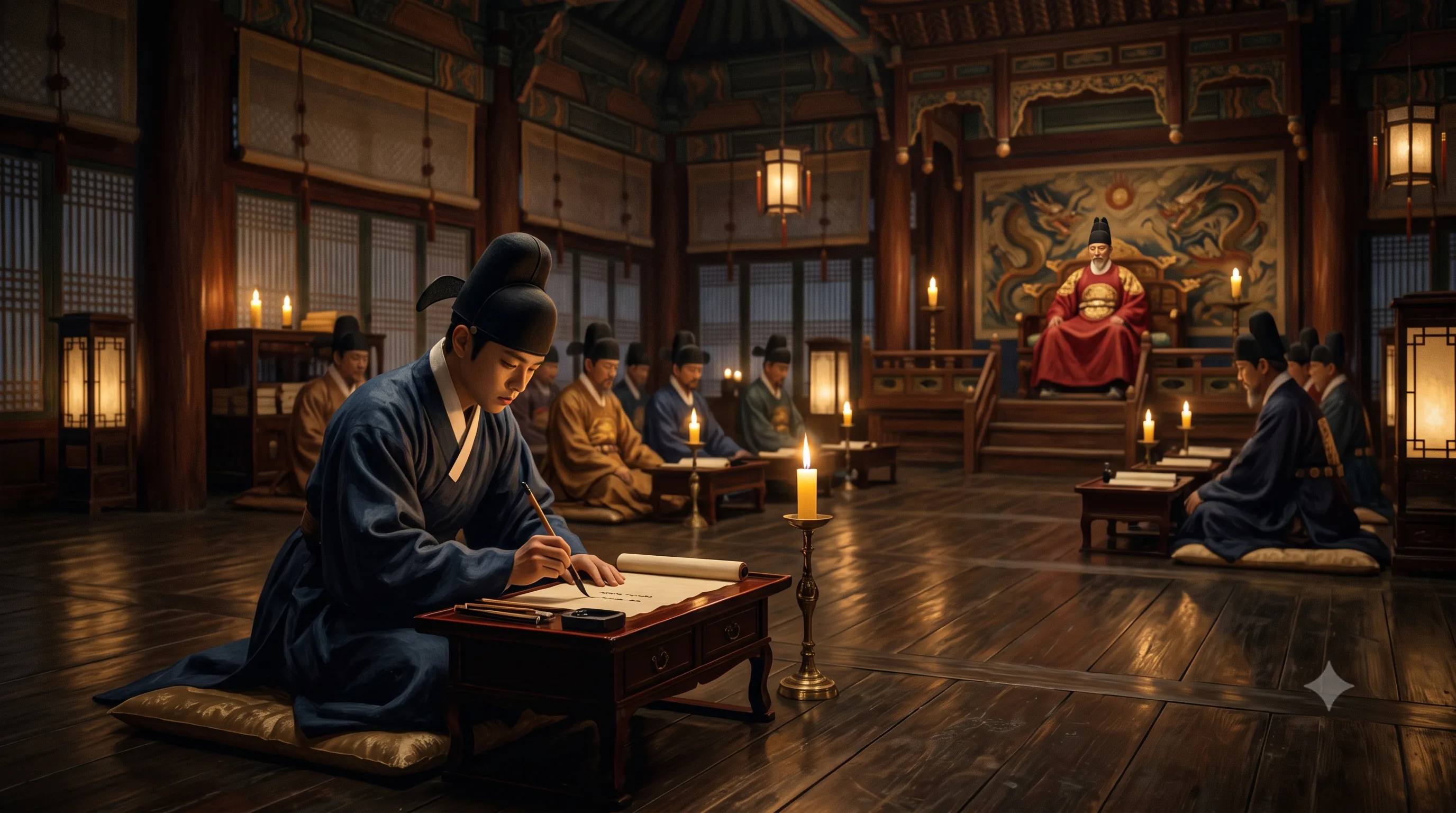
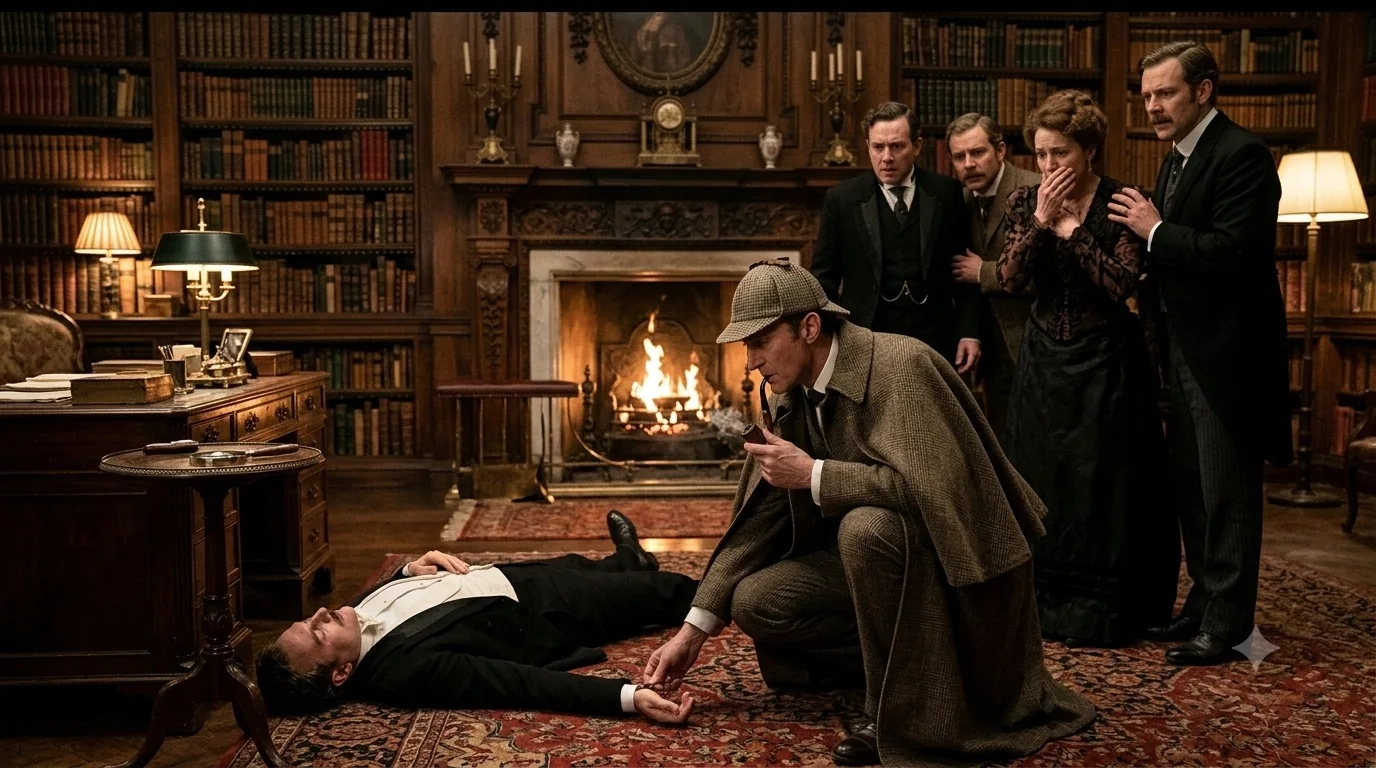 The West’s popular symbol of “scientific” detection, Sherlock Holmes, arrived in 1887 — more than four centuries after Joseon’s forensic manual was already law. (AI illustration)
The inquest itself was a checked, two-person (sometimes three-person) process. A suspicious death triggered a chogeom (초검, initial inquest), conducted by the magistrate of the jurisdiction where the body was found. That was never the end of it: a bokgeom (복검, second inquest) followed, conducted independently by a magistrate from a neighboring jurisdiction, examining the same body and evidence without simply copying the first conclusion. If the two inquests disagreed, a third — samgeom (삼검) — was ordered, and further inquests if needed, until the findings converged. The central Ministry of Punishment then compared both reports before authorizing burial (Encyclopedia of Korean Culture). It’s a strikingly modern instinct: don’t trust a single official’s word on a death, build in an independent second reviewer, and require it structurally rather than hoping someone eventually double-checks.
And the actual hands-on work fell to Joseon’s lowest-status specialists. A magistrate directed the inquest and signed the resulting document, but Confucian norms of bodily propriety meant he did not touch the corpse himself. That task belonged to the ojagin (오작인), low-ranking clerks attached to local government offices whose job was to undress, wash, turn, and physically examine the body for wounds, discoloration, and other evidence (한국학자료센터, AKS). The social irony here is worth sitting with: the people who actually possessed the specialized, hands-on forensic knowledge — reading a wound’s depth, direction, and likely weapon from the body itself — held some of the lowest social standing in the entire bureaucratic chain, while the credentialed official — who supervised the examination but generally left the direct handling of the corpse to those low-status specialists — was the one whose name and judgment went on record.
And the techniques themselves held up. The manual’s poison test using a cleaned silver hairpin, inserted into the corpse’s throat and sealed with paper, relied on the hairpin darkening to a blue-black tint — a real chemical reaction in some cases, since the sulfur impurities in a period poison like arsenic (비상) can tarnish silver. It was a genuine test of its era, not superstition — but not the universal poison detector later folklore made it out to be; it worked for specific sulfur-bearing poisons, not everything (국가유산청, 월간국가유산사랑). Examiners also had standardized “application materials” (응용법물) — vinegar, salt, and other agents used to bring out bruising or old wounds not visible on undamaged skin — plus government-issued copper measuring rulers so a wound’s dimensions, once recorded, meant the same thing in every province. And the resulting document, the geoman (검안), was not a private note. It was a formal report following a fixed template (시장, sijang), recording the scene, the body’s condition, every wound and its likely cause, and the examining official’s conclusion — submitted up the chain precisely so that a written record, not one man’s memory, was what “left no injustice” behind.
The East/West forensic-manual gap: Joseon versus the English coroner
This is where Our Blooming Youth’s premise lands somewhere unexpected: put the Muwonrok tradition next to the West’s own history of death investigation, and the timelines don’t match popular assumption at all.
England’s office of coroner is often dated to 1194, when King Richard I’s itinerant justices, under the Articles of Eyre, required each county to elect “keepers of the pleas of the crown” — the origin of the word coroner. (Coroner-like duties may well have existed earlier; 1194 is where the office gets its formal footing, not necessarily its birth.) But its emphasis was different from Joseon’s. The medieval coroner was a judicial-fiscal hybrid, heavily concerned with protecting royal revenue — tracking treasure finds, shipwreck salvage, and the property the crown could seize from a homicide or suicide — even as it also recorded and investigated sudden, violent, or unnatural deaths (ANZ Journal of Surgery). What it did not develop, for centuries, was the same kind of centralized, technically detailed examination manual that East Asian officials inherited and kept revising. Medical expertise and written evidence gradually grew more important in European death investigation too — but a systematically evidence-based approach (toxicology, standardized pathology, anything resembling the Muwonrok’s rulers and reference tests) did not really take hold in the West until the 18th and 19th centuries. So the honest contrast isn’t “the West had no way to investigate a death” — England had the coroner. It’s that East Asia had, centuries earlier, built a detailed written forensic manual: a standing body of examination knowledge and procedure that the coroner’s office simply never carried.
And in the Western popular imagination, “scientific” crime-solving often gets traced to fiction rather than to any real coroner’s office at all: Arthur Conan Doyle’s Sherlock Holmes, whose first case, A Study in Scarlet, was published in 1887 (Arthur Conan Doyle Estate). Holmes reasoning from a cigarette ash or a wound angle is often treated as the symbolic birth of evidence-based detection. But Song Ci’s foundational forensic text predates that by six hundred and forty years, and Korea’s own officially annotated, legally binding version — the Sinju Muwonrok — had already been bureaucratic routine for four and a half centuries by the time Holmes picked up his magnifying glass.
| In Our Blooming Youth | In real history |
|---|---|
| Leads investigate deaths through physical evidence, not accusation or superstition | Joseon required a documented, evidence-based inquest for every suspicious death |
| A poisoning is confirmed by testing residue on an animal | Drama commentary ties this rice-and-animal scene to a poison test in the Muwonrok tradition |
| A single verdict is never simply taken on faith | A homicide or suspicious-death inquest required both a chogeom and an independent bokgeom, with a third if they disagreed |
| The investigation is framed as a search for a defensible truth | The manual’s very name, Muwonrok, means “leaving no injustice unresolved” |
In short: Our Blooming Youth dramatizes a real Joseon instinct — that a death deserved a checkable, evidence-based answer, not a convenient one — and that instinct was already centuries-old East Asian legal infrastructure by the time the West’s own popular symbol of “scientific” detection, Sherlock Holmes, was even written.
Key terms. Muwonrok (無寃錄) — the Korean name, adapted from a Chinese/Yuan original, for the official Joseon forensic manual used in death inquests. Sinju Muwonrok (新註無寃錄) — the 1438 Joseon-annotated edition, adjusted for Korean law. Jeungsu Muwonrok (增修無寃錄) and its Korean-script Eonhae — 18th-century revisions making the manual usable at the working-clerk level. Chogeom (초검) / bokgeom (복검) — the first and mandatory second, independently conducted inquest into a suspicious death. Ojagin (오작인) — the low-status clerks who physically examined and handled the body. Geoman (검안) — the formal written inquest report submitted up the chain of command.
Coming up next
A drama about a cursed prince and a framed noblewoman turns out to rest on a real institution: a manual written to make sure a death could never just be waved away, a mandatory second opinion built into the law itself, and a chain of low-status specialists whose expertise the system depended on and whose names it rarely remembered. That’s the quiet reward of watching a serious sageuk closely — a single procedural scene is a door into an entire legal culture.
In the next essay, we’ll take another K-drama scene that looks like pure invention — and trace the real Korean history hiding underneath it.
Frequently asked questions
Is Our Blooming Youth based on a true story? Not literally. The central mystery — a noblewoman framed for her family’s murder, a crown prince navigating a curse — is fiction. But the forensic method the leads use to investigate deaths draws on a real Joseon institution: the Muwonrok tradition of judicial post-mortem examination, including at least one scene (a poison test in episode 4) that Korean drama commentary has tied to the historical manual.
What was the Muwonrok? Muwonrok (無寃錄) means roughly “the record that leaves no injustice unresolved.” It was the umbrella name for the forensic manuals Joseon officials used to investigate suspicious deaths — covering how to examine wounds, test for poison, and document a body so the conclusion could be checked rather than simply trusted.
Did Korea invent this system? No, it adapted it. The root text is Song Ci’s Xiyuan Jilu, compiled in Song-dynasty China around 1247 and often called the world’s earliest systematic forensic-medicine treatise. A later Yuan-dynasty compilation folded that knowledge into a manual called Muwonrok, which reached Korea and was officially annotated for Joseon law as the Sinju Muwonrok in 1438.
What was the dual-inquest system? A homicide or suspicious death that triggered a formal inquest received at least two independent investigations: an initial inquest (초검, chogeom) by the local magistrate, then a second inquest (복검, bokgeom) by a magistrate from a neighboring jurisdiction. If the two disagreed, a third inquest (삼검, samgeom) followed. It was a structural check against a single official’s error or corruption.
Who actually touched the bodies? Not the magistrates. Confucian norms of bodily propriety kept officials from handling a corpse directly, so the physical work — undressing, washing, turning, and examining the body — fell to low-status clerks called ojagin (오작인). The people with the most direct forensic expertise held the lowest social rank in the process.
Did Joseon examiners really use a silver hairpin to detect poison? Yes. A cleaned silver hairpin was inserted into the corpse’s throat, the mouth sealed with paper, and examiners checked afterward whether the hairpin had darkened to a blue-black tint — a real reaction linked to certain poisons of the period. It was one of several tests, alongside methods like feeding poison-soaked rice from the body to an animal.
Wasn’t Sherlock Holmes the start of scientific crime-solving? That’s the popular Western memory, but the dates don’t support it. Conan Doyle’s first Holmes story appeared in 1887. Song Ci’s foundational forensic text dates to 1247, and Korea’s own officially annotated version, the Sinju Muwonrok, was already in bureaucratic use from 1438 — more than four centuries earlier.
Did the West have anything similar before modern forensic science? England had the office of coroner from at least 1194, but it was a judicial-fiscal hybrid — heavily focused on protecting royal revenue, even as it also recorded and investigated sudden or unnatural deaths. The contrast with Joseon isn’t that the West had no death investigation; it’s that it had no equivalent standing forensic manual, and its inquiry did not become systematically evidence-based until the 18th and 19th centuries, well after Joseon’s manual was already administrative routine.
Sources & further reading
This piece was written from the historical script and fact-check of 사뚱샘의 역사방 (SaDDungSam). The specific dates, names, and procedures above are sourced inline, cross-checked against the Encyclopedia of Korean Culture (Academy of Korean Studies), 우리역사넷 (National Institute of Korean History), the Academy of Korean Studies’ KOSTMA archive, and Korea’s Heritage Service (국가유산청). For broader reading:
- Song Ci and the origins of forensic medicine in East Asia. East Asian Science, Technology and Society, “Song Ci (1186–1249), ‘Father of World Legal Medicine’: History, Science, and Forensic Culture in Contemporary China.” (Taylor & Francis)
- The English coroner’s non-scientific origins. ANZ Journal of Surgery, Sharp, “The Medieval English Coroner” (2007). (Wiley Online Library)
- Our Blooming Youth’s historical accuracy, episode by episode. PD저널, “중국 원작 지운 ‘청춘월담’ 성취와 한계.” (PD저널)
Thanks for reading — see you in the next one.
This article was researched and written by K-Drama History. Source: Our Blooming Youth, Explained: Why Joseon Korea Had a Forensics Manual Centuries Before Sherlock Holmes — K-Drama History