SBS's Jejungwon: The True Story of Korea's First Government Western Hospital
Theme: Knowledge & Science
From the research behind Pause the Drama.
If you’ve watched Jejungwon (제중원, 2010, SBS) — the medical sageuk that follows a butcher’s son, a nobleman’s son, and a translator’s daughter as they train side by side to become Korea’s first Western-trained doctors — you’ve probably assumed the hospital at the center of it all is a convenient piece of set dressing. A dramatic backdrop for a story about class, ambition, and friendship in a Korea caught between old and new.
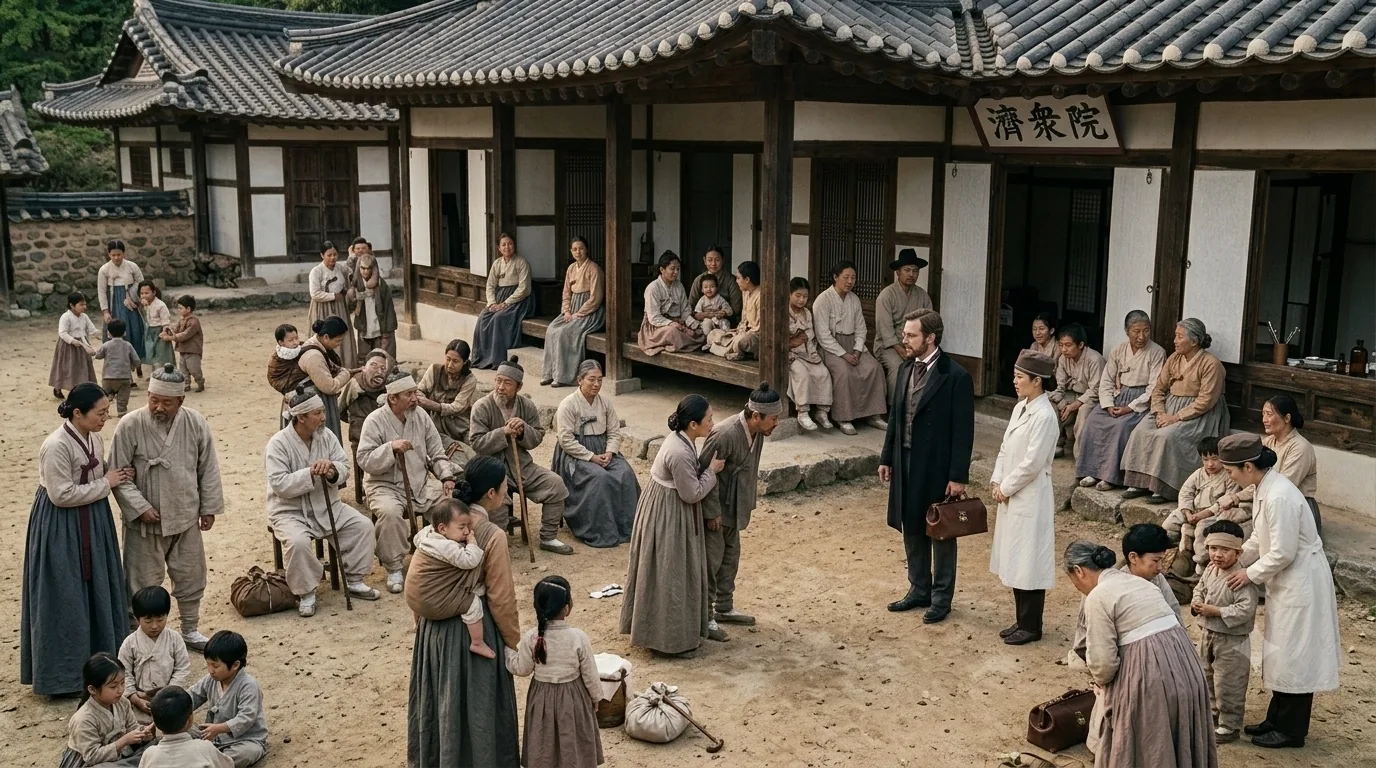 Joseon’s first government Western hospital did not open in a purpose-built building. It opened in a confiscated house in Jaedong that had belonged to one of the Gapsin coup leaders. (AI illustration)
Here’s what the drama doesn’t stop to explain: that hospital wasn’t invented. It was real, it opened in the spring of 1885, and its founding was accelerated by one desperate night five months earlier — when an American missionary physician used Western wound treatment to save a gravely injured court official, and used the royal trust that earned him to push through a hospital proposal he already had in his pocket.
Quick answer: SBS’s Jejungwon is set inside a real institution. In December 1884, American missionary doctor Horace N. Allen treated the severe sword wounds of Min Yeong-ik — a senior court official closely connected to Queen Min’s family — using Western surgical methods, after a failed coup. That success won him the trust of King Gojong, and by spring 1885 Joseon had its first government-established Western-style hospital — opened as Gwanghyewon, renamed Jejungwon on April 26. (It was not the first Western-style medical facility on Korean soil at all: a Japanese-run clinic, Jesaeng Uiwon, had been treating patients in Busan since 1877.) The Korean government supplied the building, the funding, and the administration; American Presbyterian missionaries supplied the doctors and the teaching.
Let’s unpack it.
Why did a stabbing at a banquet change the course of Korean medicine?
Because it gave the Joseon court its most dramatic and politically consequential demonstration yet of what Western surgical treatment could do.
On the night of December 4, 1884, officials gathered to celebrate the opening of Korea’s new postal service (the office itself had been established that April, and mail had begun moving in November). In the middle of the celebration, radical reformers launched what became known as the Gapsin Coup (갑신정변) — a three-day attempt to seize power and force rapid modernization. In the chaos, Min Yeong-ik (민영익), a powerful court official closely connected to Queen Min’s family, was attacked and left with severe sword wounds across his body (Encyclopedia of Korean Culture, 갑신정변; 민영익).
Min was carried to the house of Paul Georg von Möllendorff, the German adviser to the Korean government, and it was there that Horace N. Allen — an American Presbyterian medical missionary who had arrived barely three months earlier — treated him. (That Möllendorff’s household was what summoned Allen comes to us through Allen’s own diary and later recollections rather than Korean state records.) Allen treated Min’s wounds with Western surgical methods that had no equivalent at the Joseon court. Min recovered over roughly three months. The recovery was watched closely at the top of the Joseon court, and it made Allen a trusted figure there almost overnight (우리역사넷, 알렌).
Here’s the show’s premise translated into history at a glance:
| In Jejungwon | In real history |
|---|---|
| Three students of different classes train together as Korea’s first Western doctors | Formal teaching began in 1886 with sixteen students and produced no graduates; the first Koreans to graduate from a domestic modern medical school did so elsewhere, in 1902 |
| The hospital simply exists, already open, from the drama’s start | Jejungwon opened only months after Allen’s treatment of the wounded Min Yeong-ik won royal trust |
| The story plays out mainly as personal drama among the three leads | The hospital’s founding was a matter of state — a royal decision made in the aftermath of a near-fatal political crisis |
| Western and Korean medicine coexist quietly in the background | Traditional Korean medicine (hanbang) kept operating alongside the new institution for decades, not replaced by it |
| Korea’s turn toward Western medicine feels like a single clean break | It was one thread in a longer, uneven story that unfolded very differently in China and Japan |
To understand why that single treatment turned into an entire hospital, you have to see what happened in the months right after.
What was Gwanghyewon, and why did the hospital’s name change so fast?
Because the court moved quickly, and then second-guessed itself almost immediately.
It is tempting to draw a straight line from one patient to one hospital, and the drama more or less does. The honest version is that Allen’s treatment of Min was one decisive catalyst among several: the Joseon government already had reasons to want Western medical provision, Allen already had a hospital proposal, and Min’s recovery made that proposal politically compelling. King Gojong approved it.
The hospital opened in the spring of 1885 in Jaedong, central Seoul, in a house that had belonged to Hong Yeong-sik — one of the Gapsin coup leaders. Pinning down a single opening date is a trap, but the confusion resolves once you ask what each date marks: treatment began and the hospital opened around April 9–10; Gojong formally bestowed the name Gwanghyewon on April 12; and the institution was renamed Jejungwon on April 26 (우리역사넷, 제중원 설립; Seoul Metropolitan Government). Its first name was Gwanghyewon (廣惠院), roughly “house of extended grace.” On April 26, 1885 it became Jejungwon (濟衆院), “the house that broadly helps the masses” — the name that would stick. The Annals of King Gojong record the office responsible, the Tongni Gyoseop Tongsang Samu Amun (통리교섭통상사무아문, the foreign affairs and trade office, commonly abbreviated 외아문), reporting that it had made the change. What the Annals do not record is why. Explanations you will read — that the old name risked confusion with an older government relay lodging house (院) of the same name — are later interpretation, not documented fact (Encyclopedia of Korean Culture, 제중원).
Was Jejungwon a royal hospital, or a missionary one? It was, unusually, both at once.
This is the detail the drama’s premise gets right without spelling it out: Jejungwon was never a purely Korean government project, and never a purely foreign missionary one either.
It is often described as government in name and missionary in reality. That undersells the Korean side. In its early government-hospital phase, the Joseon state supplied the building, the funding, and the administrative framework; the American Presbyterian mission supplied much of the medical staff and teaching — Allen, and later his colleague John Heron, delivering care, with missionary Horace G. Underwood teaching the basic sciences (우리역사넷, 서양 의학의 전래와 구한말의 의료 활동). And a hospital is not run by a framework or by four foreigners: Korean staff, students, and interpreters were the people who actually made it function day to day. The state supplied the framework; missionaries brought the new medical expertise; Koreans turned both into a working hospital. That tension — a Confucian state and a Protestant mission sharing one roof — is exactly the world Jejungwon’s three students are dramatized as growing up inside.
Key terms. Gwanghyewon (광혜원) — the hospital’s original name when it opened in spring 1885. Jejungwon (제중원) — the name it took within roughly two weeks, and kept until 1904. Gapsin Coup (갑신정변, 1884) — the failed three-day reform coup during which Min Yeong-ik was wounded, setting the whole chain of events in motion. Horace N. Allen — the American Presbyterian medical missionary whose treatment of Min opened the door to royal trust and, soon after, a hospital.
Did the hospital actually train Korean doctors, the way the drama shows?
Eventually — but not as smoothly, or as quickly, as three friends graduating together.
There was some informal instruction from early on, but the formal programme began on March 29, 1886, when sixteen students were selected. It never produced a graduating class. The effort weakened and broke off, and only later, after physician Oliver R. Avison reorganized the curriculum, did the school produce seven graduates in 1908 (박형우·박윤재·여인석·김일순, “제중원에서의 초기 의학교육(1885–1908),” 의사학 8, no. 1 (1999)).
And here the most repeated claim about Jejungwon needs correcting, because it is the one this article originally got wrong too. Those seven were not Korea’s first Western-trained doctors. The Korean Empire’s government medical school, the Uihakgyo, had already graduated nineteen physicians in 1902 — the first graduating class of a domestic government-run modern medical school. Koreans who studied medicine abroad came earlier still. What the class of 1908 holds is a different distinction: they were the first graduates of the Severance Hospital Medical School, and, according to the state licensing records of that year, the first to receive numbered licences to practise — numbers 1 through 7.
Jejungwon’s three fictional students compress a long, broken, restarted process into one generation’s story — dramatically satisfying, historically a shortcut.
What happened to Jejungwon after the drama’s era?
The name lasted until 1904 — but its personnel, its clinical work, and its teaching continued through a series of institutional transformations.
The money came first, and earlier than usually stated. Avison’s address to the Ecumenical Missionary Conference at Carnegie Hall on April 30, 1900 brought him the backing of American businessman Louis H. Severance. Land and construction followed, and the new hospital outside Namdaemun opened as Severance Hospital on September 23, 1904 — so 1904 is the opening, not the donation. In 1957, Severance Medical College merged with Yonhee University to form what is today Yonsei University.
Whether that makes Yonsei Severance the institutional heir of Jejungwon is, it turns out, genuinely contested. The line of missionary staff, clinical practice, and medical teaching does run to Severance. But historians and the two institutions disagree over whether the 1894 transfer handed over the government hospital itself, only its clinical operations, or marked a later parting of ways between the state hospital and the missionary medical enterprise — Yonsei University Health System and Seoul National University Hospital each maintain their own account (우리역사넷, 세브란스 병원).
Why Jejungwon feels so Korean: four roads to the same operating table
Here’s what makes Jejungwon’s origin story distinctly Korean. Societies across Asia encountered Western medical institutions through very different political and cultural routes — and the route each one took reveals something about how it related to the outside world. Set Korea’s path beside three others, and the show’s world snaps into sharper focus.
Korea — a crisis and a crown built the hospital together. Korea’s route ran through a single, dramatic emergency: a coup, a stabbing, a desperate rescue, and a grateful king. Jejungwon was born from personal trust between a monarch and one missionary, then formalized as a state institution that a foreign mission actually staffed and ran day to day. Crisis, royal sponsorship, and missionary execution — all three, tangled together.
China — a missionary hospital grew through private merchant and missionary networks. Decades earlier, on November 4, 1835, American missionary Peter Parker opened the Ophthalmic Hospital in Canton — the first Western-style hospital in China — without any imperial commission. That does not mean he did it alone. The building belonged to the Chinese merchant Howqua, who let him use it and later waived the rent, and Parker worked through missionary and merchant networks; by 1838 a Medical Missionary Society had been organized to support the hospital. In its first three months it treated 1,061 patients. There was no wounded nobleman and no royal decree — but there was a support structure, just a private and commercial one rather than a court.
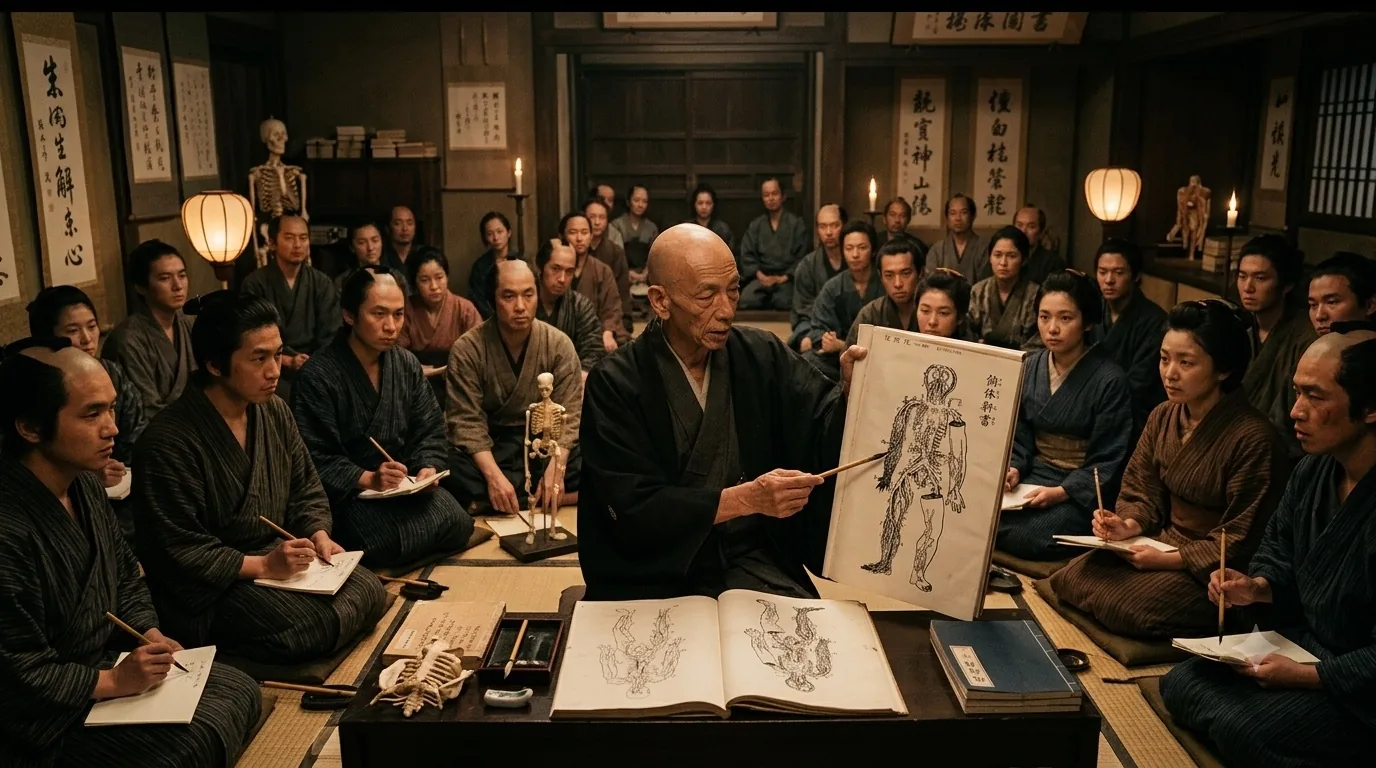 Edo, 1774. Japan’s road to Western medicine ran through Dutch books and a room full of translators — no missionary, no wounded official, no king. (AI illustration)
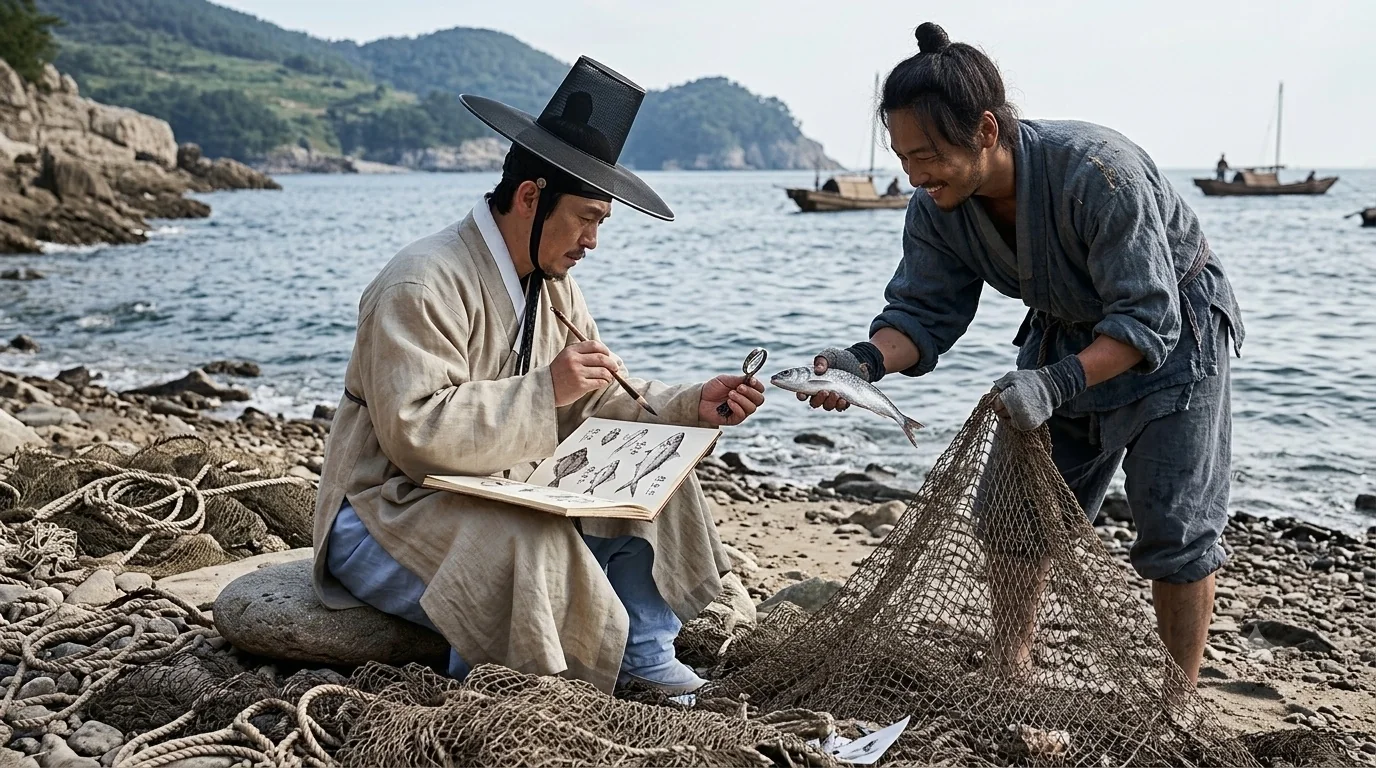
Japan — Dutch books and scholar-translators, rather than a missionary hospital. Under the Tokugawa shogunate’s restricted-contact policy, a narrow, tightly controlled channel of Dutch trade through the man-made island of Dejima gave Japanese scholars access to European scientific texts — a movement called Rangaku (蘭学, “Dutch learning”). In 1774 a group of these scholars, Sugita Genpaku among them, working with Maeno Ryōtaku, Nakagawa Jun’an and Katsuragawa Hoshū, published Kaitai Shinsho, Japan’s first translated Western anatomy text, after checking it against an actual dissection (Encyclopædia Britannica, Rangaku).
It is tempting to call this “spontaneous,” or to say Japan was a century ahead of its neighbours. Both overstate it. Japan’s route ran through Dutch trade, Dutch books, interpreters, domain physicians, and the institutional backing of the shogunate, the domains, and later the Meiji state — external mediation and state power throughout. And translating an anatomy book, running clinics, founding hospitals, building medical schools, and licensing practitioners are different stages: China had Jesuit-transmitted Western medical knowledge well before 1774. What is fair to say is that Japan’s road ran through books and scholars where Korea’s ran through a patient and a king.
The West — the “hospital” itself was still being invented. It’s easy to assume Joseon imported something ancient and fixed. The modern curative hospital was a comparatively recent Western development: earlier institutions in the Byzantine and medieval European world functioned mainly as charitable shelters for the poor, the sick, and travellers rather than as places of treatment in the modern sense. What Allen brought to Seoul — an institution organized around diagnosis, surgery, and training — was itself the product of centuries of slow change in the West, not a timeless Western default.
Korea, again — the old medicine never actually left. Perhaps the most telling detail: Jejungwon’s arrival didn’t erase traditional Korean medicine (한의학, hanuihak), rooted in centuries of practice going back to works like Heo Jun’s Dongeuibogam. Korean sources describe the two systems settling into an uneasy coexistence for decades rather than one replacing the other. Japan moved differently, though not as abruptly as it is often told: from the 1870s the Meiji government progressively built a Western-medicine-based system of medical education and examination, and the licensing and practice-examination rules enacted in 1883 and in force from 1884 required Western medical examinations for new licences. Existing practitioners kept their standing, and there were exceptions for some successors of Kampo physicians — traditional practice was squeezed out over a generation, not outlawed in a year. Korea imported the West’s newest institution without discarding its oldest one.
A stabbing at a banquet, a missionary charity in Canton, Dutch medical books arriving through one tightly controlled trading post, and a fourth country’s own slow reinvention of what a “hospital” even was — four very different roads that all ended, eventually, at the same operating table. Watch Jejungwon’s converted hanok compound again, and you’re watching one particular answer to a question every non-Western society eventually had to face: not just how do you get modern medicine, but who do you have to trust to get it?
Coming up next
One failed coup, one badly wounded official, one foreign doctor with a proposal already written — and we’ve traveled from a Seoul banquet hall to a Canton eye clinic to a Dutch-language anatomy book in Edo. That’s the quiet gift of a good historical drama: even its hospital has a paper trail.
In the next essay, we’ll take another K-drama scene that looks like pure fiction — and trace the real Korean history hiding underneath it.
Frequently asked questions
Is Jejungwon based on a true story? The three lead characters and their personal stories are fictional. The hospital is real: Jejungwon (제중원), opened in 1885, was the first Western-style hospital established by the Joseon government — not the first Western-style medical facility in Korea, since a Japanese-run clinic had operated in Busan from 1877. Its founding was accelerated when American missionary doctor Horace N. Allen treated the badly wounded court official Min Yeong-ik after the failed Gapsin Coup of December 1884.
What was Gwanghyewon, and why was it renamed Jejungwon so quickly? Gwanghyewon (광혜원, roughly “house of extended grace”) was the name the hospital opened under in spring 1885. On April 26, 1885 it became Jejungwon (제중원, “house that broadly helps the masses”). The Annals of King Gojong record that the foreign affairs and trade office — the Tongni Gyoseop Tongsang Samu Amun, abbreviated 외아문 — reported making the change, but give no reason for it. Note that this is not the same body as the 외무아문, which was created in the 1894 Gabo Reforms.
Who was Horace Allen, and why did the Joseon court trust him? Horace N. Allen was an American Presbyterian missionary and physician who arrived in Korea in September 1884. Weeks later, he treated Min Yeong-ik’s severe sword wounds using Western surgical methods after the Gapsin Coup, and Min recovered over roughly three months. That success won Allen the trust of King Gojong, who backed his proposal for a state hospital.
Did Jejungwon actually train Korea’s first Western-style doctors? No — this is the most common misunderstanding about it. Formal instruction began on March 29, 1886 with sixteen selected students, but that programme broke off without producing graduates. After Oliver R. Avison reorganized it, seven students graduated in 1908 — the first graduates of the Severance Hospital Medical School and the first holders of state licence numbers 1–7. Korea’s first formally graduated modern physicians from a domestic medical school were the nineteen who graduated from the Korean Empire’s government medical school in 1902.
What happened to Jejungwon after the era shown in the drama? Avison secured funding from American businessman Louis H. Severance in 1900, and the new hospital opened as Severance Hospital on September 23, 1904. In 1957 Severance Medical College merged with Yonhee University to form Yonsei University. The line of medical staff and medical education runs from Jejungwon to Severance; the legal and administrative succession of Jejungwon as a state institution is disputed, with Yonsei University Health System and Seoul National University Hospital offering different accounts.
Sources & further reading
This piece was written from the historical script and fact-check of 사뚱샘의 역사방 (SaDDungSam). Key dates and figures are sourced inline above. For broader reading:
- Jejungwon (濟衆院) — full entry at the Encyclopedia of Korean Culture.
- The founding of Jejungwon, told through primary-source-based narrative — National Institute of Korean History (우리역사넷).
- 박형우·박윤재·여인석·김일순, 「제중원에서의 초기 의학교육(1885-1908)」, 『의사학』 8권 1호 (1999) — the standard account of why the 1886 programme produced no graduates. (PDF)
- Rangaku, Japan’s parallel and much earlier path to Western science — Encyclopædia Britannica.
- Jejungwon, the First Western Hospital in the Country — official overview from the Seoul Metropolitan Government.
Thanks for reading — see you in the next one.
This article was researched and written by K-Drama History. Source: SBS's Jejungwon: The True Story of Korea's First Government Western Hospital — K-Drama History