Notes from the Last Row: The Joseon History of Ghostwriting, Daejak, and Exam Fraud
Theme: Knowledge & Science
From the research behind Pause the Drama.
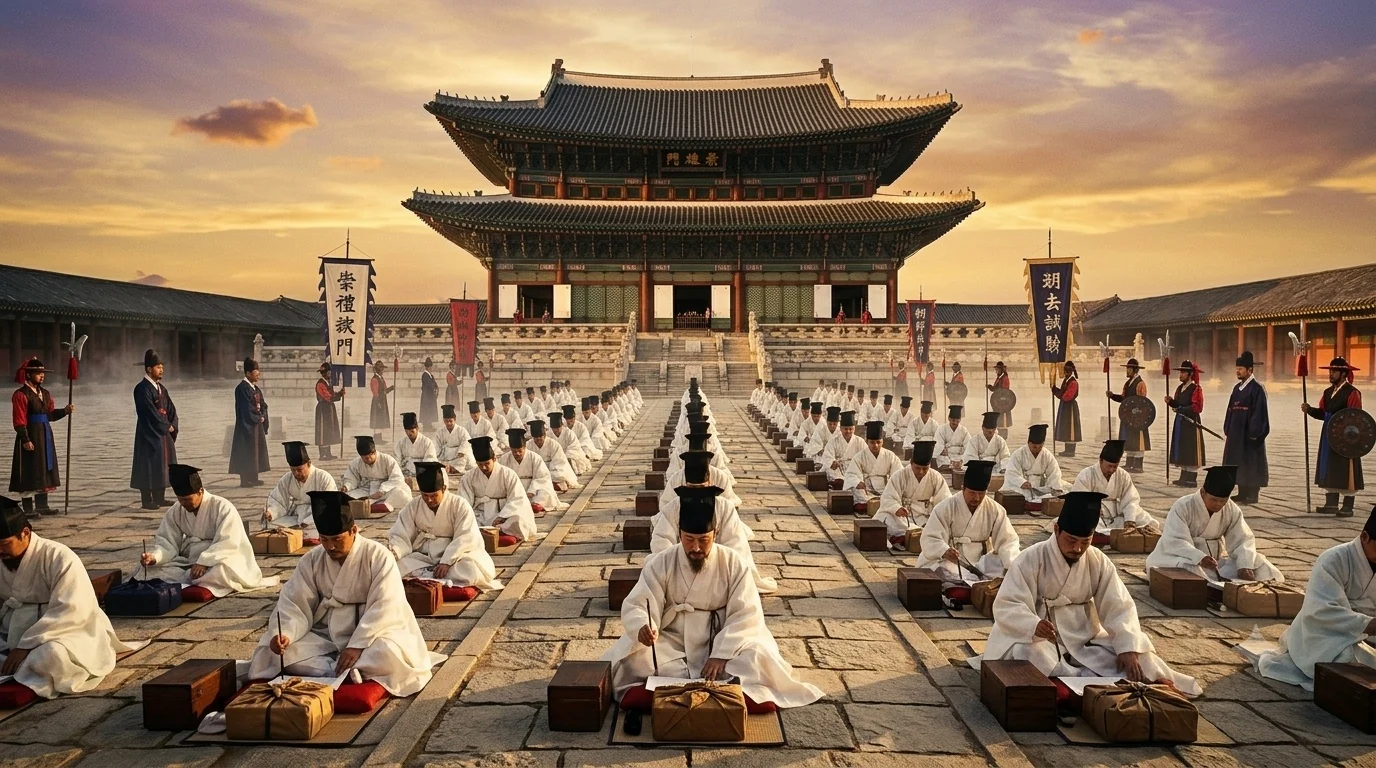
In Joseon Korea, writing under someone else’s name was not automatically a scandal. A family could commission a famous stylist to compose a father’s epitaph, and nobody pretended otherwise — the composer’s name was carved on the stone, and the fee had a courtesy term of its own. Carry the same act into the examination hall and it became an offence against the state: a hundred blows, three years’ penal servitude, and in the worst cases an entire results list cancelled.
The difference was not authorship. It was what the writing obtained.
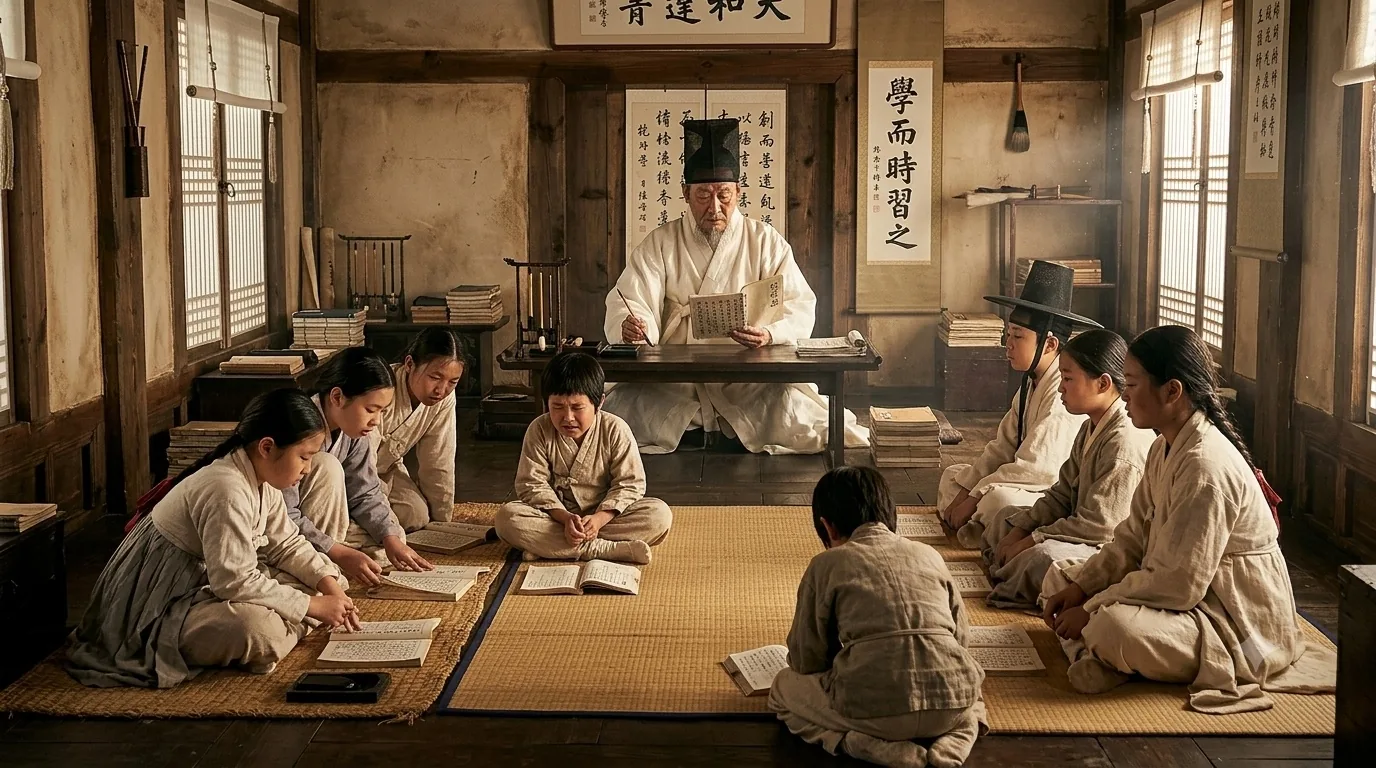
A professor reads one student’s writing and cannot stop.
Notes from the Last Row (맨 끝줄 소년), the six-part Netflix series released on 26 June 2026, gives Choi Min-sik a literature professor, Heo Mun-oh, who published one novel twenty years ago and nothing since. In the back row sits Lee Kang (Choi Hyun-wook), whose prose does the one thing Mun-oh’s no longer can: it makes you want the next sentence. Mun-oh takes him on privately, and the tutoring bends into something else.
The show is about a man who wanted a talent that was not his. Joseon had words for the transaction underneath that, and a market for it. This piece uses daejak (대작, 代作) as an umbrella for the whole practice — writing produced under another person’s name — while noting that Joseon itself had no single official term for it.
What is striking is which parts of that market the state prosecuted, and which parts it let run in the open.
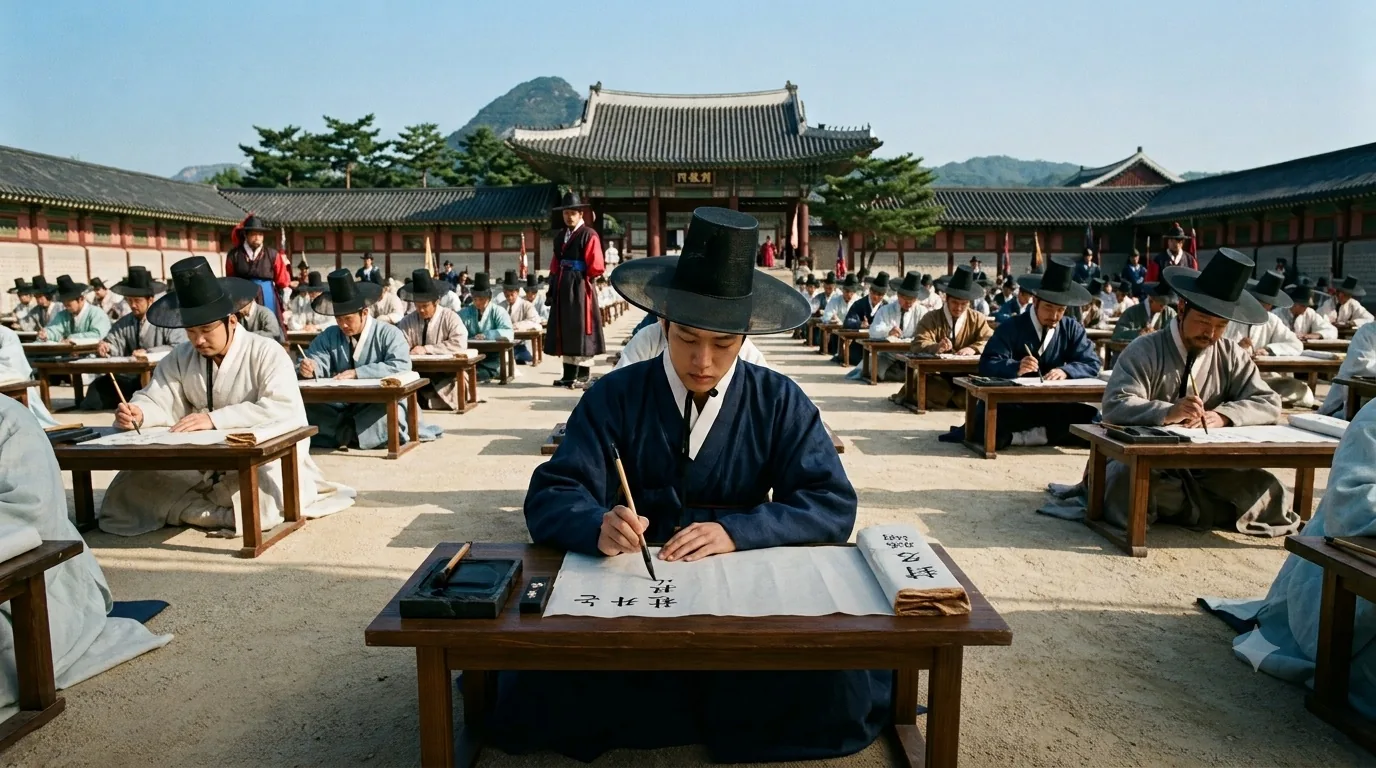 Every paper in this courtyard would have its identifying strip sealed shut before marking — and, in the literary examinations, be copied out again in red ink by clerks so no examiner could recognise a hand. (AI illustration)
Quick answer: Joseon had no copyright regime comparable to modern authors’ rights, and the punishable vocabulary around writing done in another’s name appears most sharply in examination contexts. The act itself was still criticised — pyojeol (표절) appears in the Veritable Records. Writing under another’s name was ordinary in whole genres: epitaphs were commissioned from famous stylists, and a scholar’s collected works were usually compiled after his death by descendants and disciples (Encyclopedia of Korean Culture, 문집). In the examination hall the same act had a name and a police file. The state answered with anonymity systems — bongmi (봉미) and yeokseo (역서) — and with penalties up to voiding an entire results list. The line Joseon drew was not around the author. It was around the office.
Let’s unpack it.
(This piece assumes you know roughly what the gwageo was. If not, start with our explainer on Joseon’s civil service examination — this one picks up at the point where the system starts leaking.)
What did Joseon call ghostwriting — and did it have one word for it?
It did not have one word, and that absence is itself the finding.
The vocabulary is plural, and most of it lives in one place. The Encyclopedia of Korean Culture’s survey of the gwageo, discussing the system’s abuses, treats hyeopchaek (협책, 挾冊) — smuggling books into the hall — together with chasul (차술, 借述) and daesul (대술, 代述) as habitual frauds. Chajak (차작, 借作) appears in the same article in other contexts, including the discussion of the myeonsibeop of 1749, rather than as a fourth item on one official list (Encyclopedia of Korean Culture, 과거).
Read the characters and the logic is transparent. 借 is borrow; 代 is in place of. 述 is to set down; 作 is to compose. The terms sort roughly into borrowed writing and proxy writing. The sources do not apply the distinction rigorously, and it would be a mistake to build an argument on a clean split. What matters is the shared shape: an answer paper whose text was not composed by the person whose name it would carry.
Notice what is missing: a general-purpose word for taking credit for another’s writing. Most of these terms describe a procedural violation in a specific room on a specific day. Daejak is the partial exception — the Veritable Records use it for composing royal statements and documents on another’s behalf, well outside any examination hall (Diaries of King Yeonsan, 4th year 7th month 19th day; Veritable Records of King Sukjong, 20th year 5th month 26th day). Even so, the enforcement language is examination language.
That is why importing the English word plagiarism flattens what you are trying to see. Joseon did criticise literary theft: pyojeol (표절) turns up in fifteenth-century records, and men were reproached for passing off borrowed writing (Veritable Records of King Sejong, 11th year 5th month 28th day). What did not exist was a legal category treating the wrong as one against the author, or a right of reproduction to infringe. Plagiarism names an offence against a writer. Joseon’s punished terms name an offence against a gate.
How did the state try to make the exam ghostwriting-proof?
Through several controls at once — eligibility checks, restrictions on who could enter, sanctions on collusion — but the two most elaborate devices share a strategy that is more interesting than guard-and-search. They aimed at making the grader unable to tell whose paper he was holding.
The first is bongmi (봉미, 封彌), also described as the homyeong (호명, 糊名) method. The candidate’s identifying details — his name, ancestral seat, and the sajo (사조, 四祖): father, grandfather, great-grandfather and maternal grandfather — were entered on the cover portion of the answer paper, which was then sealed or covered so that none of it was legible while the paper was marked. Only after grading were the seals opened and names matched to scores. The particular mechanics — which edge, how many folds, glue or thread — varied with period and examination format, and are described in the specialist literature on sigwon and bongmi rather than fixed once for the whole dynasty. The device came from Song China; it was implemented in Goryeo on a proposal of 1062, the sixteenth year of King Munjong, and was operated in the Joseon examinations thereafter (Encyclopedia of Korean Culture, 봉미; 시권; Goryeosa, Monograph on the Selection of Officials).
Sealing the name defeats a grader who needs to read a name. It does nothing against a grader who recognises handwriting.
Hence the second device, yeokseo (역서, 易書), the recopying system, in force from 1365, the fourteenth year of King Gongmin. Submitted papers were gathered into bound sets of one hundred, assigned identification numbers drawn from the Thousand Character Classic, and passed to sealing officials. Clerks then rewrote every answer in red ink, and it was the red copies, not the originals, that went to the examiners. Two documents now existed for each candidate: the original in his own hand, and the transcription that would actually be graded. The practice ran in the literary examinations until 1835, excepting certain formats — the lesser examinations and royally attended sittings such as the alseongsi, jeongsi and chundangdaesi (Encyclopedia of Korean Culture, 역서).
Sit with the scale of that. To grade one sitting, the state hand-copied every submitted essay in red before a single mark was awarded — an enormous, sustained commitment of clerical labour, whose stated purpose was to stop examiners identifying a candidate by his handwriting.
And the machinery had a seam, which the same entry names without flinching. Powerful households arranged for clerks they knew well to serve as registration and sealing officials, and sent their own servants and slaves into the examination compound as its soldiers — at which point the red-ink stage stopped being a shield, because the men handling the papers could alter them (Encyclopedia of Korean Culture, 역서). The anonymity system was only ever as honest as the anonymisers.
What happened when someone got caught?
Several penalties recur, operating at different scales.
Sakbang (삭방, 削榜) was the surgical one: strike the individual cheat from the list of passers, leave everyone else’s result standing.
Pabang (파방, 罷榜) was the blunt instrument: void the entire results list. Every man who passed that sitting, guilty or not, lost his pass. In the case of 1699 the ground was organised fraud with many implicated at once. The logic is worth naming: pabang treats a compromised examination not as a container of individual wrongs to be sorted out one by one, but as an object contaminated as a whole.
Jeonggeo (정거, 停擧) attacked the future rather than the past: suspension of eligibility to sit at all. Terms varied with the offence — three years (hansamnyeon jeonggeo), ten years (hansimnyeon jeonggeo), and in exceptional cases permanent (yeongyeong jeonggeo). The examples given include smuggling books into the hall, forging documents to sit a provincial examination as an outsider, and a candidate who had passed the first stage, was required to postpone after a parent’s death, concealed the fact and sat the next metropolitan examination anyway (Encyclopedia of Korean Culture, 정거).
Borrowed and proxy composition were handled separately, and more harshly than the word “suspension” suggests: chasul and daesul drew one hundred blows and three years’ penal servitude.
Here is the detail that recalibrates the scale. The encyclopedia’s account describes jeonggeo as a comparatively light penalty for a scholar when set against beating, penal servitude or assignment to military service. That is a modern compiler’s comparative judgement rather than a quotation from officials of the day — but read it against what the ban cost. A ten-year exclusion from the most important recognised route into office, in a society where that route organised a family’s entire economic strategy, sits at the mild end of the scale.
For the largest cases there was a further category: not a penalty but an event. Gwaok (과옥, 科獄) is the term for a full judicial inquisition arising from mun-gwa fraud in later Joseon. The encyclopedia’s article catalogues the methods — bringing books or extra people into the hall, having others write the answers, agreeing secret marks (ampyo, 暗標) with examiners, stealing a passing paper to substitute for one’s own — and treats two cases as exemplary. In the Gimyo gwaok of 1699, candidates were accused of colluding with examiners to swap the sealed cover portions (pibong, 皮封) of answer papers; it ended in pabang. In the Imjin gwaok of 1712, examiners visited candidates’ homes beforehand and pre-arranged marks were used; passes were cancelled and officials exiled, and after a large re-investigation in 1713 some of those involved were executed. Both unfolded during the factional conflict between the Noron and Soron, alongside problems in how the examinations were run (Encyclopedia of Korean Culture, 과옥).
Swapped cover strips and agreed marks are not cheating at the anonymity systems but through them. Bongmi and yeokseo had become the terrain on which fraud was conducted.
Late Joseon knew the system was leaking. The National Institute of Korean History’s treatment of the mun-gwa notes that in some formats — the jeongsi and alseongsi among them — rules such as the avoidance requirement between examiner and relative were not applied, and it names collusion by examiners, sigwan-ui hyeopjap (시관의 협잡), as a live problem (우리역사넷, 문과). Reform proposals from Silhak scholars followed. The examination system was abolished in 1894 under the Gabo Reforms.
So where was ghostwriting perfectly legal — and paid?
At the graveside, mostly, and it operated with a recognised division of labour.
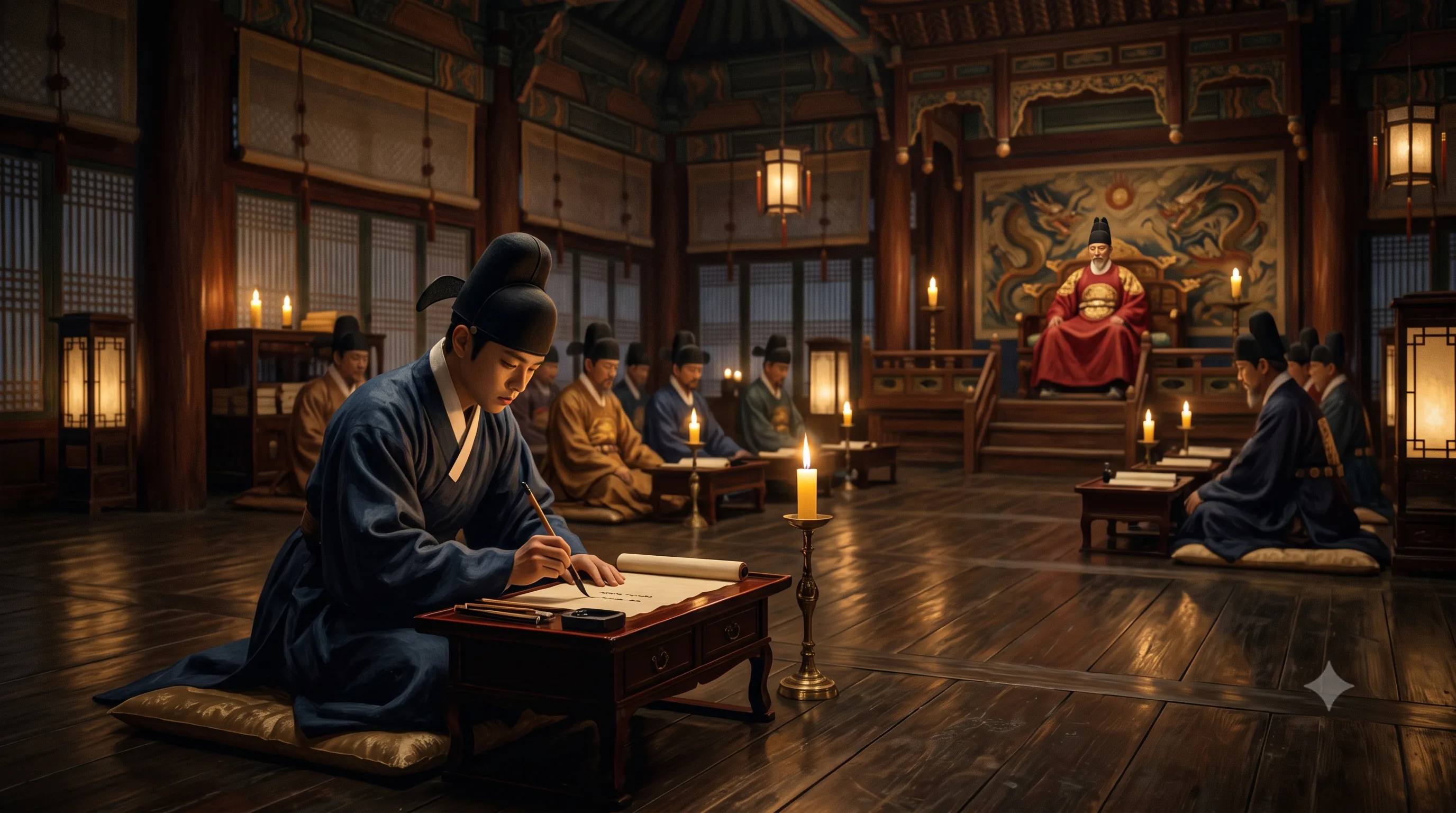
When a yangban died, the family did not write his monument. They assembled the raw biographical material — the haengjang (행장, 行狀), the account of conduct — and then went looking for the right person to compose from it. For the most prestigious monuments the request went, by custom, to a leading literary figure of the day.
A stone monument required three skills: chanmun (찬문, 撰文), composing the text; saja (사자, 寫字), writing out the characters for carving; and jeon-aek (전액, 篆額), the seal-script heading. The roles were distinct, and often filled by three different men — but one person could take on more than one of them, and did. The payment sent for such work is recorded under the name yunpil (윤필, 潤筆), literally “moistening the brush”; the attested Korean cases attach to fees paid for composing texts of this kind, and I have not found a source establishing it as the standard term for every monument commission.
The monuments were rank-coded. The sindobi (신도비, 神道碑) was the grandest form, restricted to high officials with clear merit and learning fit to serve as a model — though the sources differ on the exact threshold, giving senior second, junior second, or third rank depending on which account you read. Those are separate claims from separate records and are not combined here. The characteristic form set the stone on a tortoise base with an intertwined-dragon head, but Joseon steles also took square bases, roof-shaped caps and lotus forms, and no single shape was prescribed (Encyclopedia of Korean Culture, 신도비; 우리역사넷, 신도비).
The myogal (묘갈, 墓碣) was the more modest round-topped stone. Regulation by rank goes back to Tang China, where officials of rank 4 and above could erect the tortoise-and-dragon bi while rank 5 and below were restricted to the gal. Myogal are hard to find in Goryeo — which had its own epigraphic culture in tomb tablets, monastic steles and royal tomb inscriptions — and become common from mid-Joseon onward. Song Si-yeol (송시열) left so many that his became models for later epigraphers (Encyclopedia of Korean Culture, 묘갈).
Now hold the funerary commission against the examination hall. In both cases: one man’s words, another man’s name, money or advantage changing hands. In the hall that is fraud grave enough to void a results list and exile officials. At the graveside it is a normal transaction with a courtesy term for the fee.
The difference is not the writing. It is what the writing obtains. A commissioned epitaph obtains a family a monument. An answer paper obtains its holder a strong claim on office and the standing that came with it.
One further wrinkle, and it needs stating precisely. The stone was not a disguise: it was normal for the monument to name both the man who composed the text and the man who wrote out the characters, and the famous name was exactly what the family was purchasing. Nor is “the dead man obviously didn’t write it” quite the whole truth — self-composed epitaphs existed, and Jeong Yak-yong wrote his own in 1822, in two versions. What the grave inscription is not is a claim of authorship by the deceased; his name is there as the person commemorated. Which is why the modern instinct to call the arrangement ghostwriting misfires. Nobody was hiding.
What about a scholar’s collected works — whose book was that, really?
This is the case that troubles the modern intuition most.
A munjip (문집, 文集) is a collected edition of an individual’s prose and poetry. The Encyclopedia of Korean Culture states the crucial fact bluntly: while some men edited their own, most munjip were edited by those who came after — 자기 스스로 편집하는 경우도 있지만 대부분 후인들에 의하여 편집된다 (문집).
The process was collective and formally organised, in two stages. After the death of a scholar of standing, his descendants and his mun-in (문인, 門人) — disciples of his school — assembled and edited the manuscripts, dividing the editorial duties among themselves (bunjeong, 分定). The editorial roster for the collected works of Yi Ik (이익) ran to a general supervisor (docheong, 都廳), collation officers (gyojeong yusa, 校正有司), a library officer (jangseo yusa, 藏書有司), duty officers (jigil, 直日), a volumes officer (bongchaek yusa, 奉冊有司) and regional officers. Printing was a second stage with its own assignment roster (paim, 爬任) — supervisors, proofers, arrangers, copyists, inspectors of cutting and printing, and distributors. Publication also required wider consensus: a circular letter (tongmun, 통문) went out under the joint signature of descendants and disciples to notables connected by blood, region or scholarly lineage, and a meeting chose a chair and settled duties (문집).
So: a committee of students, meeting after their teacher’s death, deciding which of his writings exist, in what order, in what state of correction, under his name.
Every act on that list is a decision about the text — which drafts to include, which to suppress, which characters to emend where a manuscript is damaged. The encyclopedia records that editors did alter and delete passages they judged troublesome, and that in some cases already-printed collections and their woodblocks were destroyed in the course of political or scholarly conflict. So it is not the case that nothing ever went wrong here; it went wrong in a different direction from the one a modern reader expects — not a stolen book, but a managed one.
Joseon did not experience the basic arrangement as theft, and it is worth being exact about why. On the encyclopedia’s account, a munjip was evidence of a lineage’s learning as much as of one man’s output — bound up with blood, school and region. Read that way, disciples completing or correcting the master’s text were doing what disciples were for, and the book carried his name because it carried his teaching. That reading is an interpretation of the practice rather than a rule anyone wrote down. Confucius said of himself that he transmitted and did not create, 述而不作 — a self-description about handing on tradition, not a licence later editors cited for finishing a teacher’s sentences.
Which is roughly the assumption crushing Heo Mun-oh.
What was the actual crime, then?
Put the whole record next to itself.
| What the modern frame assumes | What the Joseon record shows |
|---|---|
| Taking credit for another’s writing is theft from the writer | Criticism of literary theft existed, but no copyright regime comparable to modern authors’ rights and no legal category framing the wrong as one against a writer |
| Ghostwriting is a hidden shame | Funerary texts were openly commissioned; the composer and the calligrapher were usually named on the stone, and the fee had a polite name (yunpil) |
| A book belongs to the person on the cover | Most munjip were compiled after death by descendants and disciples through formal assignment (문집) |
| The transgression is against the writer whose work was taken | The punished vocabulary — chasul, daesul — is examination vocabulary; the offence is against the state’s selection process (과거) |
| Institutions respond with academic sanctions | Sealed cover strips, red-ink recopying from 1365 to 1835, cancelled results lists, exile for complicit officials, one hundred blows and three years’ penal servitude for proxy composition (봉미; 역서; 과옥; 정거) |
In short: Joseon did not ask who wrote this? as a moral question about ownership — it asked what did this writing obtain?, and it brought the full weight of the state down where the answer was entry into the officialdom.
Key terms. Daejak / daesul (대작 代作 / 대술 代述) — composition in another’s place. Chajak / chasul (차작 借作 / 차술 借述) — borrowed composition. Hyeopchaek (협책 挾冊) — smuggling books into the examination hall. Bongmi (봉미 封彌) — sealing the candidate’s identifying details away from the answer until grading was finished. Yeokseo (역서 易書) — recopying answer papers in red ink so handwriting could not be recognised. Sigwon (시권 試券) — the answer paper itself. Pabang (파방 罷榜) — voiding an entire results list. Sakbang (삭방 削榜) — striking one individual from it. Jeonggeo (정거 停擧) — suspension of eligibility to sit. Gwaok (과옥 科獄) — a judicial inquisition arising from examination fraud. Sindobi (신도비 神道碑) — the grandest form of Joseon grave stele. Myogal (묘갈 墓碣) — the round-topped grave stele. Yunpil (윤필 潤筆) — “moistening the brush,” a fee for composing such a text. Munjip (문집 文集) — a collected edition of one person’s writings. Mun-in (문인 門人) — disciples of a scholarly school.
How does this compare with China and the West?
Two comparisons illuminate: China, source of the machinery, and Europe, source of the frame most viewers unconsciously apply.
China: the same anxiety, engineered harder. Korea’s anonymity devices came from Chinese practice and were adapted in Goryeo and Joseon rather than invented twice. General accounts of the imperial examinations describe anonymous marking with a number in place of a name and, at higher levels, clerks recopying responses to disguise the hand, alongside body searches and cells built with open fronts (World History Encyclopedia). Penalties ran from expulsion to a ban from the next sitting to loss of a qualification already earned. On substitution that account is measured rather than lurid: there was still the occasional case of a candidate sending a more able substitute.
That measured tone is worth preserving, because English-language writing about Chinese examination cheating tends toward the spectacular. The structural point is the useful one: when a written text is the mechanism by which a state distributes office, the identity of the hand becomes a matter of the highest administrative seriousness. Anonymity systems are not a curiosity of Confucian bureaucracy. They are what you build when writing is the gate.
 England’s first copyright act received royal assent on 5 April 1710 and took effect on the 10th. It vested rights in “the authors or purchasers” — transferable from day one. (AI illustration)
Europe: the frame gets invented late, and for a different reason. The instinct that copying without attribution wrongs the author is not a permanent feature of human moral reasoning. Medieval European writers had no legal claim over what they produced, and practices of copying and compiling varied by period, region and institution rather than following one rule. The legal architecture arrives late: England’s Statute of Anne received royal assent on 5 April 1710 and took effect on 10 April, and is widely regarded as the first modern statutory copyright — earlier printing privileges and licensing regimes existed, in Venice and in England, but this was the act that vested a term of rights in authors. It granted authors of new books exclusive printing rights for fourteen years, renewable once if the author lived (Avalon Project, Yale Law School).
Read its title again, because it does quiet work: for the encouragement of learning, by vesting the copies of printed books in the authors or purchasers of such copies. The right is transferable from the start — sellable to a stationer on day one. Whatever else the 1710 act founded, the romance of the author as inviolable origin is not in it; that grows afterward.
Which produces the real comparison, and it should be put as a question rather than a verdict. The West did not discover a truth about authorship that Joseon missed. England built a commercial market in reproducible printed copies, and the law that followed was a law about copies. Joseon had print early and well, and by the late period it had commercial publishing too — bangakbon woodblock editions, rental books, private publishers — but that market did not produce a law of reproduction rights. Whether the difference lies in scale, in who controlled printing, or somewhere else is a live research question, not something this piece can settle.
What can be said is where each society put its effort. Joseon developed an extremely elaborate law of examinations, because that was where writing converted into power in Korea. Both societies regulated writing where writing was worth something. They disagreed about where that was.
Coming up next
A professor sits in a lecture hall wanting a boy’s sentences, and behind that want is an apparatus most viewers never see: a sealed strip hiding four ancestors, rooms of clerks copying essays in red ink for four and a half centuries, a results list annulled entire, a scholar barred for a decade — and, at the other end of the same society, a family politely sending a fee called “moistening the brush” to the man who would write their father’s monument, his name carved on the stone beside the dead man’s.
Same act, opposite verdicts, and the difference lies in what the words were about to buy.
In the next essay, we’ll take another K-drama scene that looks like pure fiction — and trace the real Korean history hiding underneath it.
Frequently asked questions
Is Notes from the Last Row based on a true story? No. The 2026 Netflix series starring Choi Min-sik as Heo Mun-oh and Choi Hyun-wook as Lee Kang is fiction. The situation underneath it — a literary name attached to writing from another hand — was ordinary in Joseon. What makes it feel like a violation is a modern idea of authorship Joseon did not share.
Did Joseon Korea have a concept of plagiarism? Not a modern one. There was no copyright regime comparable to modern authors’ rights, and no legal category treating the wrong as one against a writer. Criticism of literary theft did exist — pyojeol (표절) appears in fifteenth-century records — but the punished vocabulary belongs to the examination hall.
What is daejak in Korean history? Daejak (대작, 代作) means composing a text in another person’s place. The Veritable Records use it for drafting royal statements and documents on someone’s behalf, so it is not purely an examination term. This article uses it as an umbrella for writing produced under another name — Joseon had no single official word for that.
Was ghostwriting legal in Joseon Korea? It depended on what the writing was for. A commissioned epitaph was an open transaction with a customary fee and the composer’s name on the stone. An examination answer written by someone else drew one hundred blows and three years’ penal servitude, because that paper opened the route into office.
What were daesul, chasul and chajak? Terms for an answer paper not composed by the candidate whose name it carried. The gwageo article treats hyeopchaek, chasul and daesul together as habitual frauds; chajak appears in other contexts. The sources do not apply the distinctions consistently.
How did Joseon prevent cheating in the civil service exam? Chiefly by anonymity. Bongmi sealed the candidate’s identifying details — name, ancestral seat and the four ancestors — away from the answer until grading finished. Yeokseo had clerks recopy every paper in red ink so handwriting could not be recognised. Bongmi was implemented in Goryeo on a proposal of 1062; yeokseo ran from 1365 to 1835, excepting certain formats.
What was the punishment for exam fraud? Pabang voided an entire results list, as in 1699. Sakbang struck out an individual. Jeonggeo suspended eligibility for three years, ten years, or permanently. Borrowed and proxy composition drew one hundred blows and three years’ penal servitude.
If ghostwriting was normal, why was exam ghostwriting a crime? Because of what the writing obtained. An epitaph obtained a family a monument. An answer paper opened the most important recognised route into office — one of several, alongside protection appointment, recommendation and technical examination, but the one that mattered most. Joseon policed the gate, not the authorship.
Sources & further reading
This piece was written from the historical script and fact-check of 사뚱샘의 역사방 (SaDDungSam). Terms, dates and case details above are sourced inline. For broader reading:
- The gwageo, its abuses, and the vocabulary of examination fraud (협책·차술·대술·차작). Encyclopedia of Korean Culture (encykorea.aks.ac.kr)
- Bongmi (봉미), the sealed identity portion, implemented in Goryeo from 1062. Encyclopedia of Korean Culture (encykorea.aks.ac.kr); Goryeosa, Monograph on the Selection of Officials
- Yeokseo (역서), red-ink recopying of answer papers, 1365–1835 — including its own corruption. Encyclopedia of Korean Culture (encykorea.aks.ac.kr)
- Sigwon (시권), the examination answer paper and its types. Encyclopedia of Korean Culture (encykorea.aks.ac.kr)
- Gwaok (과옥), the examination-fraud inquisitions of 1699 and 1712. Encyclopedia of Korean Culture (encykorea.aks.ac.kr)
- Jeonggeo (정거), suspension of examination eligibility, and its graded terms. Encyclopedia of Korean Culture (encykorea.aks.ac.kr)
- Munjip (문집), posthumous compilation, editorial assignment, and the fate of contested collections. Encyclopedia of Korean Culture (encykorea.aks.ac.kr)
- Sindobi (신도비) and its disputed rank threshold. Encyclopedia of Korean Culture (encykorea.aks.ac.kr); National Institute of Korean History, 우리역사넷
- Myogal (묘갈), Tang rank regulation, and Song Si-yeol as model composer. Encyclopedia of Korean Culture (encykorea.aks.ac.kr)
- The mun-gwa, its formats, and examiner collusion (시관의 협잡). National Institute of Korean History, 우리역사넷 (contents.history.go.kr)
- Daejak outside the examination hall, and criticism of literary theft. Veritable Records of King Sukjong, 20th year 5th month 26th day and 25th year 3rd month 23rd day; Diaries of King Yeonsan, 3rd year 5th month 13th day and 4th year 7th month 19th day; Veritable Records of King Sejong, 11th year 5th month 28th day and 14th year 3rd month 11th day
- Anonymous marking, recopying and substitution in the Chinese imperial examinations. World History Encyclopedia (worldhistory.org)
- The Statute of Anne, 8 Anne c. 19 — assented 5 April 1710, effective 10 April. The Avalon Project, Yale Law School (avalon.law.yale.edu); Ronan Deazley et al., Primary Sources on Copyright (1450–1900)
- Notes from the Last Row (Netflix, 2026) — official title page (netflix.com). The Boy in the Last Row is the English rendering of Juan Mayorga’s source play El chico de la última fila, not an alternative series title.
This article was researched and written by K-Drama History. Source: Notes from the Last Row: The Joseon History of Ghostwriting, Daejak, and Exam Fraud — K-Drama History