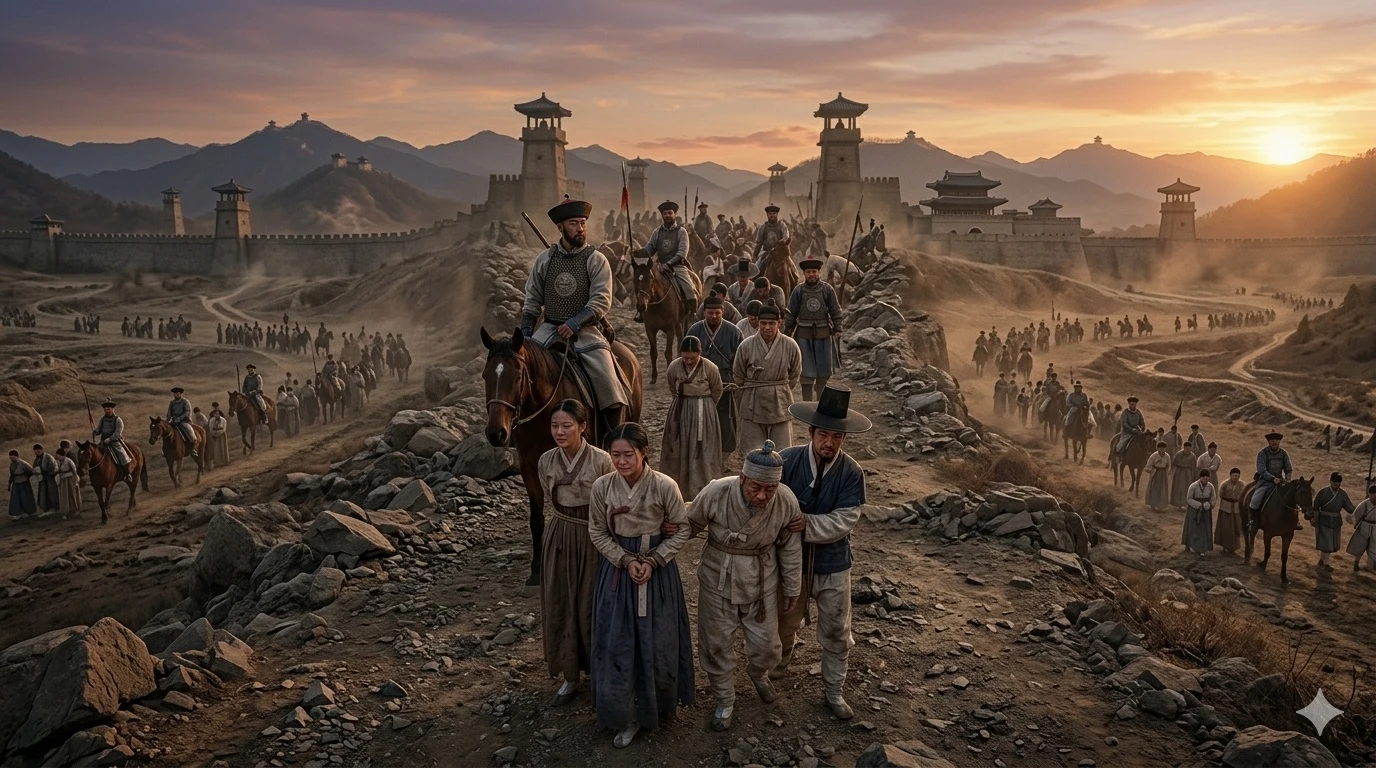
My Dearest and Joseon's Jungin Interpreters: Rich, Powerful, but Never Yangban
Theme: Status & Class
From the research behind Pause the Drama.
In MBC’s sweeping period romance My Dearest (연인), Namkoong Min plays Lee Jang-hyun — a sharp-tongued, battle-hardened man who moves easily among nobles, soldiers, and diplomats, yet carries an interpreter lineage that places him somewhere more socially ambiguous than a conventional yangban hero. On screen, he is fluent enough in the language of Joseon’s northern neighbors to negotiate on the crown prince’s behalf in Simyang. It plays, on screen, like a flourish: one more skill in an already overqualified hero’s back pocket.
It isn’t a flourish. Interpreting, in Joseon Korea, was a family trade — passed down for generations inside a very specific social class that most viewers outside Korea have never heard of, and that most Korean period dramas never bother to explain: the jungin (중인), the “middle people.” A hereditary line of interpreters wasn’t incidental set dressing for a character like Jang-hyun. It was a whole world of privilege, restriction, and quiet resentment, built around one blunt fact — you could be indispensable to the state, wealthier than half the aristocracy, and still never be allowed to call yourself a yangban.
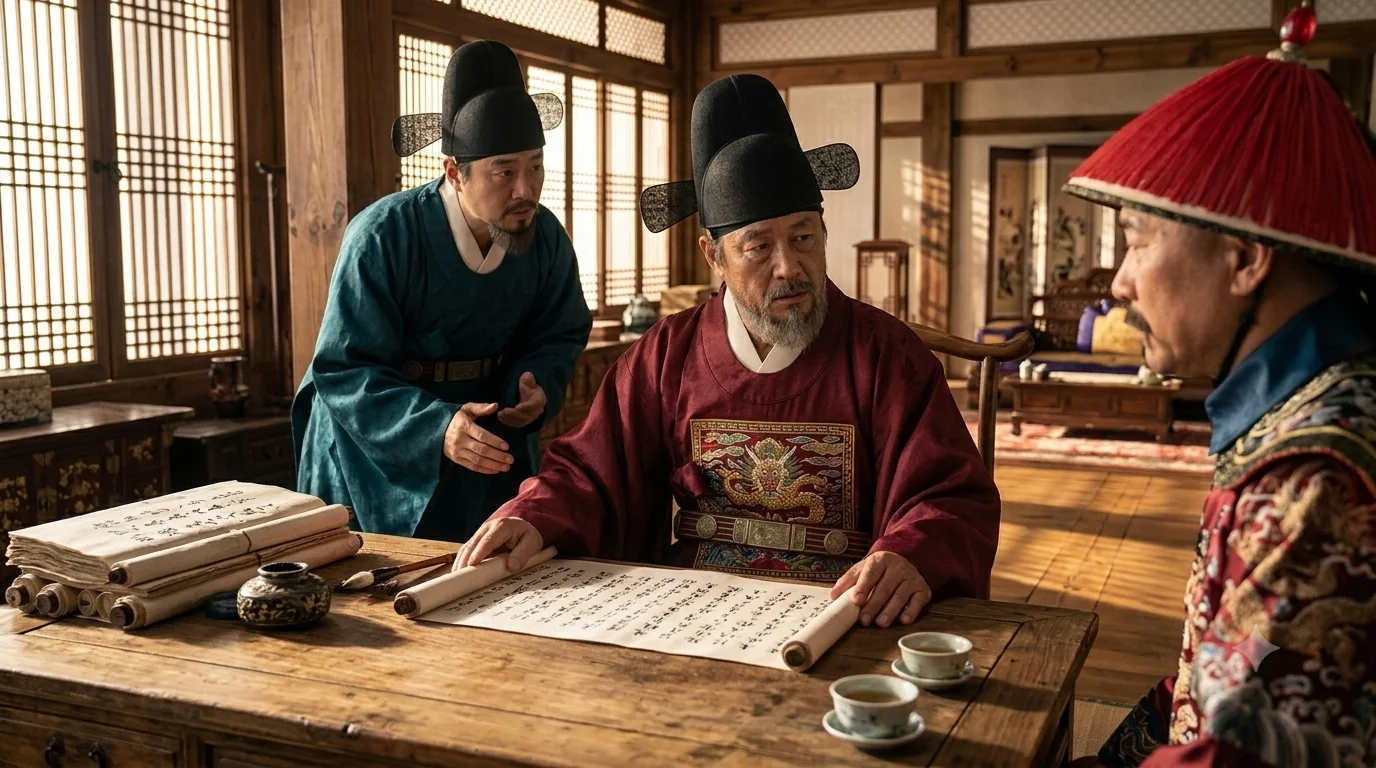 The interpreter was the indispensable third figure in every Joseon–Qing exchange — the one who could turn one court’s words into the other’s, and who saw the negotiation up close. (AI illustration)
Quick answer: In My Dearest, Lee Jang-hyun comes from an interpreter lineage — and that detail points to a real, distinct social class in Joseon Korea called jungin (“middle people”). Sitting below the yangban aristocracy but above commoners, jungin were hereditary technical specialists — interpreters, physicians, astronomers, law clerks — who qualified through the japgwa technical exam. Interpreters specifically could grow extraordinarily wealthy through trade conducted on diplomatic missions to China, even while their official rank stayed permanently capped below the elite.
Let’s unpack it.
Why does Lee Jang-hyun’s interpreter bloodline matter in My Dearest?
Because it instantly tells a Korean audience — even before the plot spells anything out — exactly where Jang-hyun stands, and doesn’t stand, in his own society.
A character born into an interpreter family isn’t a farmer’s son with a lucky talent, and he isn’t a yangban either. He’s something else: educated in a foreign language from childhood as a trade skill, likely raised expecting to sit the same specialized exam his father and grandfather sat, and quietly aware that no amount of money or usefulness to the crown will make the court address him the way it addresses a titled nobleman. That tension — indispensable but never quite legitimate — is baked into the premise of the character before he ever says a word of Manchu or Chinese on screen.
It also explains a detail the show leans on without over-explaining it: how a man like Jang-hyun can move between a battlefield, a royal negotiation table, and the rough edges of the world in between. Interpreters were not cloistered scholars. Their job put them on the road, across the border, and in direct contact with foreign soldiers, merchants, and officials — a professional life yangban bureaucrats simply didn’t have.
What actually happened? The jungin class and Joseon’s interpreter corps
Joseon Korea’s social order is usually flattened, for foreign audiences, into two tiers: yangban aristocrats on top, everyone else below. The real structure had more rungs, and one of the most historically interesting sat in between: the jungin.
In its narrower and most commonly cited sense, jungin referred to the technical officials clustered in the capital — interpreters (역관, yeokgwan), physicians (의관, uigwan), astronomers and calendar specialists (음양관), law officials (율관), and government accountants, alongside court painters and calligraphers (Encyclopedia of Korean Culture). They were not aristocrats, and they were not commoners either — a recognized middle stratum sitting between the yangban gentry and the ordinary common population. A broader definition of the term, which solidified later in the dynasty, also swept in local clerks and provincial functionaries across the kingdom — so jungin is best understood not as one fixed rank but as a band of technical and administrative strata.
What made someone jungin wasn’t wealth or personality — it was qualification through a separate examination track. Joseon’s civil service exam system, the gwageo, had two main tracks (문과/munkwa, the literary exam, and 무과/mugwa, the military exam) that fed the yangban officialdom. Running alongside them was the japgwa (잡과), the technical examination, covering four specialist fields: translation (역과), medicine (의과), astronomy and calendrical science (음양과), and law (율과) (Encyclopedia of Korean Culture; National Institute of Korean History). The status gap was visible in the certificates themselves: munkwa and military-exam graduates received a red certificate (홍패), while those who passed the japgwa received a white one (백패) — and where the white certificates of the literary licentiate exams bore the royal seal, the japgwa’s carried only the seal of the Ministry of Rites. Yangban families generally shunned the japgwa as beneath them, so it came to be dominated by technical-official and jungin families, who specialized in it generation after generation, since the training (a foreign language, a body of medical or astronomical knowledge) took years to build and was usually taught at home.
For interpreters specifically, this system had a dedicated institution: the Sayeogwon (사역원), the Bureau of Interpreters. Tracing its institutional lineage to the late-Goryeo Tongmun-gwan and Han’mun-dogam offices, the Sayeogwon was newly established in 1393, early in the dynasty, and operated for the whole of Joseon as both a language school and the government office managing translation and interpretation. It taught four languages tied to Joseon’s neighbors — Chinese, Mongolian, Japanese, and Jurchen — with the four-language system largely in place by the 1430s; after the Manchu invasions, as Manchu grew in importance, the Jurchen track was renamed “Qing studies” in 1667 (Encyclopedia of Korean Culture). Over the later dynasty, actual interpreting posts came to be filled mainly by japgwa-qualified jungin and a handful of established interpreter lineages — less a formal ban on who could enroll than a profession that hardened, in practice, into a family trade.
Once qualified, yeokgwan were essential to Joseon’s foreign relations with China, Japan, Mongolia, and the Jurchen — they traveled with official embassies and handled interpretation whenever foreign envoys visited the royal court. The biggest and most frequent relationship was with Qing China: Joseon sent 507 documented embassies to Qing China between 1637 and 1894 — a total that includes missions sent to Shenyang before the Qing moved its capital to Beijing, so it is more precise to say “507 envoy missions to the Qing” than “507 to Beijing.” They are known in the later period as yeonhaengsa (연행사, “envoys to Yeonjing/Beijing”). A typical mission carried roughly 30 core officials — three chief envoys plus staff — swelling to 200–300 people with attendants. The overland route to Beijing ran roughly 3,100 li one way — not, as it is sometimes rendered, a round-trip figure — with the journey taking about 50–60 days each direction and a full mission, including the stay in the Qing capital, lasting around five months (Encyclopedia of Korean Culture). No mission moved without interpreters.
Here is the twist that makes the jungin story genuinely striking: that same access became a business. Alongside their official duties, interpreters carried out private trade on these long overland journeys — buying and selling silver, ginseng, and Chinese goods otherwise unreachable for ordinary Koreans. This “smuggling trade,” conducted on the side of official missions, is described in Joseon-era sources as forming much of the actual core of Korea’s foreign trade at the time, and it made a number of interpreters seriously wealthy (Encyclopedia of Korean Culture). Joseon court annals single out individual cases: the 17th-century interpreter Jang Hyun (장현) is described in the Veritable Records of King Sukjong as a “great fortune of the realm” (국중의 거부), and recorded there as the great-uncle of the future royal consort Lady Jang Hui-bin (장희빈). He built that wealth across some four decades and roughly thirty missions to Beijing — and it still never bought his family a yangban surname to match it.
Here is what the drama shows beside what the historical record says:
| In My Dearest | In real history |
|---|---|
| Lee Jang-hyun comes from a line of interpreters and speaks a foreign language fluently | Interpreting was a hereditary jungin profession, trained inside families and qualified through the japgwa exam |
| Jang-hyun negotiates directly with foreign powers on the crown prince’s behalf | Yeokgwan handled real diplomatic communication on missions to Qing China and Japan, coordinated through the Sayeogwon |
| Jang-hyun moves easily between battlefield, court, and the world beyond Joseon’s borders | Interpreters’ work put them on the road for months at a stretch — a mobility yangban bureaucrats rarely had |
| Jang-hyun is treated as socially ambiguous — skilled and useful, but not quite of the elite | Yeokgwan could grow extremely wealthy through mission-adjacent trade, yet their court rank stayed capped below yangban status |
In short: My Dearest dramatizes a real historical tension — a professional class whose skills and mobility made them indispensable to the state and, for some, genuinely rich, while a rigid social hierarchy kept them permanently a rung below the aristocracy they served.
Key terms. Jungin (중인) — the hereditary “middle” social class of technical and administrative specialists, ranked below yangban and above commoners. Yeokgwan (역관) — a professional interpreter, the jungin specialization most exposed to foreign trade and diplomacy. Japgwa (잡과) — the technical civil service examination (translation, medicine, astronomy/calendar, law) that qualified jungin for office, distinct from the yangban-track literary exam (munkwa). Sayeogwon (사역원) — the Bureau of Interpreters, the government office that trained and supplied Joseon’s interpreters. Yeonhaengsa (연행사) — Joseon’s official envoy missions to the Qing court at Beijing.
Common misconception: weren’t jungin just rich commoners?
It’s a reasonable guess, and it’s wrong in an instructive way.
Commoners (양민/yangmin) were, overwhelmingly, farmers with no institutional foothold beyond their tax and labor obligations to the state. Jungin were structurally different: a recognized professional stratum with its own examination system, its own government bureaus, distinct residential tendencies (in late-Joseon Seoul, powerful yangban and royal kin clustered in Bukchon, while lower officials and some technical jungin and artists were concentrated in areas like Seochon, west of Gyeongbokgung, with many jungin and licensed merchants in the central Jungchon district — a pattern of tendencies, not an absolute segregation by status), and — crucially — its own hereditary transmission of both trade and status. A wealthy commoner farmer stayed a commoner. A jungin family, rich or poor, stayed jungin, and its children generally re-entered the same technical professions their parents held. Money alone could not dissolve that boundary; neither, categorically, could professional excellence. What separated jungin from yangban wasn’t a matter of degree — it was a different track entirely, closed off by marriage practice, examination access, and centuries of convention.
That’s the paradox worth sitting with: a jungin interpreter could out-earn a poor country yangban many times over, and the country yangban would still outrank him in every social exchange that mattered.
Why this resonates beyond Korea: the Ottoman dragoman
Here’s where the jungin story stops being uniquely Korean and starts looking like a pattern: professional interpreter classes bridging two worlds, gaining real wealth and influence from that position, while remaining socially distinct from the ruling elite, show up more than once in history.
The clearest parallel sits in the Ottoman Empire, in the office of the dragoman — an official interpreter serving Ottoman diplomacy and, later, foreign embassies in Constantinople. The term originally described any go-between working across the Ottoman world’s Arabic-, Turkish-, and Persian-speaking spheres, before hardening into a formal diplomatic post whose senior holder, at times, conducted genuine political negotiations rather than mere translation (Encyclopaedia Britannica). For roughly a century and a half — from the late 1660s until the Greek War of Independence in 1821 — that office was dominated by one community: the Phanariotes, Greek families from Constantinople’s Phanar quarter who had built substantial wealth through Mediterranean and Black Sea trade networks, and who leveraged their education and multilingual fluency to move from commerce into the Ottoman bureaucracy itself (Encyclopaedia Britannica).
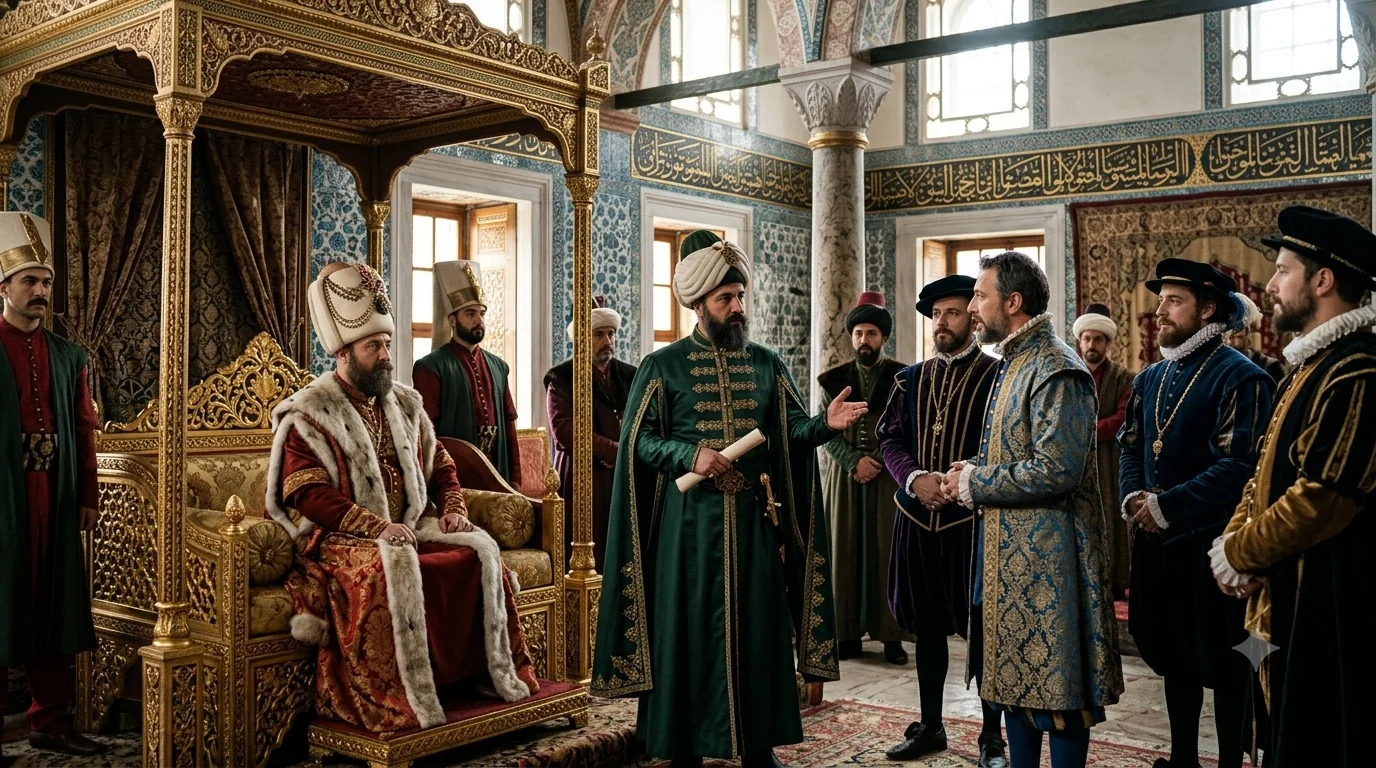 The Ottoman parallel: a dragoman interpreting between the sultan’s court and European envoys. Like Joseon’s yeokgwan, this was a professional-linguistic class that bridged two worlds without ever joining the ruling elite. (AI illustration)
The parallel to Joseon’s yeokgwan is real: both were professional-linguistic classes occupying a load-bearing but socially ambiguous middle position, both parlayed cross-border access into serious wealth, and both remained visibly distinct from the ruling elite they served — Ottoman Muslim Turks in one case, Confucian yangban in the other. But the two systems aren’t twins. Jungin status in Joseon was hereditary and exam-linked — shaped by the japgwa qualification, family training, and generations of bureaucratic convention into a hereditary technical-status group embedded in Joseon’s official order. The Phanariote hold on the dragoman post ran instead through community and institution: it was the Greek community’s existing education, language skills, and mercantile networks that funneled its members into the role, not a formal hereditary appointment system written into Ottoman law. Same basic shape — professional expertise plus trade access, without full elite status — built through different mechanics.
Coming up next
One interpreter’s family tree, and we’ve traveled from a Confucian social hierarchy in Seoul, through a technical exam most K-drama viewers have never heard named, into a Bureau of Interpreters that trained diplomats in four foreign languages, and out across the world to a Greek quarter of Constantinople. That’s the quiet reward of taking a period drama’s background detail seriously: a single line on a character’s family history opens into an entire, underexplored corner of a society.
In the next essay, we’ll take another K-drama scene that looks like pure fiction — and trace the real Korean history hiding underneath it.
The Joseon interpreter system, in one chain
- Jungin status — a hereditary middle stratum, entered by birth rather than achievement
- Family training — a foreign language learned at home from childhood as a trade
- Japgwa exam — the technical examination that granted official qualification
- Sayeogwon — the state language school and bureau that trained and posted interpreters
- Diplomatic missions — travel with the envoys to Qing China, and at times Japan
- Private trade — near-exclusive legal access to Qing markets, and the fortunes it built
- Rank ceiling — and yet, never a promotion into full yangban status
Frequently asked questions
Is My Dearest based on a true story? Not directly. My Dearest (연인) is a fictional romance, and its male lead Lee Jang-hyun is an invented character. But the show places him inside a real professional world — the hereditary interpreter families of Joseon Korea — and that backdrop, including the jungin social class and the diplomatic missions to Qing China, is documented history.
What is jungin (중인) — were they the same as commoners? No. Jungin (“middle people”) were a distinct hereditary stratum below the yangban aristocracy but above the commoner majority. They were technical and administrative specialists — interpreters, physicians, astronomers, law clerks, accountants — who typically inherited their profession and qualified through specialized exams. Commoners were mostly farmers with no such institutional standing.
What was the japgwa (잡과) exam, and how is it different from the munkwa? Japgwa was Joseon’s technical civil service examination, covering four fields: interpreting/translation, medicine, astronomy and calendrical science, and law. The munkwa, by contrast, was the literary examination on Confucian classics that produced the yangban officials who ran the government. Passing japgwa qualified you for a specialist post; even the most senior japgwa graduates hit a promotion ceiling that yangban officials did not face.
What did the Sayeogwon (사역원) actually do? The Sayeogwon, or Bureau of Interpreters, was the Joseon government office that both taught foreign languages (Chinese, Mongolian, Japanese, and Jurchen/Manchu) and supplied trained interpreters for diplomacy and trade. It ran its own tiered examinations, and over the later dynasty its interpreting posts came to be filled mainly by japgwa-qualified jungin families — making interpreting, in practice, a hereditary trade.
What did Joseon’s interpreters (역관) actually do on diplomatic missions? Yeokgwan traveled with Joseon’s official embassies to Qing China and, at times, Japan, handling every layer of communication — from formal court exchanges to the practical business of moving a 200-to-300-person delegation through foreign territory for months at a stretch. They also interpreted for foreign envoys visiting the Joseon court.
How did interpreters get rich if their official rank was capped? Alongside their official duties, interpreters conducted private trade during these missions — carrying silver, ginseng, and other goods to sell in China and bringing back Chinese goods to sell at home. Because they were among the very few Koreans with routine, legal access to Qing markets, some built substantial fortunes this way, even though their court rank stayed capped well below a yangban official’s.
Could a jungin family ever become yangban? In practice, almost never in the short term. Jungin status was hereditary and self-reinforcing — sons trained in the family trade from childhood, married within the jungin community, and re-entered the same profession through japgwa. Wealth alone did not convert into yangban rank; that boundary was maintained by marriage practices, examination access, and social convention, not just money.
Is the Ottoman dragoman a fair comparison to the Joseon yeokgwan? It’s a useful parallel, not an exact match. Both were professional interpreter classes that gained real wealth and influence by bridging two civilizations, while staying socially distinct from the ruling elite. But the mechanics differed: jungin status in Joseon was a hereditary, exam-qualified caste embedded in state law, while the Ottoman dragoman post was dominated by one community — Phanariote Greeks — through social and institutional channels, not a formal caste system.
Sources & further reading
This piece was written from the historical script and fact-check of 사뚱샘의 역사방 (SaDDungSam). The specific figures and dates above are sourced inline, drawn from the Academy of Korean Studies’ Encyclopedia of Korean Culture and the National Institute of Korean History. For broader reading:
- The jungin class, the japgwa exam, the Sayeogwon, and yeokgwan interpreters. Encyclopedia of Korean Culture, Academy of Korean Studies. (중인 · 역관 · 잡과 · 사역원)
- Joseon’s yeonhaengsa missions to Qing Beijing. Encyclopedia of Korean Culture. (연행사)
- Joseon’s status system (신분제). National Institute of Korean History, 우리역사넷. (contents.history.go.kr)
- Ottoman dragomans and the Phanariote Greek community. Encyclopaedia Britannica. (Dragoman · Phanariote)
Thanks for reading — see you in the next one.
This article was researched and written by K-Drama History. Source: My Dearest and Joseon's Jungin Interpreters: Rich, Powerful, but Never Yangban — K-Drama History