MBC's Lee San, Explained: What 'I Am the Son of Crown Prince Sado' Really Meant
Theme: Power & Politics
From the research behind Pause the Drama.
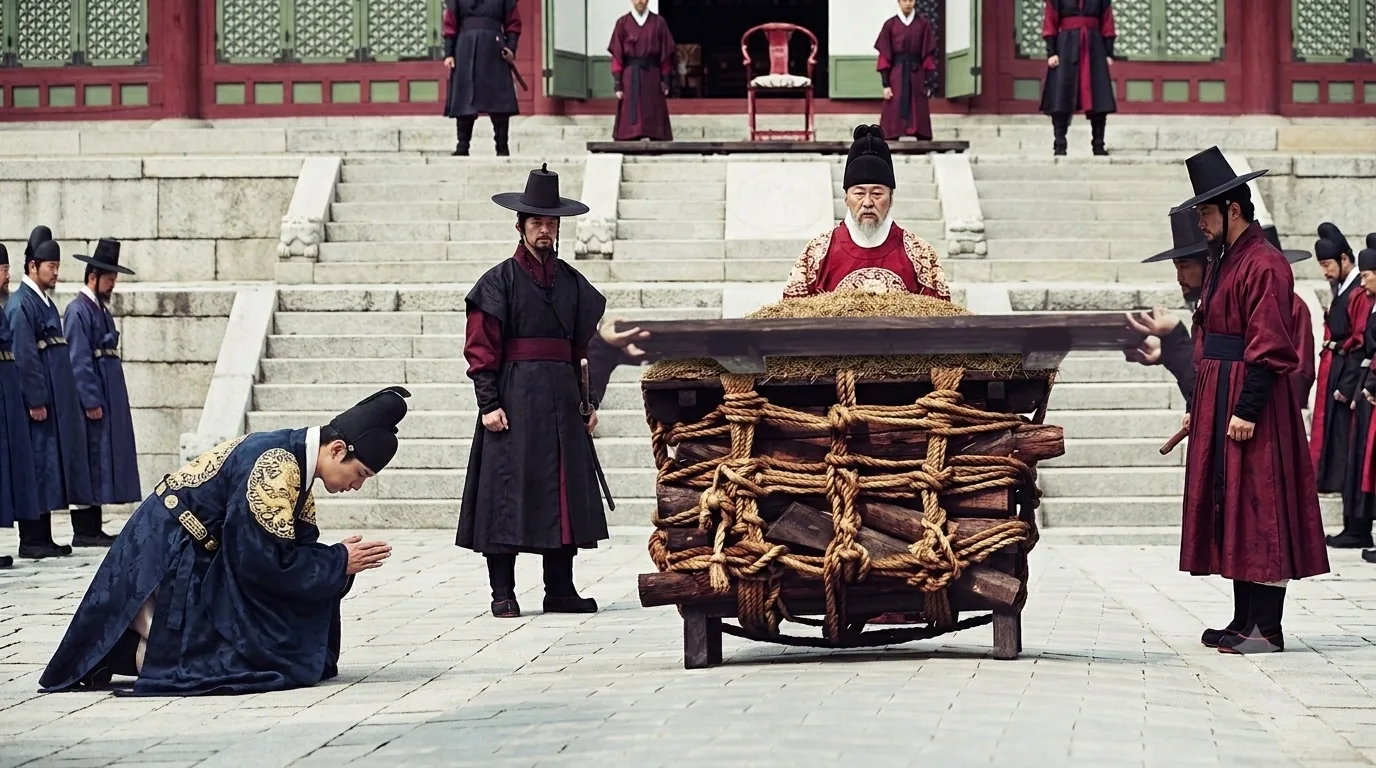
If you’ve watched Lee San, Wind of the Palace (이산, MBC, 77 episodes, 2007–2008) — the sprawling saga of the boy who survives palace conspiracies to become King Jeongjo — you remember the moment his reign actually begins. He is king now. The ministers are before him. And he says the sentence many at that court had reason to fear: “I am the son of Crown Prince Sado.”
It plays like grief breaking through royal protocol — a son finally allowed to say his father’s name out loud. And it was that. But it was not only that, and it was not a declaration of war. What the drama doesn’t have room to spell out is the reign that follows the sentence — from 1776 to 1800, fought not with armies but with a library, a retraining program for officials, a royal guard corps, a fortress city, and 297 private letters to the leader of the faction that opposed him.
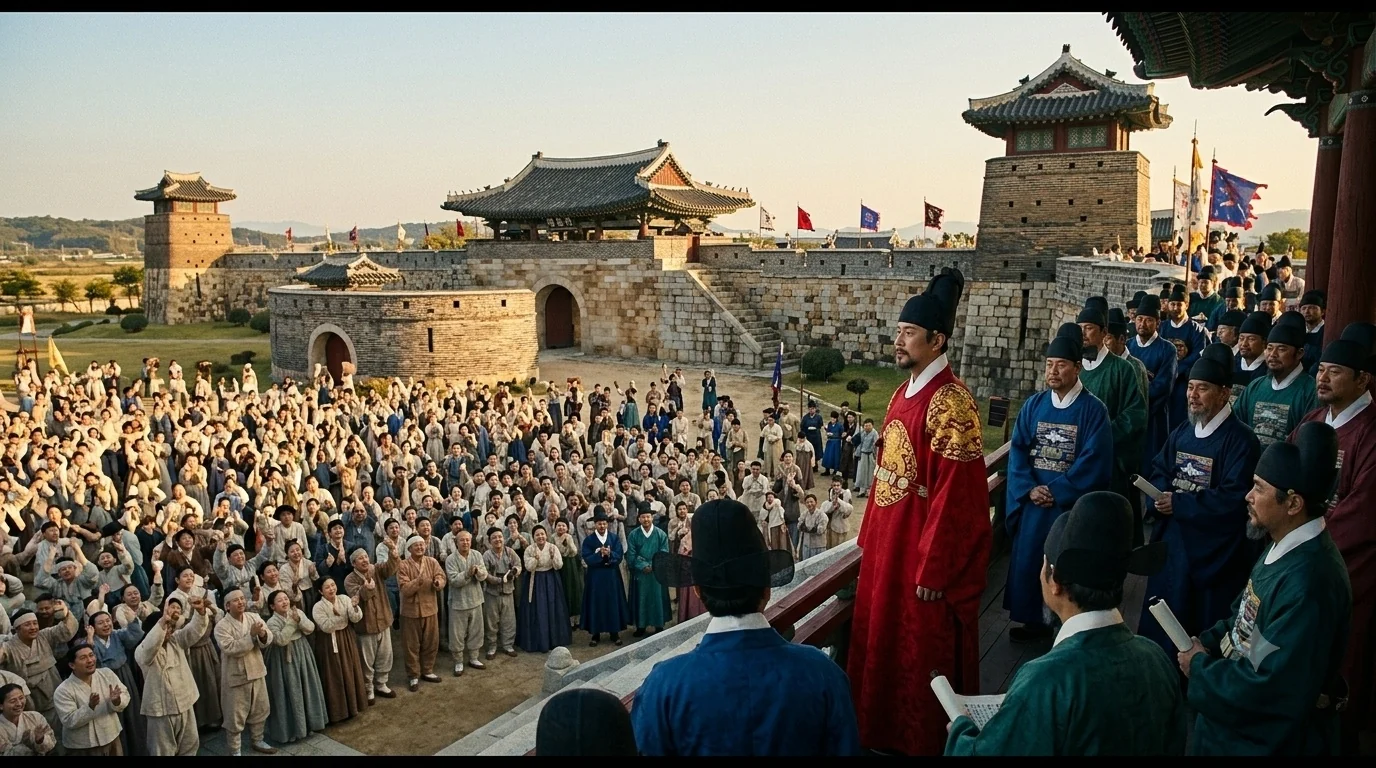 Hwaseong, Suwon: filial piety, Silhak engineering, urban planning and royal power built into a single set of walls. (AI illustration)
Quick answer: In Lee San, Jeongjo’s words about being Crown Prince Sado’s son read as a purely emotional moment. In the record they are subtler and sharper. Spoken in a yuneum — an address to ministers on the day of his accession in 1776, not in the formal accession edict — they acknowledged his father, accepted the succession order King Yeongjo had fixed (which made him heir through Prince Hyojang), and warned against anyone using Sado’s death to agitate. What followed, across his reign from 1776 to 1800, was the steady strengthening of royal power inside a Noron-dominated court: tangpyeongchaek, the Gyujanggak library, the chogyemunsin retraining program, the Jangyongyeong guard, and Hwaseong fortress.
Let’s unpack it.
What did Jeongjo actually mean by “I am the son of Crown Prince Sado”?
Grief, acceptance and warning — in a single breath.
First, the setting, because the drama gets it slightly wrong. This wasn’t a proclamation flung at a kneeling court from the throne. On the day of his accession in 1776, Jeongjo received his ministers outside the gate of the funerary hall and issued a yuneum, an address to them, in which the words appear. The Jeongjo Sillok records it (Annals of the Joseon Dynasty).
Second, what he actually said around it. In the same address, Jeongjo acknowledged that King Yeongjo, holding the royal line to be paramount, had made him the heir of Prince Hyojang rather than of Sado — and he warned against those who would seize on the Sado question to push for his father’s posthumous elevation. Every official in earshot understood the arithmetic: the new king would not deny his father, would not overturn his grandfather’s settlement, and would not let anyone else use his father’s corpse as a political instrument.
So this was not a declaration of war on the Noron. It was three things braided together: a son’s acknowledgment of his father, an acceptance of the legal order of succession, and a clear warning to anyone who might exploit that father’s death for political advantage. It was not a declaration of revenge. It was a declaration that grief would be acknowledged — and politically controlled. On day one, Jeongjo had to do two contradictory things at once: honor Sado, and not destabilize the throne he had just inherited. He held both at once. That balancing act is the whole shape of his politics.
So how do you strengthen a throne inside a court you do not yet command?
You build institutions — and the first of them looks like a library.
Start with tangpyeongchaek (蕩平策), which had been a serious instrument of state under Yeongjo: prevent any one faction from monopolizing power, manage rival forces, stabilize the throne. Yeongjo’s version is usually described as wallon (완론), the “lenient” line — balance by moderation. Jeongjo’s leaned toward junlon (준론), the “stern” line, which stressed righteousness and principle, with the king holding the center of the field rather than simply parceling posts out evenly (Encyclopedia of Korean Culture — 탕평책).
In practice that meant working inside a Noron-dominated court while raising up men from outside its mainstream — Chae Je-gong of the Namin most notably. It’s worth resisting the modern gloss here: this was not merit-based hiring in a bureaucratic sense. It was a king pulling the political field toward himself. And it did not produce harmony. By the later part of his reign the old four-faction map mattered less than a new split: the Sipa, who went along with Jeongjo’s line, against the Byeokpa, who resisted it.
The instrument was Gyujanggak (규장각), founded immediately after his accession in 1776. On paper: a repository for the writings and calligraphy of past kings — and that remained a real function. But as its remit expanded, it took on close-advisory functions overlapping those of the Royal Secretariat, the Office of Special Advisors and the Office of Royal Decrees (all of which continued to exist), oversaw state examinations, and ran the chogyemunsin program (Encyclopedia of Korean Culture — 규장각). Calling it a royal library undersells it: it was a royal library, a policy think tank and an elite training institute in one. He did not build it merely to store books. He built it to make scholarship serve rule.
The urgency was not abstract. On the night of the 28th day of the 7th month of 1777 — barely a year into the reign — men sent by Hong Sang-beom, among them Kang Yong-hwi and Jeon Heung-mun, climbed onto the roof of Jonhyeon-gak at Gyeonghui Palace, where the king was. That is the Jonhyeongak incident. Two weeks later, on the 11th day of the 8th month, Jeon Heung-mun was caught scaling the palace wall again, and the interrogation that followed exposed the wider plot — including a scheme to put Prince Eunjeon (Yi Chan) on the throne. (Eunjeon is better described as the man the plotters intended to raise up than as the leader of the plot.) That widened conspiracy is what’s known as the Jeongyu treason case.
Plots like that gave Jeongjo every reason to distrust the security arrangements he had inherited. Over the following years he built a royal guard tied more directly to the throne — though not in one stroke, and not as a single line of cause and effect: the Jangyongwi in 1785, expanded and reorganized as the Jangyongyeong in 1788, and in 1793 an outer camp based in the Suwon area, giving it an inner-and-outer structure (National Institute of Korean History — 장용영). If Gyujanggak was a guard of scholars, the Jangyongyeong was the other kind.
What was the chogyemunsin system, and why train officials who already passed the exam?
Because passing the civil service examination proved a man’s scholarly attainment — but it did not give the king a corps of younger officials trained under his own eye.
In 1781, Jeongjo layered a second institution on top of Gyujanggak: the chogyemunsin (초계문신) system, a re-education program for civil officials under the age of 37 who had already passed the state examination. Selected officials spent up to three years at Gyujanggak studying the classics and composition, tested at intervals, rewarded and penalized on results — with the king himself attending (Encyclopedia of Korean Culture — 초계문신). The program ran ten times over his reign. The number it produced depends on which roll you count: the Chogyemunsin jemyeongnok — the surviving register of selectees — gives 142 for Jeongjo’s reign (198 including 56 under Heonjong), while other sources give 138. The discrepancy comes down to whether the first four officials selected, who are absent from that register, are added back into the count.
The point of the system was subtle. These men had already cleared the examination that measured classical learning. What the chogyemunsin program added was something else: further training, and personal proximity to the sovereign who examined them. A young official who spent three years being tested by the king in person developed a direct institutional relationship with the throne — one that could compete with the older ties of faction and patronage. The stated purpose was scholarship; the political effect was a cohort of officials formed under the king’s own supervision. Among those selected was Jeong Yak-yong (정약용), who passed the higher examination in 1789 and was taken into Gyujanggak as a chogyemunsin — the man who would later design the pontoon bridge for the procession to Sado’s tomb, contribute the engineering behind Hwaseong, and write the Mongmin Simseo, the great manual against official corruption.
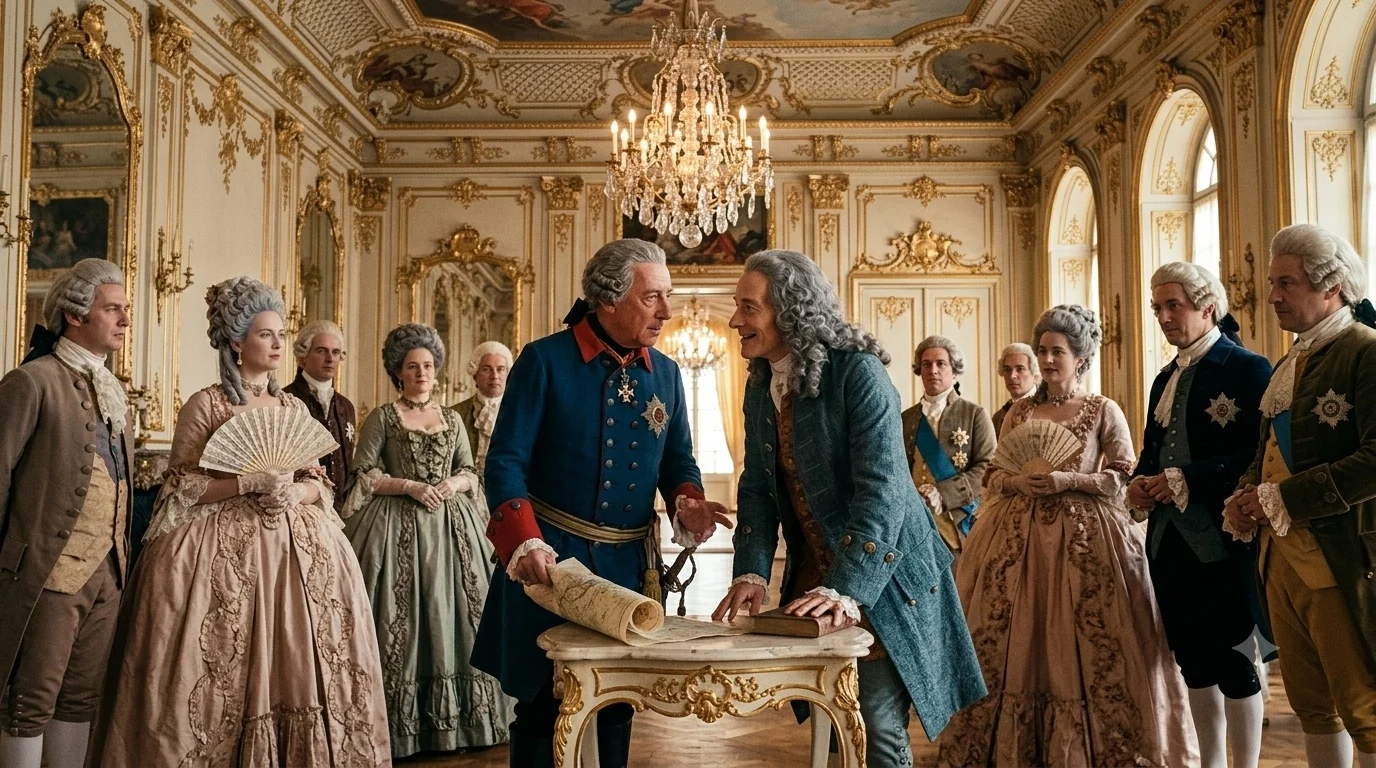 Prussia’s Frederick II ran the same 18th-century combination: the prestige of learning, and a hard bureaucratic and military state underneath it. (AI illustration)
Why did Jeongjo build an entire fortress city at Suwon?
Because filial piety, military reform, urban planning and royal power could be built into the same set of walls.
The sequence matters. In 1789 Jeongjo moved his father Sado’s tomb to Hwasan in Suwon, creating the Hyungnyungwon; a new town was laid out around it; and only then, between 1794 and 1796, was Hwaseong (화성) built — nearly six kilometers of ramparts, gates and artillery towers (우리역사넷 — 현륭원; Encyclopedia of Korean Culture — 수원 화성).
And it was not one man’s fortress, whatever the popular telling says. Hwaseong was a state project: built to the guidelines Jeong Yak-yong laid out in the Seonghwa juryak, under the overall charge of Chae Je-gong and the field command of Jo Sim-tae. Jeong Yak-yong’s contribution was real and specific — drawing on Chinese and Western technical texts, he devised lifting equipment including the geojunggi crane and the yuhyeonggeo cart, which made the work dramatically more efficient (Encyclopedia of Korean Culture — 거중기). It is precise to say his guidelines and machines made the construction faster and more efficient. It is imprecise to call him the fortress’s sole architect.
What was it for? The official reason was filial: it protected Sado’s tomb and displayed the king’s devotion. But it also developed into an important political and military center — the Jangyongyeong’s outer camp was based in the Suwon area, and would be tied closely to the fortress — complementing, rather than replacing, the Seoul-centered structure of power. It’s tempting to call Hwaseong a second capital built to escape the Noron; that overshoots the evidence. What’s defensible is quieter and still remarkable: Jeongjo built himself a base that Seoul did not wholly define. It was inscribed as a UNESCO World Heritage site in December 1997 (UNESCO World Heritage Centre).
Read the arc together and the pattern is clear: a library that trained officials under the king’s eye, a guard corps loyal to the throne, and a fortress city where filial duty, new technology and royal power stood in the same walls. Jeongjo’s reign had its punishments and its political casualties. But the central pattern was not mass purge. It was construction.
Key terms. Tangpyeongchaek (탕평책) — the policy of preventing any single faction from monopolizing power. Yeongjo’s version is described as “lenient” (wallon); Jeongjo’s drew more heavily on the junlon emphasis on principle and political legitimacy, with the king at the center — while still keeping tangpyeong’s broader goal of blocking any one faction’s monopoly. Sipa / Byeokpa (시파/벽파) — the split that came to define late-Jeongjo politics: those who went along with the king’s line, and those who resisted it. Gyujanggak (규장각) — the 1776 royal library that grew into policy think tank and training institute. Chogyemunsin (초계문신) — the retraining program for officials who had already passed the exam, run under the king’s personal supervision. Hwaseong (화성) — the fortress city built at Suwon, 1794–96.
Drama vs. history: what Lee San compresses
| In Lee San, Wind of the Palace | In real Joseon history |
|---|---|
| Jeongjo’s childhood bond with commoner friend Seong Song-yeon shapes his empathy for ordinary people | Dramatic invention; there is no historical record of such a childhood friendship |
| The words about Sado are flung at a kneeling court as a declaration of war | They come from a yuneum — an address to ministers on the day of accession — in which he also accepted Yeongjo’s succession arrangement and warned against agitation over Sado |
| The Noron are a unified, scheming antagonist bloc | Factional politics were messier, and shifted: by the later reign the decisive split was Sipa vs. Byeokpa, and Jeongjo corresponded privately for years with the Byeokpa leader Sim Hwan-ji |
| Jeong Yak-yong designs Hwaseong | Hwaseong was a state project — Jeong Yak-yong’s Seonghwa juryak set the guidelines, Chae Je-gong had overall charge, Jo Sim-tae commanded the work; Jeong Yak-yong’s geojunggi and yuhyeonggeo made it efficient |
| The drama concludes with Jeongjo secure on the throne | The balance he built rested heavily on him personally; after his death in 1800 it did not hold, and the 19th century slid toward in-law domination |
Four 18th-century monarchs, one shape of rule
Here’s the comparison worth making — and the one worth being careful about. Jeongjo was not an enlightened despot in the European sense, and calling him one distorts the Korean context. He was not a product of the European Enlightenment; he was the monarch of a Neo-Confucian state, working from the tangpyeong tradition, the Confucian ideal of kingly rule, and the practical technical learning of Silhak.
What can be compared is the shape. Set him beside the 18th-century European monarchs historians group under enlightened absolutism (Encyclopædia Britannica) — rulers who strengthened royal power through learning, bureaucracy, military reform and construction, without dismantling the aristocratic order beneath them — and something recognizable appears. The point isn’t to fit Jeongjo into a European frame. It’s to help a reader outside Korea feel what kind of political animal he was.
Prussia — Frederick II is the comparison that really lands. Frederick (r. 1740–86) modernized the bureaucracy, tolerated religious difference, corresponded with Voltaire, and cultivated the reputation of a philosopher-king (Encyclopædia Britannica; World History Encyclopedia). He made learning and culture the language of statecraft while running a hard bureaucratic and military state underneath it. Set that beside Gyujanggak and the Jangyongyeong — scholarship as the public face of rule, soldiers as its floor — and the shape is unmistakable, so long as we don’t pretend to read either man’s private motives.
Two others fill out the picture more briefly. Catherine II of Russia (r. 1762–96) reorganized administration and law, wrote to Diderot and Voltaire, and made the arts a matter of state prestige — but never broke the basic structure of serfdom (Encyclopædia Britannica). That rhymes with a limit in Jeongjo’s reign: he retrained officials and promoted men from outside the mainstream, but never pushed toward a social revolution that would dissolve Joseon’s status order. Reforming monarchs rarely outrun the societies that made them. And Joseph II of Austria — Holy Roman Emperor from 1765, co-ruler of the Habsburg lands with his mother Maria Theresa until 1780, sole ruler to 1790 — went furthest of all, abolishing serfdom and curbing the Church, only for much of it to be weakened after his death.
Four monarchs, four different states, one recognizable shape: reform pursued from the top, in the name of the state and in defense of the crown. For Jeongjo, tangpyeong, Gyujanggak, chogyemunsin, the Jangyongyeong and Hwaseong were both an ideal of governance and a strategy of survival — and it would be too cynical by half to call the reform mere theater. It was both. But reforms whose political balance depends so heavily on one monarch are hard to sustain once that monarch is gone. Joseph II’s Austria learned that. So did Jeongjo’s Joseon.
Was Jeongjo poisoned — and what does the evidence actually show?
This is one of the most contested footnotes in Joseon history, and Lee San wisely stays out of it — the series focuses on his rise, not his death.
For decades, a persistent popular theory held that Jeongjo was poisoned in 1800, at the instigation of Queen Dowager Jeongsun, or the Byeokpa, or Sim Hwan-ji himself. It’s a dramatic, tidy story — and a remarkable discovery has knocked several of its legs out.
In 2009, the Album of King Jeongjo’s Letters (정조 어찰첩) was made public: six albums, 297 letters the king wrote to Sim Hwan-ji (심환지) — leader of the Byeokpa, and on the surface one of his principal rivals — between the 8th month of 1796 and the 6th month of 1800, weeks before his death (National Museum of Korea; The Korea Herald, 2009). Their significance is not that Jeongjo was “secretly pulling Sim Hwan-ji’s strings” — that overstates it. It’s that a king we remember as the sage of the tangpyeong ideal did not govern only through formal councils and the official record. He worked opinion, personnel and the political field privately, in his own hand, with the leader of the faction opposing him. He was a meticulous political realist — almost Machiavellian in that specific sense, and in no other.
The letters also record his own account of his deteriorating condition in his final weeks. That doesn’t settle the question, and it shouldn’t be made to. The honest statement is narrower: the available evidence cannot establish poisoning, and the reading that he died of illness — possibly poorly treated by the medicine of his day — has gained ground (The Korea Times, 2009; Ahn Dae-hoe, “The Politics of Royal Letters: Jeongjo and Sim Hwan-ji,” Yeoksa Bipyeong 87, 2009). Saying “the poisoning theory is finished” would be as unearned as saying he was murdered. The Jeongjo Sillok records his death at Yeongchunheon Hall in Changgyeonggung, in 1800.
What came after is not in doubt. The balance he built leaned on him — on his management, his letters, his personal command of the field. Without him it did not hold, and the century that followed slid toward exactly the in-law domination he had spent his reign working against.
Coming up next
A boy declares his father’s name at his own enthronement — and we’ve traveled from a Confucian library posing as a bookshelf, to a fortress city built with a crane invented from a Chinese physics manual, to secret letters a king wrote his own rival, to Frederick the Great’s salons and Joseph II’s flood of edicts. That’s the quiet gift of a long historical drama: even its quietest line is a doorway into an entire century.
In the next essay, we’ll take another K-drama scene that looks like pure fiction — and trace the real Korean history hiding underneath it.
Frequently asked questions
Is Lee San, Wind of the Palace based on a true story? Partly. Its political skeleton is real: Jeongjo (1752–1800) was Crown Prince Sado’s son, succeeded to the throne as heir to Prince Hyojang by King Yeongjo’s arrangement, and became Joseon’s 22nd king in 1776, going on to build the Gyujanggak library, the chogyemunsin program, the Jangyongyeong guard and Hwaseong fortress. His childhood friendship with the drama’s heroine, Seong Song-yeon, and much of the romance and palace intrigue are dramatic invention.
What did Jeongjo mean when he said he was the son of Crown Prince Sado? Not “I will now take revenge.” The words come from a yuneum — an address to his ministers on the day of his accession, recorded in the Jeongjo Sillok — not from the formal accession edict. In the same breath he acknowledged that Yeongjo had made him heir through Prince Hyojang, and warned against anyone stirring up agitation to posthumously elevate Sado. So it was three things at once: an acknowledgment of his father, an acceptance of the succession order, and a warning to anyone who would use Sado’s death as a political weapon.
What was tangpyeongchaek, and did Jeongjo really rule above factions? Tangpyeongchaek (蕩平策) was the policy of keeping any single faction from monopolizing power by balancing appointments and managing the political field. Yeongjo’s version is usually described as “lenient” (wallon); Jeongjo’s leaned on the “stern” (junlon) line that stressed principle and righteousness, with the king himself at the center. He worked within a Noron-dominated court while promoting men from outside its mainstream — Chae Je-gong of the Namin, for one. He was never simply above faction: his own letters show him managing personnel and opinion privately with Sim Hwan-ji, the Byeokpa leader.
What was Gyujanggak, and why did a library matter politically? Gyujanggak (규장각), founded in 1776, was nominally a royal library holding the writings and calligraphy of past kings. As its functions expanded it took over advisory roles from the Royal Secretariat, the Office of Special Advisors and the Office of Royal Decrees, ran the state examinations and administered the chogyemunsin program. It’s less a library than a royal library plus policy think tank plus elite training institute — the institutional engine of Jeongjo’s rule.
Who really built Hwaseong Fortress? Not Jeong Yak-yong alone. Hwaseong (1794–96) was a state project: built to guidelines Jeong Yak-yong set out in the Seonghwa juryak, under the overall charge of Chae Je-gong and the field command of Jo Sim-tae. Jeong Yak-yong’s contribution was decisive but specific — drawing on Chinese and Western technical texts, he devised lifting equipment such as the geojunggi crane and the yuhyeonggeo cart, which made the construction dramatically more efficient. Hwaseong was inscribed as a UNESCO World Heritage site in December 1997.
What are Jeongjo’s secret letters? The Album of King Jeongjo’s Letters (정조 어찰첩) — six albums containing 297 letters he sent to Sim Hwan-ji, leader of the Byeokpa, between 1796 and 1800, made public in 2009. They show a king who did not govern only through formal councils and the official record, but managed opinion, personnel and the political field through private correspondence — a meticulous political realist rather than only the sage-king of legend. They also show that political rivalry did not prevent private coordination between the two men.
Was King Jeongjo poisoned? The poisoning theory is popular but cannot be established on the available evidence. The 2009 letters — showing Jeongjo’s private communication with Sim Hwan-ji and his own account of his worsening condition shortly before his death — weakened some of the theory’s premises, and the reading that he died of illness (possibly poorly treated) has gained ground. That is not the same as saying the question is closed. The Jeongjo Sillok records his death at Yeongchunheon Hall in Changgyeonggung in 1800.
Was Jeongjo an “enlightened despot” like Frederick or Catherine? No — and the comparison should be handled carefully. Jeongjo was not a product of the European Enlightenment; he was a monarch of a Neo-Confucian state, working from the tangpyeong tradition, the Confucian ideal of kingly rule, and the practical technical learning of Silhak. What can be compared is the shape of the thing: like Frederick II, Catherine II and Joseph II, he strengthened royal power through learning, bureaucratic retraining, military reform and city-building, without dismantling the aristocratic order beneath him.
Sources & further reading
This piece was written from the historical script and fact-check of 사뚱샘의 역사방 (SaDDungSam), drawing on Korea’s own reference works and primary-record institutions. Key claims are sourced inline above. Where the evidence does not settle a question — Jeongjo’s death above all — this piece says so rather than choosing the tidier story. For further reading:
-
The politics of the royal letters. Ahn Dae-hoe, “The Politics of Royal Letters: Jeongjo and Sim Hwan-ji” (어찰의 정치학 — 정조와 심환지), Yeoksa Bipyeong 87 (2009), 157–202.
-
Jeongjo (정조), Tangpyeongchaek (탕평책), Gyujanggak (규장각), Chogyemunsin (초계문신), Suwon Hwaseong (수원 화성), and Geojunggi (거중기) — Encyclopedia of Korean Culture / 한국민족문화대백과, Academy of Korean Studies. (정조 · 탕평책 · 규장각 · 초계문신 · 수원 화성 · 거중기)
-
Jangyongyeong (장용영), Jeongjo’s royal guard corps — National Institute of Korean History / 우리역사넷. (contents.history.go.kr)
-
Hwaseong Fortress — UNESCO World Heritage Centre, inscribed 1997. (whc.unesco.org)
-
The Veritable Records of the Joseon Dynasty (조선왕조실록), including the Jeongjo Sillok — National Institute of Korean History. (sillok.history.go.kr)
-
Album of King Jeongjo’s Letters to Sim Hwan-ji (정조 어찰첩) — National Museum of Korea, on the 2009 discovery of Jeongjo’s secret correspondence. (museum.go.kr)
-
On the poisoning theory and its reassessment — The Korea Times, “Reformative King Jeongjo Was Not Fatally Poisoned” (2009); The Korea Herald, “Jeongjo’s politics uncovered” (2009). (Korea Times · Korea Herald)
-
Enlightened despotism, Frederick the Great, and Catherine the Great — Encyclopædia Britannica; World History Encyclopedia. (Enlightened despotism · Frederick II · Catherine the Great · World History Encyclopedia — Frederick the Great)
Thanks for reading — see you in the next one.
This article was researched and written by K-Drama History. Source: MBC's Lee San, Explained: What 'I Am the Son of Crown Prince Sado' Really Meant — K-Drama History