Rookie Historian, Explained: Why Joseon Never Had a Female Court Historian — and What Women Did Instead
Theme: Women’s Lives
From the research behind Pause the Drama.
If you’ve watched the 2019 MBC K-drama Rookie Historian Goo Hae-ryung (신입사관 구해령, streaming internationally on Netflix), the central image is hard to forget: a young woman in official robes walks into the palace as a historian — a sagwan — and sits near the king, brush in hand, writing down everything he says and does. When he loses his temper, she records that too. When powerful men tell her to stop, she keeps writing.
It is a wonderful premise. It is also, in one crucial respect, a beautiful fiction. Joseon Korea did not have institutional female court historians. There was no office a woman like Goo Hae-ryung could have joined.
So why write a whole show about one? Because the invented historian asks a very real historical question — one that turns out to be far more interesting than the fantasy: who got to hold the brush, and who was kept away from it?
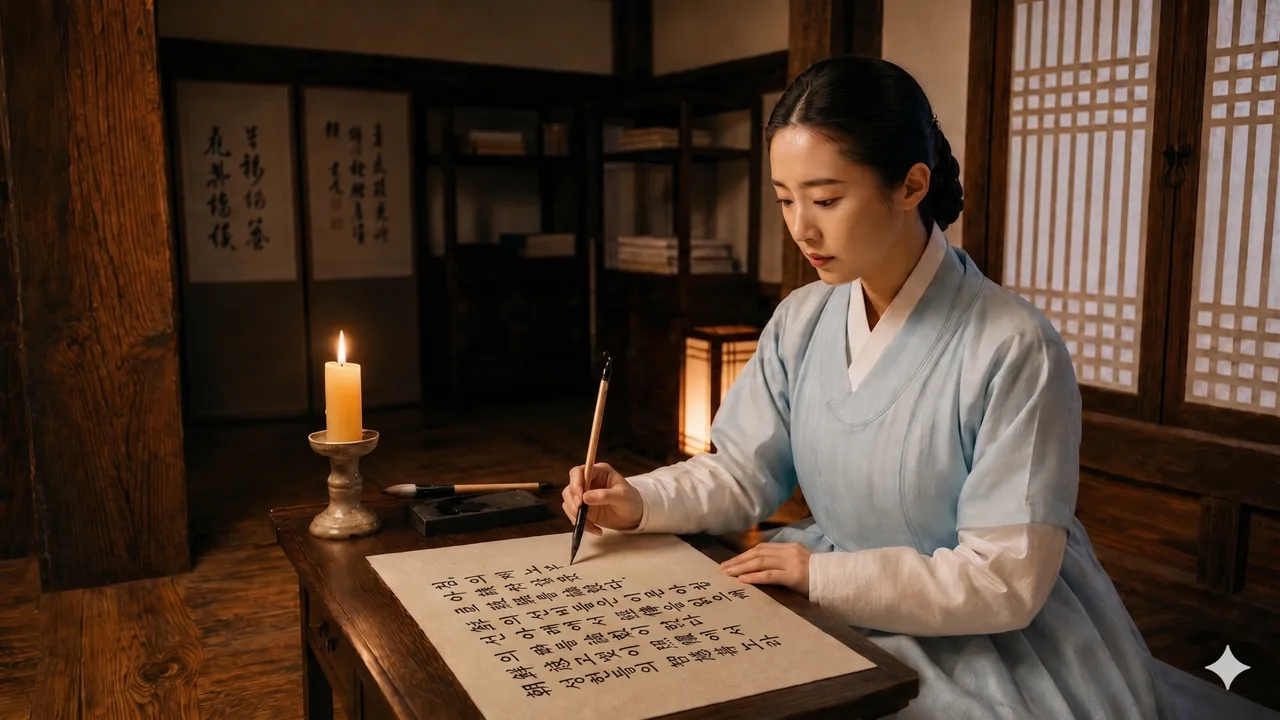
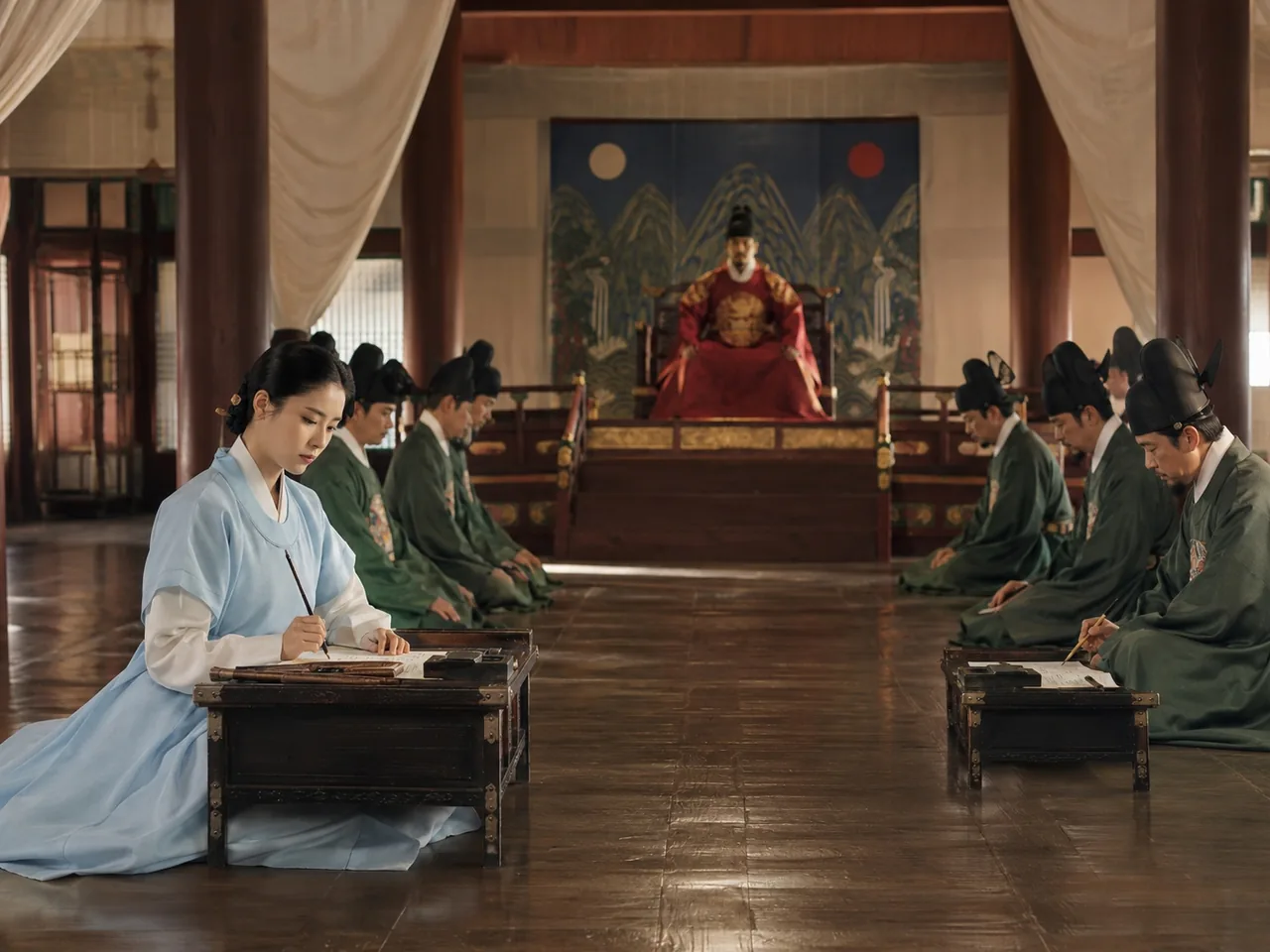 A female historian recording the king — a thrilling premise, and a historical invention. (AI illustration)
Quick answer: Rookie Historian Goo Hae-ryung centers on a fictional female court historian — a role that never existed in Joseon Korea. Real sagwan were male officials who kept candid daily records of the king (the sacho), later compiled into the UNESCO-listed Sillok, or Veritable Records. Women were barred from the civil service exams that qualified historians and found alternative paths to writing through Hangul letters, instructional texts, and, across Asia and Europe, through patronage, vernacular script, and family commission.
Let’s unpack it.
First — what was a sagwan, and why did it matter so much?
Before we can talk about who was excluded, we need to understand what they were excluded from. And the Joseon historian’s job was extraordinary.
A sagwan (사관, 史官) was an official court historian (Encyclopedia of Korean Culture). The most remarkable ones shadowed the king through his working day, recording his words, his decisions, and the arguments of his ministers in raw daily drafts called sacho (사초, 史草). After a king died, those drafts were compiled into that reign’s Veritable Records — the Sillok (실록) — the official chronicle of the dynasty. Across more than 500 years, this produced the Veritable Records of the Joseon Dynasty (National Institute of Korean History), one of the longest continuous historical records of any single dynasty in the world and a UNESCO Memory of the World.
What makes it astonishing is the independence built into the role. By rule, the king himself was not allowed to read the sacho — not even his own. The drafts were confidential, and a historian who leaked or altered them could face execution. The point was brutal and brilliant: if the king could read what was written about him, historians would only ever write flattery. Lock the records away from the throne, and you might get the truth.
How seriously did Joseon take this? Consider King Taejong, the dynasty’s hard-driving third ruler. Thrown from his horse during a hunt, he picked himself up and told his attendants, “Do not let the historian know” (勿令史官知之). The historian on duty promptly recorded both the fall and the king’s attempt to hide it — and the exchange survives in the Annals of King Taejong (Veritable Records of the Joseon Dynasty) to this day. A monarch’s most embarrassing moment, preserved forever precisely because he tried to bury it: there is no cleaner illustration of what the sagwan’s independence was for.
This wasn’t just theory. When the tyrant Yeonsangun forced his way into the historians’ drafts at the end of the 15th century, the result was the Literati Purge of 1498 (Veritable Records of the Joseon Dynasty), in which a recorder and others were executed over what the sacho contained. The sagwan’s brush, in other words, was one of the few things in Joseon that even a king was supposed to fear.
So were there really female historians like Goo Hae-ryung?
Here is the honest answer, and it’s the heart of this whole piece: no — not as the drama shows it.
| In Rookie Historian | In real Joseon history |
|---|---|
| A woman passes an exam to become an official sagwan | Women were barred from the civil service examinations entirely |
| She records the king’s words with the same authority as her male colleagues | All sagwan appointments were male — no exceptions appear in the Sillok |
| Her records carry the same institutional weight and confidentiality | The sacho system’s independence was exclusively a male institution |
| She resists men who try to silence her writing | Women were excluded from officialdom by law, not merely by custom |
| The palace treats her presence as scandalous but ultimately valid | In reality, no woman held a sagwan post in 500 years of Joseon history |
Joseon’s officialdom, including the historians’ office, was staffed by men who passed the civil service examinations. Women were not eligible for those exams and were not appointed as sagwan. There was no class of official female court historians recording the king.
This isn’t to say the idea never surfaced. In 1519, the scholar-official Kim An-guk proposed creating a post of yeosa (여사, “female recorder”) to document affairs within the royal women’s quarters (우리역사넷, National Institute of Korean History). The court discussed it — and let it quietly drop. And even a yeosa would not have been a sagwan: the role floated was recording the inner palace, not shadowing the king and his ministers to produce the sacho that anchored the Sillok. Senior court women did handle documents and books, but that was inner-palace administration — a different world from the independent historian’s brush.
The Goo Hae-ryung of the title, then, is a device — a modern writer’s “what if,” dropped into a real institution to expose its edges.
A note on honesty: when a drama dramatizes, we should say so plainly. The thrill of Rookie Historian is real; the institution it depicts is not. Mixing the two is how good entertainment quietly becomes bad history.
But — and this is why the fiction is worth taking seriously — the question it raises was painfully real. Women in Joseon were shut out of the official written record, both as its authors and, often, as its subjects. The drama didn’t invent that exclusion. It simply gave it a face and a name, and asked the audience to feel the wrongness of it.
If women were shut out, why? And could they read and write at all?
The exclusion wasn’t an accident; it grew straight out of Joseon’s ruling philosophy — and yet it was never total.
Joseon was built on Neo-Confucianism, which assigned men and women to sharply separated spheres — the famous principle of namnyeo yubyeol (남녀유별), the “distinction between men and women.” Public life, officialdom, the examinations, and the formal writing of history belonged to men. A woman’s recognized arena was the household. Add to this that the prestige language of scholarship and officialdom was literary Chinese (Hanmun), which demanded years of formal education that respectable women were rarely given, and you have a near-total lock on the official record.
Key terms. Sagwan (사관) — official Joseon court historian who shadowed the king and kept confidential daily drafts. Sacho (사초) — the raw candid draft records that even the reigning king was forbidden to read. Sillok (실록) — the Veritable Records compiled from sacho after each king’s death; UNESCO-listed. Eongan (언간) — personal letters written in Hangul, of which thousands survive as windows into women’s lives and voices in Joseon.
And yet — women were not silent. After King Sejong’s court promulgated the Korean alphabet, Hangul, in the 15th century, a vast world of women’s writing opened up in the vernacular. Court ladies and noblewomen wrote and received eongan (언간) — personal letters in Hangul — and these survive in the thousands today as some of our most intimate windows into Joseon life. (For more on the cloistered world of these palace women, see our companion piece on The Red Sleeve.) Most strikingly, the first known book written by a woman in Hangul was the Naehun (내훈, “Instructions for Women,” 1475; Encyclopedia of Korean Culture), compiled by Queen Sohye (소혜왕후) to educate palace women. The irony is sharp: a woman authoring a book — but a book teaching women their place. Excluded from the official brush, women picked up another one.
 Shut out of the official record in Chinese, Joseon women wrote prolifically in Hangul — letters, instruction, literature. (AI illustration)
Why Goo Hae-ryung’s fictional door had real counterparts: four civilizations, four side entrances
Here is where Rookie Historian stops being only a Korean story. Across the premodern world, women were almost universally barred from being official historians — yet again and again, they slipped into the written record through a side door. The shape of that side door is where each civilization reveals itself.
China — the woman who finished the dynasty’s history. China offers the most direct rebuke to “women didn’t write history”: Ban Zhao (班昭, c. 45–116 CE; Encyclopædia Britannica). When her brother Ban Gu died leaving the Han Shu (Book of Han) unfinished, Ban Zhao took over and completed its missing portions — most famously the chronological tables and the treatise on astronomy — making her, in effect, the ancient world’s most prominent female contributor to an official dynastic history. And yet the same Ban Zhao wrote the Nüjie (女誡, “Lessons for Women”), a manual of feminine submission that shaped Chinese gender norms for nearly two thousand years. The very woman who breached the wall also helped build it higher — a paradox that rhymes uncannily with Queen Sohye’s Naehun.
Japan — women who owned the literature. Heian-era Japan (794–1185) produced the most spectacular case in the world. Aristocratic men wrote their serious documents in Chinese; women were largely steered away from it and wrote instead in the native phonetic script, kana. Working in this “lesser” script, court women produced the era’s masterpieces. Murasaki Shikibu wrote The Tale of Genji, often called the world’s first novel (Europeana); Sei Shōnagon wrote The Pillow Book. Barred from the men’s Chinese, Japanese court women didn’t just sneak into literature — they came to define it.
Europe — the widow who wrote for the king. Medieval Europe walled women out of universities and clerical scholarship, where official history was written. The breakthrough figure is Christine de Pizan (c. 1364–1430; World History Encyclopedia), widowed young and refusing to remarry, who became one of the earliest professional women writers in France, supporting herself and three children by her pen. She didn’t merely write about women in The Book of the City of Ladies — in 1404 she was commissioned by the Burgundian court (Duke Philip the Bold, the late king’s own brother) to write an official biography of King Charles V. A woman formally entrusted with writing the deeds of a king: a striking real-world parallel to the role Rookie Historian imagines for Goo Hae-ryung — except Christine’s commission actually happened, in Europe.
Four civilizations, one pattern: women locked out of the official historian’s chair, and in each case finding a different unofficial door — Ban Zhao through her brother’s manuscript, the Heian women through a “lesser” script, Christine through royal patronage, and Joseon’s women through Hangul letters and books. The drama’s fantasy of a female sagwan is really a wish that one of those doors had been the front one.
Why does a fictional female historian matter today?
Because what gets written down decides what gets remembered — and for most of history, the people holding the brush were not women. (Gender wasn’t the only line Joseon drew — for who else its hierarchy erased, see our companion piece on the baekjeong outcasts in Mr. Sunshine.)
That’s the quiet power of Rookie Historian Goo Hae-ryung. It doesn’t claim Joseon had female historians; read it that way and it’s simply inaccurate. Read it as a question — what was lost when half the population was kept from the record? — and it becomes something sharper than entertainment. Every eongan letter, every line of the Naehun, every page of The Tale of Genji is a woman who found a door anyway. Goo Hae-ryung is the historian Joseon never appointed — and that absence is the truest thing the drama has to say.
In the next essay, we’ll take another K-drama scene that looks like pure fiction — and trace the real Korean history hiding underneath it.
Frequently asked questions
Were there really female court historians (sagwan) in Joseon Korea? No. This is the drama’s central invention. Joseon’s historians were male officials who passed the civil service examinations, which were closed to women, so there was no institutional role of female sagwan recording the king. Rookie Historian Goo Hae-ryung uses a fictional female historian to explore the real history of women’s exclusion from the written record.
What were the Sillok and the sagwan, exactly? A sagwan (사관) was an official court historian. They kept candid daily drafts (sacho) of the king’s words and court affairs, which were later compiled after each king’s death into that reign’s Sillok (실록), or Veritable Records. The system was famous for its independence — even the king was forbidden to read the drafts — and together the records form the UNESCO-listed Veritable Records of the Joseon Dynasty.
Could women in Joseon read and write at all? Yes — though usually not the literary Chinese (Hanmun) of officialdom and formal history. After Hangul was created in the 15th century, women wrote prolifically in the vernacular: thousands of personal Hangul letters (eongan) survive, and Queen Sohye’s Naehun (1475) is the first known book authored by a woman in Hangul. Women were shut out of the official record, not out of writing itself.
Did any women in East Asia ever hold official historian roles? The closest parallel is Ban Zhao (班昭, c. 45–116 CE) in Han China, who completed the unfinished portions of the official Book of Han — its chronological tables and astronomical treatise — after her brother’s death, making her arguably the ancient world’s most prominent female contributor to a dynastic history. No comparable institutional role existed in Joseon.
Who was Christine de Pizan, and why does she matter for this drama? Christine de Pizan (c. 1364–1430) was a widowed French writer, one of the earliest professional women writers in France, who in 1404 was commissioned by the Burgundian court to write the official biography of the late King Charles V. Her role — a woman formally tasked with recording a king’s deeds — closely parallels the fiction Rookie Historian imagines for Goo Hae-ryung, except Christine’s commission was real and European.
Sources & further reading
This piece was written from the historical script and fact-check of 사뚱샘의 역사방 (SaDDungSam). Primary and official sources are linked inline beside the claims they support:
- The Veritable Records of the Joseon Dynasty (조선왕조실록) — the sagwan institution, the sacho confidentiality rule, King Taejong’s “do not let the historian know” hunting fall, and the Literati Purge of 1498: National Institute of Korean History. Specific Taejong entry (태종 4년 2월 8일, 1404): 조선왕조실록.
- Sagwan (사관) — the historians’ office — how sacho drafts became Sillok, and the king’s prohibition from reading them: Encyclopedia of Korean Culture (한국민족문화대백과사전).
- The 1519 yeosa proposal — Kim An-guk’s discussed-but-rejected proposal for a female recorder of the inner palace under King Jungjong: 우리역사넷, National Institute of Korean History.
- Ban Zhao (班昭) — the female scholar who completed the Book of Han and wrote Lessons for Women: Encyclopædia Britannica.
- Murasaki Shikibu & Heian women’s writing in kana — The Tale of Genji, The Pillow Book, and women’s literature of the Heian court: Europeana.
- Christine de Pizan — Europe’s first professional woman writer, commissioned to write the biography of King Charles V: World History Encyclopedia.
- Naehun (내훈, 1475) — the first known book written by a woman in Hangul, by Queen Sohye: Encyclopedia of Korean Culture.
Thanks for reading — see you in the next one.
This article was researched and written by K-Drama History. Source: Rookie Historian, Explained: Why Joseon Never Had a Female Court Historian — and What Women Did Instead — K-Drama History