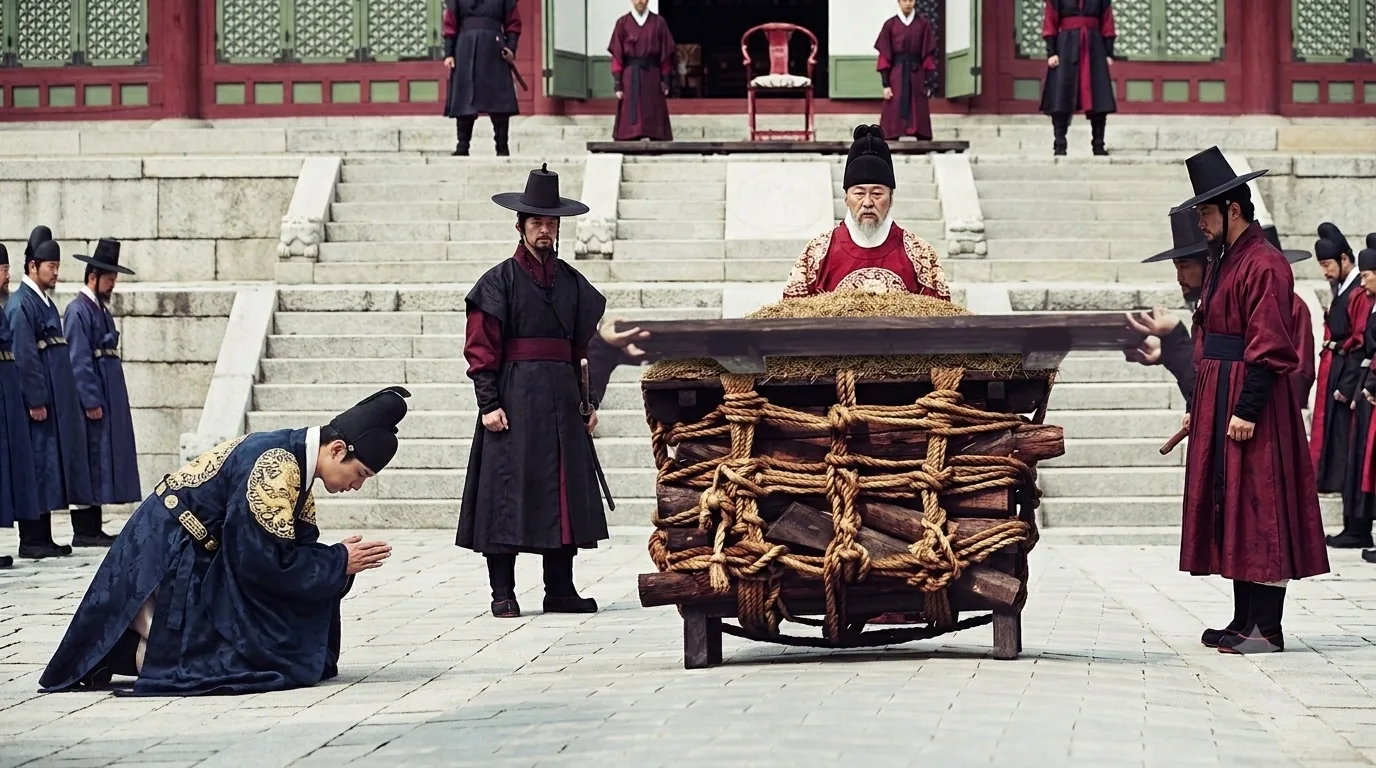
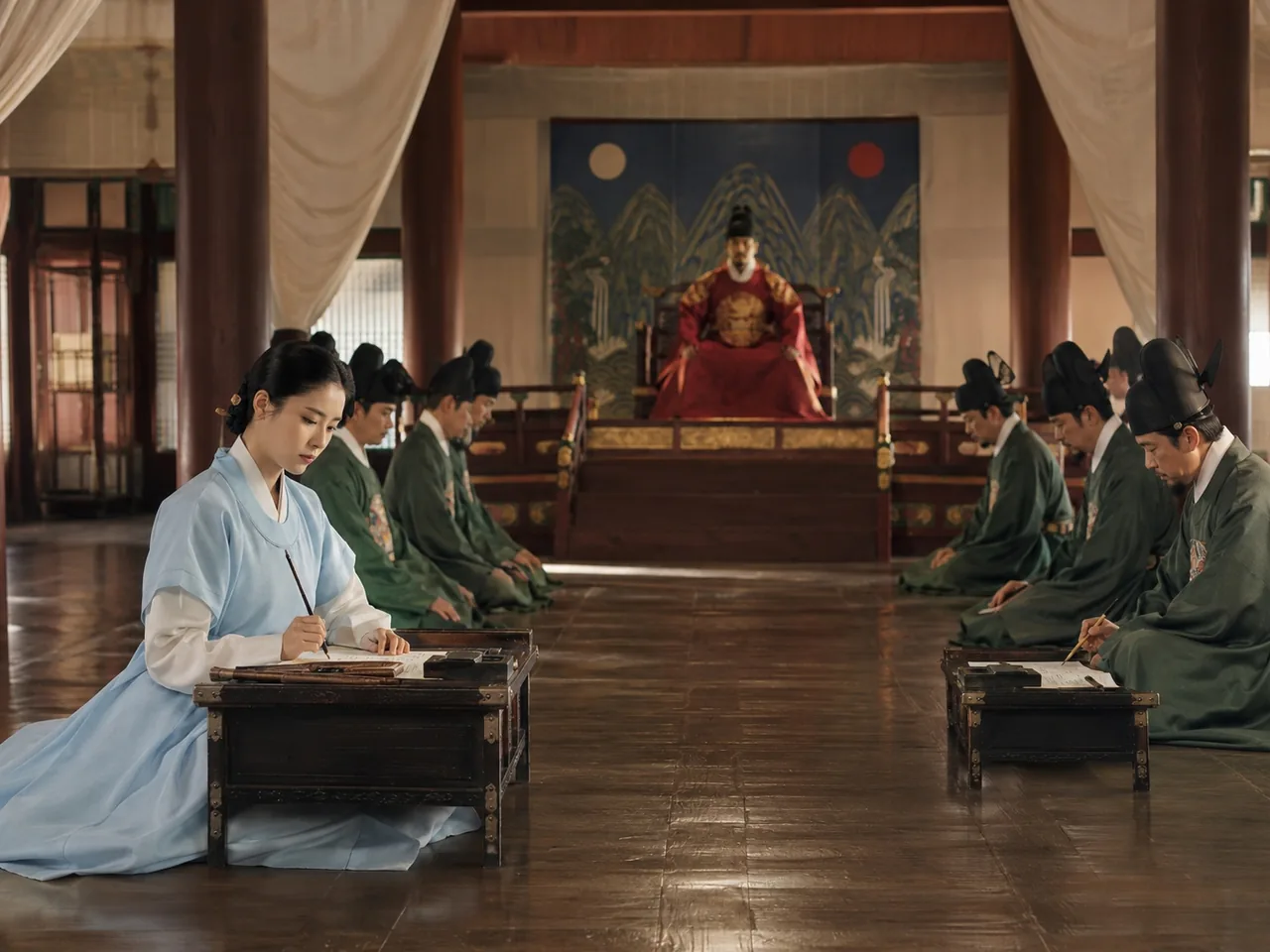
From the research behind Pause the Drama.
If you’ve watched the quietly devastating 2021 K-drama The Red Sleeve (옷소매 붉은 끝동) — the love story of the court lady Seong Deok-im and the future King Jeongjo — one thing about it probably surprised you. This is a drama where the king loves the heroine, openly and patiently, and she keeps saying no.
A modern viewer half-expects her to melt. Instead, again and again, Deok-im weighs the most powerful man in the country’s affection against something else — her own small, ordinary freedom — and hesitates. The drama frames the king’s love not as a fairy-tale rescue but as a kind of beautiful trap.
Here’s the part that international viewers often miss: the real Seong Deok-im refused him too — not once but more than once, the records documenting two refusals roughly fifteen years apart. And once you understand what a Joseon court lady actually was, you understand exactly why a king’s love could feel less like a door opening than a door quietly locking behind her.
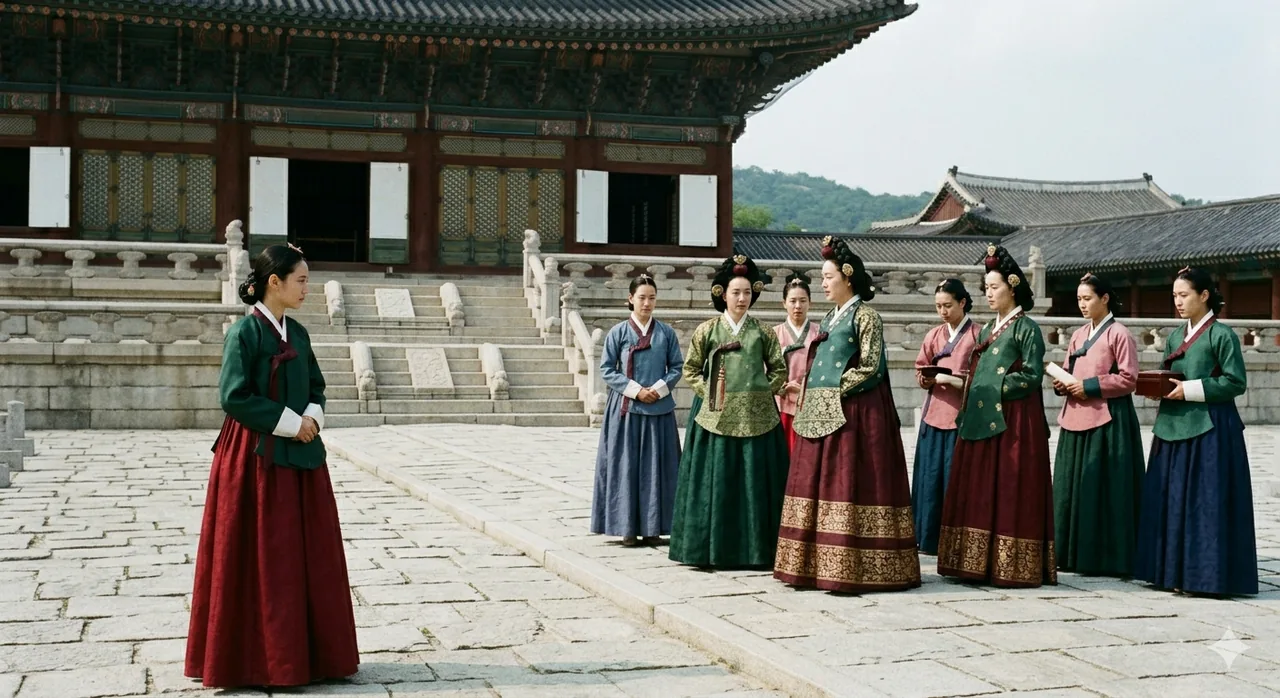 A court lady belonged to the palace before she belonged to herself. (AI illustration)
Quick answer: In The Red Sleeve, Seong Deok-im keeps refusing the king’s love — and history says the real woman did too. A Joseon court lady (gungnyeo) was a ranked professional bound to lifelong celibacy inside the palace. Accepting the king’s favor (seungeun) meant a rise in status but a permanent loss of freedom — closing the last door to an ordinary life outside the walls. Her hesitation wasn’t defiance. It was a clear-eyed reading of the price.
Let’s unpack it.
So what was a “court lady” in The Red Sleeve — was she just a servant?
Not quite a servant, and definitely not a princess. A Joseon court lady — gungnyeo (궁녀) — was something with no clean modern equivalent: a professional woman who belonged to the royal household (Encyclopedia of Korean Culture — 궁녀).
The full term, gungjung yeogwan, means roughly “a female officer of the court.” These were working women with assigned departments — sewing, embroidery, kitchens, the laundry, attending the queen — and they held actual government ranks, from the 9th grade up. They were salaried specialists inside the most exclusive institution in the country.
But “belonged to the household” is the key phrase. Girls entered the palace as children — entry age varied by department (the innermost departments, such as those serving the royal family directly, could take girls as young as four to eight; others admitted girls around age ten). They trained in court speech and etiquette for roughly fifteen years, after which a trainee underwent the coming-of-age rite — 계례 (gyerye) — and was formally recognized as a nain (나인), an ordinary court lady. The path upward from nain was equally slow: roughly another fifteen years before a nain might reach the highest rank an ordinary court lady could attain — sanggung (상궁), the senior fifth rank (정5품). That means entry to sanggung was typically a journey of around thirty years, with most sanggung reaching that rank well into their mid-thirties or later. (A court lady who received the king’s personal favor — seungeun sanggung — was a specific exception: she could be elevated to a special fifth-rank appointment in her twenties, bypassing the standard timeline entirely.) Seong Deok-im, historically, entered the palace as a child, around age ten by tradition — though the exact year is not firmly documented. This was not a job you took. It was a life you were enrolled in.
Why was the king’s love a problem in The Red Sleeve — and not a prize?
Because of one rule that hangs over the entire drama: a court lady was, in principle, the king’s woman — and only the king’s.
Court ladies were expected to remain unmarried for life. They lived under a regime of lifelong celibacy, bound to the palace; their bodies were considered to belong to the royal house. For most, romance was simply forbidden. There were narrow exceptions — a court lady might be released from palace service in cases of serious illness, old age or infirmity, the death of her royal patron, grave misconduct, or in extraordinary circumstances such as a drought prompting a royal act of mercy — but even then, a released court lady was expected to maintain her vows of celibacy and remain unwed for life. The release might free her body from the palace walls; it could not free her from the system that had shaped her entirely. So when the king turned his attention to one of them, he wasn’t offering her a normal love. He was offering the only love a court lady was ever permitted to have — and it came with the whole palace attached.
To receive the king’s favor — seungeun (승은), literally “receiving grace” — was, on paper, the dream: a leap upward in status. A favored court lady could be specially appointed seungeun sanggung, a distinct fifth-rank position that bypassed the ordinary decades-long wait. (This meant that a woman in her twenties could reach sanggung rank through the king’s favor, well ahead of the standard timeline — Seong Deok-im’s path was precisely this kind of exception.) If she bore the king a child, she could be elevated into the inner court hierarchy proper as a royal consort (후궁), receiving an official consort title (첩지) — Deok-im eventually became Uibin (의빈), a first-rank consort (Encyclopedia of Korean Culture — 의빈 성씨). That is genuine social mobility almost no other woman in Joseon could touch.
And yet. To accept seungeun was to be bound more tightly, not less. It closed off the faint possibility — held by lower-ranked palace women — of one day being released from service to live an ordinary life outside the walls. It pulled her permanently into the deadly politics of the inner court. The historical Deok-im, by the records the drama draws on, declined Jeongjo’s advances more than once — the records document two refusals, roughly fifteen years apart. One famous refusal turned on deference to his queen, who had not yet borne a child. The drama distills her real reluctance into a single, radical idea: she wanted to live her own life, and she understood that the king’s love was the surest way to lose it.
What makes this more remarkable still: Jeongjo himself wrote the epitaph. After Deok-im died in 1786, the king composed the Eoje Uibin Myojimyeong (어제의빈묘지명) — a funerary inscription in his own hand, documenting her life, her refusals, and his grief. That a king would write the epitaph of a consort himself was already extraordinary; that he recorded, in his own words, the two occasions she had said no to him is something rarer still. His love for her was not just a private matter — it entered the written record because he put it there. (어제의빈묘지명, Annals of King Jeongjo; 조선왕조실록 — National Institute of Korean History)
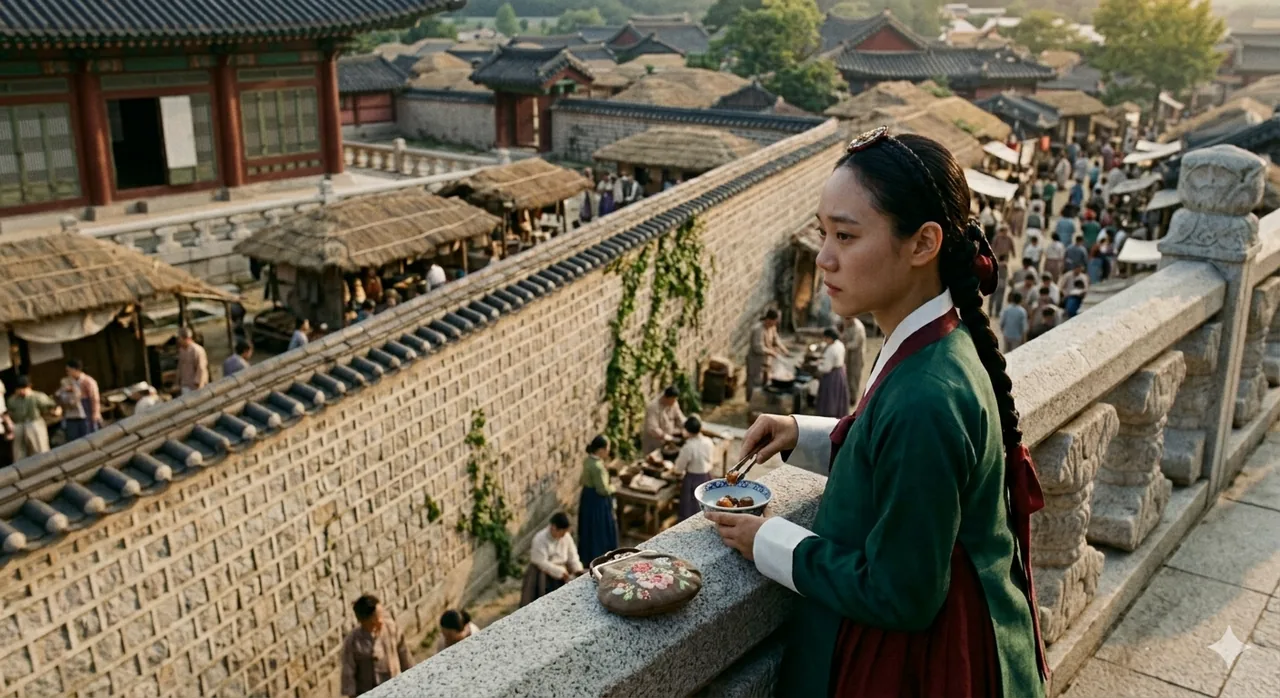 The king’s favor could raise a court lady’s rank — and close the last door back to an ordinary life. (AI illustration)
Key terms. Gungnyeo (궁녀) — a ranked female officer of the Joseon royal household, bound to lifelong celibacy and palace service from childhood. Nain (나인) — an ordinary court lady below sanggung rank. Sanggung (상궁) — a senior court lady of the fifth rank (정5품), the highest rank reachable through ordinary palace service. Seungeun (승은) — “receiving the king’s grace”: the moment a court lady became the king’s lover, raising her status but permanently closing the path back to ordinary life. Hugung (후궁) — a royal consort who has received an official consort title (첩지), placing her in the inner court hierarchy above ordinary court ladies. Uibin (의빈) — a first-rank royal consort title; Seong Deok-im received this title in 1783 after bearing Crown Prince Munhyo.
Wait — could a court lady really say no to a king in Joseon?
Here’s the myth worth correcting: that absolute monarchy meant a woman simply had no choice. The Red Sleeve suggests otherwise — and so, remarkably, does the history.
It would be wrong to romanticize this as freedom. A court lady had little formal power, and a king’s persistent will was a heavy thing. But Joseon was a Confucian bureaucratic state obsessed with propriety (예, ye), not a sultan’s pleasure-court. A king who simply seized a court lady against the rules of decorum could be quietly judged by his own scholar-officials. Process and precedence mattered.
That space was not incidental — it was structural. Joseon’s royal historians (사관, sagwan) were present at major royal events and recorded the king’s words and actions in real time. The resulting records were compiled into the Joseon Royal Annals (조선왕조실록) after each reign — famously sealed even from the king himself (National Institute of Korean History). When King Sejong attempted to read his father’s annals, his officials dissuaded him. When King Taejo reportedly asked a historian to keep something off the record, the historian recorded that request too. A king who overrode the decorum expected of a Confucian ruler could expect to be judged — quietly but permanently — in the written record. That culture of recorded propriety created the narrow but real room in which a woman like Deok-im could decline with dignity — to invoke deference to the queen, to delay, to make her reluctance itself a kind of statement.
That’s the quiet radicalism of The Red Sleeve. It doesn’t invent a feisty modern girl-boss. It takes a real woman who, within the suffocating constraints of her world, kept choosing herself for as long as she possibly could — and lets that be the love story. When she finally accepts, it reads not as surrender to romance but as a clear-eyed decision with a price attached.
Drama vs. History: what The Red Sleeve gets right
| In The Red Sleeve | In real Joseon history |
|---|---|
| Deok-im repeatedly refuses the king’s advances | Historical records confirm she declined seungeun more than once — two refusals roughly fifteen years apart are documented |
| She defers to the queen who has no son yet | One documented refusal invoked this exact rationale — improper while the queen had no heir |
| She rises to first-rank consort after accepting | Uibin Seong (의빈 성씨) was elevated to first-rank consort in 1783, after bearing Crown Prince Munhyo |
| She dies young, leaving the king bereft | The real Uibin died in 1786 at age 33, while pregnant with a second child |
| A gungnyeo’s palace life is shown as total and lifelong | Girls entered as young as age 4–10 (by department); lifelong celibacy was the formal expectation, with narrow exceptions for illness, infirmity, or special release |
In short: The Red Sleeve dramatizes a real love story — a court lady who kept saying no until she couldn’t, and a king who loved her enough to write it down himself.
Why The Red Sleeve’s cage feels so universal: five civilizations, five traps for palace women
This is where Joseon’s court lady comes into focus — because every great monarchy built a world of palace women, and each one trapped them differently. Lay them side by side and The Red Sleeve’s central conflict sharpens into something much older than one drama.
Korea — the court lady who could, in theory, refuse. As we’ve seen, the gungnyeo was a ranked professional of the household, bound to lifelong celibacy and to the king alone. Power came only through the king’s favor and, above all, through bearing his child. But within a Confucian state fixated on propriety, there was a sliver of negotiating room — and Seong Deok-im used every inch of it.
China — chosen by the state, watched by eunuchs. In the Forbidden City, the emperor’s women were selected by the state itself. Under the Qing dynasty, officials reviewed candidates every three years — judged on family, character, conduct, and appearance — to enter the imperial harem (the xiunu selection system). Their world was governed and policed by eunuchs, castrated men who were the only males allowed near the consorts, precisely so that any child could only be the emperor’s. (South China Morning Post, “Inside the Forbidden City”) The hierarchy ran from Empress down through a ladder of consort ranks, and the surest rung up was the same as in Korea: give the emperor a son. Here there was no “saying no” — entry was a state procedure, not a courtship.
Japan — the Ōoku, a sealed female city. Edo Castle held the Ōoku (大奥, “the great interior”), a vast women’s quarter that functioned for roughly 250 years (from the early seventeenth century through 1868), housing anywhere from several hundred to, by some accounts, thousands of women depending on the period (Nippon.com — Kasuga no Tsubone and the founding of the Ōoku). Recruited largely from the daughters of the shogun’s samurai retainers, they entered young and lived under strictly enforced celibacy — adult men, the shogun excepted, were forbidden to enter at all. It was a rigid, self-governing female hierarchy, ruled at the top by the shogun’s official wife and the senior women who had served for decades. The Joseon court and the Ōoku rhyme closely: a sealed world of palace women, ranked, celibate, and built around a single man’s bloodline.
The Ottoman harem — slavery, power, and the mother who ruled an empire. The Ottoman imperial harem operated on an entirely different logic. From the sixteenth century onward, the sultan’s concubines were drawn largely from enslaved women — typically war captives or purchases from slave markets across the empire’s vast territories. Entry was not a career path for free women; it was a consequence of capture or sale. Yet within this system, the possibilities at the top were extraordinary. The valide sultan — the sultan’s mother — held formal authority over the entire harem and, in certain periods of Ottoman history, exercised real political power reaching beyond the palace into the machinery of state. Figures like Kösem Sultan (early seventeenth century) effectively acted as regents, managing imperial policy during the reigns of young or incapacitated sons. The contrast with Joseon is stark: in the Ottoman system, a woman could rise from enslavement to the effective governance of an empire — but the entry point was bondage, not a ranked professional appointment.
Joseon vs. Ottoman: the sharpest contrast. A Joseon court lady entered the palace as a free subject, held a government rank, and could (in principle) decline the king’s favor. An Ottoman concubine entered as property. Yet the Ottoman system at its peak placed a woman at the summit of imperial power — regent, power-broker, empire-manager. The Joseon system gave court ladies rank and a sliver of dignity; it gave them almost no path to political power beyond the king’s bedchamber. One cage was gilded at the top; the other was more humane at the door.
The West — the unofficial mistress and the official attendant. Europe drew the line in a completely different place. At a court like Versailles, two roles existed side by side. The lady-in-waiting was the formal, respectable post: an attendant on the queen or princess. The royal mistress, by contrast, was the king’s lover — and in France this could become a startlingly public office, the maîtresse-en-titre, complete with her own apartments, estates, and a court title. Figures like Madame de Pompadour wielded influence rivaling the queen’s. (Encyclopædia Britannica: Madame de Pompadour) Here is the deep contrast: in Joseon and the Forbidden City, a king’s lover was folded inside the official rank system (concubine, consort); in France, the king’s lover sat in a glittering, semi-official slot beside the legitimate structure — acknowledged, even celebrated, yet never quite legitimate.
Five civilizations, five cages. Korea ranked her as an officer and bound her in celibacy; China selected her by decree and watched her with eunuchs; Japan sealed her inside a female city that lasted two and a half centuries; the Ottoman Empire drafted her from slavery and occasionally handed her an empire to run; the West split her in two — the honored attendant and the powerful, unofficial lover. Look closely at Deok-im hesitating at the palace gate, and you’re seeing one woman stand at the exact point where all these worlds converge: the place where a king’s desire meets a woman’s vanishing freedom.
Coming up next
One court lady’s quiet refusals — and we’ve traveled from a Joseon palace, to the Forbidden City under the Qing, to Edo Castle’s sealed female quarter, to an Ottoman harem that once governed an empire, to Versailles. That’s the quiet gift of a serious historical drama: a woman hesitating at a gate is a doorway into every system ever built to contain her.
In the next essay, we’ll take another K-drama scene that looks like pure fiction — and trace the real Korean history hiding underneath it.
Frequently asked questions
Is The Red Sleeve based on a true story? Yes, loosely. Its two leads are real: King Jeongjo (1752–1800) and Seong Deok-im, who historically entered the palace as a child and eventually became his consort Uibin Seong (의빈 성씨). The records confirm she declined his advances more than once — the historical documents record two refusals roughly fifteen years apart. The drama dramatizes and fills in the emotional detail, but its spine — a court lady who resisted a king’s love — is rooted in history.
Did Seong Deok-im really refuse to become the king’s concubine? Yes — the historical record documents two refusals, roughly fifteen years apart. One famous refusal turned on deference to the queen who had not yet borne a child. She is remembered for wanting to live her own life rather than be bound as a royal concubine. She eventually accepted, bore a crown prince, and was elevated to first-rank consort — but died young, in 1786, while pregnant again.
What was a gungnyeo (court lady), exactly? A gungnyeo was a professional woman of the royal household — a ranked “female officer of the court,” with duties like sewing, embroidery, or attending the queen. Girls entered the palace as children (entry age varied by department, ranging from around four to ten), trained in court etiquette, and faced lifelong celibacy bound to the palace and, in principle, to the king alone. Promotion was extremely slow: after roughly fifteen years of service, a trainee underwent the coming-of-age rite (계례, gyerye) and became a full nain (나인, ordinary court lady). From nain, it took roughly another fifteen years — around thirty years from entry in total — to reach the senior rank of sanggung (상궁, fifth rank, 정5품), with most sanggung achieving that rank in their mid-thirties or later. The exception was a seungeun sanggung — a court lady elevated through the king’s personal favor — who could reach sanggung rank in her twenties, bypassing the standard timeline entirely.
What was seungeun, and why did Deok-im resist it? Seungeun (승은) means “receiving the king’s grace” — the moment a court lady was chosen by the king as a lover. On paper it was a promotion: the woman became seungeun sanggung (a special fifth-rank appointment), and if she bore a royal child, could rise to full consort rank in the inner court hierarchy. But it also closed off any chance of leaving palace life for an ordinary one, and pulled her permanently into the lethal politics of the inner court. The drama captures why Deok-im hesitated: the king’s love was also a lock.
How old was Seong Deok-im when she entered the palace? The exact year of her entry is not firmly documented in the records, but tradition holds she entered the palace around age ten — a common entry age for girls assigned to departments close to the royal family. The Encyclopedia of Korean Culture entry for Uibin Seong gives the broad outlines of her life without fixing a precise entry date.
Was a sanggung a concubine? No — sanggung and royal concubine (hugung) were distinct categories. A sanggung was a senior court lady of the fifth rank (정5품), the highest rank an ordinary court lady could reach through years of palace service. A royal concubine (후궁) was a woman who had received an official consort title (첩지) from the court, placing her in the upper tier of the inner court hierarchy. A seungeun sanggung was a special fifth-rank appointment that was not yet a full consort title. Seong Deok-im held this status before being formally elevated to the consort title Uibin in 1783.
What was the Ōoku? The Ōoku (大奥, “the great interior”) was the women’s quarter inside Edo Castle, home to the shogun’s wives, concubines, and their attendants. Established in the early seventeenth century under the third shogun Tokugawa Iemitsu, it functioned for roughly 250 years, housing anywhere from several hundred to, by some accounts, thousands of women at its peak. It operated as a rigidly hierarchical, self-governing female world; adult men other than the shogun were forbidden to enter.
Could Joseon kings really be checked by their own historians? Yes — this is one of the most striking features of Joseon’s Confucian bureaucratic culture. Royal historians (사관, sagwan) were present at major royal events and recorded the king’s words and actions in real time. The resulting records — compiled into the Joseon Royal Annals (조선왕조실록) after each reign — were famously sealed even from the king himself. When King Sejong tried to read his father’s annals, he was dissuaded by his officials. When King Taejo reportedly asked a historian to keep something off the record, the historian recorded that request too. This culture of recorded propriety meant a king who overrode court decorum could expect to be judged — quietly but permanently — in the written record.
Why did Seong Deok-im refuse King Jeongjo? For Deok-im, accepting the king’s favor (seungeun, 승은) was not simply a romantic choice — it was a permanent legal and social transformation. It would elevate her rank and bring her inside the inner court hierarchy, but it would also close off the last faint possibility of ever leaving palace life for an ordinary one. A court lady who had not received the king’s attention could, in rare circumstances, be released — through illness, old age, or special royal mercy — and live outside the walls. One who had received his favor could not. She would be drawn permanently into the lethal politics of the inner court, bound to its rivalries for the rest of her life. The historical Deok-im refused more than once, the records documenting two refusals roughly fifteen years apart. Her hesitation was not defiance and not a failure to love. It was a clear-eyed reading of what the king’s love would cost: not just her body or her obedience, but the last door back to a self that was entirely her own.
Could a Joseon court lady ever leave the palace? Rarely, and never completely. Physical departure from the palace was possible in narrow circumstances — serious illness, advanced age or infirmity, the death of the royal patron a court lady had served, grave misconduct, or extraordinary royal acts of mercy such as a special release during a drought. But leaving the walls did not end the system’s claims on her. A released court lady was still regarded, socially and legally, as “the king’s woman”: she was expected to maintain lifelong celibacy and was forbidden to marry. The physical exit and the release from lifelong solitary obligation were two entirely separate things — a woman might leave the palace building and still spend the rest of her life alone, outside any normal household, unmarried and bound by the vows the palace had placed on her as a child.
Sources & further reading
This piece was written from the historical script and fact-check of 사뚱샘의 역사방 (SaDDungSam), drawing on Korea’s own primary records and standard reference works. Key claims are sourced inline above; for further reading:
- Gungnyeo (궁녀) — court ladies of the Joseon palace: ranks (nain, sanggung), entry age, celibacy regime, and service structure. (Encyclopedia of Korean Culture / 한국민족문화대백과)
- Uibin Seong (의빈 성씨) — the historical Seong Deok-im: her entry into the palace, her refusals of Jeongjo’s advances, elevation to first-rank consort (1783), and early death (1786). (Encyclopedia of Korean Culture / 한국민족문화대백과)
- 어제의빈묘지명 (Royal epitaph for Uibin, written by King Jeongjo himself) — the primary source documenting Jeongjo’s grief and his account of Deok-im’s refusals. Referenced in the Annals of King Jeongjo (Jeongjo Sillok). (어제의빈묘지명; Annals of King Jeongjo — National Institute of Korean History)
- The Veritable Records of the Joseon Dynasty (조선왕조실록) — official English archive of 472 years of Joseon court records, including the Jeongjo Sillok. (National Institute of Korean History)
- Royal concubine (후궁) in early Joseon — the social standing of the hugung, distinctions between selection-based (gantaek) and favor-based (seungeun) concubines. Lee Mi-seon, The Review of Korean History (2009). (KCI Academic Journal)
- The Forbidden City’s imperial consort selection — the Qing dynasty three-yearly xiunu review of candidates and the role of eunuchs in the inner court. (South China Morning Post, “Inside the Forbidden City”)
- The Ōoku — the shogun’s inner chambers at Edo Castle: its founding under the third shogun Iemitsu, the celibacy rules, and the female hierarchy it produced. (Nippon.com — Kasuga no Tsubone and the establishment of the Ōoku)
- Madame de Pompadour and the maîtresse-en-titre — the official royal mistress of Louis XV, her court title, apartments at Versailles, and political influence. (Encyclopædia Britannica: Madame de Pompadour)
- Ottoman imperial harem and the valide sultan — slavery, concubinage, and the political power of the sultan’s mother in the Ottoman court. (Encyclopædia Britannica, “harem”; Leslie Peirce, The Imperial Harem: Women and Sovereignty in the Ottoman Empire, Oxford University Press, 1993.)
In the next essay, we’ll take another K-drama scene that looks like pure fiction — and trace the real Korean history hiding underneath it.
Thanks for reading — see you in the next one.
This article was researched and written by K-Drama History. Source: The Red Sleeve, Explained: Why Did Seong Deok-im Refuse King Jeongjo? — K-Drama History