What Is Yeoseong Gukgeuk? Jeong Nyeon & Korea's Lost All-Female Theater, Explained
Theme: Women’s Lives
From the research behind Pause the Drama.
The curtain rises on Jeong Nyeon (정년이, 2024, MBC) to an image that stops international viewers cold: 1950s Seoul, a stage blazing with costume and light, and not a man in sight. The general is a woman. The prince is a woman. The villain is a woman. And the audience — dominated by women — is screaming.
The genre these performers practiced was called yeoseong gukgeuk (여성국극, “women’s national drama”), and it occupied a remarkable but brief golden age in the devastated landscape of post-Korean War Korea. Outside Korea, it is nearly unknown. Inside Korea, the drama Jeong Nyeon became the show that finally gave it a popular second life — and in doing so raised questions about what this strange, vivid genre meant to the women who made it and the women who watched it.
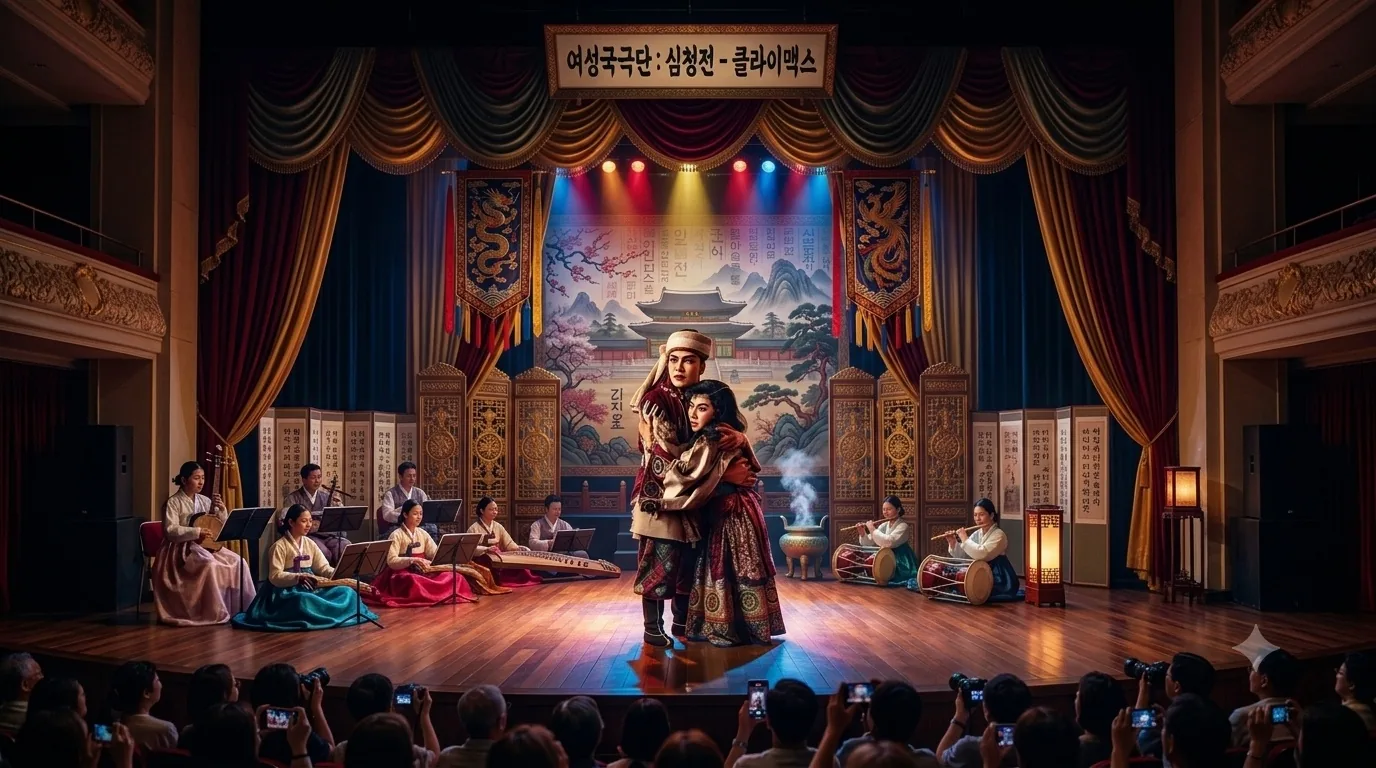
 On the yeoseong gukgeuk stage, every role — hero, villain, lover — was played by a woman. (AI illustration)
Quick answer: Jeong Nyeon dramatizes the golden age of yeoseong gukgeuk, an all-female theatrical genre derived from the pansori and changgeuk (staged pansori opera) traditions, with its commercial peak running from around the late 1940s through the 1950s. The Korean War reduced the male performer population and simultaneously created a massive female audience of war widows and women managing alone — transforming what might have remained a niche curiosity into a dominant popular entertainment. The genre peaked in the early-to-mid 1950s and largely collapsed in the 1960s as television and cinema captured the popular audience. Jeong Nyeon (2024, MBC) is its most ambitious popular revival.
At a glance
| Question | Answer |
|---|---|
| What genre is it? | Yeoseong gukgeuk — all-female Korean musical theater |
| Where did it come from? | Late 1940s, out of the pansori and changgeuk traditions |
| Golden age | The 1950s |
| Signature feature | Women played every role, including the male heroes |
| Defining star | Im Chun-aeng (1924–1975), “the prince of yeoseong gukgeuk” |
| Why it declined | 1960s — television, cinema, and institutional marginalization |
| Why Jeong Nyeon matters | It brought the near-forgotten genre back to a mainstream audience |
Here is the full picture.
Where did yeoseong gukgeuk come from — and what made it a distinct genre?
The performance traditions behind Jeong Nyeon have roots that go back centuries. Pansori (판소리) is a Korean vocal performance form in which a single singer (sorikkun) narrates a long dramatic story to the accompaniment of a barrel drum (buk), with percussive encouragements (chuimsae) from the drummer marking emotional peaks. Pansori is historically associated with itinerant lower-class performers — the gwangdae — though the form’s precise social origins are complex and not fully settled in the scholarly literature. And it did not stay confined to those roots: across the 18th and 19th centuries pansori drew the attention and patronage of yangban literati — the 19th-century theorist Sin Jae-hyo famously codified and refined its repertoire — growing into one of late Joseon’s most sophisticated narrative arts. By the late 19th century, pansori had begun to be adapted into staged ensemble theater, a format called changgeuk (창극), which retained pansori’s musical core while distributing roles among multiple performers on a proper stage with costumes and scenery.
Yeoseong gukgeuk developed as a specialization within changgeuk in which all roles — male and female — were performed by women. It did not appear overnight. Women had already begun taking male roles in mixed-cast changgeuk in the mid-1940s (the performer Park Gwi-hee won notice as a male lead in 1944–45), proving that an all-female stage was viable. The genre then crystallized in stages. In 1948, leading performers founded the Women’s Gugak Friendship Society (여성국악동호회) and staged its inaugural production, Okjunghwa, with Im Chun-aeng in the male lead. Korean performing-arts reference works — the National Folk Museum’s Encyclopedia of Korean Folk Culture and the National Gugak Center (국립국악원) — take this 1948 society as the genre’s institutional starting point. The decisive popular breakthrough came the next year, with the 1949 hit Haennim-gwa Dallim (햇님과 달님) — after which yeoseong gukgeuk took off as mass musical theater, reaching its commercial peak across the 1950s, when troupes like the Wuri Yeoseong Gukgeukdan (우리여성국극단) drew audiences that rivaled the new cinema.
The genre’s defining aesthetic was the namjang baeu (남장배우, “male-dressed actress”) — the performer who took male roles. Playing a general or a king in yeoseong gukgeuk required specific and intensive training: the commanding posture, the lower vocal register, the physical authority that made male heroes legible and electrifying to audiences who expected those roles to be inhabited with full commitment. This was not pantomime or parody — it was the central dramatic core of the genre. The most celebrated practitioner was Im Chun-aeng (임춘앵, 1924–1975), a pansori-trained performer who became the genre’s defining star and whose stage presence generated a fan culture that contemporary newspaper accounts described with something between admiration and astonishment.
Why did the Korean War give yeoseong gukgeuk its golden age?
First, a clarification the drama’s drama can obscure: yeoseong gukgeuk did not arise because the men were gone. It was already taking shape before the war — the 1948 founding, the 1949 breakthrough — as a deliberate artistic genre. What the Korean War did was supercharge it, converging several forces in the early 1950s to amplify its commercial appeal. The war (1950–1953) disrupted the male performer population dramatically — many male musicians, actors, and entertainers were conscripted, killed, or displaced — while simultaneously creating a vast new audience. The war widow population and the broader community of women managing households alone, with husbands missing or dead, became a core demographic of Korean popular entertainment in this period. Yeoseong gukgeuk offered them something that other entertainment did not: a stage full of powerful, active, decisive figures — heroes, leaders, avengers — all performed by women.
The cross-dressing dynamic was also commercially effective in a more straightforward sense. The novelty of female performers playing male roles attracted audiences from curiosity alone, and the skill required to make those roles convincing — and the emotional investment female fans formed in specific namjang baeu performers — built a loyal returning audience. Contemporary newspaper accounts from the early 1950s describe female fans waiting outside stage doors and presenting flowers and gifts to the actresses who played male heroes — and, in some accounts, sending letters written in blood, or asking a beloved male-role star to dress as a groom and pose with them for a “wedding” photograph. Read today, the descriptions are startlingly recognizable to anyone familiar with modern K-pop fan culture: named stars, distinctive fan followings, and an intensity of audience identification that went well beyond ordinary appreciation. Half a century before idol fandom had a name, it already had a stage.
The genre was absorbing influence from multiple directions simultaneously. Its musical core was pansori-derived changgeuk, but it integrated elements of sinpa-geuk (신파극, early Korean melodrama influenced by Japanese theatrical forms) and the visual spectacle of touring opera — elaborate costumes, set designs, and theatrical effects. What emerged was a genuinely hybrid popular form: not purely traditional, not purely modern, but new.
Was yeoseong gukgeuk just entertainment, or did it carry wider cultural meaning?
The question deserves careful handling. The temptation to read yeoseong gukgeuk’s female fan culture through a contemporary critical lens — as proto-feminist space, as licensed transgression of gender norms, as a queer opening within a conservative society — is understandable, and some elements of the historical record could be read that way. What the evidence supports with confidence is this: the fan culture was intense, documented, and without clear precedent in Korean performance history. Women formed passionate attachments to women who embodied male power and heroism on stage. Whether and how that dynamic exceeded the category of “theatrical admiration” within the value systems of 1950s Korean society is a more complex question that deserves the evidence before it gets the interpretation.
What is unambiguous is the genre’s place in the modernization of Korean traditional performing arts. Pansori began as the art of lower-class itinerant performers; changgeuk brought it to a theater stage and a middle-class paying audience; yeoseong gukgeuk brought it to national touring circuits and into conversation with the commercial entertainment industry of post-liberation Korea. This is not a trajectory of decline but of expansion — until, in the 1960s, the expansion met competition it could not match.
Television arrived in South Korea in 1956 (KBS television), and cinema was already fighting for urban audiences. Both offered endless content, intimate delivery, and national reach without the expense of maintaining touring companies and physically filling theaters. The genre’s audience — largely working-class and lower-middle-class women in regional cities and towns — gradually shifted their entertainment spending toward the screen. But the decline was never about television alone: cinema, the punishing economics of keeping touring companies on the road, and the institutional marginalization of yeoseong gukgeuk within the official traditional-arts establishment — where state-backed changgeuk drew the funding and prestige — pushed the genre out of the mainstream together. By the late 1960s, the major yeoseong gukgeuk troupes had disbanded or reduced to minimal activity. Im Chun-aeng continued performing in various contexts, but the genre’s commercial peak was definitively past.
The revival has been partial and largely confined to scholarly and specialist circles until recently. Jeong Nyeon (2024, MBC) is the largest-budget and highest-profile popular engagement with yeoseong gukgeuk in decades, and its commercial and critical success suggests that an appetite for this story was waiting.
How does Jeong Nyeon compare with the historical record?
| In Jeong Nyeon | In real history |
|---|---|
| The protagonist Jeong Nyeon is a prodigious new talent joining an established troupe | Jeong Nyeon is a fictional character; her trajectory is invented, modeled on the general contours of how new performers entered the yeoseong gukgeuk world |
| Im Chun-aeng appears as a named character and major figure | Im Chun-aeng (1924–1975) was a real person and the genre’s most prominent star; her depiction in the drama is a fictionalized portrayal of a historical individual |
| The drama shows troupe life, touring circuits, intense fan culture, and competition between companies | These elements reflect documented historical realities: touring was economically precarious, fan culture was intense, and commercial competition between troupes was real |
| Costumes, staging, and music are elaborately period-specific | The drama’s production design has been praised for careful attention to period stage aesthetics and to pansori-based musical performance |
| The genre’s decline is not shown — the drama ends before it arrives | Historically, yeoseong gukgeuk declined sharply in the 1960s as television arrived; the drama’s timeline does not reach this point |
Jeong Nyeon is a drama about a fictional performer in a historical world. The world is reconstructed with evident care; the story within it is invented. This is the standard creative architecture of historical fiction, and the drama’s authenticity lies in the setting rather than the specific plot.
Key terms. Yeoseong gukgeuk (여성국극) — “women’s national drama”; an all-female Korean theatrical genre derived from changgeuk, with its commercial golden age from the late 1940s through the late 1950s. Pansori (판소리) — the Korean narrative musical performance form, performed by a single vocalist with barrel-drum accompaniment; the musical root of both changgeuk and yeoseong gukgeuk; now a UNESCO Intangible Cultural Heritage. Changgeuk (창극) — ensemble staged pansori, with sets, costumes, and multiple performers each taking a distinct role. Namjang baeu (남장배우) — the “male-dressed actress”; the performer who takes male roles in yeoseong gukgeuk and constitutes the genre’s defining aesthetic identity. Im Chun-aeng (임춘앵, 1924–1975) — the defining star of yeoseong gukgeuk’s golden age, whose pansori training and stage charisma created a fan culture comparable in structure to later popular-idol phenomena. Wuri Yeoseong Gukgeukdan (우리여성국극단) — one of the leading yeoseong gukgeuk troupes of the 1950s.
Gendered stages: from Seoul to Takarazuka to Shakespeare’s London
The yeoseong gukgeuk phenomenon was not unique in world theater history, but the parallels that illuminate it most closely are specific ones.
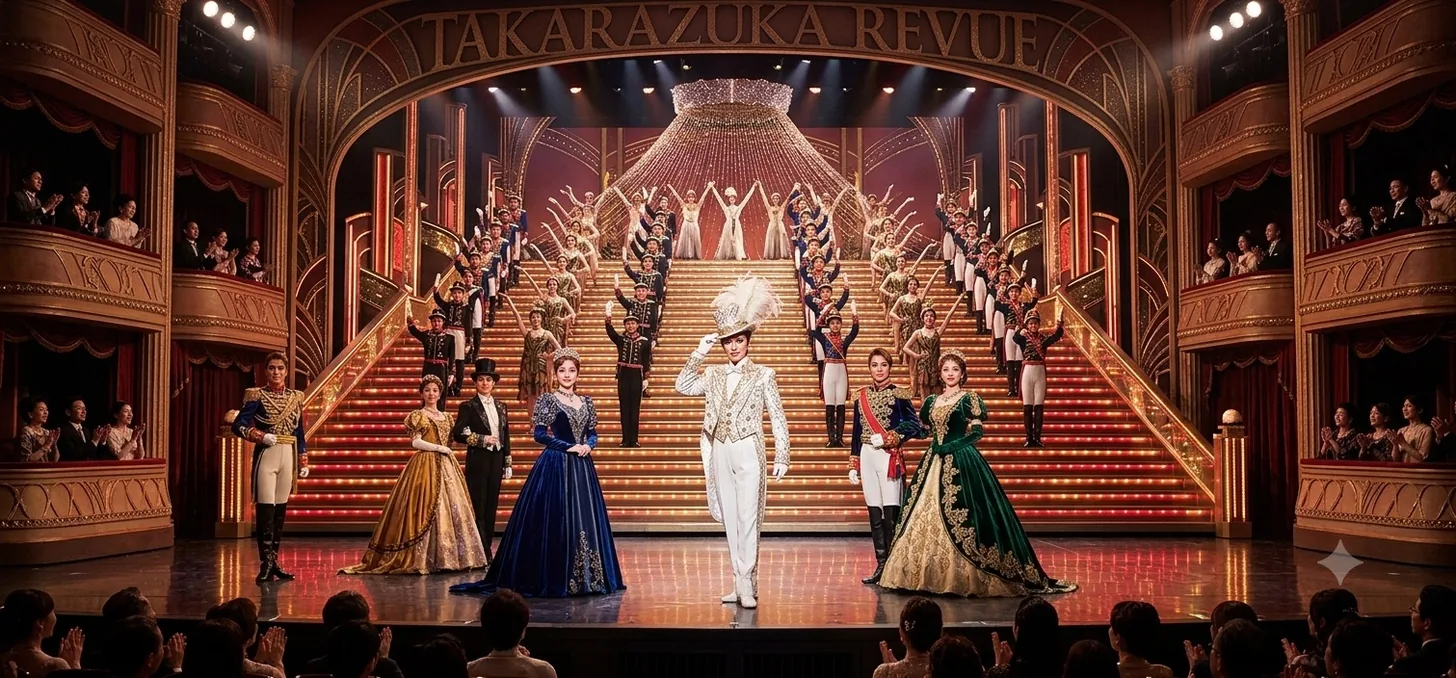
Japan — the Takarazuka Revue, the century-long parallel. The most direct comparative case is Japan’s Takarazuka Revue (宝塚歌劇団), founded in 1914 with backing from the Hankyu Railway company as a commercial entertainment venture for audiences traveling to a resort town near Osaka. Like yeoseong gukgeuk, it is exclusively female in its performer roster; like yeoseong gukgeuk, it features otoko-yaku (男役, male-role performers) who play heroes and romantic leads, with fan followings dominated by women. Unlike yeoseong gukgeuk, Takarazuka has operated continuously for over a century and today remains one of Japan’s most successful theatrical institutions. The two genres even crowned their male-role stars in the same idiom: where Im Chun-aeng was hailed as “the prince of yeoseong gukgeuk,” Takarazuka’s celebrated postwar otoko-yaku Kasugano Yachiyo was known as the “White Rose Prince.”
The parallels raise a legitimate question: did Japanese theatrical culture influence the development of yeoseong gukgeuk during the colonial period (1910–1945), when Japanese popular entertainment was present throughout Korean cultural life? This is acknowledged as a subject for further scholarly investigation, and the similarities are striking enough to warrant it. But two structural differences are worth holding onto. First, Takarazuka was a corporate creation, financed and institutionally supported by Hankyu Railway from the beginning, with the infrastructure to survive downturns that would destroy a less-capitalized competitor. Korean yeoseong gukgeuk troupes were largely voluntary associations of performing artists — entrepreneurial, precarious, and without a corporate backer. This difference partly explains why Takarazuka survived the arrival of television and cinema while yeoseong gukgeuk did not. Second, the national and social contexts of the two genres differ enough that structural similarity should not be read as derivation: both may represent parallel responses to similar theatrical and social conditions rather than one borrowing from the other.
Western Europe — Shakespeare’s all-male stage, and the Restoration’s reversal. In 16th- and 17th-century England, the situation on the public stage was the precise inverse of yeoseong gukgeuk: women were prohibited from performing, and every female role — Juliet, Ophelia, Cleopatra, Viola — was played by boy actors (boy players). The prohibition arose from a combination of religious moral censure, anxieties about the social respectability of the public stage, and conventions about female modesty in public life. The theater was not female-free from aesthetic preference but from legal and social prohibition.
This changed with the Restoration of 1660, when Charles II returned from exile in France with a different model: Parisian theater used female actresses, and English theater would now do the same. The first documented professional actresses on the English public stage appeared in the 1660–1661 season. From that point, a different kind of gendered stage play emerged: the “trouser role” (Hosenrolle) in European opera and theater — a female singer or actress performing a male character, as with Cherubino in Mozart’s Le Nozze di Figaro or Octavian in Richard Strauss’s Der Rosenkavalier. The trouser role is thus the structural reverse of the namjang baeu in one important respect: it emerged from a tradition that had initially excluded women and became a deliberate aesthetic choice after women won access to the stage. The namjang baeu emerged from a tradition in which women were the only option — and turned that condition into an art form with its own aesthetic logic and its own devoted public.
 Japan’s Takarazuka Revue — the all-female institution that ran the same idea for over a century. (AI illustration)
Coming up next
An all-female stage rising from the wreckage of war, thriving for a decade and a half on a combination of artistic ambition and social necessity, and then going nearly silent as television changed what Koreans watched — until a 2024 drama brought it back to the surface. The yeoseong gukgeuk story is about many things at once: the resilience of traditional performing arts under pressure, the cultural work that entertainment does in societies under stress, and what happens to women’s creative and commercial space in the space that opens when ordinary social arrangements break down.
In the next essay, we return to the Joseon court and ask about a different kind of power struggle — one fought not with swords but with political theory, and where the stakes were the right to govern.
Thanks for reading — see you in the next one.
Frequently asked questions
What was yeoseong gukgeuk? Yeoseong gukgeuk was an all-female Korean theatrical genre that performed traditional narrative drama — drawing on pansori and changgeuk traditions — with women playing every role, including male heroes, generals, and kings. Its golden age ran from approximately the late 1940s through the late 1950s. Male-role performers (namjang baeu) were the genre’s defining stars, with passionate female fan followings documented in period newspapers.
What is Jeong Nyeon about? Jeong Nyeon (정년이, 2024, MBC) is a coming-of-age drama set in the world of yeoseong gukgeuk — all-female Korean theatrical performance — in 1950s South Korea. The fictional protagonist joins a leading troupe and pursues mastery of a demanding art form while navigating the intense internal culture of touring performers and a devoted female fan base. The drama is both a character study and a historical recovery of a nearly forgotten genre.
Who was Im Chun-aeng, and why does she matter? Im Chun-aeng (임춘앵, 1924–1975) was the defining star of yeoseong gukgeuk’s golden age. Trained in pansori from childhood, she became the genre’s most celebrated male-role performer, whose charisma and vocal authority generated a fan culture that contemporaries described as unprecedented in Korean theater. The drama Jeong Nyeon includes her as a named character, though the dramatic portrayal is necessarily fictionalized around the historical person.
Why did yeoseong gukgeuk become so popular after the Korean War? Several forces converged: the war dramatically reduced the male performer population through conscription and casualty; the corresponding explosion of female war widows and women managing households alone created a large and loyal entertainment audience; and the aesthetic novelty of watching skilled female performers inhabit male roles proved commercially powerful in its own right. The genre met a social moment precisely shaped for it.
How does yeoseong gukgeuk compare with Japan’s Takarazuka Revue? Both are all-female theatrical institutions with prominent male-role performers (otoko-yaku in Takarazuka, namjang baeu in yeoseong gukgeuk) and strongly female fan cultures. Takarazuka was founded in 1914 with Hankyu Railway corporate backing and has operated continuously for over a century. Korean yeoseong gukgeuk troupes were generally performer-formed associations without comparable institutional support, which is part of why they did not survive the competitive pressure of television and cinema in the 1960s. Whether Japanese theatrical culture directly influenced yeoseong gukgeuk’s development during the colonial period is a question scholars continue to investigate.
Why did yeoseong gukgeuk decline in the 1960s? Television arrived in South Korea in 1956 and cinema was already a competing entertainment form. Both offered cheaper, more convenient, and more varied content to the same audiences that had sustained yeoseong gukgeuk’s touring companies. The genre’s live-performance touring model could not compete with broadcast economics. The major troupes disbanded or reduced activity, and yeoseong gukgeuk effectively left the mainstream by the end of the 1960s.
How historically accurate is Jeong Nyeon? The drama’s protagonist and most of its specific plot are fictional. What the drama recreates with historical care is the world: the performance style, stage aesthetics, costume, and music of yeoseong gukgeuk; the social structure of a touring troupe; and the intensity of the fan culture. Im Chun-aeng and other real figures appear as named characters whose dramatic portrayal is fictionalized. Historians of Korean performing arts have generally assessed the drama as thoughtfully researched in its reconstruction of the genre’s atmosphere and practice.
What is pansori, and how is it related to yeoseong gukgeuk? Pansori is a Korean narrative musical performance form in which a single vocalist, accompanied by a barrel drum, performs a long dramatic story combining singing, spoken dialogue, and physical expression. Historically associated with itinerant lower-class performers and now a UNESCO Intangible Cultural Heritage, pansori was adapted into ensemble staged theater (changgeuk) in the early 20th century. Yeoseong gukgeuk developed as an all-female specialization of changgeuk, making the genealogy: pansori → changgeuk → yeoseong gukgeuk.
Sources & further reading
This piece was written from the historical script and fact-check of 사뚱샘의 역사방 (SaDDungSam), drawing on institutional archives, academic monographs, and official cultural records:
- Pansori history, changgeuk development, and the yeoseong gukgeuk lineage — Willoughby, Heather A., “The Sound of Han: Pansori, the Korean Voice, and the Performance of Korean Identity” (PhD dissertation, Columbia University, 2000); National Gugak Center (국립국악원) documentary archives on changgeuk and yeoseong gukgeuk history.
- Im Chun-aeng biography and the yeoseong gukgeuk golden age — Encyclopedia of Korean Culture (한국민족문화대백과사전), Academy of Korean Studies, entries on yeoseong gukgeuk (여성국극) and Im Chun-aeng (임춘앵). (encykorea.aks.ac.kr)
- Yeoseong gukgeuk fan culture and period press documentation — Korean-language newspaper archives (Chosun Ilbo, Dong-A Ilbo) from the 1950s, as cited through secondary scholarship on the genre.
- Post-liberation and post-war Korean social context — Korean Film Archive historical documentation on the 1950s entertainment landscape; secondary scholarship on post-war Korean popular culture.
- Takarazuka Revue founding, history, and comparative analysis — Takarazuka Revue institutional archive; Robertson, Jennifer, Takarazuka: Sexual Politics and Popular Culture in Modern Japan (University of California Press, 1998).
- Women on the English stage: boy actors and the 1660 Restoration — Orgel, Stephen, Impersonations: The Performance of Gender in Shakespeare’s England (Cambridge University Press, 1996).
- Trouser roles in European opera — Grove Music Online entries on role types and Hosenrolle; standard performance history of Mozart’s Le Nozze di Figaro and Strauss’s Der Rosenkavalier.
Thanks for reading — see you in the next one.
This article was researched and written by K-Drama History. Source: What Is Yeoseong Gukgeuk? Jeong Nyeon & Korea's Lost All-Female Theater, Explained — K-Drama History