From the research behind Pause the Drama.
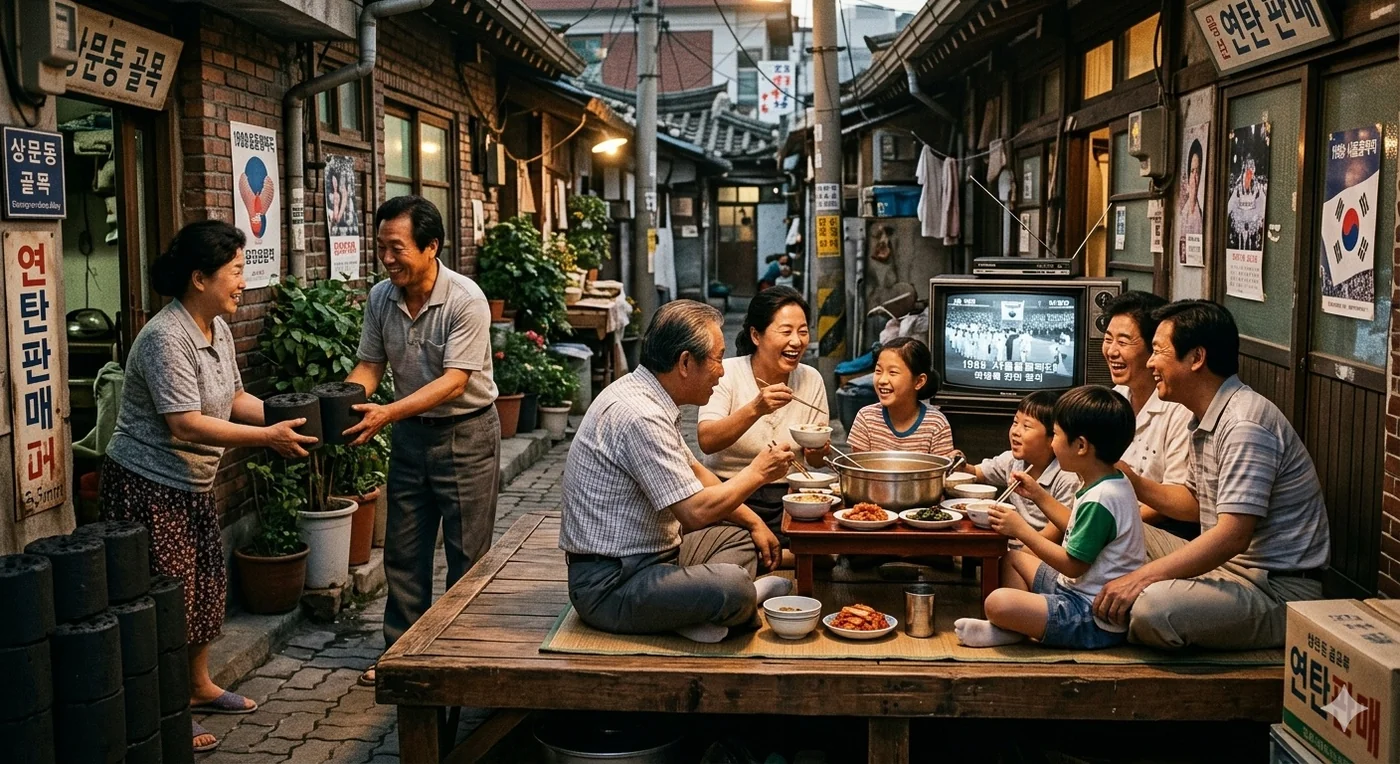
If you’ve watched the beloved 2015 tvN drama Reply 1988 (응답하라 1988), one thing about the alley probably puzzled you. The neighbors are always in and out of each other’s houses — passing plates of food over the wall, minding each other’s children, knowing everyone’s business. To many international viewers it looks impossibly close. Why are these people in each other’s homes so much?
The answer doesn’t start with sentiment. It starts with a black cylinder of coal — and the invisible danger that came with it.
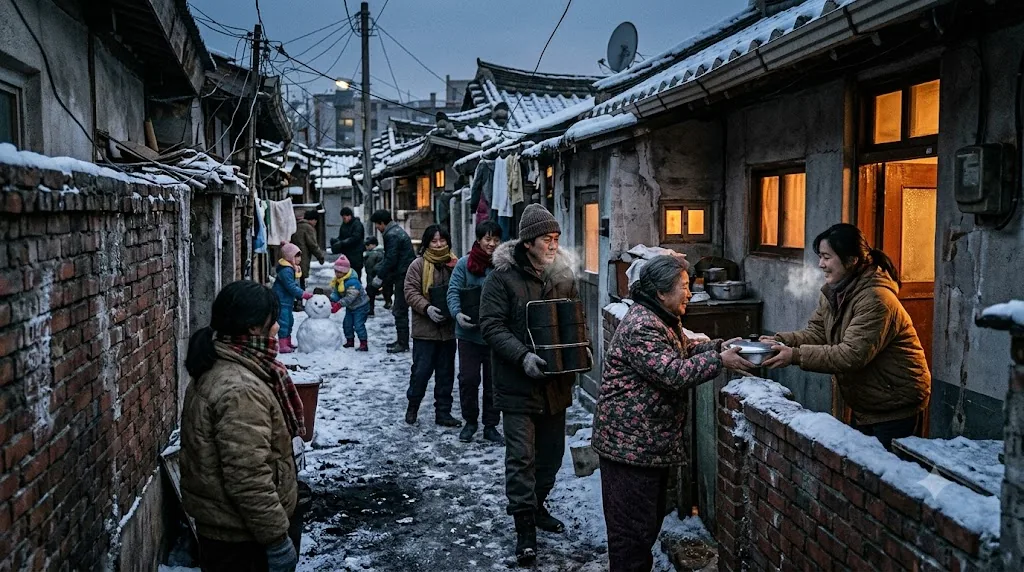 In 1980s Korea, surviving winter was a shared project — and it ran on the yeontan. (AI illustration)
Quick answer: The closeness of the Reply 1988 alley came from more than sentiment. Close-set houses and shared outdoor space made everyday life visible, while food exchange, childcare, and small favors connected the five families. The yeontan (연탄) — the coal briquette that heated many Korean ondol floors — was one important part of that environment: it needed regular handling, could run out or go out, and could produce deadly, odorless carbon monoxide when flues or floors failed. These conditions gave neighbors practical reasons to help one another — though the yeontan alone did not create the community.
Let’s unpack it.
What was a yeontan, really?
It was the fuel that got Korea through winter — a humble black cylinder that shaped daily life.
A yeontan is a solid coal briquette, shaped like a black cylinder and pierced with rows of holes so that air can pass through and the fire keeps burning slowly. Unfamiliar to today’s overseas viewers, it was utterly ordinary in 1980s Korea: in detached houses, rented rooms, hillside “moon villages,” and the outskirts of cities, families stacked briquettes by the wall, and changing the yeontan on time became one of the day’s important tasks all winter long (Encyclopedia of Korean Culture — Yeontan (연탄)).
The briquette was tied to Korea’s traditional heating system, the ondol (온돌) — underfloor heating that warms the room from the floor up (Encyclopedia of Korean Culture — Ondol culture (온돌문화)). Where households once burned wood in a furnace to heat the floor, industrialization made the yeontan take over that role in urban homes. That’s why Korean winter is remembered not as a fireplace or a radiator, but as a warm floor, a heavy blanket, and the heat of a coal fire.
The invisible danger: carbon monoxide
But the yeontan didn’t only give warmth. It carried a genuine risk — one that shaped how people lived.
Carbon monoxide from incomplete combustion could enter a room when a flue was blocked, when the heating channel or floor was cracked, or when ventilation was poor — causing carbon-monoxide poisoning. Carbon monoxide is colorless and odorless, making it extremely hard to detect without an alarm (U.S. Centers for Disease Control and Prevention — Carbon Monoxide Poisoning Basics) — and especially dangerous while everyone is asleep, when gas seeping into the room could threaten an entire family at once. Coal-gas poisoning was a serious, recurring cause of death through the 1970s and 80s. So people traded warnings as a matter of daily routine: “watch out for coal gas,” “air the room before you sleep,” “check that the flue isn’t blocked.”
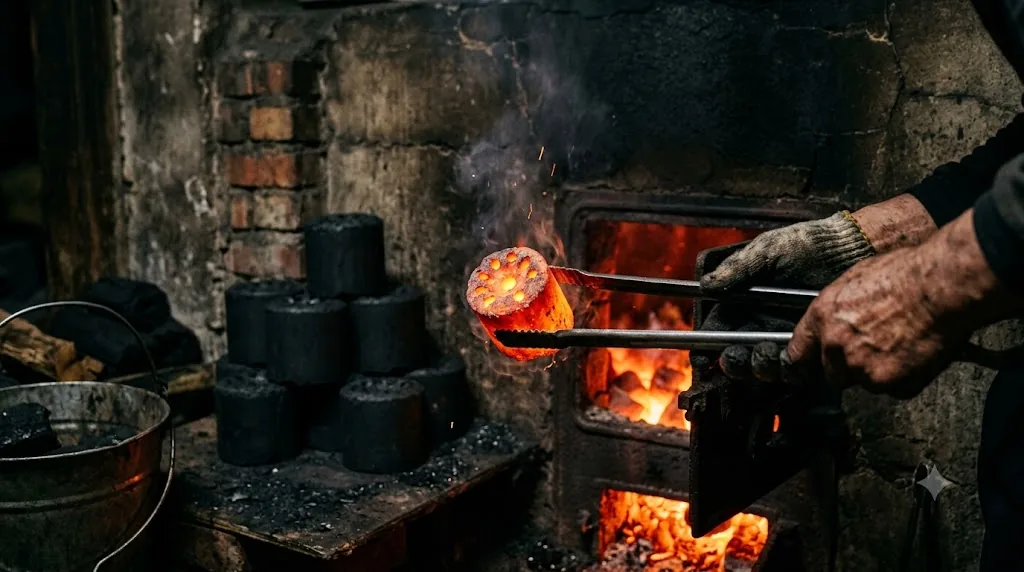 Changing the briquettes was a daily task — and coal-gas poisoning was a constant winter fear. (AI illustration)
Why the alley became a winter safety net
This is where the neighborhood comes in — because a yeontan was a private object, but the life around it was hard to manage alone.
When one house ran out of briquettes, a neighbor could lend a couple. When a coal fire went out, someone could go next door to fetch a live ember. When snow fell or the path iced over, people could carry briquettes together, and households with small children might look in on one another. A neighbor wasn’t merely someone you greeted — in practice, the alley could work as a safety net through winter.
That is exactly the part of Reply 1988’s alley scenes that puzzles international viewers most: why are the neighbors in and out so often? Why do they share food, mind each other’s children, and know each other’s household affairs? The reason isn’t simply that Koreans were uniquely warm-hearted. The housing environment and living conditions of the time made people depend on one another. Across many working-class Korean neighborhoods, yeontan heating existed alongside narrow alleys, rented rooms, shared outdoor space — and, in poorer settlements, communal taps and toilets. Not every household lived with all of these (the drama’s five families range from a semi-basement to a suddenly wealthy home), but close-set housing brought much of daily life into public view.
Key terms. Yeontan (연탄) — a cylindrical coal briquette, the main winter heating fuel of 1980s Korea. Ondol (온돌) — traditional Korean underfloor heating, warmed by the coal fire. Yeontan-gas (연탄가스) — the everyday word for the carbon-monoxide risk from burning briquettes. Moon village (달동네) — a poor hillside neighborhood of the era, densely packed and alley-woven.
Here’s the drama decoded:
| In Reply 1988 | In real 1980s life |
|---|---|
| Neighbors always in each other’s homes | Living conditions made mutual dependence practical, not just warm |
| Sharing food over the wall | One era’s structure of daily life — shared taps, alleys, rented rooms |
| Borrowing and lending small things | Running out of briquettes mid-winter was a real, shared risk |
| A warm, glowing home | A warm floor heated by yeontan — with a hidden carbon-monoxide danger |
| The alley as a second family | It worked, in practice, as a winter safety net |
Why the alley itself mattered
The most useful lens isn’t a comparison with any one foreign country — it’s the shape of the alley itself.
In a close-set alley, doors, windows, kitchens, and children’s play spaces all faced the same narrow passage. Activities a detached modern household might keep private — fuel delivery, food preparation, childcare, conversation — were repeatedly exposed to neighbors. Carrying briquettes, sharing kimchi, children playing together, adults sitting and talking on the wooden pyeongsang: the alley wasn’t simply a route between homes, it was shared social space. That physical closeness, more than any national trait, is what made the Reply 1988 neighborhood feel like one household. (For the alley community itself, see our companion piece on the neighborhood of Reply 1988.)
So a single coal briquette was never just fuel. It was a symbol of the social history left by Korea’s compressed growth. On one side, Seoul hosted the 1988 Olympics (National Institute of Korean History / 우리역사넷 — Seoul Olympics), and color TVs, refrigerators, and washing machines showed off a middle-class dream. On the other, many families were still swapping out coal briquettes to get through the cold — and this was no dying relic: briquette consumption actually rose from 20.83 million tons in 1980 to 26.92 million tons in 1986 (Encyclopedia of Korean Culture — Yeontan). In 1988, yeontan was still near the center of urban winter life. Reply 1988 turns the mutual aid of a materially constrained neighborhood into warmth. But the same conditions also meant exhausting fuel work, insecure housing, and a carbon-monoxide danger that could be fatal. The nostalgia is real — and so were the costs.
That’s the face of 1988 Korea a yeontan reveals: a country warming itself one briquette at a time, just as it was beginning a slow shift from briquettes toward city gas and oil heating — a transition that would accelerate through the 1990s — with the alley’s neighbors knocking on each other’s doors to cross the winter together.
Coming up next
One coal briquette — and we’ve traveled from a puzzling alley to the ondol floor, a silent carbon-monoxide danger, and the compressed-growth Korea of the 1988 Olympics. That’s the quiet gift of a good historical drama: a single ordinary object is a doorway.
In the next essay, we’ll take another K-drama scene that looks like pure fiction — and trace the real Korean history hiding underneath it.
Frequently asked questions
What is a yeontan? A yeontan (연탄) is a cylindrical coal briquette, pierced with holes so air can flow through and the fire burns slowly. In 1980s Korea it was the main winter heating fuel for detached houses, rented rooms, and hillside neighborhoods, feeding the ondol underfloor heating system. Changing the briquettes on time was a daily winter chore.
Why were Reply 1988’s neighbors always in each other’s homes? Partly warmth of feeling — but also the living conditions of the era. Yeontan heating, shared outdoor taps, narrow alleys, rented rooms, and shared food all pushed people to depend on one another. When a household ran out of briquettes, a neighbor lent a few; when a fire went out, someone fetched embers next door. The alley worked as a winter safety net, not just a social scene.
Was coal-briquette heating dangerous? Yes. Incomplete burning, a blocked flue, or gas seeping through cracks in the heated floor could cause carbon-monoxide poisoning. Carbon monoxide is colorless and odorless, making it hard to detect without an alarm — especially while asleep. “Watch out for coal gas” and “air the room before bed” were everyday warnings in 1980s Korea.
Why did the alley itself matter so much? In a close-set alley, kitchens, doors, and children’s play spaces all faced one narrow passage, so activities a detached home might keep private — fuel delivery, cooking, childcare — were constantly visible to neighbors. The alley wasn’t just a route between homes; it was shared social space, and that physical closeness is what made the neighborhood feel like one family.
Sources & further reading
This piece was written from the historical script and fact-check of 사뚱샘의 역사방 (SaDDungSam). Key sources are cited inline above. For broader reading:
- The yeontan (연탄), coal briquette — the cylindrical fuel whose consumption peaked in 1980s Korea. (Encyclopedia of Korean Culture / 한국민족문화대백과)
- Ondol culture (온돌문화) — Korea’s underfloor heating tradition, designated a National Intangible Cultural Heritage in 2018. (Encyclopedia of Korean Culture)
- Carbon monoxide poisoning — the colorless, odorless danger behind coal-gas warnings. (U.S. Centers for Disease Control and Prevention)
- The 1988 Seoul Olympics — the middle-class dream against which coal-briquette life stood. (National Institute of Korean History / 우리역사넷)
Thanks for reading — see you in the next one.
This article was researched and written by K-Drama History. Source: Reply 1988, Explained: How Yeontan Shaped Winter Life in a 1980s Seoul Alley — K-Drama History