Misaeng Explained: Korea's Contract Worker Crisis, the IMF Era, and the Two-Year Rule
Theme: Modern Korea
From the research behind Pause the Drama.
If you’ve watched the quietly devastating 2014 K-drama Misaeng: Incomplete Life (미생), you don’t remember it for romance or villains. You remember Jang Geu-rae — a young man with no college degree and no connections — sitting in a vast trading company, surrounded by spreadsheets he barely understands, trying not to be noticed and trying not to be fired. He is a contract worker. Everyone in the office knows it. And that single fact shapes every careful, anxious thing he does.
There’s no sword fight here, no palace intrigue. Just a young person clinging to a desk. And yet Misaeng became a national phenomenon, because millions of Koreans looked at Jang Geu-rae and thought the same chilling sentence: “That’s me.”
Quick answer: Misaeng isn’t really a workplace drama — it’s a story about precarity. It captures South Korea’s structural split between permanent and contract workers, a divide that exploded after the 1997 IMF bailout reshaped the entire economy. Jang Geu-rae’s anxiety is real policy history: roughly 38% of Korean wage earners are non-regular workers, paid substantially less, far less protected, and quietly disposable at the 24-month mark of their contracts.

Let’s unpack it.
First — what does “Misaeng” even mean?
The title sounds gentle. It is not.
Misaeng (미생, 未生) is a term from baduk (바둑) — the board game known in English as Go. On the board, a group of stones that has not yet secured enough space to survive is called misaeng: “not yet alive.” It isn’t dead. But it isn’t safe. It exists in a fragile in-between, one bad move away from being wiped off the board.
That is the metaphor for Jang Geu-rae’s entire life. As a contract worker, he is not yet alive in the corporate sense — not a real, permanent member of the company, not guaranteed a tomorrow. The original webtoon by Yoon Tae-ho ran on the portal Daum from 2012 to 2013 and drew roughly a billion views (Korea JoongAng Daily), precisely because so many readers recognized that feeling of being a stone that hasn’t yet been allowed to live. Once you know the word, the whole show reads differently.
So why is being a “contract worker” such a source of fear?
Because in Korea, the gap between a “regular” and a “non-regular” worker isn’t a small difference in paperwork — it’s two different worlds inside the same office.
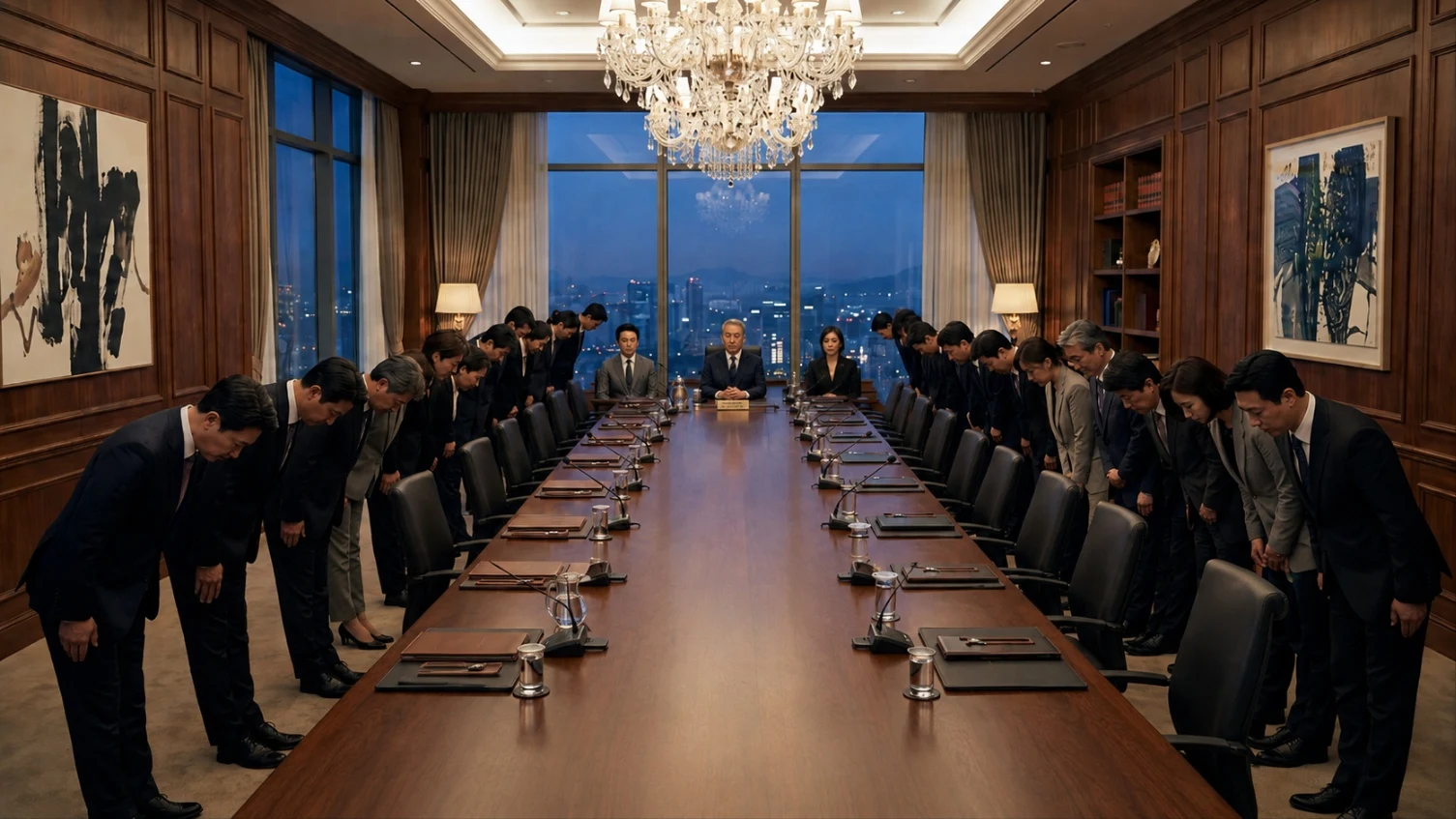
Korea’s workforce is split into regular workers (정규직, jeong-gyu-jik) — permanent employees with job security, full benefits, and a clear path to promotion — and non-regular workers (비정규직, bi-jeong-gyu-jik): contract, temporary, part-time, and dispatched workers who have none of that guarantee. They often sit at the same desks and do similar work, but they are paid less, protected less, and can be let go far more easily.
The numbers are stark. As of recent government surveys, non-regular workers make up roughly 38% of all wage earners in South Korea (Statistics Korea) — well over a third of the entire workforce. And the pay gap is real and growing: non-regular workers earn substantially less than their regular colleagues, with the monthly wage gap reaching record highs in recent years. They are also far less likely to be covered by the social safety net — for example, only about 74% of non-regular employees were enrolled in employment insurance in 2020, compared with over 90% of regular workers (OECD Economic Survey of Korea 2022).
So when Jang Geu-rae flinches, it isn’t drama for drama’s sake. He is a person who can do everything right and still, at any moment, simply not have his contract renewed.
Here’s the split at a glance:
| In Misaeng | In real South Korea |
|---|---|
| Geu-rae sits at the same desk but is treated differently | Non-regular workers do similar work for substantially lower pay |
| Everyone knows he could be gone after his contract ends | ~38% of wage earners are non-regular; turnover is structurally built in |
| He is invisible to corporate benefits and promotion | Non-regular workers have lower insurance enrollment and almost no promotion track |
| The 1997 IMF era is the background dread | The Asian Financial Crisis accelerated and entrenched this two-tier system |
| Geu-rae’s Go training is useless in the corporate world | Young Koreans without college degrees face near-total exclusion from regular employment |
Where did this whole system come from? One word: IMF.
Here’s the part international viewers almost never know: this fear has a birthday. It largely traces back to a single national trauma in 1997.
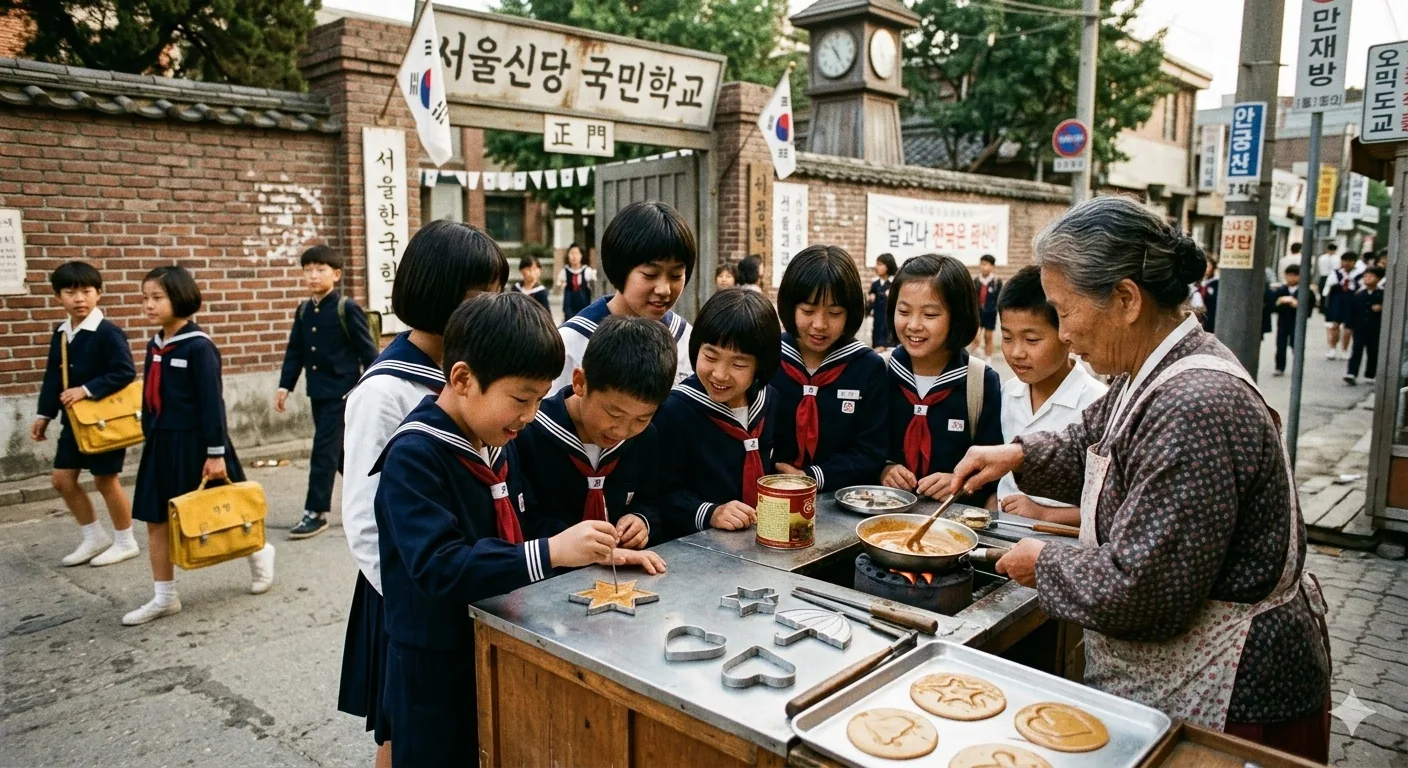
In late 1997, the Asian Financial Crisis hit Korea with brutal force. The country nearly went bankrupt and had to accept an emergency bailout from the International Monetary Fund (IMF) (Korea Economic Institute of America) — an event Koreans still refer to simply as “the IMF era” (IMF 시대), the way Americans might say “the Crash.” In exchange for the rescue, Korea agreed to sweeping economic restructuring. Companies that had once offered something close to lifetime employment laid off workers in enormous numbers, and the labor market was made far more “flexible.”
That flexibility had a price, and it was paid by the next generation. To cut costs and avoid the obligations that come with permanent staff, companies leaned heavily on hiring non-regular workers instead. What had been a rare arrangement became a structural feature of the entire economy. The young people who entered the job market afterward — Jang Geu-rae’s generation — inherited a world where a stable, permanent job was no longer the default. It was a prize, and there weren’t enough to go around.
Wait — doesn’t a law force companies to make contract workers permanent?
This is the cruel twist, and it’s worth correcting a common assumption: yes, such a law exists — and in practice it often makes things worse, not better.
Since 2007, Korean law has said that if an employer uses a fixed-term worker for more than two years, that worker is deemed to have an indefinite-term contract (기간의 정함이 없는 근로계약) (The Korea Herald). In everyday language people call this “becoming permanent” — but legally it doesn’t always mean full equality with regular workers in pay, promotion, or status. Still, on paper it sounds like protection: the intent was to stop companies from keeping people on endless temporary contracts.
Key terms. Bi-jeong-gyu-jik (비정규직) — South Korea’s non-regular workers: contract, temporary, part-time, or dispatched employees with weaker pay and almost no job security. IMF era (IMF 시대) — the 1997 Asian Financial Crisis bailout period that dismantled lifetime employment and built the two-tier labor market. 2-year rule — the 2007 law under which a fixed-term worker used beyond 24 months is deemed to hold an indefinite-term contract, which companies routinely evade by ending contracts at 23 months. Misaeng (미생, 未生) — a Go term meaning “not yet alive,” used as the drama’s title to describe workers trapped in precarious employment.
But many companies found a simple way around it. Instead of converting workers after two years, they let them go just before the two-year mark — often at one year and eleven months — and then either replace them or rehire them later under a fresh contract. The very rule meant to create stability became, for many, a built-in expiration date. This is the precise fear that hangs over a character like Jang Geu-rae: not just “will I be good enough?” but “will they keep me long enough to let me become permanent — or cut me loose right before?” It looks like a meritocracy. Underneath, schooling, specs, and your employment category quietly set the ceiling.
Why Misaeng feels so universal: Japan, China, and America say the same thing
Here’s where Misaeng stops being a Korean story and becomes an East Asian one — and then a global one. The same anxiety grew up across the region, each country with its own name for it.
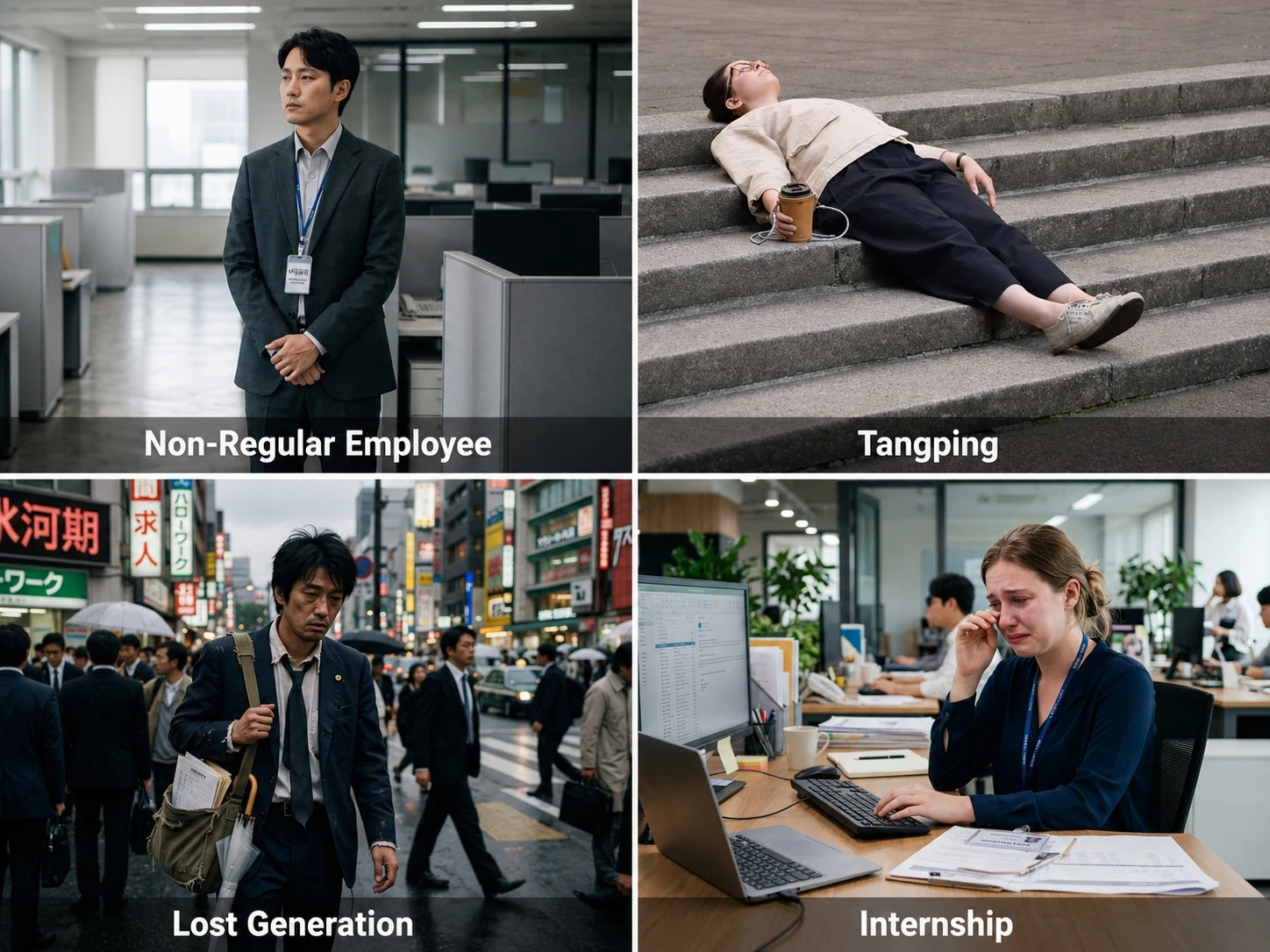
Japan — the “Employment Ice Age.” When Japan’s bubble economy collapsed in the early 1990s, companies froze hiring to protect existing senior staff. An entire cohort of graduates — roughly those finishing school between 1993 and 2004 — got shut out of stable careers right at the starting line. Japan calls them the Employment Ice Age generation (就職氷河期世代, shūshoku hyōgaki sedai) (Japan Institute for Labour Policy and Training), also known as the “Lost Generation.” Many never recovered, stuck in irregular jobs for decades; the government is still running programs to help them. Korea’s IMF generation and Japan’s Ice Age generation are almost mirror images, born from the same kind of shock.
China — “996” and “lying flat.” China’s young workers face a different but related squeeze. In parts of the tech and corporate world, the brutal “996” schedule — working 9 a.m. to 9 p.m., six days a week — became infamous. In response, a quiet protest movement emerged around 2021 called tang ping (躺平), or “lying flat” (BBC News): young people refusing to chase a race they feel they can’t win, opting out of the grind entirely. Where Jang Geu-rae clings on in fear, China’s tang ping youth ask whether clinging on is even worth it.
America — interns and the gig economy. The West isn’t exempt. The American version wears different clothes: the unpaid or underpaid internship as a gatekeeper to “real” jobs, and the rise of the gig economy — rideshare drivers, delivery couriers, freelancers — workers who are technically “independent” but often lack the benefits, security, and protections of a permanent employee. The vocabulary differs, but the underlying structure rhymes: a tier of workers doing essential labor without the safety net.
Look across all four, and a shared shape appears. After the secure, lifetime-job era faded, every one of these societies grew a large layer of young people working hard without the guarantee of stability. The difference is mostly in how each country responds: Korea argues over conversion laws, Japan funds rescue programs for its lost cohort, China’s youth stage a silent strike by lying flat, and America debates whether a gig worker is even an “employee” at all. Same wound, four different bandages.
Coming up next
One anxious contract worker at one desk — and we’ve traveled from a Go board to the 1997 IMF bailout, to a loophole in a 2007 law, to Japan’s Ice Age, China’s lying-flat youth, and America’s gig drivers. That’s the quiet gift of a show like Misaeng: a spreadsheet becomes a window into a whole generation.
In the next essay, we’ll take another K-drama scene that looks like pure fiction — and trace the real Korean history hiding underneath it.
Thanks for reading — see you in the next one.
Frequently asked questions
Is Misaeng based on a true story? Not a single real person’s story, no. It’s adapted from Yoon Tae-ho’s hugely popular webtoon and follows a fictional character, Jang Geu-rae. But its world — contract workers, office hierarchy, the fear of non-renewal — is drawn so accurately from real Korean working life that viewers coined phrases like “I feel like Jang Geu-rae” to describe their own jobs.
What’s the difference between a “regular” and “non-regular” worker in Korea? A regular worker (정규직) is a permanent employee with job security, full benefits, and promotion prospects. A non-regular worker (비정규직) is on a contract, temporary, part-time, or dispatched basis — typically paid less, with weaker benefits and far less job security. Non-regular workers make up roughly a third or more of Korea’s wage earners.
Why is 1997 so important to this? The 1997 Asian Financial Crisis forced Korea to accept an IMF bailout and undertake major economic restructuring. Mass layoffs and a push for a “flexible” labor market caused non-regular employment to surge, reshaping the job market that younger generations like Jang Geu-rae’s would inherit.
Sources & further reading
This piece was written from the historical script and fact-check of 사뚱샘의 역사방 (SaDDungSam). Primary and official sources are linked inline beside the claims they support:
- Non-regular workers ≈ 38% of wage earners — Statistics Korea (KOSTAT), Economically Active Population Survey (supplementary results by employment type): non-regular workers were 38.2% of all wage earners (Aug 2025, ~8.57 million). Under the OECD’s narrower “temporary worker” measure Korea is about 28% (2021), still among the highest in the OECD.
- Wage gap and social-insurance gap (2020 figures) — OECD Economic Surveys: Korea 2022: non-regular workers’ hourly wage was ~72% of regular workers’, and only 74% were enrolled in employment insurance versus over 90% of regular workers. By Aug 2024 (KOSTAT) the average monthly wage was about ₩2.05 million for non-regular vs ₩3.80 million for regular workers, a record high.
- Korea’s 2-year fixed-term conversion rule — the Act on Protection of Fixed-Term and Part-Time Workers (2007) and how firms work around it: The Korea Herald.
- 1997 Asian Financial Crisis and labor market restructuring — the IMF bailout conditions and non-regular employment surge: Korea Economic Institute of America (KEIA).
- Misaeng (webtoon) — the baduk term “not yet alive” and the series’ background: Korea JoongAng Daily.
- Japan’s Employment Ice Age (就職氷河期) — the 1993–2004 “Lost Generation” and government rescue programs: Japan Institute for Labour Policy and Training.
- China’s “tang ping” (躺平, lying flat) — youth protest against overwork and the 996 culture: BBC News.
Thanks for reading — see you in the next one.
This article was researched and written by K-Drama History. Source: Misaeng Explained: Korea's Contract Worker Crisis, the IMF Era, and the Two-Year Rule — K-Drama History