Crash Landing on You: The Women, Rations and Markets Behind North Korea's Jangmadang
Theme: Modern Korea
From the research behind Pause the Drama.
The 45-second version — on YouTube
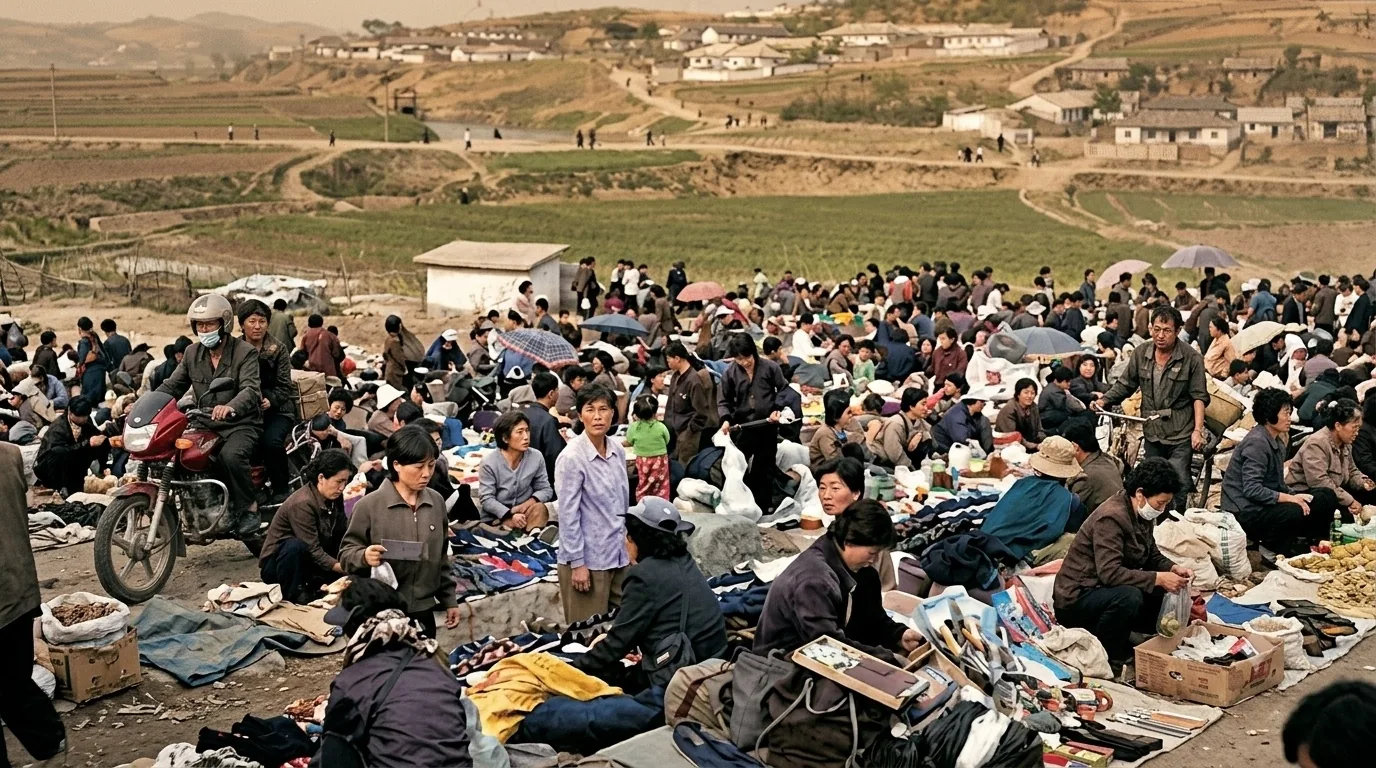 The jangmadang: not an absence of the state, but a space the state learned to tax. (AI illustration)
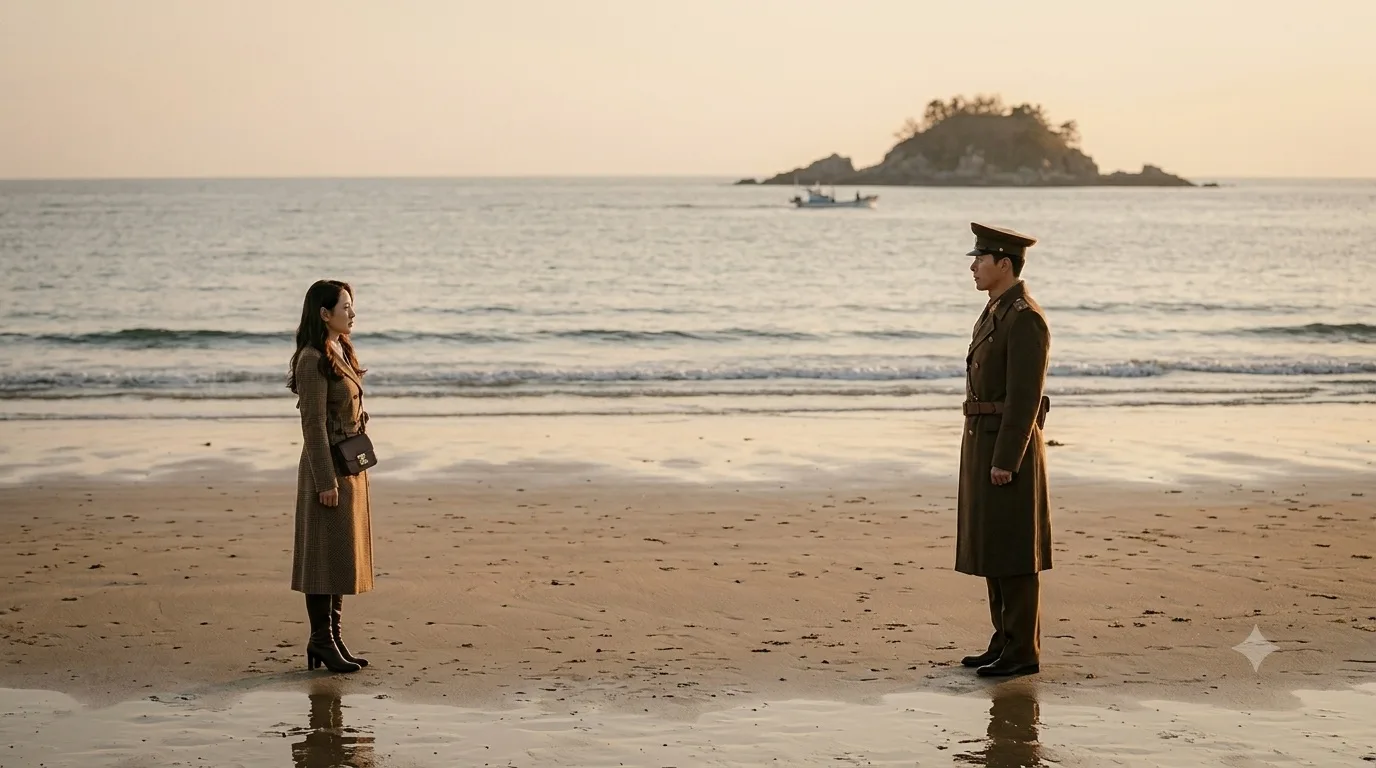
If you’ve watched the global megahit Crash Landing on You (사랑의 불시착) — the tvN romance that ran from 14 December 2019 to 16 February 2020, in which a South Korean heiress paraglides into North Korea and is hidden by a stern, kind-hearted army officer — one set of scenes probably surprised you. The North Korean villagers don’t just queue for state rations. They buy, sell, haggle, and hustle at a busy local market.
Markets? In North Korea? The state is supposed to handle distribution. To a viewer meeting the country only through news footage, those scenes can easily look like dramatic licence.
They aren’t. The market scenes are among the things some North Korean defectors have picked out as most realistic — and the history behind them is older, messier and considerably more interesting than the version usually told in English.
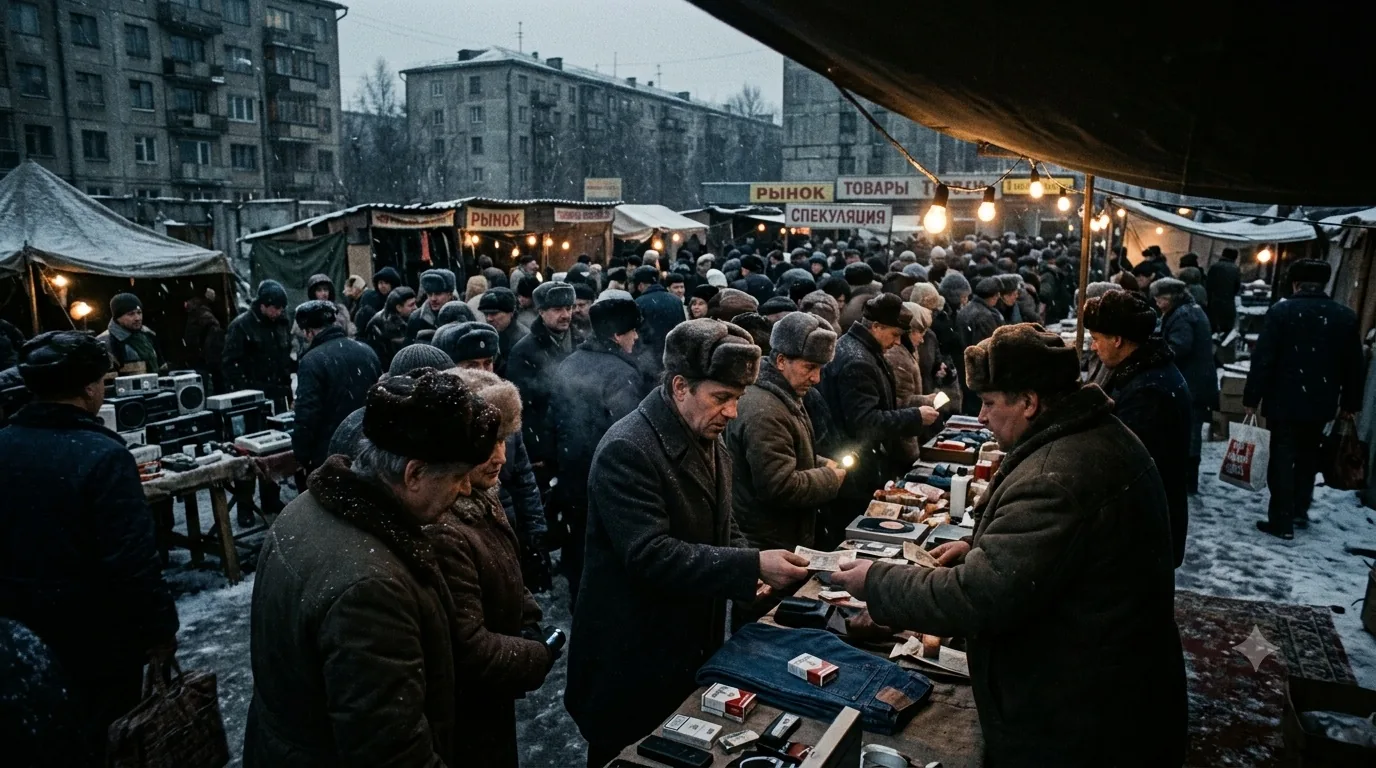 The Soviet second economy ran on the same logic — and drew the same official words for it. (AI illustration)
Quick answer: Yes. North Koreans buy food and everyday goods in both official markets and informal trading networks. These markets did not begin with the 1990s famine: regulated farmers’ markets had existed since the late 1950s. The famine transformed them from a limited sideline into a nationwide survival system, and in 2003 the state formally reorganised many as general markets and began collecting stall fees. Since then, the authorities have alternated between licensing, taxing and restricting them.
The drama’s bustling market is therefore broadly realistic, although openly displaying South Korean media would be far more dangerous than the scene suggests.
Let’s unpack it.
What the state actually did: the Public Distribution System
On paper North Korea was a textbook command economy: state-centred production and distribution, with the government responsible for supplying food and the main consumer goods. The core institution was the Public Distribution System (배급, baegeup).
The mechanics are more specific than the shorthand suggests. The state controlled both the allotted quantity and the price, and residents purchased their allotted grain at heavily subsidised state prices through public distribution centres (배급소). Other consumer goods were also sold through state shops and additional official channels. It was radically unlike buying freely on a market — you could not choose quantity, supplier or price — but it was not a pure free handout either. Money changed hands. The state was the monopoly seller at an administered price, which is a different economic animal from a charity queue, and the difference matters for understanding what happened when the system failed: people were already used to paying for food. What collapsed was not the habit of purchase but the state’s ability to be the seller.
The distribution centres were also not the only official channel. State shops (국영상점) operated alongside them, limited private sideline production was permitted, and farmers’ markets existed — points the Ministry of Unification’s North Korea Information Portal makes in its own entries on rationing and on markets. So “the state provided everything” is a slogan, not a description.
What determined how much you got? The documented allocation criteria include household size and composition, age, and occupational or labour category. Songbun (성분), the political classification system, worked through a different route: it shaped which occupations you could hold, where you could live (including whether you could live in Pyongyang), and whether you fell inside priority-supplied sectors. Those things then affected your food access, sometimes decisively — an indirect determinant rather than a line in the ration calculation. Keeping the two apart is not softening the point about North Korean inequality; it describes the machinery that produced it more accurately.
The markets are older than the famine
It is often said that the famine gave birth to the market: the state stopped feeding people, and out of sheer desperation an informal economy grew in the cracks of a command state. The record puts the birth much earlier.
Farmers’ markets (농민시장) and limited trade in private sideline produce existed in North Korea from the late 1950s, and extra-plan production and exchange expanded further through the 1980s. From at least the late 1950s, North Korea retained a narrow legal space for farmers’ markets and the sale of certain household sideline products. What was restricted was large-scale, extra-plan commercial activity and private enterprise, rather than every individual act of production and sale.
So what did the famine actually do? Something more specific, and more dramatic. It took an existing, marginal, tightly bounded market sector and expanded it to a nationwide mass scale, making market exchange the primary survival mechanism for most of the population and setting up the jangmadang-centred marketisation that has held ever since. That is the decisive turning point — and, as the work of Marcus Noland and the research on the spatial reorganisation of Pyongyang in the market-introduction period by 이시효 both indicate, it is a story of scaling and normalisation, not of spontaneous generation.
Which, if anything, makes the famine’s role easier to state precisely: it did not teach North Koreans to trade. It made trading the only thing left that worked.
Drama vs history
| What viewers may assume | Historical context |
|---|---|
| The bustling market is a space the state simply hasn’t got round to shutting down | Since 2003 official 종합시장 (general markets) have been institutionalised, with stall usage fees and market taxes (장세) collected — alongside a separate field of informal and illegal trade |
| The Chinese goods on the stalls are smuggled contraband | Chinese products are a major supply source, but they arrive through official and semi-official trade channels as well as through smuggling |
| The wandering children (꽃제비) are a background detail of present-day poverty | The term belongs to the Arduous March of the mid-1990s, when the distribution system had ceased to function reliably for much of the ordinary urban population — while Pyongyang, the military and core institutions stayed priority recipients |
| Women behind most of the stalls is incidental casting | As distribution collapsed, married women entered small-scale trade in large numbers, while men remained formally tied to assigned state workplaces — the gendered division the market produced |
| The inspectors and pay-offs are ordinary individual corruption | They sit inside repeated state campaigns: market controls tightened from 2005, the 2009 currency reform, renewed control since 2019, the COVID-era border closure, and further restrictions reported in 2025 |
| South Korean dramas and cosmetics can sit on a stall | South Korean video content circulates covertly rather than as an openly displayed legal product. Consumer goods associated with South Korea may reach markets indirectly through China, often with their origin concealed |
In short: the drama is right that the market is where life happens, and compresses about seventy years of legal history — and the gendered division of labour standing behind the stalls — into a single street scene.
What broke, and when
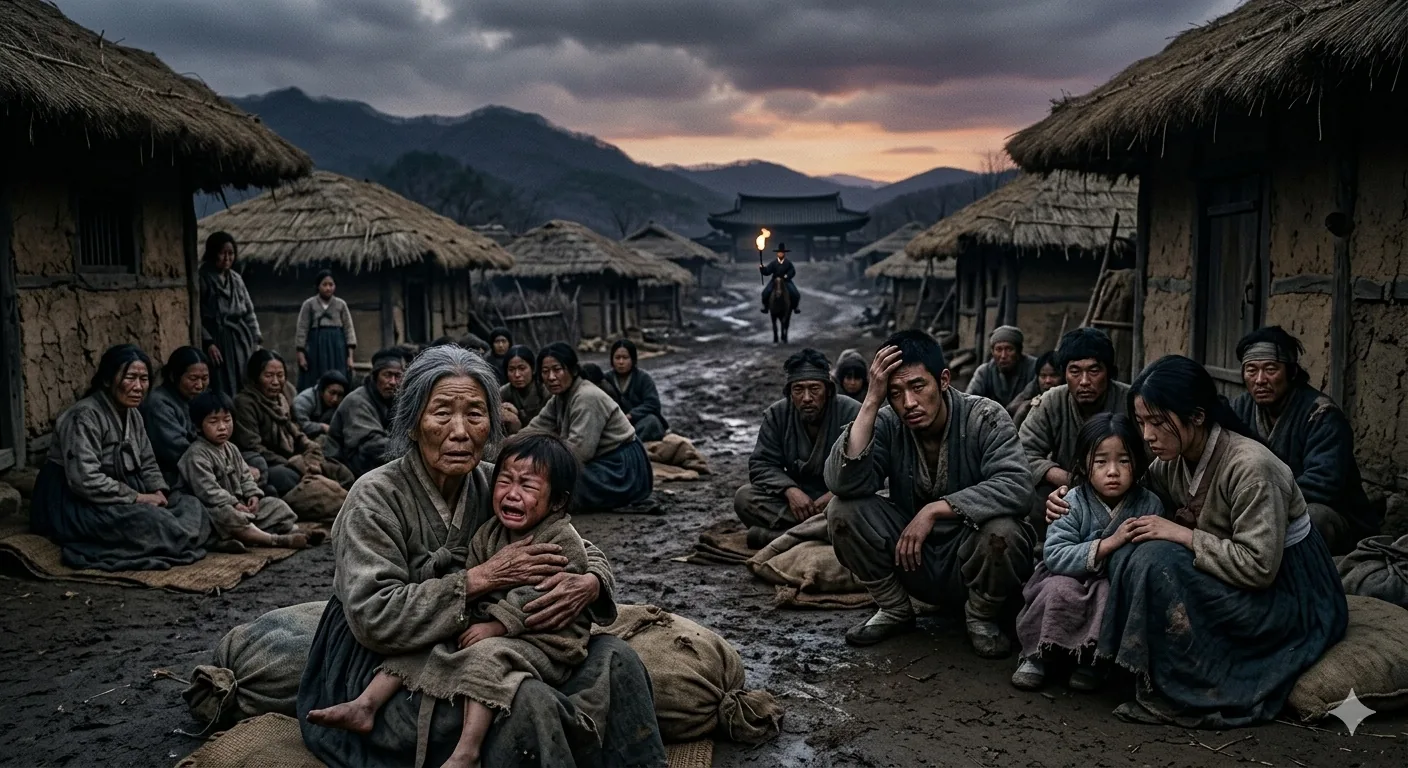
The mid-1990s famine — known inside North Korea by the euphemism Arduous March (고난의 행군) — is usually explained with three causes stacked on top of each other: the Soviet collapse of 1991, floods and droughts, and a rigid system with no give. None of those three is false. All three are too tidy.
The Soviet withdrawal was a decade-long slide, not a single cut. The USSR was formally dissolved in 1991, and the collapse of the socialist bloc was genuinely a severe shock to the North Korean economy. But Soviet support and preferential trade terms had been weakening through the 1980s; around 1990 came demands for settlement in hard currency; and Soviet crude oil exports to North Korea fell sharply in 1990–91. By the time the flag came down in Moscow, much of the damage was already priced in. What 1991 marks is the end of a process, not its beginning.
The causes were plural. Alongside the collapse of preferential trade with the USSR and Eastern Europe, the famine drew on shortages of energy, fertiliser and industrial inputs; structural weaknesses in agricultural policy and in the economic system itself; soil degradation; a collapsing capacity to earn foreign currency and therefore to import grain; and natural disasters. Noland’s work and Hazel Smith’s North Korea: Markets and Military Rule both treat it as a compound failure rather than a weather event that met a bad system.
And the distribution system did not switch off in a single moment. Supply had been weakening from the 1980s. The PDS had ceased to function reliably for much of the ordinary urban population by the mid-1990s — that is the finding, and it is a devastating one. But it was neither universal nor simultaneous: Pyongyang, the military and core institutions remained priority recipients, with supply maintained on a limited basis or resumed irregularly in later periods. Inequality of access was not a side effect of the collapse; it was the shape of the collapse.
The phrase “the state stopped feeding people” implies a decision. What the evidence supports is that the state distribution network ceased to function properly for the majority of the population — and that people turned to markets and private survival activity because nothing else was left. The intent question is separate, and the supply data does not settle it.
How many died
Estimates vary from several hundred thousand to more than a million, depending on the period examined, the demographic baseline and the assumptions used to reconstruct missing data. Later demographic studies have often produced lower estimates than early contemporary reports, but North Korea’s limited and contested population data prevent a single definitive total.
The lower end of that range comes from demographic work built on population data — Daniel Goodkind and Loraine West in Population and Development Review in 2001, and Thomas Spoorenberg and Daniel Schwekendiek in the same journal in 2012, working with the population data available for 1993–2008.
The range reflects differences in data, method, reference period and, at times, the political context in which estimates circulated.
From farmers’ market to legal marketplace — and back again
This is where the story stops being about tolerance and starts being about bookkeeping.
In 2003, North Korea reorganised the existing farmers’ markets into 종합시장 — general markets — institutionalising official marketplaces, and collecting stall usage fees and market taxes (장세) from traders. The state did not merely look away. It built a legal container for market activity, put its name on it, and started taking a cut. Whatever else that is, it is not grudging blindness; it is fiscal incorporation.
That makes the subsequent history sharper, not softer. The long arc is one in which the authorities have not managed to eliminate marketisation — and also one of repeated attempts, right up to the present. The record includes market controls tightened from 2005 and the 2009 currency reform that wiped out market savings. Since 2019, available reports indicate that the state has again been tightening control over grain distribution, border trade and informal market activity, a push that ran through the COVID-era border closure and, as Human Rights Watch’s reporting on North Korea into 2026 documents, into further reported restrictions in 2025.
So the state has not settled into living with the markets. It has repeatedly tried to take them back, repeatedly failed to remove them, and appears to be trying again. The drama’s villagers are trading in a space that the government alternately licenses, taxes, restricts and raids.
Who trades, and what
At a market you will find food, clothing, household goods, electronics and medicine, and Chinese products are a major supply source. But not everything Chinese is smuggled — official and semi-official trade channels bring in goods too, and the KINU research on consumer goods production and distribution under Kim Jong-un tracks both.
South Korean things belong in three separate boxes, and the drama’s stall scene quietly merges them. South Korean video content is not an openly traded market good: it circulates covertly, through illicit copies and storage devices, and it has been the target of intensified crackdowns in recent years. Branded South Korean consumer goods and cosmetics are a different case — they may reach markets indirectly by way of China, often with their origin concealed. And a stall openly labelling its wares as South Korean is the third case: dangerous, and not realistic. That gap between the three is precisely what makes the material significant. The risk attached to it is the measure of what it means.
Why so many market traders are women
Look at who is actually behind the stalls in the drama’s market scenes: the traders are overwhelmingly women. That is not set dressing.
When the Public Distribution System stopped delivering, the burden of keeping a household fed fell on married women, and they entered small-scale trade in very large numbers — selling home-cooked food, vegetables, cigarettes, clothing, whatever could be carried to a market and back. Men, meanwhile, remained formally tied to their assigned state workplaces long after wages had lost most of their real value. Attendance stayed compulsory even where the factory had nothing to produce and nothing to pay with. Women had comparatively more room to move in the informal economy — comparatively, which is not the same as freely. They were still subject to the same police, the same registration rules and the same campaigns.
It would be a mistake to read this as an accidental emancipation. Market work did raise the income and, in some households, the standing of the women who did it, and research has noted that shift. But it also placed them at the sharp end of enforcement. Trading meant exposure to confiscation of goods, to demands for bribes, to harassment, and — as 통일연구원’s work on the relationship between marketisation and human rights in North Korea documents — to sexual violence by officials whose authority over a trader’s livelihood was close to absolute.
So the jangmadang changed gender relations in North Korea without making them equal. It moved economic weight toward women while leaving the power to search, fine, detain and abuse them exactly where it had always been.
The jangmadang generation, carefully defined
There is a name for the cohort shaped by all this: the jangmadang generation (장마당 세대). It is a useful term and a slippery one.
Definitions vary between researchers and media outlets — birth-year boundaries are not agreed. Broadly, the term describes a younger generation that grew up in an environment depending far more on markets than on state distribution. It does not follow that every member of that generation has never experienced state rations; that goes beyond what can be established.
The same caution applies to the generation’s supposed politics. Research including KINU’s work on changes in North Korean everyday-life communities points to market experience and contact with outside information and media as factors that may encourage individualistic and pragmatic attitudes and weaken dependence on the state. That is a research finding about tendencies, offered as interpretation. Turning it into a settled political characteristic of an entire generation — more market-minded, more worldly, harder to control — is the kind of claim that gets repeated until it sounds like data. It isn’t yet.
So is North Korea still “socialist”?
Constitutionally, yes — and the constitution is more interesting than the slogan. The 2019 revision of the DPRK Socialist Constitution defines a socialist state and specifies the leadership of the Workers’ Party of Korea. Formally, other parties exist, so the precise description is not “one-party state” by statute but a party-state in which the Workers’ Party guides state activity and monopolises power in practice. The same constitution also recognises limited private property and income arising from lawful individual economic activity — which is to say that the legal text itself is not the pure command-economy document the shorthand implies.
The same nuance applies to private enterprise. It is true that an independent, privately owned firm is not a recognised general corporate form. But private capital has long participated in what amounts to enterprise activity by operating under the names of state or cooperative bodies and in combination with state organs — the phenomenon Andrei Lankov and colleagues analysed as North Korea’s “pseudo-state enterprises.” The distinction to hold onto is between the absence of an official independent private company and the presence of extensive quasi-official, de facto private business.
Which brings us to the 돈주 (donju), literally “masters of money.” The term is generally used not for petty stallholders but for people who have accumulated capital and invest it in production, distribution, transport, construction and trade — financiers and entrepreneurs. And they are not a shadow class standing outside the state economy. They work through state institution and state-enterprise names and in cooperation with officials. The interesting thing about the donju is not that they escaped the state. It is that they grew inside it.
The same story across the socialist world
The jangmadang is not a North Korean oddity. Planned economies tend to grow a second economy alongside the plan, as Steven Sampson’s 1987 survey documented across the Soviet Union and Eastern Europe. The characteristic Soviet institution was blat — the practice Alena Ledeneva analysed, of using personal connections, favours and reciprocal obligation to obtain scarce goods or get around official procedure. It overlapped with the black market without being the same thing: blat was an economy of favours and often involved no money at all. Shortage produces workarounds, and the plan produces shortage. China after 1978 is the comparison always reached for, but marketisation carries no built-in destination.
What the drama got right — and who says so
North Korean defectors have publicly praised Crash Landing on You, and the praise is specific enough to be worth quoting rather than aggregating.
Kang Na-ra (강나라) assessed much of the drama’s depiction of North Korea as close to reality. Choi Sung-guk (최성국) singled out the jangmadang scenes as particularly realistic — which is the endorsement that matters most for this article. Both appear in the 2020 coverage, including The Washington Post’s interviews with three defectors and The Straits Times’ piece on the drama as a glimpse of daily life in the North.
But there was criticism too, from the same community: that the series portrayed soldiers’ lives and North Korean society in an excessively warm and romantic light. That is not a footnote. A drama can be precise about a market stall and sentimental about the state that polices it, and Crash Landing on You is both. The market scenes are strong evidence; they are not a general certificate of accuracy for everything around them.
Coming up next
A paraglider drifts over the wrong border — and we’ve ended up tracing a distribution centre where people paid for their rations, a farmers’ market from the 1950s, a 2003 stall tax, a demographic argument in an American journal, and the women who carried a country’s food supply on their backs. That’s the quiet gift of a good drama: even a market stall has a legal history. Next time, we’ll open another door.
Frequently asked questions
Do North Koreans really shop at markets like in Crash Landing on You? Yes. Markets are a central part of North Korean daily life, and some North Korean defectors have singled out the drama’s market scenes as particularly realistic — the former animator Choi Sung-guk (최성국) among them. What the drama compresses is the history: markets were not invented by the 1990s famine, and today they include both officially institutionalised general markets and informal or illegal trade.
Did the jangmadang begin with the 1990s famine? No. Farmers’ markets and limited trade in private sideline produce existed from the late 1950s, and extra-plan production and exchange expanded further in the 1980s. What the Arduous March did was decisive but different: it expanded existing markets and informal trade to a nationwide, mass scale and made market-based survival the norm, which is how today’s jangmadang-centred marketisation became entrenched.
Are North Korea’s markets illegal? Not all of them. In 2003 the state reorganised the existing farmers’ markets into 종합시장 (general markets), institutionalising official marketplaces and collecting stall fees and market taxes (장세). Alongside those official markets there remains a large field of informal street trading, smuggling and outright illegal exchange. Lumping the two together as “tolerated illegality” misdescribes both.
Why are so many North Korean market traders women? As state distribution broke down, married women entered small-scale trade in large numbers to keep their households fed, while men remained formally tied to assigned state workplaces long after wages had lost most of their real value. That gave women comparatively more room to move in the informal economy — comparatively, not freely. It was not emancipation: trading also exposed them to confiscation, bribe demands, harassment and sexual violence by officials.
Are South Korean goods openly sold in North Korean markets? No. South Korean video content circulates covertly rather than as an openly displayed legal product, and has been the target of intensified crackdowns. Consumer goods and cosmetics associated with South Korea may reach markets indirectly through China, often with their origin concealed. A stall openly advertising its wares as South Korean would be dangerous and is not realistic.
Sources & further reading
- Marcus Noland, “Turning Back the Clock: The Changing Nature of North Korean Food Insecurity,” 2024
- 통일부 북한정보포털 — 「배급제」, 「종합시장」
- 이시효, 「시장도입 초기 평양 공간의 재배치: 1984–2003년을 중심으로」
- WFP, DPRK Interim Country Strategic Plan 2019–2021
- Hazel Smith, North Korea: Markets and Military Rule, Cambridge University Press
- CSIS Beyond Parallel — “Markets and the Private Economy in North Korea”
- 통일연구원, 『북한의 시장화와 인권의 상관성』; 『김정은 집권 이후 북한의 소비재 생산과 유통 실태』; 『북한 일상생활 공동체의 변화』
- Human Rights Watch, “North Korea: Unrelenting Repression, Hunger and Inequality,” 2026; World Report 2026 — North Korea
- 조선민주주의인민공화국 사회주의헌법, 2019년 개정본 — 제1·11·19·20·24·34조
- Andrei Lankov et al., “Making Money in the State: North Korea’s Pseudo-State Enterprises in the Early 2000s,” Journal of East Asian Studies
- Daniel Goodkind & Loraine West, “The North Korean Famine and Its Demographic Impact,” Population and Development Review 27(2), 2001
- Thomas Spoorenberg & Daniel Schwekendiek, “Demographic Changes in North Korea: 1993–2008,” Population and Development Review 38(1), 2012
- Steven Sampson, “The Second Economy of the Soviet Union and Eastern Europe,” The Annals of the American Academy of Political and Social Science, 1987
- Alena Ledeneva, Russia’s Economy of Favours: Blat, Networking and Informal Exchange
- The Washington Post — interviews with three North Korean defectors on Crash Landing on You, 2020; The Straits Times, “S Korean drama offers glimpse of daily life in North Korea,” 2020
- tvN official programme page — 《사랑의 불시착》 (14 Dec 2019 – 16 Feb 2020)
Thanks for reading — see you in the next one.
This article was researched and written by K-Drama History. Source: Crash Landing on You: The Women, Rations and Markets Behind North Korea's Jangmadang — K-Drama History