Bloody Heart, Explained: Did Ancient Rome Have a Version of Joseon's Yeonjwaje?
Theme: Power & Politics
From the research behind Pause the Drama.
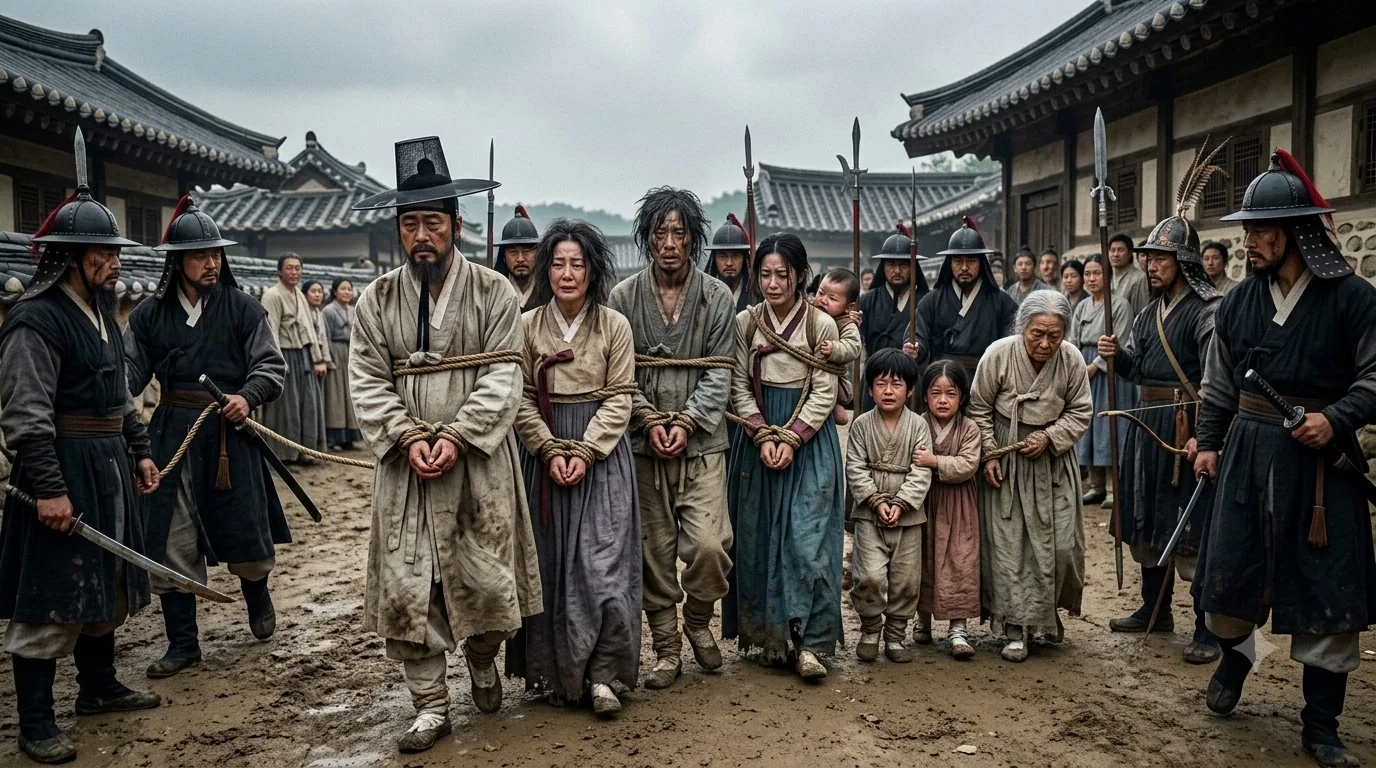
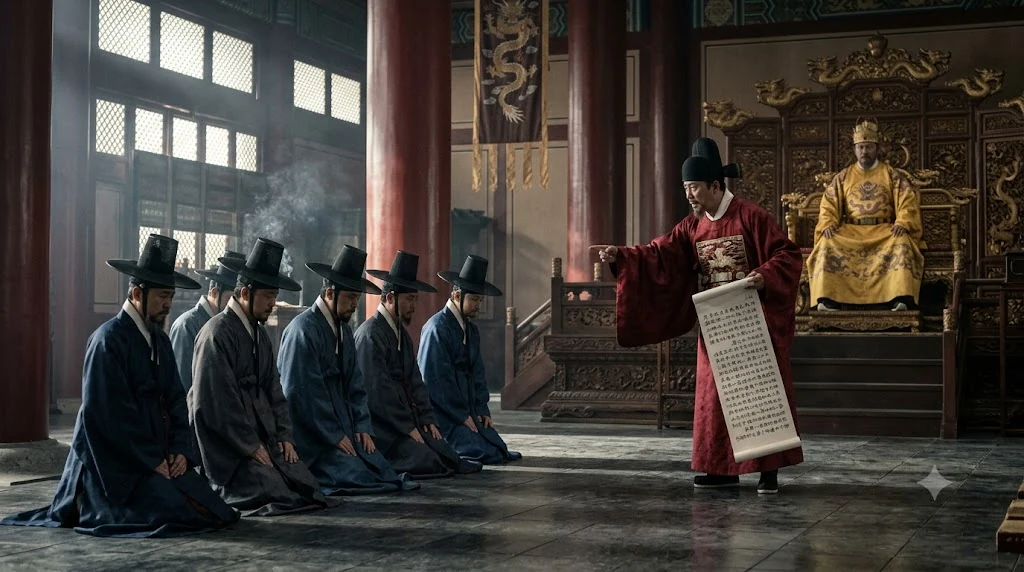
If you’ve watched the 2022 KBS drama Bloody Heart (붉은 단심), you know the dread that hangs over its politics: a charge of treason doesn’t stop with the accused. It can pull down an entire family — sons, wives, relatives, the whole house. That’s yeonjwaje (연좌제), Joseon’s “guilt by association,” and to many international viewers it looks like something uniquely, alarmingly Eastern. (For how yeonjwaje worked inside Joseon itself, see our companion piece on Joseon’s collective punishment.)
But here’s the question worth asking: was punishing a traitor’s family really a distinctly Korean, or Eastern, idea? Roman law is often treated as an ancestor of Western legal traditions — yet Roman states, too, let political punishment fall on an offender’s descendants.
 Rome had its own “guilt by association” — proscription lists that reached a target’s sons and grandsons. (AI illustration)
Quick answer: Ancient Rome had no single institution identical to Joseon’s yeonjwaje, but several Roman regimes let political punishment damage an offender’s descendants. Sulla’s civil-war proscriptions (82–81 BCE) stripped the civic rights of targeted men’s sons and grandsons, while a late imperial constitution of 397 CE excluded conspirators’ sons from inheritance, office, and public service. Joseon’s Great Ming Code went further, assigning kin execution, enslavement, exile, or confiscation by age and relationship. So the comparison shows a recurring practice of hereditary political punishment, not identical legal systems — and “the East punished families, the West prized the individual” is simply wrong.
Let’s unpack it.
Was treason a family crime in ancient Rome?
Yes — at least in the gravest political cases. In Rome, harming the majesty of the state or emperor was among the heaviest of crimes.
Roman law called it maiestas (마이에스타스) — an offense against the majesty of the Roman state or emperor (Britannica — Lex Cornelia de Maiestate). It doesn’t map perfectly onto the modern word “treason,” but it covered the core territory: political conspiracy and offenses against the authority and dignity of the state. And crucially, its punishment could reach beyond the accused.
And Rome offers several different examples, not one continuous equivalent of yeonjwaje — a Republic-era purge under Sulla, and a specific late-imperial statute, separated by nearly five centuries. Take the later one first: a constitution issued in 397 CE (by the emperors Arcadius and Honorius), preserved in the Codex Theodosianus (CTh 9.14.3, Latin text — Droit Romain · Britannica — Theodosian Code). It targeted conspiracies involving armed factions or plots to kill senior imperial officials, ordering the convicted conspirator executed and his property forfeited. But the striking part is what it did to the children: the traitor’s sons were spared their lives, but barred from inheriting from their mother, grandmother, or close kin, forbidden to receive property even by an outsider’s will, condemned to live “in perpetual poverty and disgrace,” and shut out of any office or military service. Daughters were allowed a limited, gentler share. A father’s political crime could shatter his children’s property, honor, and social future — though note this was a narrow conspiracy statute, not a blanket rule for every kind of treason.
Sulla’s proscriptions: erasing sons and grandsons
Rome’s Republic offers an even sharper scene. Around 82–81 BCE, after winning a civil war, Lucius Cornelius Sulla placed his enemies on proscription lists (proscriptio): those named could be killed, and their property was confiscated (Britannica — Proscription).
Plutarch’s Life of Sulla records how merciless it was — Sulla punished even those who sheltered the proscribed, rewarded those who killed them, and seized their estates. And Plutarch singled out, as one of the greatest injustices, that Sulla stripped the civil rights of the proscribed men’s sons and grandsons (Plutarch, Life of Sulla — Perseus Digital Library). This is not the same as Joseon’s codified kin-liability system, and Sulla’s purge was a civil-war act rather than a standing law. But in blocking the political future of descendants to eliminate a rival, it is strongly “guilt by association” in character. A treason or political enmity in Rome, too, could destroy not just a person but a family’s property, honor, and very basis for political survival.
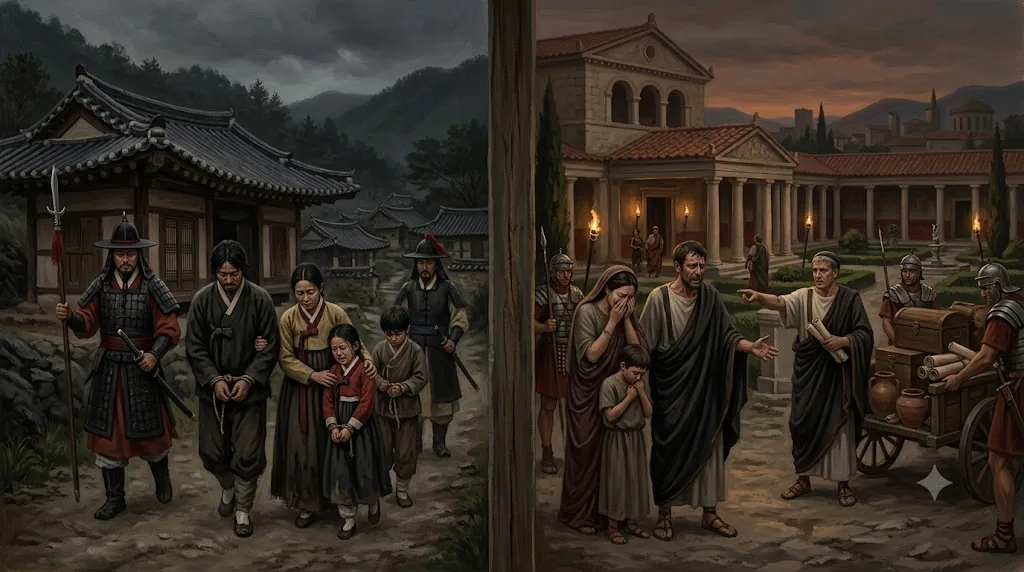 Joseon reached kin with execution and enslavement (left); Rome, more with confiscation and lost futures (right). (AI illustration)
How Joseon and Rome differed
Both Joseon and Rome treated treason — or treason-like political crime — with extreme severity. But the method diverged.
Joseon’s yeonjwaje, grounded in the Great Ming Code (Daemyeongnyul, 대명률) (Encyclopedia of Korean Culture — Great Ming Code), could extend a treason charge to family and kin. Under its ordinary provisions, a father and his sons aged sixteen or older could be executed, while younger sons and numerous female relatives were enslaved and other kin exiled. In the 1456 restoration plot (the Six Martyred Ministers), King Sejo went beyond the normal code — ordering all biological sons executed regardless of age, and widening enslavement among the relatives (National Institute of Korean History / 우리역사넷 — Sayuksin, 1456). So that famous case wasn’t simply the code applied — it was a king intensifying the sentence. Rome, in the examples here, leaned less toward executing or enslaving a defined circle of kin and more toward stripping the descendants’ inheritance, civic standing, and political prospects — though this is a difference of emphasis, not a clean binary. Joseon, too, destroyed futures; and Sulla’s proscribed could be killed without trial. The sharpest real contrast is narrower: executing children by category, simply for being kin, was part of Joseon’s written provisions in a way it was not in these Roman cases.
So the safe way to compare ancient Rome and Joseon is this: Rome had no exact copy of Joseon’s yeonjwaje — but it clearly had collective punishment in which disadvantage extended to a traitor’s family and descendants.
Key terms. Yeonjwaje (연좌제) — Joseon’s “guilt by association,” extending a treason charge to a criminal’s kin (Encyclopedia of Korean Culture). Maiestas (마이에스타스) — the Roman crime against the majesty of the state or emperor. Proscriptio (프로스크립티오) — Sulla’s published purge lists; the named could be killed and their property seized. Codex Theodosianus — the late Roman law code (439) that barred traitors’ sons from inheritance and office.
Here’s the drama decoded:
| In Bloody Heart | In real history |
|---|---|
| A treason charge dooms the whole family | Joseon’s yeonjwaje really could reach a traitor’s kin |
| Sons executed, women enslaved | Grounded in the Great Ming Code; enslavement and confiscation followed |
| “Only the East did this” | Rome, too, extended punishment to a traitor’s sons and grandsons |
| Rome as a land of pure individual law | Maiestas cases and proscriptions reached whole families |
| A uniquely Korean cruelty | A worldwide pattern of pre-modern states fearing treason |
The comparison that actually matters
For an international reader, this comparison lands hard — and it’s worth getting right.
The tempting move is a neat East–West binary: the East punished families; the West prized individual responsibility. That contrast is false. Ancient Rome, squarely in the “West,” let the shadow of treason fall on a traitor’s family and descendants. And yet modern constitutional law consciously rejected those older traditions of hereditary political punishment: the U.S. Constitution forbade that a conviction for treason “work Corruption of Blood” down a traitor’s bloodline and heirs (U.S. National Archives — Constitution, Article III). Ancient Rome and modern America show that even within the West, the principle changed over time.
Seen this way, Joseon’s yeonjwaje isn’t “a strange Korean institution.” It reflects a recurring cross-cultural pattern: more than one pre-modern legal tradition feared treason enough to treat it not as one person’s crime but as a whole family’s political danger. That is the real lesson hiding in Bloody Heart’s dread: the terror of collective guilt was never Korea’s alone.
Coming up next
One treason charge — and we’ve traveled from a Joseon family’s ruin to Roman maiestas law, Sulla’s proscription lists, and a clause in the U.S. Constitution. That’s the quiet gift of a good historical drama: a single fear is a doorway.
In the next essay, we’ll take another K-drama scene that looks like pure fiction — and trace the real Korean history hiding underneath it.
Frequently asked questions
Did ancient Rome have guilt by association like Joseon’s yeonjwaje? Not an identical system — but yes, a comparable pattern. Rome didn’t group a fixed circle of kin for execution or enslavement the way Joseon did. But in treason (maiestas) cases and political purges, punishment reached the family: later Roman law barred a traitor’s sons from inheritance and public office, and Sulla’s proscriptions stripped the civil rights of the targets’ sons and grandsons.
How was Joseon’s yeonjwaje different from Roman treason punishment? Joseon’s yeonjwaje, based on the Great Ming Code, could extend a treason charge to kin — sons executed, women and relatives enslaved, property confiscated. Roman punishment leaned instead toward stripping property, inheritance, public office, and civic honor. Put simply, Joseon’s was closer to “guilt that takes lives,” Rome’s to “guilt that takes futures.”
Isn’t collective punishment an “Eastern” idea and individual responsibility “Western”? That neat contrast is misleading. Ancient Rome also let the shadow of treason fall on a traitor’s family and descendants. Meanwhile, the modern U.S. Constitution explicitly forbade treason punishment from corrupting a traitor’s bloodline or heirs. Even within Western history, ancient Rome and modern America went in opposite directions.
Sources & further reading
This piece was written from the historical script and fact-check of 사뚱샘의 역사방 (SaDDungSam). Key sources are cited inline above. For broader reading:
- Yeonjwa / yeonjwaje (연좌), Joseon’s guilt by association — kin-liability from Buyeo through Joseon, abolished in the 1894 Gabo Reform. (Encyclopedia of Korean Culture / 한국민족문화대백과)
- The Great Ming Code (대명률) — the Ming legal code applied as Joseon’s working law. (Encyclopedia of Korean Culture)
- Lex Cornelia de Maiestate — the Roman law of offenses against state majesty (maiestas). (Encyclopaedia Britannica)
- The Theodosian Code — the late Roman code that barred traitors’ sons from inheritance and office. (Encyclopaedia Britannica)
- Proscription & Sulla — the published purge lists and their reach to sons and grandsons. (Britannica — Proscription · Plutarch, Life of Sulla — Perseus)
- U.S. Constitution, Article III (no Corruption of Blood) — the modern counter-example. (U.S. National Archives)
Thanks for reading — see you in the next one.
This article was researched and written by K-Drama History. Source: Bloody Heart, Explained: Did Ancient Rome Have a Version of Joseon's Yeonjwaje? — K-Drama History