Bon Appétit, Your Majesty Explained: Joseon Royal Food Tasters, Gimi Sanggung, and the King's Table
Theme: Power & Politics
From the research behind Pause the Drama.
A chef cooks a dish. The king eats it. If he likes it, she lives.
Bon Appétit, Your Majesty (폭군의 셰프), tvN’s twelve-part 2025 series, drops a modern chef, Yeon Ji-yeong, into Joseon to cook for a tyrant named Yi Heon. Every plate is a test — of her skill, of his mood, and of a court watching to see which way the king will turn. The time travel is fantasy and Yi Heon never existed.
Almost everything around him did.
A Joseon king did not simply pick up his spoon. Somebody tasted the food first — and in the court cuisine handed down from the last royal household, that somebody was a sanggung taking the gimi. But that familiar image is one late version of a much larger system: two centuries earlier the same duty sat with royal-pharmacy officials and a eunuch. The precaution was constant. The person was not.
The palace also ran its kitchens on a division of labour rather than a single genius at a stove. And when the harvest failed, a king really did cut dishes from his own table — and expected the court to notice.
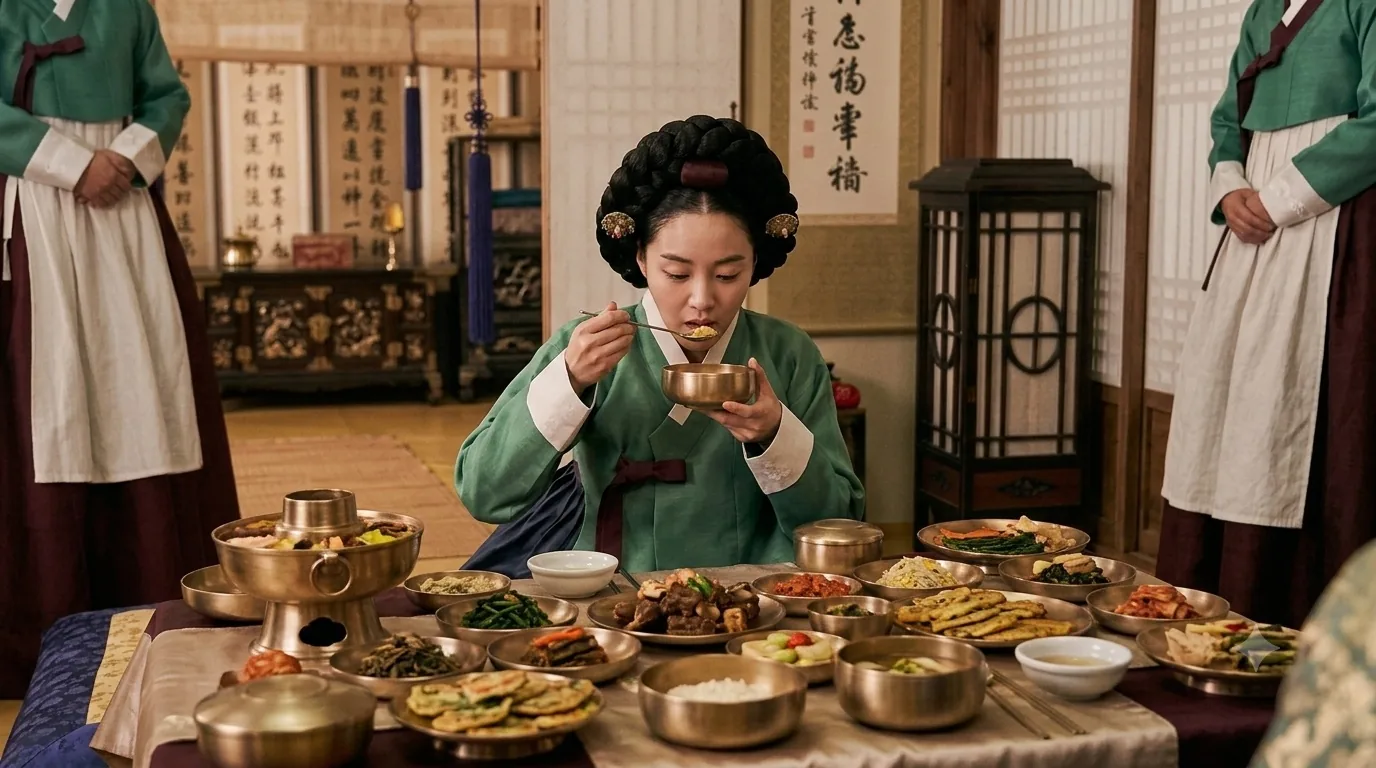 Taking the gimi: someone tasted the king’s food before the king did. Who that someone was changed with the period. (AI illustration)
Quick answer: In court cuisine as transmitted from the Gojong and Sunjong era, a sanggung took the gimi (기미, 氣味) — tasting the king’s food before he began. Earlier records assign the task differently: in 1765 the Seungjeongwon ilgi has royal-pharmacy officials inspecting the dishes and a eunuch tasting them. The kitchens were run by the Saongwon (사옹원) with day-to-day cooking in the sojubang, and large banquets staffed through a temporary kitchen, the sukseolso, where the male daeryeong suksu were prominent. During droughts and famines a king performed gamseon (감선) — fewer dishes — sometimes alongside cheolju (철주), giving up wine. The twelve-dish surasang everyone pictures belongs to the late transmission, not to all five centuries. Let’s unpack it.
Who tasted the king’s food before he did?
The familiar image is the gimi sanggung (기미상궁): a court lady seated beside the royal table who washes and presents the king’s spoon, tastes the dishes, and only then lets the meal begin. That picture is real, but it has an address. It comes from court cuisine transmitted by the last women who served in the Gojong and Sunjong palaces — the line of transmission that runs through Han Hui-sun and into the modern record of Korean royal cuisine.
Go earlier and the same precaution wears a different face. An entry in the Seungjeongwon ilgi for 1765 describes officials of the royal pharmacy examining the appearance of the food and a eunuch tasting it. So the safeguard was constant; the person performing it was not. A single fixed institution of female tasters running the length of the dynasty is more than the sources will carry.
What the word means. Gimi (기미, 氣味) means smell and taste. At court, “to take the gimi” meant tasting the food or medicine intended for the king in advance, to catch poison or spoilage. That is a specific act — not a label for the entire apparatus of palace food safety.
And there was an entire apparatus. Ingredients, cooked dishes, vessels and the laid table were checked in stages by different people — Saongwon staff, royal-pharmacy officials, eunuchs. Calling all of that “gimi” collapses a chain of responsibility into one dramatic gesture. The drama needs the gesture. The court had the chain.
The silver, while we are here. Silver spoons and silver vessels were used. Silver does tarnish on contact with certain sulphur compounds, and the reaction with the arsenic sulphides that appear in Joseon forensic practice has been examined in modern experiments. But that is one chemistry, not omniscience. A silver spoon would sail past a great many poisons — which is presumably why nobody relied on it alone, and why someone still ate first.
Is Yi Heon the real Yeonsangun?
No. Yi Heon is invented, and the drama’s events are not Yeonsangun’s record.
The resemblance is deliberate, though. The web novel behind the series is titled Surviving as Yeonsangun’s Chef, and the show gives us a tyrant fixated on banquets and pleasure, with a faction gathering to depose him.
The historical Yeonsangun did assemble female entertainers on a large scale. The Diaries of Prince Yeonsan record women gathered nationwide as unpyeong (운평), with some promoted into the heungcheong (흥청) on grounds such as musical skill and appearance — and the heungcheong themselves subdivided further, into categories recorded as jigwa, cheongwa and bancheongwa. Orders survive for filling out those numbers in the hundreds and thousands.
So: not Yeonsangun, but built out of him.
Did the king have a personal chef?
Not in the modern sense — no single figure inventing the menu and commanding the kitchens.
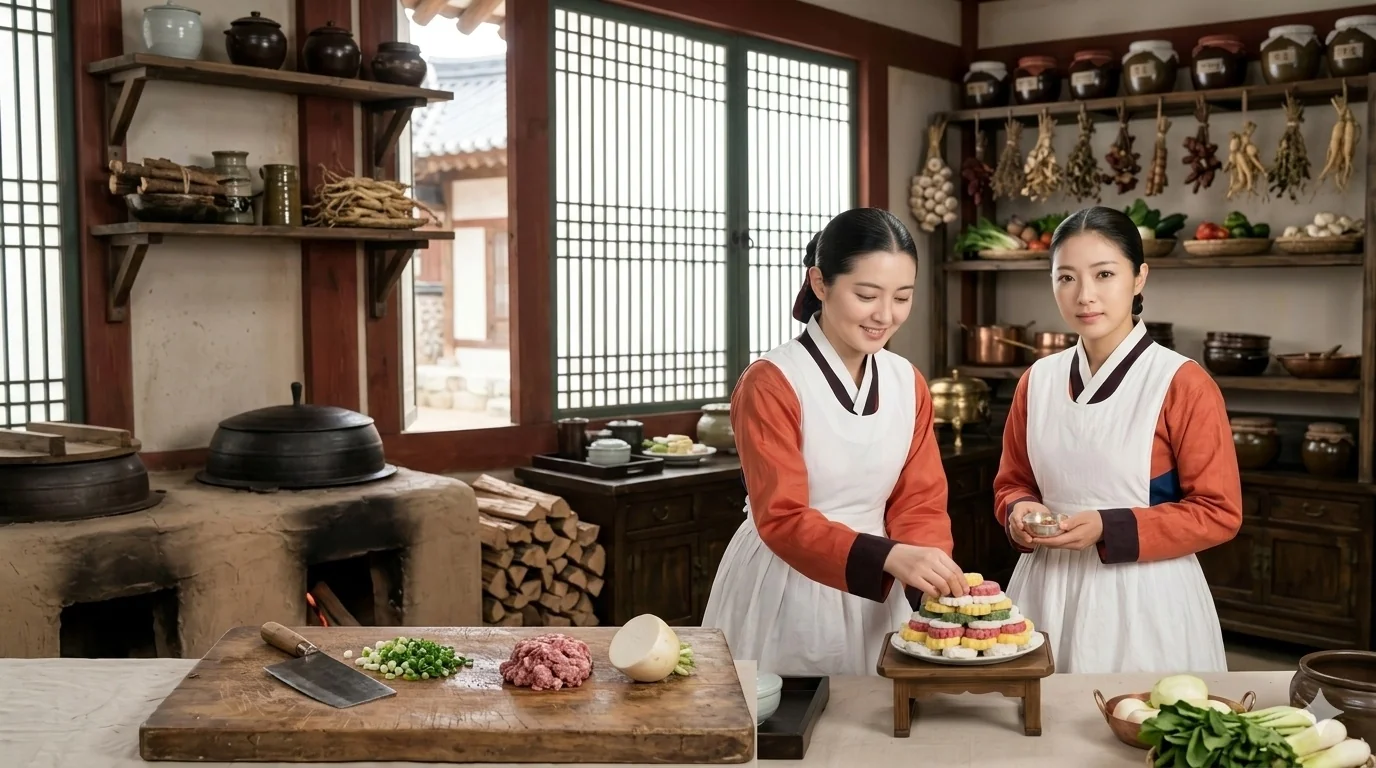
The office responsible for royal food and vessels was the Saongwon (사옹원). Everyday meals were prepared in the sojubang (소주방), also called the suragan. For weddings, birthdays and state banquets, a temporary kitchen — the sukseolso (숙설소) — was set up and staffed at scale, with the professional male cooks known as daeryeong suksu (대령숙수) especially prominent.
It is tempting to draw a clean line here — women cooked the daily meals, men cooked the banquets — and the temptation should be resisted. The Saongwon employed many male cooks and kitchen staff, while sanggung, court maids and eunuchs were involved in preparing, plating, carrying and serving palace food. What the sources support is that the sukseolso and its male cooks stood out at large banquets, not that the palace kitchen split neatly by gender.
Which means a woman cooking for the king is not fantasy. A woman single-handedly inventing dish after dish and carrying the fate of the whole kitchen on her shoulders — that is modern chef culture, imported.
Did he eat a twelve-dish table five times a day?
The twelve-dish surasang is the image everyone has. It deserves a date stamp.
The version we know was assembled largely from the transmission of the last court women of the Gojong and Sunjong era. Before that, the National Palace Museum notes, the royal table generally ran to about seven side dishes, and both the number of meals and the number of dishes moved with a king’s health, his tastes and the circumstances of the moment.
The rhythm described in that late transmission has food arriving several times a day — gruel or thin rice early, the sura proper in the morning and evening, and lighter things in between: noodles, sweets, porridge. Adding them up gives you “five times a day,” which is true and misleading at once. Five occasions, not five feasts.
So the safest statement is the narrow one: across five hundred years, no single standing menu. The twelve-dish table is a late portrait, not a dynastic rule.
Why was the king’s table political?
Because the same table had to say two opposite things.
A king was entitled to the finest food in the country, and a full table displayed the dignity of the throne. But Confucian politics also required visible restraint — and when drought, flood or a failed harvest arrived, that requirement became a procedure.
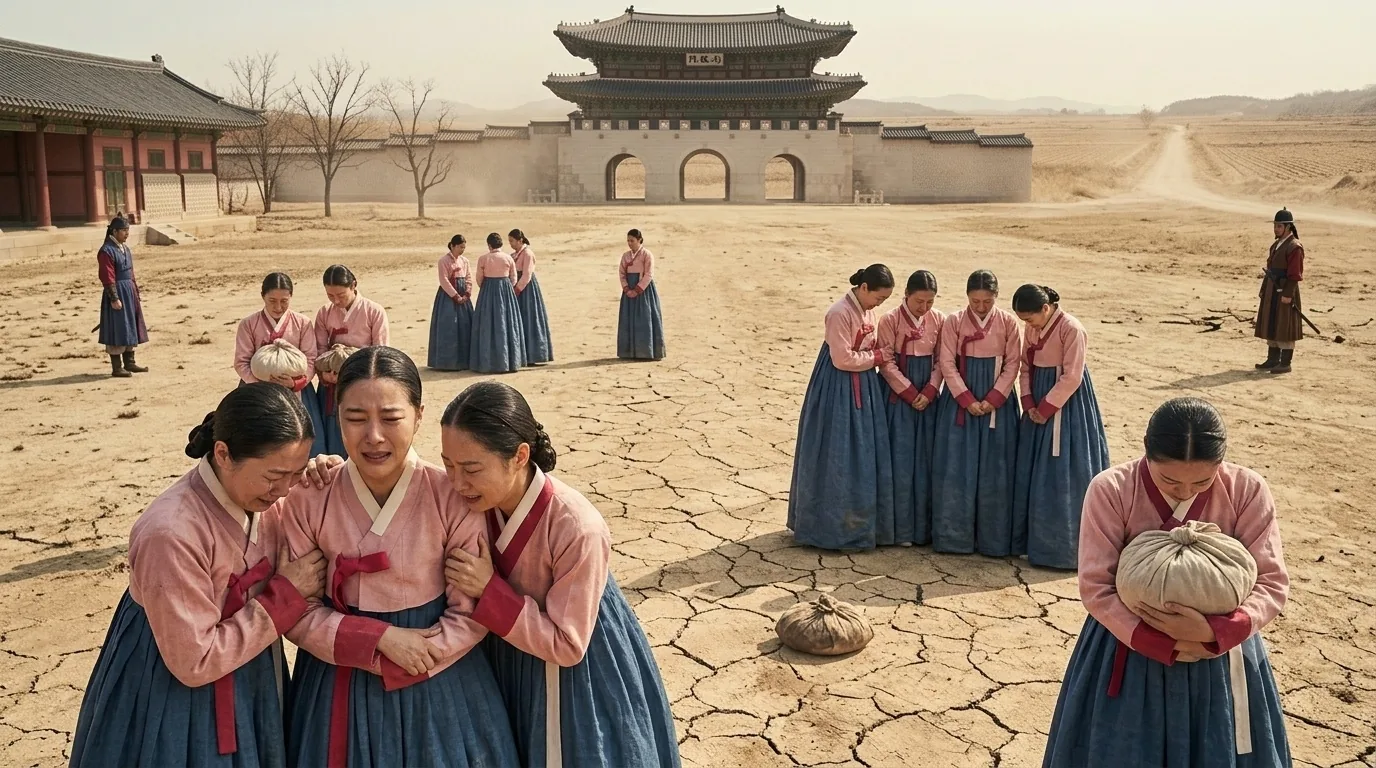
Gamseon (감선, 減膳) meant reducing the number of dishes on the royal table. It was not fasting: Sejong’s court explained it as serving fewer dishes rather than serving none. Giving up wine was a separate measure with its own name, cheolju (철주, 輟酒) — the Veritable Records of Taejong list the two side by side among drought responses.
Nobody thought the king eating three fewer dishes would feed a province. That was not the mechanism. In the Confucian reading, a great disaster could be construed as a verdict on the ruler’s virtue, and gamseon was the king answering that verdict in the one medium everyone could see: his own plate.
A full table showed the authority of the crown. A reduced table showed the accountability of the man sitting at it.
Would a cook really be executed for a bad dish?
No standing rule of that kind is on record — and the structure of the kitchens argues against it. Sourcing, preparation, cooking, plating and tasting were distributed among many hands; there was rarely one throat to hold responsible for a disappointing plate.
What is closer to the record is the cost of appetite. Royal food was tied into a nationwide system of tribute, procurement and transport, and sustained large-scale consumption and banqueting could press on state finances and on the labour owed by ordinary people. A tyrant’s table was not merely a private indulgence. It reached outward — into supply routes, corvée obligations and the household economies at the far end of them.
Folklore: did heungcheong-mangcheong come from Yeonsangun?
This one needs to be split carefully, because half of it is in the record and half of it is not.
In the record: unpyeong and heungcheong are documented in the Diaries of Prince Yeonsan, along with the criteria for promotion between them and the internal ranks of the heungcheong.
Not in the record: that today’s phrase 흥청망청 (heungcheong-mangcheong, roughly “squandering it all away”) was coined directly from those events. That is a later, popular etymology. The word may well carry the memory; the derivation is not documented.
There is also the satirical song Samoyo (사모요), said to have circulated after Yeonsangun’s deposition, mocking a king who had kept a thousand entertainers and now travelled into exile alone. It survives not in the Veritable Records but in the later miscellany Yongcheon damjeokgi (용천담적기), a collection of stories Kim An-ro set down at second hand — and the original Korean lyric does not survive at all. What the text preserves is a Chinese rendering and an account of the circumstances.
That is as far as the evidence goes, and it is worth stopping there rather than explaining why the song was remembered.
How does this compare with Japan and Tudor England?
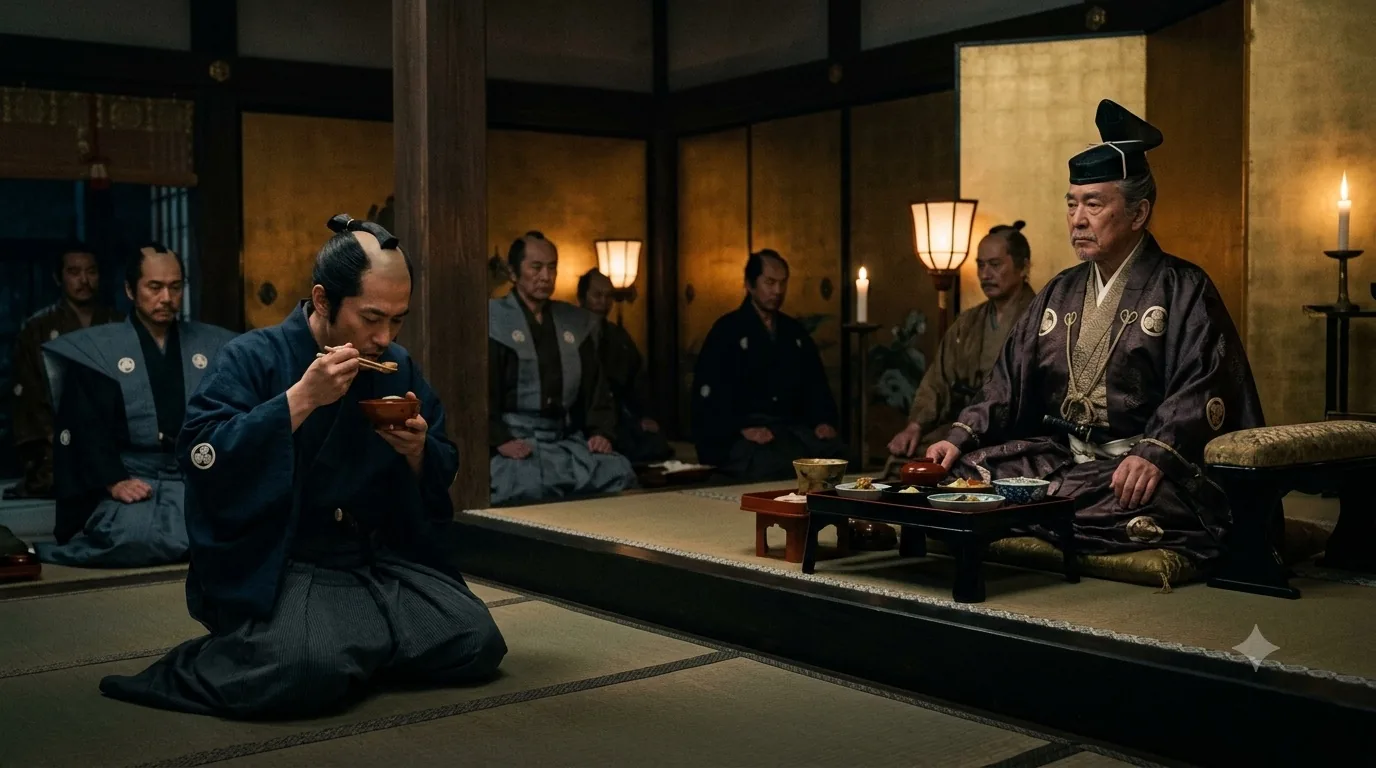 Edo castle had its own tasters. The shared logic: the ruler’s meal was a security procedure. (AI illustration)
Japan — the shogun’s tasters. Food served to the shogun at Edo castle passed through multiple hands, and those responsible for dokumi (毒味) checked it before he ate. The Korean gimi and the Japanese dokumi make the same point: at the top of a state, a meal is a security procedure. Where Joseon adds a second layer is gamseon — the ruler answering a disaster by eating less.
Tudor England — the table as display. Henry VIII’s kitchens at Hampton Court employed on the order of two hundred people and are described as turning out more than eight hundred meals a day, with expensive meat and imported spice advertising the reach of the crown. But hierarchy there was not measured by proximity to the king’s elbow — Henry commonly ate in private, and on formal occasions could sit alone at a high table. What ranked you was where in the palace you were entitled to eat, and what you were served.
Tudor England displayed the wealth of the crown through the size of its table. The Joseon ideal sometimes required a king to shrink his.
| What the drama sharpens | What the record shows |
|---|---|
| A single chef invents the royal menu | The Saongwon ran food and vessels; daily cooking in the sojubang, banquets through the temporary sukseolso with male daeryeong suksu prominent |
| A woman cooking for the king is transgressive | Court women were central to palace food; the “one genius chef” is the modern part, not her gender |
| The taster exists to die for the king | Gimi was one checking step in a staged chain — pharmacy officials, eunuchs and Saongwon staff each had a part |
| A bad dish means execution | No such standing rule is recorded; responsibility for a dish was distributed by design |
| The twelve-dish table is the Joseon royal meal | It reflects the Gojong–Sunjong transmission; earlier practice generally ran to about seven side dishes |
| A tyrant’s feasting is personal excess | It was also fiscal: tribute, procurement, transport and corvée labour stood behind every banquet |
In short: the drama asks whether the king likes the food. Joseon asked who had checked it, who had paid for it, and whether the size of the table matched the state of the harvest.
Key terms. Gimi (기미 氣味) — smell and taste; at court, tasting the king’s food in advance. Gimi sanggung (기미상궁) — the court lady who performed it, as described in the late transmission. Saongwon (사옹원) — the office responsible for royal food and vessels. Sojubang (소주방) — the everyday palace kitchen, also called suragan. Sukseolso (숙설소) — a temporary kitchen erected for large banquets. Daeryeong suksu (대령숙수) — the professional male cooks who worked them. Surasang (수라상) — the king’s table setting. Gamseon (감선 減膳) — reducing the number of dishes as a response to disaster. Cheolju (철주 輟酒) — giving up wine, a separate measure. Unpyeong (운평) / Heungcheong (흥청) — the female entertainers gathered under Yeonsangun, and the promoted group among them.
Back to the drama
Yeon Ji-yeong’s plate is never only a plate.
To her it is survival. To Yi Heon it is a test of his own appetite and power. To the sanggung and the suksu it is craft handed down. To the ministers it is a variable — something that moves the king before an argument does.
No modern chef ever softened a Joseon tyrant with French technique. But the part underneath is close to the record: one royal meal reached back through court ritual, state finance, provincial tribute and other people’s labour before it ever arrived at the table, and someone tasted it before the king did.
Bon Appétit, Your Majesty is a fantasy romance. Its most interesting truth is historical: in a palace, cooking was a language of survival and power long before it was a language of love.
Frequently asked questions
Is Bon Appétit, Your Majesty based on a true story? No. The time travel and romance are invented and Yi Heon is not a historical king. The background — tasting the king’s food, the palace kitchens, the banquet cooks, a king reducing his own table in a famine — corresponds to real Joseon practice.
Did someone really taste the Joseon king’s food first? Yes, though the person changed. Court cuisine transmitted from the Gojong and Sunjong era describes a sanggung taking the gimi; a 1765 entry in the Seungjeongwon ilgi has royal-pharmacy officials inspecting the dishes and a eunuch tasting them.
Was the royal food taster expected to die? No. Gimi was a check, not a sacrifice. Tasting sat inside a staged chain — Saongwon staff, royal-pharmacy officials and eunuchs each inspected part of it — so the aim was to catch a problem early, not to supply a body.
What was the Saongwon? The office responsible for the royal household’s food and vessels. Daily meals were cooked in the sojubang (also called the suragan); large banquets ran through a temporary kitchen, the sukseolso, staffed at scale with the male daeryeong suksu prominent.
What does gimi mean? Smell and taste. At court it meant tasting the king’s food or medicine in advance to check for poison or spoilage — one step in a longer chain of inspection, not the name of the whole system.
Is Yi Heon the real Yeonsangun? No. He is fictional, but built to evoke Yeonsangun: the source novel is titled Surviving as Yeonsangun’s Chef, and the tyranny, banquets and coup plot all point that way.
Did the Joseon king really eat a twelve-dish surasang every day? That table reflects the Gojong–Sunjong transmission rather than five centuries of practice. Earlier practice generally ran to about seven side dishes, varying with the king’s health, taste and circumstances.
What was gamseon? Reducing the number of dishes on the royal table during a disaster. Giving up wine was a separate measure called cheolju. Sejong’s court described gamseon as fewer dishes, not none.
Where does the word heungcheong-mangcheong come from? Unpyeong and heungcheong are documented in the Diaries of Prince Yeonsan, including promotion criteria and internal ranks. That the modern phrase derives directly from those events is a later popular etymology.
Did silver spoons detect poison? Partly at best. Silver tarnishes with certain sulphur compounds, including arsenic sulphides examined in modern experiments on Joseon forensic practice — but that is one reaction, not a universal detector.
Sources & further reading
This piece was written from the historical script and fact-check of 사뚱샘의 역사방 (SaDDungSam).
- Surasang (수라상), and the transmission of court cuisine through Han Hui-sun (한희순). Encyclopedia of Korean Culture
- Saongwon (사옹원) — the office for royal food and vessels. Encyclopedia of Korean Culture
- Court cuisine (궁중음식) and corvée labour (요역). National Institute of Korean History, 우리역사넷
- 「궁중음식, 공경과 나눔의 밥상」 and 『2024년 왕실문화 심층탐구』, 정병설, 「궁중의 밥상, 임금의 밥상」. National Palace Museum of Korea
- Inspection of the royal table, 1765. 『승정원일기』, Yeongjo 41st year, 9th month, 23rd day
- Gamseon and cheolju as drought responses. 『태종실록』 11th year 7th month 12th day; 『세종실록』 18th year intercalary 6th month 7th day
- Unpyeong, heungcheong and their internal ranks. 『연산군일기』 11th year 3rd month 25th day, 4th month 22nd day; 12th year 9th month 2nd day
- Samoyo (사모요) and Yongcheon damjeokgi (용천담적기). Encyclopedia of Korean Culture
- Tasters at Edo castle. National Diet Library (Japan), Collaborative Reference Database — entry contributed by 安城市図書情報館, 「江戸時代の将軍の毒見役は実際何人位いたのか。」
- Tudor dining and the royal court. Historic Royal Palaces, “Tudor Food and Eating”; “The Royal Court in the Tudor Period”
- Silver and sulphur chemistry. Royal Society of Chemistry, “Silver”; Yun Sik Nam et al., “Modern Scientific Evidence Pertaining to Criminal Investigations in the Chosun Dynasty Era,” Journal of Forensic Sciences 59(4), 2014
- Bon Appétit, Your Majesty (tvN, 2025) — Netflix / Netflix Tudum official title page
Thanks for reading — see you in the next one.
This article was researched and written by K-Drama History. Source: Bon Appétit, Your Majesty Explained: Joseon Royal Food Tasters, Gimi Sanggung, and the King's Table — K-Drama History