Jeong Do-jeon, Explained: Why Ming China Wouldn't Recognize Korea's New King for Nine Years
Theme: Power & Politics
From the research behind Pause the Drama.
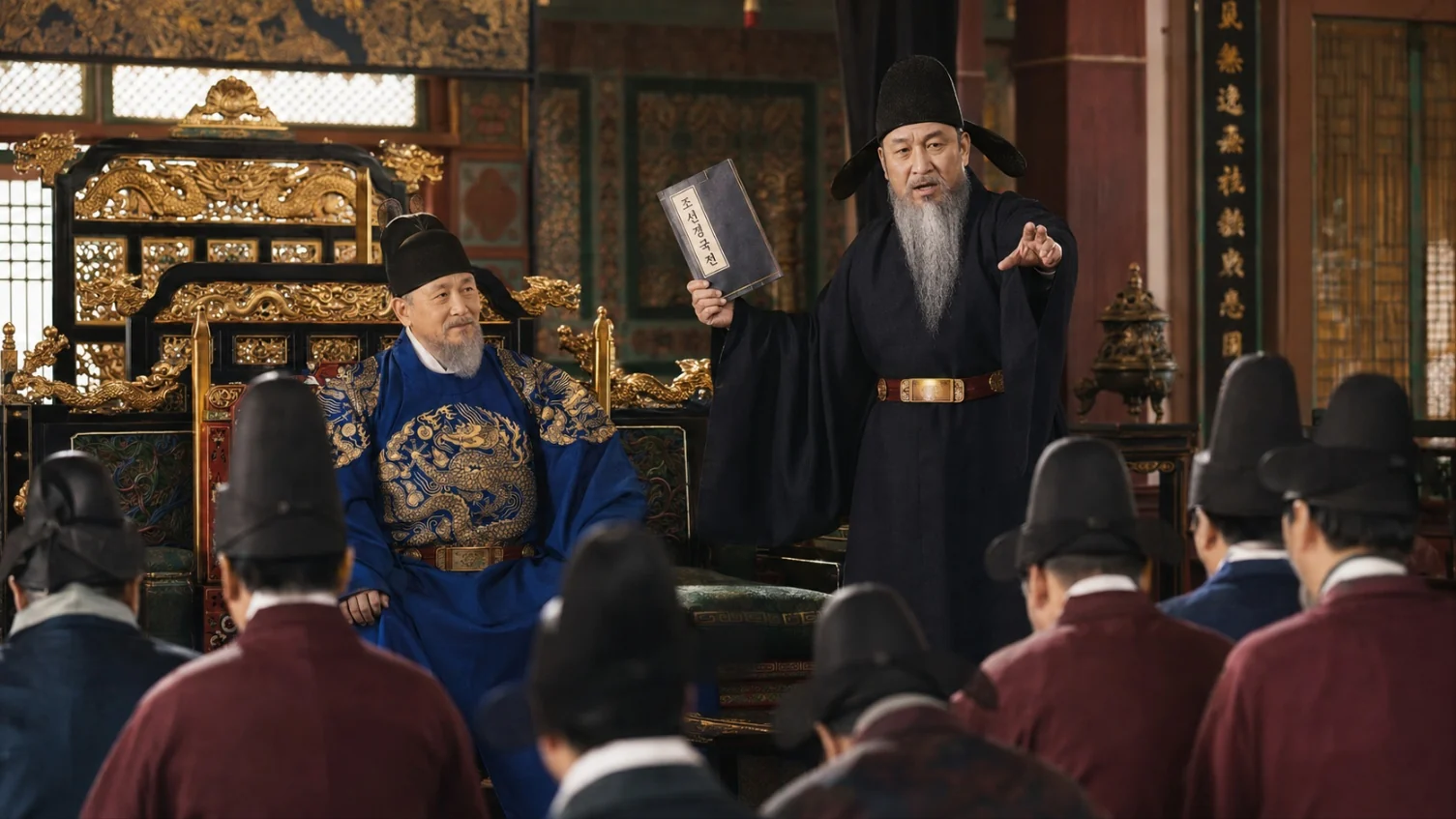
If you’ve watched the 2014 KBS1 sageuk Jeong Do-jeon (정도전) — the 50-episode epic that dramatizes the founding of the Joseon dynasty — you remember how personal the fury gets. Joseon sends a diplomatic document to Ming China. The Ming court decides its wording is insulting. Envoys are detained in Nanjing. Word comes back that some of them have died there. And Jeong Do-jeon — the brilliant, ruthless scholar-official who designed the new dynasty’s laws, capital, and army — doesn’t treat this as an unfortunate misunderstanding. He starts stockpiling grain, disbanding the private armies of his rivals to build one national force, and drawing up plans to invade Ming territory in Liaodong.
International viewers tend to read this as: wow, an argument over phrasing almost started a war. But here’s what the drama assumes you already know, and mostly doesn’t spell out: the argument was never really about the words. It was about the one thing Ming was withholding — and until it came, the brand-new dynasty couldn’t take its full place in the order it lived inside: an emperor’s official recognition of its king.
Quick answer: In Jeong Do-jeon, a fight over a diplomatic document’s wording spirals into detained envoys, executions, and a planned invasion. The real story underneath it is chaekbong (책봉) — the Chinese emperor’s formal investiture of a neighboring king. Newly founded Joseon didn’t have it yet. For nine years after 1392, its rulers governed at home but were styled only “provisional administrators” in dealings with the Ming court — not yet recognized by Ming under the formal title “King of Joseon.” (That title governed their correspondence with Ming, not the authority by which they actually ruled inside Joseon.) Ming’s Hongwu Emperor withheld the golden seal and the patent that would have made that recognition official abroad, and the paperwork dispute was one way he kept the pressure on.
Let’s unpack it.
Why wouldn’t Ming just call Yi Seong-gye a king?
Because in 1392, Yi Seong-gye hadn’t become king through succession — he’d taken the throne from the Goryeo dynasty by force, and the Ming founder, Zhu Yuanzhang (the Hongwu Emperor), was in no hurry to certify that.
When Yi Seong-gye’s court petitioned Ming for recognition, its own diplomatic paperwork called him “gwonji-goryeo-guksa” (권지고려국사, 權知高麗國事) — literally “provisionally in charge of the affairs of the state of Goryeo.” Not king. Not even ruler of a state called “Joseon” yet — that name hadn’t been approved. In 1393, after Joseon’s court submitted two candidate names, the Hongwu Emperor himself chose “Joseon” as the more fitting and ancient one, and Ming’s Board of Rites relayed the decision; Yi Seong-gye proclaimed the new name immediately (National Institute of Korean History). But even after the name was settled, the title in Joseon’s official correspondence with Ming stayed a placeholder — “provisionally in charge of state affairs” — with the exact wording shifting from document to document: gwonji-goryeo-guksa, then gwonji-guksa (권지국사, 權知國事), and variants. Not a king. An acting administrator, waiting for a recognition that hadn’t come (Encyclopedia of Korean Culture, 권지국사). And the wait outlasted Taejo himself: the placeholder status passed from him to his son Jeongjong, and then to Taejong, before Ming finally invested a Joseon king.
That waiting period is the part Jeong Do-jeon dramatizes without naming outright. It lasted nine years.
What was chaekbong, and why did a brand-new dynasty need it so badly?
Because in the Ming-centered diplomatic order, ruling as king at home and being recognized as one abroad were two different things.
Chaekbong (책봉, 冊封) was the formal act by which the Chinese emperor invested a neighboring ruler with the title of king. It was sealed with two physical objects: a gomyeong (고명, 誥命) — a patent document naming the recipient and confirming the title — and a geumin (금인, 金印), a golden seal stamped with an inscription like “Seal of the King of Joseon.” Together, they were the paperwork of legitimacy itself. Ming didn’t reserve the format of “chaek” (冊) investiture used for its own imperial family for foreign rulers; it used the gomyeong instead — a deliberately distinct, formalized channel built for exactly this purpose (Encyclopedia of Korean Culture, 고명).
This mattered for more than ceremony. In the political theology both countries shared, the Chinese emperor ruled as the Son of Heaven under the Mandate of Heaven (천명, 天命) — the idea that Heaven authorizes a just ruler and can withdraw that authorization. Ming extended a version of that same logic outward: if Heaven’s mandate flowed through the emperor, then the emperor’s official recognition of a neighboring king carried some of that same cosmic weight. A king who had chaekbong could tell his own court, and his own people, that his rule was endorsed by the wider order of Heaven and Earth — not just seized by force. A king who was still just “provisionally in charge” could not make that claim nearly as convincingly. None of this created Taejo’s power inside Korea — he already ruled, appointed officials, and commanded armies. But for a usurper who had just deposed one dynasty and needed his own to look permanent, that outside endorsement strengthened a legitimacy still being assembled at home and abroad.
What actually went wrong with the pyojeon documents?
The wording did matter — the Hongwu court was famously touchy about diplomatic style. But the punishment fell so hard because the documents landed inside a much larger conflict: over trust, recognition, and a new dynasty Ming hadn’t decided to accept.
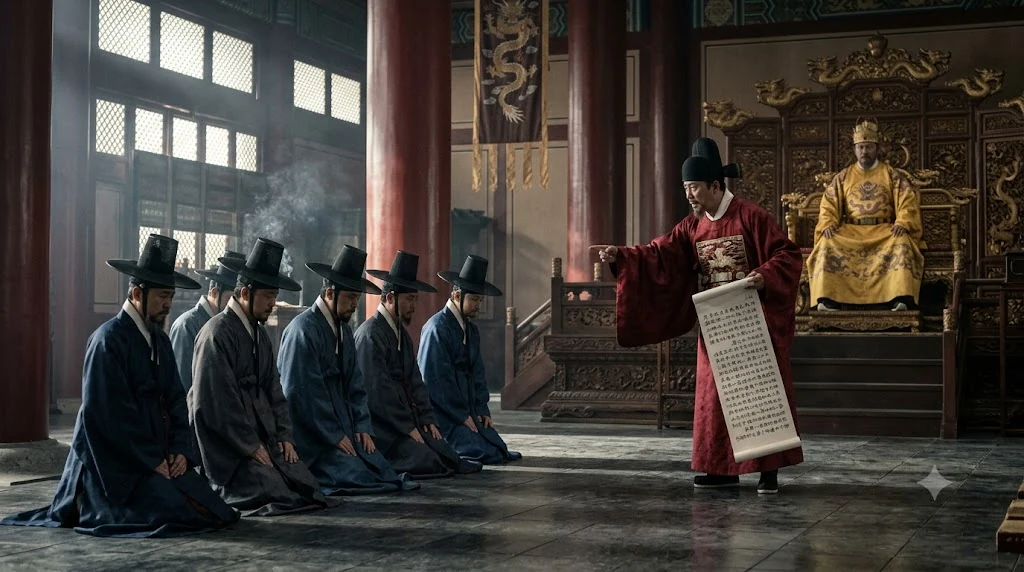
In November 1395, Joseon dispatched the scholar-official Jeong Chong (정총) to Nanjing to formally request the gomyeong and geumin. Ming’s court took offense at the wording of the documents he carried — a pyo (表), addressed to the emperor, and a jeon (箋), addressed to the crown prince — and detained him. This was the opening of the pyojeon crisis (표전문제, 表箋問題), a running dispute over the language of Joseon’s diplomatic texts. A separate, sharper flare-up followed in 1396, over another memorial — drafted by Jeong Taek (정탁), with Kim Yak-hang (김약항) composing the formal petition. This time the Hongwu Emperor demanded that the men responsible be sent to Ming for punishment, naming Jeong Do-jeon himself among them. Joseon’s court pushed back: it reported that Jeong Taek had written the text and that Jeong Do-jeon had neither drafted nor edited it — the charge was Ming’s accusation, not Joseon’s admission (Encyclopedia of Korean Culture, 표전문제).
Some envoys, including Ha Ryun and Gwon Geun, were eventually able to travel to Ming and partially defuse the situation. But Jeong Chong was not released. Held in China through 1396 and into 1397, he died there that year, along with fellow officials Kim Yak-hang and No Ingdo. Word of their deaths reached the Joseon court that November. Historians see the underlying friction as running deeper than any single sentence — Ming still resented an earlier 1374 incident in which a Ming envoy had been killed on Korean soil, and a newly founded, militarily assertive Joseon under Jeong Do-jeon’s centralizing reforms made Ming’s court uneasy about what it was dealing with next door.
Why did Jeong Do-jeon want to invade Ming territory over a paperwork dispute?
Because to him, it wasn’t a paperwork dispute. It was proof that Ming intended to keep humiliating and threatening a Joseon that couldn’t yet stand on fully recognized legal ground.
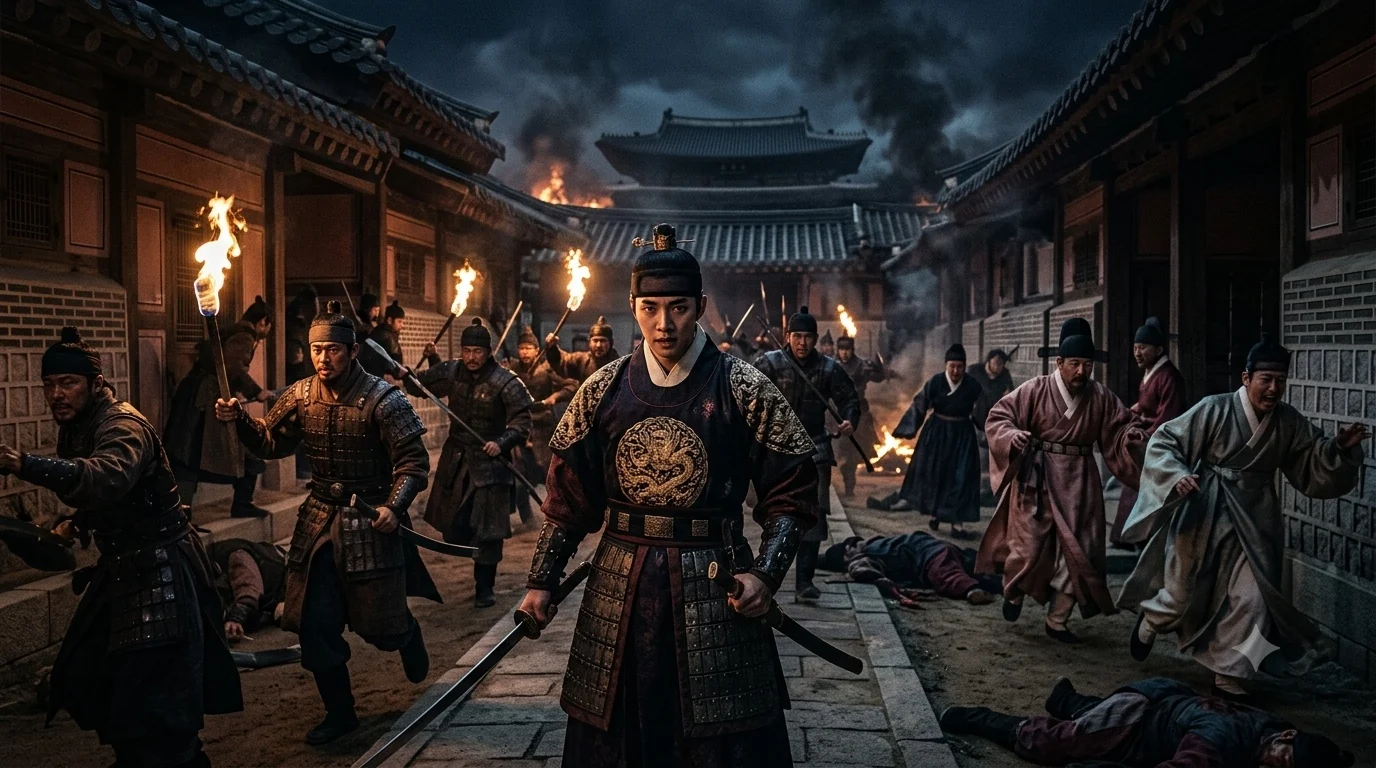
Ming’s treatment of the detained envoys sharpened a confrontation that was already building. Jeong Do-jeon pushed to consolidate Joseon’s military power directly under the throne — moving to curb the private armies (사병) still held by rival princes and nobles, a drive that served domestic ends as much as any war footing — and began stockpiling grain and troops for what’s remembered as the Liaodong campaign plan (요동정벌계획), a proposed strike into Ming’s northeastern frontier. (The private armies were not formally abolished until 1400, after his death — by the very faction that killed him.) This is the arc Jeong Do-jeon builds toward in its final episodes. History cut it short from two directions at once: the Hongwu Emperor died in June 1398, and later that year — on the 26th day of the 8th lunar month — Jeong Do-jeon was killed in the First Strife of Princes, the succession struggle in which Yi Bang-won (the future King Taejong) eliminated his father’s chief minister and several half-brothers. The invasion plan died with him. The drama ends there.
What it doesn’t show — because it happens after Jeong Do-jeon is already dead — is how the actual recognition crisis was resolved.
So did Joseon ever get its king recognized — and did it stick?
Eventually, yes. And then, almost immediately, it had to happen all over again.
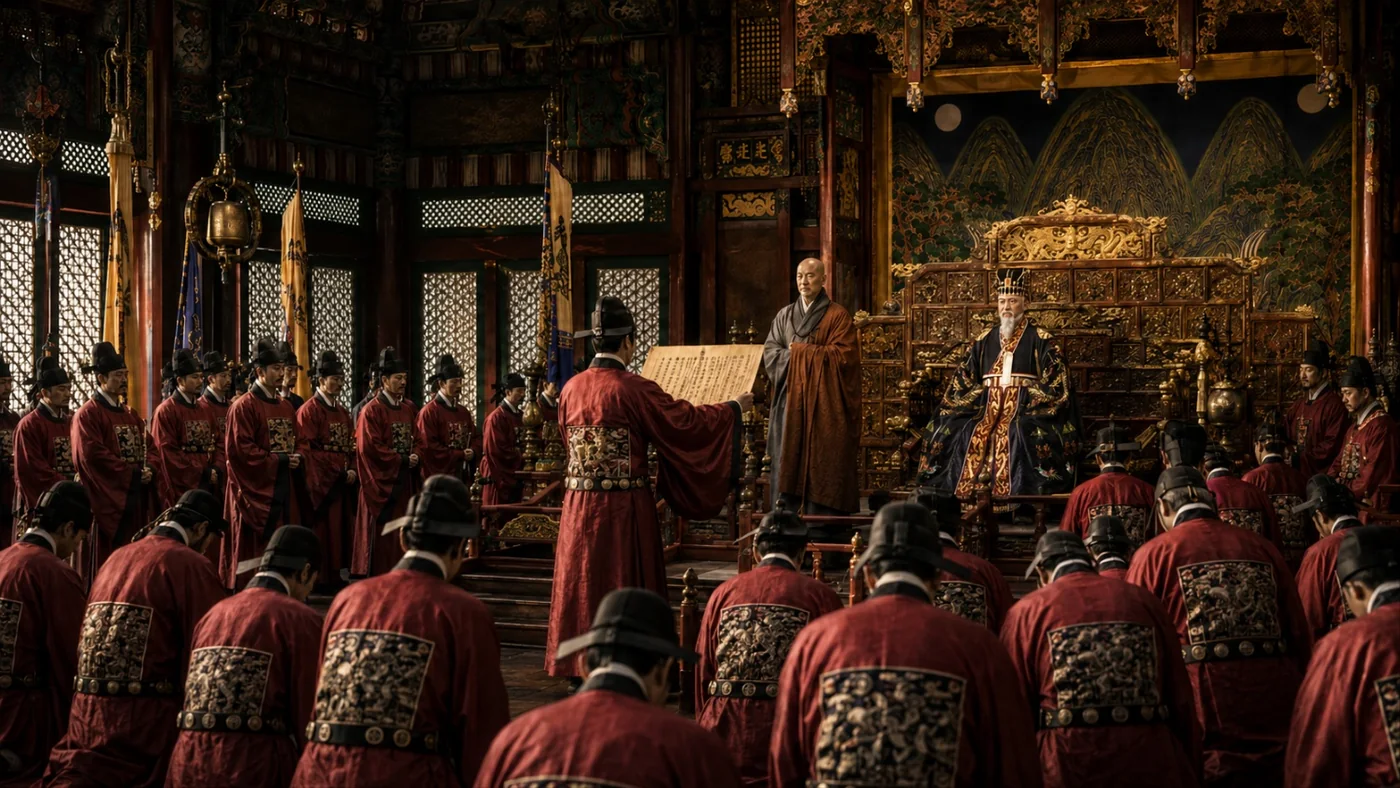
Under Taejong, on the 12th day of the 6th month of 1401, Ming envoys Zhang Jin (章謹) and Duanmu Li (端木禮) arrived at Joseon’s court bearing the emperor’s edict. The Veritable Records of the Joseon Dynasty record Taejong receiving them in full ceremonial dress outside Seonuimun Gate, with civil and military officials in procession. The edict formally invested him as “King of Joseon (朝鮮國王)” and granted him a golden seal — a square seal inscribed, in seal script, with the six characters “朝鮮國王金印,” Golden Seal of the King of Joseon (Veritable Records of the Joseon Dynasty, Taejong 1/6/12; National Institute of Korean History). Nine years after founding the dynasty, and three years after Jeong Do-jeon’s death, Joseon finally had a king Ming was willing to call a king.
The twist: the emperor who granted that investiture, the Jianwen Emperor, did not hold his own throne much longer. In 1402, his uncle overthrew him in a civil war and took the throne as the Yongle Emperor. Taejong, congratulating the new emperor, requested fresh credentials. On the 8th day of the 4th month of 1403, Yongle’s replacements arrived first: a new patent, and a new golden seal, this one inscribed “朝鮮國王之印,” Seal of the King of Joseon, in slightly different script — and only afterward, later that same month, did Joseon send the old Jianwen-era patent and seal back to Ming (National Institute of Korean History). Joseon’s king had to be re-certified because the source of his certification had itself just been overthrown. Borrowed recognition, it turns out, is only as stable as the throne that issued it.
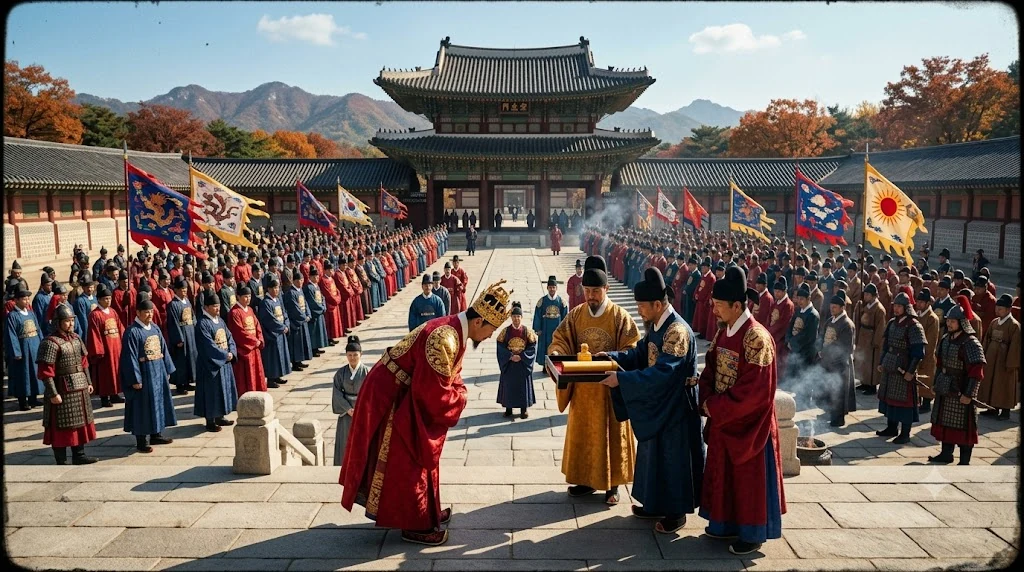
Key terms. Chaekbong (책봉, 冊封) — the Chinese emperor’s formal investiture of a neighboring ruler as king, the capstone of the tributary order. Gomyeong (고명, 誥命) — the patent document, paired with a golden seal (geumin, 금인), that made an investiture official. Gwonji-guksa (권지국사, 權知國事) — “provisional administrator of state affairs,” the placeholder title used in diplomatic documents while recognition was pending. Mandate of Heaven (천명, 天命) — the belief that Heaven authorizes a just ruler; Ming extended a version of this logic outward, treating its recognition of neighboring kings as part of the same order.
Here’s the drama’s crisis translated into the history underneath it:
| In Jeong Do-jeon | In real history |
|---|---|
| A dispute over document wording leads to detained, then dead, envoys | The 1396–97 pyojeon crisis: Ming accused Joseon’s tribute documents of disrespect and held its envoys, several of whom died in custody |
| Jeong Do-jeon rages and plans to invade Ming territory | He pushed to unify Joseon’s military and stockpile for a Liaodong campaign, partly in response to Ming’s treatment of detained officials |
| Taejo is treated on-screen as “the king” from the start | Inside Joseon he was unquestionably king; in diplomatic paperwork with Ming he was still “gwonji-guksa” — a provisional administrator, not yet Ming-recognized |
| The story ends with Jeong Do-jeon’s death, crisis unresolved | Formal recognition didn’t arrive until 1401, three years after he died, under his rival Taejong |
| Ming officials seem simply petty about phrasing | The wording dispute sat inside a wider recognition crisis — another lever for pressuring a dynasty Ming did not yet trust |
Why Jeong Do-jeon’s fury feels so Korean: four rulers, four ways to borrow legitimacy from above
Almost every East Asian and European power built some system for making a ruler’s authority feel bigger than the ruler himself. But who got to grant that authority — and what it cost to ask for it — differed sharply by civilization. Set Joseon’s investiture crisis beside three others, and the shape of the problem gets clearer.
Korea — recognition renewed every generation, sometimes every regime change. Joseon’s need for chaekbong didn’t end with Taejong’s golden seal in 1401 (or its 1403 replacement). Every new king’s succession, in principle, called for confirmation from the emperor next door — sought through Joseon’s Ming-era embassies, the jocheonsa (조천사, 朝天使), literally “envoys paying court to Heaven.” After the Manchu conquest of Ming in 1644, and Joseon’s own forced submission to the new Qing dynasty following its 1636–37 invasion, those missions continued under a new name: yeonhaengsa (연행사, 燕行使), “envoys to Yanjing” — a plainer, geographic name that no longer carried the reverence built into “paying court to Heaven.” That shift also suited a Joseon elite that complied with Qing diplomacy while often withholding the cultural reverence it had once given Ming (Encyclopedia of Korean Culture, 조천사; 연행사). Joseon still sent tribute, still received investiture, still needed the golden seal — but for over two centuries afterward, many of its own scholars quietly kept using the reign name of the last Ming emperor in private writing, a doctrine known as daemyeong-uiriron (對明義理論), “the theory of righteous duty to Ming”: obey the emperor who could actually enforce recognition, but reserve real reverence for the one who no longer existed. Legitimacy from above, and loyalty from the heart, had quietly split apart.
China — the source of the logic, and the reason Ming behaved this way at all. None of this made sense without the Mandate of Heaven on the Chinese side of the ledger. A Ming emperor’s own right to rule rested on the claim that Heaven had chosen him over the dynasty before his — which is exactly why a rough-edged new dynasty like Joseon, founded by a general who’d just deposed a king, looked so alarming from Nanjing. If a general could topple one throne, why not another? Withholding formal investiture, dragging out a wording dispute, demanding a drafter’s head — these weren’t random cruelties. They were tools for testing whether an untested neighbor deserved to be treated as legitimately as an old one, before extending any of Heaven’s borrowed authority to it.
Japan — a shogun who asked for the very thing Joseon dreaded not having. In an almost eerie coincidence, 1401 — the same year Taejong finally received his gomyeong — is also the year the Japanese shogun Ashikaga Yoshimitsu sent his own embassy to Ming, requesting recognition. The following year, Ming responded by naming him “King of Japan (日本国王)” under the same tributary framework used with Korea (Encyclopædia Britannica). But where Joseon needed chaekbong to secure a shaky new dynasty’s domestic legitimacy, Yoshimitsu wanted it for a broader but more transactional set of aims — reopening formal relations with Ming, curbing the wako pirates who plagued the coasts, and raising the shogunate’s standing at home — with a concrete prize attached: access to the lucrative, tightly regulated tally trade (감합무역, 勘合貿易), which opened in 1404 and admitted only ships carrying Ming-issued credentials. The catch was that Japan already had its own emperor in Kyoto — a shogun accepting the subordinate title “King of Japan” from a foreign court was, to later generations, an embarrassment bordering on treason. Yoshimitsu’s immediate successor rejected the arrangement and suspended the trade — though later Ashikaga shoguns revived formal relations with Ming. Two rulers under the same tributary framework at almost the same moment: Taejong won formal recognition in 1401, and Yoshimitsu opened the exchange that brought him “King of Japan” soon after — one to secure a new dynasty’s very standing, the other for an advantage he could later cast off.
The West — a fight over who does the investing, not whether it happens. Medieval Europe had its own word for exactly this kind of ceremony — “investiture” — but pointed it in a completely different direction. The Investiture Controversy (1075–1122) wasn’t a strong external power deciding whether to recognize a weaker one; it was a fight within Latin Christendom over which of two rival authorities — the Pope in Rome or the Holy Roman Emperor — had the right to formally install local bishops and abbots, complete with the ring and staff that symbolized their office. Popes and emperors excommunicated and deposed each other over the question for two generations before the Concordat of Worms in 1122 split the difference: rulers gave up the right to invest clergy with the symbols of spiritual office, while keeping the right to grant the land and worldly duties attached to it (Encyclopædia Britannica). Compare that to Joseon’s problem: nobody in Korea was seriously contesting who had the right to invest the king — it was taken for granted that this was Ming’s emperor to grant. The entire anxiety was about whether he would grant it at all, and how long a new dynasty could function as merely “provisional” while it waited. And in much of the medieval period, a ruler elected “King of the Romans” still sought a papal coronation in Rome to move from that title to full Emperor — even Europe’s most powerful rulers weren’t always above needing someone else’s blessing to finish the job. The resemblance is structural, not institutional: both turned an existing hold on power into a wider, ceremonially recognized status. Modern international law separates a state’s legal existence from another ruler’s ceremonial approval far more sharply than most premodern systems did. For most of history, being treated as a king meant getting someone bigger to say so.
Four rulers, four bargains with the same basic problem: holding a throne was rarely the same as being recognized on it. Power still had to be translated into legitimacy — through Heaven, ritual, ancestry, an emperor, a church, or the recognition of rival powers. Watch Jeong Do-jeon’s fury again, and it isn’t really about a mistranslated phrase. It’s a founding generation discovering, in real time, that toppling a throne is the easy part. Getting the region’s dominant empire to address you, formally, as the king you already were — that was the part that took nine years.
Coming up next
One diplomatic document — and we’ve traveled from a Joseon court under siege by its own paperwork, to a golden seal recut twice in three years, to a shogun in Kyoto asking for the very title Joseon dreaded not having, to a Pope and an emperor trading excommunications over who gets to hand a bishop his staff. That’s the quiet gift of a great historical drama: even its bureaucratic disputes have a body count and a body of law behind them.
In the next essay, we’ll take another K-drama scene that looks like pure fiction — and trace the real Korean history hiding underneath it.
Frequently asked questions
Is Jeong Do-jeon based on a true story? Its political skeleton is real. The 2014 KBS1 drama follows the actual rise of Jeong Do-jeon as chief architect of the Joseon dynasty’s founding under Yi Seong-gye (King Taejo), the 1395–97 pyojeon crisis with Ming China, his plan to disband private armies and invade Liaodong, and his assassination in the First Strife of Princes in 1398. Individual dialogue and staging are dramatized.
What is chaekbong (책봉), and did every Joseon king need it? Chaekbong (冊封) was the Chinese emperor’s formal investiture of a neighboring ruler, sealed with a patent (gomyeong, 誥命) and a golden seal (geumin, 金印). In principle, a new Joseon king’s succession was expected to be confirmed this way throughout the dynasty, first by Ming and, after 1637, by Qing — though the wait, and the politics behind it, varied enormously from reign to reign.
What was the pyojeon crisis, and did people really die over a diplomatic document? Yes. In 1396, Ming’s Hongwu Emperor accused Joseon’s tribute documents (表箋) of containing disrespectful language and detained the envoys who carried them. Several, including the scholar-official Jeong Chong, died in Ming custody in 1397. The dispute was less about grammar than about Ming testing and pressuring an unrecognized new dynasty.
What’s the difference between sadae, tribute, and chaekbong? Sadae (事大) was the overall posture of “serving the great” — the diplomatic framework. Tribute (조공) was the recurring diplomatic and ritual exchange within it, which also enabled highly regulated trade — but was never merely commercial. Chaekbong (책봉) was the capstone: the one-time act by which the Chinese emperor formally certified a specific ruler’s right to sit on his own throne.
Did Joseon kings need Chinese investiture for the whole 500-year dynasty? The practice continued in some form until 1894–95, when the formal tributary and investiture relationship ended during the First Sino-Japanese War and the Treaty of Shimonoseki that followed. But its weight shifted: after the 1637 Manchu invasion, Joseon accepted Qing investiture as a political necessity — and once Ming finally fell to the Manchus in 1644, many scholars privately continued to revere the vanished Ming as the “true” civilization, a tension known as daemyeong-uiriron (對明義理論).
Sources & further reading
This piece was written from the historical script and fact-check of 사뚱샘의 역사방 (SaDDungSam). Key dates and documents are sourced inline above, cross-checked against primary and official records. For broader reading:
- Veritable Records of the Joseon Dynasty (조선왕조실록), Taejong’s reign, Year 1 — the primary record of the 1401 investiture ceremony. (National Institute of Korean History)
- The pyojeon crisis and Joseon–Ming relations — overview of the 1395–97 diplomatic dispute. (Encyclopedia of Korean Culture)
- Jocheonsa and yeonhaengsa, Joseon’s tribute embassies to Ming and Qing — how the terminology itself changed with the dynasty in China. (조천사 · 연행사)
- The Investiture Controversy and the Concordat of Worms (1122) — the medieval European dispute over who could invest church officials. (Encyclopædia Britannica)
Thanks for reading — see you in the next one.
This article was researched and written by K-Drama History. Source: Jeong Do-jeon, Explained: Why Ming China Wouldn't Recognize Korea's New King for Nine Years — K-Drama History