Bloody Heart, Explained: Yeonjwaje, the Joseon Law That Could Destroy a Traitor's Whole Family
Theme: Power & Politics
From the research behind Pause the Drama.
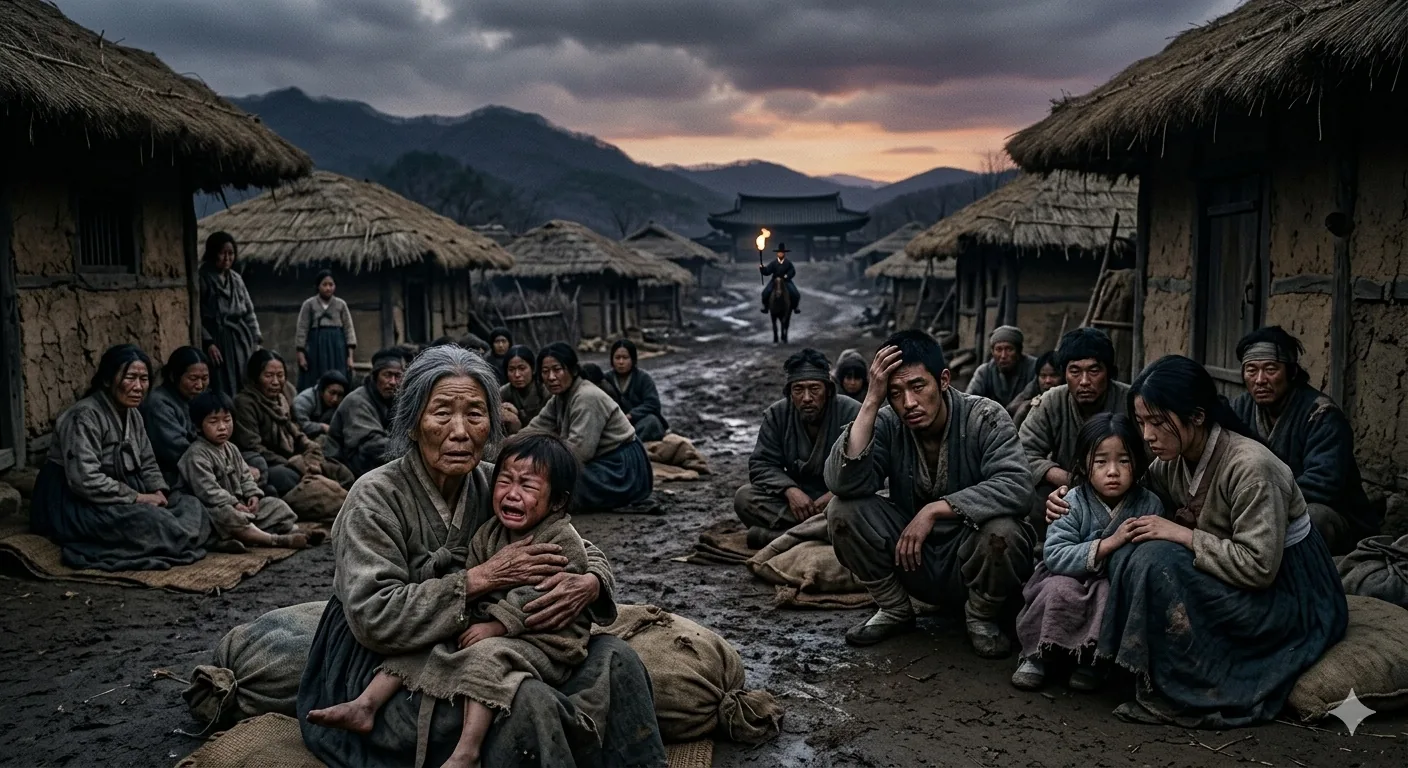
Watch KBS2’s 2022 sageuk Bloody Heart (붉은 단심, Bulgeun Dansim — literally something like “crimson, unwavering heart”) and one scene does more damage than any sword fight: a political rival brands a noble household enemies of the throne, and within a single episode, Yoo Jung’s parents are beheaded for a crime they may not have even committed. She survives only because the king secretly smuggles her out and lets the world believe she burned to death.
It plays like melodrama — a scheming minister, a devastated heroine, a king who couldn’t save her family. But the machinery is not invented. It’s a real, named legal practice Joseon inherited from Ming China, and it explains why, in this world, being related to the “wrong” person could be a capital offense on its own.
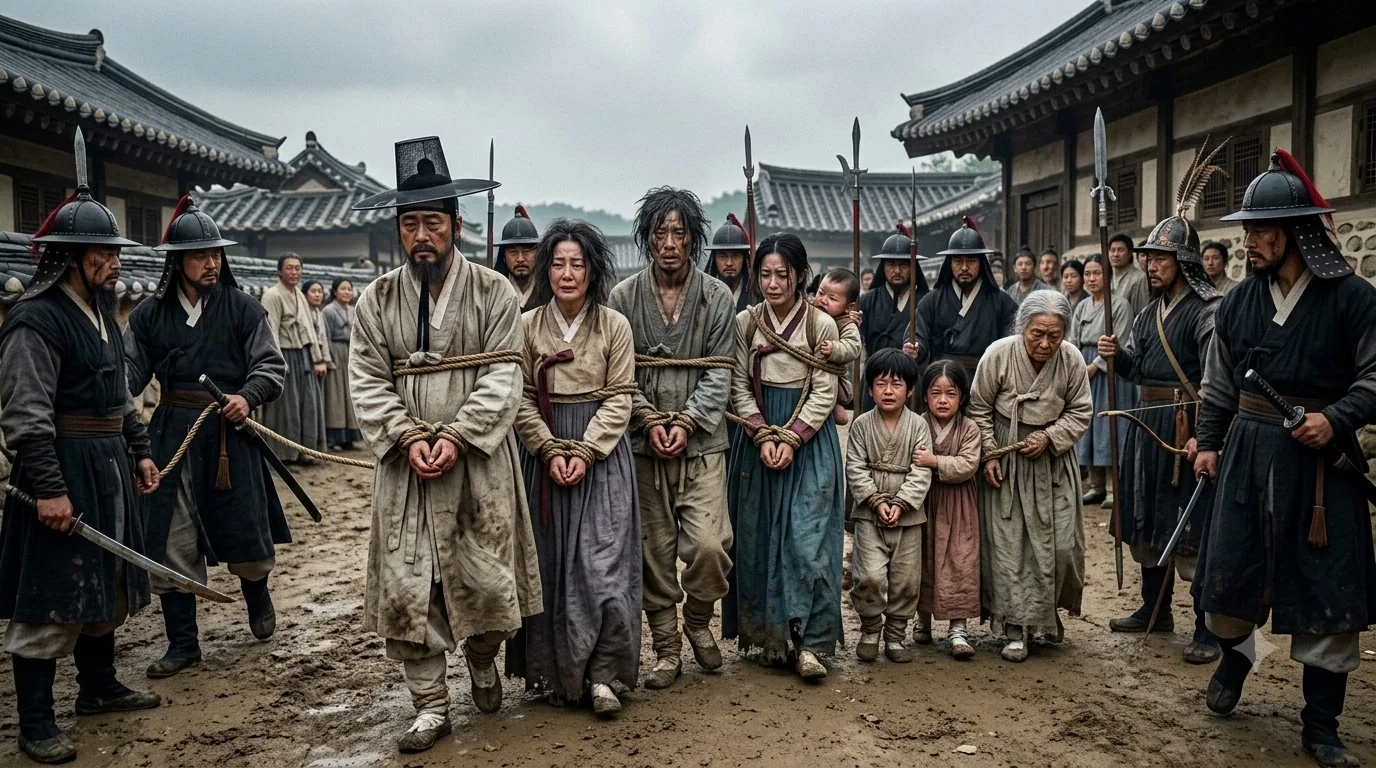 Under yeonjwaje, a treason charge reached the entire household — parents, children, and elders alike — not just the accused. (AI illustration)
Quick answer: Bloody Heart dramatizes a real Joseon-era legal doctrine called yeonjwaje (연좌제) — collective punishment that let a treason conviction reach past the guilty person and into their family. Under Joseon’s adopted Ming legal code, the gravest crimes carried “three kindred” (삼족, sam-jok) liability: a convict’s paternal family, mother’s family, and spouse’s family could all face execution, enslavement, or exile. The U.S. Constitution, written four centuries later on a different continent, bans exactly this — no conviction may ever “corrupt the blood” of a traitor’s descendants. Same crime, opposite verdict on the family.
Let’s unpack it.
Why does one family’s downfall wreck an entire household in Bloody Heart?
Because the show is dramatizing a specific, documented feature of pre-modern Korean law: for the worst category of crime, guilt was never private.
In Bloody Heart, Yoo Jung’s family is tied — fairly or not — to a rival political faction, and that association is enough for First Vice-Premier Park Gye-won to have her parents executed as a political maneuver. The show treats this as tragic but not implausible, because it isn’t. Under real Joseon law, a treason or rebellion charge (역모/반역죄) was never treated as one person’s crime. It was a stain on the whole bloodline, and the law was written to reach every branch of it.
What actually happened? Yeonjwaje and the “three kindred”
Here’s the real history underneath the drama.
Joseon did not invent its criminal code from scratch. When the dynasty was founded, King Taejo ordered that the Daemyeongnyul (大明律, the legal code of Ming China) be adopted as the basic penal law of the new state, and an idu (吏讀, clerical-script) rendering — the Daemyeongnyul-jikhae — was published in 1395 (before Hangul existed, this was a clerical-script gloss, not a vernacular one) and used as a working criminal code for roughly five centuries (Encyclopedia of Korean Culture, Academy of Korean Studies). That code organized the worst possible offenses into a category called the “Ten Abominations” (십악, sip-ak), inherited in turn from Tang law. Plotting rebellion against the ruler (謀反, mo-ban), plotting great treason such as destroying royal ancestral shrines or palaces (謀大逆, mo-dae-yeok), and plotting betrayal or defection to an enemy state (謀叛 — also read mo-ban, but written with a different character) sat at the very top of that list — the gravest of the grave.
For everything else, Joseon punished the individual. For this category, it punished the family, through a practice called yeonjwaje (緣坐制) — extending criminal liability from the convicted person to their relatives (Encyclopedia of Korean Culture). The scope of “family” here had a name: sam-jok (삼족), the “three kindreds.” In its broadest traditional sense, sam-jok covers three branches — 부족 (bu-jok, the convict’s paternal clan), 모족 (mo-jok, their mother’s family), and 처족 (cheo-jok, their spouse’s family), sometimes summarized as il-jok-i-dang (일족이당), “one clan, two allied houses” (Encyclopedia of Korean Culture). For treason specifically, the statute spelled out who fell under it and how: sons aged 16 and older typically faced strangulation, while mothers, wives, daughters, and grandchildren were confiscated as slaves rather than executed, with age-based exemptions for the very old.
The clearest documented example is the 1456 purge of the “Six Martyred Ministers” (사육신) — officials executed for plotting to restore the deposed King Danjong. Their punishment shows exactly how far the law could be pushed: the men were executed, and King Sejo ordered that even boys as young as 15 (below the usual execution threshold) be strangled, while mothers, wives, daughters, sisters, and daughters-in-law were permanently enslaved to border-region households, harsher than the code’s own default (우리역사넷, National Institute of Korean History). It’s a real, dated case — not a folk legend — and it shows the same logic driving Park Gye-won’s move against Yoo Jung’s family: a treason charge was never contained to the person who supposedly committed it.
Key terms. Yeonjwaje (연좌제) — the practice of extending criminal punishment from a convicted person to their relatives, applied most severely to treason and rebellion. Sam-jok (삼족) — “three kindreds”: traditionally the convict’s paternal family, mother’s family, and spouse’s family. Daemyeongnyul (대명률) — the Ming legal code Joseon adopted at its founding as the basis of its own penal law. Sip-ak (십악) — the “Ten Abominations,” the gravest category of crime in that code, topped by rebellion and treason.
The East-West comparison: Joseon’s law vs. the U.S. Constitution
Here is where this story stops being only Korean history and becomes something sharper: a direct textual argument between two legal systems on opposite sides of the world, centuries apart, about the exact same question — does a traitor’s family inherit the crime?
| In Bloody Heart | In real history |
|---|---|
| Yoo Jung’s parents are beheaded and her family destroyed over a court power struggle | Treason/rebellion (모반·대역) sat atop Joseon’s “Ten Abominations,” the one category where punishment legally extended past the individual |
| Yoo Jung herself is marked for death simply by being her parents’ daughter | Yeonjwaje let a conviction reach the “three kindreds” (삼족) — paternal family, mother’s family, spouse’s family |
| She survives only by being smuggled out and presumed dead — the family name itself had to disappear | Relatives who weren’t executed were typically enslaved or exiled, not simply released — the bloodline itself was treated as the liability |
| The show frames this as uniquely brutal court politics | It was, in fact, standard legal procedure under the Daemyeongnyul Joseon adopted at its founding |
In short: Bloody Heart dramatizes a real legal logic — that under Joseon law, treason was a crime a whole family could be convicted of simply by existing, and the doctrine had a name, a legal basis, and real recorded cases behind it.
Now put the literal legal texts side by side, because this is the rare case where you can compare the actual statutory language rather than just the historical pattern:
| Joseon statute logic (Daemyeongnyul, “Ten Abominations”) | U.S. Constitution, Article III, Section 3 |
|---|---|
| Treason/rebellion conviction extends liability to the “three kindreds” — father, sons, grandsons, siblings, wife, by age-scaled execution or enslavement | “…but no Attainder of Treason shall work Corruption of Blood, or Forfeiture except during the Life of the Person attainted” |
| The bloodline itself is treated as tainted by one member’s crime | Punishment ends at the death or life of the person convicted — descendants inherit nothing of the guilt |
In short, Joseon law treated treason as a crime that could stain an entire family line — relatives could be executed, enslaved, exiled, or stripped of property — while the U.S. Constitution’s treason clause took the opposite position: even a convicted traitor’s guilt cannot corrupt the blood of their descendants or reach beyond their own lifetime.
One clarification matters here: the American framers were not reacting to Joseon law, of course — they were rejecting the English common-law tradition of attainder and corruption of blood. The comparison holds not because of any direct influence, but because both systems answer the same question in opposite directions. The U.S. clause is not a vague statement of fairness — it was written specifically to reject English common-law “corruption of blood,” under which a traitor’s attainder could strip descendants of inheritance for generations (Library of Congress, Constitution Annotated; Avalon Project, Yale Law School). England’s version worked mainly through property; Joseon’s, for the worst crimes, could reach both property and person. But the underlying question both systems answer is identical: should a traitor’s child pay for the parent’s crime? Joseon’s answer, on paper, was yes. America’s founding answer was a flat constitutional no.
(One note, since English-language searches on “Korean collective punishment” now lead mostly to modern headlines: North Korea today runs its own practice, also called yeonjwaje, punishing up to three generations of a defector’s or dissident’s family, documented by human-rights investigations including the UN Commission of Inquiry on North Korea. It shares the name and the family-liability logic with the Joseon-era law but is a modern state practice, not a direct legal descendant of the old code. The sharper, more useful comparison stays Joseon’s actual statute against America’s actual constitutional clause — the contrast this piece is built around.)
Did Joseon ever roll this back?
Yes — and, like the Sōshi-kaimei name policy discussed elsewhere on this blog, the reform came in a single, datable act rather than a slow fade.
On 28 June 1894 (lunar calendar), during the Gabo Reform, the reform government passed a measure abolishing criminal yeonjwaje outright. Its text is blunt: “罪人自己外, 緣坐之律, 一切勿施事” — “beyond the criminal themselves, the law of guilt-by-association shall not be applied at all” (우리역사넷, sourced historical record of the Gabo Reform). One sentence ended five centuries of family liability for the worst crimes.
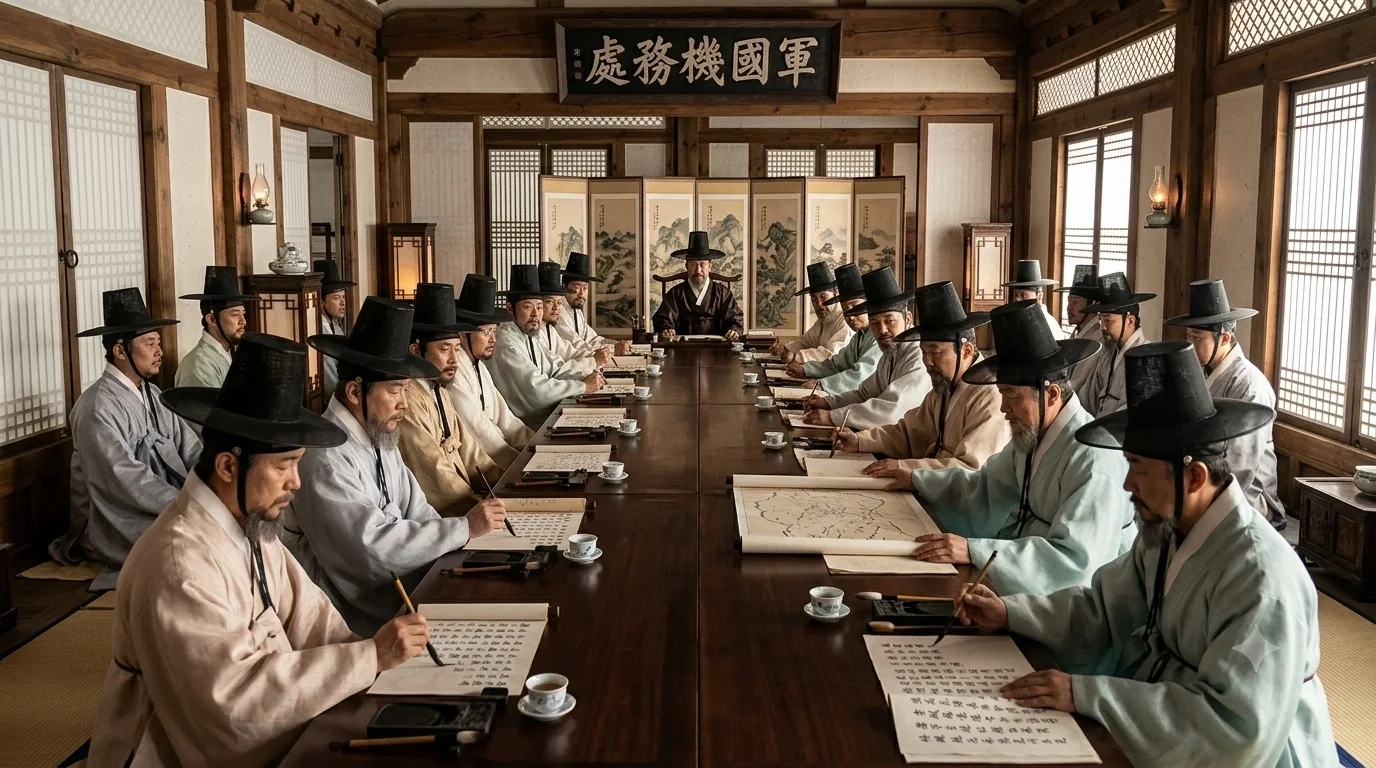 The Gabo Reform council (Gungungmugicheo), 1894 — the measure that ended criminal yeonjwaje: “beyond the criminal themselves, guilt-by-association shall not be applied at all.” (AI illustration)
It wasn’t the end of every echo of the practice. Softer administrative versions — background checks that could block a relative from a government post or a military academy over a family member’s political record — persisted well into the twentieth century and effectively faded only after the 1980s. But the criminal-law core, the part that could put a daughter to death for her father’s alleged treason, ended in 1894.
Common misconception: “Wasn’t this just ancient collective punishment, like in every old legal system?”
It’s a fair instinct — plenty of premodern societies punished groups rather than individuals. But it’s worth being precise about what made Joseon’s version specific.
Yeonjwaje wasn’t folk custom or mob justice. It was written law, with a named legal basis (the Daemyeongnyul), a defined category of crime (the “Ten Abominations,” headed by treason and rebellion), a defined scope of relatives (sam-jok), and an age-scaled table of who was executed versus enslaved. That’s a legal system with real machinery, not an outburst of collective anger. The kind of documented, codified family-liability mechanism the U.S. Constitution’s framers set out to forbid — in their case the English common-law version — was exactly this sort of studied legal machinery, not a vague fear. You don’t write a constitutional clause against something vague; you write it against a documented mechanism you want your own country never to build.
Coming up next
One beheading in a 16-episode sageuk turns out to be a doorway into five hundred years of legal history: a Ming legal code adopted at Joseon’s founding, a documented 1456 purge where the law was pushed past its own limits, a 1894 reform that ended it in a single sentence, and a Philadelphia convention that wrote the opposite rule into a founding document on the other side of the planet. That’s the quiet gift of a well-researched sageuk — a scene of court cruelty is never just plot. It’s a door into how a whole civilization decided where guilt was allowed to stop.
In the next essay, we’ll take another K-drama scene that looks like pure invention — and trace the real Korean history hiding underneath it.
Frequently asked questions
Is Bloody Heart based on a true story? No. Bloody Heart (붉은 단심, 2022, KBS2) is explicitly a fictional sageuk — its own synopsis describes a Joseon-like dynasty founded when a fictional King Sunjong deposes the previous ruler with Park Gye-won’s help. There is no real King Sunjong or King Lee Tae in Korean history. But the mechanism that destroys Yoo Jung’s family — a political rival branding her household enemies of the state and having her parents beheaded — is built on a real Joseon-era legal practice: yeonjwaje, collective family punishment for treason.
What is yeonjwaje (연좌제)? Yeonjwaje (緣坐制) is the practice of extending criminal liability from a convicted person to their relatives. Under Joseon law it applied most severely to the gravest crimes — treason and rebellion — where a single conviction could bring execution, enslavement, or exile down on family members who had no part in the act.
What does “three kindred” (삼족, sam-jok) mean? Sam-jok literally means “three kindreds.” In its broadest traditional sense it covers 부족 (bu-jok, the convict’s own paternal clan), 모족 (mo-jok, their mother’s family), and 처족 (cheo-jok, their spouse’s family) — sometimes called 일족이당 (il-jok-i-dang), “one clan, two allied houses.” For treason specifically, Joseon’s actual statutes (following the Ming code) spelled out an even more explicit list: father, sons, grandsons, siblings, wives, and concubines, with an age-based scale of who was executed versus enslaved.
What legal code did Joseon base collective punishment on? The Daemyeongnyul (大明律), the legal code of Ming China. King Taejo, Joseon’s founder, ordered it adopted as the dynasty’s basic penal law, and an idu (吏讀, clerical-script) rendering, the Daemyeongnyul-jikhae, was published in 1395 (before Hangul existed) and used as a working criminal code for roughly the next five hundred years. It grouped the worst possible offenses into a category called the “Ten Abominations” (십악, sip-ak), with plotting rebellion and treason ranked at the very top — the category that carried extended-family liability.
Were women in a condemned family executed too, or enslaved? Usually enslaved rather than executed. Sons aged 16 and older typically faced strangulation, while mothers, wives, daughters, and other female relatives were confiscated as government or meritorious-subject slaves. In the 1456 purge of the “Six Martyred Ministers,” King Sejo pushed even harsher terms — killing sons as young as 15 and permanently enslaving the women in remote border regions.
When was yeonjwaje abolished in Korea? The criminal-law version was formally abolished on 28 June 1894 during the Gabo Reform, in a measure stating that only the offender, not their family, would be punished. Softer administrative echoes (background checks affecting relatives’ government jobs or military-academy admission) persisted for decades and effectively faded only after the 1980s.
Does North Korea still practice guilt-by-association today? Human-rights investigations, including the United Nations Commission of Inquiry on North Korea, have documented a modern practice also called yeonjwaje — punishing up to three generations of a defector’s or dissident’s family. It shares the name and the family-liability logic with the Joseon-era law, but it is a distinct modern state practice, not a direct legal continuation of the old dynastic code.
How is the U.S. Constitution’s treason clause different from Joseon’s law? It’s close to a direct inversion. Article III, Section 3 of the U.S. Constitution says Congress may punish treason, “but no Attainder of Treason shall work Corruption of Blood, or Forfeiture except during the Life of the Person Attainted” — meaning a traitor’s conviction cannot legally taint or disinherit their descendants. Joseon’s yeonjwaje did the opposite: for the single worst category of crime, it explicitly extended punishment past the convicted person and into their bloodline.
Sources & further reading
Written from the historical script and fact-check of 사뚱샘의 역사방 (SaDDungSam). Terms, dates, and case details above are sourced inline. For broader reading:
- Yeonjwaje, legal basis, and abolition. Encyclopedia of Korean Culture, “연좌” (encykorea.aks.ac.kr)
- Scope of “three kindreds.” Encyclopedia of Korean Culture, “삼족” (encykorea.aks.ac.kr)
- Joseon’s adoption of the Ming legal code. Encyclopedia of Korean Culture, “대명률” (encykorea.aks.ac.kr)
- The 1456 Six Martyred Ministers case. 우리역사넷, National Institute of Korean History (contents.history.go.kr)
- The 1894 Gabo Reform abolition of yeonjwaje. 우리역사넷, National Institute of Korean History (contents.history.go.kr)
- The U.S. Constitution’s Corruption of Blood clause. Library of Congress, Constitution Annotated (constitution.congress.gov); Avalon Project, Yale Law School (avalon.law.yale.edu)
- Bloody Heart (KBS2, 2022) — synopsis and cast. (MyDramaList)
- Bloody Heart plot detail on Yoo Jung’s family. The Fangirl Verdict, review. (thefangirlverdict.com)
Thanks for reading — see you in the next one.
This article was researched and written by K-Drama History. Source: Bloody Heart, Explained: Yeonjwaje, the Joseon Law That Could Destroy a Traitor's Whole Family — K-Drama History