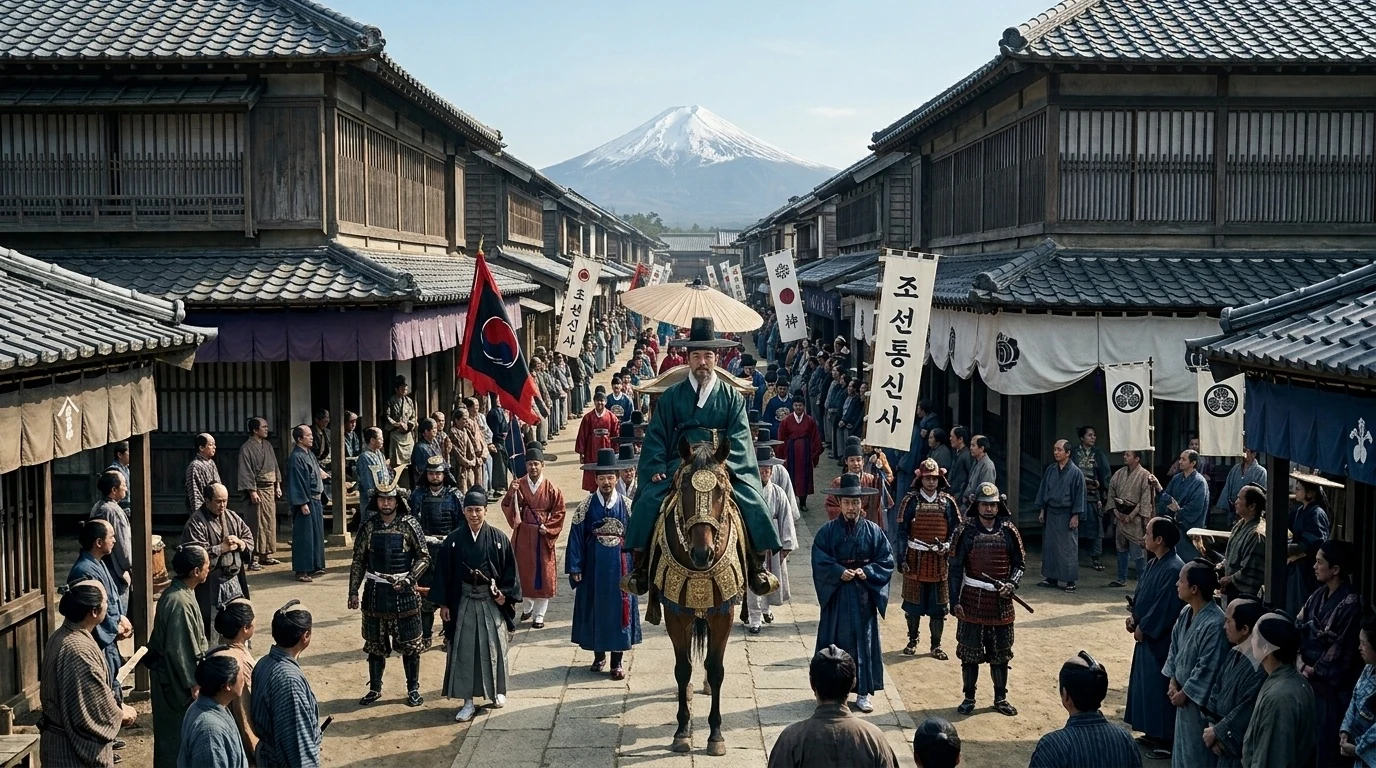
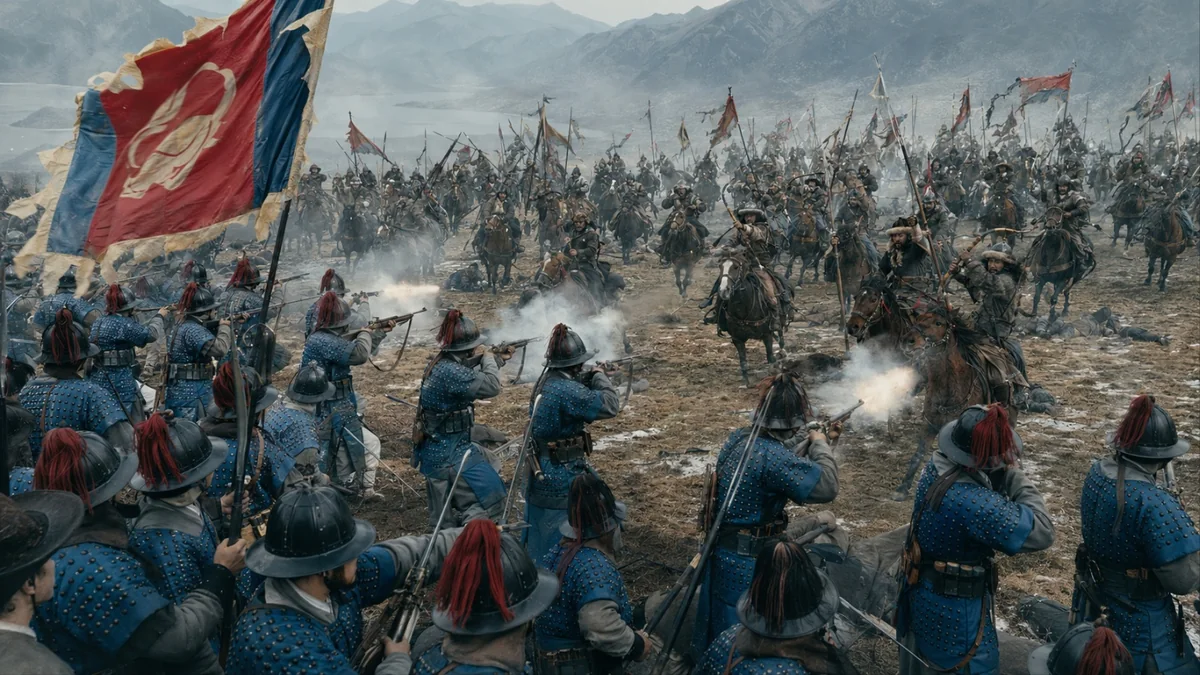
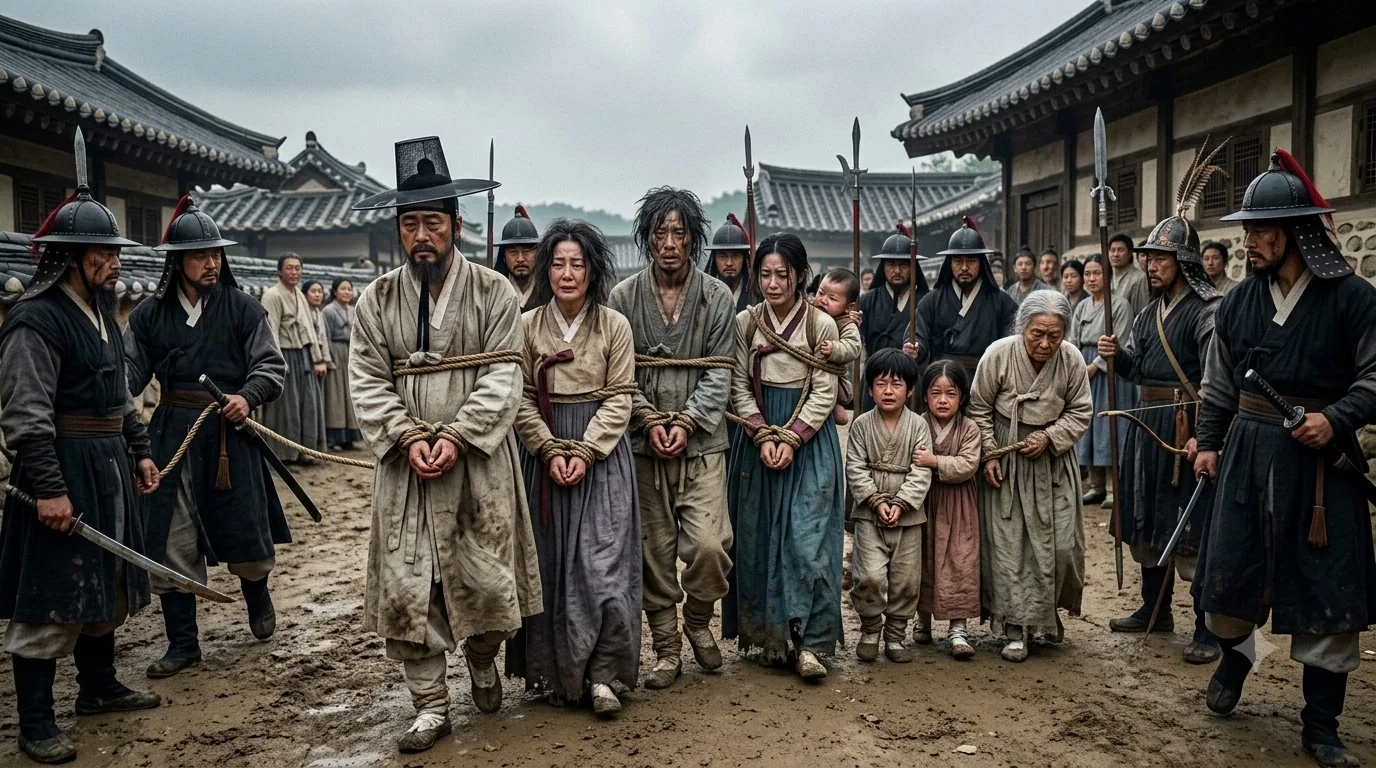
From the research behind Pause the Drama.
If you’ve watched Netflix’s genre-bending 2019 hit Kingdom (킹덤) — the one that taught the world a Joseon gat (the wide-brimmed horsehair hat) could look terrifying at full sprint — you remember the dread. A mysterious plague spreads from the south. By night the infected rise, ravenous, and tear through the living. It’s one of the best zombie shows ever made.
But here’s what the drama never stops to spell out for its international viewers: the zombies are terrifying — yet they aren’t the real horror. In Kingdom, hunger is the monster that makes all the others. The show’s own creator, screenwriter Kim Eun-hee, has said it plainly: she wanted “to portray people who were mistreated by those in power struggling with starvation and poverty through the monsters,” and what she really wanted was “to tell a story about hunger” (The Hollywood Reporter).
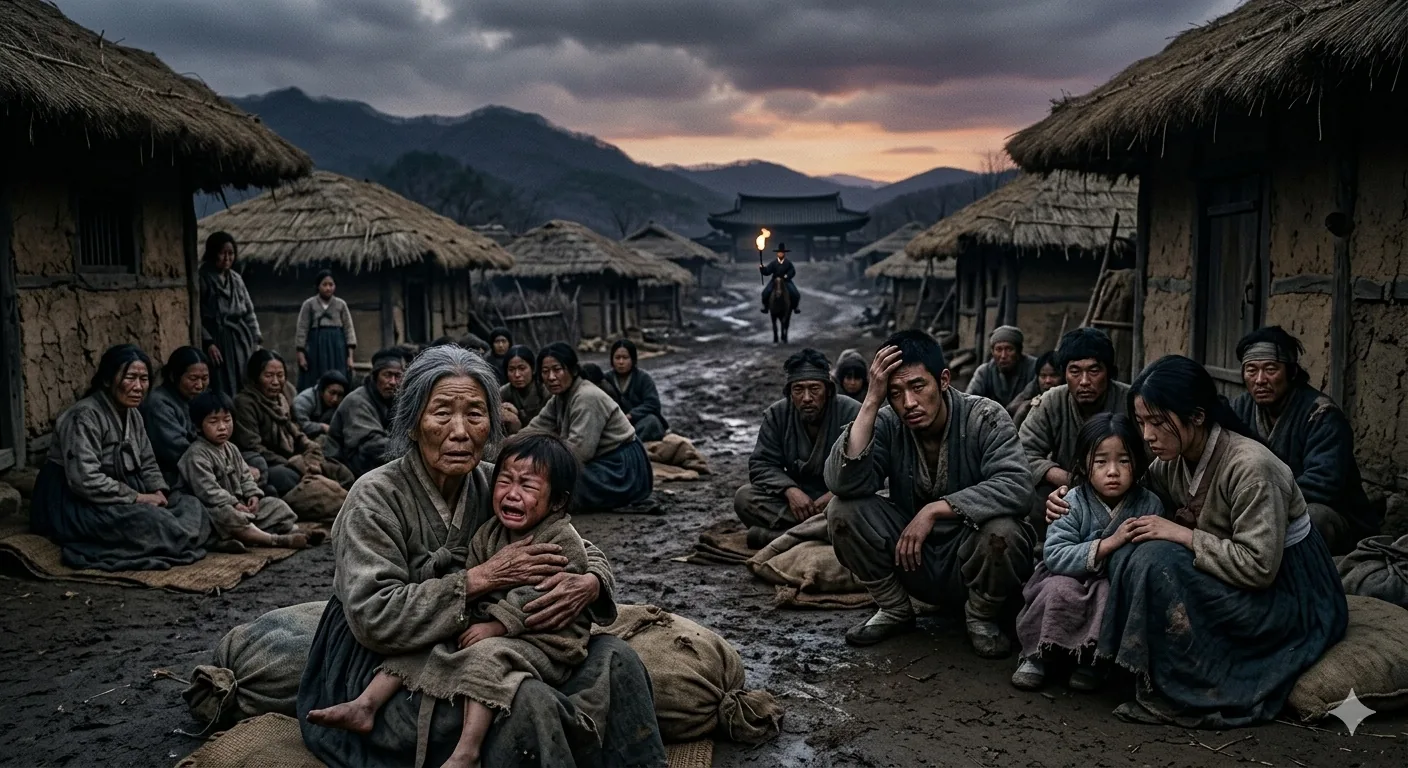 Before any monster appears, the real horror is already here: a village with nothing left to eat. (AI illustration)
Quick answer: Netflix’s Kingdom isn’t really a zombie show — it’s a story about hunger. It reimagines Joseon Korea’s very real history of famine, a corrupt grain-relief system called hwangok, and officials who failed to protect the starving. The zombie plague is a metaphor for a society where the poor are consumed first by hunger, then by disease, and finally by political neglect.
Let’s unpack it.
Why does the famine feel scarier than the zombies?
Because in Joseon Korea, a famine wasn’t only a tragedy. It was a political accusation.
Watch Kingdom closely and you’ll notice the monsters are almost an afterthought of human cruelty. The poor are starving while the powerful hoard. A desperate village boils the only “meat” it can find. The infection doesn’t fall from the sky — it crawls up from the bottom of a broken society. That’s not an accident of horror staging. It’s the show reaching for a very old Korean idea: that hunger among the people is the kingdom’s deepest sickness, and the king is the one on trial for it.
And this isn’t horror-movie exaggeration. Korea’s own chronicles record famines that drove people to the unthinkable. During the Gyeongsin Great Famine of 1670–71, a collision of freak cold, failed harvests, and epidemic is thought to have killed somewhere between one in ten and one in five Koreans. The official Annals of King Hyeonjong even record a report reaching the throne of starving people resorting to cannibalism (Veritable Records of the Joseon Dynasty, National Institute of Korean History) — a horror so total it broke the most basic human bond. Kingdom’s cannibal nightmares aren’t invented. They’re a memory.
Here’s the show’s horror translated into history at a glance:
| In Kingdom | In real Joseon history |
|---|---|
| Zombies spread through starving bodies | Famine and epidemic disease often struck together |
| The poor are devoured first | When relief failed, the peasantry was hit hardest |
| Officials hide or exploit the crisis | Local corruption hollowed out the grain-relief system |
| Hunger turns into horror | Famine was treated as a political failure of the throne |
To understand why a starving peasant terrified the Joseon court more than any ghost, you have to understand what kings were supposed to do about food.
What was the king actually responsible for?
In the Confucian world, a ruler governed not by raw force but by virtue (덕, deok) — and the clearest proof of virtue was a fed population.
Joseon built real machinery for this. The most important piece was the grain-loan system, hwangok (환곡): in the lean spring months, when last year’s harvest was gone and this year’s wasn’t ripe, the state lent grain from public granaries to hungry farmers, to be repaid after the autumn harvest. On paper, it was an astonishingly humane idea — a national famine-insurance system centuries before the modern welfare state.
And it was ancient. The lineage runs deep: from the Jindaebeop of Goguryeo — a spring-lending, autumn-collecting grain policy enacted under King Gogukcheon in 194 CE and recorded in the Samguk Sagi (Encyclopedia of Korean Culture, Academy of Korean Studies) — through Goryeo’s Uichang relief granaries, down to Joseon’s hwangok (우리역사넷, National Institute of Korean History). Korea had been engineering famine safety nets for over 1,400 years.
So when famine struck, a Joseon king was expected to do something concrete: open the granaries, distribute relief (구휼, guhyul), cut taxes, and sometimes issue a public confession that his own failings had angered Heaven. A starving people wasn’t just sad. It was the realm telling the king he was failing at his single most important job.
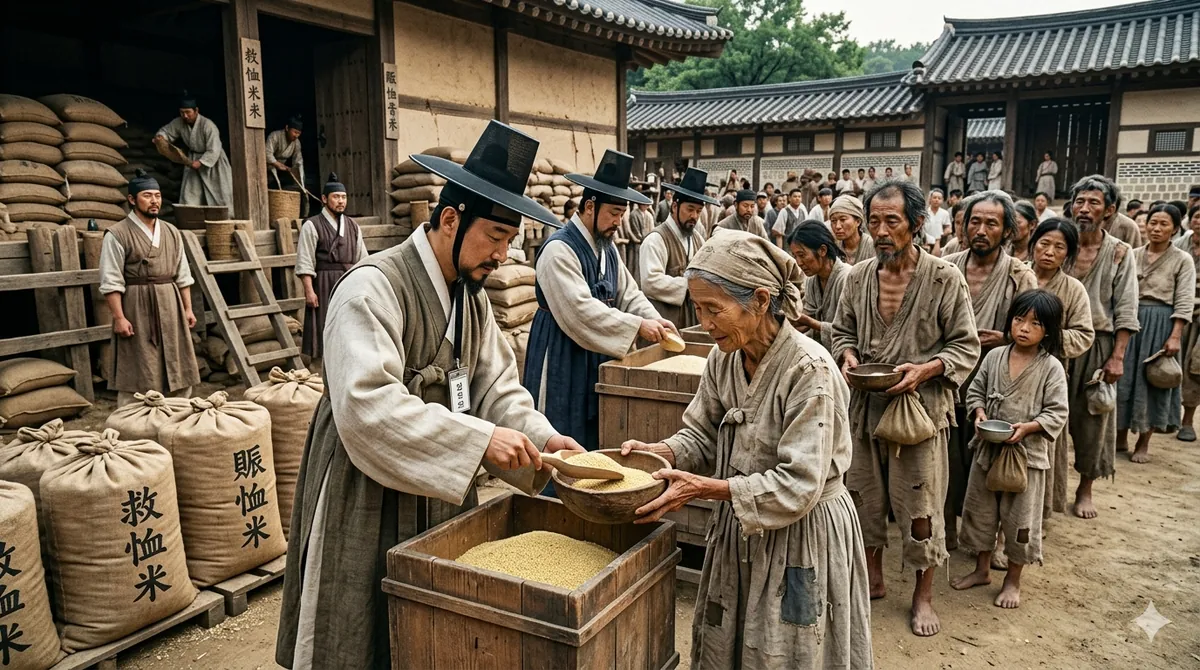 When it worked, the state’s relief granaries were a real safety net — grain measured out to the hungry (the sacks here are marked “relief rice”). Too often, corruption turned that safety net into a trap. (AI illustration)
So if there was a safety net — why were people still starving?
Here’s the dark turn, and it’s the engine of Kingdom’s whole world: the system meant to save the poor became one of the things devouring them.
Over time, hwangok curdled into corruption. Local magistrates and clerks discovered the grain loan was a perfect instrument for extortion. Interest climbed far past the 50% that already earned it a grim nickname (장리, “long usury”). By the records, the routine skim ran 50 to 100% — the great reformer Jeong Yak-yong documented exactly this in his Mongmin Simseo (“Admonitions on Governing the People”) (Encyclopedia of Korean Culture, 목민심서). In the worst districts it reached 300%, and one extreme case preserved in the official annals records an almost unbelievable 3,000%. Officials lent rotten or sand-mixed grain and demanded clean grain back. They forced loans on people who never asked for them, then collected with interest. By the late Joseon period the famine-relief fund had quietly mutated into a tax — and a racket. (Encyclopedia of Korean Culture, 환곡)
This is the soil Kingdom grows from: a countryside where the people are squeezed by the very officials sworn to protect them, where corruption travels faster than any plague. The show didn’t invent that desperation. It dramatized a structural failure that Korean history records in painful detail.
Key terms. Hwangok (환곡) — Joseon’s state grain-loan system, meant as famine relief, that decayed into a corrupt tax. Guneon (구언) — a royal order commanding officials to openly name the king’s faults during a crisis. Mandate of Heaven (천명) — the idea that Heaven endorses a just ruler and withdraws that endorsement through disasters like famine. Sedo jeongchi (세도정치) — 19th-century “in-law politics,” when royal in-law clans ruled behind weak kings and bled the country.
Did hunger really topple a dynasty? (Eventually — yes.)
The drama’s premise — that misrule and starvation can break a kingdom — wasn’t artistic license. But the real path from hunger to collapse was longer and more winding than a single uprising.
In 1862, a wave of peasant revolts swept the southern provinces, the trigger in Jinju and elsewhere being exactly this machinery gone rotten (International Journal of Korean History, “The Development of the Chinju Peasants’ Rebellion of 1862”). Yet it would be too simple to draw a straight line from there to revolution. The deeper driver was “in-law politics” (세도정치, sedo jeongchi): through the 19th century, a handful of royal in-law clans — the Andong Kim, then the Pungyang Jo — ruled from behind weak boy-kings and turned the state into a private extraction machine. After the 1862 revolts, the regent Heungseon Daewongun spent a decade reforming and stabilizing the country — but once he was forced from power, the Min clan rebuilt the very same predatory in-law rule, and crushing taxes and corruption came roaring back.
It was that accumulated misery — now sharpened by foreign encroachment — that finally erupted as the Donghak Peasant Revolution of 1894 (UNESCO Memory of the World, Archives of the Donghak Peasant Revolution), which helped pull foreign armies onto Korean soil and pushed the dynasty toward its end. The road was crooked, but the engine never changed: a state devouring the people it was sworn to feed. Strip away the supernatural, and that is simply Korean history.
Why Kingdom feels so Korean: five civilizations, five verdicts on hunger
Here’s what makes Kingdom feel so distinctly Korean. Almost every civilization faced famine — but each one read it differently, and that reading reveals what they believed about power, the gods, and the state. Set four neighbors beside Joseon, and the show’s worldview snaps into focus. This is the part single-culture histories almost never lay side by side.
Korea — the king put himself on trial. When famine struck, a Joseon king didn’t only send aid; he performed his own guilt. He issued a guneon (구언) — an order commanding his officials to name his failings as a ruler out loud. He stood up emergency relief offices, the Jinhyulcheong (진휼청), to feed the starving. And he cut the dishes at his own table and changed into plain, coarse clothes, to share — symbolically — in his people’s suffering. The famine was a verdict on him, so he answered it with public humility.
China — Heaven withdraws its mandate (and once, literally did). Korea inherited this lens from China’s Mandate of Heaven (천명, 天命) (World History Encyclopedia): floods, droughts, famines, and plagues were read as Heaven warning that a ruler had lost its favor. A Ming emperor would travel to the Temple of Heaven (천단) to pray for rain and an end to the famine, and grant tax relief. But the most chilling proof of the idea is the fall of the Ming itself. As famine ravaged the north, the last Ming emperor, Chongzhen, raised taxes anyway to fund his war against the rising Manchus — and the starving countryside detonated. A peasant-born rebel, Li Zicheng, marched on Beijing and the Ming collapsed (Britannica, Li Zicheng). Heaven, the logic went, had taken the mandate back.
China again — the Qing drew the opposite lesson. The Manchu Qing dynasty that replaced the Ming mounted staggering relief operations. Emperors like Yongzheng and Qianlong shipped grain thousands of kilometers by river and canal into famine regions (Britannica, Ever-normal granaries). As a conquest dynasty — a Manchu minority ruling a vast Han majority — they understood that their legitimacy hung on keeping the people fed, and they paid for it accordingly.
Japan — the shogun passed the buck. Edo Japan carried a far weaker sense of cosmic responsibility for famine. Rather than a Heaven-judged sovereign, the shogun largely delegated relief to the local lord — the daimyo — of each domain. Where a daimyo was capable, people survived; where he was incompetent or his land poor, they starved in droves. The great Tenmei famine (1782–88) was the deadliest of the era — hundreds of thousands died across Japan’s domains, with the Tōhoku region hit hardest, even as many local lords suppressed the true toll. Same disaster — but no single ruler stood accused before Heaven for it.
The West — God’s judgment, and the palace that was spared. In the absolutist Europe of the 17th–18th centuries, famine was read through Christianity as God’s punishment for human sin. Kings answered with fasting and public prayer, begging forgiveness. They did offer some relief — but, tellingly, almost never touched the wealth of the Church or the nobility. Even as famine killed his subjects, Louis XIV of France poured fortunes into the palace of Versailles. (A century later a different Western creed reached the same end by another road: Britain’s faith in laissez-faire left Ireland to starve through the Great Famine of 1845–52, exporting grain while a million died (Encyclopædia Britannica, Great Famine).) The throne was sorry — but the throne, and its palaces, came first.
Five civilizations, five readings of an empty rice bowl: the king on trial (Korea), Heaven’s revoked verdict (Ming), the state’s relief convoys (Qing), the lord’s private problem (Japan), and God’s judgment that somehow always spared the palace (the West). Look again at Kingdom’s starving villages, and you’re not just watching horror. You’re watching the oldest political question there is: when the people go hungry, who is to blame — and who is supposed to act?
Coming up next
One plague — and we’ve traveled from a Joseon granary to a 2,000-year lineage of relief, to a famine that drove people to cannibalism, to a Ming emperor losing the Mandate of Heaven, to grain convoys crossing Qing China, to Louis XIV’s Versailles untouched by the hunger outside its gates. That’s the quiet gift of a great historical drama: even its monsters have a paper trail.
In the next essay, we’ll take another K-drama scene that looks like pure fiction — and trace the real Korean history hiding underneath it.
Frequently asked questions
Is Kingdom based on a true story? Not literally — the zombies and characters are fiction. But its world is firmly grounded in real Joseon history. The drama is set around 1601, just a few years after the devastating Imjin War (1592–98), when the country was still rebuilding from ruin and hunger. The famine, the corruption of relief systems, the plague, and the class disparity are all real; the creator has said the premise drew on a record in the Annals of the Joseon Dynasty of a mysterious disease killing huge numbers, and that the monster was meant as a metaphor for hunger and inequality.
What was hwangok (환곡)? A Joseon state grain-loan system: public granaries lent grain to farmers in the hungry spring, to be repaid after harvest. It descended from a 1,400-year Korean tradition of relief granaries (Goguryeo’s Jindaebeop, Goryeo’s Uichang). Intended as famine relief, it gradually became a vehicle for corruption and extortion — interest of 50–100% or worse, forced loans, adulterated grain — and a major grievance behind 19th-century peasant uprisings.
Why was a famine a political problem for a Joseon king? In the Confucian framework, a ruler legitimized his reign through virtue (덕), and feeding the people was its clearest proof. A famine implied the king was failing at his core duty, obligating him to open granaries, distribute relief, cut taxes, issue a guneon inviting criticism of his own rule, and even reduce his own meals as a gesture of shared suffering.
Further reading
This piece was written from the historical script and fact-check of 사뚱샘의 역사방 (SaDDungSam). The specific dates and figures above are sourced inline, cross-checked against primary and official records. For broader reading:
- Jeong Yak-yong, Mongmin Simseo (정약용, 목민심서, 1818) — the reform classic documenting hwangok corruption. Full entry: Encyclopedia of Korean Culture.
- Joseon peasant rebellions of 1862 — overview of causes and hwangok’s role. (International Journal of Korean History)
- Donghak Peasant Revolution archives — UNESCO Memory of the World registration (2023), 185 primary documents. (UNESCO)
Thanks for reading — see you in the next one.
This article was researched and written by K-Drama History. Source: Netflix's Kingdom, Explained: Why Hunger, Not Zombies, Is the Real Monster — K-Drama History