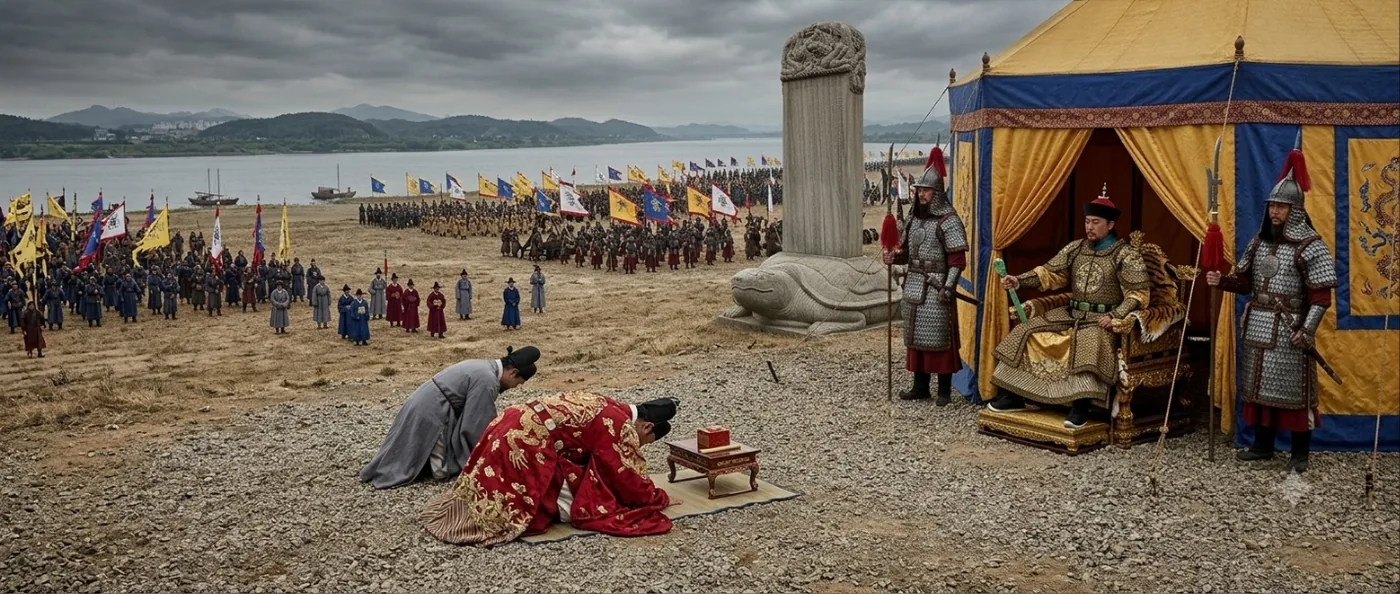
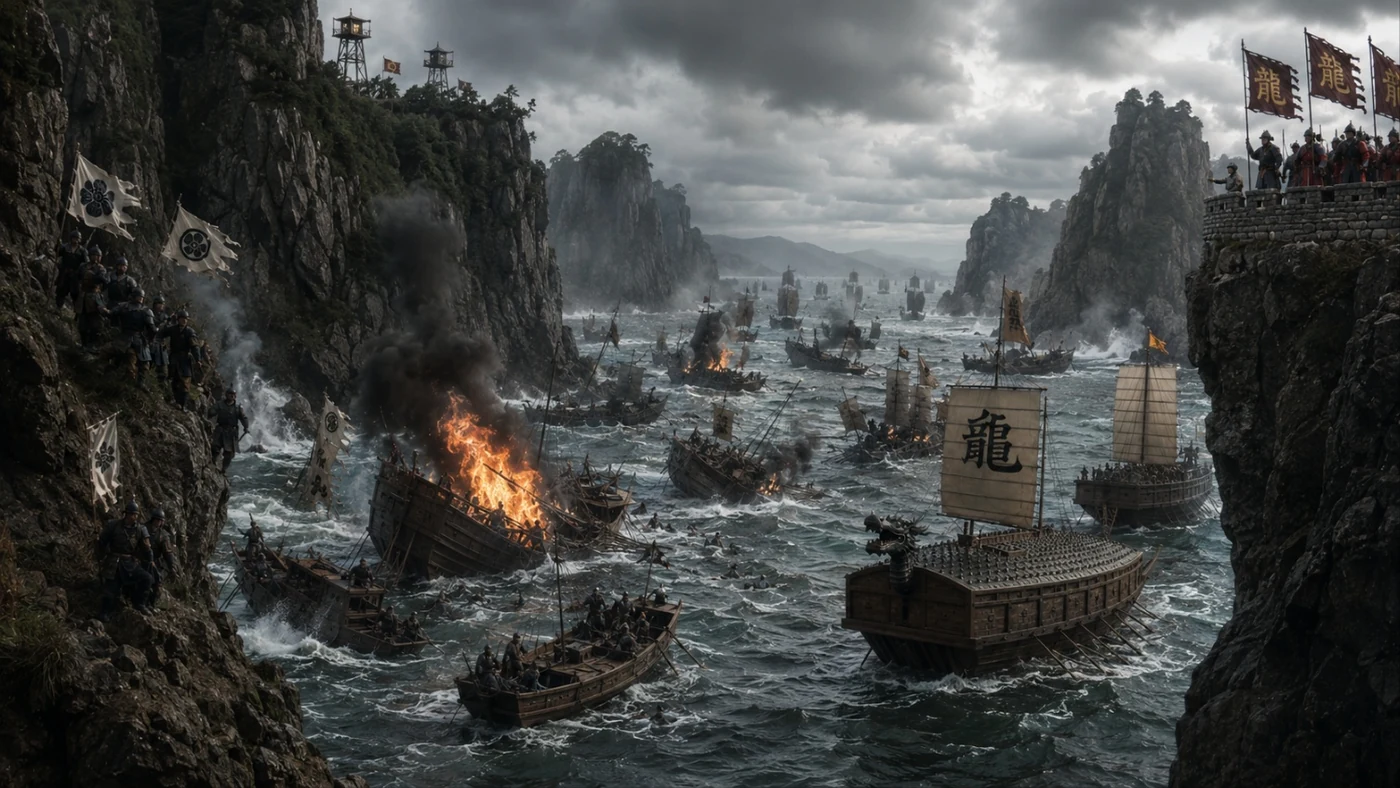
Masquerade, Explained: Why Refusing to Pick a Side Between Two Empires Cost a Korean King His Throne
Theme: Power & Politics
From the research behind Pause the Drama.
If you’ve watched Masquerade (광해, 왕이 된 남자, 2012), you know the hook: a paranoid king, fearing poison, orders his chief minister to find a lookalike for the throne. A penniless street performer named Ha-seon — near-identical in face, opposite in temperament — steps into the role, and for roughly fifteen days a commoner rules Joseon while the real king hides. It’s a gripping premise, openly built on the Prince-and-the-Pauper trope, and it helped make Masquerade one of the highest-grossing films in Korean history, with more than 12.3 million admissions (Korean Film Council).
It is also, in every specific, invented. No Joseon record describes King Gwanghaegun (r. 1608–1623) using a body double. The film’s writers built a fictional window and dropped it into a real reign.
Here’s the thing, though: the real Gwanghaegun’s story needs no body double to be dramatic — it’s the story of a king who tried to keep his war-exhausted country out of a fight between two empires, got it arguably right by many modern accounts, and lost his throne anyway for refusing to choose a side.
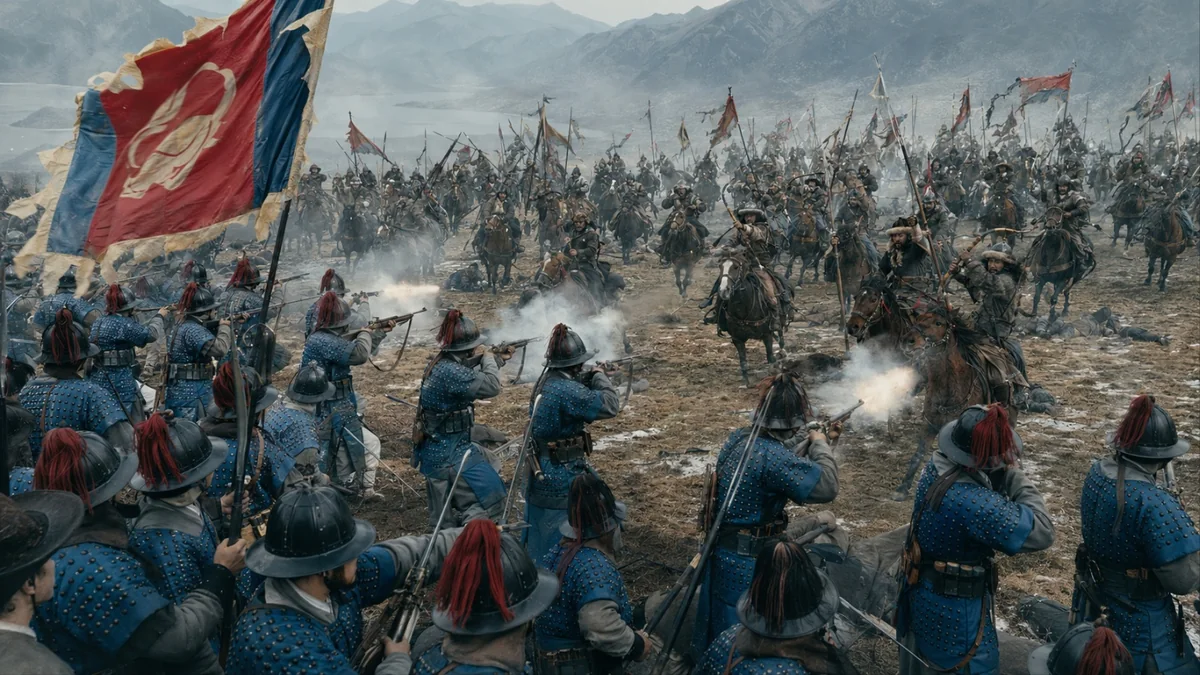 1619, Manchuria: Joseon musketeers under Gang Hong-rip — sent to satisfy Ming — meet Nurhaci’s cavalry in the Sarhu campaign, a war Gwanghaegun never wanted to fight. (AI illustration)
Quick answer: Masquerade’s body-double plot is fiction. The real Gwanghaegun inherited a Joseon devastated by the 1592–98 Japanese invasions and indebted to Ming for military rescue — a debt Confucian politics called jaejoji-eun. When Ming demanded troops against the rising Later Jin, Gwanghaegun sent an army under Gang Hong-rip with secret orders to hedge rather than fight to the death. That pragmatism, framed by his opponents as betrayal, helped trigger the 1623 coup that dethroned him.
Let’s unpack it.
What was Gwanghaegun’s “neutral diplomacy,” and why did Joseon need it?
Joseon in 1608 was still recovering from near-collapse. The Imjin War (1592–98) — Japan’s invasions under Toyotomi Hideyoshi — had burned the capital, until Ming China sent troops that helped retake Pyongyang in 1593. Out of that rescue grew a politically potent idea: jaejoji-eun (재조지은, “the grace of restoring a fallen state”). What began, in the war’s darkest moment, as officials’ hope that Ming might save them curdled, after the victory, into a fixed narrative of gratitude (AKS Sillokwiki, jaejoji-eun). Over the following decades that hardened into ideology: Ming as a political “father,” Joseon as the loyal “son,” bound by Confucian hierarchy rather than mere alliance.
That debt collided with a new fact on the ground. In Manchuria, the Jurchen leader Nurhaci unified rival tribes and, in 1616, founded the Later Jin state — the polity later renamed Qing. In 1618 Nurhaci moved against Ming-held Liaodong, and Ming, citing Joseon’s loyalty and its own Imjin War rescue, demanded troops to help crush him.
Gwanghaegun, by the encyclopedic record, was the lone voice in his own court against sending troops at all, overridden by officials who treated refusal as unthinkable (Encyclopedia of Korean Culture, Gwanghaegun). His compromise became neutral diplomacy (중립외교): satisfy Ming on paper, while quietly telling his commander not to burn every bridge with the rising power on Joseon’s own border (National Institute of Korean History, Gwanghaegun’s Neutral Diplomacy).
What actually happened at the 1619 Battle of Sarhu — and what did Gwanghaegun secretly order?
The result was the Battle of Sarhu (사르후 전투, also called the Simha campaign), fought in Manchuria in early 1619. Ming assembled roughly 100,000 troops in four separate columns to crush Nurhaci’s forces; a Joseon contingent of about 13,000 — led by Gang Hong-rip (강홍립) as supreme commander, with Kim Gyeong-seo (김경서) as his deputy — was attached to the eastern column, alongside a Ming force of some 9,000 under Liu Ting (National Institute of Korean History, The 1619 Sarhu Battle).
The plan depended on tight coordination across four separated columns — and it fell apart almost immediately. The western column attacked prematurely and was annihilated at Sarhu itself; the northern column was ambushed and routed a day later. The eastern column carrying the Joseon troops was finally caught and defeated at Buyucha (富車) on March 4, 1619 (Encyclopedia of Korean Culture, Battle of Buyucha).
In the aftermath, Gang Hong-rip made the decision historians still argue about. He withdrew to high ground, and when Later Jin forces called on him to surrender, he did — declaring the deployment “unavoidable” rather than fighting to the last man (Encyclopedia of Korean Culture, Gang Hong-rip). Behind that choice, multiple Korean sources describe a confidential instruction Gwanghaegun gave him before departure: to “assess the situation and determine allegiance accordingly” (형세를 보아 향배를 정하라) rather than commit his men to annihilation for Ming.
Two honest caveats. First, this was never a public decree — it survives as reconstructed royal intent, and historians disagree over how explicit it was; some recent scholarship, weighing the heavy Joseon casualties at Buyucha, argues there was no pre-arranged surrender order at all, and that appointing the cautious Gang Hong-rip was itself the real signal (Encyclopedia of Korean Culture, Gang Hong-rip). Second, Gwanghaegun’s own reign record is unusually fragile: alone among the Joseon annals, his chronicle survives in two versions — a middle draft (중초본) and a final copy (정초본) — because so few copies were printed that the draft was never destroyed as custom required (Encyclopedia of Korean Culture, Gwanghaegun-ilgi; National Institute of Korean History, English introduction to the Veritable Records). It is titled an ilgi (“daily record”) rather than given the usual sillok (“veritable record”) name — the convention for a deposed monarch — and it was compiled by the very Seoin faction that overthrew him, so it must be read with that bias in mind.
Why did playing both sides become the excuse to overthrow him?
Surviving Sarhu did not end the crisis — it moved back to Hanyang. Gwanghaegun kept using Gang Hong-rip, still effectively held by Later Jin, as a channel for cordial contact with Nurhaci. His officials read this as betrayal of Ming (배명행위) and fought him at every turn, until state administration fell into virtual paralysis (Encyclopedia of Korean Culture, Gwanghaegun).
That paralysis had domestic company. Gwanghaegun had already alienated the court through succession purges — the death of his half-brother Prince Imhae, the 1613 imprisonment of the child Prince Yeongchangdaegun in the Gyechuk Oksa affair (he was killed the following year, in 1614), and the 1618 confinement of Queen Dowager Inmok. When the Injo Restoration (인조반정) came — on the 13th day of the third lunar month of 1623, April 12 by the modern calendar — led by Yi Seo, Sin Gyeong-jin, Lee Gwi, Kim Ryu, Kim Ja-jeom, and Yi Gwal at the head of a few hundred soldiers, those domestic charges supplied the coup’s headline justifications (Encyclopedia of Korean Culture, Injo Restoration). His foreign policy supplied its moral undertone: a king who hedged with the power next door, rather than honoring the “father-son” debt of jaejoji-eun, could be cast not as a poor ruler but an unfilial one — close to illegitimate in Confucian Joseon. Gwanghaegun was spared execution at the new king’s request, demoted to commoner status, and exiled to Ganghwa Island for life.
Common misconception: did a body double really rule Joseon for two weeks?
No. There is no annal entry or contemporary account of any commoner secretly occupying the throne during Gwanghaegun’s reign — the substitution plot was invented for the film, modeled on the Western Prince-and-the-Pauper story and grafted onto a Joseon setting where court paranoia about poisoning and factional plots was, in fact, historically real. What’s true is the atmosphere: a reign marked by purges, intrigue, and a king increasingly isolated from his own officials. What’s invented is the mechanism the film uses to dramatize it.
Was Gwanghaegun’s gamble actually wise? A contested legacy
The popular narrative — a lone realist proven right by history, martyred by ideological hardliners — is seductive, and not groundless: hedging at Sarhu plausibly spared Joseon a war it could not have won. But that narrative’s own history is complicated. Much of the positive reappraisal of Gwanghaegun’s diplomacy was amplified by Japanese colonial-era scholars in the 1930s, whose praise served their own political interest in separating Manchuria from the Chinese mainland (Encyclopedia of Korean Culture, Gwanghaegun). Korean historians today still credit the underlying pragmatic logic, but debate whether it amounted to a coherent doctrine of “neutrality” at all, rather than an improvised course later admirers smoothed into something tidier than it was.
How does Gwanghaegun’s dilemma compare across history — and against the film itself?
Weaker states caught between stronger ones have faced this choice again and again: honor the alliance that shaped your identity, or hedge to survive. The clearest comparison is Switzerland, whose neutrality is often assumed to be a timeless choice — it wasn’t. It was formally recognized by the great powers only at the Congress of Vienna, in a declaration signed March 20, 1815. As historian Olivier Meuwly has put it, Switzerland sat as a buffer between “a France which needed containing, and Austria” — neutrality was less a Swiss initiative than something “circumstances dictated” the great powers impose on it (SWI swissinfo.ch, The day Switzerland became neutral). That status was never merely declaratory: Switzerland’s government today still defines it concretely — no participation in armed conflict, no armed assistance, no military alliances, formalized in the 1907 Hague Convention — backed by its own permanently maintained militia, an “armed neutrality” it could enforce itself (Swiss Federal Administration, Neutrality).
That contrast is the whole difference between the two cases. Switzerland’s balancing act was locked in by treaty among the powers it stood between, and reinforced by its own defensive capacity. Gwanghaegun’s was one monarch’s improvised judgment call — reversible the moment enough of his own officials decided it was treason.
| In Drama | In History |
|---|---|
| A commoner secretly rules in the king’s place | No body double ever existed; invented entirely for the film |
| Gwanghaegun appears mainly as an isolated, paranoid figure | The real isolation stemmed chiefly from a documented foreign-policy standoff |
| The crisis resolves within about fifteen days | The real crisis played out across roughly five years, 1618–1623 |
| The moral center is Ha-seon’s decency toward the poor | The real stakes were colder: does loyalty to an ally outweigh a country’s survival? |
| The story ends with quiet restoration of the “true” king | Gwanghaegun was permanently deposed, exiled, and never returned to the throne |
In short: the film compresses a five-year diplomatic standoff into a two-week morality tale, and invents a plot device to tell it — but the underlying tension is real and much older than Joseon. From Gwanghaegun’s uncodified, one-man hedge to Switzerland’s treaty-locked, self-armed neutrality two centuries later, small states between great powers have always weighed alliance loyalty against survival. Switzerland’s choice was eventually backed by law and its own guns; Gwanghaegun’s was backed by nothing but his own throne — which is exactly what he lost.
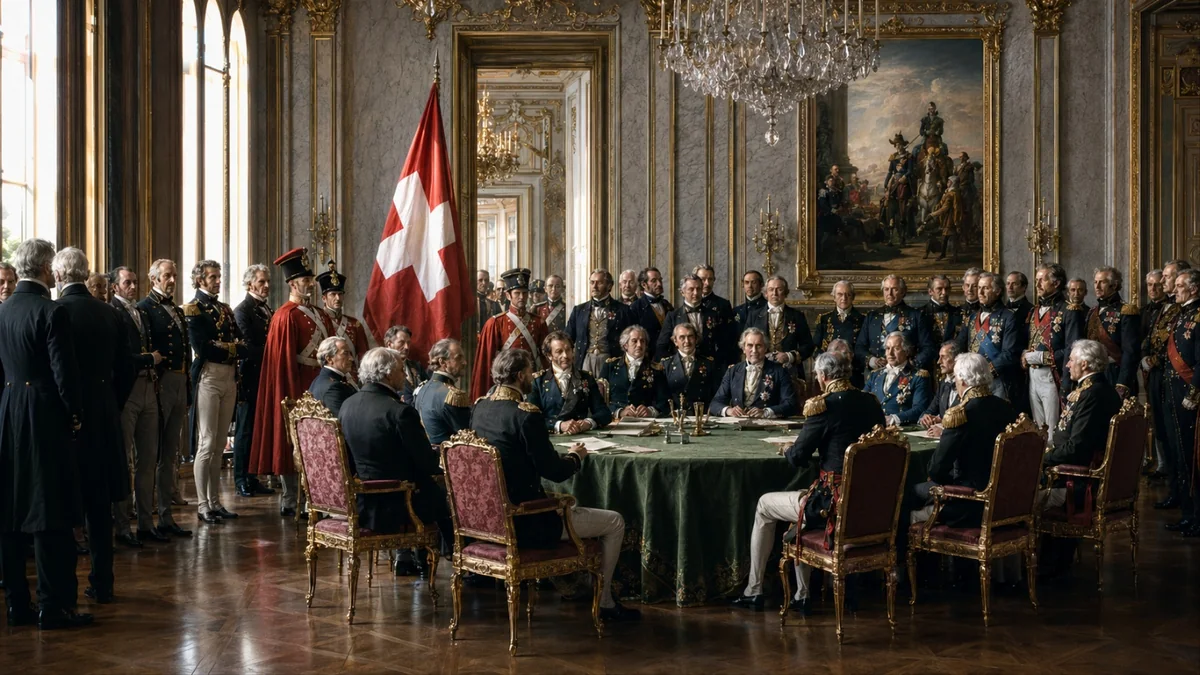 The Congress of Vienna (1815): the great powers formally guaranteed Switzerland’s neutrality by treaty — the legal backing Gwanghaegun’s one-man version never had. (AI illustration)
Coming up next
A hit film about a fake king rests on a real one whose choices need no invention to be dramatic — a monarch trying to keep a shattered country out of somebody else’s war, undone not by an enemy but by the moral logic of his own court.
In the next essay, we’ll take another K-drama scene that looks like pure fiction — and trace the real Korean history hiding underneath it.
Frequently asked questions
Is Masquerade (광해, 왕이 된 남자) based on a true story? Only its setting is. Masquerade (2012) is set during the real reign of King Gwanghaegun (r. 1608–1623), but its central plot device — a commoner look-alike secretly ruling for about fifteen days — is entirely fictional, modeled on the Prince-and-the-Pauper trope. No Joseon court record describes any such substitution.
Who was King Gwanghaegun? Gwanghaegun (born Yi Hon, 1575–1641) was the 15th king of Joseon, reigning 1608–1623. He took the throne after the devastating Imjin War (1592–98) and is remembered for postwar reconstruction and for a cautious foreign policy toward Ming and the rising Later Jin — a policy his opponents cited when deposing him.
What was Gwanghaegun’s “neutral diplomacy” between Ming and Later Jin? His attempt to avoid full commitment to either side of the emerging Ming–Later Jin conflict. Rather than break with the declining Ming, to whom Joseon owed a war debt, or provoke the rising Later Jin next door, he sent a token force to satisfy Ming’s demand for troops while privately telling his commander to keep a back channel to Later Jin open.
What happened at the Battle of Sarhu in 1619? Ming mobilized roughly 100,000 troops in four columns to crush the Later Jin leader Nurhaci, with about 13,000 Joseon troops under General Gang Hong-rip attached to the eastern column. The columns advanced separately, attacked too early, and were defeated piecemeal; the column carrying the Joseon force was routed at Buyucha on March 4, 1619, after which Gang Hong-rip surrendered his surviving troops.
Did Gwanghaegun really give Gang Hong-rip secret orders to surrender? Multiple Korean sources describe a confidential instruction to “assess the situation and determine allegiance accordingly” rather than fight to annihilation for Ming. Historians debate how explicit the order was, and whether appointing the cautious Gang Hong-rip as commander was itself the real signal — it was never a public decree, so its wording is reconstructed rather than directly quoted.
Why was neutral diplomacy used as a reason to overthrow Gwanghaegun? Joseon’s elite viewed Ming as a quasi-parental power owed absolute loyalty for its Imjin War rescue — a debt called jaejoji-eun. Gwanghaegun’s continued contact with Later Jin after Sarhu was branded betrayal of that debt, paralyzing his government. When the 1623 Injo Restoration deposed him, this perceived softness stood alongside domestic charges as justification.
Do modern historians agree that Gwanghaegun’s diplomacy was wise? Not unanimously. His reappraisal as a far-sighted realist gained ground partly through 1930s Japanese colonial-era scholarship, which had its own political motives. Many Korean historians still credit the pragmatic logic of hedging at Sarhu, but increasingly question whether it was a coherent “neutral diplomacy” doctrine at all, rather than an improvised, contested course.
How does Gwanghaegun’s dilemma compare to Switzerland’s neutrality? Both involve a weaker state between stronger powers choosing pragmatic balance over alliance loyalty. But Switzerland’s neutrality was formally guaranteed by the great powers at the 1815 Congress of Vienna and backed by its own armed readiness. Gwanghaegun’s was one monarch’s improvised policy, unsupported by treaty or his own court — which is why a palace coup could undo it.
Sources & further reading
Written from the historical script and fact-check of 사뚱샘의 역사방 (SaDDungSam), cross-checked against Korean and Swiss sources:
- Gwanghaegun and neutral diplomacy — Encyclopedia of Korean Culture, Gwanghaegun; National Institute of Korean History, Gwanghaegun’s Neutral Diplomacy
- The Battle of Sarhu / Buyucha (1619) — National Institute of Korean History, The 1619 Sarhu Battle; Encyclopedia of Korean Culture, Battle of Buyucha
- Gang Hong-rip — Encyclopedia of Korean Culture, Gang Hong-rip
- The Injo Restoration of 1623 — Encyclopedia of Korean Culture, Injo Restoration
- The Gwanghaegun-ilgi’s two surviving versions — Encyclopedia of Korean Culture, Gwanghaegun-ilgi; National Institute of Korean History, English introduction to the Veritable Records
- Jaejoji-eun — Academy of Korean Studies, Sillokwiki, jaejoji-eun
- Swiss neutrality — Swiss Federal Administration, Neutrality; SWI swissinfo.ch, The day Switzerland became neutral
- Masquerade (2012) box office — Korean Film Council (KOFIC)
Thanks for reading — see you in the next one.
This article was researched and written by K-Drama History. Source: Masquerade, Explained: Why Refusing to Pick a Side Between Two Empires Cost a Korean King His Throne — K-Drama History