From the research behind Pause the Drama.
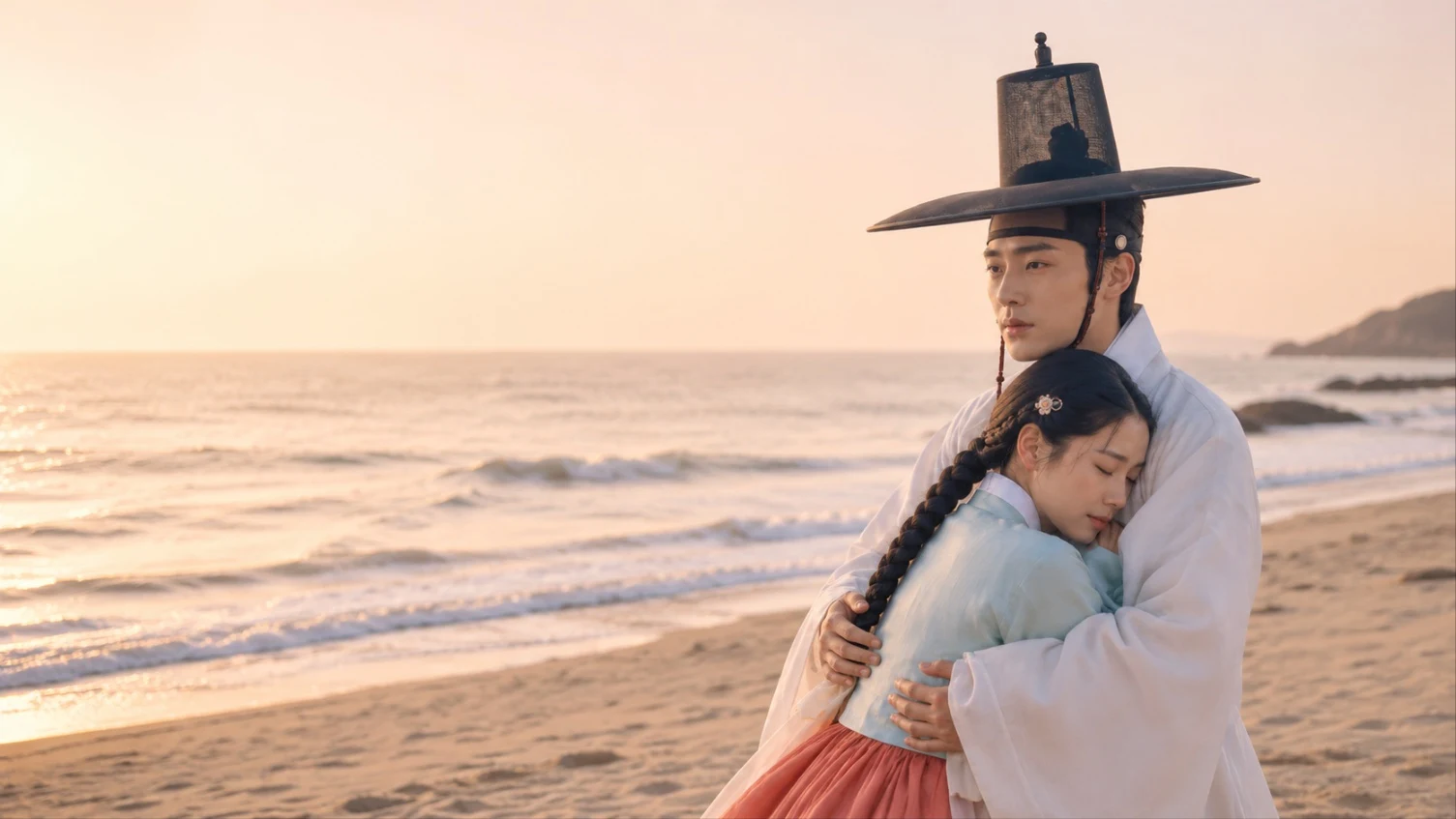
If you’ve watched the acclaimed 2023 K-drama My Dearest (연인) — a sweeping wartime romance set during Korea’s Qing invasion — you remember the part that hurts the most. It isn’t the battlefield. It’s what happens after. Women who were seized and dragged across the border as captives finally make it home — and instead of being met with relief, they are met with averted eyes, closed doors, and whispered judgment. Some families would rather their returned daughters had never come back at all.
It is wrenching to watch. And it raises a question the drama lets sit heavily in the air: why would a society punish the very women it had failed to protect?
Quick answer: In My Dearest, the women who survive Joseon’s worst military defeat — the 1636–37 Qing invasion — face a second ordeal at home. Under a rigid Confucian chastity ideology, a woman returned from enemy captivity was presumed “defiled,” and her return was treated as a stain on the family’s honor rather than a cause for relief. These women — called hwanhyangnyeo (還鄕女, “women who returned to their hometown”) — were not criminals. They were victims punished by the same society that had failed to protect them.
This was rarely punishment by formal law. It was social punishment — family rejection, divorce pressure, moral suspicion, and lifelong stigma.
Let’s unpack it. (A gentle note before we begin: this is a story about wartime suffering and the way blame can fall on victims. We’ll handle it carefully, and stick closely to what the historical record actually supports.)
What war is My Dearest actually set in?
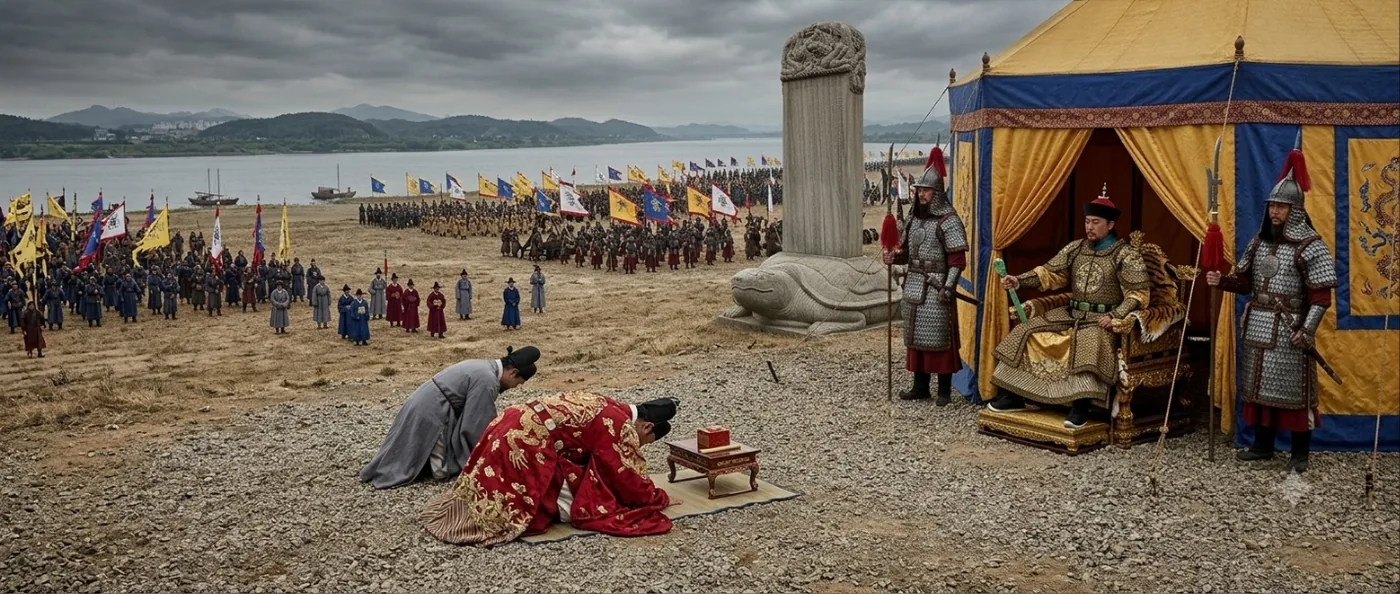
The drama unfolds around the Byeongja War (병자호란), the second Manchu invasion of Korea, in the winter of 1636–37.
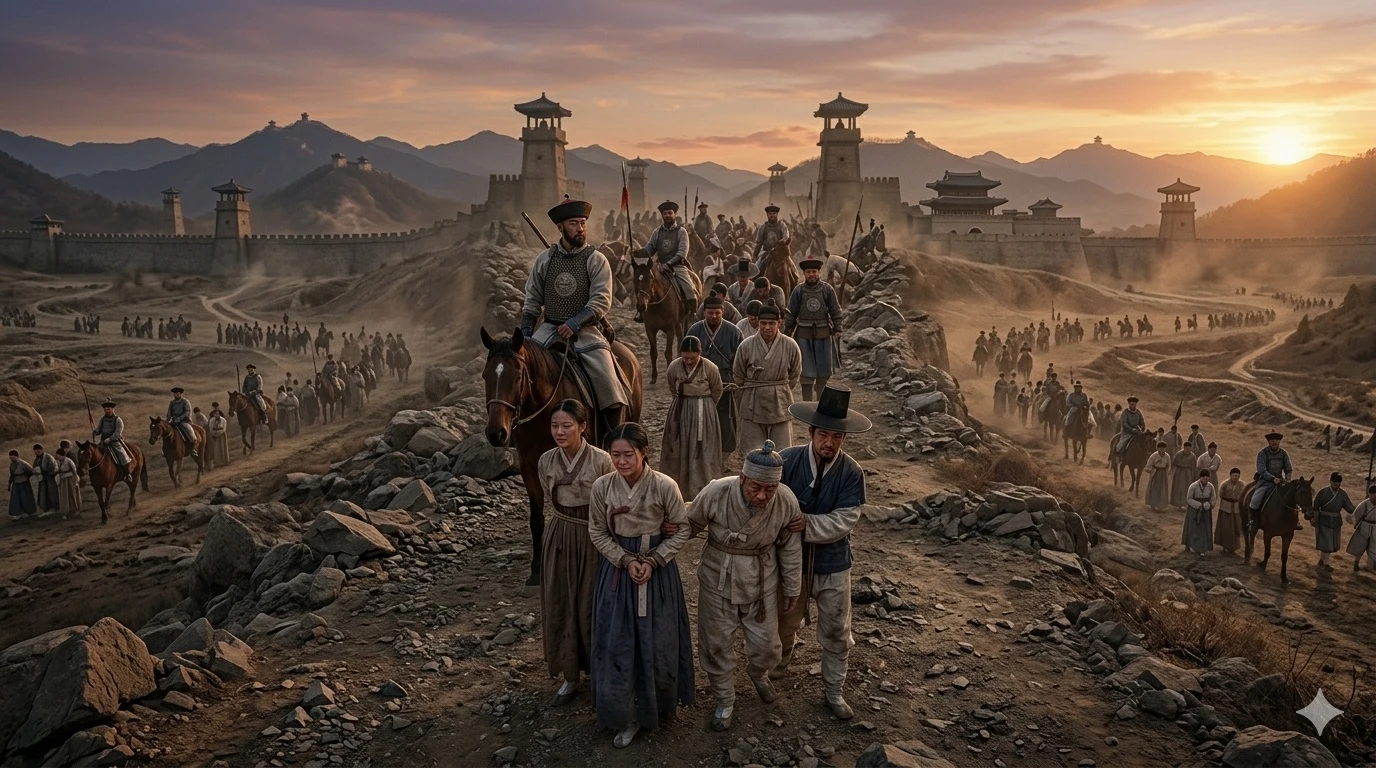
The newly risen Qing empire (1636–1912) — Manchu-led, and soon to conquer all of China — invaded Joseon Korea after Joseon refused to abandon its old loyalty to the fallen Ming. The war was short and catastrophic. King Injo (인조) was besieged at the mountain fortress of Namhansanseong (남한산성) through a brutal winter, then forced into a humiliating surrender (Encyclopedia of Korean Culture). What followed is the part that drives My Dearest: the Qing armies withdrew dragging an enormous number of Korean civilians north as captives — these prisoners were called piroin (피로인, “the seized people”).
How many? We genuinely don’t know. Contemporaries threw out staggering figures — the official Choe Myeong-gil (최명길) spoke of “five hundred thousand,” and other writers of the era cited similar or larger numbers. Modern historians treat these as shocked estimates rather than a real count, but everyone agrees the scale was immense, and that a great many of the captives were women.
Here is the drama’s world mapped against the history:
| In My Dearest | In real history |
|---|---|
| The Qing invasion tears families apart | The Byeongja War (1636–37) seized hundreds of thousands of Korean civilians |
| Captive women are dragged north across the border | The piroin (피로인) were taken to Qing territory as war prizes or sold as slaves |
| Families pay enormous sums to bring women home | Sokhwan (속환) — official ransom — drove frenzied bidding; Choe Myeong-gil proposed price caps |
| A redeemed woman is treated with suspicion at home | The hwanhyangnyeo were stigmatized under Joseon’s chastity ideology as presumptively “defiled” |
| King Injo refuses to sanction forced divorce | The Annals of King Injo record the Jang Yu petition and the royal decision against mass divorce |
What did “coming home” actually cost these women?
Here is the cruel turn at the center of the drama: for a captive woman, returning could be its own catastrophe.
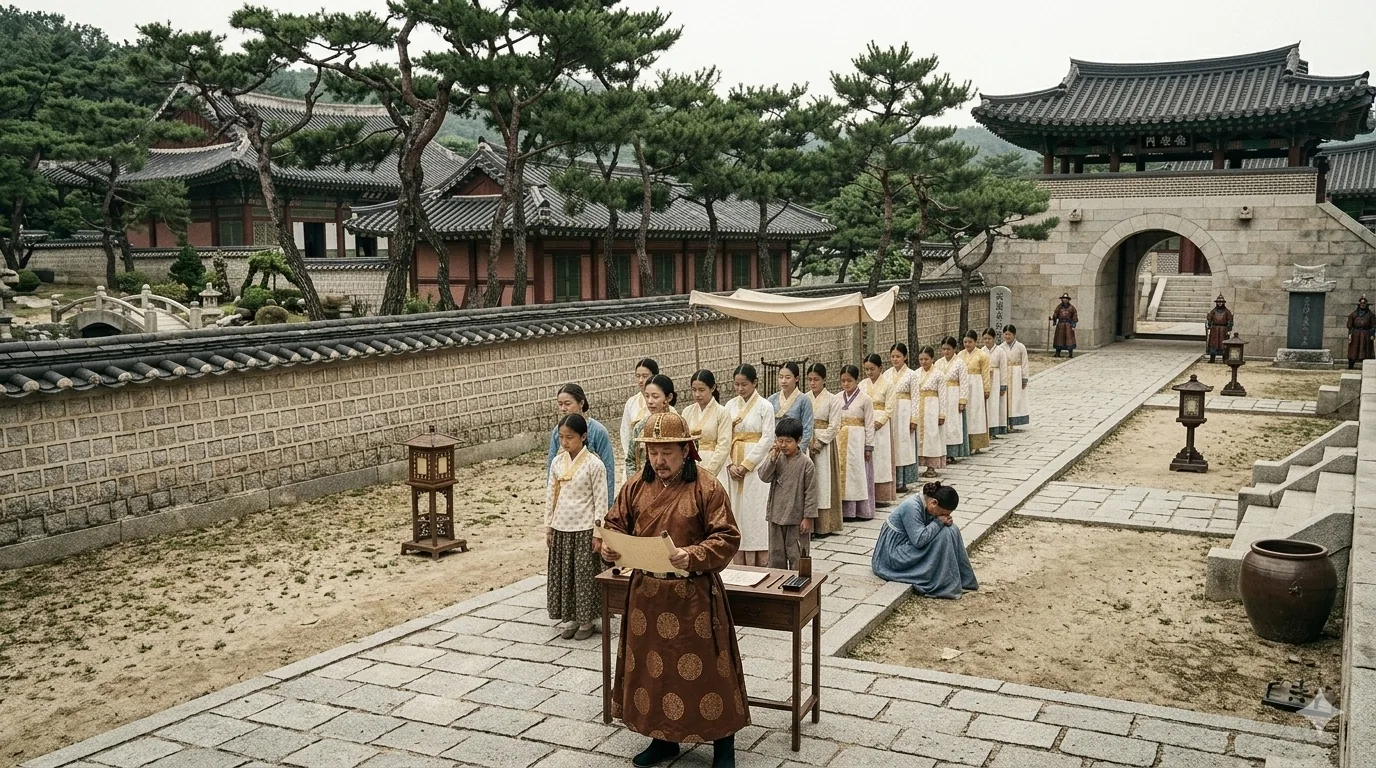
Many captives were eventually brought home through sokhwan (속환) — ransom. Families, and sometimes the state, paid the Qing a price in silver to redeem their people. (The ransom market got so feverish that Choe Myeong-gil argued for capping the price per person, fearing that runaway bidding by rich families would price the poor out of ever recovering their relatives.) A redeemed woman who came home was given a bitter name: hwanhyangnyeo (還鄕女) — literally “a woman who returned to her hometown” (Encyclopedia of Korean Culture).
It should have been a word of relief. Instead it became a mark of suspicion. Under Joseon’s rigid chastity ideology (정절), a woman’s sexual “purity” was treated as inseparable from her family’s honor. The reasoning that took hold was monstrous but, within that worldview, ruthlessly consistent: a woman who had been in enemy hands must have been defiled, and a defiled woman stained her husband’s lineage. The victim was recast as a pollutant. Some hardline scholars argued openly that such women should have killed themselves rather than return — that their survival was itself the disgrace.
Key terms. Hwanhyangnyeo (환향녀, 還鄕女) — “women who returned to their hometown”; women redeemed from Qing captivity after the 1636–37 invasion, who faced social rejection under Joseon’s chastity ideology. Byeongja War (병자호란) — the second Manchu invasion of Joseon, winter 1636–37, ending in King Injo’s surrender and mass civilian captivity. Sokhwan (속환) — the ransom system by which families and the state paid Qing to redeem captive piroin. Chastity ideology (정절) — Joseon’s Confucian framework treating a woman’s sexual “purity” as inseparable from family honor, used to condemn returned captives as “defiled.”
Did the king really get dragged into a divorce case?
Yes — and it’s one of the most revealing episodes of the whole period.
A high official named Jang Yu (장유) petitioned the court for permission to have his son divorce a redeemed daughter-in-law, on the grounds that a woman who had “lost her chastity” in captivity could no longer be entrusted with the family’s ancestral rites. Against him stood Choe Myeong-gil, who argued forcefully that these women were victims of war, not adulteresses, and that throwing them out was a moral outrage. King Injo ultimately refused to sanction forced divorce of redeemed wives as a general rule (Annals of King Injo — National Institute of Korean History) — a notably humane stand for the era (though even this no-divorce rule was abandoned in 1649, under the next king).
But it would be a mistake to read this as a clean victory. The royal ruling did not erase the social shame, and in practice many returned women were still cast aside, sent to live apart, or quietly pushed out so a son could remarry. The state said one thing; the lineage halls said another. My Dearest lives precisely in that gap — where a woman could be officially innocent and socially condemned at the very same time.
Wait — isn’t this the same as the “comfort women”? (No. Here’s the difference.)
This is the single most important thing to get right, because it’s very easy to blur — and blurring it does a disservice to the victims of both tragedies.
The hwanhyangnyeo were captives of the Byeongja War of 1636–37, taken by the Qing during a 17th-century invasion. That is the world of My Dearest.
The “comfort women” (위안부) are an entirely separate, much later history: women — Korean and from many other countries — forced into sexual slavery by the Imperial Japanese military during the Japanese colonial period and World War II, roughly 1932–1945 (Britannica). Different century, different occupying power, different system of violence.
They are not the same event, and conflating them — as casual retellings sometimes do — is simply wrong. What links them is not the history but a pattern: in both cases, women who were victims of state and wartime violence later had to fight, in addition, against a society that wanted to treat them as the source of shame. The events are distinct. The injustice rhymes.
Why My Dearest hits harder than it looks: France, 1945
Here is the part that turns this from a Korean story into a human one. The instinct to brand a “polluted” woman after a war was not unique to Joseon at all.
When France was liberated from Nazi occupation in 1944–45, crowds turned on women accused of being too close to the German occupiers. An estimated twenty thousand of them were seized, dragged into public squares, and had their heads forcibly shaved — les tondues, “the shorn women” (Imperial War Museums). Many were paraded, jeered, stripped, and marked, sometimes with tar. The charge was often “horizontal collaboration,” but historians note that a great many of the accused had done nothing more than work for, or be rumored to have associated with, Germans. The shaving was theater: a way for a humiliated community to perform its own purification on the bodies of women.
Look at the two scenes side by side. Joseon, 1637: a redeemed captive turned away at her own gate as a stain on the family. France, 1945: a woman shorn in the town square as a stain on the nation. The costumes and the centuries are different. The logic is eerily the same — a community that has been violated reaches for its women and punishes them as the thing that must be cleansed. That is the deeper, darker pattern My Dearest is quietly pointing at: war wounds a society, and the society too often passes that wound on to the women it should have shielded.
The comparison is not an equivalence: the hwanhyangnyeo were war captives, while the French cases involved a wide range of accusations about collaboration. What links them is not the specific charge but the gendered logic of public shame after national humiliation.
It’s worth saying plainly, with the distance of history: in both cases the moral failure belonged to the punishers, not the punished.
Coming up next
One returning woman at one Joseon gate — and we’ve traveled to a besieged winter fortress, to a king refusing a divorce, to the careful line between two very different tragedies, and to a French town square in 1945. That’s the quiet, serious gift of a good historical drama: a single scene of private grief opens onto something the whole world has done.
In the next essay, we’ll take another K-drama scene that looks like pure fiction — and trace the real Korean history hiding underneath it.
Frequently asked questions
Is My Dearest based on a true story? The romance and its characters are fictional, but the backdrop is real: the Byeongja War (병자호란) of 1636–37 and its aftermath, including the mass captivity of Korean civilians and the shaming of redeemed women (hwanhyangnyeo). The writer has also said the drama drew inspiration from the novel Gone with the Wind, another wartime epic.
What does “hwanhyangnyeo” mean? It literally means “a woman who returned to her hometown” (還鄕女) and referred to women taken captive during the Qing invasion who were later ransomed and brought home. Despite being victims, many faced suspicion and rejection under Joseon’s chastity ideology. (You may also hear a popular claim that a certain Korean slur derives from this word — but that origin story is rejected by most linguists, so we’ve left it out here.)
Are the hwanhyangnyeo the same as the “comfort women”? No. The hwanhyangnyeo were captives of the 1636–37 Qing invasion. The “comfort women” (위안부) were victims of a separate system of sexual slavery run by the Imperial Japanese military around 1932–1945. They are different events in different centuries and should not be confused.
Sources & further reading
This piece was written from the historical script and fact-check of 사뚱샘의 역사방 (SaDDungSam). Primary and official sources are linked inline beside the claims they support:
- The Veritable Records of the Joseon Dynasty (조선왕조실록) — the Annals of King Injo (인조실록) on the Byeongja War, the Jang Yu divorce petition, and Choe Myeong-gil’s arguments for the redeemed women. (National Institute of Korean History — official English archive)
- Hwanhyangnyeo (환향녀) & sokhwan (속환) — captive women and the ransom system after the Qing invasion. (Encyclopedia of Korean Culture / 한국민족문화대백과)
- Byeongja War (병자호란, 1636–37) — the second Manchu invasion of Joseon and its aftermath. (Encyclopedia of Korean Culture / 한국민족문화대백과)
- Comfort women (위안부) — the distinct WWII-era system of sexual slavery by the Imperial Japanese military, for clear historical contrast. (Encyclopædia Britannica)
- Les Tondues — French women publicly shaved after the Liberation of France in 1944–45. (Imperial War Museums)
Further reading: for Joseon chastity ideology and gender history, see the Encyclopedia of Korean Culture’s broader entries on Confucian ethics and 정절 (jeongjeol); for the comparative French history, Fabrice Virgili’s Shorn Women: Gender and Punishment in Liberation France (2002) is the standard scholarly reference on les tondues.
Thanks for reading — see you in the next one.
This article was researched and written by K-Drama History. Source: My Dearest, Explained: Why Joseon Punished the Women It Failed to Protect — K-Drama History