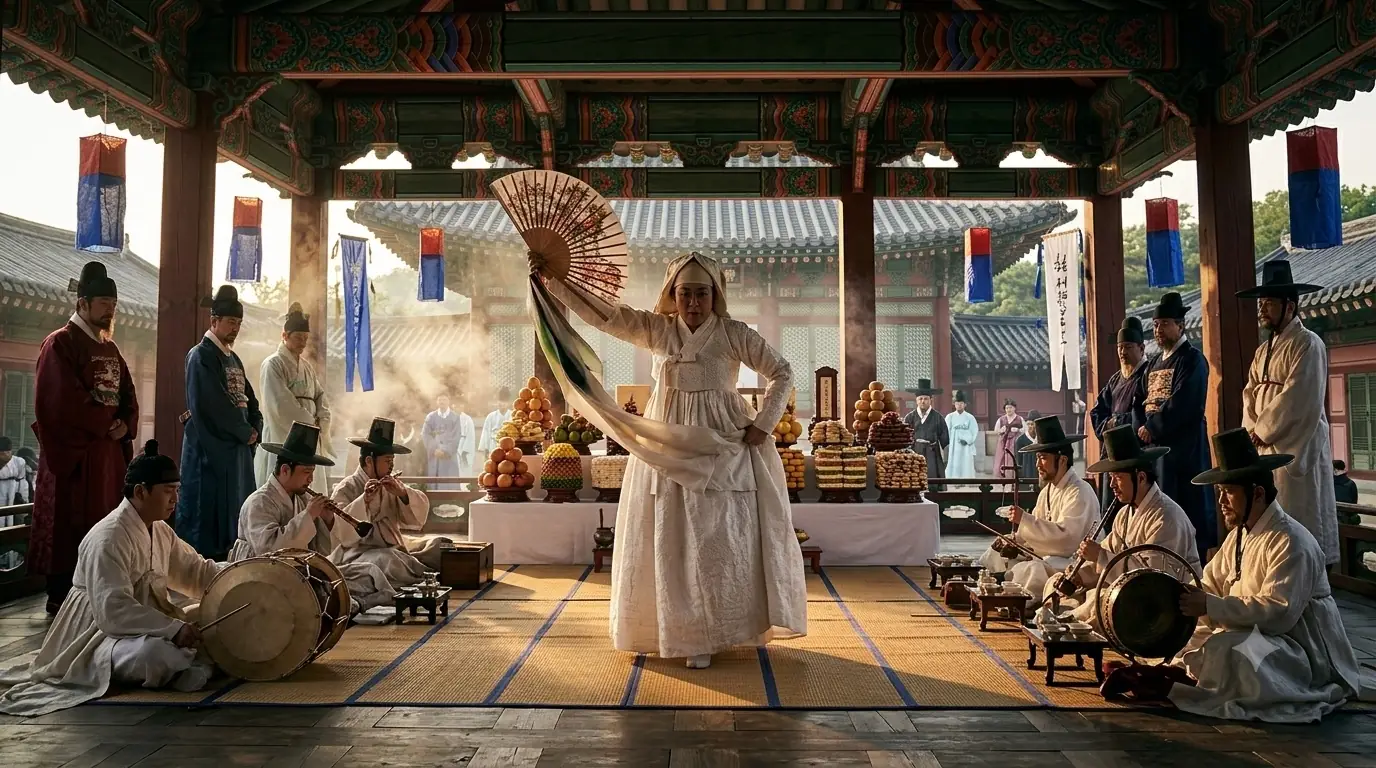
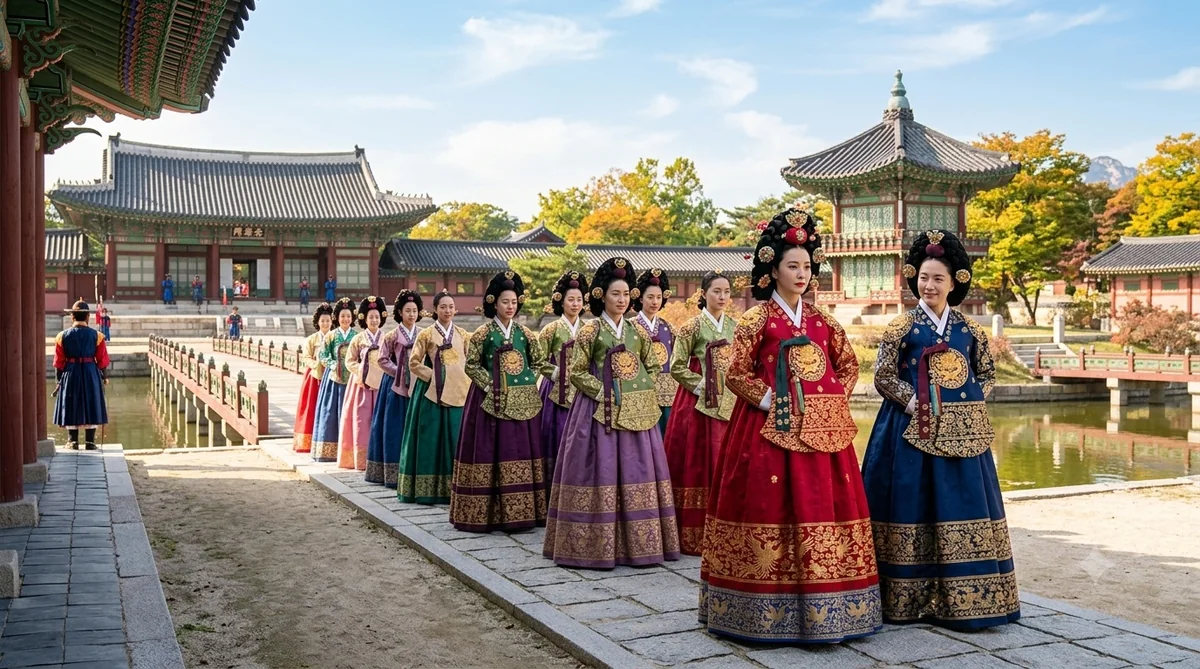
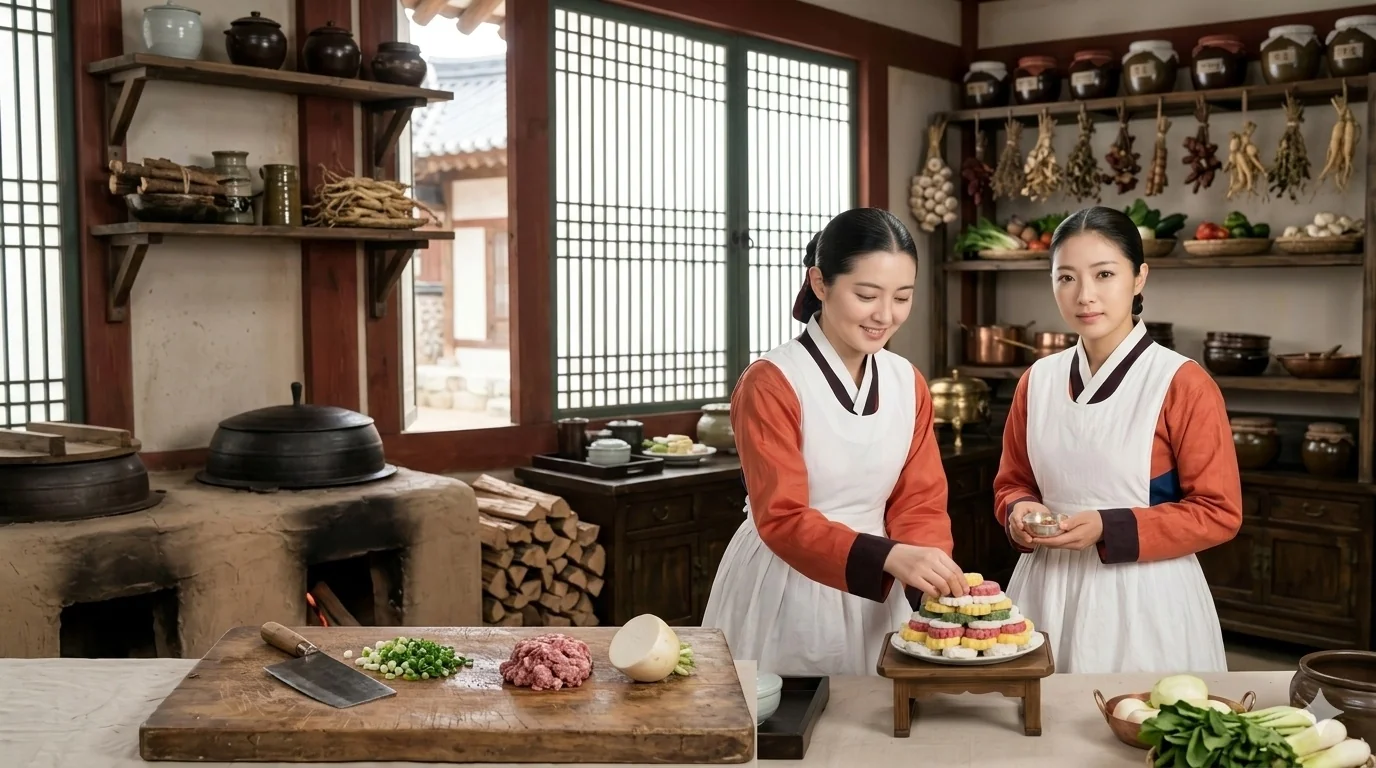
From the research behind Pause the Drama.
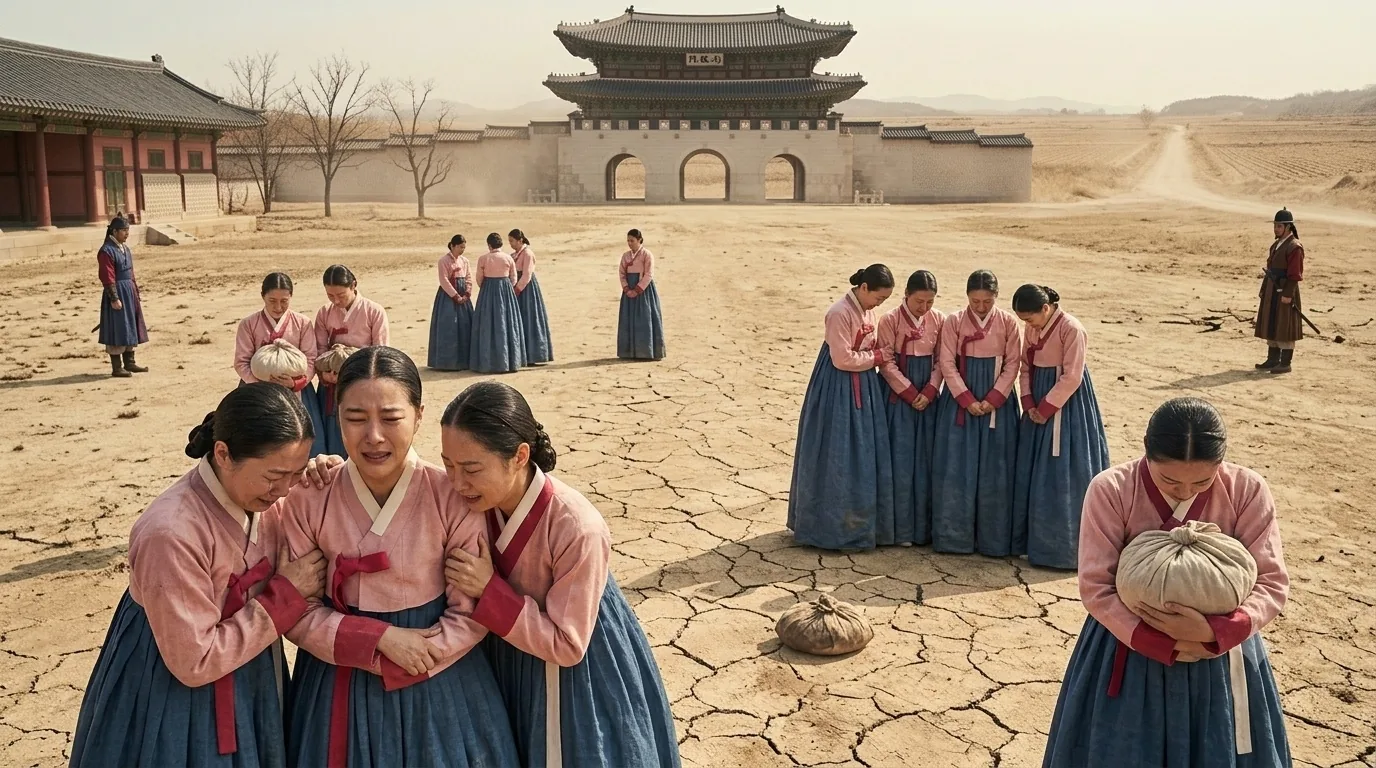 Release from the palace was not always a reward. For many it followed drought, illness or an omen. (AI illustration)
The most quietly radical thing about The East Palace (동궁) is not the exorcist. It is the other one.
Netflix’s eight-part mystery, out on July 17, 2026, opens on the death of the crown prince and a palace that cannot explain it. A king — Cho Seung-woo — summons two people: Gu Cheon (Nam Joo-hyuk), who can cross into the world of the dead, and Saeng-gang (Roh Yoon-seo), who can hear it. The kingdom is invented, and the show is upfront about that. Saeng-gang’s position is not: she is a palace maid, a gungnyeo (궁녀). In Joseon that was not a costume. It was work — ranked, salaried, departmentalised, entered in childhood and, as the Encyclopedia of Korean Culture puts it, held in principle for life.
Which raises the question dramas almost never ask, because it happens after the credits. What was the end of that job? Could she marry? Who buried her?
Some senior palace women built private provision from property, kinship and law. That is the part that almost never reaches the screen.
Quick answer: A Joseon palace woman did not retire into a state-supported residence. The sources reviewed here reveal no unified pension, housing or old-age care system for gungnyeo after service.
A woman released because of illness, her mistress’s death, punishment or an occasional mass discharge normally had to rely on private arrangements. Some returned to relatives or lived alone; religious retirement was an ideal reported for some, not a proven destination for all. Recent research shows that some senior sanggung accumulated property and transferred it to nephews or adopted heirs in arrangements that could secure care during illness, support in old age and ancestral rites after death.
The palace carefully organised a woman’s entry, duties, rank and pay. Her life after the gate was much less systematically provided for.
The job, briefly
The Encyclopedia of Korean Culture defines gungnyeo as all women of the palace apart from the royal family — a category reaching from the musuri (무수리) who did the heavy labour through the uinyeo (의녀) or medical women to bondwomen of the various offices. In ordinary use it means the two ranks that made up the bulk of them: sanggung (상궁) and nain (나인).
They ran the building. Seven departments organised around food, clothing and shelter — the jimil (지밀) or royal chamber, the sewing and embroidery rooms, the two kitchens, the confectionery, the laundry — with four smaller units for washing water, food service, errands and lamps, and above them senior sanggung holding the king’s commands, the storehouse, the royal children, ceremony and discipline. Girls entered very young, at customary ages the reference works place between roughly four and thirteen by department: late-Joseon practice, not a legal age. Fifteen years brought the coming-of-age rite and full nain status; fifteen more opened the possibility of sanggung. Pay was real if modest — a child nain drew four mal of white rice a month plus a bolt each of silk and cotton a year — and palace women filled the lower half of the naemyeongbu (내명부), the court’s female officialdom codified in the Gyeongguk daejeon, senior fifth grade down to junior ninth.
They belonged to a ranked palace workforce with official grades, defined duties and compensation. They can look superficially like civil servants for exactly that reason, but the analogy breaks down in recruitment, legal status and freedom to leave.
How did a palace woman get out of the gate?
A graded palace position, with compensation and promotion — but no ordinary route of voluntary departure. Service was understood in principle as lifelong, although illness, expulsion, a mistress’s death and occasional mass releases could take a woman outside the palace.
The Encyclopedia of Korean Culture names three routes out mid-career: grave illness; inclusion in a mass release of young palace women; and the death of the mistress one served. The Cultural History of Korea describes the same narrow set and adds expulsion for an offence. Alongside the principle of lifelong service ran the practice of putting the sick outside — two things that coexisted in different parts of the record, not two halves of one statutory sentence.
The mass releases are dated in the lunar calendar the Veritable Records use, and none of those dates converts directly to a modern one. On the tenth day of the seventh month of 1444, lightning struck the hall Yeonsaengjeon and killed a palace official, a sagi (司記) surnamed Cha. King Sejong read the strike as a warning from heaven, and in the same discussion observed that the palace women and kitchen staff had long been shut up stiflingly in the inner quarters. His ministers did not simply agree: they argued that lightning was not caused by human good and evil. Two days later, forty-five palace women were sent out. On the eighth day of the eighth month of 1765, a palace woman drowned herself in a well, relief was granted and thirty were released — an answer to a suicide, in a different category from the discharges that followed droughts.
Why did calamity produce releases at all? The reference works give competing answers: a belief that disaster could be caused by the accumulated grievance — the han — of palace women, and a reading of the drought releases as the state recognising the injustice of young palace women ageing to no purpose. The 1444 entry resists folding them into one.
The records tell us more about why women left the palace than how most of them lived afterwards.
Could she marry once she was out?
Palace women could never marry is the usual flat claim, and the record documents something more specific.
What the chronicles show directly is a restriction on particular men. In Seongjong’s eighteenth year, on the fifth day of the first lunar month, the court barred officials from marrying discharged palace women and musuri, then extended the bar to royal kinsmen — a rule aimed at the official and royal classes, not an exceptionless prohibition on any marriage by any former palace woman.
A second provision governs a different situation. The Sokdaejeon prescribed beheading — at the harsh end of the available methods — for a palace woman who had illicit relations with an outside man, and for the man involved. That applies to women in service, not to the marriages of women lawfully discharged.
The third piece is normative rather than legal. The Cultural History of Korea says a woman who left could not become the wife or concubine of a court official or a royal relative, that this was strictly applied, and that the unwritten expectation was tonsure and the nunnery, or living alone. Palace women, it adds, were held to keep their chastity facing the palace, because they had married the palace — a modern figure of speech for the norm, not any legal marriage.
The question was live, and the throne declined it. In the fourth lunar month of 1662, the royal secretary Kim Si-jin memorialised that palace women and the court ladies of the princely houses be permitted to marry. The Veritable Records of King Hyeonjong record the outcome in two characters: 不報 — the king did not reply.
The opposite behaviour could be rewarded with publicity. A palace woman surnamed Yi, who had received Crown Prince Sado’s favour in 1760 and withdrew into seclusion after his death in the rice chest in 1762, was given the rank Suchik and the honorific Jeongnyeol by Jeongjo in the seventh lunar month of 1791, at a grade equivalent to the junior second, with a plaque over her house — rare enough to be worth a ceremony.
So: the surviving rules do not establish a universal statutory ban on every former palace woman marrying any man. They do show powerful legal and social barriers: officials and royal kinsmen were barred from marrying discharged palace women, and the expected life after service was often described as chastity, solitude or religious retirement. Actual marriage may have occurred, but the sources cited here do not establish how often.
Where did she live, and where did she die?
Palace custom reserved death within the walls for a very narrow circle around the king; ageing or gravely ill palace women were ordinarily moved outside before death. Reference works describe this as court custom rather than a quoted statutory rule — not even a royal concubine, they note, was expected to die inside.
In the Cultural History of Korea’s account, a woman who fell ill was moved out to a jilbyeongga (질병가), a sickness house beyond the Sinmumun, Gyeongbokgung’s north gate. If she recovered she came back in; if she did not, she went on to a private house. When Changdeokgung served as the principal palace after the Imjin War, a woman near death was sent out through the rear gate, the Yogeummun (요금문) — a practice the source describes, not a designated door for the dying.
Where they settled afterwards is thinly recorded. In Galhyeon-dong, in Seoul’s Eunpyeong district near Suguksa temple, a lane called Gungmal-gil (궁말길) is said to be named for a settlement of discharged palace women, with graves nearby — local tradition, not survey data.
The Jeongeopwon (정업원), a convent inside the capital running from Goryeo into Joseon, offered a religious refuge for some royal and elite women — its abbesses were royalty, among them Lady Song, the queen of Danjong — but there is no evidence that it functioned as a general retirement home for ordinary palace staff. Its history was politically precarious, repeatedly challenged and at times abolished or restored.
Jeongeopwon chronology, for the record: abolished in 1448, its restoration decided in 1457 and its hall rebuilt in 1459; argued over again under Seongjong and through Seonjo’s reign. It was still standing in 1623, when the Diaries of Gwanghaegun place the palace woman Kim Gae-si there at her devotions during the coup that deposed Gwanghaegun; the available sources fix no precise final date. The stele marking the site today in Sungin-dong, Jongno-gu, cut in Yeongjo’s own hand in 1771, commemorates a spot identified by oral tradition as Lady Song’s former dwelling.
Newspapers remembered Seong Ok-yeom as one of the last surviving women formed by the old palace-service system. According to obituaries in the Kyunghyang Shinmun and the Dong-a Ilbo, she entered Changdeokgung in 1933 as a sewing-room nain at fifteen and served Empress Sunjeonghyo — the last queen consort of the Joseon house — until the empress’s death in 1966, alongside the sanggung Kim Myeong-gil and Park Chang-bok. She kept the rule that she must not marry, lived out her life alone, and died on 4 May 2001.
How did some sanggung provide for their old age?
Some of them built the provision themselves — and this is the part that most decisively breaks the king’s woman framing.
Kwon E-Sun’s 2025 study 「조선후기 상궁의 치산과 재산상속의 특징」, in Daedong Munhwa Yeon’gu, examines the property of late-Joseon sanggung and finds them managing estates. The wealth came from more than one source: royal grants and favours, salary income, and property inherited from their birth parents. With it they bought land, houses, bondservants and dojangkwon (도장권) — rights to collect from an estate rather than ownership of the land — outside the palace, typically holding what they bought for twenty to thirty years. One Sanggung Yun managed a plot of farmland for twenty-one years and sold it for thirty nyang above what she had paid.
That is a woman converting grants, salary and inherited family property into land, holding it for two decades, and arranging what it would do for her when she could no longer work — private provision, assembled inside a system that offered none as of right. Calling it a pension is a metaphor: no fund, no entitlement, no scheme.
Why kinship mattered so much
Because marriage and biological children were generally unavailable as sources of later-life support, kinship through siblings, nephews, adoption and property became especially important.
The inheritance patterns in the study are where the strategy shows. Property passed principally to male kin and their descendants, occasionally to a sister’s son; adopted heirs who were not blood relatives could inherit too, but the practice centred on nephews of the same surname, and some of those heirs took on the ancestral rites for the sanggung herself. The study reads the adoptions and transfers as more than family feeling — as carrying a strategic intent, securing care in old age and in illness, and rites after death.
There is a symmetry with recruitment. The encyclopedia says palace women were often brought into service by their aunts; the study says their property often went out to their nephews. In some cases a kin network connected entry into service at one end and support in old age at the other. The two halves are attested separately, and whether they add up to a hereditary guild is a further claim nobody has demonstrated.
What the sources do not tell us
Rules touching the end of service did exist — the marriage restrictions, the penalty for adultery in service, discharge for illness, release on a mistress’s death. What is absent from the sources is any unified provision for retirement, housing or old-age support covering palace women as a class.
What is left is improvised: a convent for royal and gentry women that the government kept trying to abolish, a lane in Eunpyeong where discharged women are said to have lived together, a nephew adopted in exchange for support and rites. Even for the sanggung whose estates Kwon reconstructs, the record runs out where the deeds stop; for the laundry-room nain sent out through the north gate, there is usually nothing at all.
| In The East Palace (2026) | In the Joseon record |
|---|---|
| A palace maid is one of two people the king relies on | Palace women held graded posts in the naemyeongbu, senior fifth to junior ninth, codified in the Gyeongguk daejeon |
| The palace maid is young and unmarried | Customary entry was roughly 4–8 for the royal chamber, 12–13 for most departments; relations with an outside man while in service drew beheading under the Sokdaejeon |
| She moves freely through the palace | Palace women were sorted into seven departments and four smaller units — even skirt-folding marked which |
| Service is a stage in her life | Service was understood in principle as lifelong, with no ordinary route of voluntary departure — only illness, mass release, a mistress’s death or expulsion |
| The palace is where the story happens | Palace custom reserved death within the walls for a very narrow circle around the king; the dying went out, at Changdeokgung through the rear Yogeummun |
| The kingdom is fictional | It is. The employment structure around Saeng-gang’s job is not |
In short: the drama’s kingdom and its haunting are invented, but the position its heroine occupies was a real, ranked, salaried career. The palace carefully organised her entry, rank and service. It did not organise her retirement.
Coming up next
Next in this series: how the inner court’s holdings were administered, and why the most consequential woman in a Joseon palace on an ordinary day was very often not the queen but the sanggung holding the storehouse keys.
Frequently asked questions
Was a gungnyeo the king’s concubine? Almost never. The Encyclopedia of Korean Culture defines gungnyeo as all women of the palace apart from the royal family, and the great majority were working staff across seven departments. A woman who did receive the king’s favour became a seungeun sanggung, and entered the concubine ranks if she bore a royal child.
Were palace women civil servants? Only by loose analogy. Sanggung and nain held graded posts in the naemyeongbu under the Gyeongguk daejeon, with compensation and a promotion ladder, so the comparison catches something real. It breaks down on recruitment (no open examination, entry in childhood), on legal status (the category also covered musuri, bondwomen and other unfree staff), and on freedom to leave, which did not exist in any ordinary form.
At what age did girls enter, and where did they come from? Very young, and the sources differ: the Encyclopedia of Korean Culture gives roughly 4–8 for the jimil, 6–13 for sewing and embroidery and 12–13 for the rest, while the Cultural History of Korea gives 4–5, 7–8 and 12–13 — late-Joseon custom, not a statutory age. The encyclopedia has the top three departments drawing from the jungin and the rest from commoners; the Sokdaejeon directed selection from the lower functionaries of the offices.
Could a palace woman leave the palace voluntarily? There was no ordinary route of voluntary departure. Reference works describing court practice say the appointment ran in principle from entry to discharge, and name three routes out mid-career: grave illness, inclusion in a mass release, and the death of the mistress one served. The Cultural History of Korea adds expulsion for an offence. That principle and the custom of sending the old and the sick out coexisted in different parts of the record, not in one clause.
Could a palace woman marry after leaving the palace? The surviving rules do not establish a universal statutory ban on every former palace woman marrying any man. They do show powerful legal and social barriers: in Seongjong’s eighteenth year officials, and then royal kinsmen, were barred from marrying discharged palace women and musuri, and the expected life after service was often described as chastity, solitude or religious retirement. Actual marriage may have occurred, but the sources cited here do not establish how often.
Why were palace women released after disasters? Mixed motives, not one. In 1444 lightning struck the hall Yeonsaengjeon and killed a palace official surnamed Cha; Sejong read it as a warning from heaven and also said the palace women and kitchen staff had long been shut up stiflingly, while his ministers argued lightning is not caused by human good and evil. Forty-five were sent out two days later. In 1765 thirty were released after a palace woman drowned herself in a well — a suicide, not a disaster.
Where did palace women go when they were old or dying? Out, before the fact. Palace custom reserved death within the walls for a very narrow circle around the king, so an ageing or gravely ill woman was ordinarily moved outside beforehand — court custom, not a statute anyone quotes. A sick woman went to a jilbyeongga outside Gyeongbokgung’s north gate Sinmumun, returning if she recovered and going on to a private house if she did not; at Changdeokgung she left by the rear gate Yogeummun.
Did palace women own property, and was there a pension? Senior ones owned property. There was no pension. Kwon E-Sun’s 2025 study shows late-Joseon sanggung building estates from royal grants, salary income and property inherited from their birth parents, buying land, houses, bondservants and dojangkwon — rights to collect from an estate — and holding what they bought for twenty to thirty years. Property passed to kin and to adopted heirs, often same-surname nephews, in arrangements the study reads as partly strategic, securing support in old age and illness.
Sources & further reading
Written from the historical script and fact-check of 사뚱샘의 역사방 (SaDDungSam), working from Korea’s reference works, the Veritable Records of the Joseon Dynasty, Joseon legal materials and current Korean scholarship. Dates drawn from the chronicles are lunar-calendar dates as the records give them.
- Encyclopedia of Korean Culture (한국민족문화대백과사전) — 궁녀, 상궁, 내명부, 정업원, 정업원구기. (The 정업원 entry carries an internally inconsistent regnal date, which this article does not repeat.)
- 박홍갑, 「3. 궁녀」·「갈린 운명, 승은 입은 궁녀와 쫓겨난 궁녀」, 『한국문화사』 23, National Institute of Korean History (우리역사넷); 우리역사넷 「정업원을 아시나요」
- 『세종실록』 권105, 세종 26년 7월 10일·7월 12일 (third article); 『영조실록』 권106, 영조 41년 8월 8일; 『현종실록』 권5, 현종 3년 4월 2일; 『성종실록』 성종 18년 1월 5일; 『정조실록』 권33, 정조 15년 7월 16일; 『광해군일기』 광해군 15년 3월 13일
- 『속대전』 형전 잡령 「궁녀통간외인」·형전 공천 — National Institute of Korean History, Joseon legal materials
- 권이선, 「조선후기 상궁의 치산(治産)과 재산상속의 특징」, 『대동문화연구』 129 (2025), 373–406쪽
- 경향신문 (6 May 2001)·동아일보 (7 May 2001) — obituaries of Seong Ok-yeom
- 국가유산청 (Korea Heritage Service) — Jeongeopwon site materials
- Netflix official title and episode pages — The East Palace (동궁, 2026)
The companion piece on the invented kingdom of The East Palace and the real office of state shamans behind its premise is our essay on the Seongsucheong.
Thanks for reading — see you in the next one.
This article was researched and written by K-Drama History. Source: What Happened to a Joseon Gungnyeo After She Left the Palace? — K-Drama History