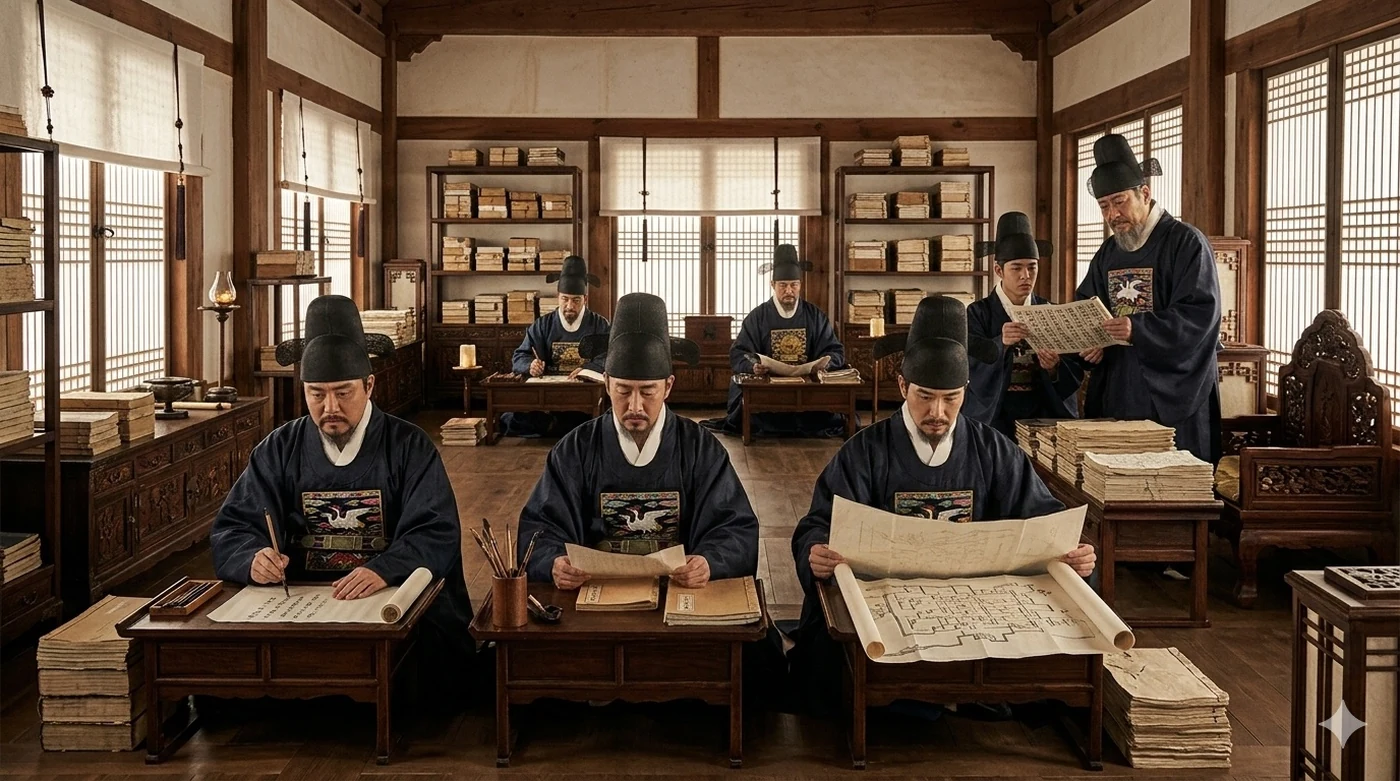
Jeong Do-jeon, Explained: Could a Powerful Chief Minister Protect Joseon From a Bad King?
Theme: Power & Politics
From the research behind Pause the Drama.
If you’ve watched KBS1’s sprawling Jeong Do-jeon (정도전) — the fifty-episode epic that ran from January to June 2014, dramatizing the birth of the Joseon dynasty — you’ve seen the scene that makes viewers sit up. A scholar-official stands before the king he helped enthrone and argues that the day-to-day running of the kingdom should not rest on the throne alone. It should rest on a chief minister chosen for ability, backed by a professional bureaucracy — because heredity can determine who inherits a throne, but it cannot guarantee he will be any good at sitting on it.
It’s a breathtaking thing to say in a monarchy — and one reason the struggle that followed ended with his death.
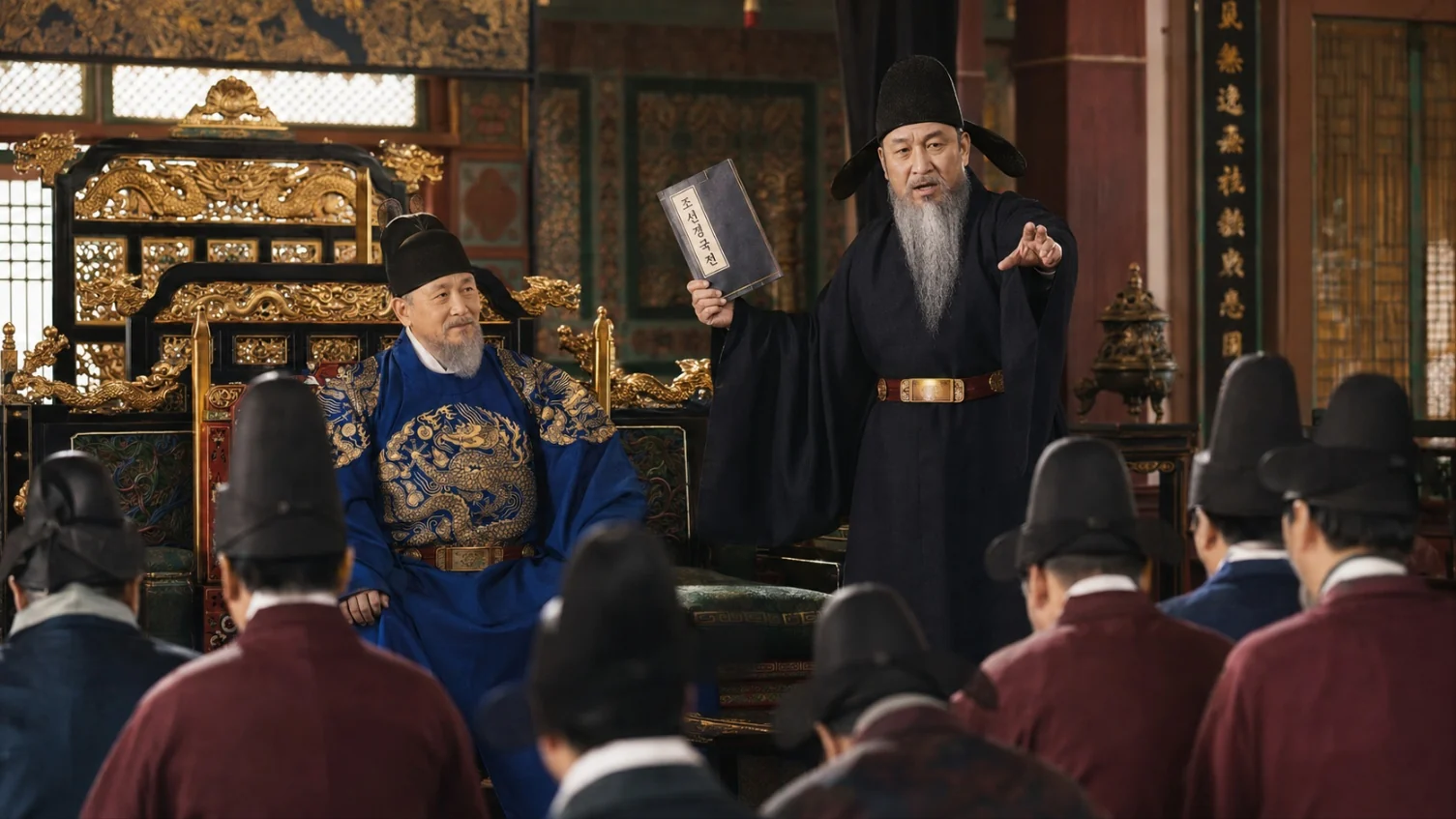 Jeong Do-jeon presents his design for the new state. His problem was never monarchy itself — it was the uncertainty built into hereditary competence. (AI illustration)
Quick answer: In KBS1’s Jeong Do-jeon, the central conflict is a real 14th-century argument about how Joseon should be run. The historical Jeong Do-jeon set out, in his 1394 treatise the Joseon Gyeongguk-jeon, a design in which the king’s crucial duty is to choose one capable chief minister (chongjae, 총재), who then commands the officials and carries the daily work of government. Crucially, this was not a plan to abolish royal authority or make the king a figurehead — it was a Confucian attempt to compensate, through ministers and bureaucracy, for the fact that hereditary succession cannot guarantee a capable king. His rival, Prince Yi Bang-won, saw that design — together with the ministers’ push to abolish the princes’ private armies, and his own exclusion from the succession — as a threat, and killed him in the coup of 1398.
Let’s unpack it.
Why did a scholar get to design an entire country’s government?
Because Yi Seong-gye could win a kingdom by force — but turning that victory into a state required scholar-officials like Jeong Do-jeon.
Jeong Do-jeon (1342–1398) rose out of the wreckage of late Goryeo, a kingdom hollowed out by a small circle of hereditary grandees (권문세족) who had turned land and office into private property, and by an entrenched Buddhist establishment he attacked with equal force. He belonged to the sinjin sadaebu, the new Neo-Confucian scholar-officials, and his enemies had a weapon to use against him: a question of slave descent on his mother’s side, which dogged him as a status vulnerability throughout his career (Encyclopedia of Korean Culture, 정도전). It’s tempting to draw a straight line from that to his politics — and worth resisting. What the sources support is that his lineage was used to attack him, not that it manufactured his ideas. He allied himself with a rising military commander, Yi Seong-gye, and helped engineer the revolution that toppled Goryeo and founded Joseon in 1392, with Yi Seong-gye enthroned as King Taejo.
But Jeong Do-jeon didn’t just help found a dynasty — he tried to write down, in law, exactly how it should run. He completed the Joseon Gyeongguk-jeon (조선경국전) in the third lunar month of 1394 and presented it to King Taejo that fifth month; modeled on the six-ministry framework of the Rites of Zhou, it laid out the legal and administrative architecture of the new state (Encyclopedia of Korean Culture, 조선경국전). In 1395 he followed it with the Gyeongje Mungam (경제문감), filling out the chijeon section on how the government’s ministers, censors, provincial governors and magistrates should actually function (Encyclopedia of Korean Culture, 경제문감). Between the two texts sits the idea the drama puts in his mouth.
What exactly was the “prime-minister-centered” system he wanted?
First, a caution about the label. Jaesang-chongjae-je (재상총재제) is not the name of an office that ever formally existed in Joseon. It’s a modern shorthand scholars use for the theory of the chongjae (총재, 冢宰) — the chief minister — that Jeong Do-jeon set out in his writings, borrowing the term from the ancient Chinese Rites of Zhou. And it is emphatically not a modern premiership. His chongjae is a Confucian chief minister who commands the officials, supports the throne, and corrects the king’s errors — not a party leader with the crown pushed aside.
A primary-source excerpt from the Joseon Gyeongguk-jeon, preserved by Korea’s National Institute of Korean History, puts the core of it in six characters: 人主之職, 在論一相 — “the ruler’s duty lies in deliberating over [the choice of] a single chief minister” (우리역사넷, “Jeong Do-jeon’s Theory of the Chief Minister”). The chongjae, the same passage says, serves the ruler above, commands the hundred officials below, and governs the people — following what is good in the king and correcting what is not.
So did he want to take power away from the king?
Not quite. He wanted to build a state that could survive a bad one.
The distinction matters, and it’s the thing most retellings of this story get wrong. Confucian political theory assumed a ruler needed both virtue and competence. But kingship is hereditary, and hereditary succession has no way of guaranteeing that the next man born to the job will be wise, or strong, or even adequate — indeed the same 우리역사넷 passage has Jeong Do-jeon saying so almost in as many words: kings differ in foolishness and brilliance, in strength and weakness, so the chief minister must follow the good in them and correct the bad. His fix was not to strip the throne. It was to put a capable minister and a professional bureaucracy alongside it, so the fate of the state would not ride entirely on whichever heir happened to inherit the throne.
This is where historians have been arguing. Scholars long described his ideal as minister-centered — sinkwon (신권, 臣權: ministerial authority, not “theocracy”) politics, with the king holding supreme dignity but little day-to-day command. Since the 2000s, that reading has been re-examined. Park Hong-kyu and Bang Sang-keun’s “A Reexamination of Jeong Do-jeon’s Chief-Minister-ism” (2008) works over the received chief-minister and joint-rule interpretations critically, and proposes reading his design instead as yusinjichi — a project for founding the order of a new dynasty. Song Jae-hyeok’s “Jeong Do-jeon’s Design for a New Order and the Book of Documents” (2017) argues that his model was drawn less from the Rites of Zhou’s division of ministerial power than from the Book of Documents.
And a still more recent study pushes the revision to its sharpest point. In “Jeong Do-jeon’s Royalism” (2025), Chang Hyun-guen argues that Jeong Do-jeon was not proposing a division of sovereign power between king and ministers at all. On this reading, the king remains the sole source of state authority; the chief minister commands the administration precisely in order to keep royal government public — to protect the state from the ruler’s private, arbitrary impulses. What Jeong Do-jeon sought to restrain, in other words, was not royal power but the king’s personal caprice (Chang Hyun-guen, The Review of Korean and Asian Political Thoughts 24:2, 2025).
That is not the last word on the question, and this essay won’t pretend it is. But notice what it does to the frame everyone starts from. If Chang is right, then “ministerial power versus royal power” — the very axis on which the drama, and most retellings, hang the whole story — is the wrong axis. Scholars have not split into two neat camps; what exists is an active current of re-examination. And the safest statement of Jeong Do-jeon’s aim is the modest one: he presupposed royal authority, and sought through ministers and bureaucracy to compensate for the king’s shortcomings and to steady the business of governing.
Who stood against this — and why?
Yi Bang-won, King Taejo’s fifth son. And it wasn’t a clean duel of ideas.
The tidy version — royal power versus ministerial power, two philosophies colliding — is too tidy. Three pressures ran together. Yi Bang-won had done as much as anyone to found the dynasty, and was passed over for crown prince in favor of Yi Bang-seok, a much younger half-brother born to Queen Sindeok (Encyclopedia of Korean Culture, 태종). Jeong Do-jeon and the ministers were pressing to abolish the princes’ private armies and reorganize military command — which meant disarming Bang-won and the royal kin specifically. And behind both sat the unresolved question of how far ministerial authority should reach into a king’s government. Succession, military power, and the design of government all converged.
How did the argument end?
Violently, in a single night — and it’s the part of the story the drama can only dramatize, not soften.
On the 26th day of the 8th lunar month of 1398 (Taejo 7), Yi Bang-won struck first. Jeong Do-jeon was cut down along with his closest allies, Nam Eun and Sim Hyo-saeng among them; the crown prince Bang-seok and his brother Bang-beon, Queen Sindeok’s sons, were killed too. Korean history remembers this as the First Strife of Princes (Encyclopedia of Korean Culture, 제1차 왕자의 난). Political initiative passed to Bang-won’s faction; his older brother Bang-gwa was installed as King Jeongjong, and after a second round of fratricidal conflict in 1400, Yi Bang-won took the throne himself as King Taejong.
There’s a sharp historiographical wrinkle here, and it’s the sort of thing that should make any reader of history slow down. The official record of Jeong Do-jeon’s death sits in the Taejo Sillok — and the Taejo Sillok was first completed under King Taejong, the very man who had him killed (and revised again under Sejong). Its obituary of him reads 量狹, 多忌且怯: narrow-minded, jealous, and timid, a man who tried to harm those better than himself and avenge old grudges (Veritable Records of the Joseon Dynasty, Taejo Sillok, year 7, 8th month, 26th day). That is an indispensable primary source. It is also the loser’s obituary, written inside the winner’s court. Both things are true, and you have to hold them at once.
Here’s the confrontation at a glance:
| In the KBS drama | What the historical evidence supports |
|---|---|
| Jeong Do-jeon argues the king should step back and let a wise minister govern | He argued the king’s crucial duty was choosing a capable chief minister — but he presupposed royal authority rather than trying to abolish it; how far he meant to go is debated, and one 2025 study argues he was a royalist restraining not the throne but the king’s private caprice |
| The clash is philosophy versus philosophy: royal power against ministerial power | It was also succession (Bang-won passed over for crown prince) and hard military politics (the ministers moving to abolish the princes’ private armies) |
| The rivalry plays out as a single dramatic confrontation | The coup — the First Strife of Princes — is dated in the Annals to the 26th day of the 8th lunar month, 1398 (Taejo 7) |
| The Annals tell us who Jeong Do-jeon really was | The Taejo Sillok’s obituary — “narrow-minded, jealous, timid” — was first compiled under Taejong, the man who had him killed |
| Jeong Do-jeon loses, and the story moves on | His ideas lost; much of his design survived — the centralized bureaucracy, the Six Ministries, and the Joseon Gyeongguk-jeon as an important basis for the Gyeongguk Daejeon, in force from 1485 |
Key terms. Chongjae (총재, 冢宰) — the “chief minister” Jeong Do-jeon placed at the center of government, a term borrowed from the ancient Chinese Rites of Zhou. Jaesang-chongjae-je (재상총재제) — not a real Joseon office but a modern scholarly label for his chief-minister theory; not to be equated with a modern premiership. Sinkwon (신권, 臣權) — ministerial authority (nothing to do with theocracy), the pole set against royal authority in the classic framing of this debate. Joseon Gyeongguk-jeon (조선경국전) — his 1394 treatise, an important basis for Joseon’s later full legal code, the Gyeongguk Daejeon. Wangja-ui nan (왕자의 난, “Strife of Princes”) — the 1398 and 1400 succession coups that killed Jeong Do-jeon and put Yi Bang-won on the throne as King Taejong.
Why Jeong Do-jeon’s argument feels so dangerous: three civilizations on the same question
Here’s what makes this single scene resonate far past Korea: at roughly the same historical moment, other societies were wrestling with a recognizably similar question — how do you keep a state from being wrecked by the person who happens to inherit it? — and reaching for very different answers. Set them beside Joseon and Jeong Do-jeon’s argument stops looking like a quirky plot point.
One caution before we start, because it’s the kind of thing that turns good history into bad history: these are comparisons, not causal links. Jeong Do-jeon was not writing a rebuttal to the Ming emperor, and he did not anticipate the British constitution. What the comparison shows is that the same problem kept getting posed, and kept getting answered differently.
Ming China — the opposite answer, fourteen years earlier. Joseon’s founding generation looked to Ming China as the reference point for how a proper Confucian state should be organized. But Ming had just gone the other way, hard. In 1380 the Ming founder, the Hongwu Emperor, used the alleged treason of his chancellor, Hu Weiyong, as grounds for a massive purge — and then abolished the office of chancellor itself, along with the central chancellery it headed, binding the Six Ministries directly to the throne (Encyclopædia Britannica, “Hongwu — Despotism, Reforms, Dynasty”). Fourteen years later, Jeong Do-jeon wrote a treatise placing a chief minister at the heart of government. The institutional histories are genuinely different, and neither man was answering the other. But within one Confucian world, at nearly the same moment, the imagination of where power should sit ran in opposite directions — and that is worth noticing.
Renaissance Florence — a related anxiety, a different diagnosis. A century later, the Florentine Niccolò Machiavelli was working a related problem in an entirely different political tradition. The Prince, written in late 1513 or early 1514 and published posthumously in 1532, asks how a ruler acquires and holds power in a dangerous and unstable world (Stanford Encyclopedia of Philosophy, “Machiavelli”). It is tempting — and wrong — to file him as the pro-tyranny mirror image of Jeong Do-jeon: the same man wrote the Discourses on Livy, a searching defense of republics and civic liberty. The honest comparison is narrower and more interesting. Jeong Do-jeon, inside Confucian monarchy, looked to ministers and a bureaucracy to compensate for an unreliable ruler. Machiavelli, inside the Italian city-states, analyzed the techniques by which a ruler seizes and keeps power at all. Two very different responses to the recognition that an unreliable ruler is a state’s deepest vulnerability.
England — the comparison to handle with tongs. England spent the 17th century fighting a civil war and staging a revolution over who really governs. The Glorious Revolution of 1688–89 and the Bill of Rights of 1689 were a decisive turn: frequent parliaments, free elections, freedom of speech within Parliament (UK Parliament, “Bill of Rights 1689”). It is tempting to say Jeong Do-jeon got there three centuries early. Don’t. The modern cabinet system, the premiership as we know it, and the idea that the sovereign “reigns but does not rule” were not born in 1689 — they developed over a long stretch of time afterwards. And Jeong Do-jeon was never reaching for parliamentary government; he was working entirely inside Confucian kingship, where the check on the king was a virtuous minister and a censorial bureaucracy, not an elected assembly. The routes and the principles are simply different.
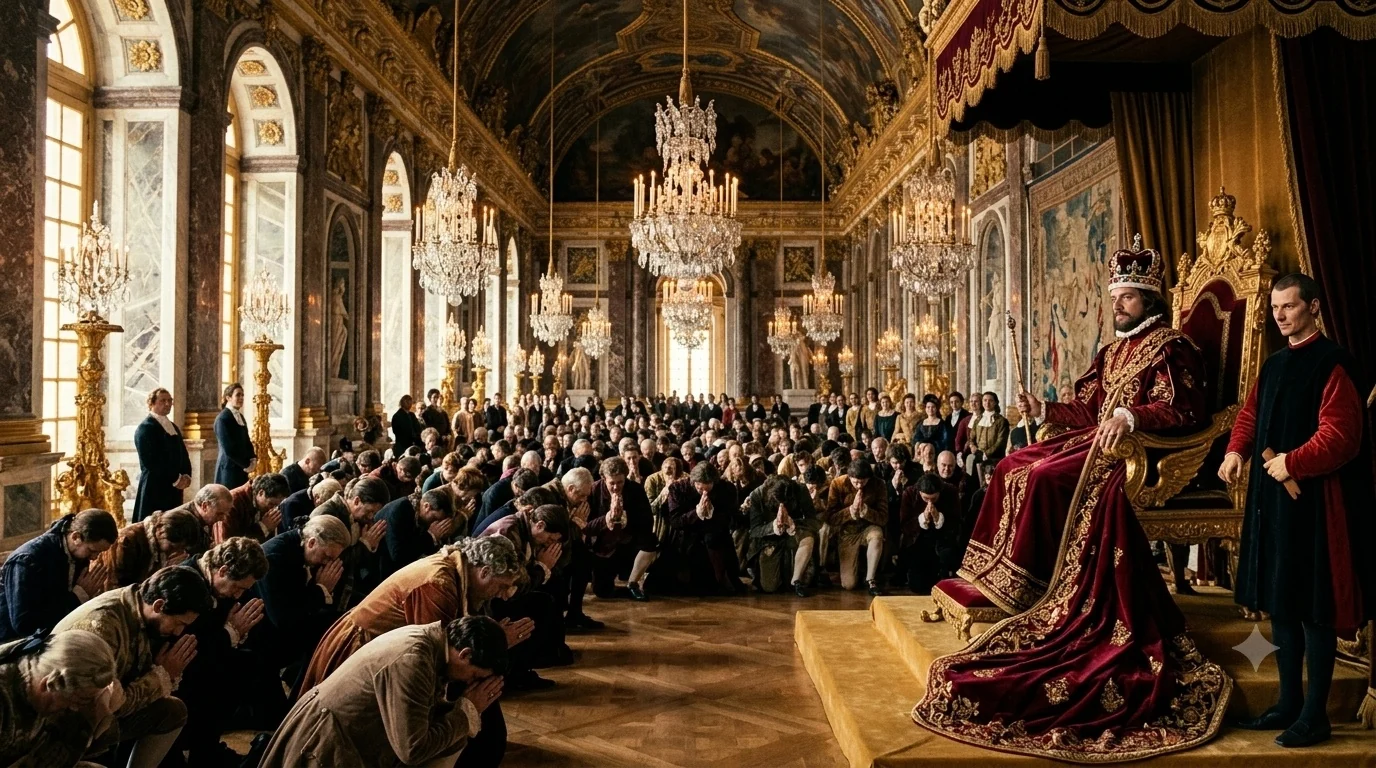 Europe’s own answer to the same question, for a long stretch of its history, ran the other way: power concentrated in the sovereign’s person. The restraint of royal power by institutions was slow, contested, and nowhere inevitable. (AI illustration)
What survives the comparison isn’t a story of Korea being ahead. It’s something less flattering and more durable: very different societies, with no knowledge of one another, kept circling the same design flaw in hereditary rule — and kept solving it differently, incompletely, and at considerable cost to whoever proposed the solution first.
Coming up next
One scene of a scholar arguing with his king — and we’ve traveled from a Confucian treatise written in 1394, to a coup fought over a single night in 1398, to a Ming emperor tearing out his own chancellor’s office fourteen years earlier, to a Florentine writing for princes, to an English parliament wrenching power from a throne three centuries later. Jeong Do-jeon lost the argument and his life. Much of what he built outlived both: the ministries, the bureaucracy, the habit of writing the state down in law. That’s the quiet gift of a great historical drama — even its arguments have a paper trail.
In the next essay, we’ll take another K-drama scene that looks like pure fiction — and trace the real Korean history hiding underneath it.
Frequently asked questions
Is Jeong Do-jeon (2014) based on a true story? Yes, in its political skeleton. The drama dramatizes real people and real events: the fall of Goryeo, the founding of Joseon in 1392, Jeong Do-jeon’s role as chief architect of the new state’s laws and institutions, his rivalry with Prince Yi Bang-won, and his death in the 1398 coup known as the First Strife of Princes. Specific dialogue and staged scenes are dramatized, but the underlying power struggle is documented history.
What was the “prime-minister-centered” system Jeong Do-jeon wanted? Jaesang-chongjae-je is not an official Joseon institution but a modern label scholars use for the chief-minister theory Jeong Do-jeon set out in his 1394 treatise, the Joseon Gyeongguk-jeon. Its logic: a hereditary king cannot be guaranteed to be wise, so the king’s crucial duty is to choose one capable chief minister (chongjae, 총재), who then commands the officials and carries the daily work of government. It is not a modern premiership, and it is not republicanism — it is a Confucian design for compensating for the uncertainty built into hereditary rule.
Why did Yi Bang-won kill Jeong Do-jeon? Not for one reason. Yi Bang-won had been passed over for crown prince in favor of his much younger half-brother Yi Bang-seok; Jeong Do-jeon and the ministers were pressing to abolish the princes’ private armies and reorganize military command, which struck directly at the power base of Bang-won and the royal kin; and behind both lay the unresolved question of how royal and ministerial authority should be balanced. Those pressures broke open in the coup of 1398 known as the First Strife of Princes.
Did Jeong Do-jeon actually want the king to have no power at all? No. He was not a republican and did not seek to abolish the monarchy. He worked inside Confucian kingship, arguing that ministers and the bureaucracy should compensate for a king’s shortcomings and correct his errors. Scholars have long described this as a minister-centered ideal, but since the 2000s that reading has been re-examined — as joint rule of king and ministers, as a broader design for a new dynastic order, and most recently (Chang Hyun-guen, 2025) as a form of royalism in which the chief minister exists to keep royal government public and to restrain not the throne’s power but the king’s private caprice. His intent is genuinely debated; it is not settled that he wanted a figurehead king.
Was Jeong Do-jeon’s mother really a slave? That flattens it. The Encyclopedia of Korean Culture notes a question of slave descent on his mother’s side, and that status question was used against him politically by his enemies. But writing “his mother was a slave,” or treating his reformism as a direct product of that background, goes beyond what the sources support.
Can we trust what the Annals say about him? Read it with care. The Taejo Sillok obituary calls Jeong Do-jeon narrow-minded, jealous and timid (量狹, 多忌且怯). But the Taejo Sillok was first completed under King Taejong — Yi Bang-won, the man who had him killed — and revised again under Sejong. It is an essential primary source, and it is also an account of the loser written inside the winner’s court.
What happened to Jeong Do-jeon’s vision after he died? Yi Bang-won, as King Taejong, broke the chief-minister-centered design and built a strongly royal-centered state, abolishing the private armies. But not everything was discarded: the centralized bureaucracy, the Confucian principles of state administration, and the direction of legal codification were absorbed into Joseon’s framework. The Joseon Gyeongguk-jeon became an important basis for later codes, ultimately feeding into the Gyeongguk Daejeon, in force from 1485. His ideas lost; a good deal of his institutional design survived.
Did Ming China do the same thing? The opposite, and shortly before. In 1380 the Ming founder, the Hongwu Emperor, used the Hu Weiyong affair to abolish the chancellorship and the central chancellery outright, concentrating power in the emperor. This is a contrast worth drawing — the same Confucian world imagining power distribution in opposite directions — but not a direct confrontation: Jeong Do-jeon was not writing a rebuttal to Hongwu, and the two systems have different institutional histories.
Did he anticipate British constitutional monarchy? It is safer not to put it that way. Britain’s path ran through the Glorious Revolution and the 1689 Bill of Rights, and even then the modern cabinet-and-prime-minister system, and the idea that the sovereign “reigns but does not rule,” developed over a long period afterwards. Jeong Do-jeon worked entirely inside Confucian kingship. The honest comparison is that very different societies kept returning to the same problem — how to keep one person’s rule in check by institutional means — not that one predicted the other.
Sources & further reading
This piece was written from the historical script and fact-check of 사뚱샘의 역사방 (SaDDungSam). Key facts and figures above are sourced inline. Where the scholarship is unsettled — above all on how far Jeong Do-jeon meant to restrain royal authority — this piece reports the disagreement rather than picking a winner. For broader reading:
- Jeong Do-jeon’s obituary record (졸기), Taejo Sillok, year 7, 8th month, 26th day — the annal entry recording his death, first compiled under the reign of the man who killed him. (Veritable Records of the Joseon Dynasty)
- “Jeong Do-jeon’s Theory of the Chief Minister” — primary-source excerpt and analysis of the Joseon Gyeongguk-jeon’s chief-minister passage. (우리역사넷, National Institute of Korean History)
- The re-examination of “chief-minister-ism.” Park Hong-kyu & Bang Sang-keun, “A Reexamination of Jeong Do-jeon’s Chief-Minister-ism,” Journal of the Korean Political Science Association 15:3 (2008) · Song Jae-hyeok, “Jeong Do-jeon’s Design for a New Order and the Book of Documents,” Asiatic Research 60:3 (2017) · Chang Hyun-guen, “Jeong Do-jeon’s Royalism: Focusing on His Theory of Chief-Minister Politics,” The Review of Korean and Asian Political Thoughts 24:2 (2025), 1–30 — the sharpest revision, arguing he sought to restrain the king’s private caprice, not royal power itself.
- The Hongwu Emperor’s abolition of the chancellorship (1380) — the Ming precedent moving in the opposite direction. (Encyclopædia Britannica) For a fuller treatment, see Edward L. Dreyer, Early Ming China; Charles O. Hucker, The Governmental Organization of the Ming Dynasty; and The Cambridge History of China, Vol. 7.
- Machiavelli, beyond The Prince. (Stanford Encyclopedia of Philosophy)
- The Bill of Rights (1689) — the English turning point, and the long road afterwards. (UK Parliament)
Thanks for reading — see you in the next one.
This article was researched and written by K-Drama History. Source: Jeong Do-jeon, Explained: Could a Powerful Chief Minister Protect Joseon From a Bad King? — K-Drama History