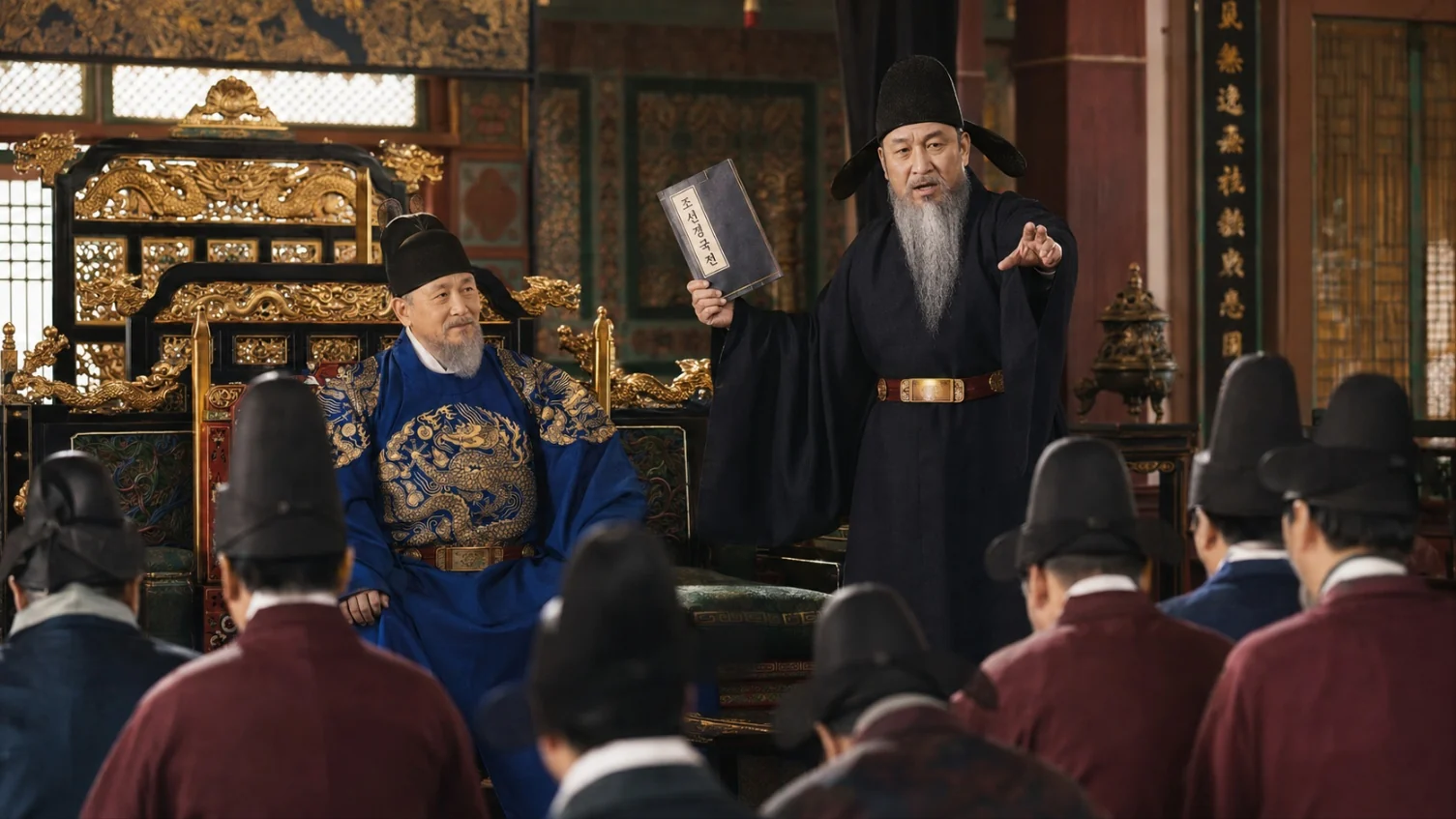
KBS's The King of Tears, Lee Bang-won, Explained: Why Yi Bang-won Killed Two Half-Brothers — but Spared the Brother Who Attacked Him
Theme: Power & Politics
From the research behind Pause the Drama.
You’re watching KBS’s The King of Tears, Lee Bang-won (태종 이방원), and the scene doesn’t look like a founding myth — it looks like a family being torn apart from the inside. Brothers who fought side by side to build a new dynasty are suddenly hunting each other through palace corridors. A father watches his sons kill each other for a throne he built. And the man who wins isn’t the eldest, the most beloved, or the one anyone expected — he’s simply the one willing to go furthest.
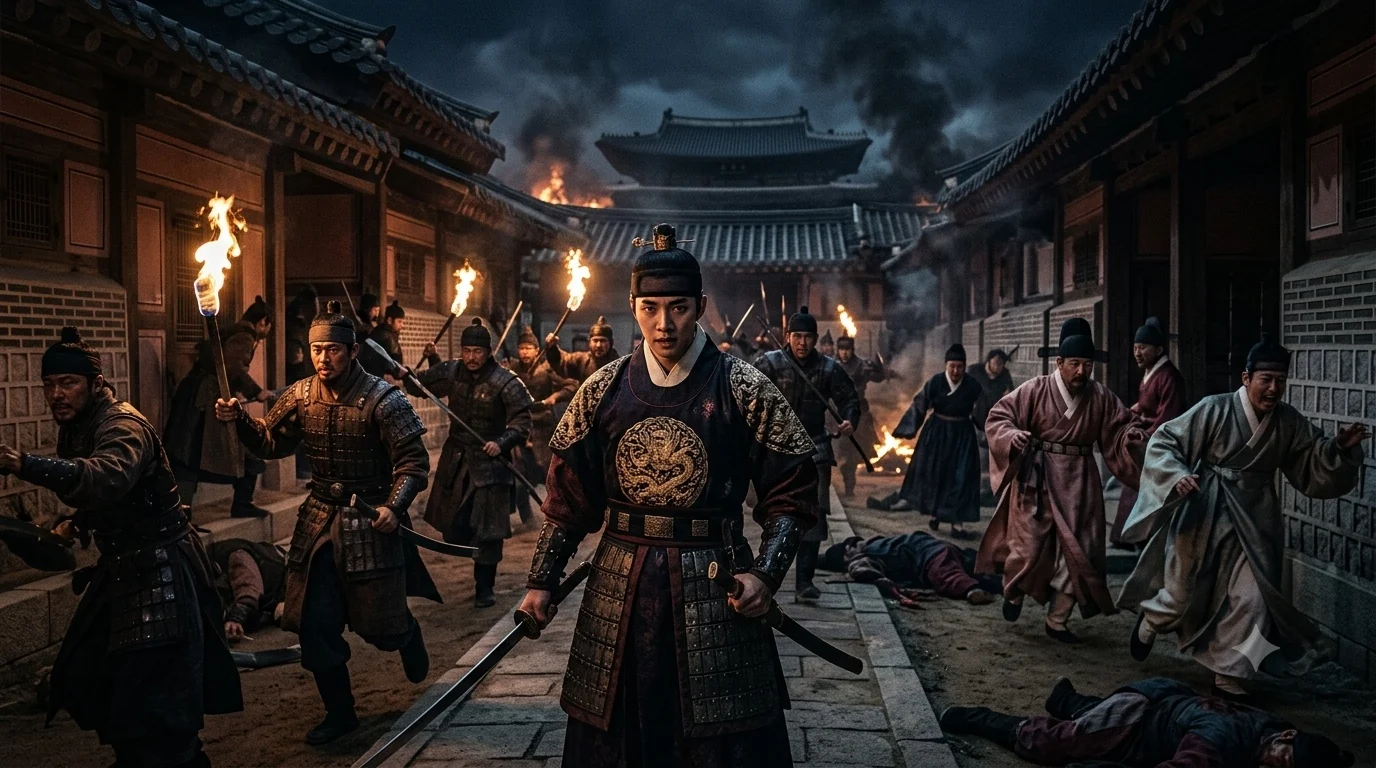 The night Joseon’s founding family turned on itself: the First Strife of Princes, the 26th day of the 8th lunar month, 1398. (AI illustration)
Here’s what the drama’s title alone tells you, if you know the history: this isn’t really a story about a king’s triumph. It’s a story about what a founding dynasty is willing to do to itself just to survive its first two decades — and about a man who, having taken the throne by force, spent the rest of his life building a state that could not be taken the same way.
Quick answer: The King of Tears, Lee Bang-won dramatizes a real chapter of early Joseon history: the Strife of Princes — two rounds of armed conflict (1398 and 1400) among the sons of dynasty founder Taejo. Yi Bang-won killed his half-brothers Bang-seok and Bang-beon along with the chief minister Jeong Do-jeon in the first; defeated his brother Bang-gan in the second, exiling rather than killing him; then became King Taejong (r. 1400–1418). But the story doesn’t end at the throne. He abolished the princes’ private armies, made the six ministries report straight to the king, and removed his own in-laws from power — turning the violence that made him king into a state where that violence could not be repeated.
Let’s unpack it.
Is this drama based on a true story?
Mostly, yes — the politics are real; the palace dialogue is not.
Yi Bang-won was the fifth son of Yi Seong-gye — the general who overthrew the crumbling Goryeo dynasty in 1392 to found Joseon — by his first wife, Queen Sinui. Bang-won had done as much as almost anyone to make that happen: it was he who sent Jo Yeong-gyu and others to eliminate Jeong Mong-ju, the minister who embodied loyalty to Goryeo and stood as the last great political obstacle to his father’s throne. That killing wasn’t merely a personal assassination; it was the hinge on which one dynasty turned into another. It also tells you something uncomfortable about what follows: the man who would later fight his brothers had already, before Joseon existed, chosen removal-by-violence at a decisive moment.
Then the new dynasty handed out its rewards — and the two that mattered most to him went elsewhere. Bang-won was left off the roll of founding merit subjects and passed over in the succession; the heir’s seat went to his much younger half-brother Bang-seok, son of Taejo’s second queen, Sindeok, while real power settled with Jeong Do-jeon and the ministers (Encyclopedia of Korean Culture, 태종). (He was not excluded forever — he was entered onto the merit-subject roll, in the first rank, in the twelfth month of 1398, after the First Strife had made him the strongest man in the kingdom.)
That grievance mattered. But it became explosive only because it ran together with everything else that was unsettled: who would inherit, who commanded the kingdom’s armed force, and what the power structure of a five-year-old dynasty was actually going to be.
What actually happened in the First Strife of Princes (1398)?
On the 26th day of the 8th lunar month of 1398, Bang-won struck first.
He and his allies moved on the palace, killed Jeong Do-jeon and his key supporters — Nam Eun and Sim Hyo-saeng among them — and killed two of Taejo’s other sons, his young half-brothers Bang-seok and Bang-beon (Encyclopedia of Korean Culture, 제1차 왕자의 난). On the surface it was a fight among brothers. Underneath, four things collided at once: the succession, the attempt to consolidate military command under the state, the princes’ private armies, and the unsettled power structure of a five-year-old dynasty.
Taejo, the founder, was reportedly devastated — not just by the deaths, but by what they meant: his own sons had been willing to slaughter each other for what he’d built. He abdicated almost immediately. And here is the part most retellings rush past: the winner did not take the crown. The throne went to Bang-won’s older brother, who became King Jeongjong. It’s tempting to read that as a calculated pause, Bang-won biding his time — but we don’t get to narrate a man’s private intentions. What the record shows is simpler and more telling: Jeongjong wore the crown, and political power had already gathered around Bang-won and his faction.
Why did the brothers fight again in 1400?
Because one round of bloodshed hadn’t settled anything — it had just proven that the throne was up for grabs by whoever kept the biggest army.
By 1400, another of Taejo’s sons, Bang-gan (Prince Hoean), had his own private forces. According to the surviving official account, Bak Po — embittered at being under-rewarded for his part in the first coup — told Bang-gan that Bang-won meant to destroy him, and urged him to strike first. (That account comes down to us through the winner’s court, which is worth holding in mind.) He struck at Bang-won directly. Bang-won crushed him.
The contrast is what’s revealing. Bang-won did not kill his brother: he exiled Bang-gan, and executed Bak Po, the man officially blamed for inciting the revolt (Encyclopedia of Korean Culture, 제2차 왕자의 난). Whether that was restraint, or the political cost of killing a full brother, or deference to Taejo, we don’t get to say. What we can say is that his political violence was selective rather than indiscriminate — which is, if anything, more chilling, not less.
In the second month of 1400, Jeongjong invested Bang-won as crown prince. That word matters. Bang-won was Jeongjong’s younger brother, and ministers argued the correct title was therefore “crown brother” (wang-taeje). Jeongjong overruled them: he would, he said, “take this younger brother as a son” — and installed him as wang-seja, crown prince, with charge of the kingdom’s military affairs (Annals of the Joseon Dynasty, Jeongjong sillok, year 2, 2nd month, 4th day). It was a way of folding a naked power transfer back inside the ritual grammar of succession. That eleventh month, Jeongjong abdicated, and Bang-won took the throne as King Taejong.
Here’s the drama’s arc against the historical record:
| In the KBS drama | What the historical record shows |
|---|---|
| Bang-won turns on his own brothers | Two rounds of armed conflict (1398, 1400) among Taejo’s sons |
| A trusted minister is cut down early | Jeong Do-jeon, with Nam Eun and Sim Hyo-saeng, killed in 1398 |
| One brother is defeated but not killed | Bang-gan was exiled in 1400; Bak Po, officially blamed for inciting him, was executed |
| The story seems to move straight to Bang-won’s kingship | It did not: Jeongjong (r. 1398–1400) held the throne for two years, while power gathered around Bang-won — who was then made crown prince, not “crown brother,” in 1400 |
| Taejong rules with an iron grip from the moment he wins | The private armies were abolished while he was still crown prince, under Jeongjong; the six-ministries direct-report system came in 1414, well into his reign |
Key terms. Wangja-ui nan (왕자의 난, “Strife of Princes”) — the two rounds of 1398 and 1400 fighting among Taejo’s sons over succession. Sabyeong (사병) — the private armies royal princes and merit subjects kept, abolished under Bang-won’s direction as crown prince and folded into a single state command. Yukjo jikgyeje (육조직계제) — the “six ministries direct-report system,” instituted in 1414, which had the six ministries report straight to the king instead of through the State Council. Taekhyeon (택현) — “choosing the worthy,” the principle that a capable heir may be preferred, in tension with succession by the eldest legitimate son. Sangwang (상왕) — a “retired king,” the position Taejong held after abdicating in 1418, from which he kept control of the military.
What did Taejong do with power once he had it?
He made sure no one — not a minister, not a prince, not even his own in-laws — would ever again have the private muscle to do what he had done.
The most important of those measures came before he was king, which is easy to miss. As crown prince under Jeongjong, Bang-won drove through the abolition of the sabyeong — the private armies that princes and merit subjects had personally commanded — folding military force into a single state command (Encyclopedia of Korean Culture, 사병). He of all people knew what those armies could do: he had ridden to power on them. Abolishing them was less a military reform than a political declaration — that no power outside the throne would hold arms of its own.
Then, as king, he rebuilt the state’s wiring. In 1405 he strengthened the standing and functions of the six ministries; in 1414 he instituted the yukjo jikgyeje, under which the six ministries — personnel, taxation, rites, war, punishments, works — reported straight to the king, bypassing the State Council of high ministers that had previously filtered and debated royal business (우리역사넷, 태종).
It’s tempting to draw this as the perfect mirror image of Jeong Do-jeon — ministers versus king, one man’s vision cancelling the other’s. Resist it. Jeong Do-jeon never proposed removing the king from government, and Taejong never abolished the bureaucracy or the State Council. What actually moved was the balance: where Jeong Do-jeon emphasized a chief minister who coordinated the administration and corrected the ruler, Taejong shifted decisively toward direct royal control over the ministries. Same machinery. Rewired. (We go into the argument itself, and the scholarly quarrel over what Jeong Do-jeon really meant, in the companion piece on Jeong Do-jeon.)
Did Taejong’s ruthlessness actually make Joseon more stable?
In the short term, brutally so — including toward his own family.
Having taken the throne through family violence, Taejong knew exactly how princes, merit subjects, private armies and royal in-laws could combine to shake a crown. So he went after his own. His brothers-in-law — Min Mu-gu and Min Mu-jil, brothers of his queen, Wongyeong, of the Yeoheung Min — were impeached in 1407 and ordered to take their own lives in 1410; their brothers Min Mu-hyul and Min Mu-hoe were impeached in 1415 and died the same way in 1416 (Encyclopedia of Korean Culture, 민무구의 옥). The formal charge in the Annals was disloyalty and grasping at power. The affair is commonly interpreted today as a political purge — a strike at the queen’s natal family before it could become an independent power base bound to a future crown prince. Both statements belong in the same paragraph: the charge as recorded, and the later judgment about what it was for.
The last act was the coldest. Yangnyeong, his eldest, had been made crown prince in 1404 and never grew into it — ritual discipline, Confucian schooling, the closed life of the palace; the problems of conduct accumulated until officials demanded his removal. He was deposed in 1418, Grand Prince Chungnyeong was invested as crown prince in the 6th month, and Taejong abdicated to him in the 8th. That is not simply “the eldest was unfit so he picked the third.” It is the collision of two Joseon principles — succession by the eldest legitimate son, and taekhyeon, choosing the worthy — resolved by a king with the power to resolve it.
Then, as retired king with the military still in his hands, Taejong destroyed the new king’s father-in-law. Shim On was seized on his way home from an embassy to Ming China and put to death shortly after Sejong’s accession — late 1418 by the traditional calendar, which falls in early 1419 by the modern one. The official charge was treason. Later assessments questioned whether it truly amounted to that, and his rank was restored under King Munjong (Encyclopedia of Korean Culture, 심온). It’s tempting to write that the charge was simply exposed as a fabrication; the safer, and truer, statement is that history came to doubt it and eventually restored him.
The new king was Sejong — who would preside over Joseon’s most celebrated golden age, on a throne his father had spent two decades making certain no one could seize the way he had.
Four dynasties, one danger: who inherits the throne?
Nearly every hereditary monarchy had to answer the same question sooner or later: when a ruler dies, who gets the throne — and what stops every capable son from taking it by force? The point of setting Joseon beside other dynasties is not to decide whose court was the most savage, or whose civilization handled it best. It is that succession was one of the most dangerous problems a monarchy faced, and each society tried to institutionalize or contain that danger differently.
| System | Main strategy | The danger that remained |
|---|---|---|
| Early Joseon | Violence, then centralization of military and administrative power | Succession still turned on the king’s own choice |
| Ottoman | Fratricide justified, in law and politics, for the order of the state | Enormous human cost; practice varied by era |
| Mughal | No fixed rule; open competition among princes | Recurring wars of succession |
| Western Europe | Primogeniture — settle the order in advance | Disputed legitimacy still produced wars |
Joseon — violence first, then engineered order. Early Joseon had the Confucian ideal that the eldest legitimate son should inherit, but no mechanism strong enough to enforce it against a determined rival with soldiers. Founding merit subjects, princes with private armies, ministers like Jeong Do-jeon, the founder’s own preferences, and the question of which queen bore which son were all tangled together. Bang-won cut the knot with force — and then spent his reign building the order that a firm rule of succession is supposed to provide: no private armies, a bureaucracy answering to the throne, no in-law faction left standing. He had felt how easily a crown could be taken by a prince with an army of his own, and he made sure his chosen heir would never face one.
The Ottoman Empire — the violence given a legal justification. After Mehmed II, Ottoman practice allowed fratricide to be justified, legally and politically, in the name of the order of the state: a sultan who took the throne could have his brothers put to death rather than leave rival claimants alive to raise a civil war (Ekrem Buğra Ekinci, “Fratricide in Ottoman Law,” Belleten). It is important not to flatten this into “the Ottomans always killed all the brothers.” Practice varied by era and by sultan, and later the empire moved toward confining princes within the palace instead. But the contrast with Joseon is real: Joseon fought, then reformed afterwards; the Ottomans built a justification for the violence into the logic of the state itself.
The Mughal Empire — competition that kept recurring. The Mughals never fixed a firm rule of inheritance. Princes held provincial commands, armies and networks of noble backing, so when an emperor weakened, armed competition between sons could escalate quickly. In 1657 Shah Jahan’s illness set his four sons against one another, and the war of succession of 1658–59 ended with Aurangzeb — neither the eldest nor his father’s favored heir — victorious and enthroned in 1658; his brother Dara Shikoh was executed in 1659 (Britannica, Aurangzeb). Structurally, that rhymes with Taejong: not the first son, and king by force of arms and nerve. The eras, religions, and imperial structures are entirely different, and the two men should not be collapsed into one another — but the shape of the problem is unmistakable.
Western Europe — trying to settle it in advance. Many western European houses leaned on primogeniture — the rule that the eldest son has priority in inheritance — to reduce succession disputes before they could begin. It’s a different theory of the same danger: settle the order by law and custom in advance, rather than let it be settled afterwards by whoever wins. Europe was never a single system, and the rule never worked cleanly: disputed successions and dynastic wars ran through European history all the same. Primogeniture reduced the fight. It did not abolish it.
Four dynasties, four different bets on the same danger — and not one of them solved it. Joseon fought and then engineered order; the Ottomans built a justification for the violence into the state; the Mughals lived with recurring armed competition; western Europe tried to legislate the fight away in advance. Watch The King of Tears, Lee Bang-won again with that in mind, and Yi Bang-won stops looking like an aberration of Korean cruelty. He looks like one answer, among several, to a problem hereditary monarchy never fully escaped.
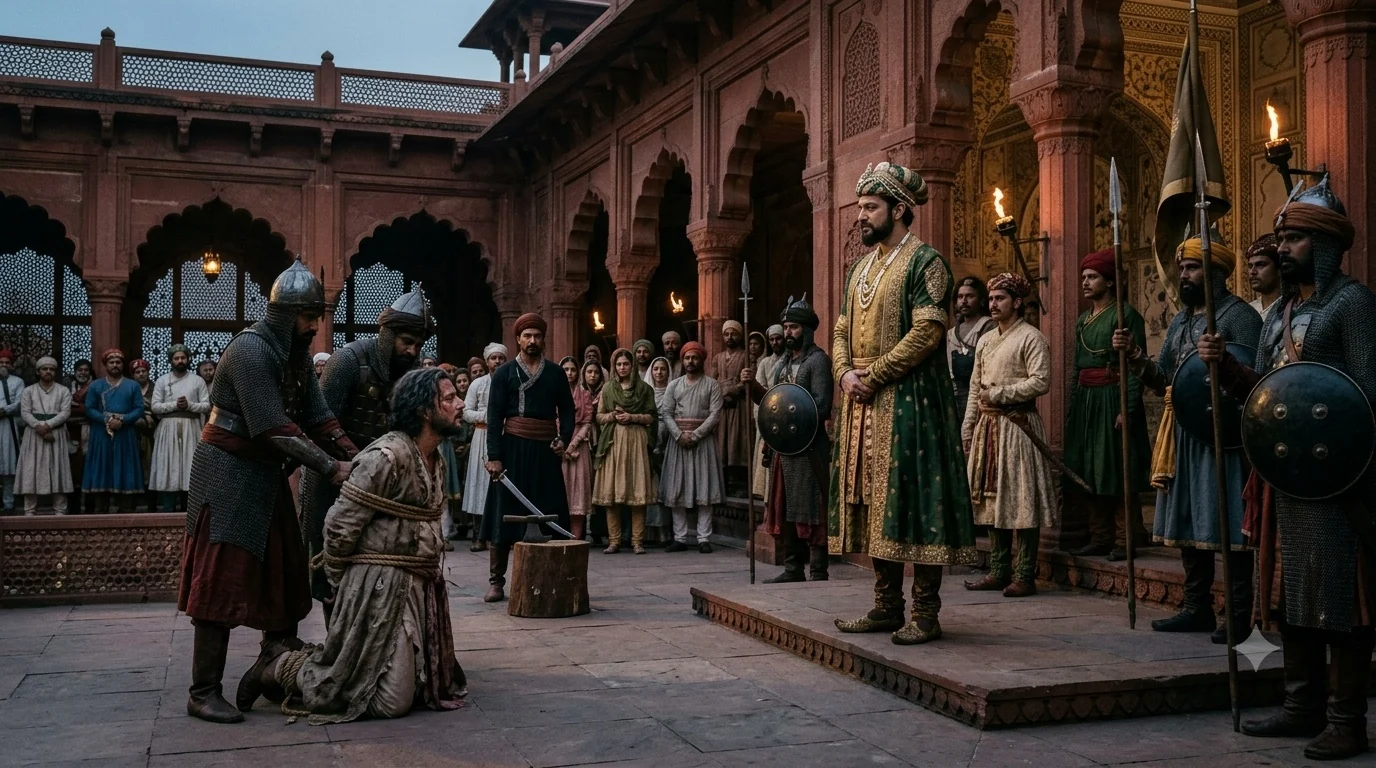 Mughal India, 1659: Aurangzeb — not the eldest, not his father’s chosen heir — takes the throne by war and has his brother Dara Shikoh executed. Structurally, Taejong’s story rhymes. (AI illustration)
Coming up next
One founding generation — and we’ve traveled from a Joseon palace courtyard to the execution of a queen’s own brothers, to a law written by an Ottoman sultan, to four Mughal princes tearing an empire apart, to European crowns trying to legislate the fight out of existence before it began. That’s the quiet gift of a great historical drama: even its bloodiest scenes have a paper trail.
In the next essay, we’ll take another K-drama scene that looks like pure fiction — and trace the real Korean history hiding underneath it.
Frequently asked questions
Is The King of Tears, Lee Bang-won based on a true story? Yes, in its political skeleton. The drama follows Yi Bang-won, a real historical figure who became King Taejong, Joseon’s third king. The First Strife of Princes (1398), the Second Strife of Princes (1400), the abolition of private armies, and Taejong’s later purges of his own in-laws are documented events, though the show dramatizes dialogue and inner motivation.
What was the Strife of Princes? Two rounds of armed conflict among the sons of Joseon’s founder, Taejo. In the First Strife (1398), Yi Bang-won killed his father’s chief minister Jeong Do-jeon along with Nam Eun and Sim Hyo-saeng, and killed his two half-brothers Bang-seok and Bang-beon. In the Second Strife (1400), he defeated his brother Bang-gan, who had been egged on by Bak Po. Bang-won then became crown prince and, later that year, King Taejong (r. 1400–1418).
Did Taejong really kill his own brothers? He killed two half-brothers, Bang-seok and Bang-beon, in 1398, along with Jeong Do-jeon and his allies. But in 1400 he defeated his full brother Bang-gan and exiled rather than executed him, while having Bak Po — who had incited him — put to death. The violence was real, and it was selective: aimed at those he judged a threat to the throne, not at every brother.
Wait — didn’t Yi Bang-won become king right after winning in 1398? No. The victor did not take the crown. Taejo abdicated and the throne went to Bang-won’s older brother, who became King Jeongjong — though real political power had already concentrated around Bang-won and his faction. Only in the 2nd month of 1400 did Jeongjong invest him as crown prince (wang-seja, not “crown brother”: ministers proposed the latter, but Jeongjong said he would “take this younger brother as a son”), and Jeongjong abdicated to him that 11th month.
When were the private armies abolished? Before Taejong was king — an important distinction. The abolition of the sabyeong (private armies of princes and merit subjects) was driven by Yi Bang-won as crown prince during Jeongjong’s reign, folding military command into a single state body. It belongs to the arc of his consolidation of royal power, but it is not something he did after taking the throne.
Why did Taejong destroy his own in-laws if the fighting was already over? Having taken power through family violence, Taejong knew how easily princes, merit subjects, private armies and royal in-laws could combine against a throne. In 1407 his brothers-in-law Min Mu-gu and Min Mu-jil — Queen Wongyeong’s brothers — were impeached, and in 1410 ordered to take their own lives; Min Mu-hyul and Min Mu-hoe followed in 1415–16. The formal charge was disloyalty and grasping at power. Today the affair is widely read as a political purge of the royal in-laws — though it’s safer to say that reading is dominant than to declare the charges pure fabrication.
What happened to Sejong’s father-in-law, Shim On? Shim On was arrested returning from an embassy to Ming China and put to death, around the turn of 1418–19, in the first year of Sejong’s reign, while Taejong — now retired king — still held military command. The official charge was treason. Later assessments questioned whether it amounted to that, and his official rank was restored under King Munjong. It is too strong to say the charge was simply “revealed to be fabricated”; what is documented is the later doubt and the eventual restoration.
Why did Taejong pass over his eldest son? Yangnyeong was made crown prince in 1404, but reportedly never took to the ritual discipline, Confucian schooling and palace life the role demanded; repeated problems of conduct built up until officials pressed for his removal. He was deposed in 1418; Grand Prince Chungnyeong was invested as crown prince that 6th month, and Taejong abdicated to him in the 8th — the king we know as Sejong. It’s less “the eldest was no good, so he picked the third” than a collision between two principles: succession by the eldest legitimate son, and taekhyeon, choosing the worthy.
Did other monarchies deal with royal succession the same violent way? Every hereditary monarchy faced the danger; they managed it differently. After Mehmed II, Ottoman practice allowed fratricide to be justified, legally and politically, in the name of order — though it varied by era and sultan, and later gave way to confining princes in the palace. The Mughals never fixed a rule of succession, and armed competition between princes recurred. Many western European houses leaned on primogeniture to reduce disputes in advance — which reduced succession wars without ever eliminating them.
Sources & further reading
This piece was written from the historical script and fact-check of 사뚱샘의 역사방 (SaDDungSam). Key dates and figures are sourced inline above. Dates from the Annals are given in lunar reign-years as the records give them, with the modern equivalent noted where the two fall in different years. Where the official charge in the record and the later historical judgment differ — as with the Min brothers and with Shim On — this piece reports both rather than collapsing them. For broader reading:
- Taejong (태종) — full biographical entry covering the Strifes of Princes and his reforms. (Encyclopedia of Korean Culture) · Taejong, 1367–1422 (우리역사넷, National Institute of Korean History)
- The investiture of Yi Bang-won as crown prince — Jeongjong sillok, year 2, 2nd month, 4th day. (Annals of the Joseon Dynasty)
- The Min Mu-gu affair, and Shim On — the purges of the royal in-laws. (Encyclopedia of Korean Culture, 민무구의 옥 · 심온)
- Fratricide in Ottoman law — the legal history of Mehmed II’s succession code and its consequences. (Ekrem Buğra Ekinci, Belleten, Turkish Historical Society)
- Aurangzeb and the Mughal war of succession — the 1657–59 conflict among Shah Jahan’s sons. (Encyclopædia Britannica) For the fuller account, see John F. Richards, The Mughal Empire (Cambridge University Press), ch. 7, “The War of Succession.”
- Primogeniture — the European rule that the eldest son has priority in inheritance and succession. (Oxford Reference)
Thanks for reading — see you in the next one.
This article was researched and written by K-Drama History. Source: KBS's The King of Tears, Lee Bang-won, Explained: Why Yi Bang-won Killed Two Half-Brothers — but Spared the Brother Who Attacked Him — K-Drama History