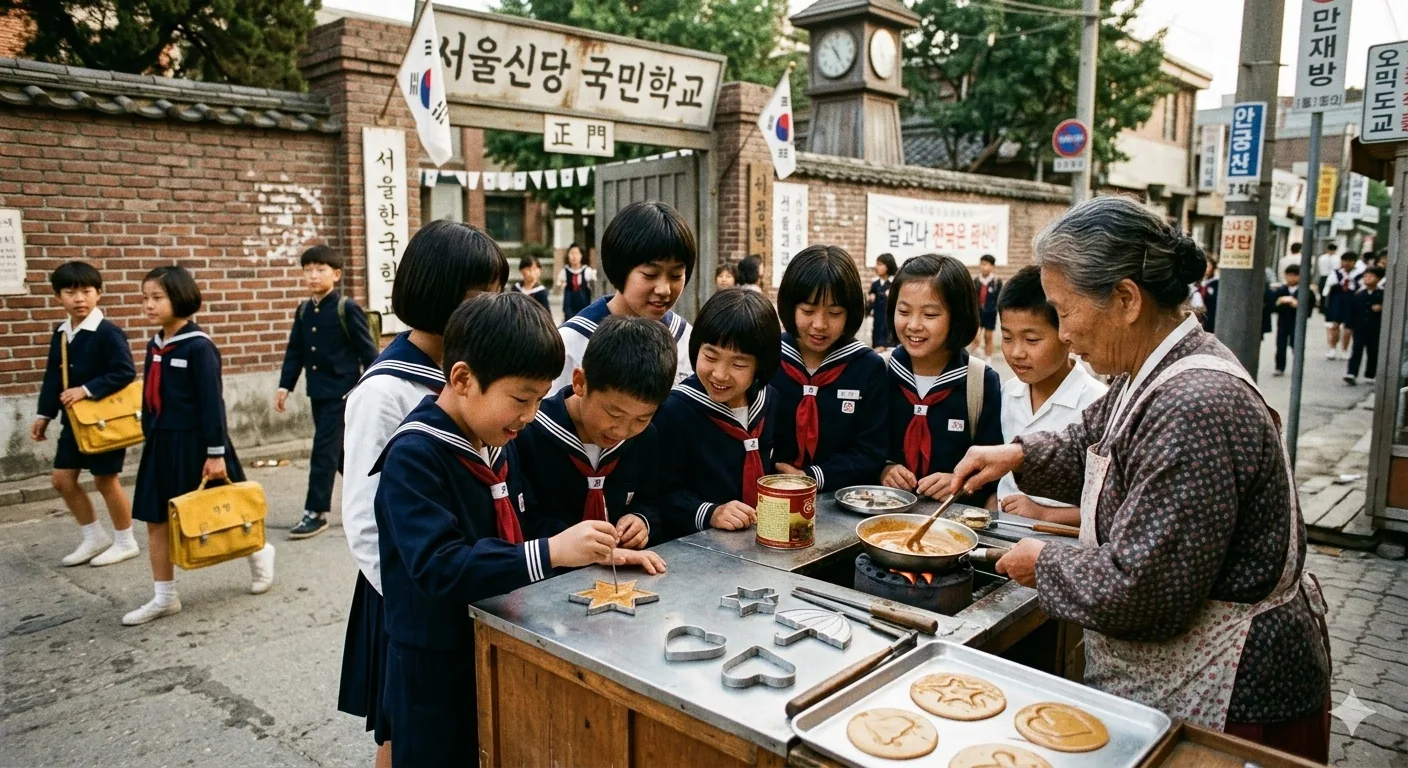
From the research behind Pause the Drama.
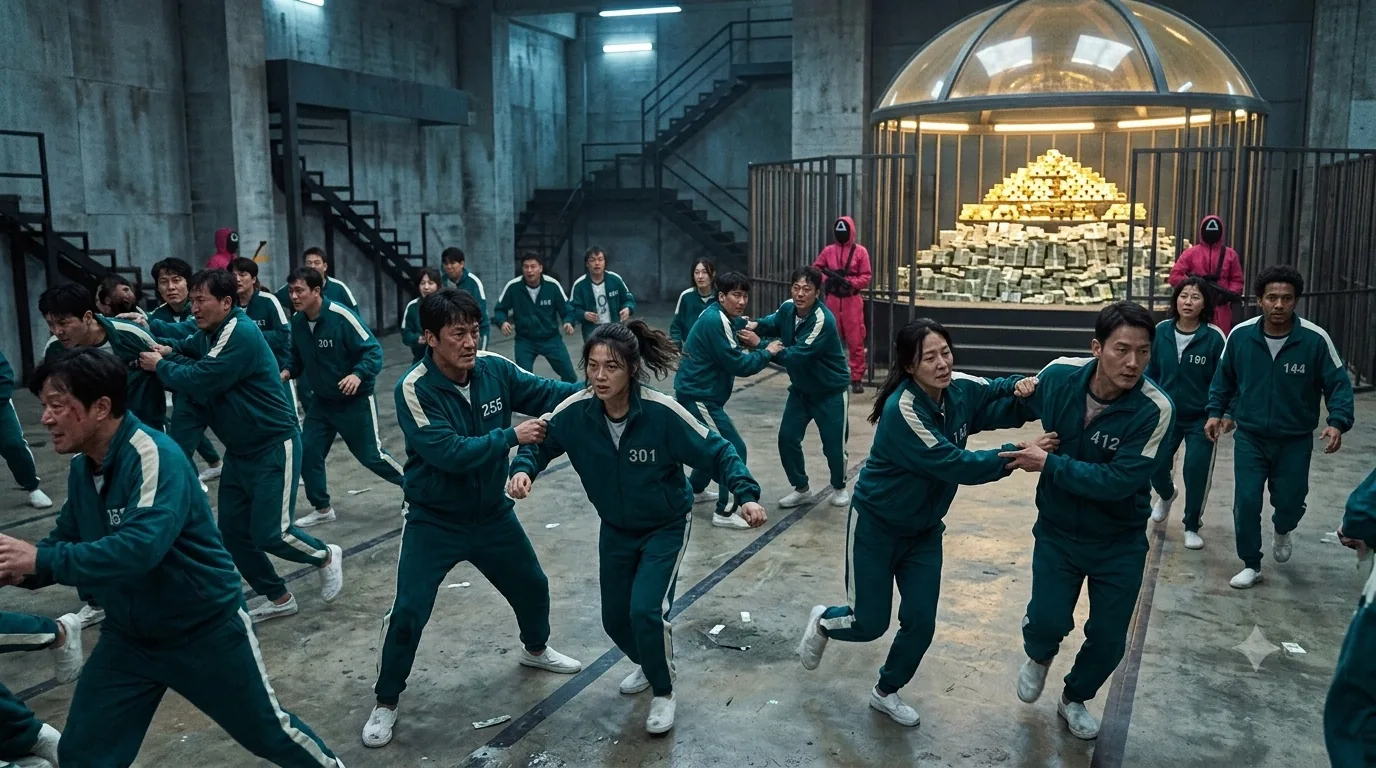 The prize is visible from everywhere in the room. So is the arithmetic. (AI illustration)
If you watched Squid Game (오징어 게임), one plot point may have nagged at you. After the players discover that losing a game means death, they vote to leave. They go home. And then most of them choose to come back and risk everything again.
To some viewers that beat looks implausible — who would willingly return to a death game? It is also the most carefully reasoned thing in the show, and seeing why means looking at what the series says waited for the players at home, and then at what Korean statistics actually say.
Quick answer: The players return because the world outside offers them no realistic path out. In the game, death is possible but escape is imaginable; at home, debt, criminal charges, medical costs and family crises feel certain to continue.
That logic is fictional, but the social pressure behind it is not. South Korea has a high household-debt burden, although the national debt-to-GDP ratio alone does not explain Gi-hun. His situation is closer to that of a vulnerable borrower with low income, several kinds of debt and little access to affordable credit.
Two things to carry with you: household credit (가계신용) stood at 88.2% of nominal GDP in Q4 2025 on the Bank of Korea’s basis, and the BIS’s comparable household-debt ratio at 88.6% — high internationally, below GDP. And Gi-hun’s backstory has a stated source: director Hwang Dong-hyuk drew on the 2009 Ssangyong Motor mass layoffs.
Let’s unpack it.
The games are fiction. The debts are specific.
The deadly playground is invented. The reason each player enters it is written with more precision than the summaries usually allow.
Gi-hun’s debt in Season 1 is built out of gambling, bank borrowing, private lending and a failed spell in self-employment. His mother’s hospital costs are not the origin of that debt; they are an urgent cash need he discovers after he leaves the game, which is what makes the second entry land — the debt was already there, and then a bill arrived that no restructuring would wait for. Sang-woo is not a generic failed businessman either: his ruin comes from derivatives and futures losses made with misappropriated client money, which carries criminal liability on top of the debt. A different trap with a different door.
The distinction does real work. Existing debt is a slow structure you live inside; a sudden emergency need is a shock that turns a survivable structure into an impossible one. Squid Game stages both, and the collision is the plot.
What “one of the world’s highest household debt levels” actually means
It is often said that Korean household borrowing is close to or above the size of the entire economy. In the fourth quarter of 2025, the ratio of household credit — 가계신용, the Bank of Korea’s series — to nominal GDP was 88.2%; on the BIS’s credit-to-households basis, compiled separately for international comparison, it was 88.6%. The two series rest on different definitions, which is why the figures differ, and they should not be swapped for each other mid-sentence. As of Q4 2025, the latest period reported in the June 2026 Bank of Korea report, the ratio remained below 100%. High by international standards — that direction is not in dispute.
There is also a conceptual problem hiding inside the sentence. Household debt is a stock measured at a point in time; GDP is a flow measured over a year. Their ratio is useful for comparing financial vulnerability across countries, but it does not mean that households owe an amount equal to “the value of the economy.”
And there is a second, more important gap. A high aggregate ratio describes macro-financial risk — how exposed the system is if rates rise or incomes fall. It does not, on its own, demonstrate the distress of a low-income borrower juggling several loans at once. That is measured by different evidence: vulnerable-borrower shares, delinquency rates, living-cost lending. The Bank of Korea’s Financial Stability Report and the OECD’s Addressing High Household Debt in Korea treat them as separate questions, and so should we. That gap is where Gi-hun stands: not the aggregate ratio, but a vulnerable borrower — low income, several debts at once, no access to cheap credit.
Drama vs history
| As the story is usually told | In the record |
|---|---|
| Debt so large it removes every option | True to individual desperation; the aggregate figure quoted alongside it — about 88% of nominal GDP in Q4 2025 (BOK 88.2%, BIS 88.6%) — is high internationally but below GDP |
| The players’ debts blur into one pile | The show itself distinguishes them: Gi-hun’s gambling, bank and private borrowing plus failed self-employment; Sang-woo’s misappropriation of client funds in derivatives and futures |
| Medical bills as the cause of Gi-hun’s debt | His mother’s hospital costs are an urgent need discovered after he leaves the game, not the origin of the debt |
| Gi-hun as a laid-off autoworker | Fictional, but with a stated source: Hwang Dong-hyuk cited the 2009 Ssangyong Motor mass layoffs in an AFP interview |
| 1997 as the moment everything broke at once | Major corporate failures preceded the December 1997 agreement (Hanbo January, Sammi March, Jinro April, Kia from July); the employment shock landed mainly in 1998 |
| Lifetime employment ends overnight | A practice concentrated in large firms, the public sector and core regular workers — the expectation weakened; labour-market dualisation deepened afterwards |
The drama is accurate about the shape of individual desperation. It is the commentary surrounding the show that often becomes imprecise about the scale of Korea’s household debt — and almost every number that gets quoted alongside it in English needs a date, a basis and a definition attached before it means anything.
Two roads into debt — and one thing that is not a road
Loan sharks, self-employment and a winner-take-all society get listed together as paths into Korean household debt. Only two are paths. Private lending is a way of borrowing. Debt-financed self-employment is a form of economic activity and a financing pattern. Winner-take-all competition is an interpretation of a social structure — the pressure that pushes people down the first two.
Private lending — and the words for it. The Korean term 사채 (sachae) is broad: it covers lending between individuals and non-bank finance generally, and does not by itself mean violent illegal usury. What English calls “loan sharks” maps more precisely onto 고리대금업자 (usurious lenders) or 불법 사채업자 (illegal private lenders), and the line between registered lenders under the 대부업법 and unregistered illegal lending is a regulatory boundary, not a shade of grey. A statutory maximum rate of 20% a year has applied since 7 July 2021 — a rule of the present, not of the period the drama depicts (scope details in the FAQ). And that illegal lending is the general last resort for low-credit borrowers is a claim needing its own evidence, of the kind the Financial Services Commission’s illegal-lending materials collect.
Self-employment — and the trouble with counting it. Korea’s self-employment share is above the OECD average, and that is the part everyone quotes. Two things belong with it: it has been falling over the long run, and the number depends entirely on the definition. Statistics Korea’s 비임금근로자 (non-wage workers) includes unpaid family workers alongside employers and own-account workers, so quoting it as a self-employment rate inflates it. For a comparable figure, use the OECD indicator, or employers plus own-account workers from the Statistics Korea supplementary survey — and say which year.
The fried-chicken shop is real cultural shorthand for this world. But the chain that usually follows it — laid-off workers borrowed money and were pushed into self-employment — is far more tangled in KDI’s and the Korea Labor Institute’s research. Some displaced workers did move into subsistence self-employment after the crisis; sources disagree about the aggregate, some showing the share rising temporarily in 1997–98 while the absolute number of self-employed people fell.
The winner-take-all society is an interpretation. Nobody borrows money from a competitive social structure. The phrase describes how Korean opportunity is distributed — a narrow set of good outcomes, sharp sorting early, a sense that falling behind is hard to reverse — and the labour-market dualisation below is one of the structures it points at. But it frames the other two roads rather than joining them. Squid Game’s contestants are not defeated by an abstraction; they are defeated by specific instruments with specific interest rates.
1997: the sequence, not the thunderclap
In late 1997 South Korea, engulfed by the Asian financial crisis, agreed an IMF-supported programme. Letters of Intent were signed on 3 December and 24 December 1997; the IMF announced the arrangement in Press Release No. 97/55 on 4 December. Koreans still call the whole episode IMF 사태 — “the IMF affair” — as the National Institute of Korean History’s 우리역사넷 files it.
The popular telling compresses this into a single blow: the IMF arrived, imposed harsh terms, companies collapsed, the country was laid off. Three corrections.
The causes were domestic as much as regional. Corporate over-borrowing, financial institutions’ short-term external debt and the maturity mismatch it created, corporate insolvency, problems of financial supervision — and then the withdrawal of international capital that turned a chronic condition into an acute one. Regional contagion was the trigger, not the whole mechanism.
The corporate collapses came first. Hanbo failed in January 1997, Sammi in March, Jinro in April, and Kia’s crisis built from July — all ahead of the December agreement. Date the wreckage from the bailout and you get the causation backwards: the bailout was a response to a solvency crisis already visibly under way.
The programme’s terms. High interest rates, fiscal tightening, financial and corporate restructuring and labour-market flexibility requirements did shape the contraction and the employment adjustment. But the judgement that the conditions were excessive belongs to particular researchers and assessment reports — the IMF’s own Independent Evaluation Office among them — and should be attributed.
What actually happened to Korean working life
The employment shock was real, and it was mostly 1998: unemployment rose from 2.6% in 1997 to 6.8% in 1998, the shape tracked by the OECD’s 1999 survey of Korea and the ILO’s labour-market analyses.
Lifetime employment was never a universal entitlement. It was a practice concentrated in large firms, the public sector and core regular positions — a stratified privilege before the crisis touched it. What 1997–98 broke was the expectation that such a job was the normal destination of a working life.
What followed was not a one-for-one swap of regular jobs for irregular ones. Non-regular and atypical employment did expand, but the process the OECD describes in Addressing Labour Market Duality in Korea, and the IMF in The Korean Labor Market: The Crisis and After, is dualisation — a deepening gap between a protected core and an insecure periphery, with different pay, tenure and social insurance coverage. A structural divide, not a substitution, and the world Squid Game’s contestants live in.
Nor did 1997 make debt normal. Household debt was already rising before the crisis, and in 1998 the GDP ratio actually fell temporarily as recession and credit contraction squeezed borrowing. The sustained climb came afterwards, driven by the promotion of credit cards, low interest rates, the expansion of housing finance and changes in financial regulation — the sequence the OECD lays out in Addressing High Household Debt in Korea. 1997 is better described as the hinge on which the expectation of employment security turned than as the year debt became a survival strategy.
Gi-hun and Ssangyong: the part that is on the record
Gi-hun’s backstory is not a parallel drawn by reporters after the fact. Director Hwang Dong-hyuk (황동혁) has said directly, in an AFP interview, that he drew on the 2009 Ssangyong Motor mass layoffs for the background of Gi-hun’s dismissal. It was reported in the same period by NME and The Straits Times, the latter in a piece on how much of the cast came from the director’s own life.
The limit still needs saying: Gi-hun is a fictional character built on a real dispute, not a portrait of any dismissed worker. But the connection is on the record, and it changes how you watch him. The show is not gesturing vaguely at Korean precarity. It reached for a particular, named, still-painful industrial conflict and built its protagonist on top of it.
Isn’t crushing debt a problem everywhere?
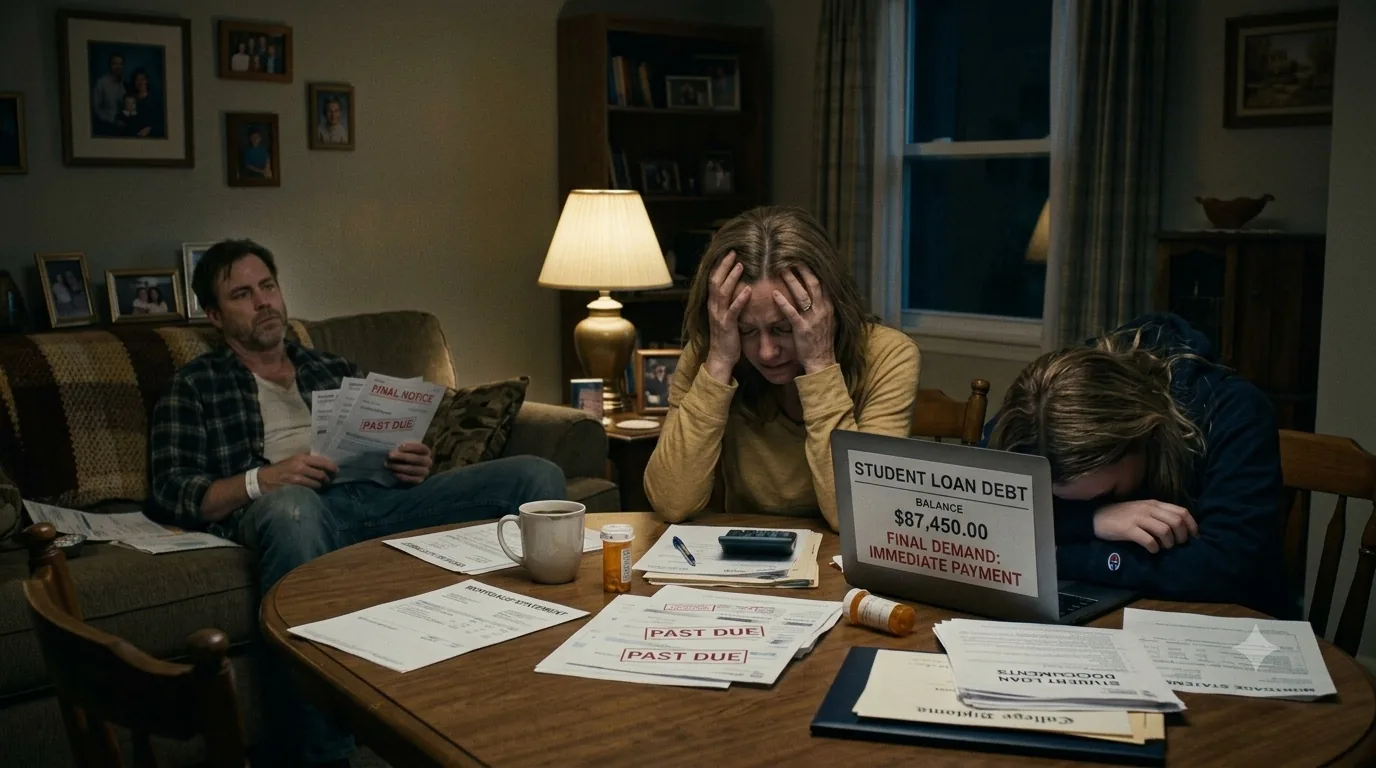 Household debt is not a Korean peculiarity — but its shape and speed differ by country. (AI illustration)
The show travelled because debt-driven desperation is not uniquely Korean. Different countries produce it through different combinations of medical costs, education loans, housing, unemployment or insecure work. What is specifically Korean is the route through the 1997 crisis, labour-market dualisation, fragile self-employment and high household borrowing.
Same machine, different settings — which is why a Korean show about Korean debt became a story the whole planet understood at once. The games were never the point. The arithmetic of having no options was.
Coming up next
A children’s playground turned deadly — and we’ve ended up tracing a stock against a flow, 1997 corporate failures that ran ahead of the bailout, a 2021 interest-rate ceiling and a 2009 industrial dispute. That’s the quiet gift of a sharp drama. Next time, we’ll open another door.
Frequently asked questions
Why do the players in Squid Game come back to a deadly game? Because the world outside offers them no realistic path out. In the game, death is possible but escape is imaginable; at home, debt, criminal charges, medical costs and family crises feel certain to continue. That logic is fictional, but the pressure behind it is not: Korea has a high aggregate household-debt burden, and a separate, harder problem of vulnerable borrowers carrying multiple debts on low incomes. The show is dramatising the second while the headlines usually quote the first.
Is Squid Game based on a true story? No single true story, but one of its key backstories has a stated real-world source. Director Hwang Dong-hyuk said in an AFP interview that he drew on the 2009 Ssangyong Motor mass layoffs for Gi-hun’s background as a dismissed autoworker. That makes Gi-hun a fictional character built on a documented motif, not a reproduction of any specific real worker.
Is South Korean household debt really bigger than the whole economy? No, and the comparison itself needs care. As of Q4 2025 the ratio of household credit — 가계신용, the Bank of Korea’s series — to nominal GDP was 88.2%; on the BIS’s credit-to-households basis, compiled separately for international comparison, the ratio was 88.6%. High by international standards, but below 100%. Household debt is a stock measured at a point in time; GDP is a flow measured over a year. Saying households owe “as much as the economy is worth” compares two different kinds of number.
Is Squid Game really Netflix’s most-watched show? It is number one on Netflix’s official most-popular list for non-English TV, and the ranking is measured by 265.2 million views in the title’s first 91 days. That is not a count of cumulative viewers, not a count of accounts, and not an all-time total since release — Netflix publishes the methodology alongside the chart. A number used as an argument should carry its measurement basis with it.
What was the “IMF crisis” in Korea? In late 1997 South Korea, caught in the Asian financial crisis, agreed an IMF-supported programme — Letters of Intent on 3 and 24 December 1997, announced by the IMF in Press Release No. 97/55 on 4 December. Koreans still call the episode simply IMF 사태. The causes were domestic as well as regional: corporate over-borrowing, banks’ short-term external debt and maturity mismatch, corporate insolvency, supervisory failures, and the withdrawal of international capital.
Did the IMF programme cause the mass layoffs? It contributed; it was not the single cause. Major corporate failures ran ahead of the December agreement — Hanbo in January 1997, Sammi in March, Jinro in April, Kia’s crisis building from July. The programme’s high interest rates, fiscal tightening, financial and corporate restructuring and labour-market flexibility requirements then shaped the contraction and the employment adjustment that followed. Calling the conditions “harsh” is an evaluation belonging to particular researchers and assessment reports, including the IMF’s own Independent Evaluation Office.
Did lifetime employment really end overnight in 1997? The employment shock landed mainly in 1998, when unemployment rose from 2.6% to 6.8%. And lifetime employment was never a universal guarantee — it was a practice concentrated in large firms, the public sector and core regular workers. What weakened was the expectation; what deepened afterwards was labour-market dualisation, which is not the same as regular jobs being swapped one-for-one for irregular ones.
Are loan sharks really the last resort for Koreans shut out of banks? That framing is too broad. 사채 (sachae) covers private lending and non-bank finance generally and does not by itself mean violent illegal usury; “loan sharks” corresponds more precisely to 고리대금업자 or 불법 사채업자. Registered lenders under the 대부업법 and unregistered illegal lending are different worlds with different rules. Since 7 July 2021 the statutory ceiling has been 20% a year, though the 이자제한법 and the 대부업법 differ in scope — and that ceiling should not be read back onto the period the drama depicts.
Why do so many Koreans run their own small businesses? Korea’s self-employment share is above the OECD average, but it has been falling over the long run, and the figure depends on the definition. Statistics Korea’s non-wage workers category includes unpaid family workers alongside employers and own-account workers, so it should not be quoted directly as a self-employment rate. After 1997 some displaced workers did move into subsistence self-employment, but sources disagree — some show the share rising temporarily in 1997–98 while the absolute number of self-employed fell.
Sources & further reading
- 한국은행, 『금융안정보고서』 2026년 6월 — 가계신용/명목GDP 비율 (Q4 2025: 88.2%)
- BIS — credit to households statistics (international comparison basis: 88.6%)
- OECD, Addressing High Household Debt in Korea
- OECD, Addressing Labour Market Duality in Korea
- OECD, 『한국경제보고서 1999』 (OECD Economic Surveys: Korea, 1999)
- OECD — Self-employment rate (indicator); 통계청, 「2024년 8월 비임금근로 및 비경제활동인구 부가조사」
- IMF, Korea — Letter of Intent, 3 December 1997 and 24 December 1997; IMF, Press Release No. 97/55, 4 December 1997
- IMF Independent Evaluation Office — evaluation of IMF-supported programs in capital account crises
- IMF, The Korean Labor Market: The Crisis and After
- ILO — Republic of Korea labour market analysis
- KDI, 「자영업자 현황 및 정책 방향」; 한국노동연구원, 『자영업 노동시장 연구Ⅰ』
- 국사편찬위원회 우리역사넷 — 「IMF 사태」
- 국가법령정보센터 — 「이자제한법 제2조제1항의 최고이자율에 관한 규정」; 「대부업 등의 등록 및 금융이용자 보호에 관한 법률」
- 금융위원회 — 불법사금융 관련 자료
- Netflix official Top 10 — Most Popular (Non-English TV); Netflix, “Squid Game by the Numbers”
- AFP interview with director Hwang Dong-hyuk; NME, “Squid Game Director Discusses Tackling ‘Real World’ Issues with the Series”; The Straits Times, “Squid Game Characters Drawn from Director’s Life”
- Netflix, 《오징어 게임》 Season 1, episodes 1–2 (primary text)
Thanks for reading — see you in the next one.
This article was researched and written by K-Drama History. Source: Squid Game, Explained: Why Would Anyone Risk Their Life in a Game Over Debt? — K-Drama History