Squid Game's Dalgona Candy, Explained: The Real Korean Childhood Game Turned Deadly
Theme: Modern Korea
From the research behind Pause the Drama.
If you’ve watched the global Netflix phenomenon Squid Game (오징어 게임), one game tends to haunt people more than the rest. Not the giant doll, not the glass bridge — the dalgona (달고나). Desperate players are handed a thin, brittle disc of sugar candy with a shape pressed into it — a circle, a triangle, a star, an umbrella — and told to carve that shape out cleanly. Crack it, and you’re shot on the spot.
It’s a brilliantly cruel piece of television. But here’s what the show never pauses to explain to its international audience: for millions of Korean adults, that candy is not a horror prop. It’s their childhood. And that — nostalgia weaponized — is exactly why the scene lands so hard.
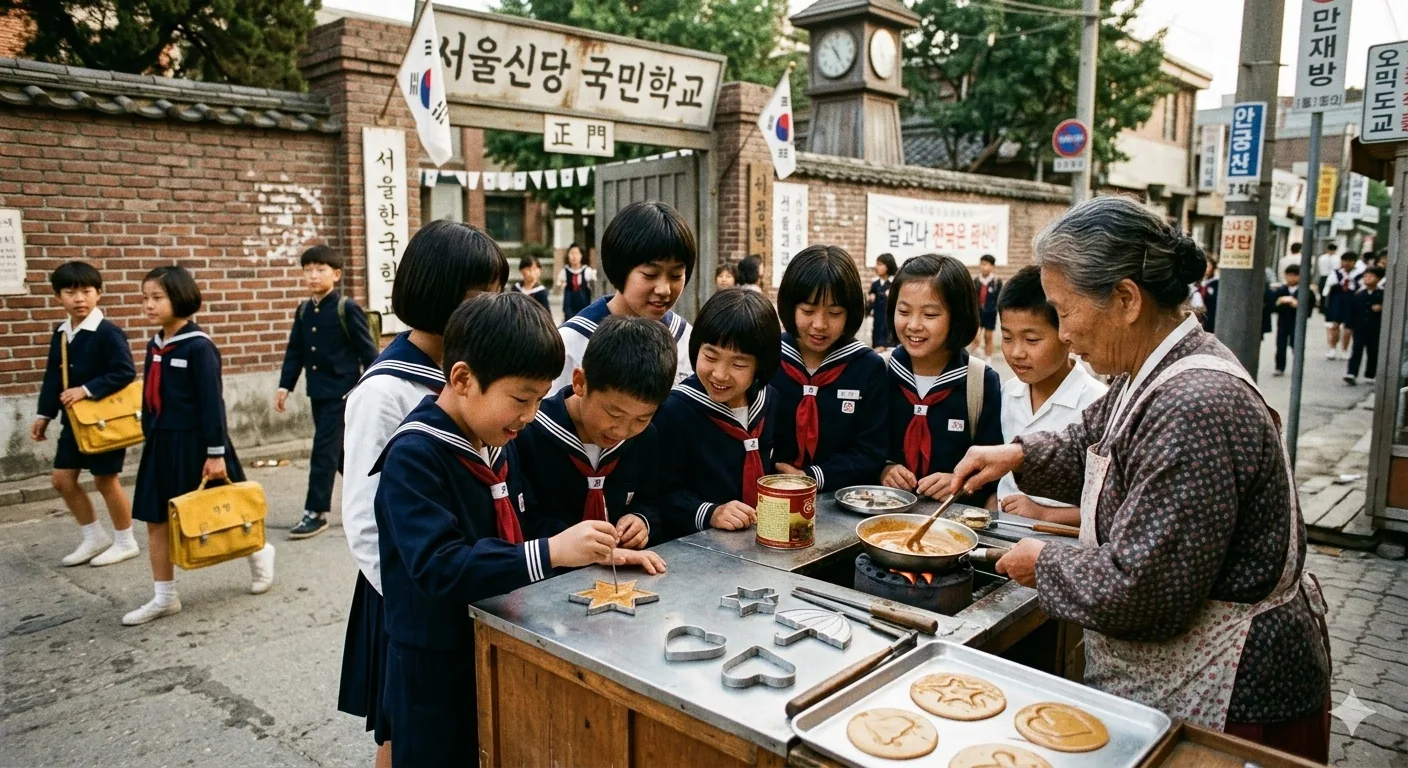
Quick answer: Netflix’s Squid Game didn’t invent dalgona — it weaponized it. The brittle sugar disc is a real Korean street candy dating to the 1960s, when it was sold at school gates as one of the cheapest sweets a child could buy. In the original ppopgi carving game, a winner could be rewarded — depending on the vendor — with a free second candy. Squid Game kept every rule and changed one thing: the prize for losing. That single inversion — innocence turned into execution — is the engine of the whole scene.
Let’s unpack it.
So what is dalgona, really?
Before it was a death game, dalgona was one of the cheapest, happiest treats a Korean child could buy.
The candy itself is almost absurdly simple: sugar melted in a ladle, with a pinch of baking soda stirred in. The soda makes it foam up and turn pale and airy, and when it’s pressed flat it sets into a thin, crisp disc with a faintly bitter, caramel-nutty sweetness. That’s it — sugar and soda, cooked over a tiny portable stove right on the street.
It goes by two names. Dalgona (달고나) is commonly thought to be related to the Korean verb dalda (달다), “to be sweet” — by one folk account, from an exclamation like “oh, how sweet” — though its exact origin isn’t firmly established. The other name is ppopgi (뽑기), meaning “to pick out” or “to pull out” — and that name is the whole game. The vendor pressed a metal mold into the soft candy to stamp a shape, and the child’s job was to free that shape from the surrounding disc without breaking it.
Why does a simple sugar candy mean so much to Koreans?
Because of when it was born — and how poor that time was.
Dalgona emerged in the lean years around the Korean War (1950–1953) and spread through the 1960s, 70s, and 80s, an era when South Korea was still climbing out of poverty and sugar was only gradually becoming an everyday thing. Its exact birthplace is hard to pin down: by one widely told account it took hold in the port city of Busan in the early 1960s — often linked to the wartime flow of American aid sugar and the sweets soldiers had handed to children — though this is folk tradition more than settled fact. With a stove, a ladle, and a few cheap molds, a vendor could set up outside a school gate, and for a coin a child could buy a few minutes of sweetness and suspense.
That combination — cheap, sweet, and tied to the school gate — is what fixes dalgona so deeply in memory. It belongs to a specific Korean generation’s idea of childhood: scarce money, simple pleasures, a snack you could actually afford. To carve a dalgona was a tiny, sugary act of skill and hope.
| In Squid Game | The real ppopgi game |
|---|---|
| Crack the shape = shot dead | Crack the shape = you’ve still eaten your candy |
| Win = survive another round | Win = the vendor might give you a free second dalgona |
| The umbrella is the hardest shape | The umbrella was notorious as the hardest pick |
| Needle provided as a tool | Children used needles, toothpicks, and their own licks and breath |
| Rules unchanged from the original | Rules taken almost verbatim from the real street game |
How did dalgona become a game — and what was the original prize?
This is the detail Squid Game borrows and then twists.
In the original street version, success was rewarded, not punished. A child who carefully licked, warmed, and picked the stamped shape free — without snapping the brittle disc — would win a prize from the vendor: often another dalgona, free. The hard shapes (the umbrella was notorious) were the real test of nerve and patience. It was a game of gentle stakes: lose, and you’ve still eaten your candy; win, and you might get a second one.
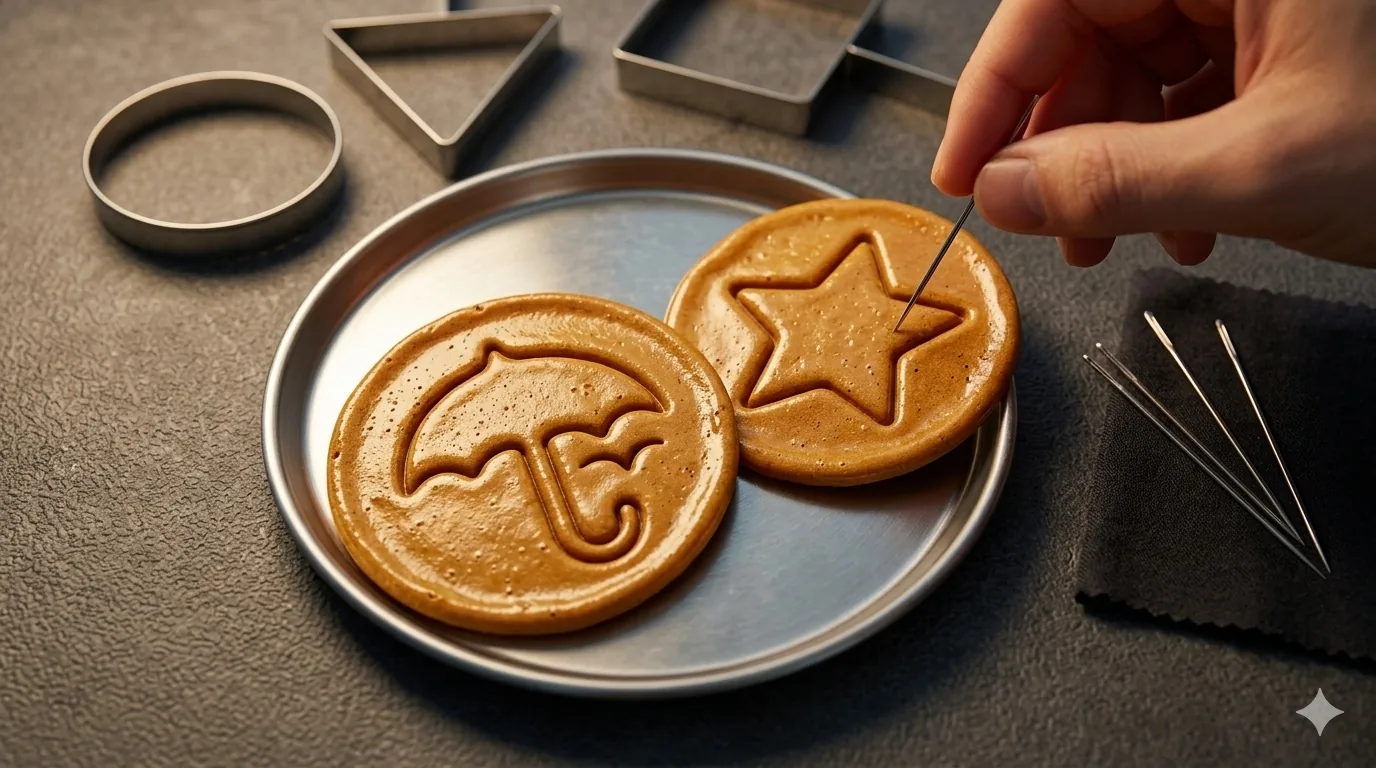
Now look at what Squid Game does. It keeps the rules almost exactly — the molds, the shapes, the needle, the “don’t crack it.” It even keeps the difficulty curve, where the umbrella is the deadliest pick. Then it changes one thing: the prize for losing. A children’s reward becomes an execution. The horror isn’t invented from nothing; it’s manufactured by taking the safest, sweetest memory of a generation and quietly swapping survival in for the free candy. The candy of innocence is weaponized into the candy of death. That inversion — nostalgia turned into terror — is the engine of the whole scene.
Key terms. Dalgona (달고나) — a thin, brittle disc of caramelized sugar and baking soda, sold by Korean street vendors since the 1960s; the name is commonly thought to relate to dalda, “to be sweet,” though its exact origin isn’t certain. Ppopgi (뽑기) — the street-game name for the same candy, meaning “to pick out”: the challenge of freeing a stamped shape from the disc. Dagashiya (駄菓子屋) — Japan’s direct equivalent: a small neighborhood shop selling cheap dagashi sweets in the postwar Showa era, near elementary schools. Penny candy — the American version: loose sweets sold by the piece across the counter of a general store or five-and-dime.
Wait — did Squid Game invent dalgona? (A common misconception)
No. This is the misunderstanding worth correcting: dalgona is not a Squid Game creation. It’s a real street snack that predates the show by roughly sixty years.
What Squid Game did do was send it around the world. The series became one of Netflix’s biggest launches ever — watched, by Netflix’s own count at the time, by an estimated 142 million households in its first four weeks (Deadline) — and the dalgona challenge spilled straight onto social media. The carving challenge went viral across TikTok and YouTube, as people from dozens of countries who had never heard of the candy melted sugar in spoons and carved stars with toothpicks. Korean dalgona vendors who had quietly worked for decades — including the Segyero Dalgona stand in Seoul that supplied candy for the show itself — suddenly found queues stretching down the street, with daily sales jumping five to seven times overnight (Good Morning America). So the candy is old; the global craze is new.
Around the world — the poor era’s cheap sweet that a whole generation grew up to miss
Here’s the part that makes dalgona feel less like a Korean quirk and more like a human one. Almost every culture has its own dalgona — a cheap childhood sweet from a leaner time that an entire generation now remembers with a lump in the throat.
Japan — dagashi and the dagashiya. Japan has dagashi (駄菓子), literally “cheap sweets” — tiny snacks costing a few yen, sold in small neighborhood shops called dagashiya (駄菓子屋), often right by elementary schools. They peaked in the postwar Showa era, when children would stop in after class to spend their pocket money and chatter with the shop owner. At their height in 1972, Japan counted over 228,000 dagashiya; by 2016 fewer than 75,000 remained (The Japan Times). Today the dagashiya is a powerful symbol of Showa nostalgia — childhood, friendship, a slower world before screens — and it turns up constantly in anime and film as shorthand for “simpler times.” It is, almost exactly, Japan’s dalgona.
America — penny candy at the five-and-dime. In the United States, the equivalent memory is penny candy — Mary Janes, Tootsie Rolls, lemon drops, rock candy — bought a piece at a time across the wooden counter of a general store. The phenomenon scaled up at Woolworth’s “five-and-dime” stores; Frank Woolworth placed the candy display strategically just inside the entrance, building the penny-candy aisle into an American institution (Tasting Table). For generations of Americans, “penny candy” is less a product than a doorway to childhood.
Europe — the funfair sweet. In Britain and across Europe, the same nostalgia clings to fairground treats: the toffee apple, brandy snaps, and above all candy floss — invented in Nashville in 1897 by dentist William Morrison and first sold as “fairy floss” at the 1904 St. Louis World’s Fair, where Morrison and his partner John Wharton sold over 65,000 boxes at half the price of a fair ticket (Smithsonian Magazine). The fair was where cheap sugar met pure fun, and the sticky, spun-sugar memory of a childhood fairground is Europe’s version of the same feeling.
Four cultures, four cheap sweets — dalgona, dagashi, penny candy, fairy floss — and one shared truth: the inexpensive treat of a poorer time becomes the most expensive memory of all. What makes Squid Game’s dalgona scene so quietly devastating is that it understood this perfectly. It reached for the single object most loaded with warmth and safety — and turned it into a gun pointed at your head.
Coming up next
One brittle disc of sugar — and we’ve traveled from a school gate in 1960s Busan to a Netflix record, to a Showa-era dagashiya in Japan, to a Woolworth’s counter, to a World’s Fair in St. Louis. That’s the quiet gift of a good drama: even its props have a history.
In the next essay, we’ll take another K-drama scene that looks like pure fiction — and trace the real Korean history hiding underneath it.
Thanks for reading — see you in the next one.
Frequently asked questions
Did Squid Game invent dalgona? No. Dalgona (달고나), also called ppopgi (뽑기), is a real Korean street candy that dates back to the years after the Korean War and was popular from the 1960s through the 1980s. Squid Game didn’t create it — it made it globally famous, sending the dalgona carving challenge viral worldwide in 2021.
What is dalgona made of, and how does the ppopgi game work? Just melted sugar with a pinch of baking soda, cooked in a ladle and pressed into a thin disc. A vendor stamps a shape into it — a circle, triangle, star, or umbrella — and you try to carve that shape free without cracking the candy. In the original street game, succeeding could win you a free second candy (depending on the vendor); Squid Game kept the rules but made losing fatal.
Why is dalgona so nostalgic for Koreans? Because it belongs to a specific, poorer era. In the 1960s–80s, sugar was a small luxury and dalgona was a cheap treat sold at school gates. For the generation that grew up then, it’s tied to childhood, scarcity, and simple joy — which is exactly the warmth Squid Game inverts into horror.
What does “dalgona” mean in Korean? The word dalgona (달고나) is commonly thought to be related to the Korean verb dalda (달다), meaning “to be sweet” — by one folk account, from an exclamation like “oh, how sweet” — though its exact origin isn’t firmly established. The street-game name, ppopgi (뽑기), means “to pick out” or “to pull out” — which describes exactly what you have to do: free a stamped shape from the surrounding disc.
What is a dagashiya, and how does it compare to dalgona? A dagashiya (駄菓子屋) is a Japanese neighborhood candy shop selling cheap dagashi sweets — the direct Showa-era equivalent of Korea’s dalgona stall. Both peaked in the postwar decades as affordable treats near elementary schools, and both now carry powerful childhood nostalgia for generations who grew up with them.
Sources & further reading
This piece was written from the historical script and fact-check of 사뚱샘의 역사방 (SaDDungSam). Primary sources are linked inline beside the claims they support:
- Squid Game’s dalgona craze — how the 2021 Netflix series turned a street candy into a global trend, and how the Segyero Dalgona stand in Seoul saw sales jump five-to-sevenfold. (Good Morning America / ABC News)
- Squid Game viewership record — 142 million Netflix households in four weeks, making it the platform’s biggest-ever series launch. (Deadline)
- Cotton candy / fairy floss — invented by William Morrison and John Wharton (1897), first sold at the 1904 St. Louis World’s Fair at 25 cents a box. (Smithsonian Magazine · Encyclopædia Britannica)
- Dagashiya in decline — Japan’s cheap-sweets shops fell from 228,123 (1972) to 74,304 (2016); Showa-era nostalgia context. (The Japan Times)
- The nostalgic history of penny candy stores — Woolworth’s five-and-dime and the American penny-candy institution. (Tasting Table)
Thanks for reading — see you in the next one.
This article was researched and written by K-Drama History. Source: Squid Game's Dalgona Candy, Explained: The Real Korean Childhood Game Turned Deadly — K-Drama History