When Did Koreans Start Grilling Samgyeopsal? The History Behind The Dream Life of Mr. Kim
Theme: Modern Korea
From the research behind Pause the Drama.
In episode 3 of JTBC’s The Dream Life of Mr. Kim (서울 자가에 대기업 다니는 김 부장 이야기, 2025), a company dinner falls through. Kim Nak-soo — department head at a large company, owner of his own apartment in Seoul, the man whose entire identity is assembled from those two facts — goes to a grill house anyway. He orders samgyeopsal and gabeurisal — two cuts, for one person. He cooks them himself. Nobody sits down opposite him.
The scene works without a word of explanation, and it works on exactly one assumption: that this is food you are supposed to eat with other people. A man grilling pork belly alone is a man something has gone wrong for.
So here is a question with a stranger answer than it deserves. How long has this been Korea’s shared meat? Since the Joseon dynasty? Or much, much more recently?
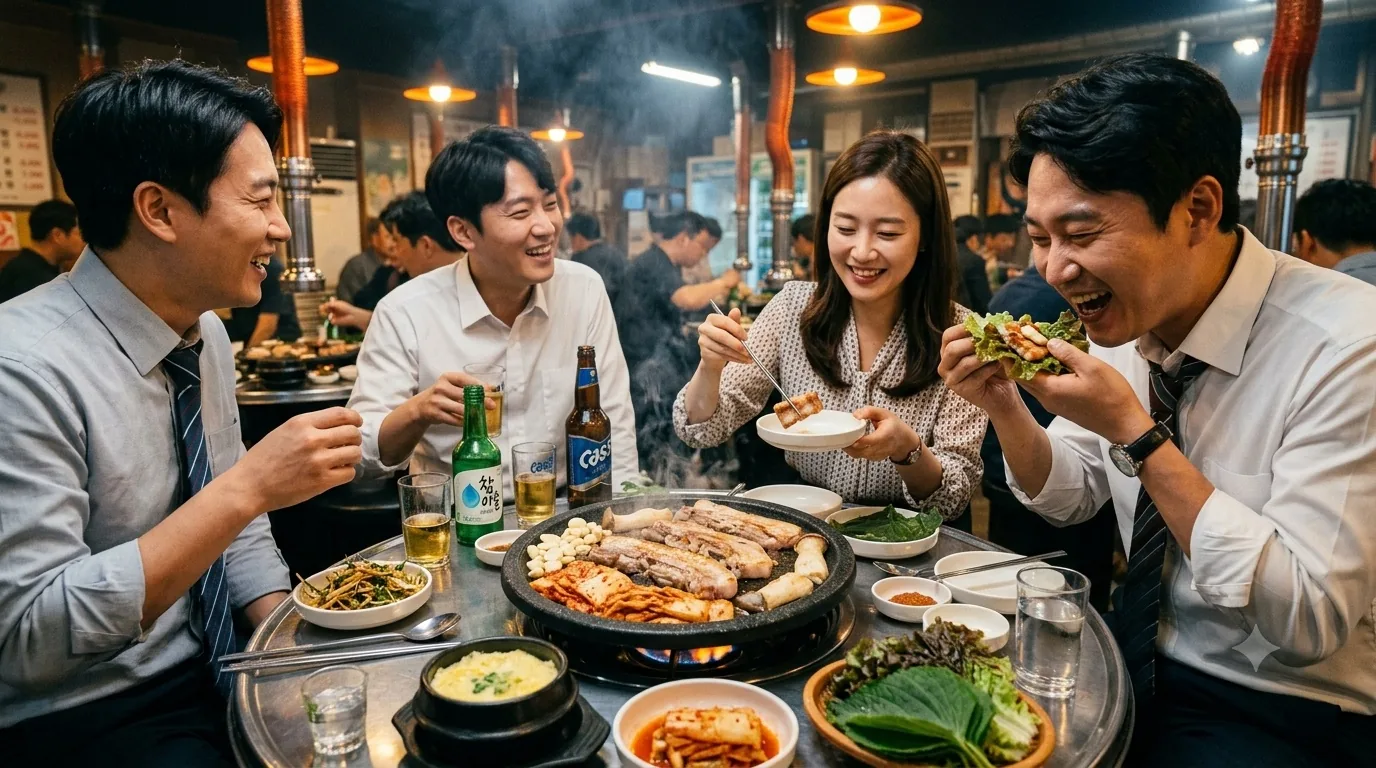 The form the food is built for — a table of colleagues, a shared grill, and a bottle in the middle. (AI illustration)
Quick answer: Nobody knows exactly when Koreans began grilling samgyeopsal (삼겹살). It is one of the country’s most iconic shared foods and one of its least documented. The name of the cut is in Korean print in the 1930s, spelled segyeopsal (세겹살). The earliest clearly described cooking method for it in the sources consulted here is boiling, in a 1957 court-cuisine manual. Restaurants specialising in grilling it do not appear until the late 1970s — and the word “samgyeopsal” itself was still being printed as slang in 1983. Between the name and the grilling culture sits a forty-year gap in the sources we were able to check — a documentary gap, not proof that nobody grilled it earlier. The best-known origin stories do not close that gap, and they fail in different ways: the miner story appears late in the written record, the export story outruns what the trade figures can actually show, and the portable gas burner arrived after specialist restaurants were already appearing. No documented beginning has yet been identified.
Let’s unpack it.
The name came first — and it was a different word
Start with what is actually on the page.
On 3 November 1934, the Dong-a Ilbo, explaining which part of a pig tastes best, printed this: “the segyeopsal (also written 三枚, sammae) between the hind haunch and the belly is the tastiest.” Not samgyeopsal. Segyeopsal — “three-layered flesh.”
Five years later the word turns up in a cookbook. Bang Sin-yeong’s Joseon yori jebeop (조선요리제법), in its 1939 enlarged ninth edition, glosses it: “Segyeopsal (baetbaji): the meat on the belly (the tastiest of pork).” Baetbaji (뱃바지) is an older word for the belly part.
Now the thing that matters, and that is easy to read past. Both of these are descriptions of a cut, not of a dish. The Joseon yori jebeop sentence sits inside the entry for suyuk — boiled meat — at the point where the author is telling the reader which part of the animal to buy. The sentence itself cooks nothing. It names a piece of meat and says it is the best one.
So the 1930s records establish one thing cleanly: Koreans knew this cut and rated it highly. They do not establish that anyone was grilling it.
The earliest source consulted here that clearly states a cooking method points the other way. A 1957 manual of Yi-dynasty court cuisine, the Ijo gungjeong yori tonggo, defines jeyuk-pyeonyuk as “pork belly boiled and sliced thin.” Simmered, not grilled.
That is a claim about what was found, and it needs its limits stated plainly: it does not mean nobody grilled pork belly between 1930 and 1957. It means no record of it was located for this article — and the archive that would settle it most efficiently, the searchable run of Korean newspapers from the 1920s to the 1990s, could not be queried in the course of this research.
One further data point pushes the same way without proving anything. A recent food-magazine piece reports that a Dong-a Ilbo article of 1974 introduced “braised pork segyeopsal” — the cut still being written up as something to simmer, not to grill, three or four years before the grill houses appear. This article has not seen the 1974 piece itself and cites it as a second-hand report.
A note on the cookbook. Many popular accounts date the first written record of samgyeopsal to a 1931 edition of Joseon yori jebeop, and the sentence they quote is close to identical to the 1939 one above — which could mean the author carried the same glossary entry across editions, or could mean the 1939 text has been misattributed to 1931. A 1931 printing does exist: the National Library of Korea catalogues a Hanseong Doseo edition dated April 1931 (call number 594.51-4-48). Two things could not be established here. Its text was not consulted — the library’s digital copy is restricted. And the Encyclopedia of Korean Culture’s own list of the book’s editions runs 1917, 1942, 1952, 1958 and does not include a 1931 edition at all, while popular sources variously call it the fifth or the sixth printing. This article therefore works from the 1939 ninth edition, itself quoted at second hand. If the passage does prove to be in the 1931 text, the chronology below starts eight years earlier and otherwise stands.
The grilled-restaurant culture becomes visible about forty years later
Restaurants that specialise in grilled pork belly appear in the record from the late 1970s.
And they did not take hold immediately. A column in the Dong-a Ilbo of 25 August 1979 reports that summer had thinned out the customers at pork-belly restaurants — it speaks of “the samgyeopsal houses that had been multiplying like bamboo shoots after rain along the drinking streets.” Two things sit inside that one clause: by 1979 the word was ordinary newspaper Korean, and by 1979 the restaurants were already numerous enough to be a phenomenon worth a wry column. Reading the same article, Lee Kyu-jin — the food historian who wrote the Korean encyclopaedia’s entry on grilled pork belly — concluded that such restaurants “sprang up like bamboo shoots after rain around the late 1970s, but did not settle immediately; with the summer months turning slack, they appear to have gone through a period of adjustment.”
What that tells us is narrower than it looks: at the start this was food people bought less of when the weather turned. Whether it was ever near failing, the sources do not say.
The early scene did not look like the one you have in mind either. A novel serialised in the Kyunghyang Shinmun on 5 November 1980, Nasin-ui jedan (“The Altar of the Naked Body”), describes it: “On top of the yeontan brazier she had set a thick iron plate lined with foil, and… once the plate had heated enough, the girl laid the pork samgyeopsal on it.” Not gas — yeontan, the coal briquette. Not today’s tabletop gas griddle — a thick iron plate lined with foil, over a briquette stove. The briquette stove in that sentence is the same object that heated homes and killed families across the alley neighbourhoods of 1980s Seoul.
Even the word settled late
If the food arrived late, the name arrived later still.
On 14 August 1983 the Chosun Ilbo wrote: “segyeopsal-gui, colloquially called ‘samgyeopsal’, eaten with saeujeot, is still one of the nourishing dishes ordinary people enjoy.” Read the grammar of that sentence. Samgyeopsal is the slang. Segyeopsal is the proper term. In 1983.
By then the food was already making streets. On 27 October 1983 the Kyunghyang Shinmun referred to “Myeongdong, the centre of the fashion, or Samgak-dong, the samgyeopsal alley” — meaning that in central Seoul there was by then a lane you went to for this and nothing else.
So the sequence runs:
| When | What arrives |
|---|---|
| 1930s | The name of the cut — as segyeopsal |
| 1957 | The earliest clearly recorded cooking method — boiling |
| Late 1970s | Restaurants that grill it |
| Early 1980s | A street known for it, cooked over briquettes on a foil-lined plate |
| 1983 | The word samgyeopsal still printed as slang |
The food and its name moved on separate schedules. Neither of them is where you would have guessed.
Why this cut? What the sources support, and what they don’t
This is the section where care is needed, because Korea has three standard explanations for why pork belly and not some other cut, and all three are repeated constantly.
One: “the good cuts went to Japan and the belly was left behind.”
This is the version you will hear most often. It does not fit the research.
The 1987 Korea Rural Economic Institute study by Yu Cheol-ho and Lee Il-hyeong found that pork exports to Japan in the 1970s consisted of six frozen cuts, together amounting to roughly 43 per cent of the animal, alongside carcass shipments. An account limited to loin and tenderloin does not survive that finding. But the study does not name which six cuts they were. Which means the record cannot confirm that the belly stayed home — and cannot confirm that it was shipped out either. Neither version of the story can be settled from this source.
The timing is the harder problem. Exports to Japan surged between 1974 and 1977 — about 22,000 tonnes over those four years — then fell to zero in 1978 when domestic prices rose. They were small in 1979–80, back to zero from 1981 to 1983, and resumed only in the mid-1980s. Which means that in the early 1980s, precisely when pork-belly restaurants were spreading through Seoul, there was almost no export trade to Japan for them to be a leftover of.
One further wrinkle is worth keeping, because it points the other way from the popular story. A Korean livestock-industry writer working from the same 1987 paper reads the trade as the reverse: that loin and tenderloin were exported because Korean consumers did not want them, not that belly was left over because Japanese buyers did not. That is one specialist’s reading in trade commentary rather than a peer-reviewed finding, and this article does not adopt it as fact. It is here because it shows how unsettled the causality is once you leave the anecdote behind.
Two: “it spread when the portable gas burner arrived.”
The direction is right. The dates are not, and different sources are describing different events.
| Date | Event |
|---|---|
| June 1980 | Portable gas burners and disposable butane canisters go on sale in Korea |
| 1985 | Production of portable butane ranges put at 550,000 units |
| Mid-1980s | General use |
Launch in 1980; mass production and general use in the mid-1980s. But the specialist restaurants were already appearing in the late 1970s. On those dates the burner cannot be what started grilled pork belly. It looks more like the condition under which something that already existed could travel — into homes, onto camping trips, out of the restaurant.
Three: “the 1976 beef crisis pushed Koreans from beef to pork.”
Part of this is documented. Korean beef supply did fall short in the mid-1970s, and the government began importing foreign beef in 1976 as a price measure. What has not been located is any statistic or study demonstrating that the subsequent rise in pork consumption was a result of that event — not least because beef consumption rose over the same period too. A shortage that coincides with a change is not the same as a shortage that caused it.
And then the origin story arrived — decades after the food
The most famous explanation is the one we have not dealt with yet. It goes like this: in the coal-mining towns of Gangwon Province, miners ate fatty pork belly to wash the coal dust out of their throats, and that is where grilled samgyeopsal began.
For this article, no document or newspaper record from before the 1970s was found to support it. The earliest appearance of the story in print located in this research is an article in the Segye Ilbo of 3 June 2005, headlined “Samgyeopsal: truth or lie” — reported at second hand, since the 2005 article itself could not be retrieved for this piece. The detail carried with that citation is worth keeping: the person telling the story there is neither a historian nor a miner, but a livestock buyer at a distribution company.
Everything found since points the same way without adding evidence. Every popular retelling of the miner story that could be examined dates from 2005 or later, and none of them names a source earlier than itself. A local newspaper in the mining region itself, writing in 2020, presents it as “one of the most widely known stories in the Taebaek area” — that is, as something people say, not as something written down at the time.
Two clarifications, because this is easy to overstate in either direction.
The mining towns are not being called fictional. Regional culture materials from the Federation of Korean Culture Centers document a real pork-eating and dolgui culture in Korea’s coal towns. The problem is not whether miners ate pork. It is that turning that local custom into the national origin of grilled samgyeopsal has no contemporary evidence behind it.
And “2005” is a floor, not a birthday. It is the earliest print appearance found, by research that could not search the one archive best suited to the job — the digitised run of Korean newspapers from the 1920s to the 1990s was not reachable here. So the honest statement is: no earlier printed reference was found, which is not the same as none exists. If one turns up in a 1970s or 1980s newspaper, magazine or oral-history collection, the gap narrows and this section needs rewriting. What survives that caveat is the direction — the story is documented later than the food — rather than any precise number of years.
It is also worth noting that the scepticism here is not unusual. The Korean state heritage agency’s own magazine ran a column in March 2018 by the food writer Hwang Gwang-hae under the title “The comedy-like ‘legend’ of grilled samgyeopsal,” which dismissed both the miner story and the schoolteacher variant of it in one line: “It’s a comedy. Samgyeopsal and other food goes down the oesophagus; chalk dust and coal dust go down the windpipe.” His own dating is a little later than the encyclopaedia’s — he puts the grilling culture “around the 1980s” rather than the late 1970s — and he arrives at the same shape of conclusion from the other side: “We ate samgyeopsal for a long time. It is only that we started eating it as gui — grilled — around the 1980s.” That is a columnist’s judgment published by a state body, not a peer-reviewed finding, and the two datings are left standing side by side here rather than reconciled.
The same applies to the other well-travelled origin — that merchants in Kaesong tied the word to ginseng (sam, 蔘) and coined “samgyeopsal” that way. No pre-modern source supporting it was located. It is treated here as a later story, not as history.
There is one thing this article genuinely cannot answer, and it should be said rather than papered over: why so many of these stories formed. A reasonable guess is that the food became nationally ubiquitous faster than anyone could account for, and the speed itself demanded an explanation. That is a guess. What is documented is only the sequence — that the explanations arrived after the thing they explain.
Today: a country tilted toward one cut
The imbalance shows up in numbers, with a caveat attached to all of them.
National Institute of Animal Science data from 2013 put consumer preference at 67 per cent for pork belly and 26 per cent for neck. The same material sets those against supply figures of about 27 per cent for belly and 10 per cent for neck. Demand and supply are more than two to one apart. We were not able to open the original page for this article, and other figures for per-animal production circulate — one National Institute of Animal Science item gives 18 per cent belly and 9 per cent neck — so these numbers are given as supply-side comparison, not as an anatomical yield.
Price follows. In the Korea Institute for Animal Products Quality Evaluation’s cut-by-cut data, pork belly runs at a large multiple of the other cuts — on the order of two to three times loin and three to four times hind leg. Same pig; different money. (That series is continuously updated and the ratio moves, so read it as an order of magnitude rather than a fixed figure. Trade commentary citing procurement prices on particular days gives wider gaps still.)
The caveat. Korea has no approved national statistic for meat consumption by cut. The figures above are a preference survey and a price series. They are not measurements of what people ate.
Drama vs. real history — what The Dream Life of Mr. Kim gets right
| The drama | The record |
|---|---|
| Samgyeopsal is the default food of the shared meal — the thing a hoesik is made of | Accurate for the present. But the shared-grill culture is documented only from the late 1970s, not from the deep past |
| Grilling it alone reads instantly as isolation | The reading is real. The convention it depends on is roughly two generations old |
| A briquette-and-foil setup would look archaic | It was the normal arrangement as recently as 1980, in a novel serialised in a national newspaper |
| The food carries a long Korean tradition behind it | No documented beginning has been found. The gap between the cut’s name and the visible grilling culture is about forty years in the sources checked here |
Key terms. Samgyeopsal (삼겹살) — “three-layered flesh,” grilled pork belly; printed as slang as late as 1983. Segyeopsal (세겹살) — the same cut, and the formal term through the early 1980s. Baetbaji (뱃바지) — an older word for the belly part, used as a gloss in the 1939 cookbook. Suyuk (수육) / jeyuk-pyeonyuk (제육편육) — boiled meat, and boiled pork belly sliced thin; the earliest clearly recorded treatment of this cut. Hoesik (회식) — the after-work company dinner, the social form the drama’s scene is measured against. Yeontan (연탄) — the coal briquette, the heat source in the earliest described grilling scene. Invented tradition — Eric Hobsbawm’s term for a practice that presents itself as old and is not.
Foods with a birthday, foods without one
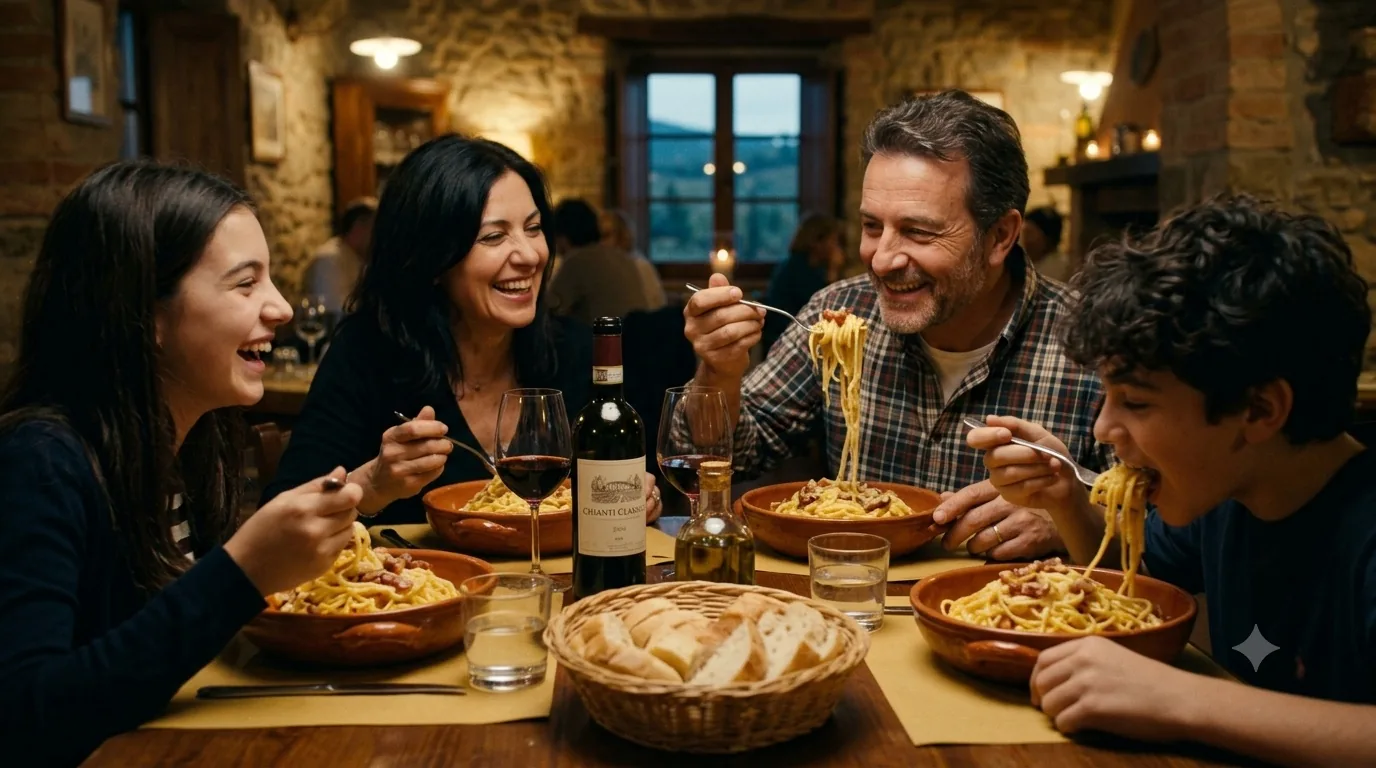 A dish can be a national symbol and still have a contested address — the earliest printed carbonara recipe anyone has produced is not from Rome. (AI illustration)
Italy, carbonara — the contested kind. Carbonara is often taken for an ancient Roman dish, and its origin is actively contested. Alberto Grandi, a historian at the University of Parma who works on food and economic history, argues it is comparatively recent and owes its origin to American bacon and powdered egg in Italy at the end of the Second World War — an argument that reached a wide audience through a Financial Times interview in March 2023 and caused a considerable row in Italy. It is also frequently noted that the earliest printed carbonara recipe yet produced appears in a 1952 guide to restaurants in Chicago, with the first recipe published in Italy following in 1954. This article has not read Grandi’s own book, and this is a live dispute rather than a settled finding. The point is not who is right. It is that carbonara has rival origin stories being argued over documents.
Japan, instant ramen — the rare settled kind. The opposite case. Instant noodles have a date: Chicken Ramen went on sale on 25 August 1958, developed by Ando Momofuku. The company records it, the Japanese government’s own public-relations material records it, and there is a museum in Osaka built on it. A national food with a birthday. This is unusual enough to be worth noticing.
Korea, samgyeopsal — the third kind. It sits in neither camp. Nobody is arguing rival origins over documents, because no documented origin has turned up to argue about — and no birthday has been proposed at all. What there is: a cut named in the 1930s, a grilling culture visible from the late 1970s, and a forty-year gap in the surviving sources we could check, later filled by stories.
Eric Hobsbawm’s phrase for what happens next is “invented tradition”: when a community feels a hole where its history should be, it makes one. That is a borrowed frame and it needs its borders marked. Hobsbawm was writing about nations and nationalism, not about dinner, and reading Korea’s samgyeopsal legends through his concept is this article’s interpretation, not an established scholarly position. What is not interpretation is the chronology: the explanations are younger than the thing they explain.
Back to the grill house
In the last stretch of the drama, Kim Nak-soo starts work at his brother’s car wash. He eats samgyeopsal with the staff there — meat pushed into his mouth by someone else, the whole table talking over him. It is the same man who sat alone in episode 3.
Same food. Different chair on the other side of the table.
That is the whole of what this dish carries, and it is worth being exact about how little of it is inherited. No founder has been identified, no origin town, no first restaurant, no date. The meat the department head grilled by himself and the meat the car-wash crew grill together is the same meat, and no deep historical lineage has been identified running between those two scenes — only about half a century of documented shared grilling. That turns out to be long enough for a habit to feel inherited.
The stories came afterwards. They often do, and usually we cannot see the seam. With samgyeopsal you can, because the food is recent enough that the dates still line up in the wrong order.
Coming up next
If the office scene interested you more than the meat, Misaeng and Korea’s contract-worker crisis takes up the world Kim Nak-soo is being pushed out of — and the 1997 crisis that produced both the job market and the phrase “IMF samgyeopsal.” For the physical world of the 1980 grilling scene, the coal briquette and the alleys of Reply 1988 cover the fuel and the neighbourhood it was burned in.
Frequently asked questions
Did Koreans eat samgyeopsal in the Joseon dynasty? Not in the form you would recognise. The name of the cut is documented from the 1930s, and the earliest clearly described cooking method in the sources consulted here is boiling — a 1957 court-cuisine manual defines jeyuk-pyeonyuk as pork belly simmered and sliced thin. Restaurants that grill it are not visible until the late 1970s. This is a statement about what was found, not proof that nobody grilled it earlier.
Are segyeopsal and samgyeopsal different things? Two names for one cut. The 1930s sources use segyeopsal; as late as 1983 a newspaper was still printing samgyeopsal as the colloquial form and segyeopsal as the proper one.
Is the coal-miner story true? The mining towns’ pork culture is documented. The claim that it is the origin of national samgyeopsal is not documented at the time — the earliest print appearance located is a Segye Ilbo piece of 3 June 2005, cited at second hand, in which the story is told by a livestock buyer at a distribution company. That is the earliest reference found, not proof that none is earlier: the digitised newspaper archive that would settle it could not be searched for this article.
Is it true that the good cuts went to Japan and the belly was left over? It cannot be settled. A 1987 study found the 1970s exports to Japan were six frozen cuts amounting to roughly 43 per cent of the animal, not loin and tenderloin alone — but it does not name the six. And exports had fallen to almost nothing in the early 1980s, exactly when pork-belly restaurants were spreading.
Did the portable gas burner create samgyeopsal? It arrived after the dish. Burners went on sale in June 1980 and came into general use in the mid-1980s; the specialist restaurants are visible from the late 1970s. The burner spread it rather than started it.
Do Koreans really eat that much pork belly? Preference data from 2013 put belly at 67 per cent against 27 per cent of what a pig yields, and belly prices run at a large multiple of other cuts. But Korea has no approved national statistic for consumption by cut, so these are preference and price figures, not consumption.
What is “IMF samgyeopsal”? A coinage from after the 1997 financial crisis, when cheap grilled pork belly spread further as recession eating — the period encyclopaedia entries treat as decisive for the dish’s mass popularity.
Is Samgyeopsal Day on 3 March an old tradition? No. It was first run on 3 March 2003 by the Paju livestock cooperative, after the foot-and-mouth outbreaks of the early 2000s hurt pig farmers — matching the sam (“three”) of samgyeopsal to the third day of the third month.
Sources & further reading
- The 1934, 1957, 1979, 1980 and 1983 newspaper and manual passages — Encyclopedia of Korean Culture (Academy of Korean Studies), ‘Samgyeopsal-gui’ (E0079961), written by Lee Kyu-jin. These originals were not consulted directly for this article; they are quoted at second hand from the encyclopaedia entry and from Lee’s dissertation, and are presented as such.
- The 1939 cookbook — Bang Sin-yeong, Joseon yori jebeop, 9th enlarged edition (Keijō: Hanseong Doseo, 1939). Quoted at second hand from Lee Kyu-jin’s dissertation; the original volume and its pagination were not checked. Popular accounts commonly cite a 1931 edition as the first record. A 1931 printing is real — the National Library of Korea catalogues a Hanseong Doseo edition of April 1931, call number 594.51-4-48 — but its text was not consulted (the digital copy is access-restricted), popular sources disagree on whether it is the fifth or sixth printing, and the Encyclopedia of Korean Culture’s own edition list (‘Joseon yori jebeop’ (E0039322): 1917, 1942, 1952, 1958) does not mention a 1931 edition at all. The “1931 first record” claim is therefore not verified here.
- The late-1970s emergence and the “period of adjustment” — Lee Kyu-jin, Changes in Korean grilled-meat culture over the past hundred years, doctoral dissertation, Ewha Womans University, 2010, pp. 102, 204, 206, 207 (identifier OAK-000000060952).
- Meat consumption trends and the 1976 beef imports — Lee Kyu-jin and Cho Mi-sook, ‘Changes in meat consumption and consumption culture in Korea since the modern period’, Journal of the Korean Society of Food Culture 27(5), 2012, 422–433 (KCI).
- Exports to Japan — Yu Cheol-ho and Lee Il-hyeong, ‘Problems in pork overproduction and export to Japan’, Nongchon Gyeongje 10(4), Korea Rural Economic Institute, December 1987, 209–219; the export table is at p. 216. The share of the animal covered by the six frozen cuts is rendered in Korean secondary citations both as a proportion of live weight and of total weight; this article gives it as “roughly 43 per cent of the animal” rather than choosing between them. The year exports resumed is given variously as 1984, 1985 and 1986 in different accounts, so this article says only “the mid-1980s.”
- The portable gas burner — Center for International Affairs, Academy of Korean Studies (CEFIA), The Birth of K-Food (2025), for the June 1980 launch; Kim Seong-min, ‘The state of the domestic gas-appliance industry and the outlook for 2000’, p. 4 (National Library of Korea file FILE-00013412087), for the 1985 production figure. The latter is a gas-industry association document, not a national statistic.
- Preference and price — National Institute of Animal Science, cut-by-cut consumer preference data (2013), notice item 2140; Korea Institute for Animal Products Quality Evaluation, ‘Dabom’ livestock distribution information. The institute’s own page could not be retrieved directly for this article and the 2013 figures are reported here as widely cited. No approved national statistic for consumption by cut was found.
- The coal-miner story — Segye Ilbo, 3 June 2005, ‘Samgyeopsal: truth or lie’, cited at second hand as the earliest appearance located in print, not as the story’s date of birth; the 2005 article itself was not retrieved for this piece. For the mining towns’ documented pork culture, Federation of Korean Culture Centers regional materials, ‘Pork and dolgui culture enjoyed by miners’.
- The heritage agency’s column — Hwang Gwang-hae (food columnist), “The comedy-like ‘legend’ of grilled samgyeopsal”, Monthly National Heritage Love (Korea Heritage Service / National Heritage Service), 6 March 2018. A signed column carried by a state body, not an official finding; his dating of the grilling culture to “around the 1980s” is given here alongside, not in place of, the encyclopaedia’s “late 1970s.”
- The 1974 braised-pork reference — reported in a food-magazine feature on samgyeopsal (Korean Air, Morning Calm, 2026) as appearing in a 1974 Dong-a Ilbo article. The 1974 article was not examined for this piece and the point is carried as a second-hand report only.
- A limit on this research, stated plainly — the digitised archive of Korean newspapers from the 1920s to the 1990s could not be searched in the course of writing this article. Two conclusions above rest on absence of evidence and are weaker for it: that no record of grilling this cut exists between 1930 and 1957, and that no printed reference to the coal-miner origin predates 2005. Both should be read as “not found,” not as “does not exist.”
- “Invented tradition” — Eric Hobsbawm and Terence Ranger (eds.), The Invention of Tradition (Cambridge University Press, 1983). Hobsbawm’s subject was nations, not food; the application here is this article’s own.
- Carbonara — Marianna Giusti, ‘Everything I, an Italian, thought I knew about Italian food is wrong’, Financial Times, 23 March 2023, the interview through which Alberto Grandi’s argument circulated. Grandi’s Denominazione di origine inventata (2018) was not consulted. The 1952 Chicago restaurant guide is widely cited as the earliest printed recipe; this article has not examined the volume. The question is disputed, not settled.
- Instant ramen — Nissin Foods Group, ‘Our Founder’, and the Japanese Government Public Relations Office, ‘ANDO Momofuku, the Inventor of Instant Noodles’ (November 2024), both giving 25 August 1958 for the launch of Chicken Ramen. “First mass-market instant noodle” is how those bodies present it; this article does not test any “world’s first” claim.
- The drama — The Dream Life of Mr. Kim (서울 자가에 대기업 다니는 김 부장 이야기), JTBC, 12 episodes, 25 October to 30 November 2025, directed by Cho Hyun-tak, from the novel by Song Hee-gu. The English title and the character name Kim Nak-soo follow The Korea Herald’s coverage of 22 October 2025, which describes it as “the 12-part series.” The series was also carried on Netflix; the exact territories were not confirmed for this article. Reporting that the later car-wash sequence was product placement was not verified here and is left out of the article.
This article was researched and written by K-Drama History. Source: When Did Koreans Start Grilling Samgyeopsal? The History Behind The Dream Life of Mr. Kim — K-Drama History