Revenant and Korean Ghost Folklore: How 1960s Cinema Shaped the Woman in White
Theme: Belief, Death & the Uncanny
From the research behind Pause the Drama.
Revenant, episode 1. At the funeral of the father she thought was already dead, Gu San-yeong is handed one of his belongings: a red hair ribbon, a daenggi. After that day people around her begin to die, and a folklorist called Yeom Hae-sang tells her that something has attached itself to her.
From early on, the thing is shown as a dark, loose-haired shadow whose face is hard to make out. It is not the ghost most viewers expect.
Ask almost anyone to picture a Korean ghost and they will describe a woman in white with long, unbound hair. A drama that shows something else is a good reason to ask how old that picture actually is.
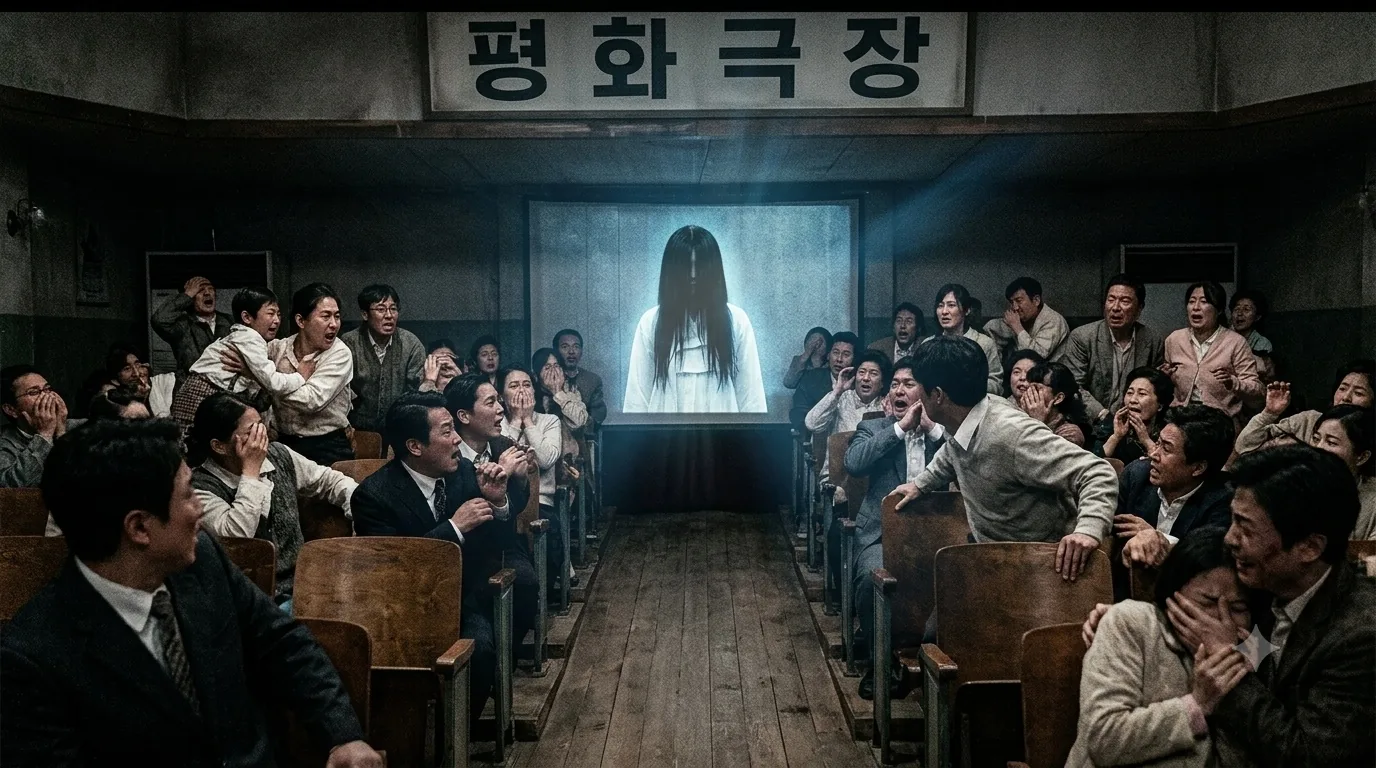 The face most people picture became a widely recognized convention through the cinema of the 1960s. (AI illustration)
Quick answer: The white-clad, loose-haired female ghost was popularized in the 1960s, when Korean horror films helped make it a widely recognized visual convention. Joseon-period writers had described ghosts in changing ways across four centuries. Two Korean horror films of the mid-1960s — A Devilish Homicide (1965) and A Public Cemetery of Wol-ha (1967) — are the works most often credited with fixing the image, and film scholarship finds their make-up repeated in Korean horror from then on (Hong 2009). That is a story about how a look became conventional — not proof that nothing like it existed before, or that the image has never changed since.
How were ghosts described in Joseon texts?
One study lays the change out in sequence. In 2008 Kim Jeong-suk published an article in Hanja Hanmun Gyoyuk tracing how ghosts and monsters were depicted in Joseon-period pilgi and yadam collections — the miscellanies and story anthologies of the literati. What follows is her reading of a defined set of literary texts, taken from her published abstract; it is not a consensus timeline for every Joseon source on ghosts.
Concrete description, she finds, begins in the early Joseon period, in the Yongjae chonghwa of Seong Hyeon. What those tales carry is mostly wonder — the marvel of the uncanny rather than horror.
The change comes with the wars, and the two collections she names belong to two different wars. The Eou yadam of Yu Mong-in, with its abundant monster tales, was written in the decades after the Japanese invasions of 1592–98; Yu died in 1623, before the Manchu invasion. The Gangdo mongyurok, a dream-narrative in which the spirits of women who died at the fall of Ganghwa Island speak, belongs to the aftermath of that later war, in which Ganghwa fell in early 1637. In both, Kim finds the figures becoming far more concrete and grotesque, and she reads the horror as a way of criticizing a disordered reality.
In the eighteenth century, in her account, the descriptions become less vivid — though the stories do not stop. Her example is the Cheonyerok, of which she says more than half the tales are ghost stories.
From the nineteenth century, she finds female wongwi — ghosts of women who died with unresolved grievances — appearing in classical fiction, and treats these figures as the prototype of the female ghost completed after 1900, reading them against the pressure late Joseon patriarchal ideology placed on women.
Compressed, her sequence runs: wondrous, then grotesque, then subdued, then a settled type. Two things not to take from it. First, it does not mean ghosts became women in the nineteenth century: wronged female ghosts were in circulation earlier — the tale of the sisters Janghwa and Hongryeon, and the Arang legend of Miryang. What changed, in Kim’s reading, is that scattered stories converged into a recognizable type. Second, a type in a story is not a look on a screen. The nineteenth century produced a narrative type; the costume and hairstyle that everyone now recognizes took a different medium.
Which films made the white-clad ghost the convention?
Yeom Hae-sang, in Revenant, is not an exorcist; he is a man who reads records about ghosts. It is a fitting profession for this article’s central turn, because the face we now give the Korean ghost came less from records than from film.
Two films are usually named. A Devilish Homicide (살인마, 1965, dir. Lee Yong-min) came first. A Public Cemetery of Wol-ha (월하의 공동묘지, 1967, dir. Kwon Cheol-hwi) is the one most often credited with fixing the image. Hong Su-gyeong’s 2009 study of the two films’ ghost make-up analyses them side by side and, in its abstract, describes the “white clothing and dishevelled hair” of their female ghosts as a make-up style “used repeatedly in Korean horror films since the 1960s”. Paik Moon-im of Yonsei University, who wrote her doctorate on Korean horror, is reported in a 2009 Weekly Kyunghyang interview as treating A Public Cemetery of Wol-ha as a founding work of the genre, with its ghost Wolhyang, in white with her hair down, as the completed form of the Korean female ghost.
What that evidence supports is a claim about convention: in the mid-to-late 1960s, Korean films gave the wronged female ghost a look — white clothes, loose hair — that later films and television repeated until it became the representative image; radio, as the next paragraph shows, spread the stories rather than the look. It does not show that no shared image existed before, that the process was finished in exactly those three years, or that later filmmakers were bound by it. Several films, one look, made habitual.
One correction is worth making, because the drama’s vocabulary invites the mistake. Wolhyang is not a maiden ghost. KMDb’s plot summary is clear: Myeong-sun becomes the gisaeng Wolhyang to save her brother and her lover, marries the lover, bears a son, is slowly poisoned by a scheming housekeeper, is framed, kills herself and returns to haunt the guilty. She is a wronged wife. What the 1967 film helped standardize was the look of the wronged female ghost — not the folk category of the young woman who died unmarried.
The cinema was not the only channel. Kim Jeong-suk’s abstract names, alongside foreign film, the enormous popularity from the 1960s of Jeonseol ttara samcheolli, an MBC radio drama broadcast from 1 May 1965 until 1983 that dramatized legends from every province. Radio cannot transmit a face. What it did was make the legend format a national habit; film gave the ghost its look; television horror later repeated it.
Did the image come from Japan?
The question is often asked, and the Weekly Kyunghyang article is the most accessible place it is discussed. Two things are reported there. Paik is cited as arguing that A Devilish Homicide (1965), Yu Hyun-mok’s Han (1967) and Ha Gil-jong’s Sujeol (1973) drew on two Japanese ghost films, Tokaido Yotsuya kaidan (1959) and Kwaidan (1964) — a claim about particular films and their sources. The article also presents expert views on the resemblance between the Korean image and Japanese ghost iconography more generally, while noting that the surviving materials are too thin to establish the point.
The accurate summary is therefore not “the white dress came from Japan”, and not “there is nothing to the idea” either. Japanese influence has been proposed, for individual films with some specificity and for the image as a whole as a hypothesis; the materials needed to settle the origin and transmission of the composite image are lacking.
What did the 1970s do with the look?
Less than a neat story would want. Kim Ji-young’s 2022 study reads three 1970s films — Sujeol (1973), Myonyeo (1974) and Neo ttohan byeori doeeo (1975) — as horror with occult and psychic themes and a counter-cultural edge under the censorship of the period. That shows some 1970s horror moving away from the graveyard formula; it does not, by itself, show the genre as a whole declining or the formula being rejected.
The smaller point this article set out to make stands without that. Across four centuries the Joseon ghost was redrawn — wondrous, grotesque, subdued, typed. The cinema of the 1960s helped fix one look as the widely recognized one, and that convention has held long enough that a drama showing something else now reads as a departure.
A short detour: the ribbon, the unmarried dead, and weddings for the dead
Revenant’s red ribbon brings a cluster of folklore to mind. We set it out briefly, as related background — not as an explanation of what the drama’s ghost is.
The ribbon. A daenggi ties off the end of a braid. In Joseon, a woman’s basic hairstyle was a chignon if married and a braid if unmarried, and boys too wore a braid and a daenggi until they came of age. Putting the hair up — a topknot for a man, a chignon fixed with a binyeo pin for a woman — marked coming of age or marriage; the encyclopaedia’s entry on the chignon gives the rule that a girl put her hair up at the coming-of-age rite at fifteen, or the day before her wedding if she married younger. But the ribbon as an object did not mean “unmarried”: the same entry notes that the chignon was itself tied with a jjok-daenggi, in colours that varied by occasion. Loose hair and a braid ribbon can be read, in that older code, as pointing toward a life before marriage. We use the ribbon here only as a prompt to the related folklore, and draw no inference about the prop’s owner or her death.
The unmarried dead. Korean folk belief has a name for one kind of ghost. The sonkaksi is “the ghost that a young woman becomes when she dies without marrying” — also cheonyeo gwisin, the maiden ghost; its pair is the mongdal gwisin, the bachelor ghost. Households did not only fear it: the entry describes the spirit being taken into the house as a household deity, with a small shelf, a jar or box as its seat, and new goods offered to it first. The same entry records harsher practices reported from some places — burial face down in men’s clothes, or at a crossroads. Its references are field surveys of 1969–1982; nothing dates these practices to the Joseon period or generalizes them across the country.
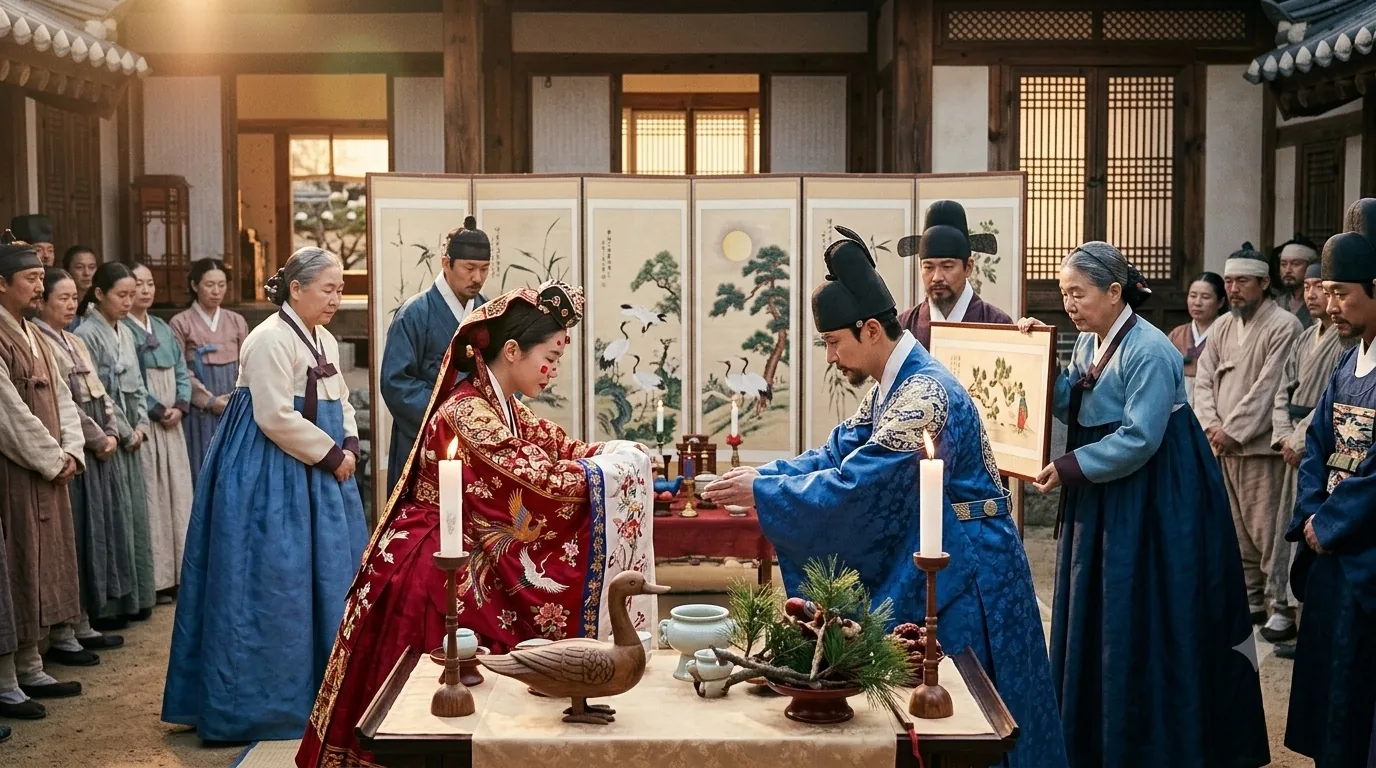
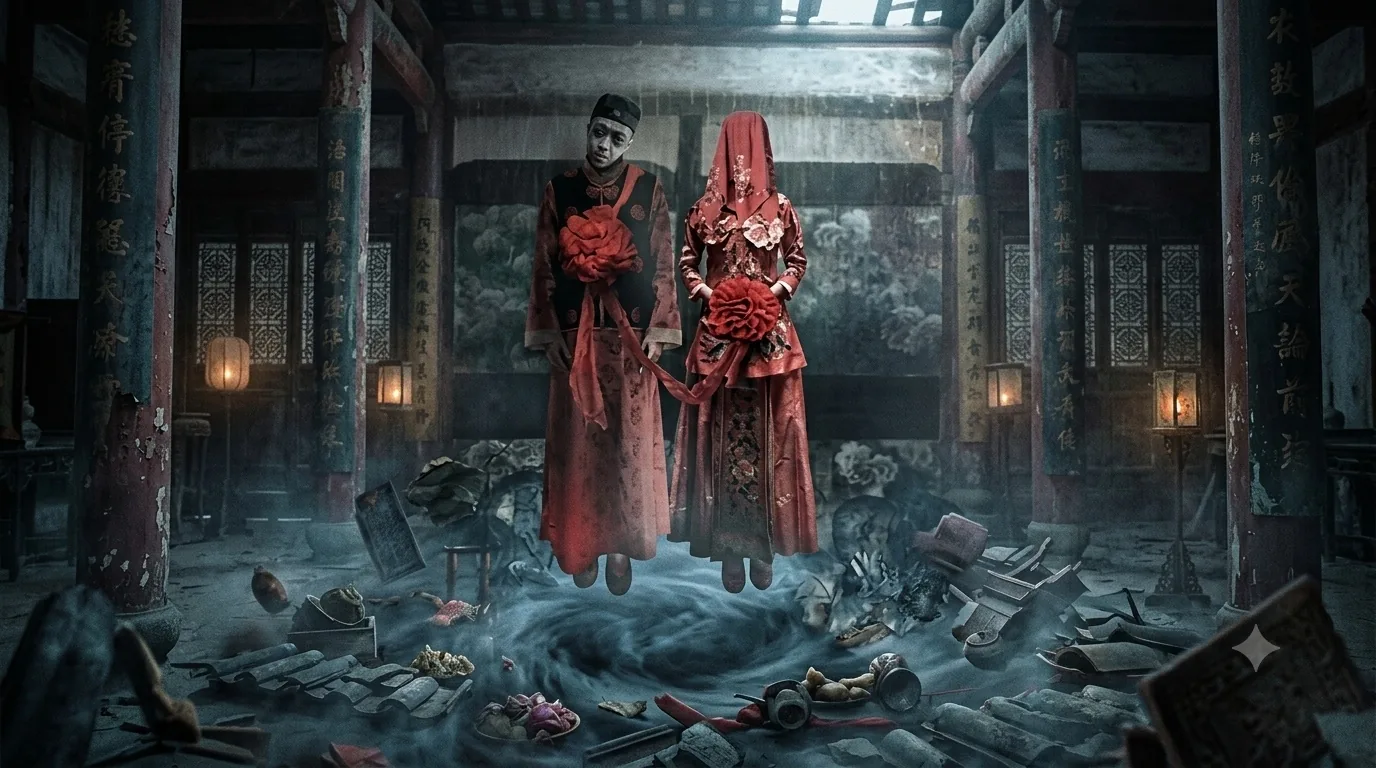 A wedding performed for the dead follows the order of a wedding for the living. (AI illustration)
Weddings for the dead. The most remarkable response was to marry the ghost. The encyclopaedia’s entry on sahon, “a marriage between the spirits of the dead”, describes two families each with a child who died unmarried agreeing a match by age and compatibility, dolls or folded paper dressed as bride and groom under a shaman’s direction, the gyobae bows and hapgeun cups of a living wedding (our article on Flower Crew walks through those), and the figures burned or buried afterwards. The entry was written in 1995 on sources of 1978–1985; it reports the custom from Seongju, Dongnae and Gwangsan “until recently” and as widespread on Jeju at that time. It says nothing about the present, and nothing that dates the procedure to Joseon.
Drama vs. real history
Two tables, because they answer different questions.
Common assumptions and what the sources support
| Common assumption | What the sources support |
|---|---|
| Korean ghosts have always been women in white with loose hair | In Kim Jeong-suk’s reading of Joseon literary collections, ghost imagery changed across four centuries. The white-clothes-and-loose-hair image of the wronged female ghost became the convention through Korean films of 1965–67 and the media that repeated it |
| One film created the image | At least two films are named — A Devilish Homicide (1965) and A Public Cemetery of Wol-ha (1967) — and radio and television spread the format. The films made a look conventional; “created” overstates it |
| The 1967 ghost was a maiden ghost | Wolhyang is a married woman with a son. The film helped standardize a look, not the folk category of the sonkaksi |
| The image came from Japan | Influence has been proposed — for particular films with some specificity, for the image as a whole as a hypothesis. The materials to settle it are lacking |
| A Joseon ghost wore grave clothes, which were white hemp | Grave clothes were made of silk as well as ramie and hemp, usually undyed but sometimes pale or brightly coloured. Plain white dress was worn at the 1446 royal mourning until formal mourning clothes went on — a mourning practice, not a ghost’s uniform |
What Revenant shows, and the folklore it borrows
| In the drama | In the record |
|---|---|
| A red daenggi passes from the dead to the living | The braid ribbon of the unmarried of both sexes — but also, as jjok-daenggi, part of a married woman’s chignon. We draw no inference from it about the drama’s ghost |
| A “taeja ghost” is spoken of | Myeongdu, taeju and taeja are terms of shamanic practice: a shaman who speaks with a possessing spirit’s voice, and the child’s or girl’s spirit so enshrined, with regional variation. A different family of ideas from the maiden ghost |
| The ghost is a dark shadow with loose hair, not a woman in white | A choice that departs from the media convention. We do not rank it against the older record either way |
Key terms. Wongwi (원귀) — a wronged, vengeful ghost. Sonkaksi (손각시) — the ghost of a young woman who died unmarried; also cheonyeo gwisin. Mongdal gwisin (몽달귀신) — the bachelor ghost. Sahon (사혼) — a wedding performed between two dead people’s spirits. Daenggi (댕기) — a ribbon tying the hair; on a braid, worn by the unmarried of both sexes; as jjok-daenggi, on a married woman’s chignon. Jjokmeori (쪽머리) — the married woman’s chignon, fixed with a binyeo pin. Sobok (소복) — plain white clothing worn in mourning; in the 1446 record, worn before formal mourning dress. Myeongdu / taeju / taeja (명두·태주·태자) — terms for a shaman who delivers a possessing spirit’s voice, and for the child’s or girl’s spirit enshrined by such a shaman; usage varies by region.
Back to the ribbon
The red daenggi in Revenant is where this article began, and the older code of hair and marriage is why a braid ribbon can call the folklore of the unmarried dead to mind. That is as far as we take it.
So the next time a Korean drama shows you a ghost, look past the colour of the dress. The white robe and the loose hair, as a combined image of the female ghost, became a widely shared convention in the 1960s. What people feared, and what they did about it, is older than that — and it never had one face.
Coming up next
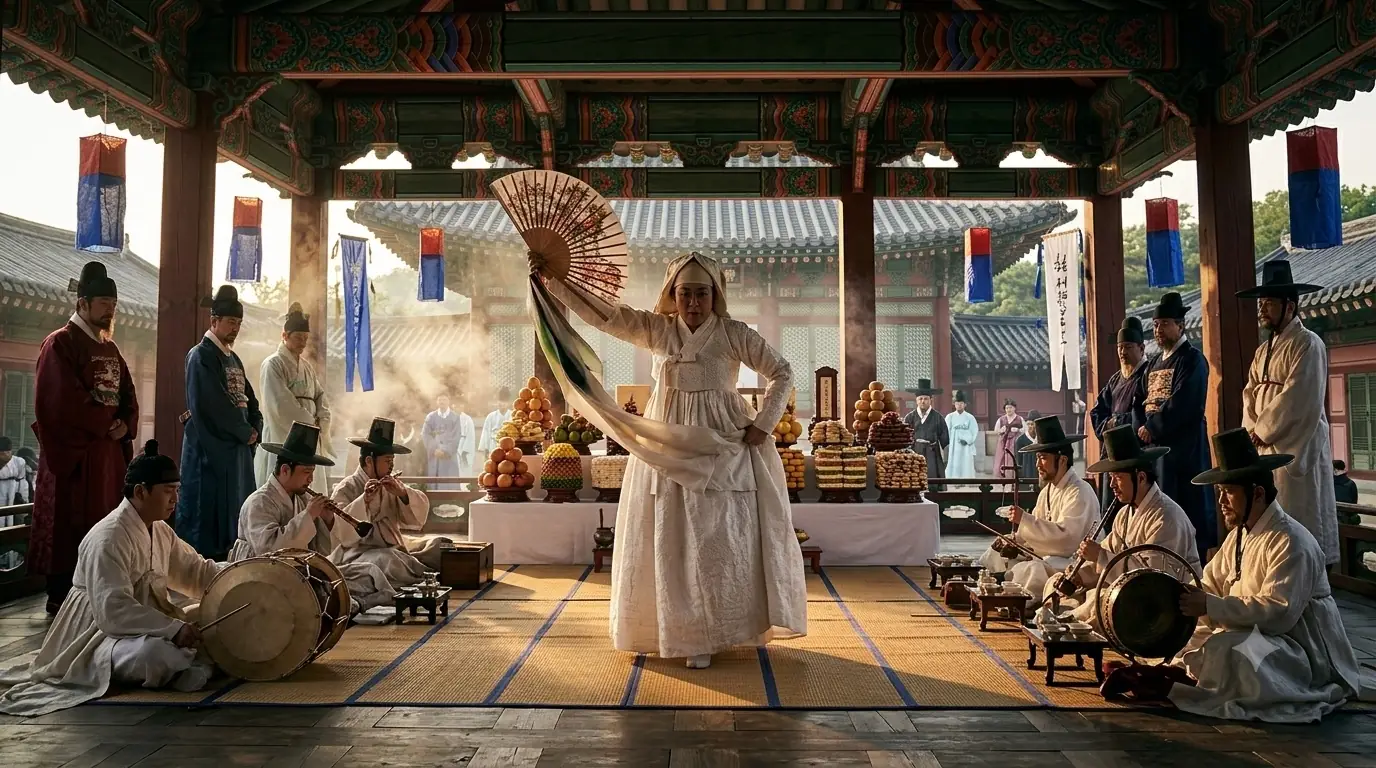
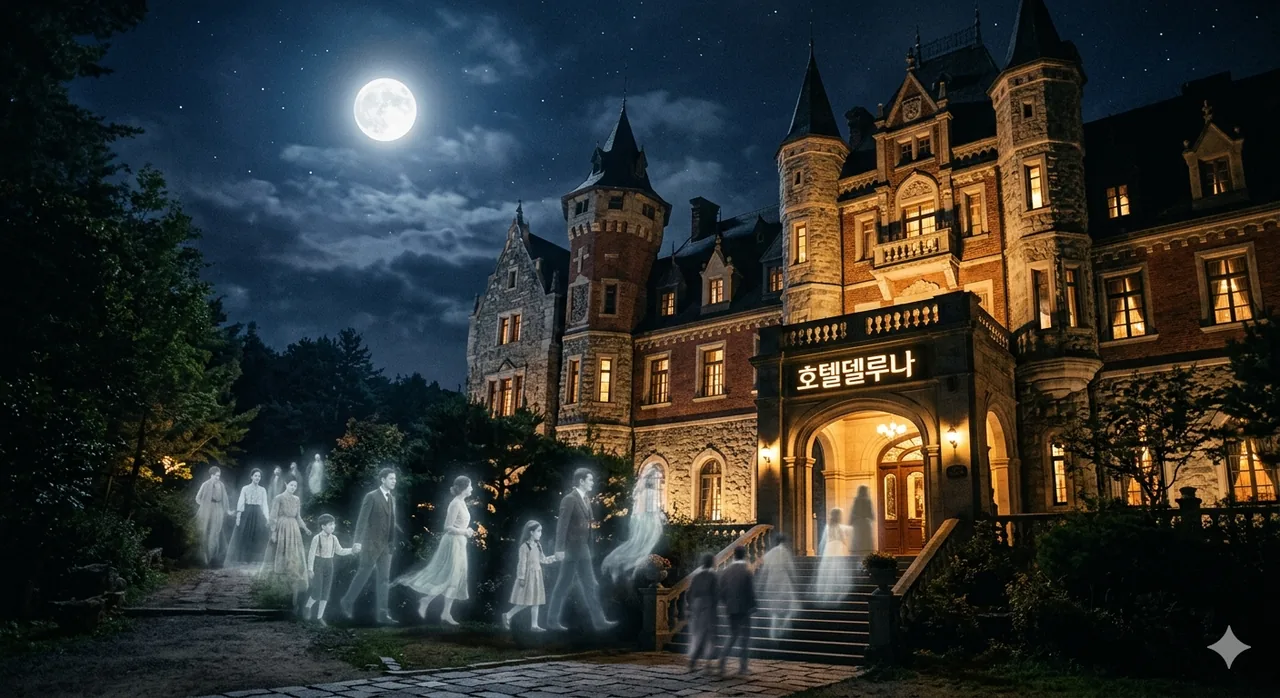
Revenant’s folklorist reads records; the Joseon court kept its own. Our article on The East Palace covers the shamans the state employed and the rites it held for the unmourned dead. Hotel del Luna takes the other end of the same question — what the living owe the dead — in a modern setting.
Frequently asked questions
Did Korean ghosts always wear white? Not as a fixed image. Joseon writers described ghosts in changing ways across four centuries; the white-clothes-and-loose-hair image of the wronged female ghost became conventional through films of the mid-1960s and the media that repeated them.
Which film created the white-clad female ghost? No single one, and “created” is too strong. A Devilish Homicide (1965) and A Public Cemetery of Wol-ha (1967) are the films credited with fixing the look; the 1967 ghost, Wolhyang, is a wronged wife, not a maiden ghost.
Did the image come from Japan? Influence has been proposed — for particular films, and as a hypothesis for the image as a whole. The materials to settle the origin and route of the composite image are lacking.
Do Joseon records describe what ghosts looked like? Yes, in changing ways: wonder in the fifteenth-century Yongjae chonghwa; grotesque figures in the Eou yadam (written before its author’s death in 1623, after the war of 1592) and the Gangdo mongyurok (after the fall of Ganghwa in early 1637); subdued forms in the eighteenth century; the wronged female ghost as a type in the nineteenth.
What is the red ribbon (daenggi) in Revenant? A hair ribbon. On a braid it marked the unmarried of both sexes; as jjok-daenggi it also tied a married woman’s chignon. This article draws no inference from it about the prop’s owner or her death.
Is the “taeja ghost” real folklore? The vocabulary is: myeongdu, taeju and taeja are terms for a shaman who speaks with a possessing spirit’s voice and for the child’s or girl’s spirit so enshrined, with regional variation. The drama’s plot built on the word is fiction.
Were weddings really held for the dead? Yes, as sahon, recorded in folklore surveys of 1978–1985: paper or doll bride and groom, the bows and shared cups of a living wedding, then burning or burial. Reported from the south and from Jeju at that time; not dated to Joseon, and not a statement about today.
Does Revenant’s ghost wear white? In episode 1, no — it is a dark, loose-haired shadow. We did not compare all twelve episodes, and we do not rank the choice against the historical record.
Sources & further reading
- The changing Joseon ghost — Kim Jeong-suk, Hanja Hanmun Gyoyuk 21 (2008), pp. 555–577, published abstract. The dating of the Eou yadam to before 1623 follows the encyclopaedia’s entry on Yu Mong-in; the placing of the Gangdo mongyurok after the fall of Ganghwa is from the work’s subject.
- The 1960s films — Hong Su-gyeong, Journal of the Korean Society of Beauty and Art 10:1 (2009), pp. 137–152, abstract; KMDb, A Public Cemetery of Wol-ha (1967), plot summary; Jeong Yong-in, Weekly Kyunghyang no. 838, 6 August 2009, reporting Paik Moon-im’s Wolha ui yeogokseong (Chaeksesang, 2008) and expert views on Japanese iconography.
- The 1970s — Kim Ji-young, Korean Literary Theory and Criticism 26:1 (2022), pp. 305–336, abstract.
- Hair — Uri yeoksa net, ‘The aesthetics of putting hair up: gache’; Encyclopedia of Korean Culture, ‘Jjokmeori’ (E0055107); National Folk Museum webzine, ‘Daenggi and binyeo’ (2018). All consulted directly.
- The unmarried dead; the wedding for the dead; the child-spirit — Encyclopedia of Korean Culture, ‘Sonkaksi’ (E0030464), ‘Sahon’ (E0026113) and ‘Myeongdu’ (E0018243), all consulted directly. The sonkaksi entry’s references date from 1969–1982; the sahon entry was written in 1995 on sources of 1978–1985.
- White in mourning; grave clothes — Veritable Records of Sejong, 28th year, 3rd month, 24th day, entry 1: “宗親駙馬文武百官, 俱以素服入臨 … 自此至成服, 每朝夕哭臨” — a record of one royal mourning, not a rule for every rank and funeral. Encyclopedia of Korean Culture, ‘Suui’ (E0031638) on the fabrics and colours of grave clothes.
- Limits of this article — The three KCI articles (Kim 2008, Hong 2009, Kim 2022) were read in abstract only, and the Joseon texts they discuss (Yongjae chonghwa, Eou yadam, Gangdo mongyurok, Cheonyerok) were not opened. Paik Moon-im’s book was not read; her views are given as the magazine reported them. The drama was watched for episode 1 and its recurring motifs, not compared across all twelve episodes. Where those limits bear on a claim, the claim has been kept to what the abstract or report actually says.
This article was researched and written by K-Drama History. Source: Revenant and Korean Ghost Folklore: How 1960s Cinema Shaped the Woman in White — K-Drama History