Hotel del Luna, Explained: Why Korean Ghosts Check In Before Moving On
Theme: Belief, Death & the Uncanny
From the research behind Pause the Drama.
If you’ve watched the lavish 2019 K-drama Hotel del Luna (호텔 델루나) — the one with the moon-lit hotel run by the imperious, centuries-old Jang Man-wol — you remember its strange and beautiful premise. The guests are the dead. They check in not to rest, but because something still ties them to this world: a regret, a grudge, a love left unfinished. Only once that knot is loosened can they finally leave through the hotel’s doors and move on.
It’s a gorgeous fantasy. But here’s what the drama never quite stops to explain to its international viewers: that hotel is not just a pretty set piece. It’s a centuries-old Korean answer to a question every culture has to face — what do we owe the dead? And the Korean answer leans the opposite way from the one a typical Western ghost story gives you.
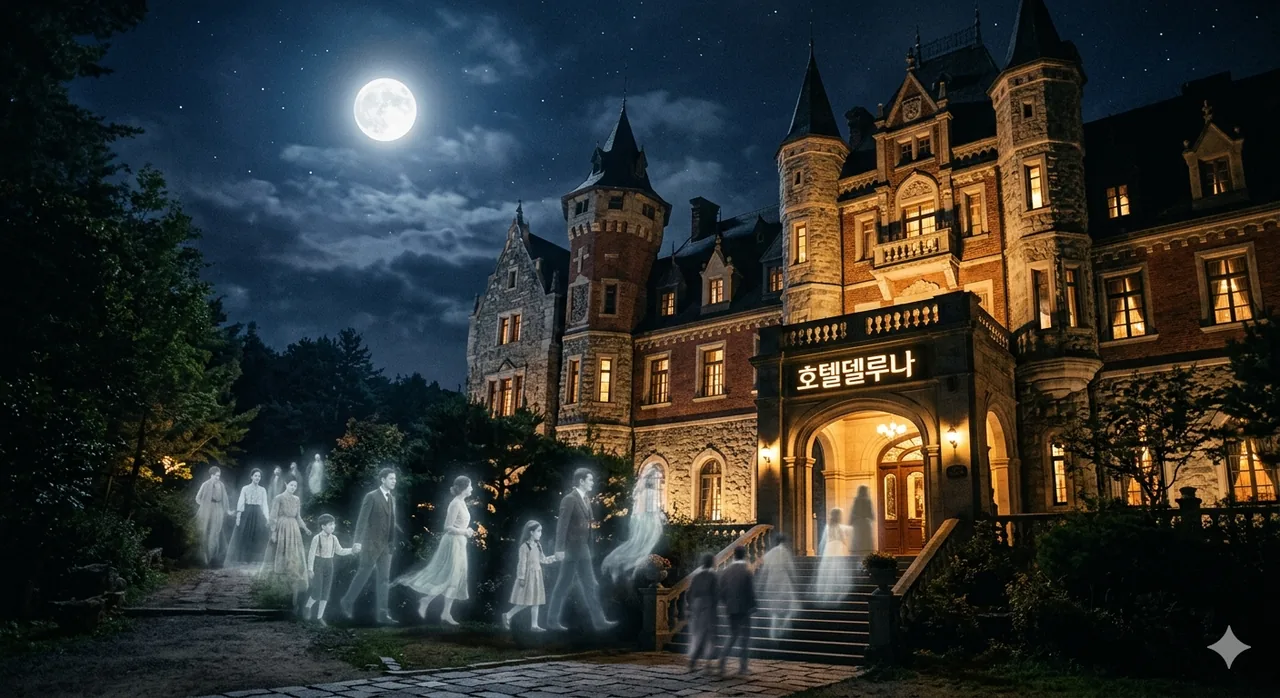 A hotel where the dead check in to settle what they left behind — a centuries-old Korean idea dressed in modern fantasy. (AI illustration)
Quick answer: Hotel del Luna is built on a real strand of Korean belief: a soul weighted down by han — unresolved sorrow or grievance — may not pass on cleanly after death. The living’s job is to tend the dead: feeding ancestors at the jesa table, hiring a shaman to perform a gut that washes the soul clean, and guiding it onward with care rather than fear. The hotel is a luxury reimagining of that old logic. Korean ghost stories often do more than frighten the living — they ask why the dead have not been heard, fed, mourned, or guided onward.
Let’s unpack it.
Why do the dead in this drama need to finish something first?
Because in Korean thought, a soul doesn’t simply switch off at death — it can get stuck.
The thing that snags it has a name: han (한, 恨). Han is one of the hardest Korean words to translate. It’s not quite sorrow, not quite resentment, not quite regret — it’s the deep, accumulated ache of something unresolved, an injustice or longing that was never set right (Encyclopedia of Korean Culture, Academy of Korean Studies). And in the older folk imagination, a person who dies with too much han may not move on cleanly. Such a soul can linger as a wonhon (원혼) — a spirit of unresolved grievance; and when it cannot reach the afterlife and instead roams among the living as something to be feared, folklore calls it a wongwi (원귀). (A caution worth keeping: han is a powerful lens on Korean feeling, but it has also been exaggerated in the past — Korean culture should never be explained by han alone. We dig into that debate in a companion piece on han and sinmyeong.)
Notice what this means: the ghost is not evil by nature. It is sad. A classic Korean ghost — the pale woman in white you see in so many horror tales — is most often someone who died with a wrong unaddressed, returning not to feast on the living but to have her story finally heard. That’s the engine of Hotel del Luna. Each guest is a parcel of han, and the hotel’s whole purpose is to help unwind it so the soul can rest. The dead aren’t a threat to be destroyed. They’re a debt of memory to be settled.
So how did Koreans actually send the dead onward?
Several traditions, layered side by side — and Korea kept them all.
The first is Confucian ancestral rite, the jesa (제사, 祭祀). On the anniversary of a death and on major holidays, a family sets a table of carefully prepared food, bows before the ancestor’s tablet or photo, and quite literally invites the dead to come and eat. This isn’t morbid; it’s the highest form of love. Under Confucian filial piety (효, hyo), your duty to your parents doesn’t end when they die — it simply continues in a new form (Encyclopedia of Korean Culture, Academy of Korean Studies). The ancestors remain members of the family, consulted, fed, and honored generation after generation. In a classical Confucian context, neglecting these rites could be seen as a serious failure of filial duty.
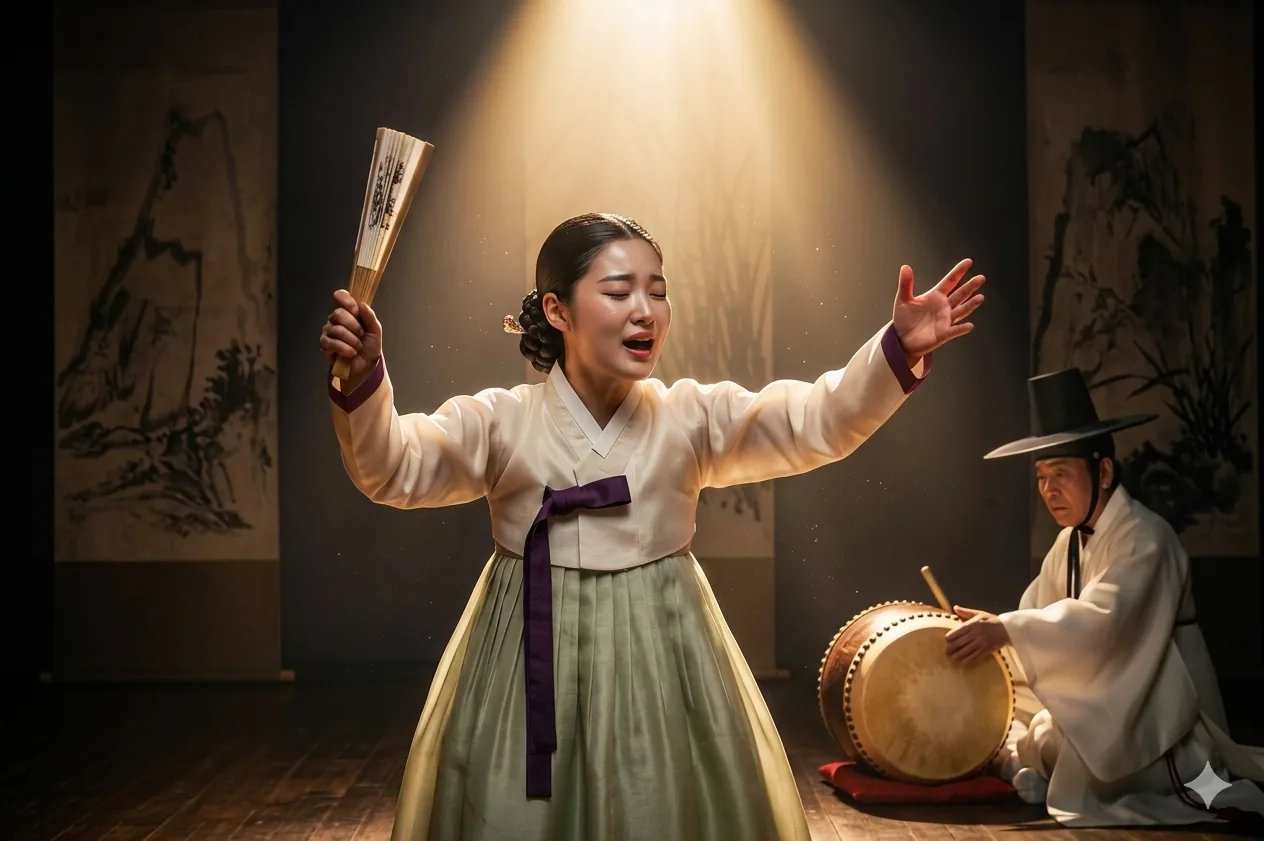
The second is older and wilder: Korean shamanism (무속, musok) (Encyclopedia of Korean Culture, Academy of Korean Studies). When a death is especially raw — a drowning, a sudden loss, a soul thought to be trapped — a family might call a mudang (무당, a shaman) to perform a gut (굿), a ritual to guide the spirit out of this world and into the next. In the southwestern Jindo region, the famous ssitgim-gut (씻김굿) literally “washes” the soul clean of its lingering impurity and grief so it can depart in peace — designated a National Intangible Cultural Heritage of Korea in 1980 as No. 72 (National Heritage Portal, Korea Heritage Service). The word for this sending-onward is cheondo (천도) — to ferry a soul to a better place.
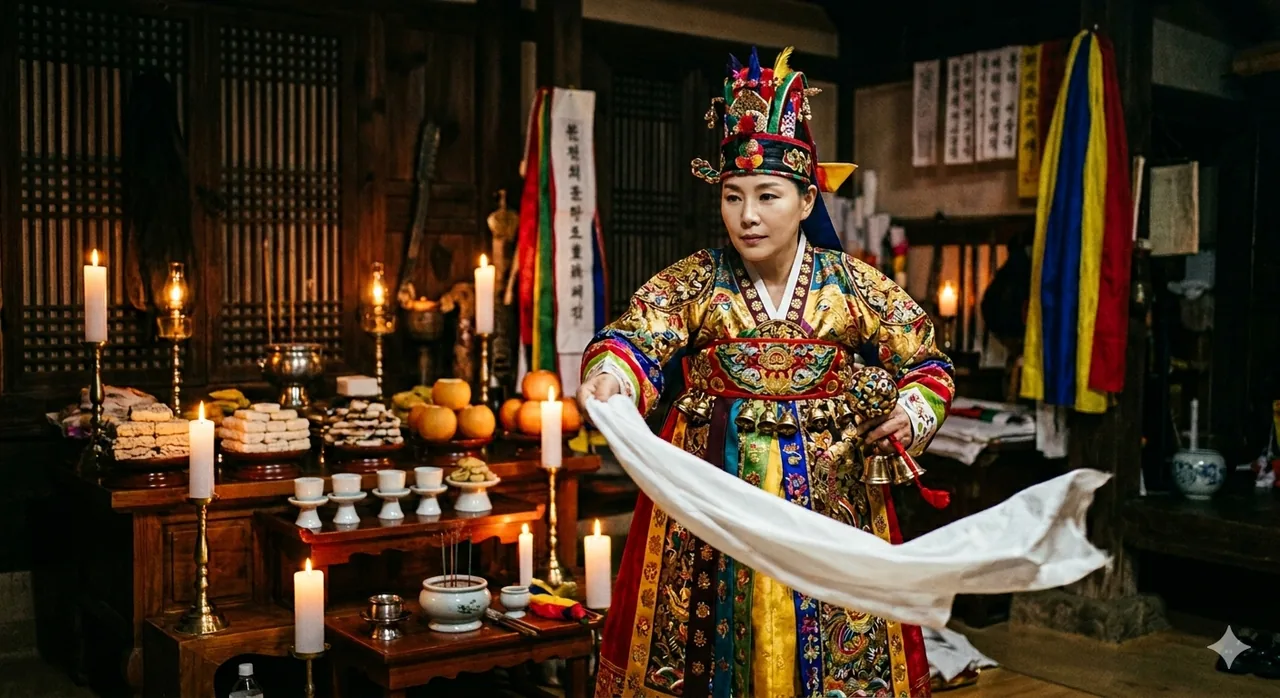 A gut — the shamanic rite that “washes” a grieving soul clean and ferries it onward (cheondo). The living grieve; the dead are released. (AI illustration)
Buddhism added a third layer. Korean Buddhist tradition developed its own rites for consoling souls who died unjustly. The suryukjae (수륙재) is a Buddhist ceremony for the lonely, wandering dead of water and land; King Taejo, founder of the Joseon dynasty, had it performed in 1395 at temples including Samhwasa to console the wronged spirits of the deposed Goryeo royal house (Encyclopedia of Korean Culture — 국행수륙전), and over time it came to serve all who died unjustly — in epidemics, disasters, and war. The Samhwasa Suryukjae is today a National Intangible Cultural Heritage of Korea (No. 125, designated 2013) (National Heritage Portal, Korea Heritage Service). The cheondojae (천도재) works at the scale of a single soul: a Buddhist rite that helps the departed let go of personal han and their attachment to this world so they can reach the Pure Land, the Buddhist paradise. Confucian, shamanic, Buddhist — Korea never settled on a single answer to death. It kept all three, layered together.
Look closely and Hotel del Luna feels like a gut reimagined as a luxury hotel: the dead arrive with grief, someone hears them, the knot is loosened, and the soul is guided onward. Man-wol does what a mudang does — she hears the dead, helps them release their han, and ushers them through the door. The drama swapped the shaman’s drum for a marble lobby, but the logic underneath is drawn straight from Korean ritual imagination.
And the man in black who collects souls — is he Death itself?
Not the way the West means it. Here’s a quiet but important difference.
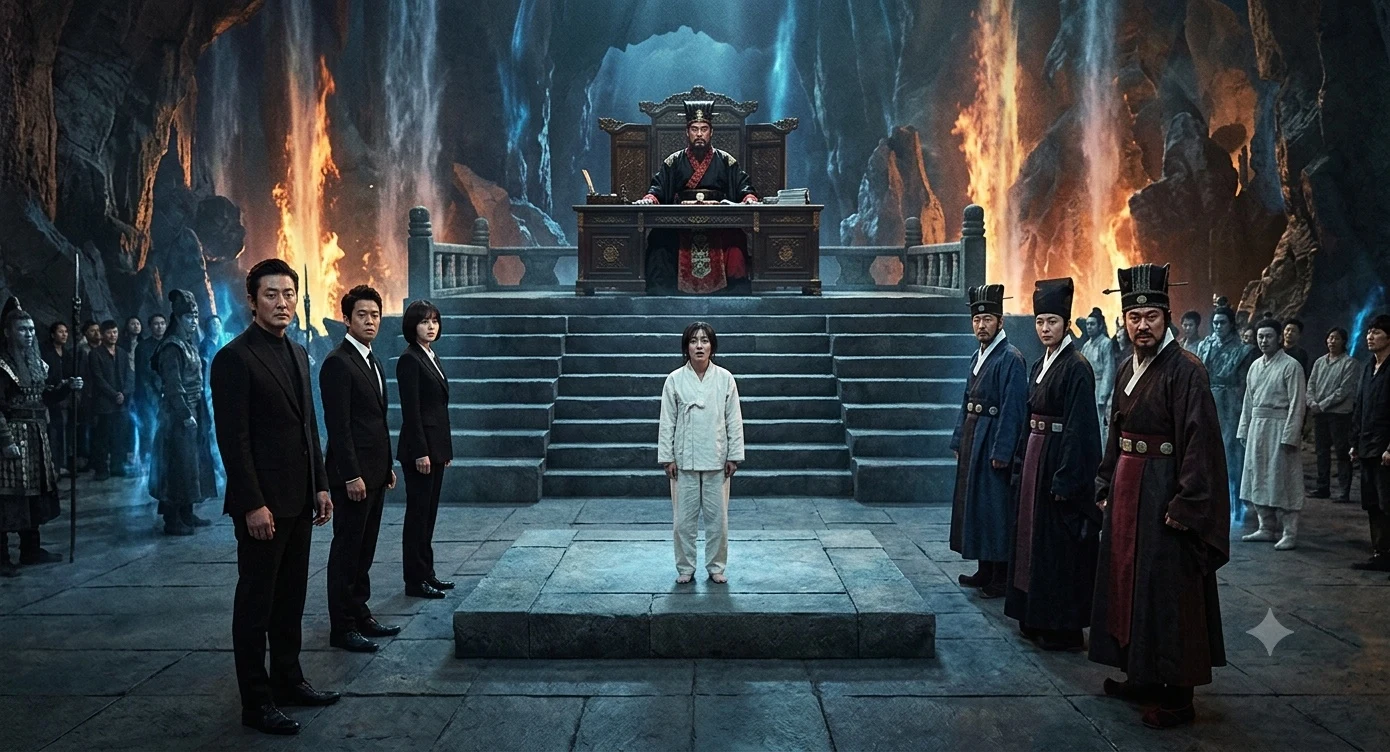
The grim figure in black who comes for the dead in Korean stories is the jeoseung-saja (저승사자, also called the chasa, 차사) — usually translated “grim reaper,” but he isn’t a scythe-wielding personification of Death (Encyclopedia of Korean Culture, Academy of Korean Studies). He’s closer to a civil servant of the underworld: a stern messenger in a black hat and robe, escorting souls along the road to the afterlife on the orders of King Yeomna (염라) and the Ten Kings of the underworld (시왕) — a picture of the afterlife in which shamanic belief and the Buddhist netherworld tradition blend into one. He is less a monster than an underworld official carrying out his orders.
That detail tells you something about the whole Korean cosmology of death. The afterlife isn’t a void or a hungry darkness — it’s an administered place, with offices, judges, and proper procedure. Death is a transition you are escorted through, not an annihilation you’re swallowed by. Once you see that, the gentle, orderly melancholy of Hotel del Luna makes complete sense.
Hotel del Luna vs. real Korean tradition — what the drama got right
Here is the drama’s fantasy logic set side by side with the older Korean ritual logic behind it.
| In Hotel del Luna | In Korean folk belief & history |
|---|---|
| The dead check in with unresolved grief | Souls with too much han linger as wonhon (spirits of grievance) |
| Man-wol hears each guest’s story and releases them | The mudang performs a gut to wash grief clean — cheondo (soul-ferrying) |
| Guests can only leave once their knot is untied | Jesa feeds and honors ancestors until their bond with the family is properly completed |
| The man in black escorts souls away | The jeoseung-saja, an underworld official, escorts the dead — a messenger carrying out orders, not Death itself |
| The hotel’s whole purpose is to serve the dead gently | Korean tradition tends the dead rather than banishing them |
A common mistake: “So Korean ghosts are just like Western horror ghosts, right?”
This is the misread that the word ghost sneaks into the subtitles — and it’s worth correcting.
On the surface, yes: Korea has scary ghosts, and the West has restless spirits with “unfinished business” too. The overlap is real. But the default storytelling reflex is where the two traditions tend to part. In much modern Western horror, the recurring solution to a lingering spirit is banishment — the priest with holy water and incense, the exorcist’s circle, the command to depart. The haunted house must be cleansed; the ghost must be made to leave. The emotional key is fear, and the goal is removal.
The Korean instinct runs the other way. You don’t primarily expel the dead — you tend them. You feed them at jesa, you hear them out, you hire a shaman to wash their grief and walk them onward kindly. Even the frightening wongwi is treated less as an enemy to be destroyed than as a sufferer to be understood and released. Same raw material — a soul that won’t leave — and two different reflexes: modern Western horror often reaches for the exorcism, while Korean ritual tradition more often reaches for the ritual meal and the farewell rite. Hotel del Luna is built on that second reflex, which is exactly why it feels tender where a Western ghost story feels terrifying.
Key terms. Han (한, 恨) — the deep, unresolved ache of injustice or longing that, in folk belief, can trap a soul after death; the emotional engine of every Hotel del Luna guest. Gut (굿) — a Korean shamanic rite; the ssitgim-gut of Jindo literally “washes” the soul clean of grief so it can depart. Cheondo (천도) — the act of ferrying a soul to a better place; what Man-wol does in every episode. Jeoseung-saja (저승사자) — the underworld official who escorts the dead, closer to a civil servant than a monster.
Why Hotel del Luna feels so Korean: how five cultures keep their dead
Step back from Korea and a striking pattern appears. Across much of the world, the dead aren’t pushed away at all — they’re invited back. Several cultures imagine the dead as returning guests or continuing family; modern Western horror, by contrast, often frames them as a haunting presence.
China — the dead as family, forever. The Korean jesa grew partly from Chinese roots: the ancient cult of the ancestors, where filial piety doesn’t end at the grave but becomes a lifelong duty of offerings and remembrance. Archaeologists trace Chinese ancestor veneration to Neolithic Yangshao communities — the instinct runs at least 5,000 years deep (World History Encyclopedia, “Ancestor Worship in Ancient China”). But Korean jesa is no simple copy. The Confucian form was codified in Korea during the Joseon era through Zhu Xi’s Family Rituals — yet it fused with much older indigenous Korean beliefs about the soul and a native, shamanic sense of the ancestors. The result is a hybrid, not an import: a Chinese ritual grammar speaking with a deeply Korean accent.
Japan — Obon, when the ancestors come home. Each August, Japan holds Obon (お盆), a period in which the spirits of ancestors are believed to return to their old homes (japan-guide.com, “Obon”). Families light lanterns to guide them in, share food and dance the bon odori — then, at the end, float lanterns down rivers and out to sea to gently see the spirits off again. It is the exact emotional grammar of Hotel del Luna at the scale of a whole nation: welcome the dead, honor them, then guide them lovingly back. Japanese Buddhist and folk traditions also include hungry or restless spirits (gaki), which is exactly why proper remembrance and offerings mattered so much. The reflex was rarely exorcism; it was care.
Mexico — Día de los Muertos, a party for the departed. Across the Pacific, on the other side of the planet, Mexico arrives at almost the same answer. On the Day of the Dead (Día de los Muertos, Nov 1–2), families build ofrendas — altars heaped with photos, candles, marigolds, and the favorite foods of the departed — to welcome the souls of loved ones back home for a joyful reunion (UNESCO Intangible Cultural Heritage, “Indigenous Festivity Dedicated to the Dead,” inscribed 2008). Marigold petals are scattered to light the path for returning spirits. It is loud, bright, and full of laughter — death met not with dread but with marigolds and music. That an East Asian Confucian rite and a Mexican folk-Catholic festival arrived at such a similar emotional answer says something deep about the human heart.
Modern Western horror — the ghost you must get rid of. And then there’s the dominant image the English word ghost tends to carry in modern Western storytelling: the haunting. The spirit in the attic, the cold spot on the stairs, the figure that must be exorcised, banished, escaped. There are gentle exceptions, of course — Catholic tradition keeps All Souls’ Day to remember and pray for the departed, and Western ghosts often have “unfinished business” too — but the mainstream story, from old folklore to the modern horror film, treats the returning dead as a problem to be solved by removal. The house is “cleansed.” The spirit is sent away. Fear is the default note.
Same fact of life — that the dead don’t always feel finished — and several different reflexes: feed them (China), house them and see them off (Japan), throw them a homecoming (Mexico), wash their grief and walk them onward (Korea) — and, in much modern Western horror, make them leave. Watch Jang Man-wol usher one more soul gently through her door, and you’re seeing the warm half of that map: a world that doesn’t erase the dead, but keeps them inside memory and relationship until they’re ready to go.
Coming up next
One moonlit hotel — and we’ve traveled from the ache of han, to a family bowing over a jesa table, to a shaman washing a soul clean, to lanterns floating out to sea in Japan and marigolds lighting a path in Mexico. That’s the quiet gift of a good fantasy drama: even its ghosts have a history.
That same instinct — unknotting grief rather than burying it — runs even deeper in Korean culture, into its music, its dance, and the emotional charge of the Korean Wave itself. We follow that thread in a companion piece: From Han to Sinmyeong: Why Korean Culture Feels Both Sad and Alive.
And in the next essay, we’ll take another K-drama scene that looks like pure fiction — and trace the real Korean history hiding underneath it.
Frequently asked questions
Is Hotel del Luna based on a real Korean belief? The hotel itself is fiction, but its core idea is deeply traditional. Korean folk belief holds that a soul burdened by han (unresolved grief or grievance) can linger after death, and that the living help it move on through rites — Confucian ancestral offerings (jesa) and shamanic gut rituals such as the ssitgim-gut. The drama dresses that old logic in modern fantasy.
What is “han,” and why does it matter to the story? Han (한, 恨) is a Korean concept often described as a deep, unresolved ache — a blend of sorrow, longing, and grievance that was never set right. In folklore, dying with too much han is what keeps a spirit bound to the world. In Hotel del Luna, every guest is essentially a knot of han the hotel exists to help untie. (Han is a much-discussed and debated idea — it has even been overstated in the past — so treat any single definition as one interpretation, and never explain Korean culture through han alone.)
Is the Korean attitude toward the dead really that different from the West’s? In broad strokes, yes. Korea — like China, Japan, and Mexico — leans toward tending the dead: feeding, honoring, and gently guiding them onward through ritual. Much modern Western horror, by contrast, leans toward banishing a lingering spirit through exorcism and is keyed to fear. Both traditions contain exceptions — Catholic All Souls’ Day remembers the departed, and Korea has its own feared spirits — but the default reflex differs.
Further reading
This piece was written from the historical script and fact-check of 사뚱샘의 역사방 (SaDDungSam). Key facts are sourced inline above. For deeper exploration:
- Han (한, 恨) — the full academic debate — how the concept developed, how it differs from Chinese yuan and Japanese urami, and why it should not be used as a single key to Korean culture. (Encyclopedia of Korean Culture / 한국민족문화대백과사전)
- Jindo Ssitgim-gut (진도 씻김굿) — encyclopedia entry — ritual structure, regional variants, and transmission history. (Encyclopedia of Korean Culture / 한국민족문화대백과사전)
- Ghosts in ancient Japan & the logic of Obon — how neglected ancestor spirits (gaki) could harm the living, and why Japanese tradition responded with offering and welcome rather than exorcism. (World History Encyclopedia)
Thanks for reading — see you in the next one.
This article was researched and written by K-Drama History. Source: Hotel del Luna, Explained: Why Korean Ghosts Check In Before Moving On — K-Drama History