Are the Haenyeo in Our Blues & When Life Gives You Tangerines Real? Jeju's Diving Grandmothers, Explained
Theme: Women’s Lives
From the research behind Pause the Drama.
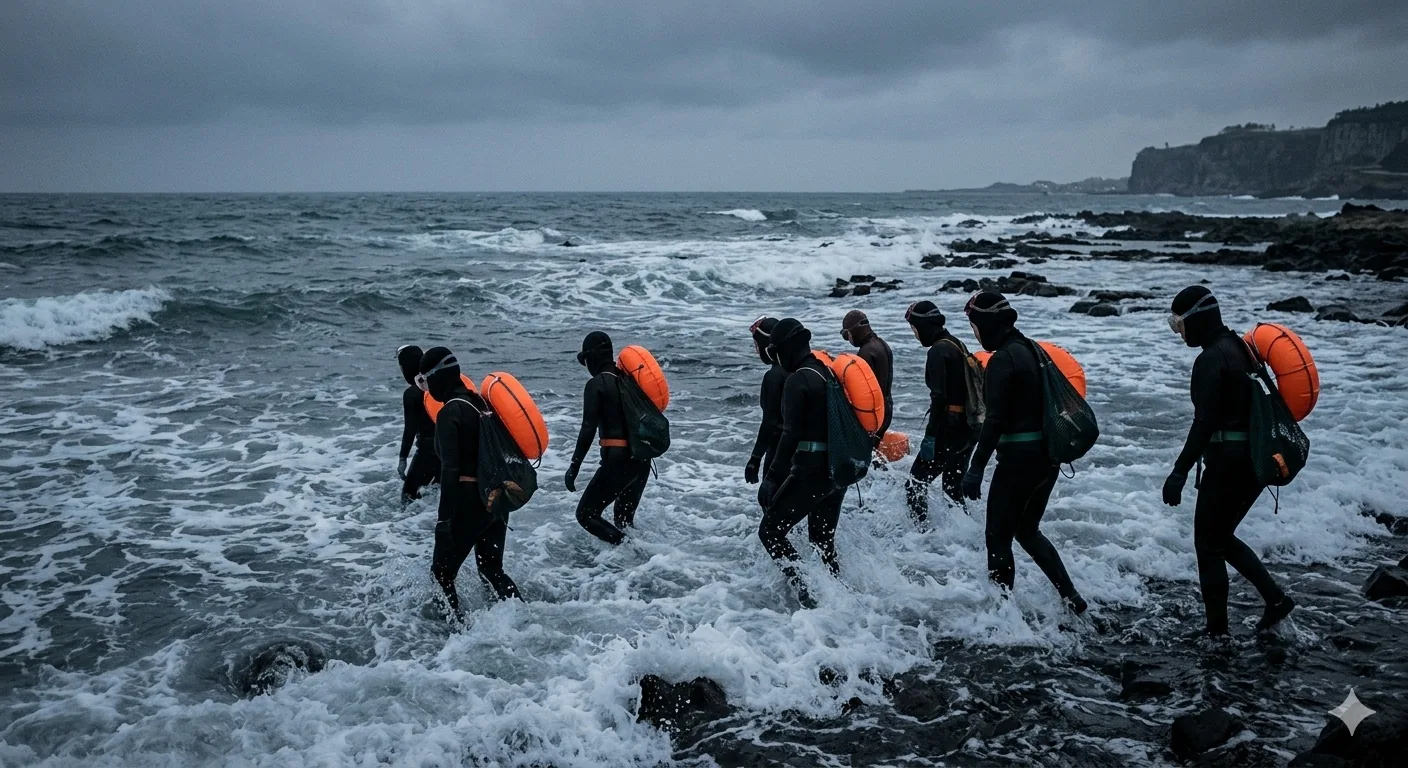
If you’ve watched the 2022 omnibus K-drama Our Blues (우리들의 블루스), you’ve met them. And if you cried your way through the 2025 phenomenon When Life Gives You Tangerines (폭싹 속았수다) — the IU and Park Bo-gum saga set on Jeju — you met them again. In both, the camera keeps returning to the same figures: weathered women, many of them grandmothers, who walk into the sea in wetsuits, vanish beneath the surface, and come back up with shellfish in their nets and a sharp, whistling gasp on their lips.
They are the haenyeo (해녀) — Jeju’s “sea women.” And here’s what the dramas don’t pause to explain to international viewers: these are not a charming bit of local color. They are one of the last living matriarchal labor cultures on Earth — and UNESCO agrees.
Quick answer: Our Blues and When Life Gives You Tangerines show elderly women free-diving without oxygen tanks off Jeju Island — and they are entirely real. These are the haenyeo (해녀), Jeju’s “sea women,” who built one of the world’s rare matriarchal labor cultures because diving income made women the household breadwinners. Inscribed by UNESCO in 2016, the tradition is now vanishing: the average haenyeo is around 75, and numbers have fallen from 14,000 in 1970 to roughly 4,000 by 2015 and just 2,371 by the end of 2025.
Let’s unpack it.
So what exactly is a haenyeo?
A haenyeo is a woman who dives — without any breathing apparatus — to harvest the sea floor for a living.
No oxygen tank. No air hose. She fills her lungs at the surface, drops as deep as ten meters, and works the rocks for abalone, sea urchins, conch, and seaweed, holding her breath for around a minute at a time before she has to surface. Then she does it again, and again, for hours. The only modern concession is the wetsuit, which Jeju divers adopted from the 1970s onward; before that, they worked the cold water in thin cotton suits, and physiologists once studied them for their almost unbelievable tolerance to cold.
The crucial thing the dramas get right is who these women are. The haenyeo are old. The average age of a working Jeju diver today is around 75, and many are in their 70s and 80s. Their numbers have collapsed — from over 14,000 in 1970 to roughly 4,000 by 2015, and down to just 2,371 by the end of 2025 — because the young no longer take up the breath-hold life. So when Our Blues or Tangerines shows a grandmother shrugging into a wetsuit, that isn’t a quaint stylistic choice. That is what a haenyeo actually looks like in 2026. You are watching the last generation of a vanishing craft.
Why is their breathing called a “sound”?
Listen closely in either drama and you’ll hear it: a high, sharp, almost flute-like whistle every time a diver breaks the surface. That sound has a name — sumbisori (숨비소리) — and it is the single most haenyeo thing there is.
When a diver surfaces after a breath-hold dive, her body is starved of oxygen and loaded with carbon dioxide. The sumbisori is the technique she uses to fix that in a heartbeat: a forceful, whistling exhale that dumps the spent air and pulls in fresh, so she can recover and dive again within seconds. It is, very literally, the sound of survival — a body at the edge of its limits, resetting itself to go back down.
That’s why Koreans don’t describe it as mere “breathing.” The sumbisori is treated almost as the voice of the haenyeo — the sound that says she made it back up this time. For a community where every working day carried the real risk of not surfacing, that whistle is anything but decorative.
How did diving women end up running the household?
Here is the part that makes the haenyeo genuinely rare in world history: on Jeju, the women were often the breadwinners.
Jeju is a hard volcanic island — thin soil, brutal winters, and for centuries, fewer men than women in many villages. The sea, not the land, was where reliable income came from, and it was the women who worked it. A skilled haenyeo could out-earn her land-bound husband, sometimes by a wide margin, financing the household, the children’s schooling, and the village itself with what she pulled from the water. That economic reality bent the usual Confucian script: Jeju developed a reputation as a place where women held unusual financial and social weight — a rare matriarchal-leaning labor culture in a country otherwise organized around male authority.
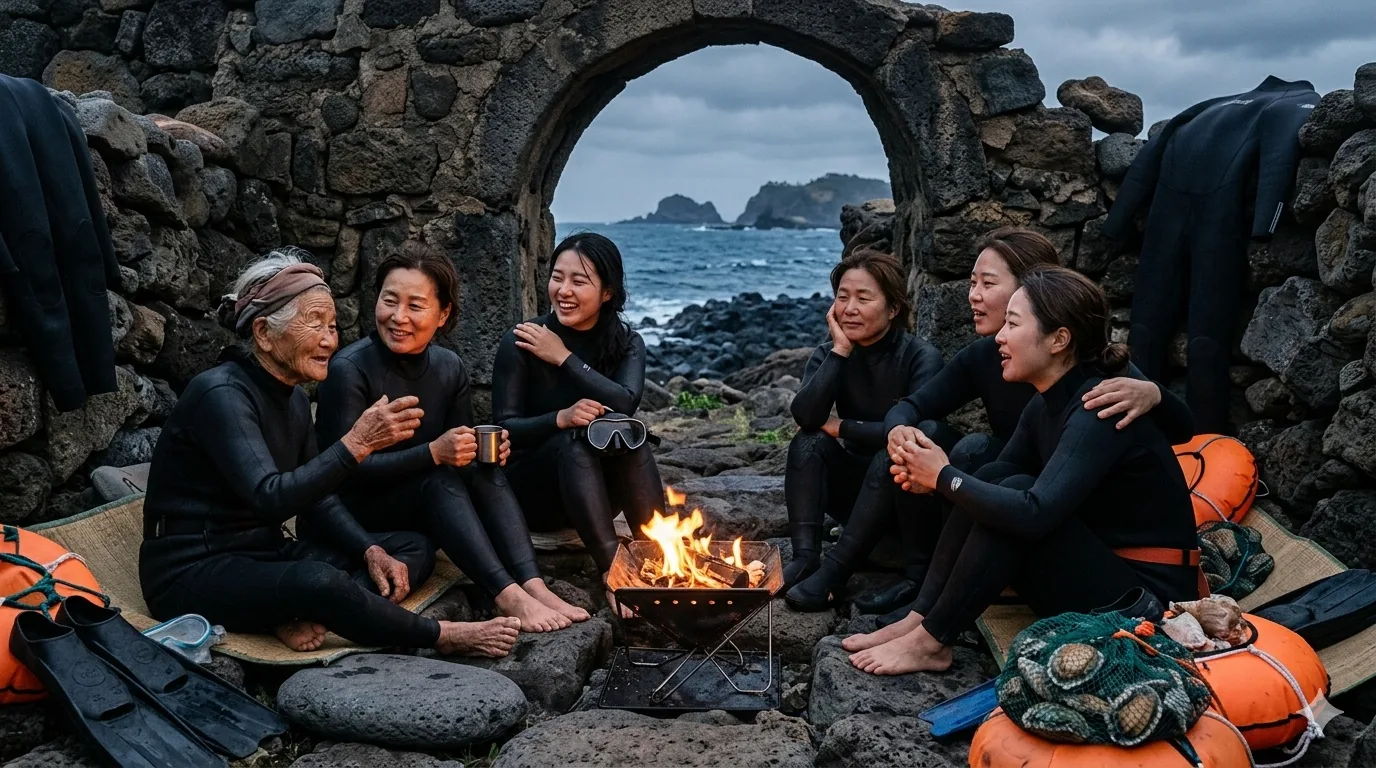
The work was also fiercely communal, and it ran on its own rules. The divers are ranked by skill into three tiers — hagun (beginners), junggun (intermediate), and sanggun (the masters who lead). The most respected sanggun decide where and when the group dives, read the sea for danger, and watch over the less experienced. Their headquarters is the bulteok (불턱) — an open-air stone windbreak on the shore where divers warm themselves at a fire between dives, change, pass down knowledge, and settle disputes by talking until everyone agrees. It is half break room, half parliament. The drama families and their squabbles aren’t invented drama; that is how the diving collective has always governed itself.
Drama vs. real history — how much did the shows get right?
| In Our Blues / Tangerines | In real history |
|---|---|
| Grandmothers in their 70s–80s still diving | Average working haenyeo age is ~75; over 63% of divers are now past 70 |
| Tight, contentious community bonds | The bulteok collective is real — disputes settled by consensus among the sanggun |
| Women as the economic anchor of family life | Haenyeo historically out-earned their husbands, funding households and schooling |
| Younger generations leaving the tradition | Diver count fell from 14,000+ (1970) to ~4,000 (2015) to 2,371 (2025); almost no new recruits |
| The sharp whistle when they surface | That is the sumbisori — a real breath-recovery technique, not a dramatic flourish |
Hold on — isn’t this just a pretty, peaceful tradition?
This is the romantic trap, and it’s worth naming directly: the haenyeo life is not, and never was, a postcard.
It is dangerous, body-wrecking work. Divers face the cold, the currents, entanglement, and the slow toll of decades of breath-holding on the ears and head. Women have died doing it. And the community’s toughness wasn’t a lifestyle aesthetic — it was forged in genuine hardship, including a startling chapter of resistance: in January 1932, the haenyeo of eastern Jeju — Hado, Sehwa, Jongdal, Udo, and Seongsan — rose against the colonial fishery cooperative that was underpricing and skimming their catch. Korea’s National Institute of Korean History records it as the largest women-led protest of the entire colonial era (and the single largest fishers’ uprising), drawing some 17,000 cumulative participants across roughly 238 demonstrations over three months — a running total as the movement spread, not one mass gathering. Many divers were detained, though only a few were ultimately prosecuted. These were not passive figures of scenery. They were a self-organized labor force that could, and did, fight back.
So when a show frames the haenyeo as serene grandmothers communing with the sea, it’s only telling half the story. The fuller truth — the one Our Blues and Tangerines reach for in their better moments — is that this was survival labor done by women the rest of society often undervalued, sustained by a sisterhood tough enough to outlast empires.
Key terms. Haenyeo (해녀) — “sea women”; Jeju’s female free-divers who harvest abalone, conch, and seaweed without oxygen tanks, now averaging 75 years old. Sumbisori (숨비소리) — the sharp whistling exhale a diver makes on surfacing; a breath-recovery technique and the defining sound of the tradition. Bulteok (불턱) — the stone windbreak collective hall on shore where haenyeo rest, train, and govern by consensus. UNESCO Intangible Cultural Heritage — the “Culture of Jeju Haenyeo” was inscribed on the Representative List in 2016, recognizing the community’s ecological knowledge, ranked hierarchy, and bulteok governance.
Why Our Blues feels so rare: sea women around the world — same work, very different fates
Korea is not the only place where women went into the water. But how those traditions were organized — and whether they survived — varies dramatically, and the contrasts are the whole point.
Japan — the ama. Japan’s ama (海女, literally “sea women”) are the haenyeo’s closest cousins: women who free-dive for shellfish and pearls, also without tanks, concentrated today around Mie Prefecture’s Toba-Shima coast. The parallel is so exact that the two words translate each other directly. But the differences matter. Japan’s Agency for Cultural Affairs describes ama diving as a women’s craft — yet notes that in some methods men took part from the boat, hauling a diving woman back up by rope (the funado style) or steering a shared vessel of divers (noriai). So the work was female-centered, but not strictly female-only, and it was never tied to the same intense, formalized female-led collective economy that defined Jeju. The two traditions even met the sea’s danger differently: where Jeju divers leaned on the sumbisori, the bulteok, and collective rule, the Toba-Shima ama marked their towels and tools with the star-shaped seiman and grid-like doman — protective charms to repel harm and ensure a safe return from the water. Both traditions are now aging and shrinking fast. The sharpest contrast is one of organization and recognition: the haenyeo turned their craft into a structured, self-governing institution — with ranks, a shared shore-hall, and protest history — and won global heritage status for it, while the ama remain more loosely organized and far less globally known. Same bare-skin dive; very different social architecture around it.
The wider world — gleaning and fishwives. Step further out and you find that women’s coastal labor is everywhere, but it’s usually been made invisible. Across Southeast Asia and the Pacific, women have long done the gleaning — gathering shellfish and small catch by hand in the shallows at low tide — and dominated the marketing of fish, yet rarely got counted as “fishers” in the official record. In Scotland, the fishwives baited the lines, mended the nets, and carried the catch to market, an essential pillar of the fishing economy until industrialization erased the small fisheries. In the Nordic countries, “seawomen” worked the boats and the shore for centuries with barely a book written about them.
See the pattern? Women’s sea labor is a global constant — and a globally under-credited one. What makes Jeju extraordinary isn’t that women worked the sea. It’s that the haenyeo got organized, got economically powerful, and got recognized. Where so many sea women’s traditions dissolved quietly or were written out of the ledger, the haenyeo built an institution durable enough that UNESCO inscribed the Culture of Jeju Haenyeo on its Representative List of the Intangible Cultural Heritage of Humanity in 2016. That is the rare exception — and it’s exactly what Our Blues and Tangerines are quietly memorializing on screen.
Coming up next
Two dramas, one sharp whistle of breath — and we’ve traveled from a Jeju shoreline to a 1932 protest against an empire, to the ama of Japan, to the fishwives of Scotland, to a UNESCO list in 2016. That’s the quiet gift of a good drama: a grandmother in a wetsuit turns out to be the last keeper of a thousand-year-old world.
In the next essay, we’ll take another K-drama scene that looks like pure fiction — and trace the real Korean history hiding underneath it.
Thanks for reading — see you in the next one.
Frequently asked questions
Are the haenyeo in Our Blues and When Life Gives You Tangerines real? The characters are fictional, but the haenyeo themselves are entirely real — a living tradition of Jeju women who free-dive for seafood without oxygen tanks. The actors trained in free-diving basics and observed working divers to portray them. The aging, the wetsuits, the tight community, and the matriarchal weight the shows depict all reflect the real culture.
Why are the haenyeo so old? Because almost no young people are taking up the work. The breath-hold diving life is dangerous and physically punishing, and as Jeju modernized, younger generations chose other careers. The number of divers fell from over 14,000 in 1970 to about 4,000 by 2015, and to just 2,371 by the end of 2025 — more than 63% of them now over 70, with the average working diver around 75. The grandmothers you see on screen are, quite literally, the last generation.
What does it mean that the haenyeo are a “matriarchal” culture? On Jeju, diving women often earned more than their husbands, making them the financial backbone of their households and villages. Combined with their self-governing diving collectives — ranked by skill and led by master divers — this gave women unusual economic and social power, a rarity in historically male-led Confucian Korea. It isn’t a full matriarchy, but it’s far closer than the mainland norm.
What is sumbisori? Sumbisori (숨비소리) is the high, sharp, flute-like whistle a haenyeo makes every time she surfaces from a breath-hold dive. It is a forceful exhale technique that dumps spent air and pulls in fresh oxygen so she can recover and dive again within seconds. Koreans treat it as almost the “voice” of the haenyeo — the sound that says she made it back up this time.
What is a bulteok? The bulteok (불턱) is an open-air stone windbreak on the Jeju shore where haenyeo warm themselves at a fire between dives, pass down knowledge, and settle disputes by talking until everyone agrees. It functions as a break room, a school, and a kind of parliament for the diving collective — and it is inscribed as part of the UNESCO heritage.
Sources & further reading
This piece was written from the historical script and fact-check of 사뚱샘의 역사방 (SaDDungSam), drawing on official inscriptions, peer-reviewed research, and primary-source journalism:
- Culture of Jeju Haenyeo (women divers) — the official UNESCO inscription (2016), covering dive depths, breath-hold practice, sumbisori, sanggun ranks, and bulteok governance. (UNESCO Intangible Cultural Heritage)
- Cold adaptation, aging, and Korean women divers haenyeo — peer-reviewed study documenting the population decline (14,143 in 1970 → 4,005 in 2015), average age ~75, and the cotton-suit-to-wetsuit transition. (PMC / National Institutes of Health)
- Jeju’s 2025 census of working haenyeo — the provincial full survey (as of 31 Dec 2025) recording 2,371 active divers, down 252 in a single year, with over 63% now past 70. (Jejusori)
- The free-diving techniques of the Toba-Shima ama — Japan’s Agency for Cultural Affairs on the ama as a women’s craft, the funado and noriai methods that involved men from the boat, and the seiman and doman protective marks. (Japan Heritage / Agency for Cultural Affairs)
- A Deep Dive: the Haenyeo of South Korea and the Ama of Japan — a direct historical comparison of the two diving traditions, including organizational differences and heritage recognition. (Princeton Historical Review, Winter 2025)
- The Haenyeo and the Sea: Diving As Community-Led Resistance — the bulteok, the matriarchal economy, and the divers’ history of organized resistance including the 1932 colonial-era protest. (YES! Magazine, Nov 2022)
- ‘When Life Gives You Tangerines,’ a new addition to K-drama fascination with Jeju haenyeo — on the 2025 drama and the wider haenyeo cultural wave. (The Korea Herald)
Thanks for reading — see you in the next one.
This article was researched and written by K-Drama History. Source: Are the Haenyeo in Our Blues & When Life Gives You Tangerines Real? Jeju's Diving Grandmothers, Explained — K-Drama History