Netflix's Mr. Sunshine, Explained: Why Joseon Never Bound Its Women's Feet — and What It Controlled Instead
Theme: Women’s Lives
From the research behind Pause the Drama.
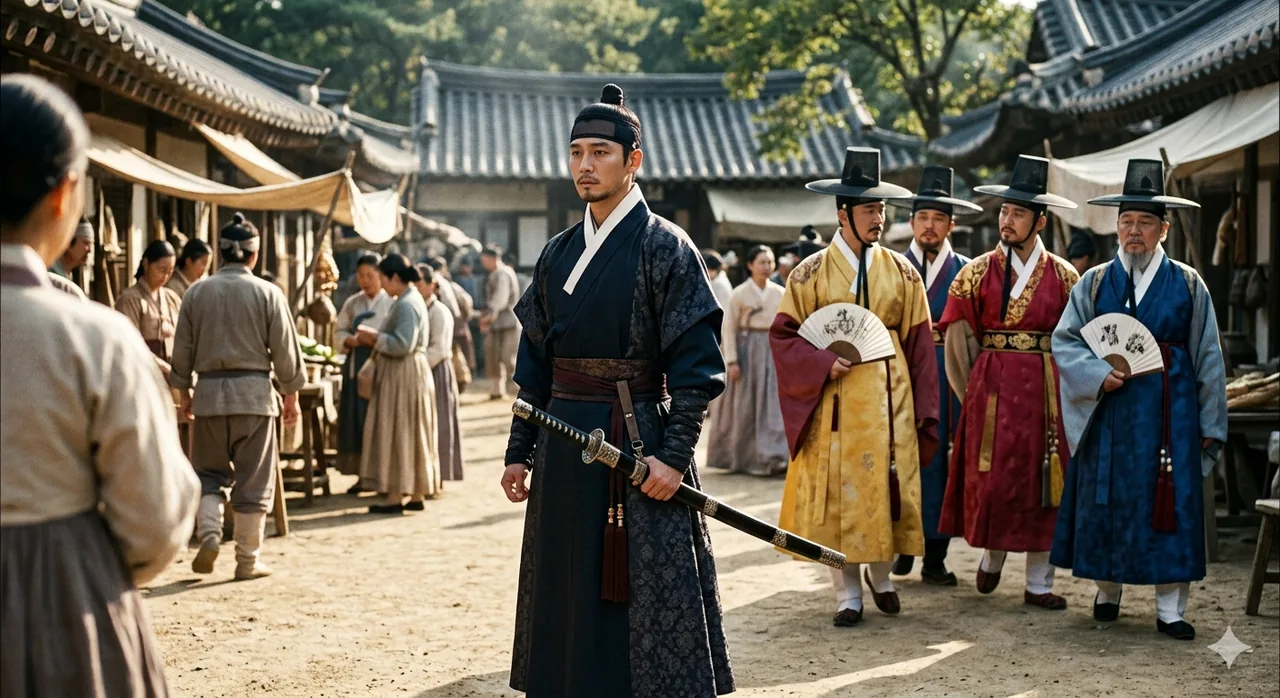
If you’ve watched Netflix’s 2018 epic Mr. Sunshine (미스터 션샤인), you know Go Ae-shin before you know her name: a Joseon noblewoman who runs across rooftops, vaults down alley walls, and fires a long rifle at pro-Japanese collaborators — all without her hanbok skirts ever seeming to slow her down (About Netflix). Secretly trained as a sniper — in the drama, by the gunman Jang Seung-gu, while living under her aristocratic grandfather’s roof — she moves through 1900s Hanseong like the city belongs to her.
It’s a striking image precisely because it collides with an assumption a lot of international viewers carry into any premodern East Asian costume drama: that a “traditional” Asian woman’s body was, in some way, physically constrained — bound, hobbled, folded into stillness. Joseon Korea never did that. Unlike its much-admired teacher, Ming and Qing China, Korea never adopted foot-binding as a recognized social institution or marriage custom — the practice that broke and permanently reshaped the feet of Chinese girls for roughly a thousand years. But that fact needs to be handled carefully, because it’s easy to over-read it. The absence of one very specific bodily mutilation is not the same thing as freedom — Joseon built its own machinery, legal and moral rather than surgical, that regulated much of what footbinding touched elsewhere: a woman’s visibility, her marriageability, her family’s standing. Not the same institution; a comparable patriarchal function.
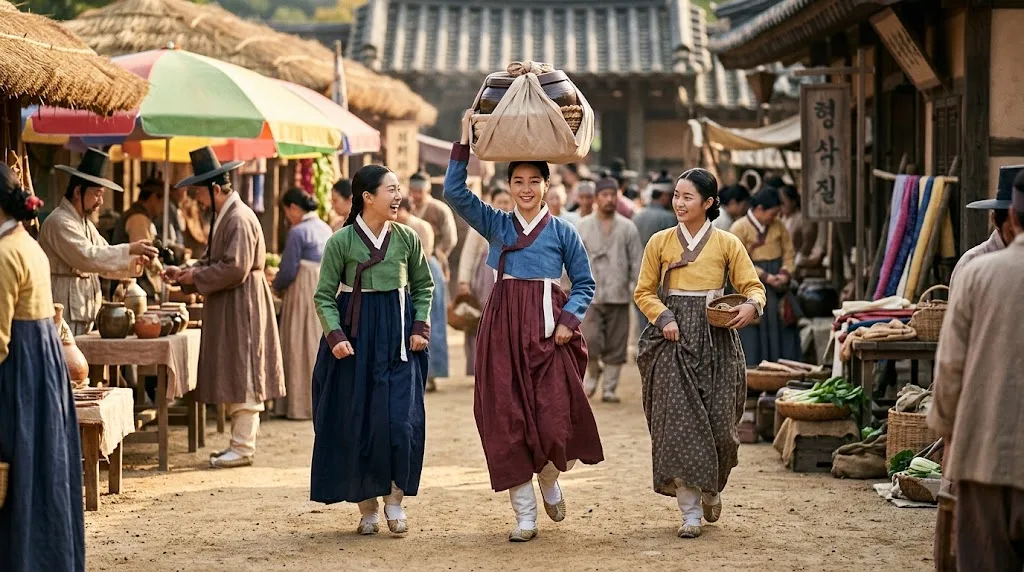 The unremarkable miracle this essay is about: Korean women, walking. In parts of late imperial China, the elite marriage market turned restricted, altered movement into a marker of feminine status. (AI illustration)
Quick answer: Joseon Korea never adopted Chinese-style foot-binding as a social institution — the roughly 1,000-year custom of breaking and reshaping young girls’ feet — a genuinely striking contrast, given how deeply Joseon copied Ming China’s laws, exams, and Confucian ritual. But don’t read that as “Joseon women were free.” Instead of permanently reshaping girls’ bodies, Joseon increasingly regulated respectable womanhood through gender segregation (naeoebeop), public face-covering norms for elite women in the later period, penalties attached to widow remarriage, and state promotion of female chastity (yeolnyeo) that could create intense pressure toward self-sacrifice. These systems were not equivalents of foot-binding — but they served a comparable patriarchal function: defining respectable womanhood and narrowing women’s choices.
Let’s unpack it.
Was a noblewoman sniper like Go Ae-shin ever real?
Not quite as the drama stages her — but the world she’s dropped into is real, and one detail is closer to fact than fiction suggests.
Mr. Sunshine’s Righteous Army (의병, uibyeong) were genuine Korean guerrilla fighters who resisted Japanese encroachment from the 1890s through the 1910s. And real women stood inside that resistance: Yun Hui-sun (윤희순, 1860–1935) — from a family of Confucian scholars, married into a prominent righteous-army household of the Hwaseo school — composed nationalist battle songs (including the first Korean militia song known to be written by a woman), raised funds, and supported weapons-making for the fighters (Encyclopedia of Korean Culture, 윤희순; The Korea Times). Later accounts also credit her with organizing local women — a group often numbered around 30 — for resistance activity around 1907, in what is remembered as one of Korea’s earliest organized women’s righteous-army efforts, though the group’s precise size and military structure are less securely documented than her songs and munitions work. The crucial difference from the drama is role, not spirit: there is no verified historical case of a woman serving as a lone armed sniper the way Ae-shin does. The real story is collective — organizing, arming, singing an army into existence — and the drama distills it into a single invented heroine.
What isn’t invented, though, is the physical premise underneath her: a Joseon woman’s body was never surgically altered to restrict how she moved. To see why that’s worth pointing out at all, you need the Chinese counter-example the drama is implicitly arguing against.
So why didn’t Confucian Joseon copy China’s foot-binding?
Joseon imported almost everything else from Ming China — its law code, its exam system, its ancestral rites, its entire intellectual framework. Foot-binding, one of the most visible markers of elite womanhood in China for centuries, never crossed the border. Be honest about the state of the evidence first: no surviving Joseon document gives a single official explanation for why the custom was not adopted. The best answer is comparative — built from what foot-binding was, and wasn’t, in China itself.
First, timing and identity: according to one traditional account, foot-binding began among court dancers in 10th-century China, and it spread through the elite during the Song dynasty (960–1279) — well after Korea had already built its own independent aristocratic and marriage customs — and it remained an overwhelmingly Han Chinese practice, not a universal “Confucian” one (World History Encyclopedia, Foot-Binding). Even inside China’s own borders, groups whose women needed to work, travel, or ride — including, notably, China’s own Manchu rulers once they took power — did not bind feet. The Manchu Qing court banned the custom among civilians in 1664, only to rescind the ban in 1668 in the face of Han resistance (Encyclopædia Britannica, Footbinding). The Qing case shows that foot-binding was deeply embedded in Han social practice rather than something imposed — or removable — from the imperial center. Which makes its absence in Joseon less surprising than it first appears: adopting Chinese Confucian institutions never required adopting every Han Chinese bodily custom.
Second, and more pointed: Confucian classics never mandated it. The principle that a child’s body is a gift from one’s parents existed in both countries — and it prevented foot-binding in neither of them by itself, since Chinese society accommodated both that principle and the custom for centuries. What the comparison actually shows is that Confucianism underdetermined how a society disciplined women’s bodies. China’s gender order came to run partly through the reshaped foot; Joseon’s came to run through visibility, marriage and chastity — machinery that left girls’ feet intact while regulating much of the rest of a woman’s life.
If not footbinding, then what actually controlled a Joseon woman’s life?
Mostly, three things: where her body could be seen, whether she could remarry, and how far she was expected to go to prove her devotion to a husband — alive or dead.
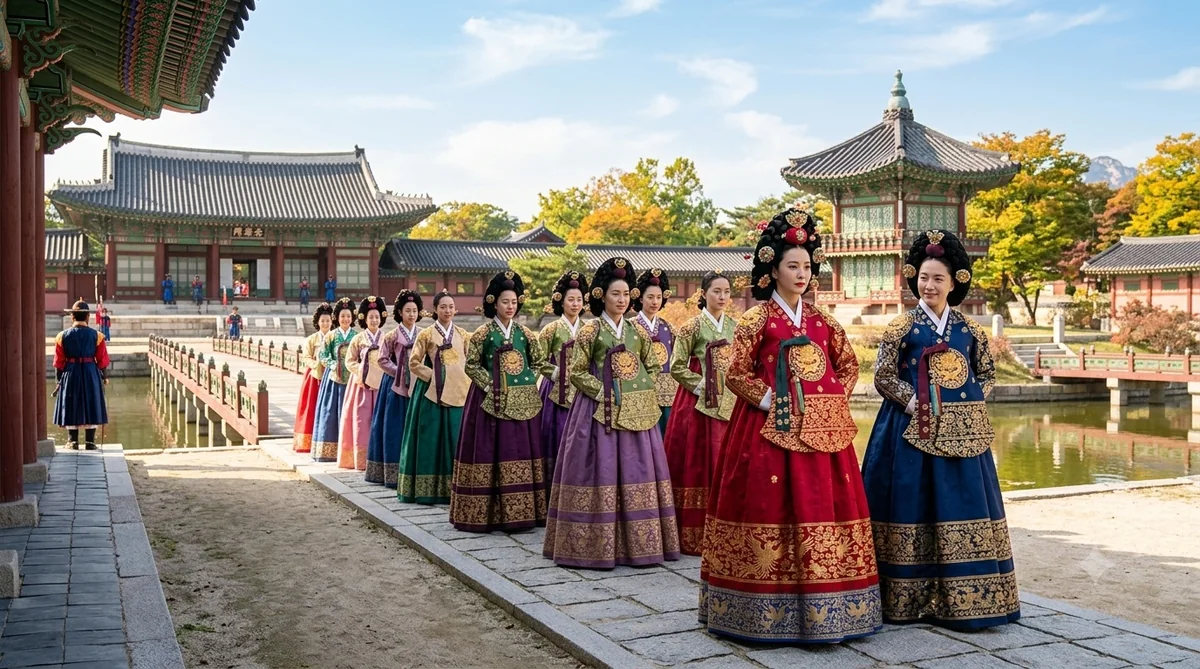
The first was naeoebeop (내외법), the Confucian principle of separating men’s and women’s spheres, which hardened over the Joseon period into real restriction on where and how a woman’s body could appear in public. A respectable woman leaving her home was, by the later Joseon period, expected to cover her face — in a hooded outer robe called jangot (장옷) or a headpiece-skirt called sseugaechima (쓰개치마), garments whose class associations blurred and mixed by the dynasty’s final decades — specifically “because of strict naeoebeop” governing what an unrelated man could see of her (Encyclopedia of Korean Culture, Jangot). Foreign observers who visited late Joseon Korea recorded just how far this went: one 19th-century Western traveler described women as unable even to look at any man besides their own husband — an outsider’s account that carries its era’s orientalist exaggeration, but points at a real norm (National Institute of Korean History, 우리역사넷). No bone was ever broken to enforce that. A veil and a social rule did the job instead.
The second was marriage law, and this is where the real machinery lived. In Goryeo, widow remarriage was legally and socially far more acceptable than it would later become — even royal women could remarry — and that relative ease carried into Joseon’s early decades, when women still held independent inheritance rights (National Institute of Korean History, 우리역사넷). Then Neo-Confucian orthodoxy tightened its grip. The court had debated restricting widow remarriage from as early as 1436; in the seventh lunar month of 1477 a rule was enacted barring the sons and grandsons of a remarried noblewoman from holding government office, and it entered the dynasty’s foundational law code, the Gyeongguk Daejeon (경국대전), in force from the start of 1485 (Encyclopedia of Korean Culture, 과부재가금지법). It wasn’t a direct criminal ban on remarriage — a widow could still legally remarry, and among commoners, remarriage driven by economic necessity never disappeared. But for a status-conscious yangban family whose standing ran through sons entering office, barring a remarried woman’s descendants from the exam path could function much like a practical ban. No surgery. Just a law that made a woman’s second marriage politically and socially costly far beyond her own lifetime.
The third was yeolnyeo (열녀) — the “chaste woman” ideal, and the most severe of the three. The state didn’t just discourage remarriage; it rewarded lifelong widowhood, and by the later period the reward system increasingly elevated women who died defending their chastity or took their own lives after a husband’s death — helping make self-sacrifice an admired extreme of female virtue. Women recognized as yeolnyeo received memorial gates built in their honor, tax exemptions, even elevated status for enslaved women, and their stories were spread nationwide through illustrated morality texts like the Samgang Haengsildo (Encyclopedia of Korean Culture, 열녀). Crucially, the bar for what counted as sufficiently virtuous rose over time. Early Joseon honored women simply for staying unmarried and tending their husband’s ancestral rites. By the 17th century and after, the standard increasingly meant dying alongside — or shortly after — one’s husband, whether by starvation, hanging, or worse. Here’s the discomfort this piece won’t smooth over: Joseon spared women’s bodies one specific, institutionalized form of injury, and then built a value system whose social pressure, at its most extreme, could end in a woman taking her own life to satisfy it. A different mechanism from foot-binding, and not an equivalent one — but in its extremes, not a gentle one either.
Did every Joseon woman live under these constraints the same way?
No — and this matters for keeping the picture honest. Naeoebeop and the veil requirements pressed hardest on yangban women: a noblewoman’s face, marriage, and widowhood were tied up in her family’s status and its access to office, which is exactly why the constraints on her were so elaborate. The yeolnyeo reward system, by contrast, reached across status lines — the state honored chaste widows of every rank, commoners and even enslaved women included — though the pressure bit deepest where a family’s standing depended on it. And for commoner and enslaved women, the vast majority of the population, economic necessity made elite-style seclusion far less practical: they worked fields, homes and markets, and moved through public space daily. They were not free of gender hierarchy — family and community norms reached them too — but the form and intensity of restriction differed sharply by status. Freedom of movement in Joseon, in other words, was partly a function of how much status a family had to protect.
Here’s the drama’s core image measured against the historical record:
| In Mr. Sunshine | In real history |
|---|---|
| Go Ae-shin, a yangban noblewoman, trains as a sniper and moves through the capital at night | No verified case of a lone woman sniper; Korea’s real 1907 women’s righteous-army unit was organized by Yun Hui-sun — about 30 women who drilled and sustained the resistance with munitions and supply work |
| Ae-shin’s hanbok never restricts a sprint, a climb, or a gunfight | Historically accurate in one specific sense: Joseon never adopted foot-binding, so a Korean woman’s feet, unlike a Chinese woman’s, were never surgically broken and bound |
| Ae-shin disguises herself as a man to move freely after dark | Reflects a real constraint — naeoebeop restricted a respectable woman’s visibility in public, forcing workarounds rather than the total physical incapacitation foot-binding caused elsewhere |
| The show frames her defiance as a personal, almost singular act of rebellion | Real constraints on Joseon women were chiefly legal and institutional (the 1485 remarriage penalty, the yeolnyeo reward system) — a structure, not just a personal cage to individually defy |
Key terms. Naeoebeop (내외법) — the Confucian principle separating men’s and women’s spheres, which by late Joseon required respectable women to cover their faces in public. Jangot / sseugaechima (장옷 / 쓰개치마) — the outer robe and headpiece-skirt Joseon women wore to cover their faces when leaving home. Yeolnyeo (열녀) — the state-rewarded ideal of the “chaste woman,” a widow who never remarried or who died to preserve or prove her fidelity. Gwabu jaega geumjibeop (과부재가금지법) — the rule, codified in the Gyeongguk Daejeon by 1485, barring the descendants of a remarried noblewoman from government office.
Three civilizations, three different targets on a woman’s body
Here’s what makes Go Ae-shin’s unbound stride worth pausing on: almost every premodern patriarchal society found some way to mark or manage a woman’s body. What’s genuinely interesting — and this is where the comparison earns its keep — is how differently each one chose to aim.
China — the feet, for a thousand years. Foot-binding — traditionally traced to court dancers in 10th-century China — spread through the Song-dynasty elite and eventually reached deep into the general population. What started as an upper-class fashion statement became, over centuries, a hard requirement of the marriage market itself: a small, bound foot signaled elegance, moral virtue, and modesty, and families without the means to bind a daughter’s feet risked her prospects entirely (World History Encyclopedia, Foot-Binding). It endured roughly a millennium, outlasted the Qing court’s 1664 civilian ban (rescinded by 1668), and was only formally outlawed by the new Republic of China in 1912 — with the practice not fully disappearing until decades later (Encyclopædia Britannica, Footbinding).
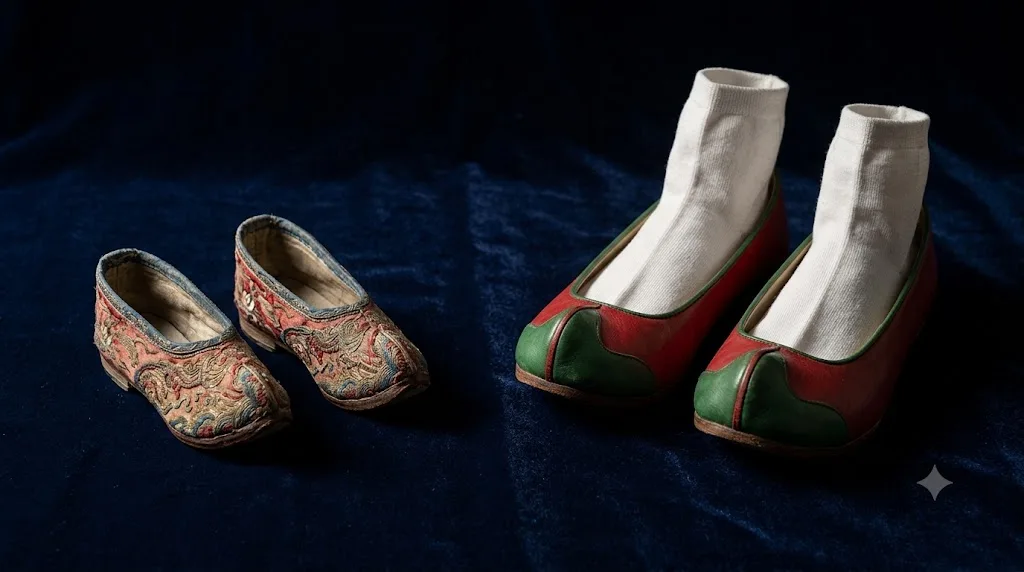 Two pairs of women’s shoes, one era. The size difference is the entire argument. (AI illustration)
One caution before the tour: foot-binding, corsetry and Joseon’s legal-moral controls are not equivalent practices — they differed in severity, prevalence, and social meaning. The comparison earns its keep at exactly one level: very different societies made respectable femininity visible through disciplined bodies, clothing, or conduct.
The West — the waist. European and later American fashion found its own anatomical target: the corset, which shaped a woman’s ribs and waist rather than her feet. Worn first by aristocratic women and later adopted by the emerging bourgeoisie, the corset carried its own physical costs — period physicians debated its links to respiratory trouble and difficult childbirth, and studies of skeletal remains have been read as showing rib deformation from long-term “tight-lacing,” though the scholar behind one widely cited study has since revisited some of her own premises, so the osteological case should be cited with care (Encyclopædia Britannica, Corset). Corsetry only lost its grip in the 1920s, when the flapper era’s looser silhouette made an unbound waist fashionable for the first time in generations.
Korea — no widespread body-modification custom, but legal, spatial and moral regulation instead. Set beside those two, Joseon’s approach looks almost like a different species of control. No girl’s foot was ever broken for the marriage market; no woman’s ribs were laced into a new shape. Be precise about the limits of that claim, though: Joseon was not free of bodily harm done in virtue’s name — the culture honored finger-cutting (danji) to feed blood to a dying parent, and the yeolnyeo ideal, at its extreme, ended in women’s deaths. What Joseon lacked was a standing institution of childhood mutilation tied to marriageability. And a noblewoman’s actual room to move — where she could be seen, whom she could marry twice, what she owed a dead husband — was locked down by naeoebeop, marriage law, and the yeolnyeo cult just as tightly, if not identically. Even the era’s most famous fashion crackdown ran on different logic: when elaborate wig headdresses called gache (가체) ballooned in the 18th century, kings Yeongjo and Jeongjo restricted them chiefly as ruinous extravagance — wedding costs that bankrupted families — with their size and weight also drawing criticism as impractical and physically burdensome (Encyclopedia of Korean Culture, 가체).
Watch Go Ae-shin vault over a rooftop tile in that unbroken, unbound stride, and you’re watching something historically real: a body Joseon never systematically reshaped with a binding cloth. Just don’t mistake that unbound foot for an unregulated life.
Coming up next
One rooftop chase — and we’ve traveled from a real 1907 women’s militia to a thousand years of Chinese foot-binding, to Manchu emperors who couldn’t ban their own subjects’ customs, to Victorian rib cages bent by lacing, to a 1485 law that could end a Korean bloodline’s future over a second marriage. That’s the quiet gift of a good historical drama: even a single stride carries a whole argument about what a body was, and wasn’t, allowed to be.
In the next essay, we’ll take another K-drama scene that looks like pure fiction — and trace the real Korean history hiding underneath it.
Frequently asked questions
Is Mr. Sunshine based on a true story? Not literally — Go Ae-shin and the other main characters are fictional. But the world around them is real: Joseon Korea in the 1900s, the Righteous Army resistance against Japanese encroachment, and the arrival of American diplomats and businessmen are all historically grounded. Real women supported that resistance — most famously Yun Hui-sun, who wrote militia songs and aided righteous-army activity through organizing, fundraising and weapons-related work — but no verified record shows a lone aristocratic sniper like Ae-shin.
Did Joseon Korea ever practice foot-binding? No. Despite importing enormous amounts of Chinese Confucian philosophy, law, and court ritual, Joseon never adopted foot-binding, the roughly thousand-year Chinese practice of breaking and binding young girls’ feet. Korean women’s feet went physically unaltered throughout the dynasty.
If Joseon didn’t bind women’s feet, does that mean Joseon women were free? No — and this is the key distinction. The absence of foot-binding means Joseon women were spared a specific form of bodily mutilation. It does not mean they had freedom of movement or choice. Confucian Joseon restricted women through naeoebeop (the norm and social system separating the inner female sphere from the outer male one), face-covering norms for respectable women in the later period, a legal penalty on widow remarriage from 1477–85, and a state-rewarded chastity ideology (yeolnyeo) whose pressure, at its extreme, could push women toward self-harm and suicide.
Why didn’t Korea adopt Chinese foot-binding? No Joseon source gives a single official reason. The most defensible explanation is comparative: foot-binding was not a universal Confucian requirement but a historically specific custom that developed largely within Han Chinese society. Joseon adopted Chinese political and ritual ideas selectively while keeping its own marriage practices, clothing and standards of female respectability.
Was foot-binding required by Confucianism? No. Confucian texts did not require girls’ feet to be bound, and several deeply Confucian societies — including Korea and Japan — never adopted the custom. Foot-binding developed within specific parts of Chinese society and coexisted with Confucian ideas rather than following automatically from them.
Did all Chinese women bind their feet? No. Prevalence varied enormously by period, region, ethnicity and class. The practice became especially common among Han Chinese women in many regions, but Manchu, Mongol and various other communities generally did not bind feet — one reason it makes no sense to treat foot-binding as a universal “Asian” or “Confucian” custom.
Could Joseon women remarry? It depended on the era. Early Joseon genealogies record women remarrying with little stigma, and women held independent inheritance rights. That changed after a law effectively barring the descendants of remarried noblewomen from holding government office was written into the Grand Code (경국대전, Gyeongguk Daejeon) by 1485. It was not a direct ban on remarriage itself, but it made remarriage so costly to a woman’s family that it functioned as one in practice among the yangban class.
What was yeolnyeo, and how far did it go? Yeolnyeo (열녀) was the ideal of the “chaste woman” — a widow who never remarried, or who died to protect her chastity or follow her husband in death. The state rewarded it with memorial gates, tax exemptions, and status upgrades, and promoted it through books like the Samgang Haengsildo. Over the Joseon period the bar for recognition rose, from simply staying unmarried to dying alongside or shortly after one’s husband — real physical harm, just channeled through a different mechanism than footbinding.
Sources & further reading
This piece was written from the historical script and fact-check of 사뚱샘의 역사방 (SaDDungSam). Key sources are cited inline above. For broader reading:
- Yun Hui-sun (윤희순, 1860–1935) — Korea’s first women’s righteous army, 1907. (The Korea Times)
- Gwabu jaega geumjibeop (과부재가금지법) — the 1485 law penalizing the descendants of remarried noblewomen. (Encyclopedia of Korean Culture)
- Foot-binding’s roughly thousand-year history and its end — origins, spread, and 1912 abolition. (World History Encyclopedia · Encyclopædia Britannica)
Thanks for reading — see you in the next one.
This article was researched and written by K-Drama History. Source: Netflix's Mr. Sunshine, Explained: Why Joseon Never Bound Its Women's Feet — and What It Controlled Instead — K-Drama History