Feng Shui (Myeongdang), Explained: Did Namyeongun's Tomb Really Make Gojong King?
Theme: Belief, Death & the Uncanny
From the research behind Pause the Drama.
If you’ve seen the 2018 Korean film Myeongdang (Feng Shui), you know the question that drives it: can seizing the right burial ground actually change a family’s fate? (For the film and Korean feng shui more broadly, see our companion piece on Myeongdang and the art of geomancy.) In Korea’s late-Joseon history, no one embodies that question more dramatically than Heungseon Daewongun, Yi Ha-eung — father of King Gojong and, for a time, the center of Korean politics (Encyclopedia of Korean Culture — Yi Ha-eung).
And here’s the story people have told ever since: his rise to power wasn’t just politics — it was a grave.
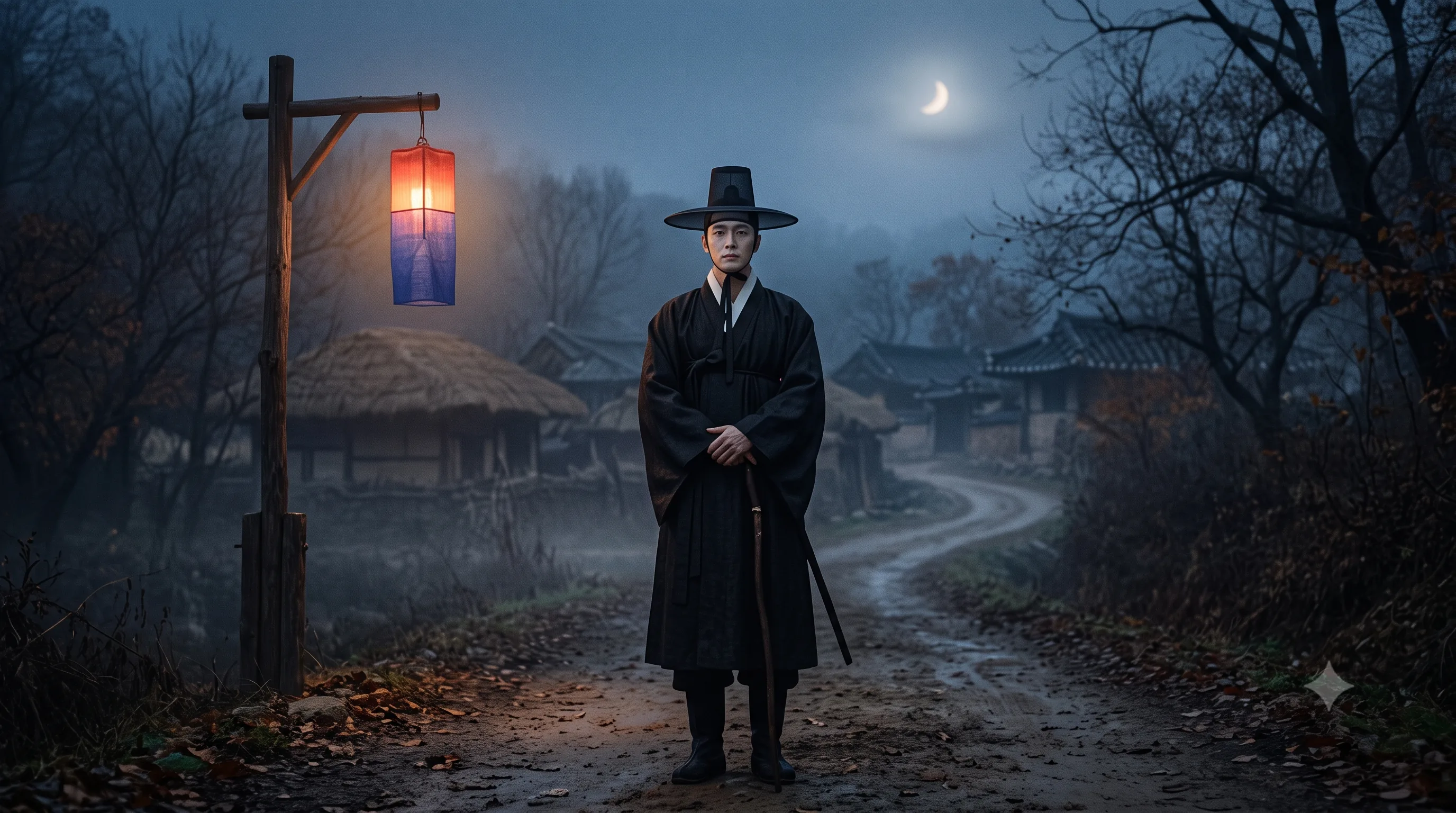
 In Joseon, a myeongdang — an auspicious grave site — could be tied to a family’s very destiny. (AI illustration)
Quick answer: In 1846, Yi Ha-eung — later Heungseon Daewongun — relocated his father Namyeongun’s tomb from Yeoncheon to a site below Gayasan. Later tradition called it idae cheonja ji-ji, “a place that would produce emperors for two generations.” Namyeongun’s grandson, Myeongbok, did become King Gojong — but the grave provided no mechanism of succession. After King Cheoljong died without an heir in 1863, the Queen Dowager Sinjeong chose Myeongbok amid a struggle over the throne and the power of the Andong Kim clan. The relocation is documented history; the claim that the site caused the accession is a powerful, retrospective feng-shui tradition — and the 1868 Oppert grave-robbing hardened it into political legend.
Let’s unpack it.
The tomb that supposedly made a king
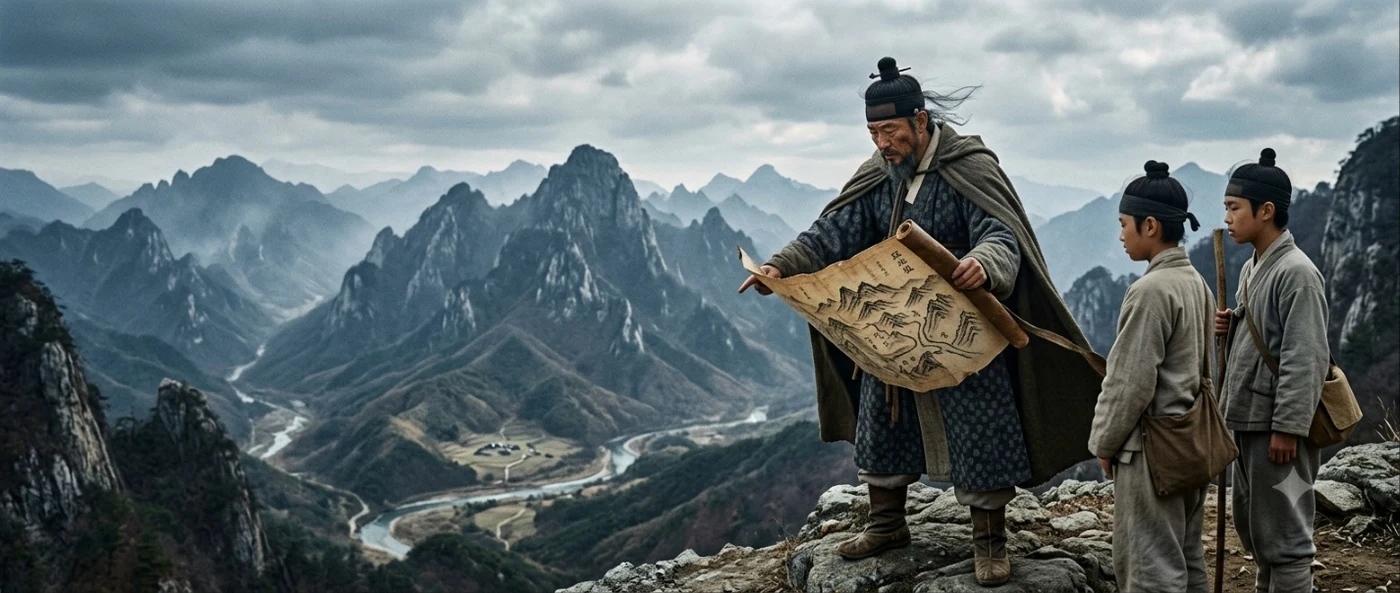
The heart of the story is one relocated grave. Heungseon Daewongun’s father was Yi Gu, Prince Namyeongun. His tomb had stood in Yeoncheon, Gyeonggi Province — but Heungseon had it moved to the foot of Gayasan in Deoksan, Chungcheong. Records say the grave was relocated to its present site at the foot of Gayasan in 1846 (the 12th year of King Heonjong) (Encyclopedia of Korean Culture — Tomb of Namyeongun). And the chosen spot was not empty land: Gayasa Temple and its pagoda had stood there first. Later accounts — including official heritage descriptions — say Heungseon had the temple cleared and the pagoda removed to make way for the grave, though some histories present the temple’s burning as a widely circulated story rather than a securely documented fact.
A geomancer, Jeong Man-in, is said to have identified the location as idae cheonja ji-ji (二代天子之地) — “a place that would produce emperors for two generations.” And in a way that seemed to prove itself: Namyeongun’s grandson, Myeongbok, later became the 26th king of Joseon — Gojong (Encyclopedia of Korean Culture — Gojong), and Gojong’s own son Sunjong would reign after him. With rulers actually emerging from the line, people connected the grave site directly to the succession — the two-generations prophecy reading all the more neatly because it was told and retold once the outcome was known.
History versus feng-shui legend
Here’s the distinction that matters most. That the Namyeongun tomb was moved to its present site by 1846 is something we can confirm from the historical record. But the explanation that “Gojong became king because of that grave site” is less a historical cause-and-effect than the feng-shui imagination of the time. The real mechanism was political and genealogical. When King Cheoljong died without an heir in 1863, the Queen Dowager Sinjeong (Jo) selected Heungseon’s twelve-year-old son Myeongbok to continue the royal line — a choice bound up in the era’s power struggles, above all the drive to check the dominant Andong Kim clan. The tomb legend gave that political decision the language of destiny only after the fact.
Burial geomancy was, all the same, taken seriously — a belief system known as eumtaek feng shui (음택풍수, the geomancy of burial sites) (Encyclopedia of Korean Culture — Feng shui / pungsu). Within that worldview, the story of the Namyeongun tomb grew into a potent political legend. So the accurate way to read it is this: the relocation is real history; the claim that the grave produced a king is a feng-shui tradition. And that tradition wasn’t socially trivial just because its causal claim can’t be demonstrated — decisions about graves were taken seriously by many families and political elites, and could involve status, lineage rivalry, property, and ambition as much as belief.
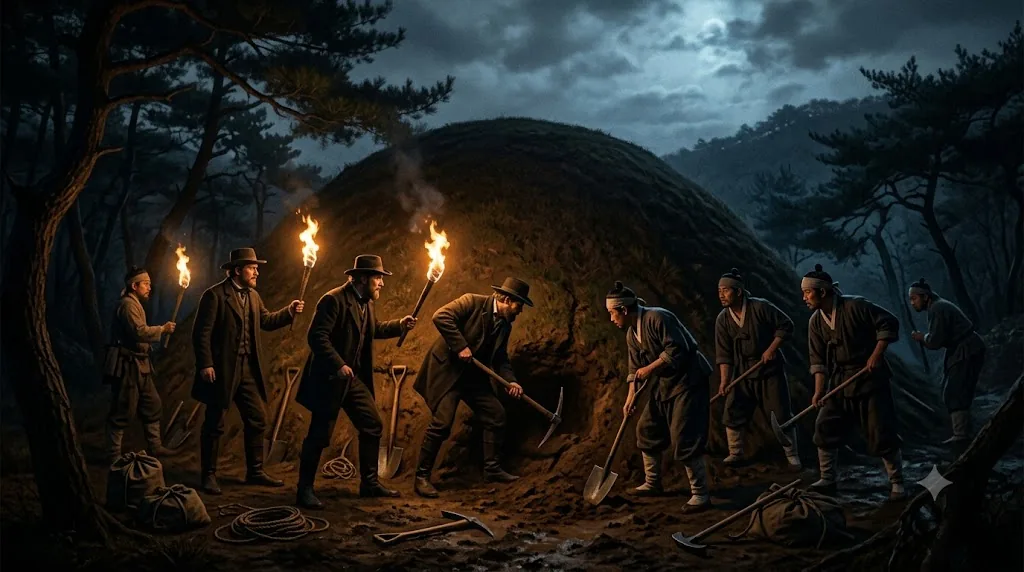 The 1868 Oppert grave-robbing attempt turned the Namyeongun tomb into a political legend. (AI illustration)
The grave robbery that made it famous
The tomb’s fame owes a great deal to a scandal. In 1868, a party led by the German merchant Ernst Oppert tried to dig up Namyeongun’s grave — reportedly hoping to use the remains of the regent’s father as leverage to force the Joseon government into negotiations (Encyclopedia of Korean Culture — Oppert’s attempted robbery of the Namyeongun tomb).
To Koreans, this was no ordinary act of robbery. It was an assault on the grave of the reigning king’s own grandfather — a violation of human and familial order that touched the royal family’s fortune and the authority of the ancestors. The tomb’s masonry held and the robbery failed; but the incident did more than deepen the site’s mystique — it hardened anti-Western and anti-Catholic sentiment across Joseon and gave the government further grounds to reject foreign demands for trade and contact.
So the Namyeongun story is best understood not as proof that geomancy really makes kings, but as a vivid example of how deeply grave sites, ancestors, family fortune, and royal power were woven together in Joseon society. That’s exactly why the characters in Myeongdang are willing to kill over a burial ground. To a Joseon person, a myeongdang was never just a piece of land — it was a family’s future, the legitimacy of power, and sometimes the fate of a dynasty itself.
Key terms. Myeongdang (명당) — an auspicious site, especially a burial ground believed to bring good fortune. Eumtaek feng shui (음택풍수) — the geomancy of grave sites, based on the belief that an ancestor’s tomb shapes descendants’ fortunes. Namyeongun (남연군) — Yi Gu, Heungseon Daewongun’s father, whose grave is at the center of the legend. Heungseon Daewongun (흥선대원군) — regent father of King Gojong.
Here’s the drama decoded:
| In Myeongdang | In real history |
|---|---|
| People kill over an auspicious grave site | Joseon really did treat a myeongdang as world-altering |
| A grave that “produces a king” | The Namyeongun tomb was called exactly that |
| Feng shui changing a dynasty’s fate | A belief system (eumtaek feng shui), not a proven mechanism |
| The regent’s rise tied to a grave | Namyeongun’s grave was moved (1846); Gojong did become king |
| Foreigners violating a sacred tomb | The real 1868 Oppert grave-robbing attempt |
Believing that place shapes destiny — around the world
The idea that the land itself can decide a family’s or a nation’s fortune wasn’t Korea’s alone. Many cultures have read power into specific places and objects.
The West had its own geomantic and place-based traditions — from geomancy (divination by reading the earth) to sacred coronation objects like the Stone of Scone, on which Scottish and later English monarchs were crowned, treated as if legitimate kingship itself lived in the stone (Britannica — Stone of Scone). The comparison is symbolic rather than institutional, though: the Stone of Scone never claimed that an ancestor’s burial place altered a descendant’s fortune. What the cases share is the broad human intuition that certain ground and certain sites carry a power tied to those who hold them. Feng shui itself formed in China and spread across East Asia; what Korea developed was a distinctive local form of burial geomancy — adapted to its mountainous terrain and its lineage-and-politics culture — a whole grammar for reading the fortunes of the dead into the futures of the living. Seen that way, the Namyeongun tomb isn’t a quaint superstition; it’s a window into a culture that read destiny in the shape of a hillside.
Coming up next
One grave — and we’ve traveled from a film’s fatal obsession to a hillside on Gayasan, a German merchant’s midnight dig, and a Scottish coronation stone. That’s the quiet gift of a good historical drama: a single burial site is a doorway.
In the next essay, we’ll take another K-drama scene that looks like pure fiction — and trace the real Korean history hiding underneath it.
Frequently asked questions
Did feng shui really make Heungseon Daewongun’s son a king? That’s feng-shui legend, not established cause and effect. It’s historically documented that Heungseon Daewongun moved his father Namyeongun’s grave to a site on Gayasan around 1846, and that his grandson later became King Gojong. But the claim that the grave site caused Gojong’s accession reflects the feng-shui imagination of late-Joseon society, not a proven historical mechanism.
What is the Namyeongun tomb? It’s the grave of Yi Gu, the Prince Namyeongun — father of Heungseon Daewongun and paternal grandfather of King Gojong. Originally in Yeoncheon, Gyeonggi Province, it was relocated to the foot of Gayasan in Deoksan, Chungcheong, by around 1846. Because Gojong later took the throne, people linked the burial site to the royal succession and called it a “spot that would produce a king.”
What was the Oppert grave-robbing incident? In 1868, a party led by the German merchant Ernst Oppert attempted to dig up the Namyeongun tomb, reportedly hoping to use the remains of the regent’s father to pressure the Joseon government. To Koreans this was not a mere robbery but a shocking violation of the royal family’s ancestral authority — and it helped make the tomb’s legend even more famous.
Sources & further reading
This piece was written from the historical script and fact-check of 사뚱샘의 역사방 (SaDDungSam). Key sources are cited inline above. For broader reading:
- Heungseon Daewongun (흥선대원군, Yi Ha-eung) — regent father of King Gojong. (Encyclopedia of Korean Culture / 한국민족문화대백과)
- The Tomb of Namyeongun (남연군의 묘) — the relocated grave at the center of the legend, at Deoksan, Gayasan. (Encyclopedia of Korean Culture)
- Feng shui / pungsu (풍수) & eumtaek feng shui — the geomancy of grave sites. (Encyclopedia of Korean Culture)
- Oppert’s attempted robbery of the Namyeongun tomb (1868) — the incident that made the tomb famous. (Encyclopedia of Korean Culture)
- King Gojong (고종) — Namyeongun’s great-grandson, the 26th king. (Encyclopedia of Korean Culture)
- The Stone of Scone — the Western place-and-power parallel. (Encyclopaedia Britannica)
Thanks for reading — see you in the next one.
This article was researched and written by K-Drama History. Source: Feng Shui (Myeongdang), Explained: Did Namyeongun's Tomb Really Make Gojong King? — K-Drama History