Why the Korean Grim Reaper Wears a Black Hat — and Why It Isn't an Ancient Tradition
Theme: Belief, Death & the Uncanny
From the research behind Pause the Drama.
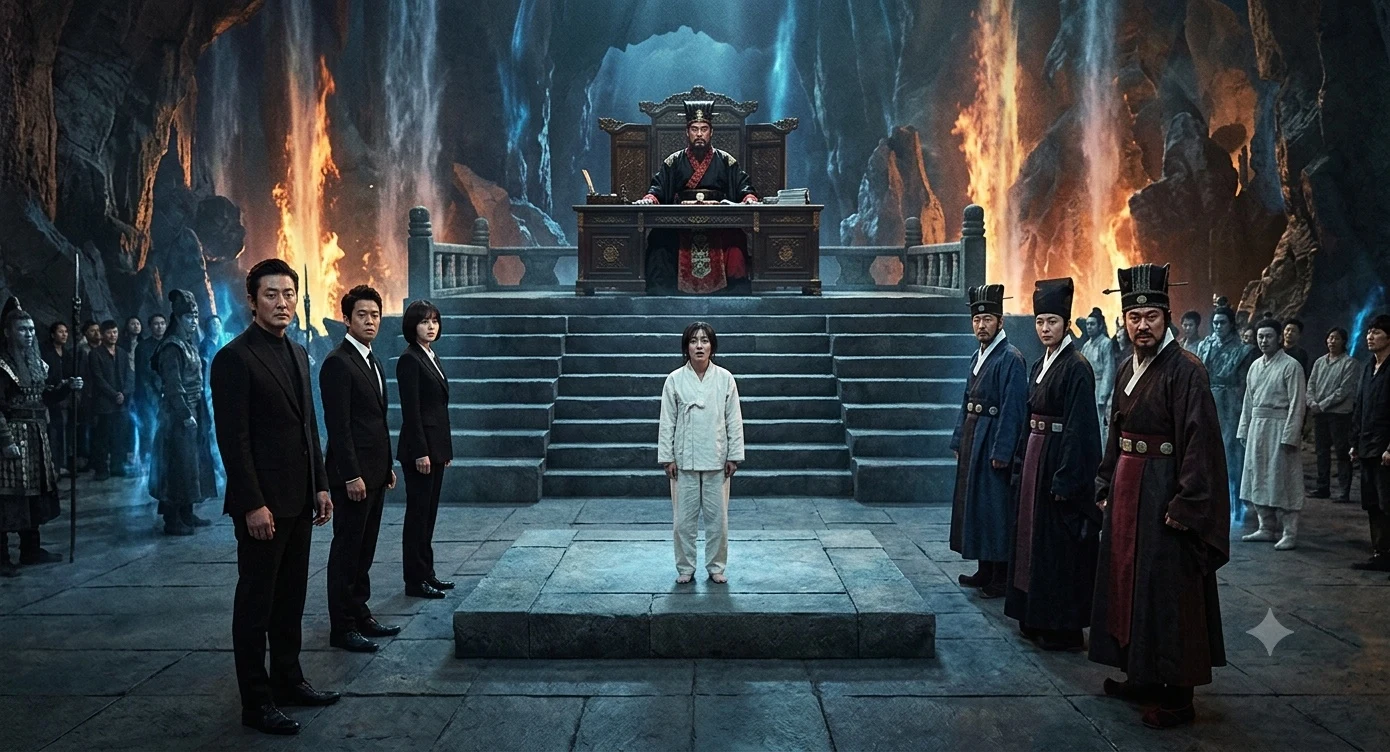
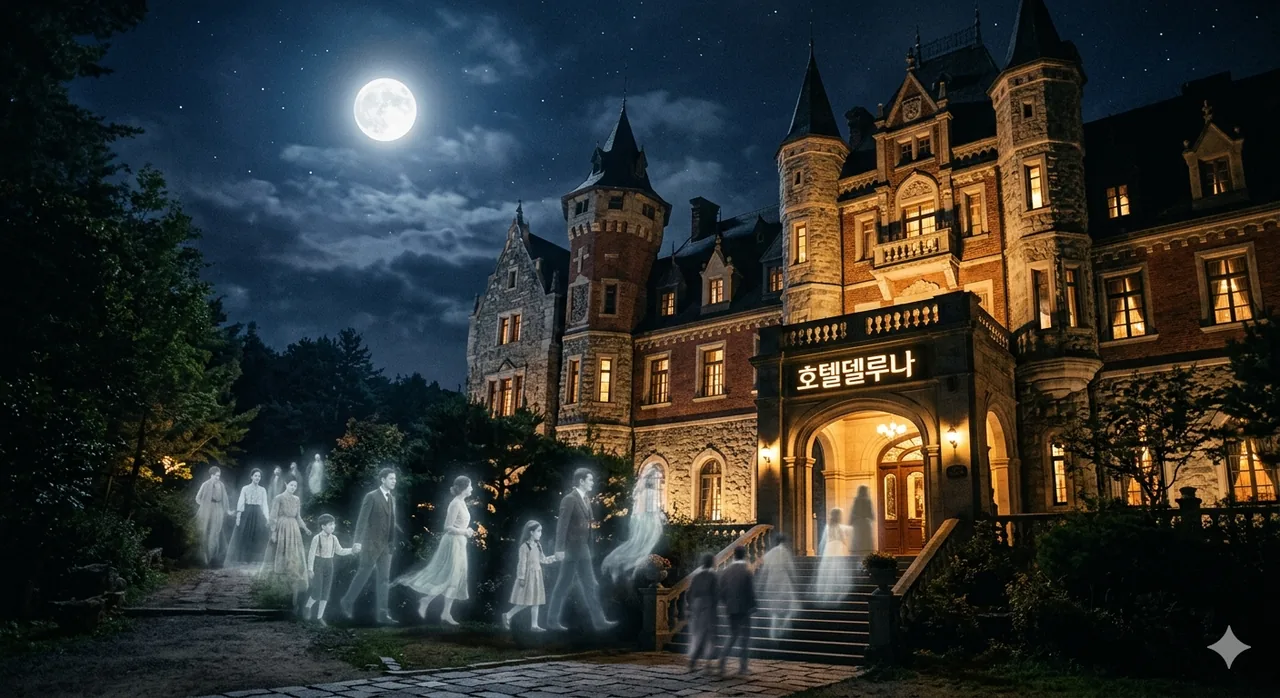
If you’ve watched the beloved 2016 K-drama Guardian: The Lonely and Great God (도깨비), you remember the Grim Reaper — a quiet, elegant man in a black fedora and long black coat, appearing beside the newly dead to walk them to the other side. You’ve met him again in Hotel del Luna (2019), where the dead check into a hotel between worlds, and in Along with the Gods (2017), where black-clad guardians escort a fallen firefighter through the trials of the afterlife.
Across all of them, Korean death wears the same outfit: dark clothes, and a black hat. It feels ancient, inevitable, traditional. But here’s the twist most international fans never hear: the black-hatted reaper is not from any old scripture — and the real Korean death-messenger is less a monster than a kind of civil servant.
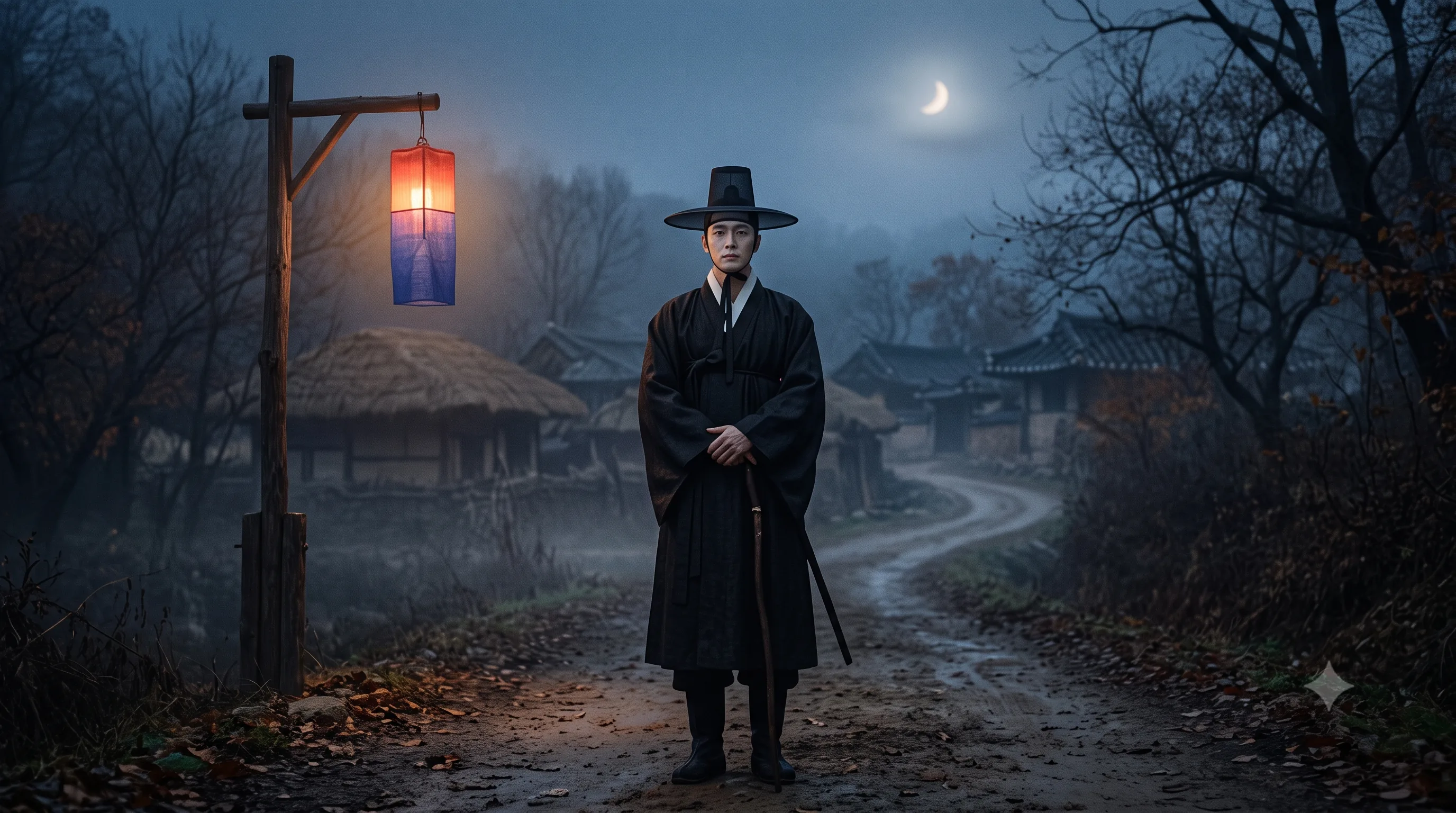 The jeoseung-saja as K-dramas imagine him — a calm figure in a black hat, waiting by the road. But where does that black hat come from? (AI illustration)
Quick answer: In dramas like Guardian (Goblin), Hotel del Luna, and Along with the Gods, the Korean grim reaper — the jeoseung-saja (저승사자) — arrives in a black hat and coat. But this look isn’t drawn from tradition. Older folktales and Buddhist paintings usually pictured the death-messenger as a soldier or official, not a hooded skeleton. The black gat (traditional hat) reads as the mark of an underworld bureaucrat — an enforcer of cosmic order — and the all-black styling is a modern screen convention, not an ancient rule.
Let’s unpack it.
Was the Korean grim reaper always a black-hatted gentleman?
No. That polished, black-hatted figure is largely a modern creation — older ritual and folk representations pictured death’s messenger very differently.
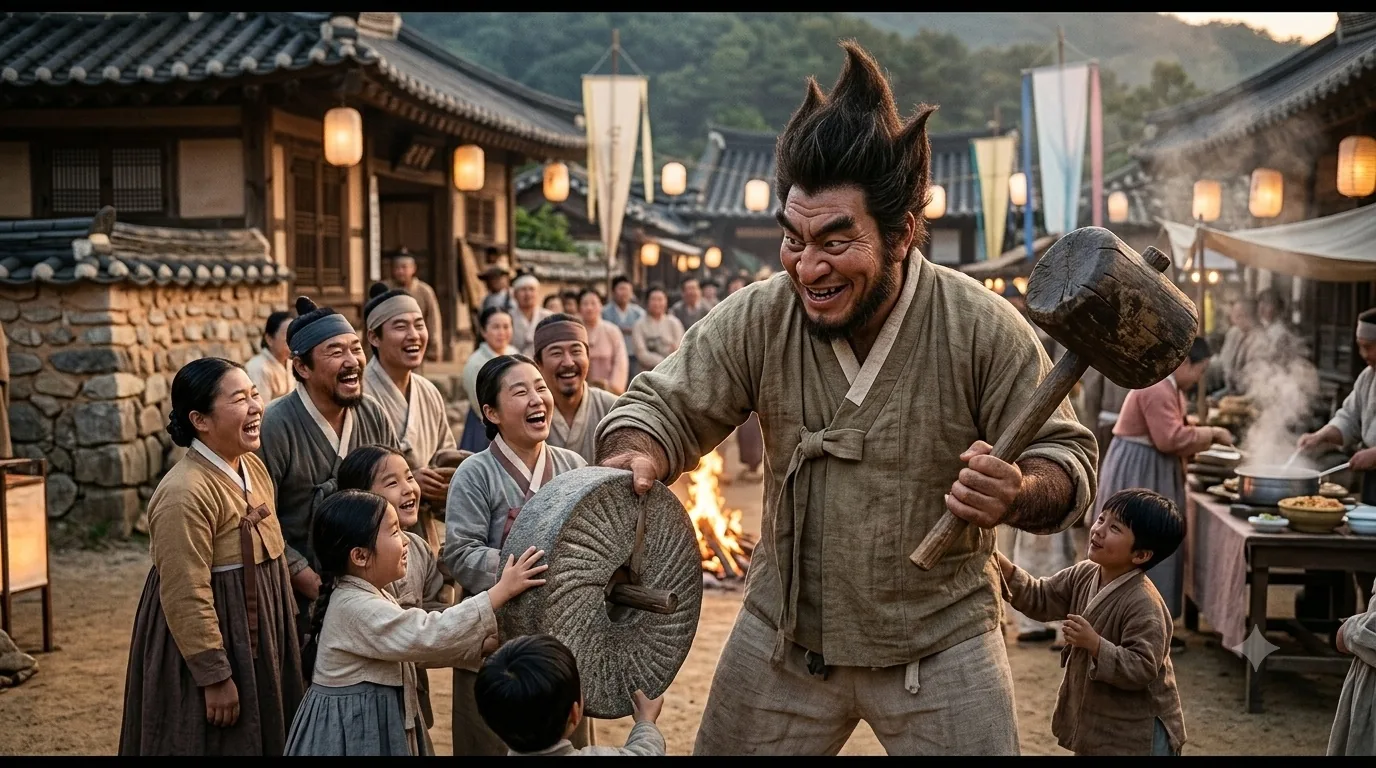
Today the jeoseung-saja is inseparable from the sleek image of black clothes and a black hat. But in older folktales, shamanic (mudang) narratives, and Buddhist hell paintings, the death-messenger was frequently drawn as a soldier, a general, or a government official — not a shadowy gentleman and certainly not a hooded skeleton. He was less a ghost than a chasa (差使): an agent dispatched on orders.
That word matters. In Korean folk belief, the underworld messenger came at the command of Yeomra (염라, the King of the Underworld) or the wider underworld order, arriving to collect a person whose appointed lifespan had ended — working from fixed records, not personal malice (Encyclopedia of Korean Culture — Jeoseung-saja · Chasa bon-puri, the shaman narrative of the death-messenger’s origins). He didn’t hunt or destroy on a whim. He executed a warrant. Put simply: the Korean death-messenger is closer to “a civil servant of the underworld” than to “the monster of death.”
Why a black hat — and specifically a gat?
Because the hat borrows the visual language of a formally dressed Joseon man. The gat (갓) was the signature hat of the adult Joseon male — worn not only by yangban officials but widely across society — and, depending on its material and trim, it could also communicate status and rank (Encyclopedia of Korean Culture — Gat).
So when a death-messenger appears wearing a black gat, that formal silhouette makes him look less like a wandering ghost and more like an authorized agent of the underworld. The hat lends the air of official authority — it says, this being has jurisdiction over you.
But — and the fact-check here is important — this is best read as a symbol, not a rule fixed in any text. There is no old scripture that decrees “the death-messenger shall wear a black gat.” Rather, the modern reaper is what happens when the image of a Joseon official fuses with the styling of contemporary film and television — a look standardized in Korean media in no small part by television, notably the long-running ghost-story anthology Korean Ghost Story (전설의 고향), which helped fix the now-familiar image of the black-robed, black-hatted, pale-faced messenger in the popular imagination (Encyclopedia of Korean Culture — Jeoseung-saja). The result feels timeless, but it’s a relatively recent visual invention dressed in traditional cloth.
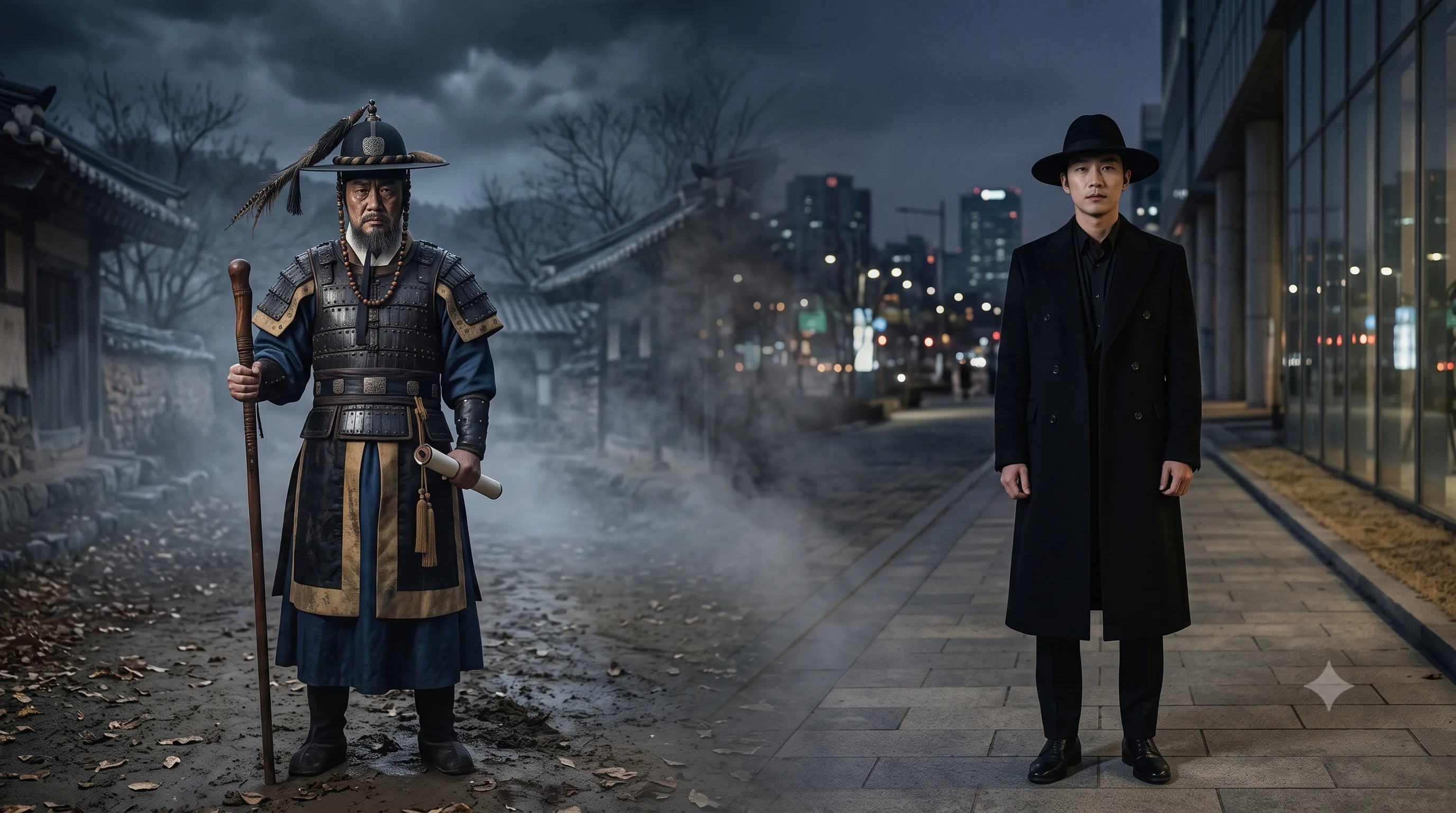 In older tradition the death-messenger was often pictured as a soldier or official (left). The black-hatted “gentleman” reaper (right) is a modern screen image of the same idea. (AI illustration)
Why black? Wasn’t white the color of Korean mourning?
This is the detail that surprises people most. In Korean tradition, the color of death was not always black.
Joseon mourning was strongly associated with white and undyed hemp (삼베) — the coarse, pale cloth of funeral garments. In fact, a mourner might wear a white gat, the baengnip (백립), rather than a black one (Encyclopedia of Korean Culture — Gat). If anything, the color tied to death in Korea leaned white, not black — which makes the reaper’s black gat especially telling: the white gat mourns death; the black gat comes to enforce it. So why, then, is the on-screen reaper drenched in black?
The answer is modern visual grammar. In contemporary film and television, a black suit, black coat, and black hat instantly communicate solemnity, cold distance, and the chill of the beyond. Black became the fast, legible shorthand for “this figure comes from the world of the dead, not the living.” Dramas dress the jeoseung-saja in black not because tradition demanded it, but because black lets a viewer feel, in a single frame, that death has entered the room.
Key terms. Jeoseung-saja (저승사자) — the Korean death-messenger who collects the dead and guides them onward. Chasa (차사, 差使) — an “agent dispatched on orders,” the older concept behind the messenger: an enforcer, not a free-roaming spirit. Gat (갓) — the traditional black hat of a Joseon man, a marker of rank and propriety that lends the reaper an air of official authority. Yeomra (염라) — the King of the Underworld, on whose orders the messenger acts.
Here’s the single trope decoded:
| In the dramas | In real tradition |
|---|---|
| A black-hatted gentleman reaper | Often a soldier, general, or official — not a fixed “look” |
| Death arrives as a lone figure | The messenger is a chasa, dispatched on the underworld’s orders |
| All-black clothing = death | Traditional Korean mourning leaned toward white hemp |
| The hat feels ancient and required | A modern screen image blending a Joseon official with film styling |
| The reaper decides who dies | He collects those whose appointed lifespan has already ended |
How the jeoseung-saja differs from the Western Grim Reaper
Line the two up and you can see two different ideas about death itself.
The West — death personified. The Grim Reaper is usually death itself given a body: a hooded skeleton draped in black, carrying a scythe to “harvest” souls (Britannica — Where Does the Concept of a “Grim Reaper” Come From?). He is not someone’s employee; he is the end. The imagery is about the raw fact of mortality — the leveling force that comes for everyone.
Korea — death’s functionary. The jeoseung-saja is not death embodied. He is the being who carries out death’s orders — collecting a person by name, according to a fixed lifespan and underworld records, and escorting them to judgment. This is exactly why the reaper fits so naturally into Along with the Gods, where the escorted dead move through a sequence of afterlife trials: the messenger is the usher at the courthouse door, not the judge and not the executioner. (For the seven-trial structure of that Korean underworld — the Ten Kings and the 49-day judgment — see our companion piece, Why Along with the Gods Has Seven Afterlife Trials.)
So the black hat of the K-drama reaper isn’t mere decoration. It carries three things at once: the dread of death, the authority of the underworld’s order, and the procedural role of the one who escorts you onward. Just don’t mistake it for something the old texts required — the traditional messenger wore many faces, and the black-hatted gentleman is our own age’s way of making that ancient idea legible on screen.
Coming up next
One black hat — and we’ve traveled from a Goblin’s melancholy companion to Joseon officials, white hemp funeral cloth, and a skeletal Western scythe-bearer. That’s the quiet gift of a good historical drama: a single costume choice is a doorway.
In the next essay, we’ll take another K-drama scene that looks like pure fiction — and trace the real Korean history hiding underneath it.
Frequently asked questions
What is a jeoseung-saja? The jeoseung-saja (저승사자) is the Korean death-messenger — the being who comes to collect the dead and guide them to the underworld. Traditionally understood as a chasa (差使), an “agent dispatched on orders,” it acts on the authority of the underworld’s kings rather than killing on its own whim. It is closer to an enforcer or escort than to a monster.
Is the black hat and black coat historically accurate? Not as a fixed rule. In older folktales, shaman narratives, and Buddhist paintings, the death-messenger was often shown as a soldier, general, or official — not a black-hatted gentleman. The now-iconic black hat and coat are best understood as a modern screen convention that blends the image of a Joseon official with contemporary film styling, not a detail preserved from scripture.
How is the Korean grim reaper different from the Western one? The Western Grim Reaper is usually death itself personified — a hooded skeleton with a scythe. The Korean jeoseung-saja is not death embodied but a functionary who carries out death’s orders, collecting the deceased according to a fixed lifespan and underworld records and escorting them to judgment. One is the face of death; the other is its civil servant.
Why is the K-drama reaper always dressed in black if white was the color of Korean mourning? Traditional Joseon mourning did lean toward white and undyed hemp — a mourner might even wear a white gat (baengnip) — so black isn’t the “authentic” color of Korean death. The all-black styling is modern visual shorthand: on screen, black clothing instantly signals solemnity and the world beyond, letting viewers feel death has arrived without a word of explanation.
Is the jeoseung-saja a god? No. He is usually understood as a messenger or agent acting under the authority of Yeomra (the King of the Underworld) or the Ten Kings, not as a deity in his own right.
Does the Korean grim reaper kill people? Traditionally, no. He does not choose or cause death on his own. He collects those whose appointed lifespan has already ended and escorts them to the underworld — an enforcer of a fixed order, not the cause of death.
Sources & further reading
This piece was written from the historical script and fact-check of 사뚱샘의 역사방 (SaDDungSam). Key sources are cited inline above. For broader reading:
- The jeoseung-saja (저승사자), the black-hatted death-messenger — its now-standard image, popularized through Korean television. (Encyclopedia of Korean Culture / 한국민족문화대백과 — “저승사자”)
- Chasa bon-puri (차사본풀이) — the shaman narrative explaining the death-messenger’s origins and errands. (Encyclopedia of Korean Culture)
- The gat (갓), the Joseon man’s hat — the marker of rank and propriety that lends the reaper his official air. (Encyclopedia of Korean Culture)
- The Ten Kings of Hell (시왕상) — the underworld judges behind the 49-day judgment the messenger escorts you toward. (Encyclopedia of Korean Culture) See also the companion piece on Along with the Gods and Korea’s seven afterlife trials.
- Where does the concept of a “Grim Reaper” come from? — the Western death-figure for contrast. (Encyclopaedia Britannica)
Thanks for reading — see you in the next one.
This article was researched and written by K-Drama History. Source: Why the Korean Grim Reaper Wears a Black Hat — and Why It Isn't an Ancient Tradition — K-Drama History