From the research behind Pause the Drama.
If you’ve watched KBS’s sprawling historical epic Empress Myeongseong (명성황후, 2001–2002) — 124 episodes tracing a teenage bride’s rise into the most powerful woman in the Joseon court — you already know where it’s heading. The music turns cold. Foreign men in dark coats move through the palace grounds at night. A court lady throws herself in front of the queen and is cut down in her place. And then the queen herself is gone.
It’s one of the most-dramatized deaths in Korean television, and the core of it is historical: Japanese-led attackers entered Gyeongbokgung before dawn, searched the queen’s residence, killed her, and burned her body — and not one of them was ever punished. What happened inside those rooms, minute by minute, is less certain than any drama can afford to admit.
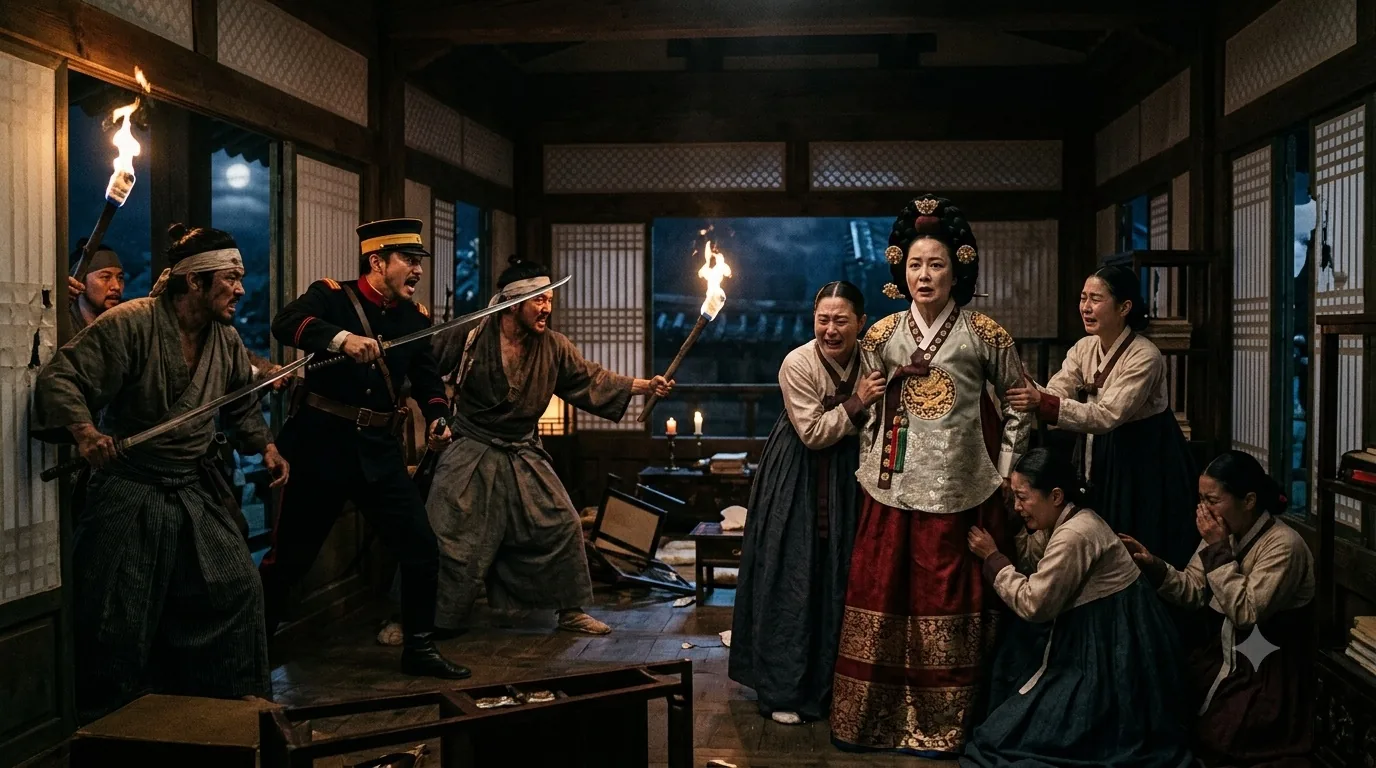 Before dawn on October 8, 1895, the queen’s own quarters at the rear of Gyeongbokgung. The intruders had to hunt through the residence to find her — and court ladies died in the process. (AI illustration)
Quick answer: In the early hours of October 8, 1895, a group of Japanese agents organized by Japan’s own minister to Korea, Miura Gorō, broke into Gyeongbokgung Palace, killed Queen Min (later titled Empress Myeongseong), and burned her body. It’s known in Korea as the Eulmi Incident (을미사변). Japan referred the men to its own courts the following year — and the case was thrown out at the preliminary stage, before any trial took place.
Let’s unpack it.
Why did Japan want the queen dead?
Because, after the Triple Intervention, she and her allies increasingly looked to Russia as a counterweight to Japan — and Japan had just been shown, humiliatingly, that Russia could make it back down.
The sequence matters, and it was fast. On April 17, 1895, the Treaty of Shimonoseki ended the First Sino-Japanese War and handed Japan the Liaodong Peninsula. Six days later, on April 23, Russia, Germany, and France jointly “advised” Japan to give it back — the Triple Intervention. By May 4 Tokyo had decided to comply, and the formal retrocession convention followed on November 8. Japan had beaten China and then been made to hand back the prize by three European powers who never fired a shot.
Korea’s court read that correctly: Japan was not unstoppable, and a counterweight was available. Queen Min and her allies leaned into it. This was less a fixed pro-Russian doctrine than the latest adjustment in a court that had spent two decades shifting its footing between Qing, Japan, Russia, and the United States.
To Miura Gorō — a former army general newly installed as Japan’s minister in Seoul, with little diplomatic experience — the queen was the central figure driving that realignment. It would overstate it to call her the only obstacle Japan saw, and it would also understate who was involved: Miura developed the plan to remove her together with other Japanese figures in Seoul, including the legation secretary Sugimura Fukashi, Okamoto Ryūnosuke, and Kusunose Sachihiko. This was not one hothead acting alone.
What actually happened inside the palace that night?
Before dawn on October 8, 1895 (August 20 by the lunar calendar), a force assembled under Miura’s direction forced its way into Gyeongbokgung: Japanese legation staff, Japanese army guards, consular police, newspapermen, and hired sōshi — armed civilian toughs — along with members of the Korean Training Battalion, a Japanese-trained Korean unit then facing dissolution. The killing took place at the rear of the palace in Geoncheongung (건청궁), in the queen’s own quarters, the Gonnyeonghap–Okhoru complex (곤녕합 옥호루).
The intruders hunted through the residence for her, and court ladies were killed in the process. Exactly how the attackers identified the queen is not settled: 우리역사넷 describes men who did not know her appearance, while the British consul Walter Hillier’s report — quoted in the Encyclopedia of Korean Culture — describes one attacker carrying a photograph of her, and court ladies who resembled her being killed. Afterward her body was burned. The Russian architect Afanasy Seredin-Sabatin, working inside the palace that night, was among the foreign witnesses whose accounts made denial impossible.
Japanese officials initially framed the raid as an internal Korean coup, led by the Daewongun and the Training Battalion. The record does not support that framing: planning and command ran through Miura and the Japanese legation. Two things still have to be held apart, and this is where careless writing usually goes wrong — that some Training Battalion soldiers and Korean collaborators took part is a separate question from who planned and directed the operation, and the Daewongun’s presence and political role must be assessed separately from Japanese efforts to portray the night as primarily a Korean affair.
Here’s the drama’s version set beside the record:
| In Empress Myeongseong | In real history |
|---|---|
| A court lady dies shielding the queen | Several women were killed because the assassins couldn’t identify the queen on sight |
| Dark-coated foreign agents move through the palace at night | The raid was organized by Japan’s own minister to Korea, Miura Gorō |
| The scene plays as a singular tragedy | It followed a specific diplomatic trigger — Korea’s tilt toward Russia after the Triple Intervention |
| The killers vanish from the story | The men were sent to a Japanese court — which dismissed the case before trial and released all 48 |
Key terms. Eulmi Incident (을미사변) — the October 1895 assassination of Queen Min by Japanese agents. Geoncheongung (건청궁) — the king and queen’s private residential quarters at the rear of Gyeongbokgung, where the killing took place. Agwan Pacheon (아관파천) — King Gojong’s 1896 flight to the Russian legation. Sōshi (壯士) — armed, often unemployed former-samurai-class men used by Japanese political factions for intimidation and violence, both at home and abroad.
Why did nobody go to prison for it?
Because the case was handled in Japan, by Japan — and it never actually reached a verdict.
That last part is the detail almost every retelling gets wrong, including, at first, this one. Foreign envoys in Seoul suspected Japanese involvement immediately and pressed Miura about it, and as international criticism mounted the Japanese government ordered him and the others home and referred them to judicial proceedings. Forty-eight men connected to the incident were sent to the Hiroshima District Court.
On January 20, 1896, the court closed the case at the preliminary examination stage — the pre-trial phase in which a court reviews the evidence and decides whether there is enough to send defendants to trial — and ruled the evidence insufficient to proceed. All were released without the case ever reaching a full trial.
The distinction matters. These men were not acquitted after a public trial. The case was terminated during the preliminary examination, so no public trial took place and no judgment of guilt or innocence was ever issued. What today’s sources do establish is that the operation was planned and directed by Miura and the Japanese legation. What the Hiroshima proceedings produced was no verdict at all.
What happened next — did the king just accept it?
Not for long. Terrified for his own safety inside a palace that had already proven unsafe, Gojong — with Russian help — slipped out of Gyeongbokgung in secret on February 11, 1896, and took refuge at the Russian legation in Seoul, an episode remembered as the Agwan Pacheon (아관파천, “flight to the Russian legation”). He governed Korea from Russian diplomatic grounds for roughly a year. The pro-Japanese cabinet collapsed almost immediately, and two of its ministers — Prime Minister Kim Hong-jip and Agriculture, Commerce and Industry Minister Jeong Byeong-ha — were killed by crowds in the streets.
Gojong’s return to royal rule unfolded in three distinct steps, not one. Gojong moved into Gyeongungung (today’s Deoksugung) on February 20, 1897. On October 12 he performed the imperial accession rite at the Hwangudan altar. On October 13 the Korean Empire (대한제국) was formally proclaimed. Gojong was turning the restored court into the ceremonial center of an empire claiming full sovereign equality with its neighbours — a response not only to his wife’s killing but to the collapse of Qing suzerainty and the scramble of foreign powers around him.
It did not stop what came next, and the road there was longer than the shorthand suggests: through the Russo-Japanese War, the 1904 Korea–Japan Protocol, and the First Japan–Korea Convention, Japan took Korean sovereignty in stages. In 1905 the Eulsa Treaty stripped the Korean Empire of its diplomatic powers — Gojong refused to ratify it and appointed no plenipotentiary, and the signature was forced from Foreign Minister Pak Che-sun under Japanese military pressure. Annexation followed in 1910.
Why the Eulmi Incident was an assault on Korean sovereignty, not a court intrigue
Almost every civilization in this period had monarchs who died violently. What sets the Eulmi Incident apart — and what a single-country history of Korea can’t fully show you — is who did the killing and why, because that detail tells you what kind of danger a throne actually faced. Set Korea’s case beside three others from the same rough era, and a pattern of very different threats snaps into focus.
Korea, 1895 — organized by a foreign state’s officials, on her own soil. This is the starkest category. Queen Min was not killed by a domestic rival, a lone fanatic, or a rebel faction. Serving Japanese officials — the minister to Korea, legation staff, army officers, consular police — organized an operation that also drew in civilian toughs, newspapermen, and some Korean collaborators, and carried it out inside the palace of a country Japan was not at war with. Not every man in the courtyard was a government agent; the organizing, the command, and the cover-up were governmental, and that is the part that matters.
It is worth being careful about how far to push this. Whether Tokyo issued a specific prior order is still read differently by different historians. What the record supports is heavy enough without embellishment: officials of one state used their public offices to organize the killing of another state’s queen in her own palace, and their own legal system declined to examine it — a grave violation of Korean sovereignty.
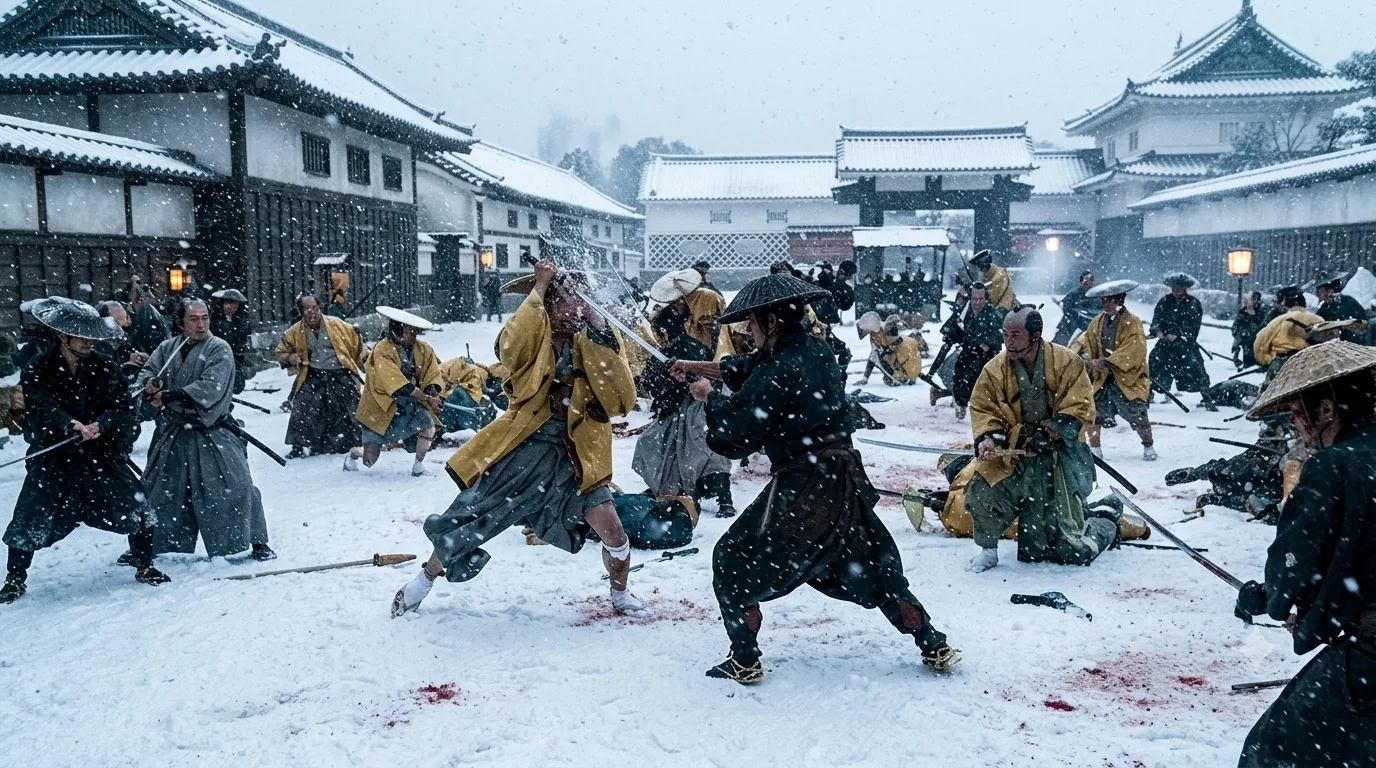 Sakurada Gate, Edo, in the snow of March 1860. The same weapon as Gyeongbokgung — men with swords settling politics — but pointed at a government, not wielded by one. (AI illustration)
Japan itself, 1860 — killed by his own countrymen, over the opposite fear. Thirty-five years before that night in Seoul, Japan’s own chief minister, the tairō Ii Naosuke, was cut down in the snow outside Edo Castle’s Sakurada Gate by eighteen attackers — seventeen former Mito retainers and one former Satsuma retainer. Their grievance was that Ii had concluded the 1858 Treaty of Amity and Commerce with the United States without imperial sanction, and had then crushed his critics in the Ansei Purge.
The temptation is to draw a straight line — masterless swordsmen then, hired sōshi later, same type of man. It doesn’t hold, and the difference is the interesting part. The Sakuradamon assassins were domain samurai striking at their own government from outside it. The sōshi at Gyeongbokgung were civilian hired muscle brought in alongside a legation, an army detachment, and consular police — men working with state power, not against it. Similar political violence, opposite relationship to state power: one struck at a government to keep foreigners out; the other served a government reaching into someone else’s country.
China, 1908 — killed from within the palace, and hidden for a century. Where Korea’s queen died at foreign hands, amid evidence and testimony from foreigners present in the palace, the Qing dynasty’s Guangxu Emperor died in a way nobody could account for at all. He died one day before his aunt and longtime political rival, the Empress Dowager Cixi, who had kept him effectively confined for years to block his reform efforts. For a century the cause of death was disputed. Then in 2008 a joint research project under China’s Qing History Compilation Committee analysed his remains, clothing, and hair and concluded he had died of acute arsenic poisoning (钟里满 et al., 清史研究 2008:4) — establishing how he died, while leaving entirely open who administered it. No one has been identified, and Cixi’s involvement remains an inference, not a finding. No foreign power, no trial, no confession — just a monarch’s death that palace secrecy nearly buried for good.
The West, 1881 and 1898 — killed by revolutionaries and anarchists acting outside state power. Europe supplies two more variations. Russia’s Alexander II was killed in 1881 by a bomb thrown by Ignacy Hryniewiecki, a member of the underground revolutionary group Narodnaya Volya (“People’s Will”) — a domestic movement trying to blow up the tsarist system from within, not a rival state (Britannica, Alexander II). Austria’s Empress Elisabeth (“Sisi”) died even more arbitrarily on September 10, 1898, stabbed in Geneva with a sharpened file by Luigi Lucheni, an Italian anarchist driven by hatred of royalty and the privileged classes. She was not even his intended target: Lucheni had come to kill Prince Henri Philippe of Orléans and switched to Elisabeth when that plan fell through — which is, if anything, a bleaker fact than a chosen assassination. Neither killer represented a government. Neither attack was ordered by any state. They were closer to what we’d now call ideological terrorism than to any of the other three cases.
Line them up and the real difference isn’t the violence — it’s who was behind it, and what that says about the danger a throne actually faced: a foreign government’s covert operation (Korea), a domestic backlash against opening to the outside world (Japan), a secret done from within the palace walls (China), and stateless revolutionary or anarchist violence (the West). A single scene of a queen dying in her own home turns out to be a doorway into four completely different ways the 19th century’s crowned heads met their end.
Coming up next
One assassination — and we’ve traveled from a dawn raid inside Gyeongbokgung, to a Hiroshima courtroom that let the killers go home, to a king fleeing his own palace for a foreign legation, to a chief minister cut down at Edo’s gates for the opposite reason, to a poisoned emperor whose death stayed a secret for a hundred years. That’s the quiet gift of a serious historical drama: even its darkest scene has a paper trail.
In the next essay, we’ll take another K-drama scene that looks like pure fiction — and trace the real Korean history hiding underneath it.
Frequently asked questions
Is KBS’s Empress Myeongseong based on a true story? Yes, in its political core. The 124-episode drama (2001–2002) follows the real Queen Min’s rise at court, her role as Gojong’s political partner, her rivalry with the Daewongun, the shifts in Korea’s foreign policy, and her killing in October 1895 — all grounded in the historical record. Individual scenes and dialogue are dramatized, and the drama tidies her politics into a more consistent personal modernization campaign than the sources support.
Who actually killed Empress Myeongseong? Miura Gorō, Japan’s minister to Korea, and key legation figures planned and directed it. Those who took part included Japanese army guards, consular police, legation staff, newspapermen, civilian sōshi, and some Korean collaborators. They entered Gyeongbokgung before dawn on October 8, 1895; the queen was killed and her body burned. Public historical sources identify the planners and the groups involved, but do not establish which individual struck the fatal blow.
Was anyone ever punished for the assassination? No. Forty-eight men were referred to the Hiroshima District Court, and on January 20, 1896 the case was terminated at the preliminary examination stage for insufficient evidence and all of them were released. That is not an acquittal after trial — the case never reached trial at all.
What happened to King Gojong after the assassination? Fearing for his own life, Gojong fled Gyeongbokgung in secret with the crown prince on February 11, 1896, and took refuge at the Russian legation in Seoul — an episode called the Agwan Pacheon. He ruled from there for about a year, moved into Gyeongungung (Deoksugung) on February 20, 1897, performed the imperial accession rite on October 12, and proclaimed the Korean Empire on October 13.
Was Korea already a Japanese colony in 1895? No. In 1895 Korea was an independent state, not a Japanese colony. In 1905 the Eulsa Treaty stripped the Korean Empire of its diplomatic powers and placed it under Japanese protectorate status — Gojong never ratified it and appointed no plenipotentiary, and the signature was forced from Foreign Minister Pak Che-sun under military pressure. Annexation came in 1910.
Sources & further reading
This piece was written from the historical script and fact-check of 사뚱샘의 역사방 (SaDDungSam). Key facts are sourced inline above. For broader reading:
- 을미사변 (Eulmi Incident) and 명성황후 (Empress Myeongseong) — full entries at the Encyclopedia of Korean Culture, Academy of Korean Studies.
- 아관파천 (Agwan Pacheon) — the king’s 1896 flight to the Russian legation, at the Encyclopedia of Korean Culture.
- 명성황후 시해와 단발령 — the assassination and its immediate aftermath, at 우리역사넷, National Institute of Korean History.
- Kim Young-Soo, “Two Perspectives on the 1895 Assassination of Queen Min,” Korea Journal 48, no. 2 (2008) — a scholarly account of the diplomatic aftermath, drawing on Russian and Japanese legation records.
Thanks for reading — see you in the next one.
This article was researched and written by K-Drama History. Source: KBS's Empress Myeongseong: The True Story of the Eulmi Assassination — K-Drama History