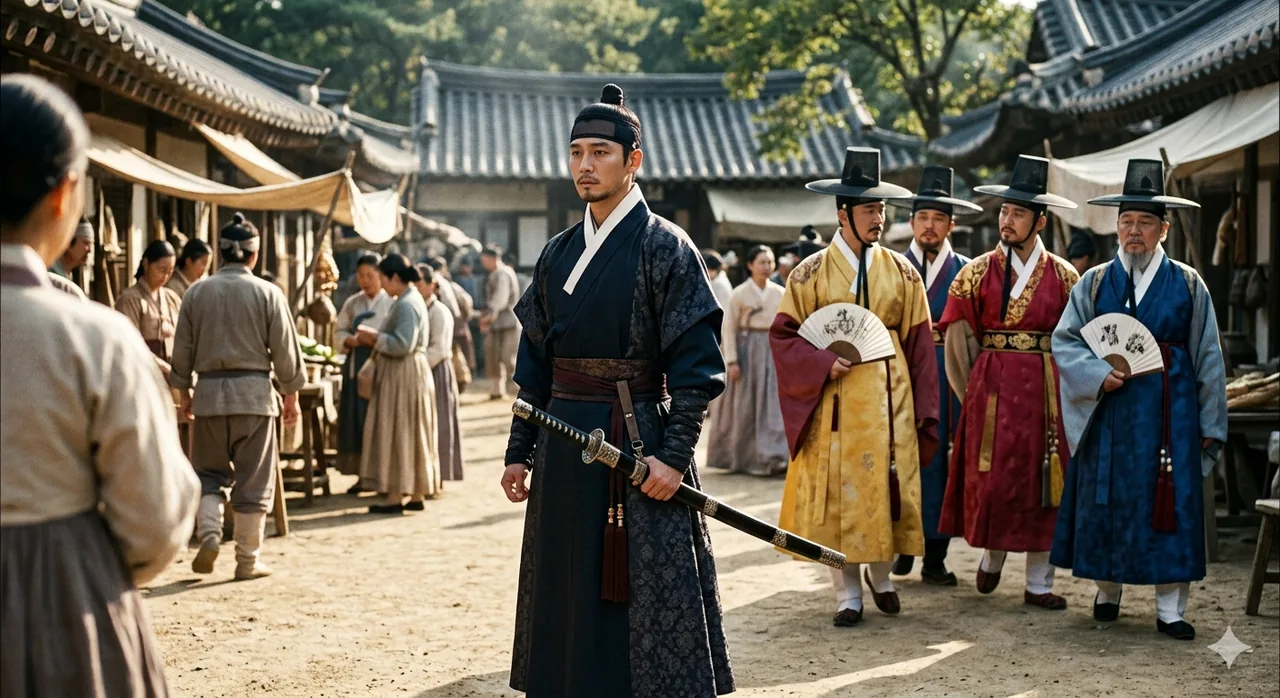
From the research behind Pause the Drama.
If you’ve watched Apple TV+‘s acclaimed 2022 series Pachinko (파친코) — the four-generation saga of a Korean family that emigrates to Japan — you’ve felt the quiet tension that runs underneath almost every scene: names. Characters hold a Korean name and a Japanese name at the same time. Some hide which one is “real.” A child learns to answer to one name at school and another at home. A grandfather’s surname becomes a thing to manage, conceal, or quietly grieve.
The show rarely stops to explain why this hurts so much. But here’s what’s underneath it: for a colonized people, being made to change your name was not paperwork. It was an attempt to change what you were allowed to be.
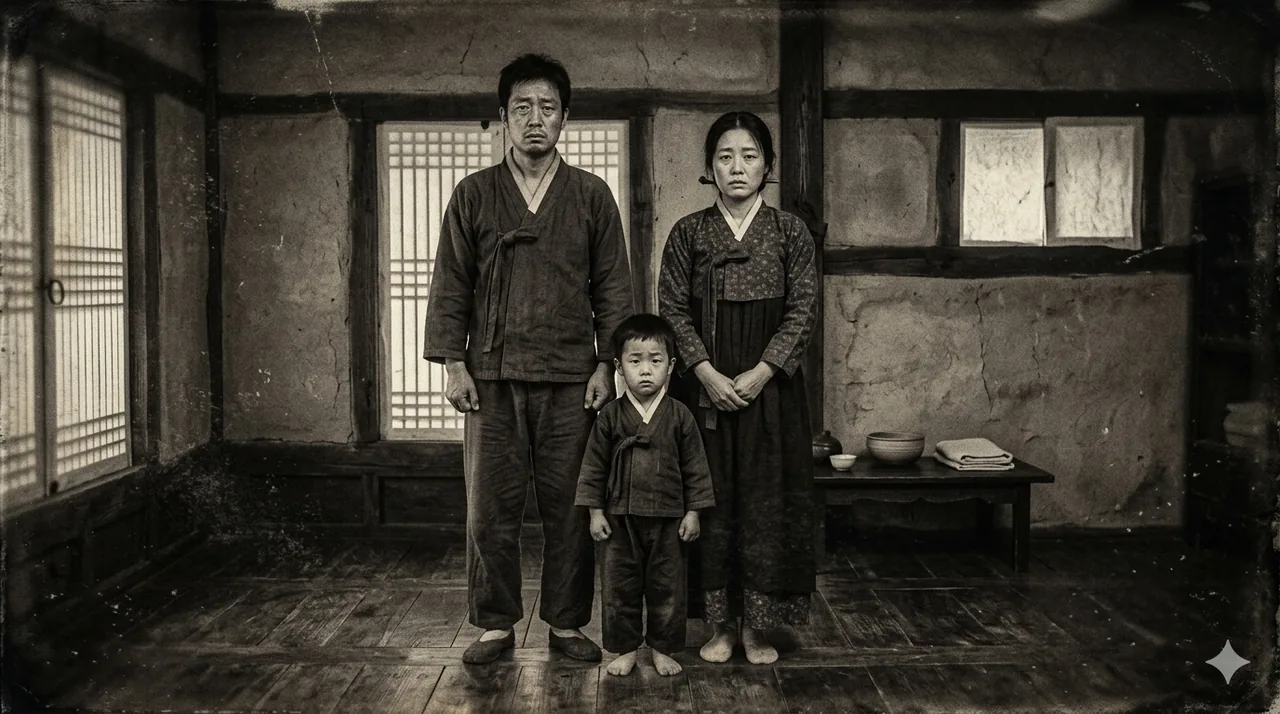 A name carried family, language, and history — which is exactly why colonial power reached for it. (AI illustration)
Quick answer: Apple TV+‘s Pachinko follows a Korean family navigating colonial Japan — and the name tension running through every scene is real history. Japan’s 1939–40 Sōshi-kaimei policy pressured Koreans into adopting Japanese names, officially “voluntary” but effectively coercive. In Korean Confucian tradition, a name is a thread tying you to your ancestors — which is exactly why colonial power reached for it. Names, it turns out, are something a people fight to lose last and rush to take back first.
Let’s unpack it.
Why is a name such a big deal in Pachinko?
Because in the Korean tradition a name is not a personal label you pick — it’s a thread tying you to your family, your ancestors, and your place in a line that goes back generations.
A Korean name traditionally carries the family surname (the clan), and often a generational name (돌림자, dollimja) — a shared syllable that marks which generation you belong to among your cousins and siblings. Your name literally locates you on a family tree. To a Confucian worldview that prized lineage and ancestral rites above almost everything, that name was sacred in a quiet, everyday way.
So when Pachinko shows a character switching between a Korean and a Japanese name, it isn’t a small inconvenience. It’s the visible edge of something much larger — a family being asked to set down the very thread that told them who they were. That’s why the show lets these moments sit in silence. The wound doesn’t need a speech.
What actually happened? The Sōshi-kaimei name policy
This isn’t only fiction. It points to one of the most painful chapters of the colonial period: a 1939–40 policy usually called Sōshi-kaimei (창씨개명, 創氏改名).
Here’s the careful version of the history. After annexing Korea in 1910, Japan’s rule grew steadily more assimilationist, and by the late 1930s — as Japan mobilized for war — it pushed a program of “imperialization” (황국신민화) meant to turn Koreans into loyal subjects of the emperor. As part of this, the colonial government issued two ordinances: an Ordinance No. 19 of 1939 requiring the “creation of a (Japanese-style) family name” (sōshi), and an Ordinance No. 20 of 1940 permitting the “change of given name” (kaimei). Together they reversed an earlier policy that had actually forbidden Koreans from taking Japanese names.
How forced was it? This is where it pays to be precise — and Pachinko is set partly in exactly these years, so it matters. On paper, registering a new Japanese-style family name was framed as voluntary notification. But the mechanism had a cruel default built in. A household that actively filed for a new name was performing what was called seoljeong-changssi (설정창씨, “creation by declaration”). A household that refused to file, however, did not get to keep its Korean surname: by law, the head of household’s existing surname was automatically read as a Japanese-style ssi — a fallback called beopjeong-changssi (법정창씨, “creation by operation of law”). In other words, silence was not a way out. The policy was engineered so that even not choosing produced a Japanese-style family name.
And the pressure to choose actively was intense. The ordinances took effect on 11 February 1940, opening a six-month registration window that closed on 10 August. As of mid-May, only about 7.6% of households had filed (Encyclopedia of Korean Culture, Academy of Korean Studies); once the administration threw its weight behind the campaign, the figure climbed to around 80% by the time the window closed on 10 August (National Institute of Korean History). One distinction is worth keeping straight: that ~80% counts households that registered a Japanese-style family name (씨, ssi) — the part the policy pushed hardest. Actually swapping one’s given name for a Japanese one (the kaimei half) was far rarer — about 9.6% of the population, by the standard scholarly count (Mizuno Naoki, Sōshi-kaimei, Iwanami Shoten, 2008). The state’s real target was the family unit, not the individual’s first name. Households that held out could face real disadvantages — barriers to schooling, employment, rationing, and postal service, and even labor conscription (징용, jingyong), plus harassment by officials. So “voluntary” is the official word; coercive in practice is the honest description most historians give. (The exact degree of force varied by region and official — but the trajectory from 7.6% to roughly 80% in three months tells its own story.)
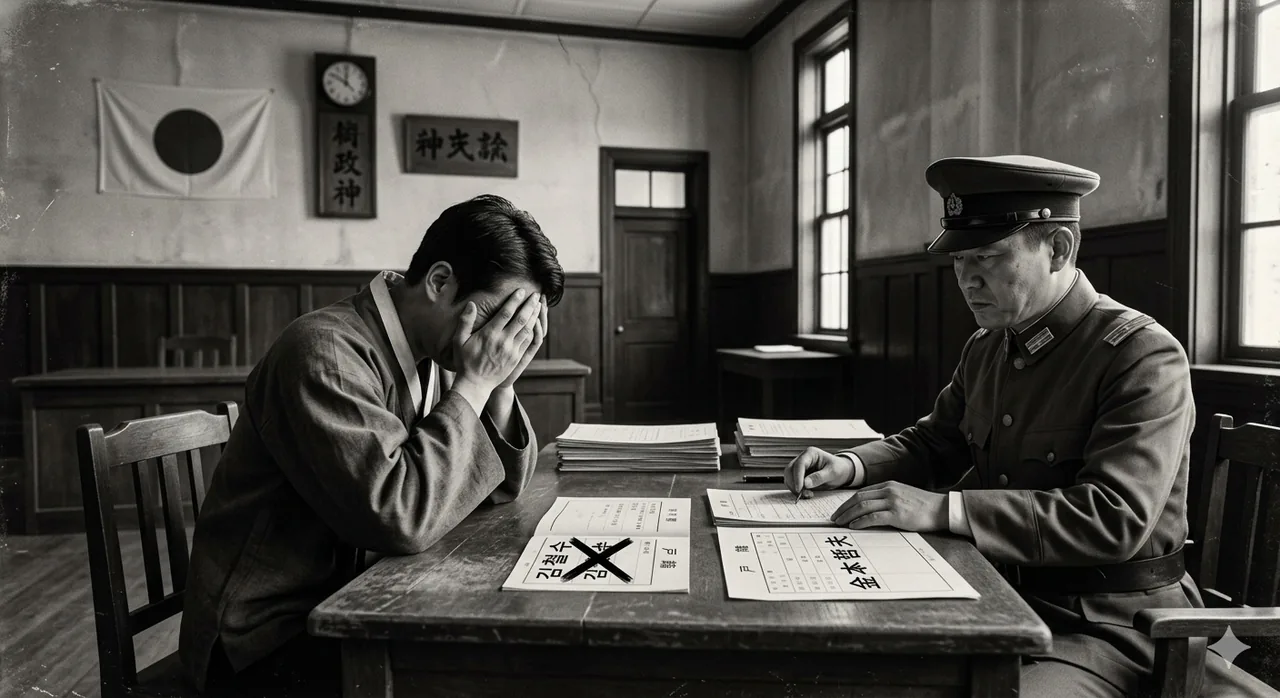 Two ordinances (1939–40) turned a family’s name into something the state could rewrite. (AI illustration)
Here is what the drama shows beside what the historical record says:
| In Pachinko | In real history |
|---|---|
| Characters manage two names — Korean at home, Japanese in public | Sōshi-kaimei (1939–40) pressed Koreans to register Japanese-style family names |
| The switch between names is laden with grief and concealment | The policy was officially “voluntary” but backed by employment, schooling, and service barriers |
| A family’s surname becomes something to manage and protect | Refusing registration risked administrative harassment and blocked access to public institutions |
| Liberation is felt as a release — from Japan and from imposed names | The Name Restoration Order (23 Oct 1946) let Koreans reclaim their original names; most did immediately |
In short: Pachinko dramatizes a real historical pattern — Korean names kept at home, Japanese-style names increasingly required in public, and liberation making name-restoration one of the first symbolic acts of recovered sovereignty.
Key terms. Sōshi-kaimei (창씨개명) — Japan’s 1939–40 dual-ordinance program pressing Koreans to adopt Japanese-style family and given names. Dollimja (돌림자) — the generational syllable shared among cousins of the same generation in a Korean family, embedding a person’s place in the family tree into their name. Kōminka (황국신민화) — Japan’s late-colonial “imperialization” drive to turn colonial subjects into loyal imperial subjects, of which the name policy was one instrument. Zainichi (재일교포) — ethnic Koreans who emigrated to or were brought to Japan during colonial rule (1910–45) and their descendants; the community whose experience Pachinko dramatizes.
How did Koreans resist the name change?
Faced with this, Koreans did not simply comply — and the forms their resistance took almost never reach English-speaking audiences.
Some chose death over the name. Seol Jin-yeong (설진영), a Confucian scholar who had taken up arms as a “righteous army” volunteer after the 1895 assassination of Queen Min, was warned that his children would be expelled from school unless he registered. He filed the papers to save them — and then, unable to bear the dishonor before his ancestors, took his own life. Yu Geon-yeong (유건영), another former righteous-army figure, sent a letter of protest to the Government-General, refused outright, and likewise died by suicide. Both were later honored by the Republic of Korea as independence patriots.
Some hid their identity inside the new name. Rather than invent a Japanese surname, certain clans registered their bon-gwan (본관) — their ancestral seat — as the new “ssi.” The Pyeongsan Shin clan took “Pyeongsan”; the Cheongju Han clan took “Cheongwon.” On paper it read as compliance; in meaning it was a quiet refusal — we are not a Japanese house, and we still remember where we came from.
And some mocked the policy to its face. The poet Kim So-un registered as Tetsu Jinpei (鐵甚平) — a name engineered to read, roughly, “perfectly at ease even having lost the Kim name,” a bitter joke aimed straight at the policy. Another man appended a single character (也) to his name so that his household surname became the absurd “Eom-i.” Ordered to rename themselves, people turned the names into instruments of ridicule. A tool of control became, in their hands, a weapon of contempt.
Did Koreans ever get their names back?
Yes — and the timing tells you how tied a name is to sovereignty itself.
After liberation in 1945, the restoration of Korean names came quickly. In the U.S.-administered south, the military government promulgated the Name Restoration Order (조선성명복구령, USAMGIK Ordinance No. 122) — on 23 October 1946 (register of U.S. military-government ordinances, Korean Wikisource) — which nullified the Japanese-style names imposed under colonial rule and let Koreans reclaim their original family and given names. Most did so. The speed of it is the point: the moment the colonial state was gone, one of the first things a people reached to recover was their own names. A name, it turns out, is something you fight to lose last and rush to take back first.
Common misconception: “Wasn’t this just like immigrants changing their names?”
It’s a fair question — and the answer reveals exactly what made the colonial case different.
It’s true that immigrants the world over have adjusted their names. Newcomers to the United States, for instance, often anglicized names to fit in or to ease daily life — Wáng might become Wong, a long surname might get shortened. (The popular legend that officials at Ellis Island forcibly renamed arrivals is mostly a myth; most changes were made later, by the immigrants themselves.) The key word there is chose. It was uneven, sometimes pressured by prejudice — but it was broadly a personal adaptation, and it could be undone.
The colonial name policy was a different animal. It was a state program, applied to a whole people, by the power that ruled them, with the explicit aim of dissolving a national identity — and backed by the machinery of registration, schools, and jobs. One is an individual navigating a new society; the other is a government trying to erase one. Telling them apart is the whole point. Pressure to fit in is not the same as a policy designed to make you disappear.
Why Pachinko resonates beyond Korea: names as a colonial tool, from Taiwan to Canada
Here’s the part that lifts Pachinko out of one country’s history: using names to erase identity is a pattern that colonized peoples around the world recognize instantly.
Taiwan — the other Japanese name campaign. Korea was not the only place Japan tried this. In its colony of Taiwan, the same wartime “imperialization” drive (here called kōminka) included a name-changing campaign (改姓名, kaiseimei) around 1940, pushing Taiwanese to swap Chinese names for Japanese ones. Interestingly, the result differed sharply: Taiwan’s campaign had no automatic-default mechanism like Korea’s, and adoption stayed strikingly low — only around 7% of Taiwanese households (Taiwan Insight, on Wan-yao Chou’s Kōminka Movement), against the roughly 80% registered in Korea. Same empire, same goal, different gears. That contrast is itself a useful caution against flattening all colonial policy into one shape. (The 7%-vs-80% gap is well attested; the precise degree of compulsion in each colony is best read in the scholarship — e.g. Wan-yao Chou’s comparative work on the kōminka movement.)
Canada and the United States — residential and boarding schools. Cross the Pacific and the same instrument appears in a very different empire. In Canada’s Indian residential schools and the United States’ Native boarding schools, Indigenous children removed from their families were routinely stripped of their names — given European first names, or in some documented cases referred to only by an assigned number. Canada’s Truth and Reconciliation Commission described the broader system as a deliberate attempt to destroy Indigenous cultures, language, and identity — a “cultural genocide,” in the Commission’s own words (CBC News, 2015). The name was one of the first things taken, because it was understood — correctly — to be load-bearing.
Why this is current, not just historical. This isn’t a closed chapter. In Canada, the TRC’s 2015 Calls to Action included a specific demand (Call to Action #17) that governments let survivors and their families reclaim names changed by the residential school system (NCTR, Calls to Action) — and in June 2021 Canada began letting Indigenous people restore traditional names on passports and other federal ID, with fees waived (Government of Canada). The arc echoes Korea’s 1946 restoration order almost eerily: take the name by force, and sooner or later a people will organize to take it back. Across a Japanese colony, a Pacific empire, and a settler state, the logic rhymes — rename to erase; reclaim to survive.
That is why the quiet name-tension in Pachinko lands far beyond Korea. A family deciding which name to use at the door is standing, without knowing it, in a line that stretches from Seoul to Taipei to a residential school on the Canadian prairie.
Coming up next
One family’s two names — and we’ve traveled from a Confucian family tree, to two colonial ordinances in 1939–40, to a 1946 restoration order, to a Taiwanese name campaign, to a Canadian classroom where a child became a number. That’s the quiet gift of a serious historical drama: a single hesitation over a name is a doorway into a century.
In the next essay, we’ll take another K-drama scene that looks like pure fiction — and trace the real Korean history hiding underneath it.
Frequently asked questions
Is Pachinko based on a true story? Not literally. Pachinko is adapted from Min Jin Lee’s 2017 novel; its characters and plot are fiction. But its backdrop is real history — the Japanese colonial period (1910–1945), the wartime assimilation drive, and the experience of Zainichi Koreans (ethnic Koreans in Japan) — and the name tensions it dramatizes reflect genuine colonial policy.
What was Sōshi-kaimei (창씨개명)? It was Japan’s 1939–40 policy pressing Koreans to adopt Japanese-style names, enacted through two ordinances (Ordinance No. 19 in 1939 and No. 20 in 1940) and effective 11 February 1940. It was officially framed as “permitted” or voluntary notification, but in practice was applied with heavy social, economic, and administrative pressure, which most historians describe as effectively coercive. Registration climbed from about 7.6% of households in mid-May 1940 to over 80% by that August.
Did Koreans get their original names back after liberation? Yes. After 1945, the U.S. military government in the south issued the Name Restoration Order (23 October 1946), which nullified the imposed Japanese-style names and let Koreans reclaim their original family and given names. Most people did so quickly — the speed itself is the point.
Why is a name such a big deal in Korean culture? In the Korean Confucian tradition, a name is not merely a personal label — it carries a generational syllable (dollimja) that locates you precisely in the family tree among cousins and siblings. Your name is a thread to your ancestors. To erase it was to cut that thread.
Did Japan do the same thing in Taiwan? Yes, though with different mechanics. Japan’s wartime kōminka drive in Taiwan included a name-changing campaign (kaiseimei, 改姓名) around 1940. Taiwan’s version was application-based and adoption stayed low — roughly 7% — compared to the broader push in Korea that reached around 80%. Same empire, same goal, different gears.
Why do characters in Pachinko use Japanese names? Because the show is set largely during the years of Sōshi-kaimei (1939–45), when colonial pressure pushed Korean households to register Japanese-style family names for school, work, and public life. Characters keep a Korean name at home and use a Japanese one in public — exactly the double life the policy forced on millions.
What’s the difference between sōshi and kaimei? Sōshi (창씨) means creating a new Japanese-style family name — the part the policy pushed hardest, reaching around 80% of households. Kaimei (개명) means changing one’s given name to a Japanese one, which was optional and far rarer — about 9.6%. The state cared most about reorganizing the family unit, not the individual’s first name.
Did all Koreans change both their family and given names? No. Family-name registration reached around 80%, but given-name changes stayed under 10%. And many resisted even the family-name registration — adopting their ancestral seat as the new name, filing deliberately mocking names, or refusing outright at real personal cost.
Sources & further reading
This piece was written from the historical script and fact-check of 사뚱샘의 역사방 (SaDDungSam). The specific dates and figures above are sourced inline, cross-checked against primary and official records — the Encyclopedia of Korean Culture (Academy of Korean Studies), the National Institute of Korean History, the register of U.S. military-government ordinances, the NCTR, and the Government of Canada. For broader reading:
- Korean naming traditions and the dollimja generational syllable. Asia Society Korea, “An Introduction to Korean Names: Are All Kims the Same?” (Asia Society)
- Sōshi-kaimei in colonial Korea — a narrative overview with primary-record context. Korea Society Education, “Becoming Japanese: Identity Under Japanese Occupation.” (Korea Society PDF)
- Pachinko (Apple TV+, 2022) — Soo Hugh, showrunner interview on the series’ Zainichi themes. (NPR)
Thanks for reading — see you in the next one.
This article was researched and written by K-Drama History. Source: Pachinko, Explained: Why Changing a Name Was a Colonial Wound — K-Drama History