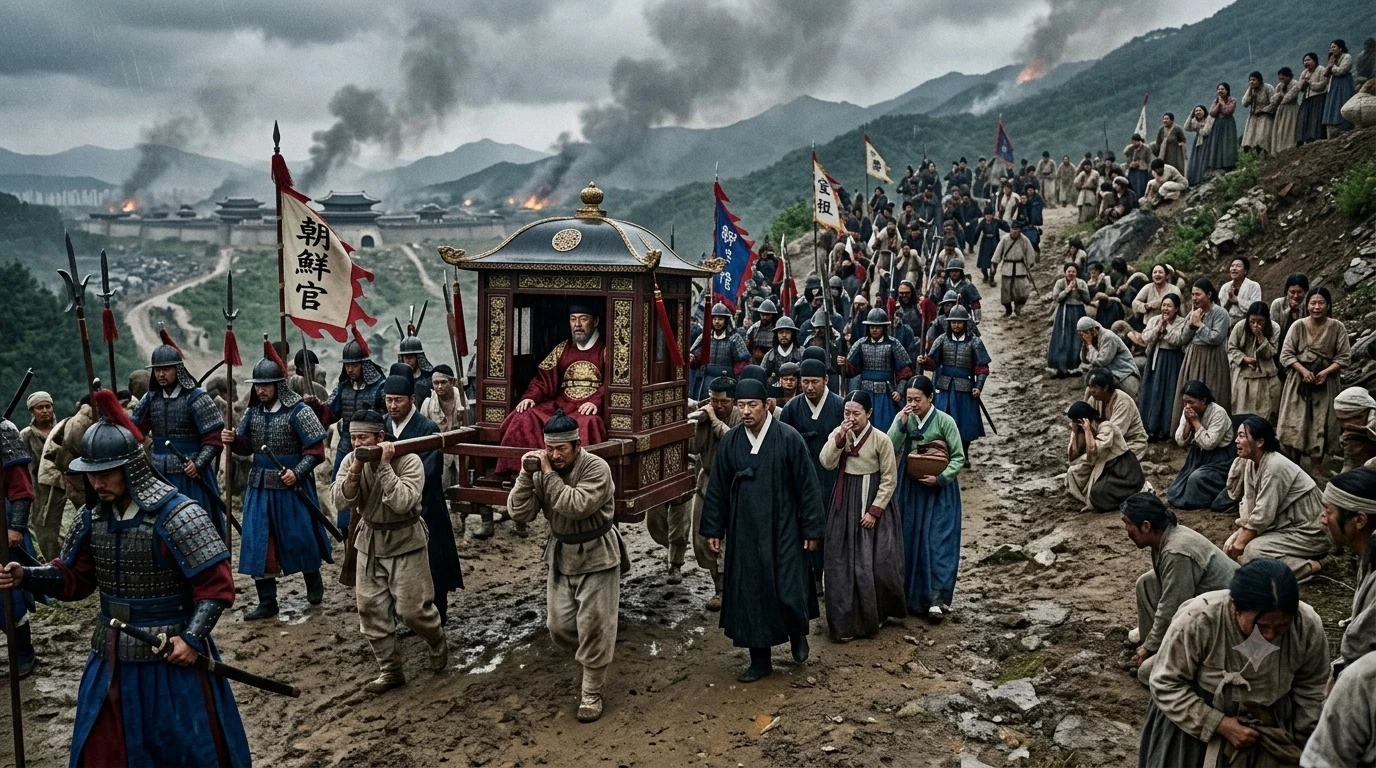
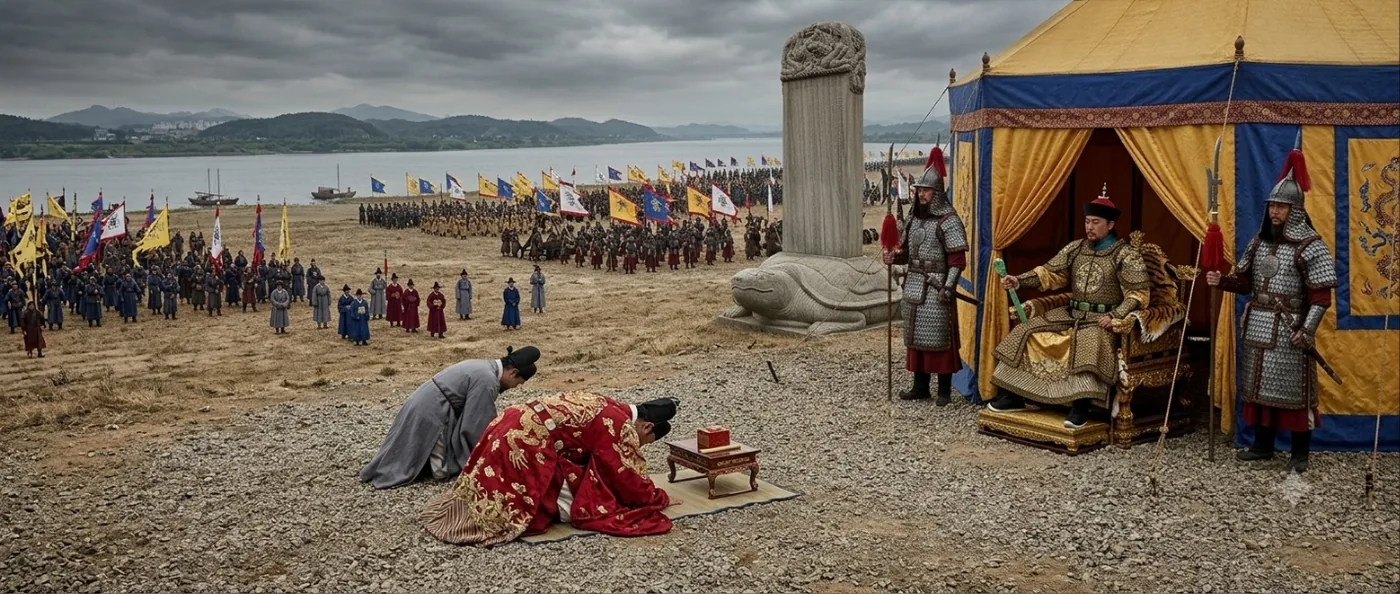
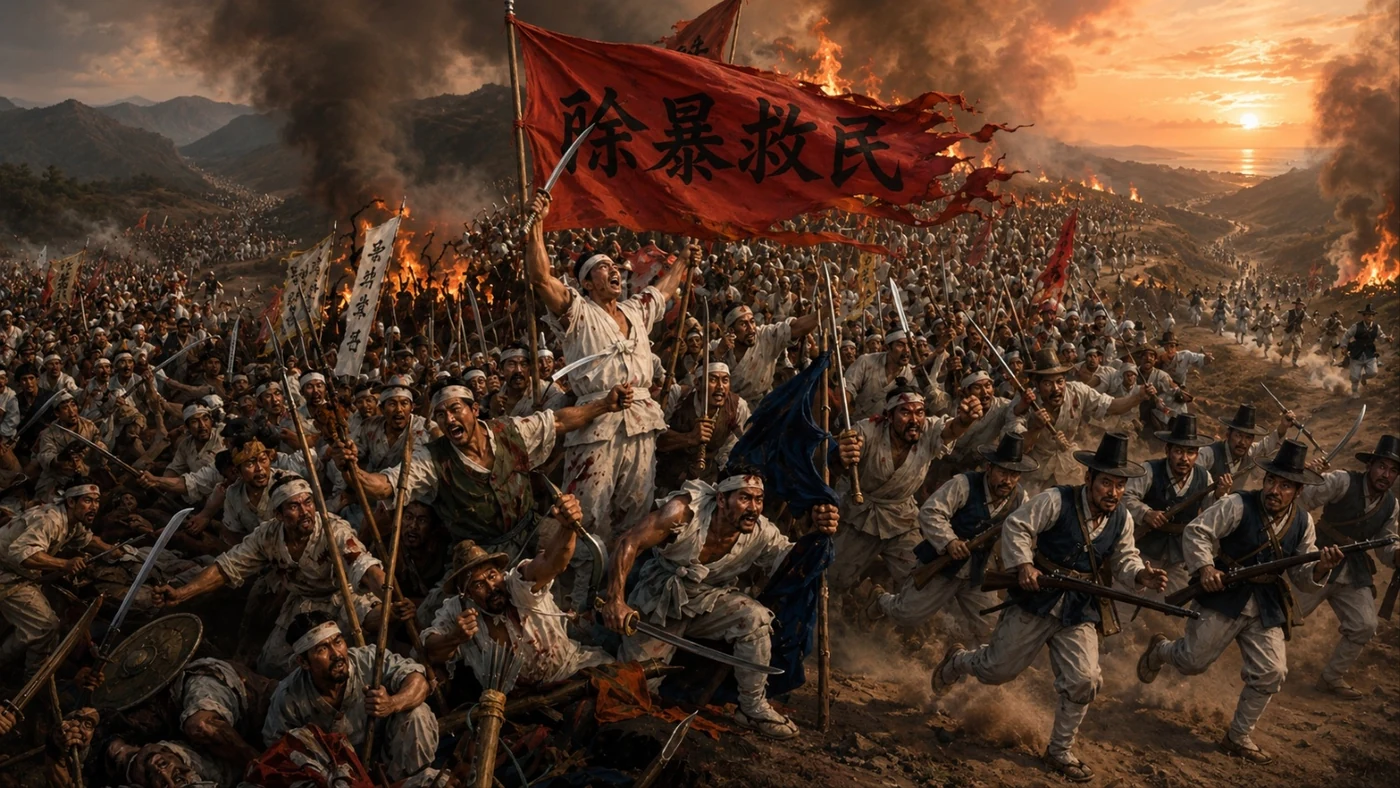
How Did 12 Ships Hold Off a Fleet of 133? Yi Sun-sin and the Battle of Myeongnyang, Explained
Theme: War & Resistance
From the research behind Pause the Drama.
In The Admiral: Roaring Currents (명량), the scene that stops the audience cold is not a sword fight or an explosion. It is a moment of arithmetic. Yi Sun-sin (이순신) stands before the royal court’s envoy and receives the news: the Joseon navy has been destroyed. Over a hundred warships lost at the Battle of Chilcheonryang. Admiral Won Gyun killed. A Japanese armada of more than 300 vessels is moving north.
What does Yi have left? Twelve ships.
The court wants to abolish the navy entirely. There is a logic to this: 12 against 300 is not a battle, it is a massacre. Yi’s response, preserved in his memorial to the throne, has become one of the most quoted lines in Korean military history: “I still have 12 ships.” In the 2014 film this line is spoken quietly. It is the calmness that unsettles. Because Yi was not bluffing — he was calculating. The Myeongnyang Strait was waiting, and he knew exactly what it could do.
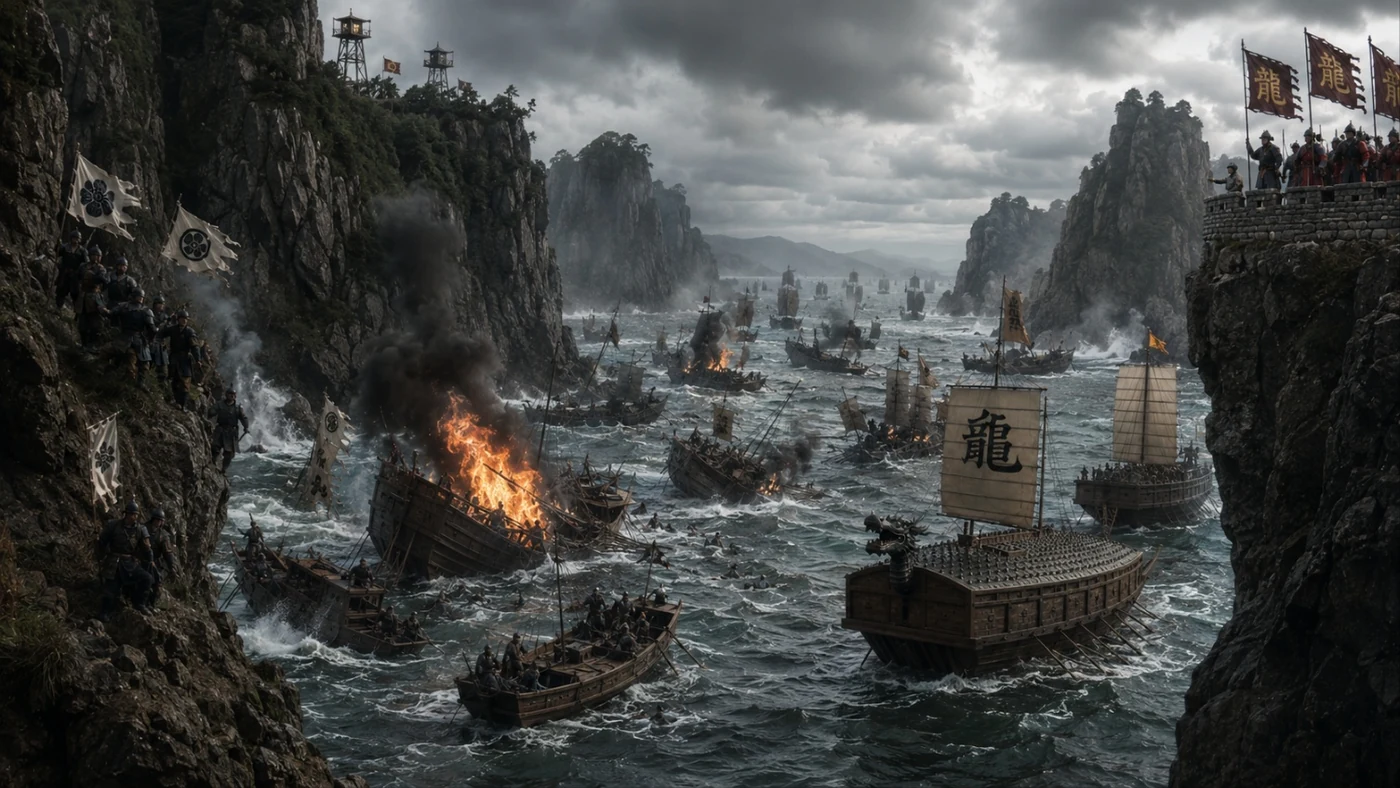 What most of us picture when we imagine Myeongnyang — and yet, as the history below shows, the real battle almost certainly had no turtle ship in it at all. (AI illustration)
Quick answer: The Battle of Myeongnyang was fought on the 16th day of the ninth lunar month, 1597 — the date Korean sources give as September 16, 1597, which corresponds to October 26, 1597 in the Gregorian calendar — during the second Japanese invasion of Korea (the Jeong Yu War, 1597–1598). Yi Sun-sin had 12 panokseon warships — the figure in his famous memorial to the throne, though a thirteenth had joined the line by the day of battle. Against them stood a Japanese fleet popularly numbered at 300-plus, of which the main engaged force in the strait was around 130 (the Seonjo Sillok and the Encyclopedia of Korean Culture record 133) — not the whole armada at once. The Joseon navy destroyed approximately 31 Japanese ships and blocked the advance up the Yellow Sea. The battle’s decisive element was the tidal current of the Myeongnyang Strait, which Yi used as a force multiplier. The iron chain and turtle ship associated with the battle in popular memory are not confirmed for this specific engagement — and the film, tellingly, leaves the chain out.
Let’s unpack it.
Was the tidal current of Myeongnyang Strait a tactical weapon — or a lucky coincidence?
The Myeongnyang Strait (명량해협, locally called Uldolmok) runs between Haenam County and Jindo Island in South Jeolla Province. At its narrowest the passage is only about 293 metres wide. This geography creates an unusual hydrological condition: tidal water forced through a narrow bottleneck between the Yellow Sea and the South Sea generates one of the fastest tidal currents on the Korean coast. At spring tides the current is described as reaching up to approximately 11.5 knots (about 21 km/h) — a representative peak rather than a constant speed, since velocity varies with the tidal cycle, the observation point, and depth. And it was never simply “fast water”: through the tidal cycle the current slackens, reverses, and builds again, with moments of near-stillness followed by a surge in the opposite direction. That rhythm — not raw speed alone — is what a commander could weaponize.
For Yi Sun-sin, these physics were not background knowledge. He had served in this region. He understood that a current of that speed makes it extremely difficult for a human-powered or sail-assisted vessel to make headway against the flow. In practical terms, this meant that the Japanese fleet — however vast — could not enter the strait as a single unified mass. Ships would have to pass in sequence, compressed into the narrow mouth, with their front lines cut off from the rear as the current shifted.
Yi’s timing was the battle’s hidden variable. He initiated combat when the morning current was flowing eastward, drawing the leading Japanese vessels into the strait. When the current reversed in the afternoon, those ships could no longer retreat easily — while the Japanese rear was simultaneously pushed backward. The 12 Korean vessels, anchored at the point where the current advantage was greatest, did not need to fight the entire fleet. They needed to destroy the vanguard and hold long enough for the current to do the rest.
This was not improvisation. Yi’s diary, the Nanjung Ilgi (난중일기, National Treasure No. 76), records careful reconnaissance of the strait in the days before the battle. He was timing a trap, not waiting for a miracle.
The iron chain, the turtle ship, and the tally: separating legend, film, and record
Three claims dominate popular retellings of Myeongnyang. What is striking is that the 2014 film — often assumed to be the source of the exaggerations — is in several ways more careful than the legend it is accused of inflating.
The iron chain (철쇄). The most famous Myeongnyang legend holds that Yi stretched a great chain underwater across the strait, snagging Japanese hulls at the moment the current reversed. It is a vivid image — but it does not appear in the Nanjung Ilgi, the Seonjo Sillok, or Yu Seong-ryong’s Jingbirok, the sources closest to the battle. It surfaces only in later works: the geography treatise Taengniji, the Hyeonmugong Silgi (a later record tied to the commander Kim Eok-chu), and the Honam Jeorirok. Crucially, this is not a case of the primary sources denying the chain — they simply never mention it. And here is the twist most retellings miss: the 2014 film leaves the chain out entirely. It builds its climax on the strait’s whirlpool-like current, the crews’ terror, and Yi’s judgment — not on a steel rope. On this point the movie is closer to the historical record than the legend is. The chain belongs to later tradition, not confirmed history.
The turtle ship (geobukseon, 거북선). The turtle ship was the Joseon navy’s signature weapon: a boarding-resistant assault vessel — its back set with spikes or blades so that no one could climb aboard — that served as a battering ram in the opening campaigns of the Imjin War. (Whether it was also sheathed in iron is a separate question, and an unsettled one: the Encyclopedia of Korean Culture holds that iron plating “has still not been accurately confirmed.” We take that up in The Turtle Ship Nobody Has Seen.) It saw devastating action at the Battle of Sacheon (May 1592), at Dangpo, and at the great victory of Hansan Island (July 1592). Most turtle ships were lost at Chilcheonryang. No primary record places a turtle ship at Myeongnyang — the Seonjo Sillok entry lists 13 warships and 32 scout boats (chotamseon, 초탐선), with no turtle ship among them — and Yi’s fleet is generally understood to have been standard panokseon (판옥선, board-roofed warships), though a source naming a vessel simply as a “warship” cannot always confirm its exact type. The internal structure of the turtle ship — fully enclosed versus partially open-decked — also remains unsettled in Korean maritime archaeology.
“Destroying the whole fleet.” The film implies total annihilation. The Seonjo Sillok records approximately 31 Japanese warships destroyed through sinking, burning, or forced withdrawal. The full Japanese fleet of 300-plus vessels was not eliminated. What was eliminated was the Japanese navy’s ability to advance up the Yellow Sea, cutting the supply corridor through Jeolla Province and collapsing the entire western campaign strategy. That outcome — 31 ships and a halted campaign — is a complete strategic victory. It is simply not the same as 330 ships destroyed.
Drama vs. real history — how much does Myeongnyang embellish?
| In The Admiral: Roaring Currents | In the historical record |
|---|---|
| Yi Sun-sin commands 12 ships against 300+ | 12 in Yi’s memorial; 13 by the day of battle. The main engaged Japanese force was ~130 (Seonjo Sillok / EKC: 133), not 300-plus at once |
| An iron chain stops the Japanese fleet | Not in the primary sources; appears only in later works (Taengniji, Hyeonmugong Silgi, Honam Jeorirok). The film itself omits the chain |
| The turtle ship takes part in the battle | No primary record places one there; the Seonjo Sillok lists 13 warships + 32 scout boats, generally understood as panokseon |
| Japanese ships are annihilated | 31 Japanese warships destroyed; strategic objective — blocking western advance — fully achieved |
| Yi’s resolve alone steadies his wavering officers | The psychological dimension is real; the Nanjung Ilgi records pre-battle preparations and unwavering determination |
The film’s most accurate claim is also its most important: one commander’s reading of geography and timing rendered arithmetic irrelevant.
Key terms. Panokseon (판옥선) — the standard Joseon warship: a flat-bottomed, broad-beamed vessel with an upper fighting deck, well-suited to the shallow coastal waters of Korea’s southwest. Geobukseon (거북선) — the “turtle ship,” a specialized forward-assault vessel used in the early Imjin War; its exact internal structure remains a subject of ongoing scholarly study. Nanjung Ilgi (난중일기) — Yi Sun-sin’s personal combat diary (National Treasure No. 76), the most detailed first-person record of the Imjin War. Jeong Yu War (정유재란, 1597–1598) — the second Japanese invasion of Korea; the Battle of Myeongnyang belongs to this phase. Uldolmok (울돌목) — the local name for the narrowest section of the Myeongnyang Strait, where the tidal current is strongest.
Narrow waters, long odds: where Myeongnyang sits in the global history of asymmetric naval battle
Yi Sun-sin’s achievement at Myeongnyang is remarkable, but it is not structurally unprecedented. Across centuries and oceans, commanders have turned geographic chokepoints into force equalizers — and comparing Myeongnyang with the Western tradition reveals both what it shared with and where it stands apart from the canon.
Greece — Themistocles at Salamis (480 BC). When Xerxes’ Persian armada invaded Greece, the Greek allied fleet was heavily outnumbered. Herodotus — echoed by the near-contemporary playwright Aeschylus in The Persians — put the Persian expeditionary fleet at 1,207 ships. Modern historians treat that as the ancient tradition rather than the number that fought at Salamis: after storm damage in the Aegean and losses in the Artemisium campaign, and with ships tied up in supply and escort duty, estimates for the force actually committed in the channel usually fall around 600–800. Either way, the disparity with the allied Greek fleet of roughly 370 triremes was severe. Athenian commander Themistocles withdrew to the Salamis Channel — a narrow strait between the island of Salamis and the Attic mainland — where Persian numerical advantage could not be deployed in a full line. The Greeks defeated the Persian fleet in the confined water. The structural resemblance to Myeongnyang is the most direct in world military history: choose the battlefield, use a strait to compress the enemy front, let geography do the heavy work.
England — Nelson at Trafalgar (1805). The comparison most often made in English-language writing is between Yi Sun-sin and Horatio Nelson. The analogy is understandable: both are their nation’s supreme naval commander; both died in their final great battle. But tactically, Trafalgar is a poor parallel for Myeongnyang. Nelson’s fleet (27 ships) faced the Franco-Spanish combined fleet (33 ships) at nearly equal numbers, and his celebrated T-crossing was an aggressive attack tactic — not a defensive chokepoint strategy. Calling Yi “the Nelson of the East” is a common cultural tribute; calling Myeongnyang a Korean version of Trafalgar misrepresents both battles. The true structural parallel is Salamis.
Japan — Togo Heihachiro at Tsushima (1905). Japan’s own Togo Heihachiro destroyed the Russian Baltic Fleet in the Tsushima Strait using superior intelligence, T-crossing maneuvers, and modern fire control. It is well documented that Togo expressed deep admiration for Yi Sun-sin, reportedly saying he was not worthy of comparison with the Korean admiral. The Tsushima parallel is less about tactical resemblance than about historical consciousness: Japan’s naval tradition explicitly acknowledged Myeongnyang as a benchmark that its own greatest victory was measured against.
What makes Myeongnyang distinctive within this company is the sheer asymmetry. Salamis involved hundreds of ships on each side. Trafalgar was nearly a matched contest. Yi had twelve. No battle in the Western or East Asian naval canon produced a comparable strategic result from so few vessels — which is precisely why, whatever the film embellishes, the core of the story requires no embellishment at all.
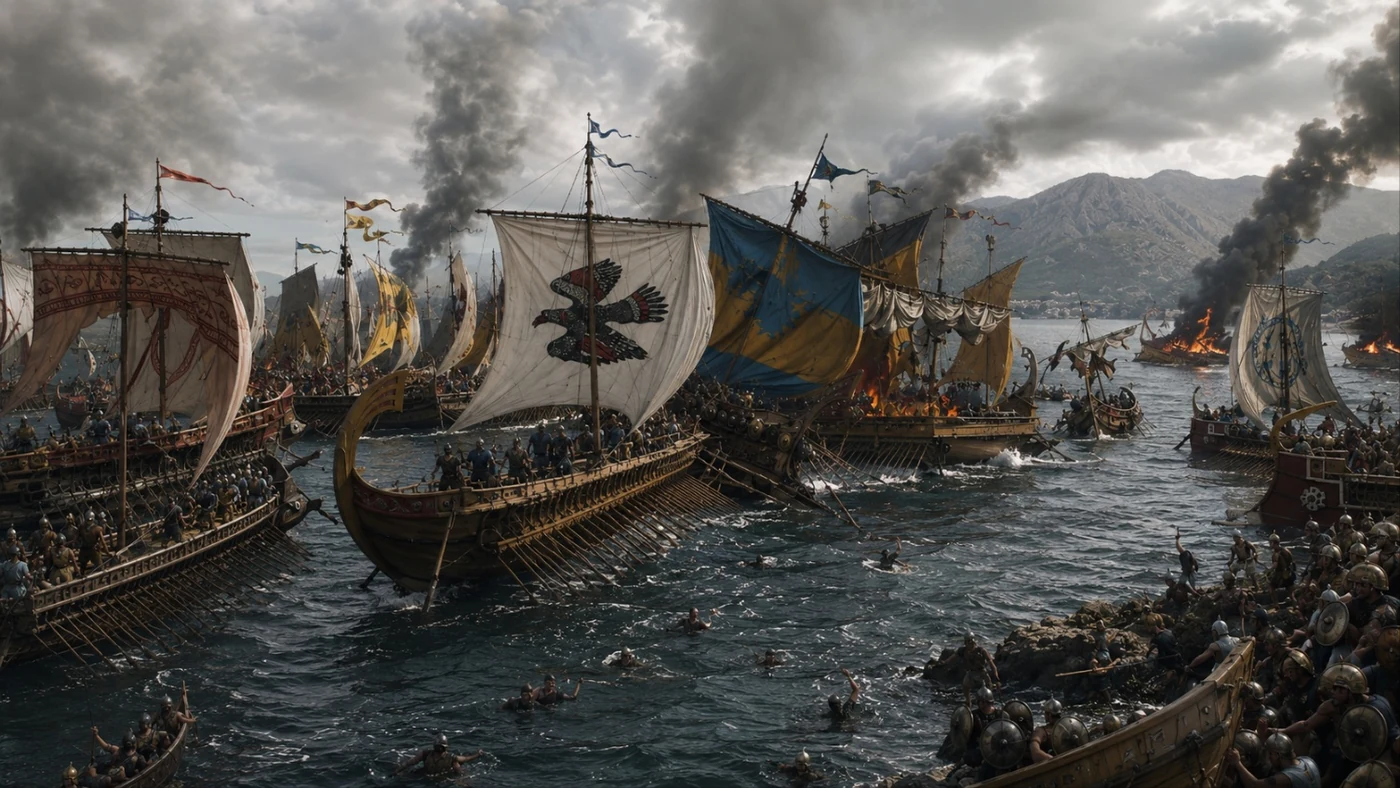 Salamis, 480 BC: Themistocles drew a far larger Persian fleet into a narrow channel where its numbers could not deploy — the closest structural parallel to what Yi did at Myeongnyang. (AI illustration)
Coming up next
Twelve ships, a reversing current, and a commander who had already been arrested, tortured, and stripped of his rank — and Japan’s western campaign collapsed. History rarely delivers cleaner demonstrations of the principle that geography, timing, and one person’s refusal to accept arithmetic can outweigh any opponent’s headcount.
In the next essay, we’ll look at the broader Joseon naval tradition and ask why Korea’s maritime defences were so underfunded before the Imjin War turned them into a national survival question.
Thanks for reading — see you in the next one.
Frequently asked questions
What is the film Myeongnyang (The Admiral: Roaring Currents) about? Myeongnyang (2014, CJ ENM) is a Korean historical war film depicting Yi Sun-sin’s defense at the Battle of Myeongnyang in September 1597. With the Joseon navy reduced to 12 ships after the Chilcheonryang disaster, Yi uses the Myeongnyang Strait’s narrow channel and its powerful tidal current to defeat a Japanese fleet of over 300 vessels. The film drew over 17 million admissions and, as of 2026, still holds South Korea’s all-time record for cinema admissions, though later films have since surpassed it in box-office revenue.
How many ships did Yi Sun-sin actually have at the Battle of Myeongnyang? Yi’s memorial to the throne records 12 panokseon warships — the source of the line “I still have 12 ships.” By the day of the battle a thirteenth vessel had joined; the Seonjo Sillok notes 13 warships alongside 32 scout boats (chotamseon). Both figures are correct: 12 is the memorial count, 13 the fighting strength on the day. All were survivors of the Battle of Chilcheonryang (July 1597), which destroyed the Joseon fleet under Admiral Won Gyun.
Were iron chains stretched across the Myeongnyang Strait to stop Japanese ships? The primary sources — the Nanjung Ilgi, the Seonjo Sillok, and Yu Seong-ryong’s Jingbirok — do not record an iron chain; it appears only in later works such as the Taengniji, the Hyeonmugong Silgi, and the Honam Jeorirok. So the chain is best treated as a later tradition, not confirmed history — and the sources do not actively deny it so much as never mention it. Notably, the 2014 film itself leaves the chain out, building its climax on the current instead.
Was the turtle ship (geobukseon) used at the Battle of Myeongnyang? Almost certainly not. Turtle ships were active in the first phase of the Imjin War but most were destroyed at Chilcheonryang. The Seonjo Sillok lists 13 warships and 32 scout boats with no turtle ship among them, and the fleet is generally understood to have been panokseon.
Why was Yi Sun-sin dismissed from command before the battle? In early 1597, Yi was arrested for insubordination — refusing to pursue a Japanese commander based on intelligence historians largely believe was a Japanese deception. Court factional politics played a role; Won Gyun replaced Yi, led the fleet to catastrophe at Chilcheonryang, and was killed. Yi was hastily reinstated.
What was the actual military outcome of the Battle of Myeongnyang? The Seonjo Sillok records approximately 31 Japanese warships destroyed. Yi did not eliminate the entire Japanese fleet. The strategic outcome — blocking the Japanese advance up the Yellow Sea and collapsing their overland supply plan through Jeolla Province — was complete.
How does the Battle of Myeongnyang compare with the Battle of Salamis? The structural parallel is strong: both battles involved a smaller force luring a larger fleet into a narrow channel where numerical advantage could not be fully deployed. At Salamis (480 BC), Themistocles used the Salamis Channel against the Persian fleet; Yi Sun-sin used the Myeongnyang Strait and its tidal current. Trafalgar (1805), commonly cited in Yi comparisons, involved near-equal fleet sizes and a very different tactical situation.
What happened to Yi Sun-sin after the Battle of Myeongnyang? Yi rebuilt the Joseon navy over the following year. He died at the Battle of Noryang (December 1598), the final major naval engagement of the Imjin War, reportedly struck by a musket ball while pursuing a withdrawing Japanese fleet. He was posthumously honored with the title Chungmugong (충무공, “Duke of Loyal Valor”).
Why is the Battle of Myeongnyang considered one of history’s greatest naval victories? Because the odds and the stakes were both extreme. Yi held off the main Japanese engaged force of roughly 130 ships with about a dozen of his own — destroying some 31 while losing none — and blocked Japan’s advance up the Yellow Sea, collapsing their overland supply strategy through the Jeolla breadbasket. Few battles in world naval history produced so decisive a strategic result from so small a force, which is why Myeongnyang is set beside Salamis and Trafalgar.
Sources & further reading
This piece was written from the historical script and fact-check of 사뚱샘의 역사방 (SaDDungSam), drawing on primary records, academic scholarship, and official research:
- Yi Sun-sin’s diary and the 12-ship count — Nanjung Ilgi (난중일기, National Treasure No. 76), Yi Sun-sin’s personal combat diary; paired with relevant entries in the Seonjo Sillok (선조실록, Joseon Royal Annals) for the battle’s fleet numbers and outcome figures.
- Japanese fleet engagement figures (~133 in active combat) and the tally of ~31 ships destroyed — Seonjo Sillok entries on the Battle of Myeongnyang, corroborated against the Encyclopedia of Korean Culture (한국민족문화대백과사전, encykorea.aks.ac.kr) entries on Yi Sun-sin and the battle.
- Tidal current data for the Myeongnyang Strait — National Research Institute of Maritime Cultural Heritage (국립해양문화재연구소) reports on Joseon naval operations; the 11–13 knot range is the figure most commonly cited in Korean-language scholarship but should be treated as approximate, pending specialist hydrological confirmation.
- Turtle ship construction and deployment records — National Research Institute of Maritime Cultural Heritage (국립해양문화재연구소) ongoing research program; Naval Academy War History Research Division (해군사관학교 해전사연구실).
- The iron chain (철쇄) controversy — the chain does not appear in the Nanjung Ilgi, the Seonjo Sillok, or Yu Seong-ryong’s Jingbirok; it is found only in later works — Yi Jung-hwan’s geography Taengniji, the Hyeonmugong Silgi (tied to the commander Kim Eok-chu), and the Honam Jeorirok. This essay treats it as a later tradition, not confirmed history. The 2014 film notably omits the chain.
- Western and East Asian naval battle comparisons — Samuel Hawley, The Imjin War: Japan’s Sixteenth-Century Invasion of Korea and Attempt to Conquer China (Seoul: Royal Asiatic Society Korea Branch, 2005), the standard English-language scholarly account of the Imjin War, supplemented by the Encyclopedia of Korean Culture entries on Joseon military history.
Thanks for reading — see you in the next one.
This article was researched and written by K-Drama History. Source: How Did 12 Ships Hold Off a Fleet of 133? Yi Sun-sin and the Battle of Myeongnyang, Explained — K-Drama History