Why Did Korea's Farmers Take Up Bamboo Spears? Nokdu Flower and the Donghak Peasant Revolution, Explained
Theme: War & Resistance
From the research behind Pause the Drama.
In Nokdu Flower (녹두꽃), the uprising begins with a document — but not any ordinary document. The sabal tongmun (사발통문, “circular letter”) is a petition signed not in a column but in a ring, so that no name appears at the top. In a society where the first name on a petition could become the first person targeted, arrested, and made an example of, this circular arrangement was not a bureaucratic peculiarity. It was a survival protocol. The farmers of Gobu County, in what is today North Jeolla Province, wanted to register their grievances against a corrupt magistrate. They also wanted to remain alive long enough to act on them.
The SBS drama follows two brothers caught on opposite sides of the 1894 uprising — one who joins the revolutionary peasant army under Jeon Bong-jun (전봉준), one who serves the forces trying to suppress it. That fraternal split is a fictional frame; the uprising itself is not. What the drama traces — from the spark at Gobu to the catastrophic defeat at Ugeumchi — is one of the most consequential events in late Joseon history, and one of the least known outside Korea.
Quick answer: Nokdu Flower dramatizes the Donghak Peasant Revolution of 1894, Korea’s largest pre-modern popular uprising. Sparked by corrupt taxation in Gobu County, it grew into a movement demanding an end to illegal extraction by local officials, the easing of hereditary status discrimination, and resistance to foreign encroachment. Its leader, Jeon Bong-jun, earned the nickname Nokdu Janggun (녹두장군, “Green Bean General”) for his small stature. Its most consequential unintended effect was becoming a decisive trigger of the First Sino-Japanese War: when the Joseon government called in Chinese troops to suppress the revolt, Japan sent its own using a treaty as pretext — and the two powers went to war over Korea’s future. The revolution ended in military defeat at Ugeumchi (lunar November 1894), where bamboo spears and matchlocks met modern rifles and artillery.
Let’s unpack it.
Why bamboo spears?
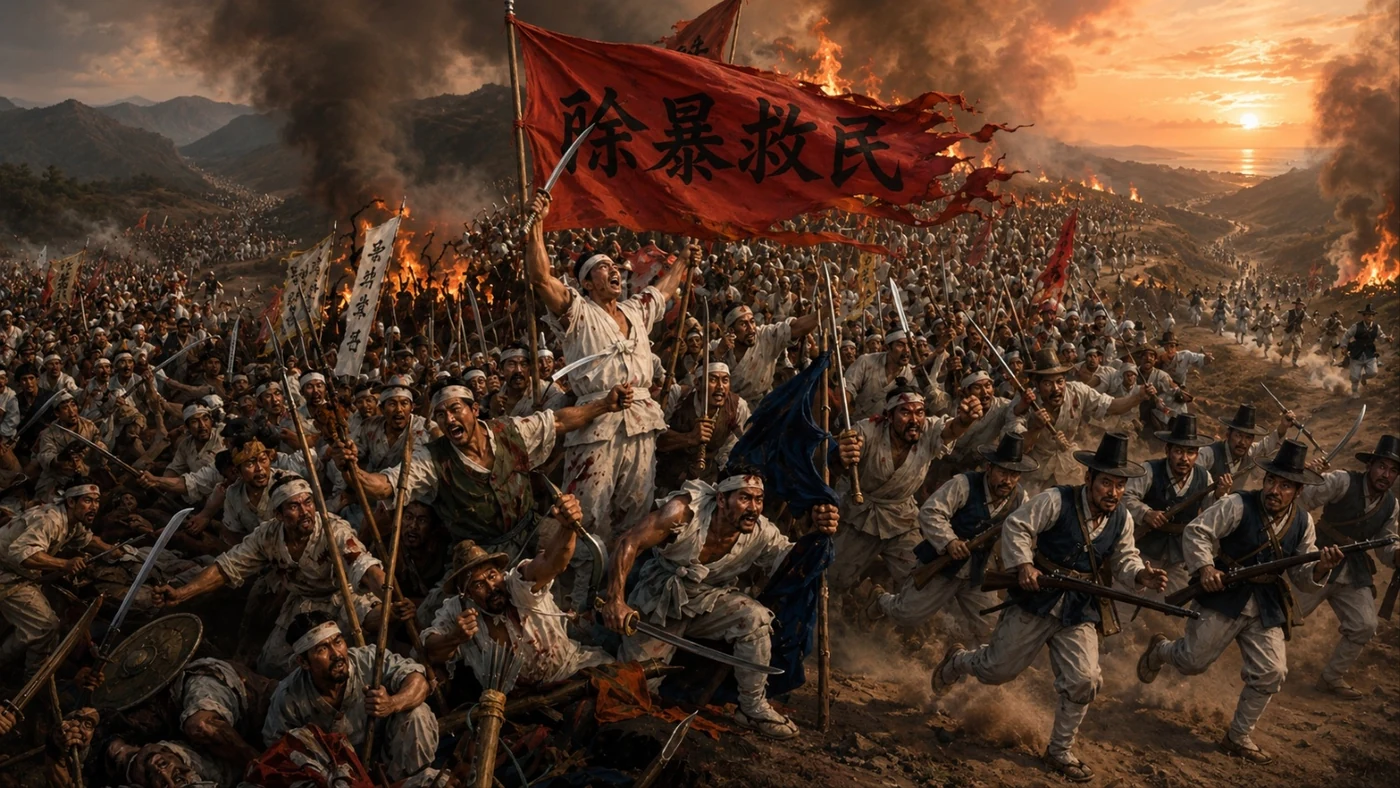
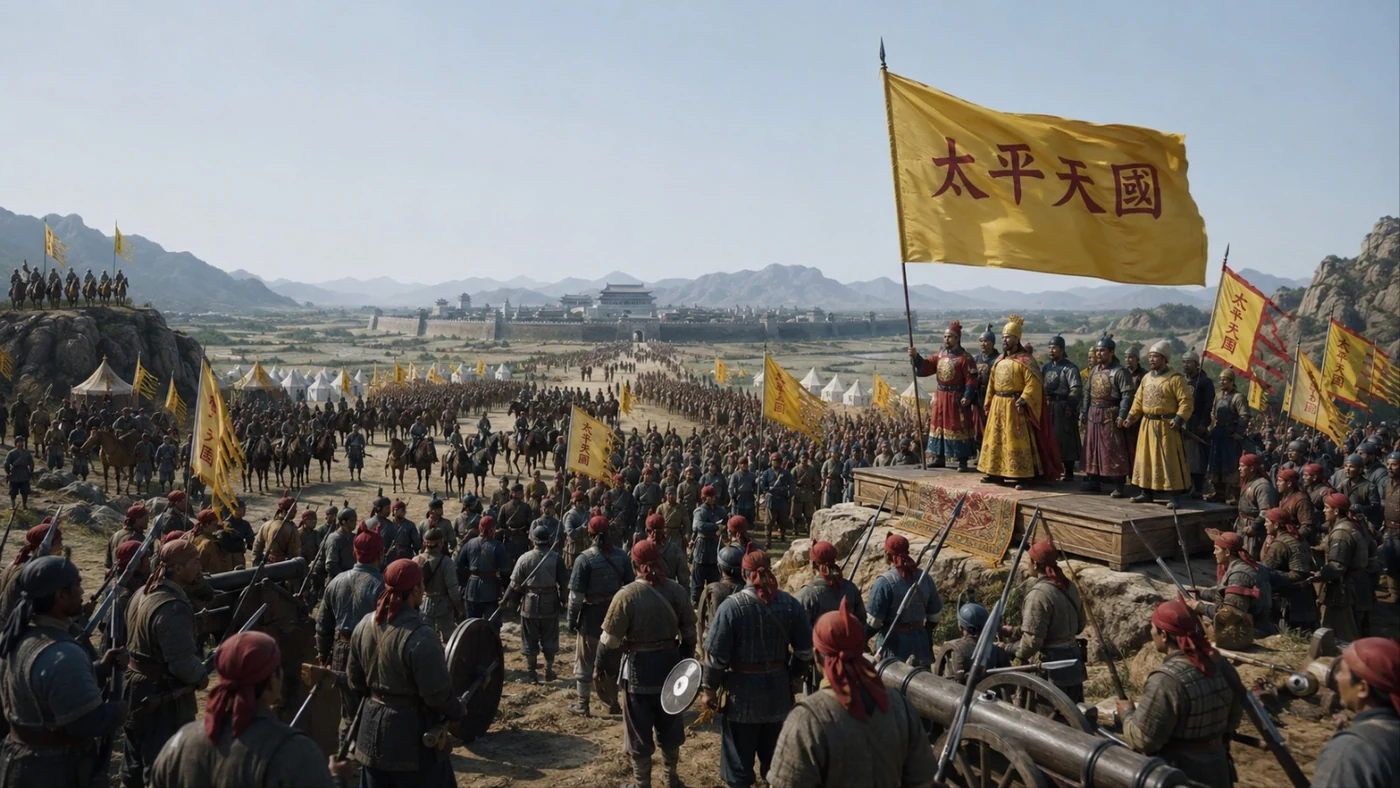
The bamboo spear became the visual symbol of the Donghak Peasant Revolution because most farmers entered the uprising with whatever a rural community could gather quickly: farm tools, bamboo spears, old matchlock guns, and captured arms. The point was never that bamboo could defeat artillery. The point was that a locally armed peasant society had reached the limit of its endurance and picked up whatever was at hand. At Ugeumchi in late 1894, that symbolic mismatch turned literal — peasant fighters charging uphill against government and Japanese troops equipped with modern rifles and field guns. The bamboo spear endures as the single clearest image of the technological and social imbalance the revolution ran into.
How did a religious movement become a revolutionary army?
Donghak (동학, “Eastern Learning”) was founded in 1860 by Choe Je-u (최제우), a scholar from Gyeongju. The name positioned itself explicitly against Seohak (서학, “Western Learning”) — the Korean term for Catholicism arriving via China. Donghak synthesized Confucian social ethics, Buddhist elements, and Daoist philosophy around a radical egalitarian core. Its most famous slogan, In-nae-cheon (인내천, “humanity is heaven”), is often quoted as if Choe Je-u coined it — but that is an anachronism. Choe’s own teaching centered on si-cheon-ju (시천주, “each person bears heaven within”); it developed through Choe Si-hyeong’s sa-in-yeo-cheon (사인여천, “serve others as you would heaven”) and was only crystallized as in-nae-cheon by the movement’s third leader, Son Byeong-hui, in the twentieth century. Whatever the exact phrasing, the message was the same: in a Joseon society structured by hereditary rank — aristocrats (yangban) above commoners above nobi (hereditary servants) — a farmer carried the same spiritual weight as a nobleman.
Choe Je-u was executed in 1864 on the charge of hoksemumin (혹세무민, “deluding the world and deceiving the people”) — the standard official grounds for suppressing his teaching. His movement went underground, gathered adherents, and emerged in the 1890s as a mass organization with a dense network of local branches (jeop, 접) spread across Jeolla, Chungcheong, and Gyeonggi provinces.
Jeon Bong-jun (전봉준, 1855–1895) was one of these local branch leaders (jeopju, 접주). His physical smallness gave rise to the nokdu janggun (녹두장군, “Green Bean General”) nickname. But the drive behind the 1894 uprising was not religious faith alone. It grew from a combination of forces — the magistrate Jo Byeong-gap’s extortion, the collapse of peasant livelihoods, entrenched local corruption, and demands for reform — carried through the Donghak network’s organizational reach.
The magistrate of Gobu County, Jo Byeong-gap (조병갑), had forced local farmers to build a new irrigation weir — the Manseokbo (만석보, a bo or river weir for channeling water to paddies, not a storage reservoir) — below an existing one, then levied a water tax on its use. According to the Encyclopedia of Korean Culture, he skimmed some 700 seok of grain by charging two du per durak of upper paddy and one per durak of lower paddy; he also demanded that farmers fund a monument to his own father. The Gobu revolt cannot be reduced to the Manseokbo tax alone — it was the most representative of Jo’s many abuses, which also included fictitious levies on wasteland and extortion of wealthy households. On the 10th day of the 1st lunar month, 1894, the farmers acted. The sabal tongmun was their instrument: a circular letter with names written in a ring, so the magistrate could not single out a ringleader.
From peasant revolt to political revolution: the Jipgangso and the demands that almost became law
The Gobu uprising was initially suppressed by the central government — but the government’s method of suppression made things worse. When a royal commissioner arrived and punished farmers rather than investigating the corrupt magistrate, the revolt spread across Jeolla Province.
By April 1894, at the Battle of Hwangtohyeon (황토현 전투), Jeon Bong-jun’s peasant forces defeated a government army in open-field combat. The victory sharply raised the peasant army’s morale and became a turning point, propelling the revolt outward across Jeolla Province.
The uprising carried a concrete program. The Poljeong Gaehyeok (폐정개혁안), the peasant reform demands, called for:
- Punishment of corrupt officials and predatory powerful houses
- An end to illegal and arbitrary taxation
- Easing of hereditary status discrimination
- Burning the registers of lowborn and slave status
- Abolition of discrimination against the baekjeong outcaste class
These demands are most familiar in the form of the “12 articles” recorded in Oh Ji-yeong’s later chronicle Donghaksa — the version textbooks usually cite. But the count is not fixed: the contemporary negotiation documents transmit 14-, 24-, and even 27-article versions, and the historicity of the Donghaksa list is itself debated. What is consistent across versions is the substance — demands not merely for the removal of one bad official but for a restructuring of Joseon’s social order. For foreign readers, the radicalism here is easy to miss: the farmers were not asking simply for lower taxes. They were demanding the destruction of the very paperwork — the status registers and slave documents — that made hereditary discrimination legally enforceable.
After the Jeonju Treaty (전주화약, lunar May 8 / June 11, 1894), the peasant army agreed to stand down in exchange for a remarkable concession: the right to establish Jipgangso (집강소) — peasant-run local-governance offices empowered to supervise the reforms. Across most counties of mainland Jeolla Province — by one National Institute of Korean History accounting, roughly 52 of the 53 mainland counties, with Naju a contested exception — these offices ran local security and administration from summer into autumn 1894. It was not a single centralized machine: Jeon Bong-jun commanded the western districts while Kim Gae-nam held the east, and towns like Naju, Namwon, and Unbong resisted hard. Still, for a season, peasant leadership exercised real authority over local security and administration across much of Jeolla — a short-lived but documented experiment in popular self-rule.
The foreign powers ended that experiment. When the Joseon government had called in Chinese troops to help suppress the first uprising, Japan sent forces of its own, using the 1885 Tianjin Convention’s notification clause as a pretext for intervention. After the Jeonju Treaty, neither army went home. On July 23, 1894 (lunar 6th month, 21st day), Japanese troops seized Gyeongbok Palace. Jeon Bong-jun declared a second uprising, now explicitly framed as resistance to Japanese occupation.
At the Battle of Ugeumchi (우금치, lunar November 1894) near Gongju in Chungcheong Province, the peasant army — armed with bamboo spears and matchlock guns — confronted a coalition of Japanese and government troops equipped with modern rifles and artillery. The scale of the peasant force is debated: sources give figures from around 10,000 to as many as 40,000 for the broader Gongju campaign. After repeated charges against fortified high ground, the peasant army suffered catastrophic losses and was defeated. Jeon Bong-jun was captured in late 1894 and, after trial, executed by hanging at dawn on the 30th day of the 3rd lunar month, 1895 (April 24 by the solar calendar), alongside Son Hwa-jung, Choe Gyeong-seon, Kim Deok-myeong, and Seong Du-hwan. His interrogation records (gongcho, 공초) survive; he maintained the revolution’s legitimacy to the end.
Drama vs. real history — what does Nokdu Flower reconstruct?
| In Nokdu Flower | In the historical record |
|---|---|
| Farmers sign a circular petition to hide the ringleader | Confirmed: the sabal tongmun is documented in contemporary records |
| Jeon Bong-jun is small, fierce, and politically driven — not merely a religious figure | Confirmed: the nickname and his leading role are established; his motives blended Donghak organization with economic and political grievance |
| The Jipgangso functions as a people’s court and self-governing body | Broadly confirmed: Jipgangso operation in Jeolla Province is documented |
| The peasant army defeats a regular government force at Hwangtohyeon | Confirmed in contemporary accounts |
| The Joseon government’s call for Chinese troops triggers Japanese counter-deployment | Confirmed: this sequence is the immediate cause of both armies’ presence |
| Defeat at Ugeumchi ends the revolution | Confirmed: Ugeumchi (November 1894) was the decisive defeat |
The drama’s central invention — the two brothers — does not distort the historical record. It opens a window into it.
Key terms. Donghak (동학) — “Eastern Learning”; the Korean philosophical-religious movement founded in 1860 that fused egalitarian ideas (from si-cheon-ju, “each person bears heaven within,” to the later in-nae-cheon, “humanity is heaven”) with Confucian, Buddhist, and Daoist elements; its organizational network provided the infrastructure for the 1894 uprising. Sabal tongmun (사발통문) — the circular petition with names arranged in a ring, spreading legal liability evenly among all signatories. Jipgangso (집강소) — the peasant-run local-governance offices established across most of mainland Jeolla Province under the Jeonju Treaty; a documented experiment in popular self-rule. Poljeong Gaehyeok (폐정개혁안) — the peasant reform demands (commonly the “12 articles,” with 14-, 24-, and 27-article versions in other sources) covering punishment of corrupt officials, an end to illegal taxation, and the easing or abolition of hereditary status discrimination. Jeon Bong-jun (전봉준, 1855–1895) — the uprising’s leader, captured in late 1894 and executed by hanging in spring 1895; his interrogation records survive as a primary source.
A world in revolt: where the Donghak Revolution fits in 19th-century global history
The 1890s are sometimes called the decade when the old agrarian orders of Asia cracked simultaneously. Korea’s Donghak uprising was among the largest, but it shared structural features — and instructive differences — with other 19th-century peasant movements across three continents.
France — the French Revolution (1789–1799). The French Revolution combined rural peasants crushed by regressive taxation (the taille) with urban workers and bourgeois idealists under the banner of liberté, égalité, fraternité. Like Donghak, it demanded abolition of hereditary privilege. The critical difference is one of leadership: the French Revolution’s ideological agenda was shaped and articulated by the educated middle class, who channeled peasant energy into constitutional frameworks. The Donghak movement’s ideas were formulated by its religious founders — Choe Je-u and Choe Si-hyeong — but it was the farmers who took those ideas up as a program of social reform and carried it into the countryside. They were not recruited to someone else’s revolution; they were its base and the force that spread it.
China — the Taiping Rebellion (1850–1864). Hong Xiuquan gathered rural followers under a heterodox Christian framework proclaiming a Heavenly Kingdom of Great Peace. At its height the movement controlled much of southern China; by the time it was suppressed, between 20 and 30 million people had died — making it one of the deadliest conflicts of the nineteenth century. Like Donghak, the Taiping Rebellion was powered by class grievance and millennial religious energy. The key difference is in aim: the Taiping sought to replace the Qing dynasty entirely with a new state and new religion; the Donghak movement first demanded reform within the existing Joseon system, turning explicitly anti-foreign only when Japanese military presence foreclosed the possibility of domestic reform.
Mexico — the Zapatista Revolution (1910–1920). Emiliano Zapata led an agrarian revolution under the slogan La tierra es de quien la trabaja — “the land belongs to those who work it.” Like Donghak, Zapata’s movement was driven by land and tax grievances among rural communities excluded from the modernizing economy. The structural comparison is striking: both movements demanded redistribution of agricultural resources, both were ultimately defeated by superior military technology and external political pressure, and both produced leaders who were captured and killed. The critical difference lies in outcome: Mexico’s revolution eventually produced a constitution (1917) that partly encoded Zapata’s demands, while Korea’s Donghak uprising was extinguished before it could shape any constitutional settlement — a difference shaped not only by internal social structure and leadership, but also by the timing and scale of foreign military intervention.
The Donghak Peasant Revolution’s most distinctive feature, viewed globally, may be this: it is the clearest example in Korean history of a popular movement that articulated a concrete reform agenda, briefly institutionalized it through the Jipgangso, and was defeated not by domestic politics alone but by the collision of two great-power rivalries on Korean soil — a collision that the revolution itself inadvertently triggered.
Coming up next
A circular letter with names in a ring, a bamboo-spear army that briefly governed its own provinces, and a defeat that ignited a war between China and Japan — the 1894 Donghak Peasant Revolution is one of the clearest hinge points in modern Korean history: the moment when the empire’s internal contradictions met an industrial military age it was not equipped to survive.
In the next essay, we’ll look at what the Donghak movement’s legacy became — and why Korean democracy movements of the twentieth century consistently looked back to 1894 as a founding reference point.
Thanks for reading — see you in the next one.
Frequently asked questions
What is the SBS drama Nokdu Flower about? Nokdu Flower (녹두꽃, SBS 2019) is a historical drama following two brothers on opposite sides of the 1894 Donghak Peasant Revolution. One joins the peasant revolutionary army under Jeon Bong-jun; the other serves the government forces trying to suppress it. The drama traces the uprising from Gobu County to the decisive defeat at the Battle of Ugeumchi.
Who was Jeon Bong-jun, and why was he called the “Green Bean General”? Jeon Bong-jun (1855–1895) was the principal leader of the Donghak Peasant Revolution. A local Donghak branch leader (jeopju), he helped drive the 1894 Gobu uprising and led the subsequent campaigns. His nickname Nokdu Janggun (녹두장군, “Green Bean General”) refers to his small stature. He was captured in late 1894 and executed by hanging at dawn on the 30th day of the 3rd lunar month, 1895 (April 24); his interrogation records survive as a primary historical source.
What was the sabal tongmun (circular petition)? The sabal tongmun (사발통문) was a petition or manifesto with signatories’ names arranged in a circle rather than a column, so no single person appeared as the first name — and therefore the legal instigator. In a system that arrested the petition’s leader first, this circular arrangement spread the legal risk evenly. It is one of the Donghak movement’s most recognizable documentary artifacts.
What were the Donghak peasants’ key demands? The reform demands (폐정개혁안) centered on punishing corrupt officials, ending illegal taxation, easing hereditary status discrimination, burning lowborn and slave registers, and abolishing baekjeong outcaste discrimination. They are most often summarized as the “12 articles” from Oh Ji-yeong’s Donghaksa, but 14-, 24-, and 27-article versions survive in other contemporary documents. Widow-remarriage, sometimes listed here, is more securely a clause of the later Gabo Reform.
What was the Jipgangso, and why does it matter? The Jipgangso (집강소) were peasant-run local-governance offices established across most counties of mainland Jeolla Province under the Jeonju Treaty (lunar May 8 / June 11, 1894), allowing the peasant leadership to run local security, administration, and reform. They functioned from summer into autumn 1894 — a short-lived but historically documented experiment in popular self-rule, though coverage and control varied by region (Naju, Namwon, and Unbong resisted especially hard).
How did the Donghak Peasant Revolution trigger the First Sino-Japanese War? When the Joseon government called in Chinese troops to suppress the uprising, Japan sent its own forces, using the 1885 Tianjin Convention’s notification rule as a pretext. After the Jeonju Treaty, neither army withdrew. Japan seized Gyeongbok Palace on July 23, 1894 (lunar 6th month, 21st day), and Sino-Japanese fighting began shortly after. The Donghak revolt was an important trigger, though both powers had long been moving toward confrontation over Korea’s status.
Did the Donghak Revolution succeed or fail? It failed militarily. The decisive defeat at Ugeumchi (lunar November 1894) saw a peasant force overwhelmed by a Japanese-and-government coalition with modern weapons. Jeon Bong-jun was captured in late 1894 and executed by hanging in spring 1895. Some scholars note that several reform aims — especially abolition of hereditary status, of public and private slavery, and of human trafficking — corresponded strongly with clauses of the 1894 Gabo Reform, though that reform arose from many forces (reformist officials, long-term social change, Japanese pressure), not the Donghak demands alone.
How does the Donghak Peasant Revolution compare with the French Revolution? Both demanded abolition of hereditary privilege and were fueled by rural tax grievances. The key structural difference is leadership: in France, the bourgeoisie shaped the ideological agenda; in Korea, farmers were both the movement’s base and its articulating voice. Mexico’s Zapatista Revolution (1910) is structurally closer — land and tax demands, peasant leadership, superior military defeat — with the critical difference that Mexico’s revolution eventually produced a constitution encoding its demands, while the Donghak movement was crushed by foreign military intervention before constitutional change was possible.
Why are bamboo spears associated with the Donghak Peasant Revolution? Bamboo spears became the revolution’s most recognizable symbol because they captured the contrast between locally armed peasants and the modern rifles and artillery used by Japanese and government forces. The peasant army also carried matchlock guns and captured weapons, but the bamboo spear remains the clearest image of the technological and social imbalance that culminated at the Battle of Ugeumchi.
Sources & further reading
This piece was written from the historical script and fact-check of 사뚱샘의 역사방 (SaDDungSam), drawing on primary records, official research institutions, and academic scholarship:
- Gobu uprising origins, the Manseokbo weir tax, and Jo Byeong-gap — Encyclopedia of Korean Culture (한국민족문화대백과사전), entries “Gobu Minran,” “Jo Byeong-gap,” “Manseokboji”; National Institute of Korean History, 우리역사넷, “Gobu Peasant Uprising.” The tax figures (roughly 700 seok; two/one du per durak) and the 10th-day-of-the-1st-lunar-month, 1894 date follow these sources; the Manseokbo levy was the most representative of Jo’s several abuses, not the sole cause.
- Jeon Bong-jun’s interrogation records — Jeon Bong-jun Gongcho (전봉준 공초), the formal interrogation transcript; a primary source for Jeon’s own account of his motivations and the uprising’s aims.
- Poljeong Gaehyeok reform demands — National Institute of Korean History, 우리역사넷, “Poljeong Gaehyeok 12 Articles” and Sinpyeon Han’guksa vol. 39; Encyclopedia of Korean Culture, “Poljeong Gaehyeokan”; Oh Ji-yeong, Donghaksa. The “12 articles” are the Donghaksa representative form; 14-, 24-, and 27-article demand lists survive in contemporary negotiation documents.
- Jipgangso establishment and Jeonju Treaty — National Institute of Korean History, Sinpyeon Han’guksa vol. 39, “Establishment of the Jipgangso”; Encyclopedia of Korean Culture, “Jipgangso,” “Daedoso.” By the Sinpyeon Han’guksa accounting, offices operated in 52 of the 53 mainland Jeolla counties (Naju excepted); the Encyclopedia of Korean Culture records Naju as also included, so the exact figure varies by source.
- Battle of Ugeumchi — Encyclopedia of Korean Culture, “Ugeumchi Jeontu”; National Institute of Korean History, “Ugeumchi Battle” and Sinpyeon Han’guksa vol. 39. Force estimates for the wider Gongju campaign range from about 10,000 (Jeon’s gongcho) to 20,000 (Japanese records) to 40,000 (government records).
- Jeon Bong-jun’s execution — National Institute of Korean History, 우리역사넷, “Jeon Bong-jun,” “Son Hwa-jung”; Donghak Peasant Revolution Commemoration Foundation; National Archives of Korea, “Restoration of the Donghak Peasant Army Sentencing Records.” Executed by hanging at dawn, 30th day of the 3rd lunar month, 1895 (April 24), with Son Hwa-jung, Choe Gyeong-seon, Kim Deok-myeong, and Seong Du-hwan.
- International and comparative context — Michael Robinson, Korea’s Twentieth-Century Odyssey (Honolulu: University of Hawai’i Press, 2007); James B. Palais, Confucian Statecraft and Korean Institutions: Yu Hyongwon and the Late Choson Dynasty (Seattle: University of Washington Press, 1996).
Thanks for reading — see you in the next one.
This article was researched and written by K-Drama History. Source: Why Did Korea's Farmers Take Up Bamboo Spears? Nokdu Flower and the Donghak Peasant Revolution, Explained — K-Drama History