The Turtle Ship Nobody Has Seen: Korea's Most Famous Warship Left No Blueprint — The History Behind Hansan: Rising Dragon
Theme: War & Resistance
From the research behind Pause the Drama.
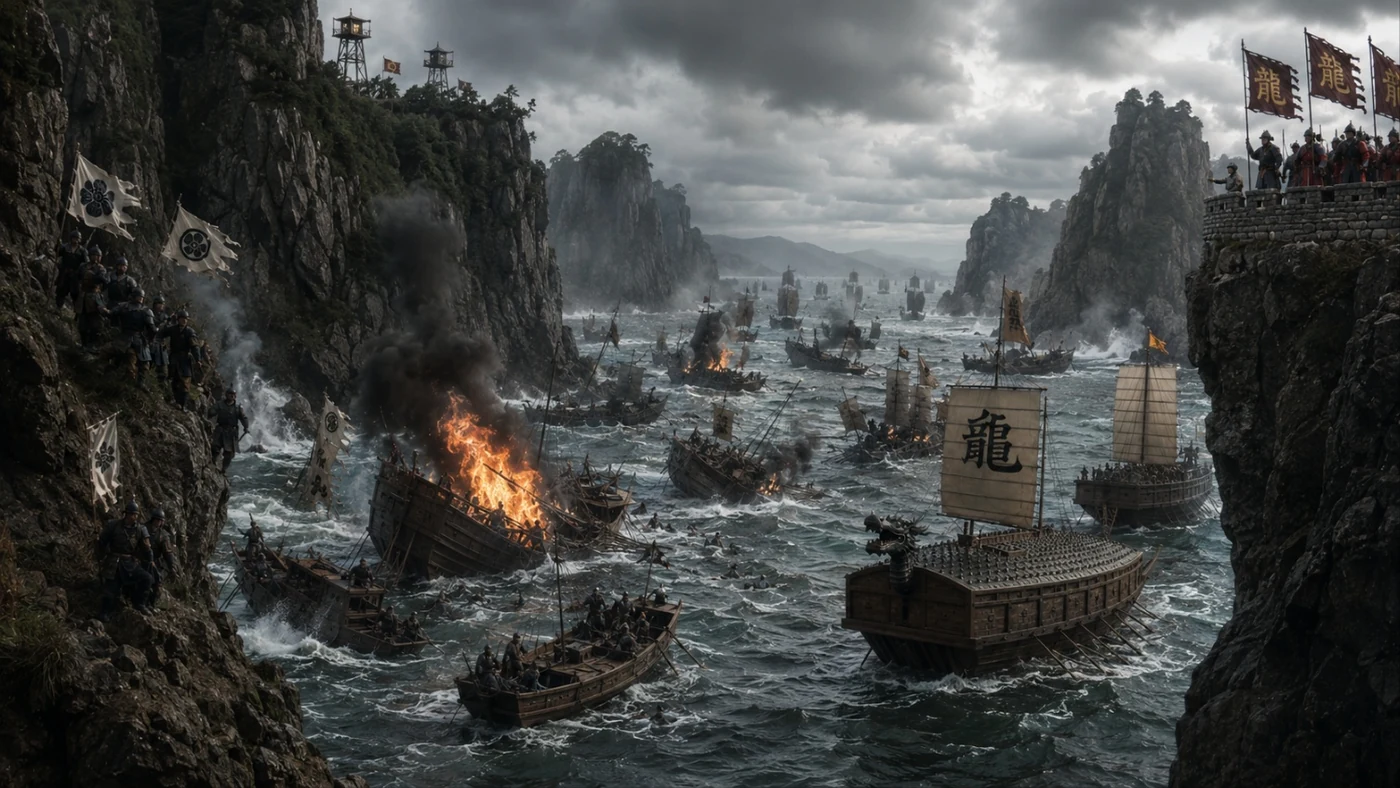
In Hansan: Rising Dragon, the turtle ship does not arrive as a finished weapon. It arrives as a problem. It rams into an enemy hull and cannot pull itself back out. Men argue about it. They take it apart and work on it. Fully half the tension of a film named after one of the most celebrated naval victories in Korean history is set not on the water but in a shipyard.
That looks like a screenwriter’s invention — a way to manufacture suspense before the battle. It is not, or not entirely. Yi Sun-sin’s own diary shows him testing the ship’s guns and rigging its sail in the last weeks before the war began.
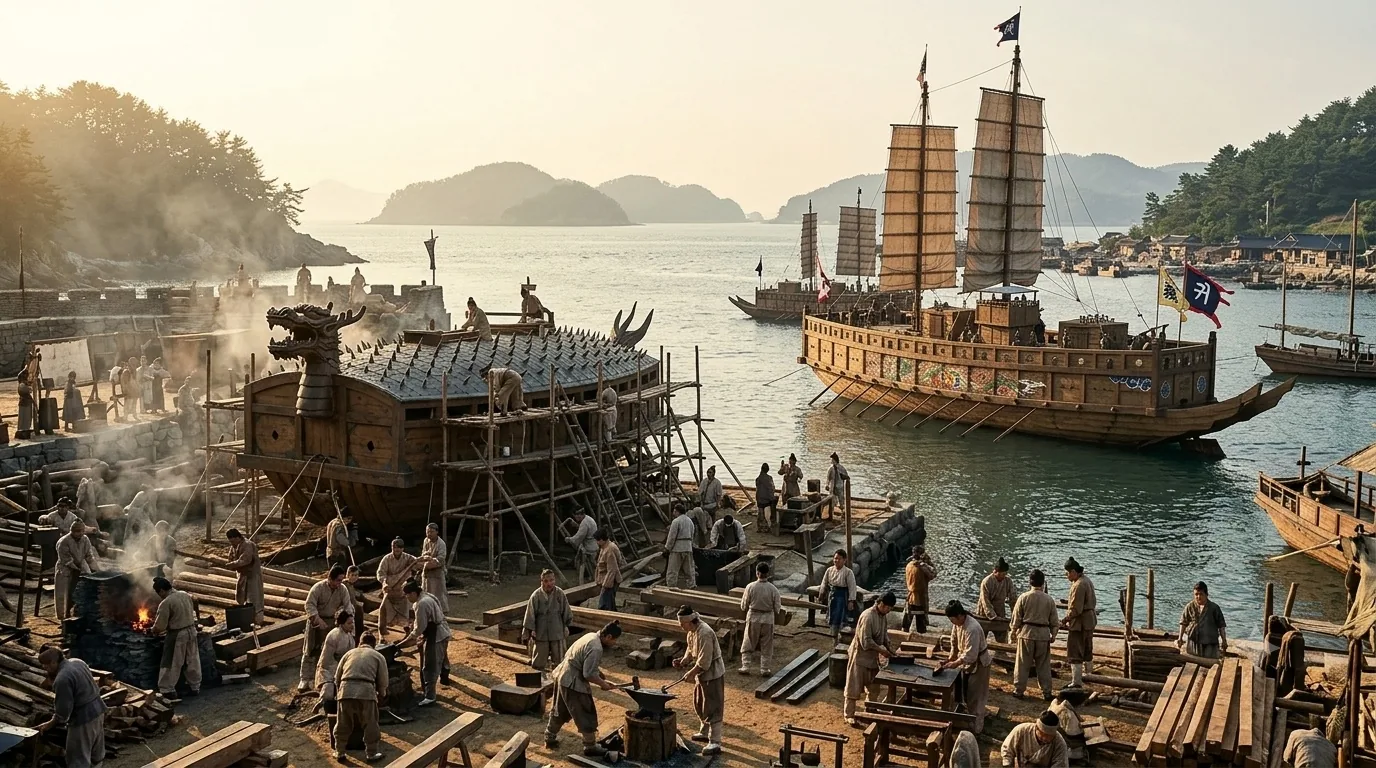 The workshop, not the battle — the part of the story the film spends half its running time on. (AI illustration)
Quick answer: The geobukseon (거북선), or turtle ship, is the most reproduced warship in Korean memory and the hardest one to draw accurately. The surviving early record gives two references: in 1413 King Taejong, passing the Imjin ford — a river, not the sea — watched a turtle ship and a Japanese vessel fighting, the text saying he watched (觀), which fits a demonstration better than a battle; and in 1415 an official asked that they be built again. The early record then goes quiet for most of two centuries. In 1592 Yi Sun-sin built turtle ships on his own initiative, first using one in combat at Sacheon on the 29th day of the fifth lunar month — his second sortie, not his first. They did not disappear with him: a memorial of 1606 records that one turtle ship was kept at each naval command, and the 1795 Yi Chungmugong Jeonseo preserves drawings and detailed measurements of two of them. What does not survive is a contemporary technical record of Yi’s own 1592 vessels — and the 1795 account itself says the later ship, while descended from the wartime one, had its dimensions altered. The Encyclopedia of Korean Culture also declines to support the familiar phrase “the world’s first ironclad.” So: the turtle ship survived. Yi Sun-sin’s turtle ship did not.
Let’s unpack it.
What a turtle ship actually was — a warship built on the panokseon design
One term first. The panokseon (판옥선) was the standard warship of the Joseon navy: a two-tiered vessel where oarsmen worked on the lower level, protected, while gun crews fought from the deck above. It was flat-bottomed and broad, suited to the shallow, tide-driven waters of Korea’s south-west coast.
The Encyclopedia of Korean Culture describes the turtle ship as a panokseon “whose upper structure was modified and covered over.” That single sentence rearranges the popular picture. The turtle ship was not a separate line of secret weapon standing outside the fleet; it was built on the design of the navy’s standard warship — roofed, spiked, and given a head at the bow. Its formal name in the records is gwiseon (龜船).
That matters for what follows, though not in the way you might expect. Because the turtle ship was a variant of the main warship rather than a one-off invention, it was the kind of vessel a navy could keep making. And, as we will see, it did.
1413: the first turtle ship in the record was on a river
Here is the fact most readers outside Korea have never encountered. The name “turtle ship” enters the Korean record 179 years before the Imjin War, and it enters on fresh water.
The entry is in the Veritable Records of Taejong, volume 25, under the fifth day of the second lunar month of 1413 (original text, National Institute of Korean History). Its heading reads: “Stays at the southern bridge of Tongjewon. Passing the Imjin ford, watches a turtle ship and a Japanese ship fighting.” The Chinese text runs:
上過臨津渡, 觀龜船、倭船相戰之狀。 The king passed the Imjin ford and watched the scene of a turtle ship and a Japanese ship fighting.
Two things are worth pausing on.
First, the place. The Imjin ford is on the Imjin River. Korea has coastline on three sides, and its most famous warship first appears in the record on an inland waterway.
Second, what kind of event this was. The verb is 觀 — to watch, to observe. The king was travelling and stopped to look. A situation a passing monarch can pull up and watch is far more consistent with a demonstration or an exercise — one vessel cast in the role of the Japanese ship — than with a real engagement in which he happened to be a spectator. The entry does not use the word “drill,” so we will not either. What we can say is that the text records the king watching, and that this reads as a display rather than a battle.
1415: build them again — and then the early record goes quiet
Two years later the turtle ship appears once more, in a different register. In the seventh lunar month of 1415, Tak Sin (卓愼), Left Royal Secretary, submitted a memorial on military preparedness in six articles (original text). The sixth reads:
龜船之法, 衝突衆敵而敵不能害, 可謂決勝之良策… The method of the turtle ship: it can crash among many enemies and the enemy cannot harm it — this may be called a fine plan for deciding a victory.
He asked that they be made again, “firmly and ingeniously,” so that the state might be equipped for victory.
The phrase 龜船之法 — literally “the method of the turtle ship” — could in principle mean a tactic rather than a vessel. The rest of the sentence settles it: what Tak Sin asks for is that they be made again. You do not “make” a tactic firmly and ingeniously. He is talking about ships.
There is a second thing in his memorial that usually gets left out. In the same document he warned that with Japanese raiding quiet for some time, the equipment and defences of the war fleet had grown slack. The proposal to build turtle ships again sat on top of a diagnosis: preparedness had decayed. The Joseon of 1415 was passing through a period when the threat was receding.
And then, for most of two centuries, the early record goes quiet.
Here a distinction has to be held carefully, because it is easy to overrun it. Records becoming sparse and a technology being wholly lost are not the same claim. This article does not say Joseon “forgot” the turtle ship. What can be said is narrower: between 1415 and the Imjin War, no specific process of development or transmission is confirmed in the sources available to us. The Encyclopedia of Korean Culture, working from these two entries, concludes only that “the institution of the turtle ship was already in place in the early Joseon period.”
1592: a ship built because one commander decided to build it
In the film, the turtle ship is built in the margins — pushed forward without a clear budget or a clear mandate, out of the court’s line of sight.
That impression matches the record. Urihistorynet, the National Institute of Korean History’s public reference, states that after taking up his post as Naval Commander of Left Jeolla Province, Yi Sun-sin prepared against the possibility of war and built the turtle ship on his own initiative.
It is worth being precise about how far that goes, because the stronger English phrasing is tempting and wrong. “On his own initiative” tells us who started it. It does not tell us that the court forbade it, or knew nothing of it. Writing “without royal orders” would smuggle in a confrontation the source does not describe.
The Nanjung Ilgi shows the work in progress, and the dates are worth reading in sequence:
| Date (1592, lunar) | Entry |
|---|---|
| 2nd month, 8th day | Receives 29 bolts of sailcloth for the turtle ship |
| 3rd month, 27th day | Tests firing cannon from the turtle ship |
| 4th month, 11th day | The sail, newly made, is finally finished |
| 4th month, 12th day | Fires the jija and hyeonja cannon |
| 4th month, 13th day | Japanese forces land at Busan |
The last gunnery trial was one day before the invasion began. The film’s half-built ship is not a liberty taken with the record; it is close to the texture of it.
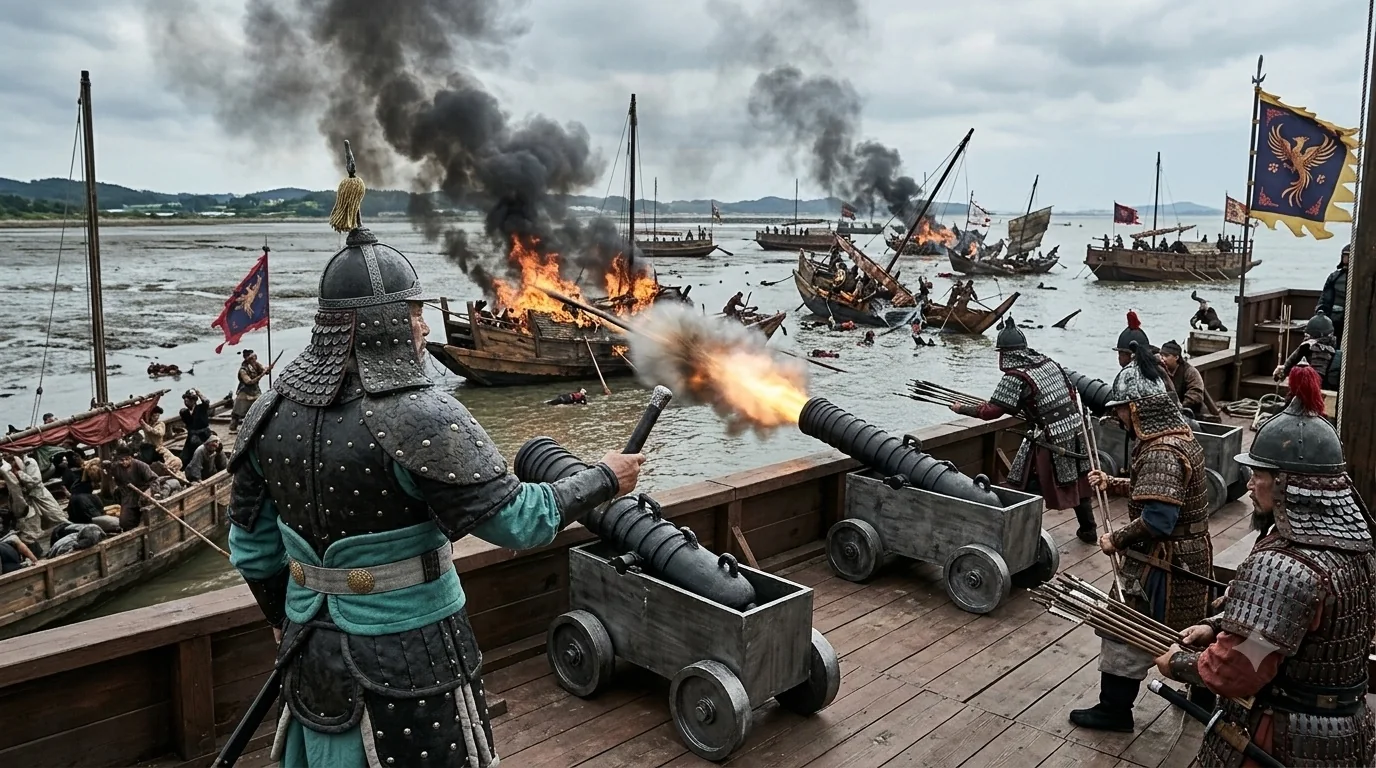
One correction the film invites, though. The turtle ship was not in Yi’s first engagement. Its first recorded combat use came at Sacheon, on the 29th day of the fifth lunar month of 1592 — his second sortie. Urihistorynet puts his force there at 23 warships including the turtle ship, joined by 3 warships under Won Gyun off the Hadong coast.
After the war: turtle ships did not disappear — and this is where the legend usually goes wrong
The popular version of this story ends with Yi Sun-sin, as though the ship died with the man. The record says otherwise, and it says so in the words of the officer whose name tradition attaches to the ship’s construction.
In the twelfth month of 1606, a memorial on naval strength put the position plainly (original text):
거북선[龜船]은 전쟁에 쓰기는 좋지만 사수(射手)와 격군(格軍)의 숫자가 판옥선(板屋船)의 1백 25명보다 적게 수용되지 않고 활을 쏘기에도 불편하기 때문에 각 영(營)에 한 척씩만을 배치하고 더 이상 만들지 않고 있다. The turtle ship is good for war, but it takes no fewer men — archers and oarsmen — than the 125 of a panokseon, and it is awkward to shoot from. So one is stationed at each naval command, and no more are being built.
Read that carefully, because it cuts two ways.
Turtle ships were still there. Eight years after the war, one was kept at each naval command as a standing part of the fleet. This is not a lost technology; it is an inventory decision.
And the reason given is cost, not mystery. The ship was manpower-hungry and awkward for archery. It was kept, and not multiplied.
The same memorial goes on to describe its author serving as an officer under the inspector Han Hyo-sun and supervising the building of twenty-five warships that were “neither panokseon nor turtle ship,” bristling with swords and spears — the vessel known as the changseon (鎗船). That author is Na Dae-yong, the man whose name tradition attaches to the turtle ship. He is not a legend here. He is writing a staff paper about manning ratios.
And the record continues past him. In 1795, by royal command, the Yi Chungmugong Jeonseo was compiled, and it contains illustrated descriptions of two turtle ships — one at the Tongjeyeong (the naval headquarters) and one at the Jeolla Left Naval Command — with measurements that are anything but vague. For the Tongjeyeong ship: a bottom length of 64 cheok 8 chon, a bow width of 12 cheok, a waist width of 14 cheok 5 chon; ten oars on each side; twenty-two gun ports on the sides, four at the front, twelve on the back; twelve compartments on the deck.
So the honest summary is not “no plans survive.” Plans survive. They are just plans of the wrong ship.
What we cannot recover — and why the 1795 drawings say so themselves
The film shows you a turtle ship. It has a dragon’s head, a roof that reads as iron plate, and a two-level interior. You watch it and feel you already knew that shape.
Ask what that shape is based on, and the ground gives way — not because nothing survives, but because of one sentence in the very document that survives.
The Encyclopedia of Korean Culture, describing the 1795 compilation, records that the Tongjeyeong turtle ship derived from the turtle ship of the Imjin War, “but with additions and subtractions in its measurements.” And the compilation was made more than two hundred years after the war.
That is the whole problem in a line. We have a detailed drawing. The drawing tells us it is not the same ship.
No hull survives. No technical account of the design and construction of Yi Sun-sin’s own 1592 vessels has been identified. So every reconstruction now standing — and there is one in nearly every Korean city of any size — is assembled from four kinds of evidence:
- the 1795 illustrations and measurements, which describe later ships and say so;
- Yi Sun-sin’s own dispatches to the throne;
- excavated remains of other Korean vessels;
- naval-engineering analysis of what such a hull could and could not do.
The fullest contemporary description we have is a few lines in Yi’s dispatch after the Battle of Dangpo: a dragon’s head fixed at the bow, cannon fired from its mouth, iron spikes set into the back, and an arrangement by which those inside could see out while those outside could not see in.
That is close to the whole of it. What we know of Yi Sun-sin’s turtle ship rests on a handful of lines.
”The world’s first ironclad” — a phrase the Korean encyclopaedia will not sign
If you have heard anything about the turtle ship in English, you have probably heard this. In the film, its back turns musket balls and fire arrows.
The Encyclopedia of Korean Culture does not endorse the claim.
According to the encyclopaedia, the origin of the ironclad description is itself unreliable. It rests on oral tradition and Japanese-side writings — and Japanese accounts have long been read with caution here, since attributing the defeat to an extraordinary ship served an obvious purpose. Within Korea, the phrasing spread after Yu Gil-jun, in his Seoyu gyeonmun, described Yi Sun-sin’s turtle ship as an iron-armoured warship (鐵甲兵船), the first made anywhere in the world. Many writers followed him. The encyclopaedia’s verdict on the claim is blunt: “it was not a claim with certain grounds.” On the ship’s surface it says only that whether it was covered in iron plate “has still not been accurately confirmed.”
What the sources do carry is the dispatch: spikes or blades set into the back so that no one could climb aboard. Driving spikes into a roof and sheathing a hull in iron are two different things.
This is also the point in the story where we have to watch our own footing. “World’s first” anything would require having checked every case in the world, which is not a thing anyone can do — so this article does not use the phrase. It is the same discipline we applied when we looked at the claim that the Battle of Jinpo in 1380 was the world’s first naval battle fought with cannon: the narrow statement the evidence supports is worth more than the large one it cannot carry.
And a further irony follows from it. The less design a ship left behind, the more people have hung on it. The empty space is what makes room.
Drama vs. real history — how much does Hansan embellish?
| Hansan: Rising Dragon | The record |
|---|---|
| The turtle ship is newly developed for this war | Yi’s turtle ships were genuinely built new for combat — but a warship called “turtle ship” is already in the record in 1413 |
| A structural flaw is diagnosed and fixed to complete the ship | Trials did continue up to the eve of war, confirmed by the Nanjung Ilgi. The specific flaw and its solution are invention |
| The turtle ship is the decisive weapon of Hansan Island | It played a significant part, but the backbone of the Joseon navy was the panokseon |
| It is there from the first sortie | Its first combat use was the second sortie — Sacheon, 29th day of the fifth month |
Key terms. Geobukseon (거북선) / gwiseon (龜船) — the “turtle ship”; in the encyclopaedia’s description, a panokseon with its upper structure modified and roofed over. Panokseon (판옥선) — the standard two-tiered Joseon warship, oarsmen below and gun crews above. Nanjung Ilgi (난중일기) — Yi Sun-sin’s wartime diary, National Treasure No. 76. Yi Chungmugong Jeonseo (이충무공전서) — a later compilation of Yi’s writings; its prefatory turtle-ship illustrations are one basis of modern reconstructions. Jangye (장계) — a field commander’s official dispatch to the throne, and here the most concrete contemporary description of the ship.
What survives of a warship: three ways of losing a ship
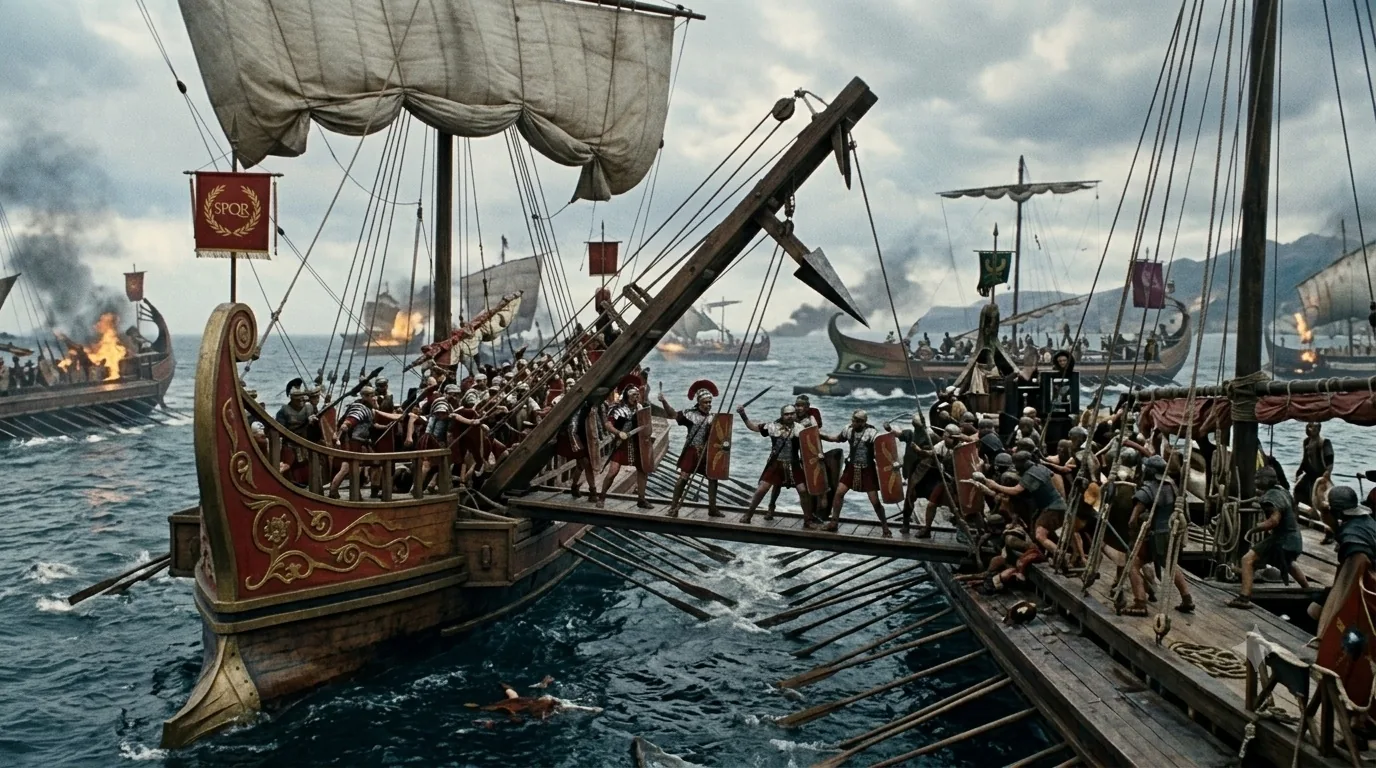 Rome’s answer to the same problem, and the same evidentiary hole — the corvus is described in the sources and has never been found. (AI illustration)
Ships are lost in more than one way, and the differences matter more than the losses.
Rome’s corvus — lost completely. In the First Punic War of the third century BC, Rome had little naval experience and a great deal of experience in infantry fighting. The answer attributed to it was a boarding bridge dropped onto an enemy deck so that soldiers could cross, turning a sea fight into the kind of fight Rome already knew how to win. The principal evidence is Polybius. No object, no plan, and no successor. It appears in a particular phase, is not carried forward, and survives in a few lines of description; scholars differ over its details and over how far the accounts can be trusted. This is total loss — the case the turtle ship is usually, and wrongly, compared to.
Venice’s Arsenale — kept as a process. The Venetian Republic ran a state shipyard for centuries. When a shipyard is a permanent institution, what survives is not only ships but process, standards and paperwork. Hulls rot; the method persists in documents. Loss of the object, survival of the method.
Joseon’s turtle ship is a third case, and the most interesting one. It was neither forgotten like the corvus nor preserved intact like a Venetian standard. It was kept — one at each naval command in 1606, still drawn and measured in 1795 — and in being kept it was changed. The 1795 compilation is explicit that the later ship descends from the wartime one with additions and subtractions in its measurements.
That is the shape of this loss. Not a technology that vanished, but a lineage that continued and drifted. An institution preserves a type, not an instance. The navy kept turtle ships; it did not keep that turtle ship, and nobody at the time had any reason to think it should.
So the honest sentence is narrower than the legend and stranger than it: the turtle ship survived, and Yi Sun-sin’s turtle ship did not. What remains of his ships is a few lines in a diary, one passage in a dispatch — and drawings made two centuries later by people who were describing a different vessel and said so.
The most frequently depicted ship in Korea is the one we can least confirm we have drawn.
Back to the film
Knowing this, the long stretches of Hansan in which men take a ship apart and put it back together look different.
That ship was unfinished until the day before it was needed. It was not built because the state ordered it built. And when the war was over, the exact design of the vessels he fought in was never recorded clearly enough for anyone to reproduce them with confidence — even though turtle ships themselves went on being stationed, drawn and measured for two hundred years more.
You can see a turtle ship in almost any Korean city — on the banknote, in a plaza, in a museum. Not one of them was made by looking at the original. The most reproduced ship in the country has never once been confirmed as accurately reproduced.
The turtle ship did not disappear. Yi Sun-sin’s turtle ship did. That unfinished feeling the film keeps returning to may be the most accurate portrait of this ship anyone has made.
Coming up next
If the turtle ship interests you as a question of evidence rather than legend, two companion pieces follow the same thread. The Battle of Myeongnyang looks at what the sources say about twelve ships against a fleet — and at why the turtle ship is almost certainly not in that battle. The Battle of Jinpo in 1380 takes up the same problem two centuries earlier: a weapon Korea built itself, and a “world’s first” claim the evidence will not carry.
Frequently asked questions
Did Yi Sun-sin invent the turtle ship? Not the name, and the sources will not settle the rest. A warship called a turtle ship (gwiseon, 龜船) appears in the Veritable Records of Taejong in 1413, 179 years before the Imjin War. Whether that vessel and Yi’s were the same kind of ship, or whether any technique passed between them, cannot be established, because no contemporary design for either survives. What is clear is that Yi built turtle ships for combat and commanded them in it.
Where was the first turtle ship in the Korean record? On a river. The 1413 entry places it at the Imjin ford — the Imjin River, not the sea.
Was that 1413 event a real battle? Almost certainly not. The text says the king watched (觀) the scene while travelling, which fits a demonstration or exercise better than a real engagement. The entry does not use the word “drill,” so we do not state it as fact.
Does the original design of the turtle ship survive? Drawings survive — of later ships. The Yi Chungmugong Jeonseo (1795) illustrates two turtle ships with detailed measurements, but the Encyclopedia of Korean Culture notes the headquarters ship descends from the wartime one “with additions and subtractions in its measurements,” two centuries on. No hull survives and no contemporary technical account of Yi’s 1592 vessels has been identified.
Did turtle ships disappear after the Imjin War? No. A memorial of the twelfth month of 1606 records that one turtle ship was stationed at each naval command and no more were being built — because it took as many men as a panokseon and was awkward to shoot from. They were still being drawn and measured in 1795.
Was the turtle ship the world’s first ironclad warship? The Encyclopedia of Korean Culture does not support the claim, noting that it rests on oral tradition and Japanese-side writings and that whether the surface was iron-plated “has still not been accurately confirmed.” What the sources support is spikes set into the back to stop boarders — which is not the same as iron plating.
Did Yi Sun-sin build the turtle ships on royal orders? Urihistorynet says he built the turtle ship on his own initiative after taking up his post. That is a statement about who began it, not a claim that the court forbade it.
Did the turtle ship fight in Yi Sun-sin’s first battle? No. Its first recorded combat use was at Sacheon on the 29th day of the fifth lunar month of 1592 — his second sortie.
Is the film’s story about fixing a flawed turtle ship true? The situation is close to the record; the specific fault and its fix are invention. The Nanjung Ilgi records trials continuing until the day before the Japanese landed.
Sources & further reading
- The 1413 turtle ship — Taejong sillok, vol. 25, Taejong 13 (1413), 2nd lunar month, 5th day, 1st entry, Korean and Chinese text via the National Institute of Korean History. The Chinese reads 上過臨津渡, 觀龜船、倭船相戰之狀.
- Tak Sin’s 1415 memorial — Taejong sillok, vol. 30, Taejong 15 (1415), 7th lunar month, 16th day, 2nd entry. Six articles on military preparedness; the turtle ship is the sixth. The passage quoted reads 龜船之法, 衝突衆敵而敵不能害, 可謂決勝之良策.
- Turtle ships after the war — Seonjo sillok, Seonjo 39 (1606), 12th lunar month, 24th day (original text): one turtle ship at each naval command, none being added, on grounds of manning and archery.
- The 1795 drawings — Yi Chungmugong Jeonseo, prefatory volume: two turtle ships with detailed measurements. Via the Encyclopedia of Korean Culture, which notes the headquarters ship derived from the wartime vessel “with additions and subtractions in its measurements.”
- The turtle ship as a modified panokseon, and the “ironclad” assessment — Encyclopedia of Korean Culture (Academy of Korean Studies), ‘Geobukseon’ (E0001833), which records the claim’s basis in oral tradition, Japanese-side writings and Yu Gil-jun’s Seoyu gyeonmun, and concludes that iron plating “has still not been accurately confirmed.”
- Construction on Yi’s own initiative; Sacheon as first combat use; fleet numbers — National Institute of Korean History, Urihistorynet, ‘Turtle Ship 1592’ (kc_r300020).
- Nanjung Ilgi dates and the Dangpo dispatch — cited here from state-institution summaries. These specific passages have not been collated against the original texts for this article, and are presented as such.
- The panokseon — National Research Institute of Maritime Cultural Heritage, Panokseon research report (2021); Hong Sun-jae, ‘Understanding the structure of the panokseon, the main warship of the Joseon navy’, Gunsa 135 (Institute for Military History, Ministry of National Defense, 2025), 79–122 (KCI).
- The corvus — Polybius, Histories. No physical remains or plans are known; details and even its existence are debated among specialists.
- The Venetian Arsenale — Robert C. Davis, Shipbuilders of the Venetian Arsenal (Johns Hopkins University Press), cited for the shipyard’s long-running institutional operation.
- Film versions — Netflix’s Hansan listing and reporting on the 28 November 2022 release schedule; the extended Hansan: Redux opened on 16 November 2022 with roughly 21 minutes of additional footage. Which cut is available differs by country and region.
This article was researched and written by K-Drama History. Source: The Turtle Ship Nobody Has Seen: Korea's Most Famous Warship Left No Blueprint — The History Behind Hansan: Rising Dragon — K-Drama History