Jing-bi-rok, Explained: Why King Seonjo Fled Seoul Before the Palaces Burned
Theme: War & Resistance
From the research behind Pause the Drama.
The 45-second version — on YouTube
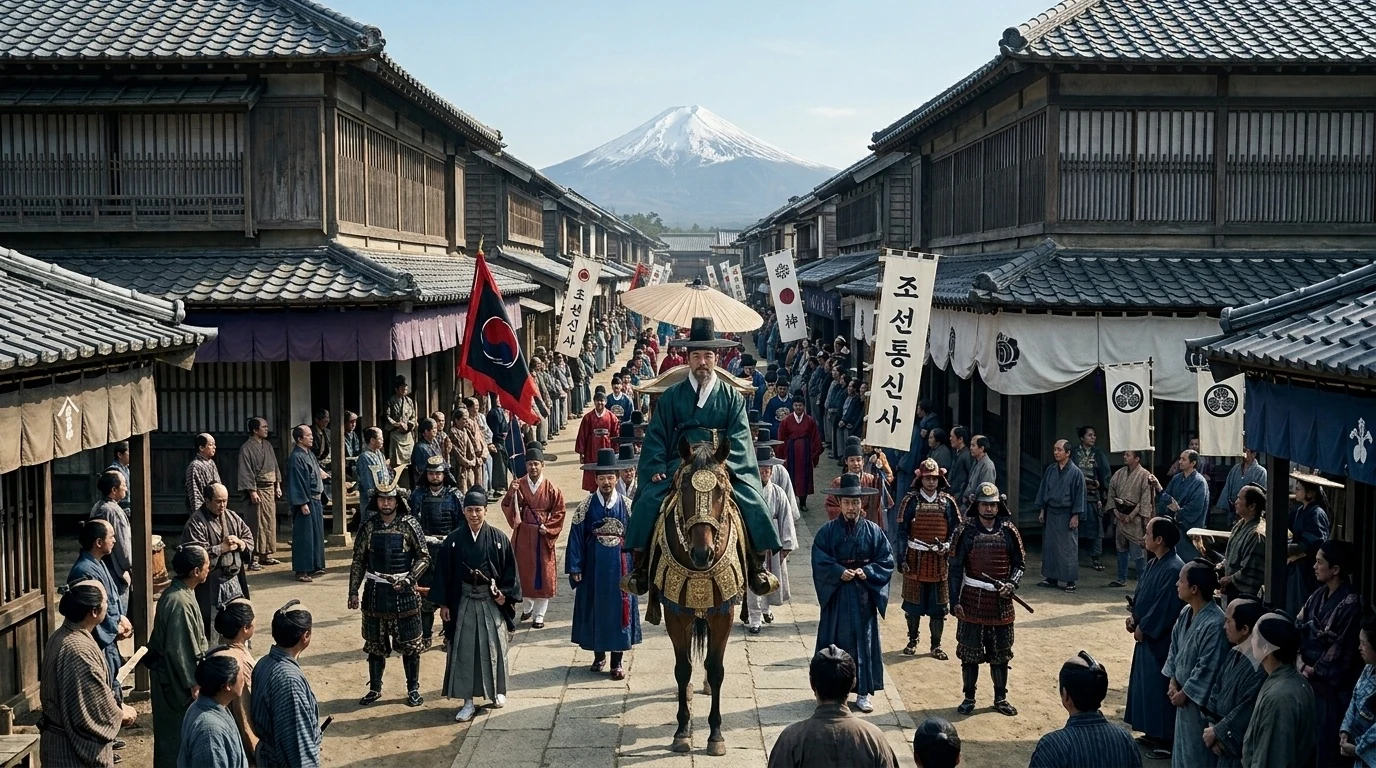
You are watching Jing-bi-rok (징비록, released internationally by KBS World as The Jingbirok: A Memoir of Imjin War), and the scene that should feel like fiction is the one that is closest to verified fact: the King of Joseon leaving his own capital in the dark — not to rally an army, not to inspect a front line, but to put distance between himself and an invasion he cannot stop. Behind him, a city he is abandoning. Ahead, a border he does not yet know he will reach. And somewhere in the chaos of that departure, before a single Japanese soldier reaches the gates, his own palaces begin to burn.
This is not a monarch riding out to meet a crisis. This is a monarch outrunning one — and the fires started before the enemy even arrived.
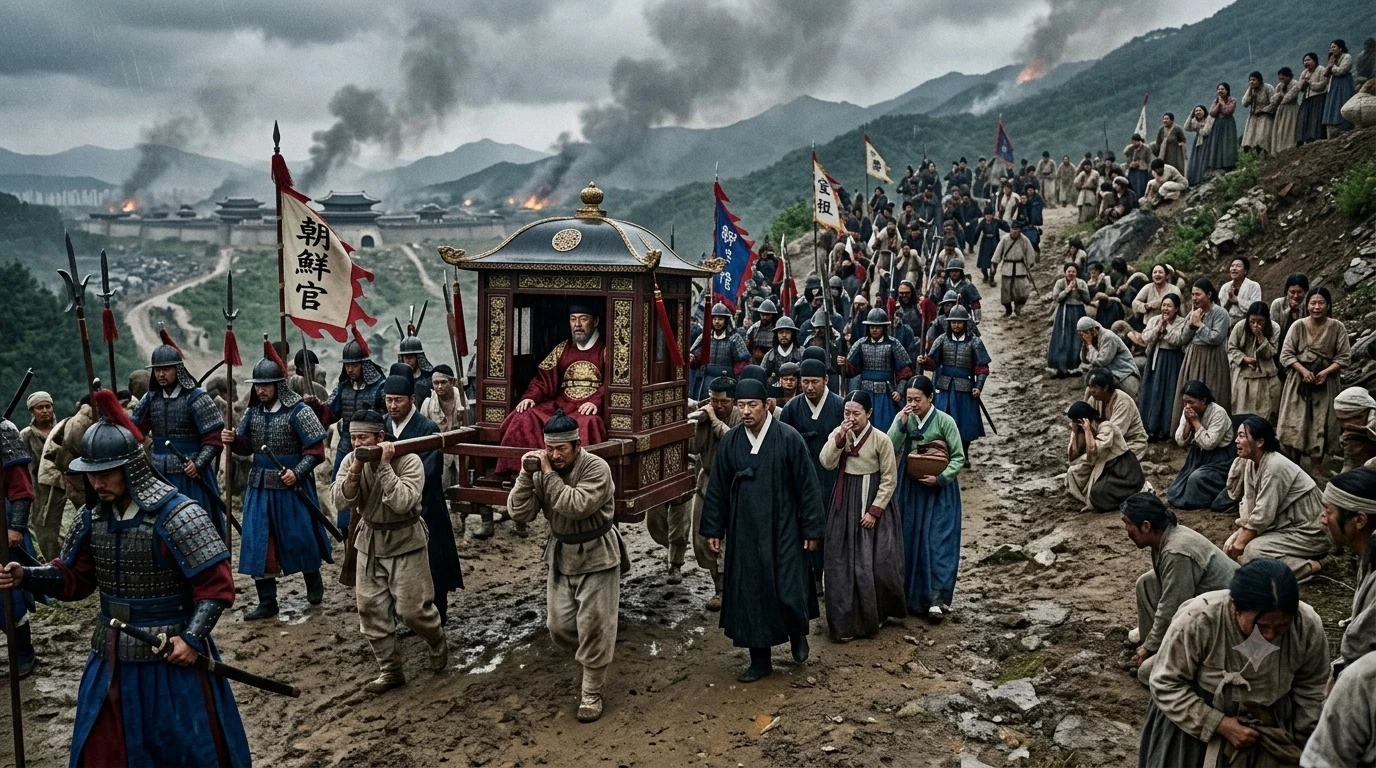
Quick answer: In 1592, as Japanese forces raced toward Seoul at the start of the Imjin War, King Seonjo left the capital rather than defend it, eventually reaching Uiju on the Chinese border. After he was gone, the Revised Veritable Records report, a crowd remaining in the city burned the offices holding the slave registers, then looted and torched the palace offices and storehouses. Seonjo also pursued refuge inside Ming China and got only a limited, reluctant contingency in return. He did not return to Seoul for roughly a year and a half. The episode left a scar on Joseon’s politics that outlasted the war itself.
Let’s unpack it.
Why did Seonjo actually run — and how fast did the kingdom fall?
Because Joseon’s main field army had been destroyed, and the improvised defenses behind it did not hold.
The invasion opened with startling speed. Japanese forces landed and pushed north through the peninsula, and Joseon’s central defense collapsed at the Battle of Chungju in the fourth lunar month of 1592, when General Sin Rip’s army — the kingdom’s main striking force — was broken (National Institute of Korean History, 우리역사넷). Commanders including Kim Myeong-won and Sin Gak did try to hold the Han River line afterward; those efforts failed to stop the advance. The court’s own annals record what happened next in blunt, almost clinical detail: at dawn on the thirtieth day of the fourth month, the king departed the capital, and by evening his party had reached the Imjin River crossing and was ferried across by boat (Veritable Records of King Seonjo, 선조실록 25/4/30). The night before, Seonjo had raised his son Gwanghaegun to crown prince, and the officials offered their congratulations. In context the decision reads as more than routine succession planning: it ensured that a second recognized center of royal authority could survive if the king were captured, killed, or cut off from the rest of the country — which is exactly what the bunjo would become five weeks later. (The edict announcing the investiture was proclaimed to the provinces during the flight itself; the record does not fix exactly when or where.)
From Seoul, the royal party moved to Kaesong, then Pyongyang, then finally to Uiju (의주), a border town on the Yalu River — as far from Japanese forces, and as close to Ming China, as Joseon territory allowed. Japanese troops entered Seoul within days. The city had not been stormed; the court and the defending command had pulled out, and no organized defense remained to meet them. The people, of course, were still there.
Who burned Gyeongbokgung during the Imjin War — and what does the record actually say?
This is the most argued-over detail in the whole episode, so it is worth being exact about what the record actually says — and what it doesn’t.
The Revised Veritable Records of King Seonjo (선조수정실록), compiled after the war rather than contemporaneously, record that once the king had gone, people the annals call nanmin (난민, 亂民) — literally “disorderly people,” a riotous crowd rather than refugees in the modern sense — burned the Jangnyewon (장례원) and the Board of Punishments (형조) — the offices where the registers of public and private slaves were kept — and then extensively looted the palace offices and storehouses before setting fire to them to erase the traces (선조수정실록).
Read that carefully, because the specific, documented thing is stranger and sharper than the version usually told. The first targets named are not the throne room. They are the filing cabinets — the two offices whose paperwork was the legal machinery of hereditary servitude. Burn the registers, and the record of who owns whom burns with them.
What the record does not do is equally important. It does not identify the participants as palace slaves specifically. It does not describe the crowd’s emotions. And the fact that this account appears in a revised set of annals, compiled later, does not by itself make it hearsay or rumor — it makes it a record assembled after the fact, which is a different thing. What Japanese forces did to the palace compounds during the occupation that followed is a separate question with its own evidence.
So: the sequence in the record is that the king’s departure came first and the fires followed. That much is documented. Anyone who tells you flatly who lit which fire, and what they were feeling when they did, is telling you something this record does not contain.
Did Seonjo try to cross into Ming China?
He seriously considered it — and Ming’s answer is almost more revealing than the request.
The option was called naebu (內附): the king and the royal house entering Ming territory. It is often glossed in English as seeking asylum, though it is not quite the modern idea of individual political exile. Seonjo was already weighing it before he reached Uiju — the question surfaced back at Bakcheon — and it stayed live once he got to the border.
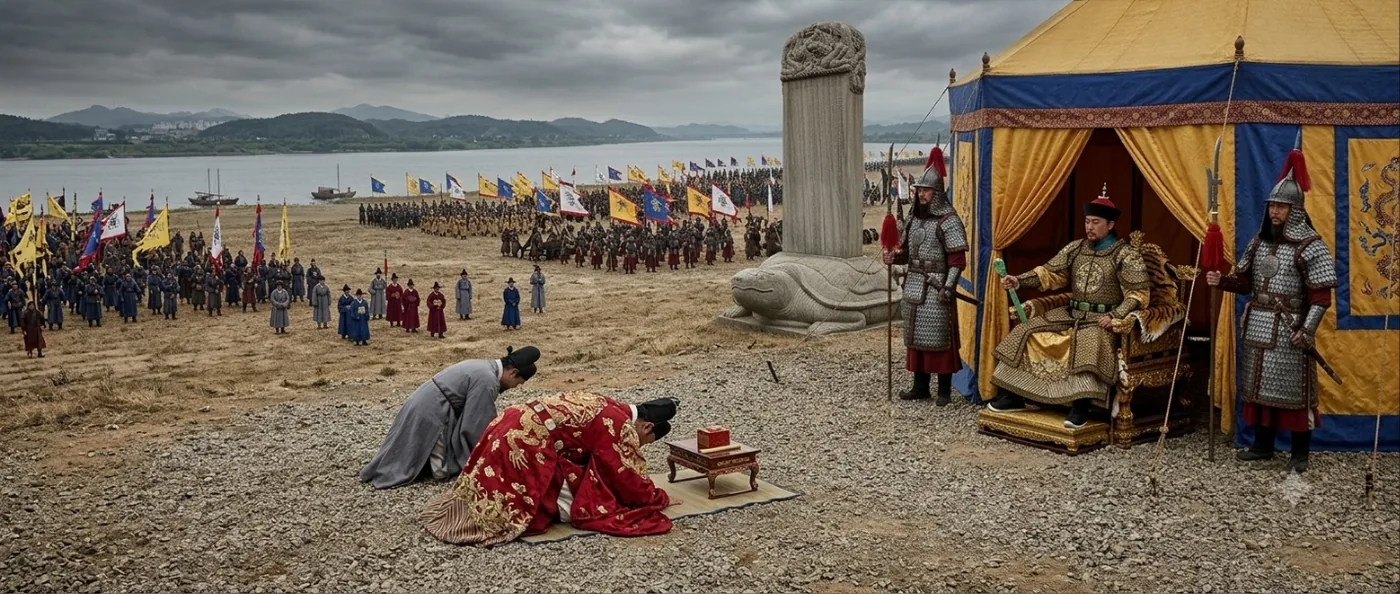
The terms on offer were not what a king might hope for. The Veritable Records note word, in the sixth lunar month of 1592, that Ming meant to house him in the empty government quarters at Kwanjeonbo (관전보 공해) — not a derelict ruin, simply offices no one was using, across the river. A discussion recorded in the seventh month proceeds on the assumption that the enemy had overrun the country and that his entourage would be severely limited. None of that adds up to a formal imperial grant of asylum. It was a limited, reluctant contingency, framed for the most extreme case — a long way from an invitation to a fellow sovereign.
The plan was never carried out. Seonjo’s own officials opposed it, and so did the practicalities: the constrained terms, the hard mountain roads to Liaodong, repeated river crossings, few houses to shelter in, and bad water along the way. He stayed at Uiju.
Key terms. Pajeon (파천, 播遷) — the flight of a monarch from the capital during a crisis; Seonjo’s version is remembered specifically as the Uiju pajeon. Naebu (내부, 內附) — the king and royal house entering the territory of a stronger state and submitting to it; Seonjo’s aborted plan to cross into Ming. Bunjo (분조, 分朝) — a “divided court,” a second royal government operating in parallel with the king’s during an emergency. Jaejoji-eun (재조지은, 再造之恩) — “the grace of being given a second founding,” the idea that Ming China’s intervention had saved Joseon from extinction.
What was Gwanghaegun’s bunjo — and why does it complicate the story of a fleeing king?
Because while the king kept moving north, his teenage son was doing something closer to what a wartime ruler is supposed to do.
On the first day of the sixth lunar month of 1592, Seonjo ordered his newly named crown prince, Gwanghaegun — eighteen by Korean reckoning, seventeen by modern count — to lead a bunjo (분조), a “divided court,” operating in parallel with the main royal government. Into around the tenth month of 1593, Gwanghaegun traveled through Pyeongan, Hwanghae, and Gangwon provinces with a small circle of officials, working to steady displaced populations, encourage local resistance, and keep some visible symbol of royal authority present in regions the king’s own court had left behind (Gwanghaegun — Encyclopedia of Korean Culture; Bunjo, 분조 — 우리역사넷).
It is worth being precise about what this was and wasn’t. The bunjo did not divide sovereignty between two equal monarchs. It was an emergency wartime device: Seonjo and his court spreading the functions of rule across two bodies, so that the dynasty and its ancestral rites had a better chance of surviving whatever happened to any one of them.
The later stages are often folded into “the bunjo” but were institutionally distinct. In the eleventh intercalary month of 1593 the crown prince’s field headquarters was reconstituted as the bunbibyeonsa (분비변사), renamed the mugunsa (무군사) that twelfth month; it was under that name that the southern work in Jeolla and Chungcheong — raising troops and provisions, including for the Ming army — was carried out, with activity recorded into the third month of 1594. Different name, different stage, same basic idea.
It is not a coincidence that the drama, and Korean popular memory more broadly, often treats Gwanghaegun’s wartime conduct with more sympathy than his father’s — a contrast that would matter enormously to how each man’s reign was later judged.
If the king fled, what kept Joseon from collapsing?
Start with three dates.
The fourteenth day of the fourth lunar month, 1592. Japanese forces land.
The twenty-second. In Uiryeong, a county in the far south, a man named Gwak Jae-u raises a militia (Encyclopedia of Korean Culture, 곽재우).
The thirtieth. King Seonjo leaves Seoul.
Read them in that order and the shape of the war’s first month changes. A private man in a southern county had an army in the field eight days before the king finished deciding whether to run. Nobody sent him. There was nobody left to send him.
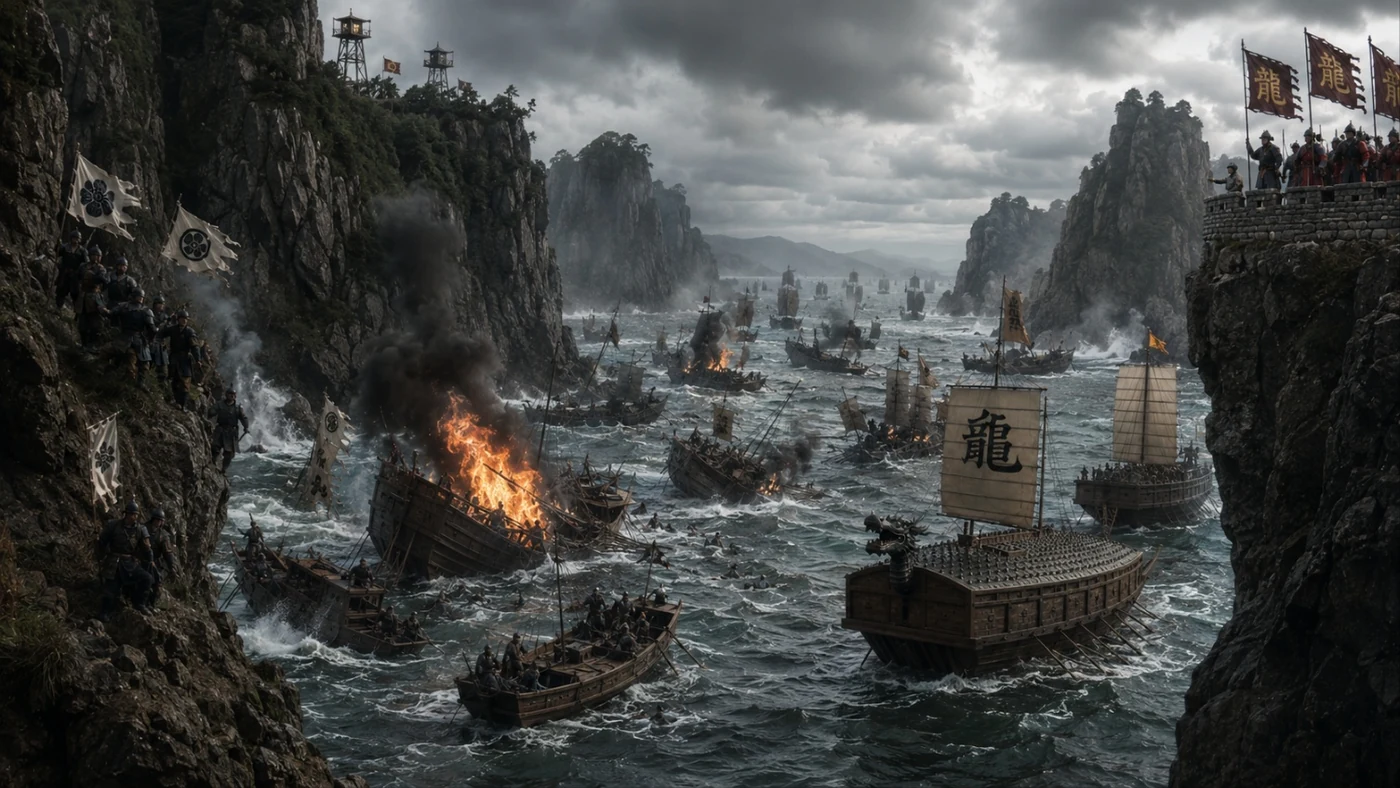
That is the pattern, repeated across the peninsula: uibyeong (의병), “righteous armies,” forming while the court was still moving north and the central military system was in pieces. Gwak Jae-u went on to hold the Jeongam ford, where he met a Japanese crossing operation and won decisively — blocking a key route into Jeolla province, the region that fed the rest of the country. In Chungcheong, the scholar Jo Heon organized volunteers who, joined by the monk-soldiers of Yeonggyu, recaptured Cheongju. In the first lunar month of 1593, the nationwide tally of righteous army fighters reported to Ming came to roughly 22,600 — about a quarter the size of Joseon’s regular government army (Righteous Armies, 의병 — Encyclopedia of Korean Culture). That is a reported count at one moment in the war, not a ceiling on how many ever served. No single force saved Joseon, and it cheapens the others to pretend one did: Yi Sun-sin’s navy cut Japan’s supply lines by sea, the regional government troops who survived the collapse kept fighting, monk-soldiers marched, and from 1593 the Ming intervention changed the arithmetic again. But look at the dates once more. The recovery started underneath the government, and it did not wait for it.
| In Jing-bi-rok | In real history |
|---|---|
| Seonjo departs the capital before dawn | The Veritable Records date his departure to the 30th day of the 4th lunar month, 1592 |
| The palace burns behind him | The Revised Veritable Records record a crowd (亂民) burning the slave-register offices, then looting and torching the palace offices and storehouses — after the king had gone. The record names no specific group and no motive |
| The court fractures under crisis | It split by design — Gwanghaegun led a parallel “divided court” (bunjo) from mid-1592, an emergency arrangement rather than a rival throne |
| The country appears leaderless | Spontaneous righteous armies (uibyeong) rose within days, without waiting for royal orders |
| Seonjo eventually reaches safety at Uiju | He also pursued refuge across the border in Ming territory — and got only a limited, reluctant contingency in reply |
What is jaejoji-eun, and why did Korea spend two centuries paying it back?
Because after nearly losing everything, Joseon’s ruling class decided the debt they owed their rescuer was too large, and too politically useful, to ever stop repaying.
In early 1593, a joint force — Ming troops under Li Rusong at its core, alongside Joseon regulars and monk-soldiers — retook Pyongyang, turning the momentum of the war. Out of that relief came a phrase that would outlive the war by centuries: jaejoji-eun (재조지은, 再造之恩) — “the grace of a second founding,” the idea that Ming China had, in effect, brought a dying Joseon back to life. It began as diplomatic language aimed at Beijing and visiting Ming generals, but spread through the Joseon aristocracy as a broader, almost sacred framing of the Ming relationship (Jaejoji-eun — AKS Sillok-wiki).
It was not a neutral piece of gratitude. Read it against the year it was born in. A court whose king had left his capital — and left it burning — now had a story in which the dynasty’s survival was evidence of a moral order rather than evidence of a failure. No one wrote that down as a plan, and it would be inventing history to say they did. But the language was there, it was useful, and it stuck. What followed isn’t in dispute: as the Ming dynasty crumbled and Manchu power rose through the early 1600s, jaejoji-eun was one of the factors that pushed Joseon toward a rigid pro-Ming posture at precisely the moment flexibility would have served it best.
Four rulers, four capitals, four verdicts
Almost every civilization has, at some point, watched its ruler leave a capital under threat. What differs — sharply — is what each one decided that flight meant. Set Seonjo beside three other rulers who lost their capitals, and the interesting thing isn’t the running. It’s the verdict.
Korea — the flight is judged separately from the necessity. Two things about Seonjo’s pajeon are both true, and Korean historians hold them apart deliberately. The flight kept the king, the court, the chain of wartime command, and the Ming diplomatic channel alive — no small thing in a war Joseon nearly lost. And the manner of it — a capital and its people left behind, a court debating whether to leave the country entirely — cost the throne credibility it never fully regained. Later Confucian historiography treated the episode as a case study in why virtue, not mere bloodline, legitimized a ruler, and Seonjo’s reputation has never recovered from the comparison with his more decisive son. Necessity and leadership are different charges, and he is acquitted on one and convicted on the other.
China — the flight cost the ruler his power, one station at a time. In 756, as the An Lushan rebellion tore through Tang China, Emperor Xuanzong fled Chang’an westward toward Sichuan. At Mawei Station his own imperial guard mutinied, destroyed the faction of his chief minister Yang Guozhong, and forced him to order the death of his consort Yang Guifei (An Lushan — Encyclopædia Britannica). That was not the end of the bill but the start of it: his heir was enthroned at Lingwu without him, and Xuanzong finished the war as a retired emperor with the title and none of the power. The flight didn’t cost him a mistress. It cost him the throne, in installments.
Japan — the shogun didn’t flee; the governing simply stopped. During the Ōnin War (1467–77), Kyoto itself became the battlefield, and much of the city was destroyed over a decade of fighting. Shogun Ashikaga Yoshimasa, whose contested succession had helped trigger the war, never fled under fire the way Seonjo or Xuanzong did. He is criticized instead for failing to control the war at all and for leaning ever further into culture and the arts rather than politics (Ōnin War — Encyclopædia Britannica). (His Higashiyama villa — the site of the Silver Pavilion, Ginkakuji — came later: the retreat was begun in 1482 and the pavilion itself in 1489, well after the war ended.) No crowd burned his palace in protest; there was no need to. Shogunal authority dissolved anyway, opening the door to Japan’s Warring States period. Korea and China judged a ruler’s movement. Japan’s disaster came from a ruler’s absence of will while sitting still.
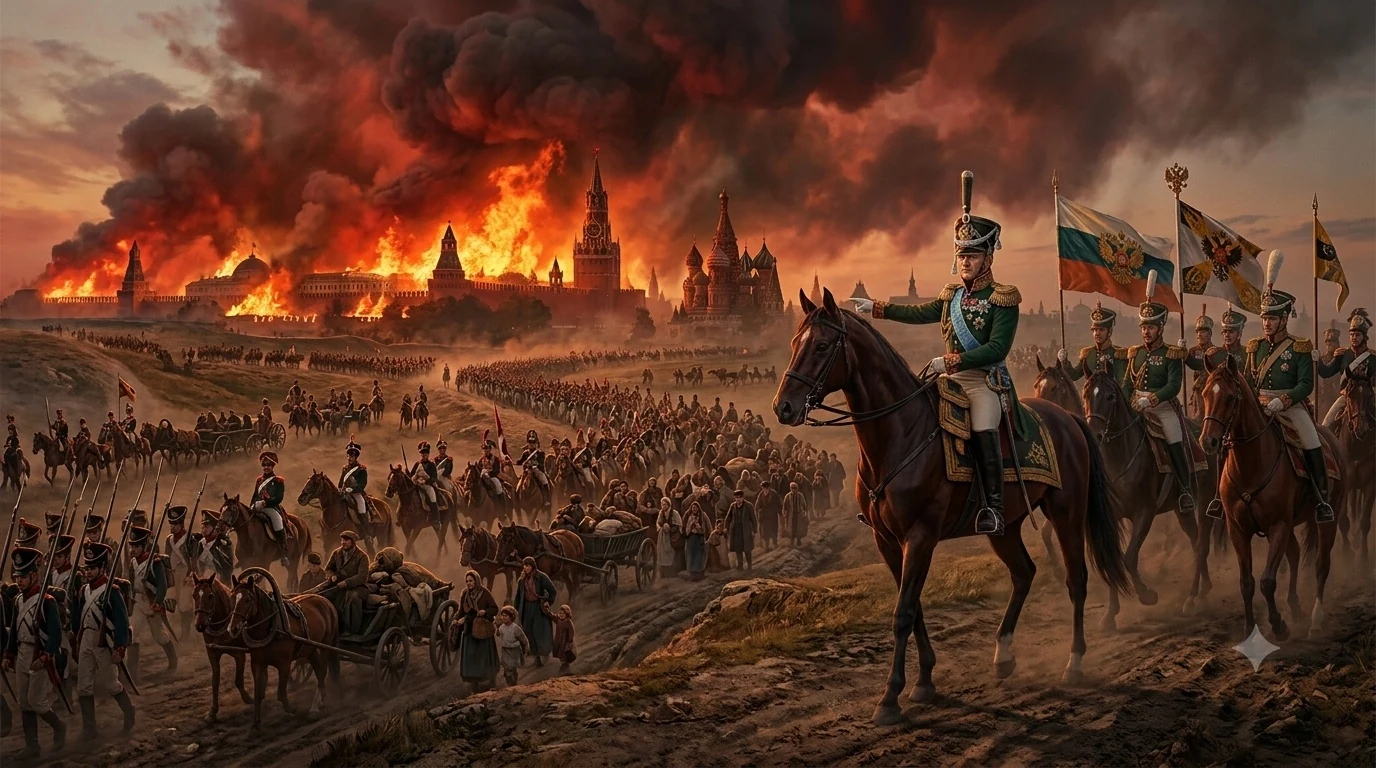
Europe — one prince reconquered his throne from exile; one empire gave up its old capital and kept fighting. In 1418, factional violence in Paris drove out the Dauphin Charles — the future Charles VII — and with Paris and much of northern France effectively lost to the English and their Burgundian allies, he ran a royal government from Bourges, south of the Loire, mocked by his enemies as merely the “King of Bourges” (Charles VII — Encyclopædia Britannica). It took him roughly eighteen years to recover Paris — a far longer exile than Seonjo’s, but one that ended in genuine political vindication. Centuries later, a different kind of loss offered a different lesson: when Napoleon’s Grande Armée entered Moscow in September 1812, they found the city burning — fires widely attributed to, and often laid at the door of, Moscow’s governor Rostopchin, though the extent of his orders is disputed and he himself denied it (Napoleon’s Invasion of Russia — World History Encyclopedia). Moscow was not the imperial capital — that was St. Petersburg — but it was Russia’s old capital and its symbolic heart, and Tsar Alexander I refused to negotiate for it. What destroyed the Grande Armée was not that refusal alone but a compound: Russian strategic withdrawal and sustained military pressure, scorched ground, broken supply, disease, and the weather. Russia gave up its symbolic center and kept fighting.
Line them up, and the real subject of Jing-bi-rok’s flight scene comes into focus. It is not a story about whether a king ran — almost every threatened monarchy has faced that same emergency. It is a story about what a political culture does with one: splits the court in two as an emergency measure, strips the ruler’s power at a roadside station, quietly stops governing, gets mocked for a generation, or burns its own symbolic capital and fights on. Joseon’s answer was an emergency second court, and a debt of gratitude heavy enough to shape foreign policy for generations. Historians are still arguing about the verdict.
Coming up next
One royal procession leaving Seoul at dawn — and we’ve traveled from burning slave registers to a failed asylum bid at the Chinese border, to a teenage prince running a parallel government, to a roadside mutiny outside Chang’an, to a shogun building a pavilion after his capital burned, to the ashes of Moscow. That is the quiet reach of a single historical drama: even a king’s retreat has a paper trail spanning continents.
In the next essay, we’ll take another K-drama scene that looks like pure fiction — and trace the real Korean history hiding underneath it.
Frequently asked questions
Is Jing-bi-rok based on a true story? Yes, closely. It is built on a real primary source — the Jingbirok, Ryu Seong-ryong’s war memoir, completed around 1604 — plus the wider documented history of the Imjin War. Dialogue and personal scenes are dramatized; the flight, the fall of the capital, the righteous armies, and Yi Sun-sin’s campaigns are not.
Did King Seonjo really abandon Seoul during the Imjin War? Yes. He left at dawn on the 30th day of the 4th lunar month of 1592 and moved north through Kaesong and Pyongyang to Uiju on the Ming border, not returning until late 1593. Historians keep two questions apart: whether the flight was militarily necessary — the court, the royal line, and the Ming channel all survived because of it — and whether it was well led, which is where the criticism lands.
Who burned Gyeongbokgung Palace — the Japanese army or Korean commoners? The Revised Veritable Records, compiled after the fact, say that once the king had gone a crowd the annals call nanmin (亂民) burned the Jangnyewon and the Board of Punishments — where the slave registers were kept — then looted the palace offices and storehouses and set fire to them to erase the traces. The record names no specific group and no motive. Beware anyone who tells you flatly who lit which fire.
Did Seonjo try to flee to China? He pursued the option called naebu (內附) — the king and royal house entering Ming territory — and it was already being raised before he reached Uiju. But the Records only note word, in the sixth lunar month of 1592, that Ming meant to house him in the empty government quarters at Kwanjeonbo; that is a limited, reluctant contingency, not a formal grant of asylum. It was dropped amid his own officials’ opposition and hard practicalities.
What was Gwanghaegun’s bunjo? A second, mobile royal government under the crown prince, running in parallel with Seonjo’s court from the sixth lunar month of 1592 into around the tenth month of 1593. It was an emergency device to spread the functions of rule — not a split of sovereignty between two equal monarchs.
Sources & further reading
This piece was written from the historical script and fact-check of 사뚱샘의 역사방 (SaDDungSam). Key dates and figures are cited inline above. Note that the flight itself is documented in the Veritable Records of King Seonjo, while the palace fires and the order to establish the bunjo come from the later Revised Veritable Records — different compilations, cited separately above. For broader reading:
- Ryu Seong-ryong, Jingbirok (류성룡, 징비록, c. 1604) — the primary-source war memoir behind the drama. Encyclopedia of Korean Culture.
- The Uiju pajeon and Seonjo’s wartime conduct — the primary record of the flight itself. Veritable Records of King Seonjo, National Institute of Korean History.
- Righteous armies of the Imjin War — overview of the uibyeong uprisings that filled the vacuum left by the court. Encyclopedia of Korean Culture.
Thanks for reading — see you in the next one.
This article was researched and written by K-Drama History. Source: Jing-bi-rok, Explained: Why King Seonjo Fled Seoul Before the Palaces Burned — K-Drama History