Samjeondo Humiliation, Explained: Why King Injo Submitted to the Qing Emperor
Theme: War & Resistance
From the research behind Pause the Drama.
The scene that The Fortress (남한산성, 2017) spends 47 days building toward takes less than a minute to complete on screen. Joseon’s King Injo descends from the mountain fortress, walks to a temporary platform on the Samjeondo sandbar beside the Han River, and performs the sambaegugo-du (삼배구고두, 三拜九叩頭) — three full bows, each with three head-to-the-ground kowtows, nine prostrations in all — before Qing Emperor Hong Taiji. A king’s face to the frozen ground, in the open, before a foreign court, witnessed by an army.
The film’s great subject is not that moment, but what made it inevitable: the 47 days of debate inside the fortress, and the two men who represent two impossible choices.
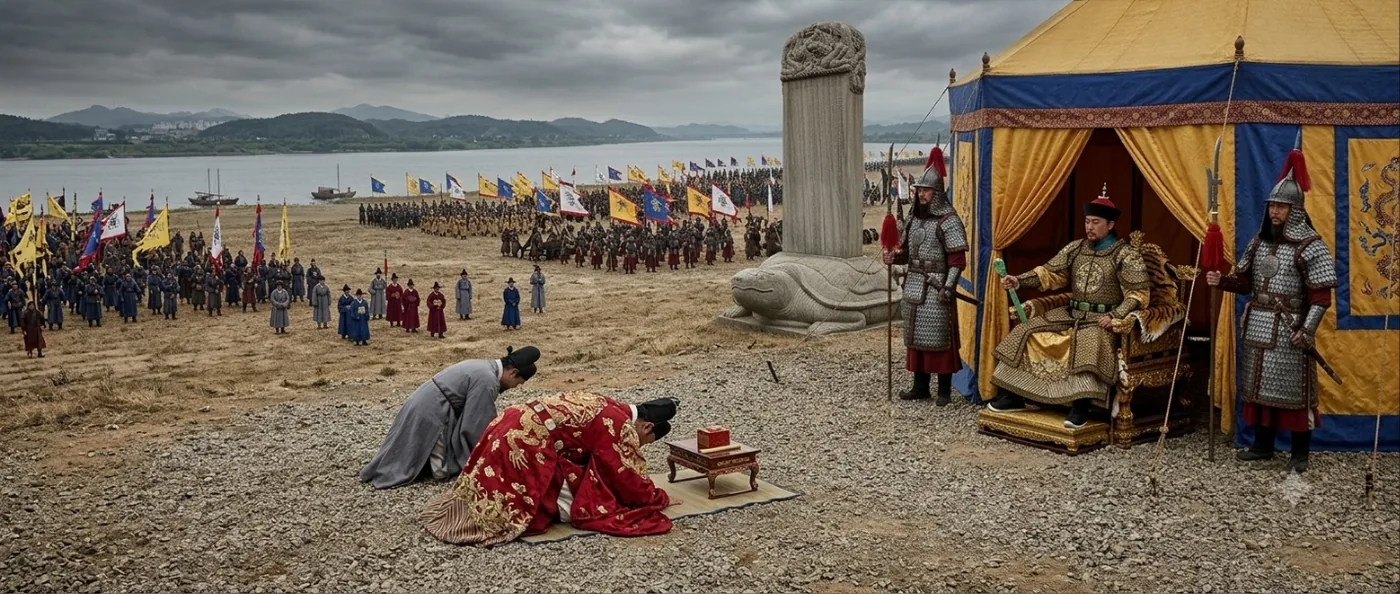 Samjeondo, first month of 1637: a king performing the sambaegugo-du before a foreign court, in the open, witnessed by an army. (AI illustration)
Quick answer: The Byeongjahoran (병자호란, the Manchu Invasion of 1636–1637) was the defining trauma of late Joseon foreign policy. Joseon had staked its legitimacy on loyalty to Ming China as the seat of Confucian civilization — but Ming was collapsing and Qing was rising. When Joseon refused to recognize Qing’s imperial title, Hong Taiji invaded with a force that moved too fast for the royal court to reach safety. Forty-seven days of siege in Namhansanseong followed, with the court split between the pro-resistance Kim Sang-heon and the pro-negotiation Choi Myeong-gil. The siege ended at Samjeondo: the sambaegugo-du (three bows, nine prostrations), Joseon’s formal entry into the Qing tributary order. For roughly the next two centuries, Joseon paid tribute to Qing outwardly while privately maintaining an inner culture of loyalty to the memory of Ming.
Why did the Manchu invasion happen — the structural causes
The Byeongjahoran was not a bolt from a clear sky. It was the culmination of a foreign-policy crisis rooted in a civilizational realignment that Joseon’s ruling ideology could barely acknowledge.
Joseon’s political identity was built around sadae (事大) — “serving the great” — with Ming China as the paramount power and cultural model. When the Later Jin (later Qing) emerged from Manchuria under Nurhaci and then Hong Taiji, it challenged not just the regional military balance but the entire cosmological framework by which Joseon understood its place in the world.
Gwanghaegun, the Joseon king deposed in the 1623 coup known as the Injobanjeong, had navigated this tension through pragmatic dual diplomacy — maintaining nominal Ming relations while avoiding direct confrontation with the rising Jurchen power. His deposition and replacement by King Injo under a firmly pro-Ming, anti-Manchu court shifted Joseon’s posture sharply. When Hong Taiji proclaimed the Qing dynasty in 1636 and demanded that Joseon recognize him as emperor rather than merely as a king, the Joseon court refused. The invasion followed within months.
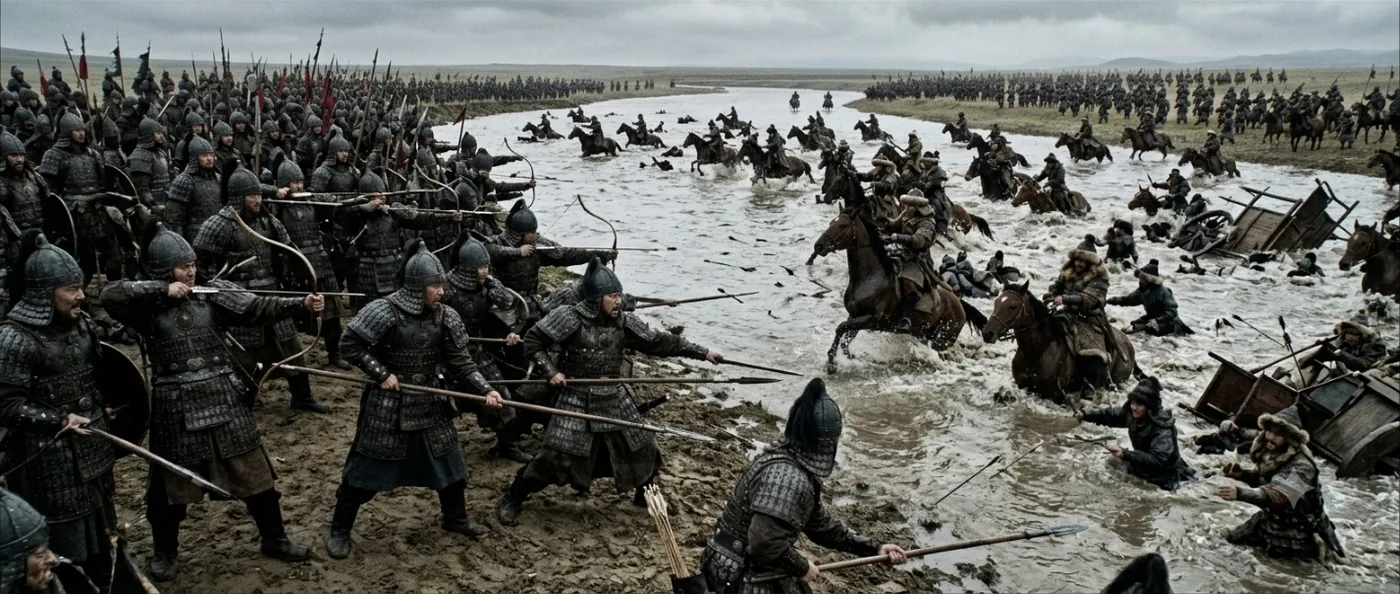
The speed of the Qing advance was decisive. Joseon’s strategic plan assumed time to evacuate the royal family to the fortified island of Ganghwa, where earlier Joseon courts had endured Mongol invasions. Qing cavalry moved faster than anticipated. Injo took refuge in Namhansanseong instead — a mountain fortress that could be defended but not indefinitely supplied.
The 47 days: what the ideological split actually meant
The 47-day siege was not simply a military standoff. It was a philosophical crisis conducted in the cold.
And it was not held in abstraction. Every day inside Namhansanseong made principle more expensive: food ran lower, winter deepened, promised relief failed to arrive, and the fall of Ganghwa turned negotiation from one option among many into the last remaining instrument of survival. The ideological debate did not resolve so much as get overrun by time.
Kim Sang-heon (金尙憲), representing the cheokwa (斥和, pro-resistance) faction, argued from Confucian principle: Joseon owed Ming the loyalty of a tributary state, and capitulation to Qing would betray the moral order that legitimized Joseon’s own existence. Resistance, even hopeless resistance, was the only honorable course.
Choi Myeong-gil (崔鳴吉), representing the juhwa (主和, pro-peace) faction, argued from contingency: the Ming alliance was already a strategic fiction. Ming was unable to send relief — its own collapse was advancing — and continuing to fight meant the death of the king, the destruction of the court, and the end of the very state both men were trying to protect. Humiliating peace preserved Joseon’s institutions and its people.
The most famous image of this impasse is grounded in the record. The Injo sillok (18th day, 1st lunar month, 1637) carries an entry to the effect that “Kim Sang-heon tears up the diplomatic letter Choi Myeong-gil had drafted and begs for punishment.” By the annals’ account, after Injo had Choi revise a letter to be sent to the Qing, Kim came upon the draft, wept, and tore it apart — then went before the king to say he had already committed a capital offense and should be punished first (Injo sillok, 1st lunar month of 1637, via the National Institute of Korean History). What is not in the annals is the theatrical line often attached to the scene — “You tear it up; I will piece it back together” — which belongs to later literary and dramatic retelling. (Strictly, the torn document was a gukseo, a diplomatic letter to the Qing, rather than a signed treaty.) The core, though, is history rather than legend: these two men were both trying to save the same country and could not agree on what saving it required.
The fall of Ganghwa Island to Qing forces removed the last strategic alternative. With the royal family now in Qing hands, Injo had no leverage and no recourse.
Samjeondo: the politics of ritual submission
The sambaegugo-du (三拜九叩頭) was the highest register of submission within the East Asian tribute-investiture system. It was not a bureaucratic formality — it was a staged public declaration, witnessed by armies, that Joseon had passed from one cosmological order (Ming-centered) into another (Qing-centered).
Qing’s demands did not end at the ceremony. The post-surrender terms included: the handover of two royal princes — Crown Prince Sohyeon and Prince Bongnim (later King Hyojong) — as hostages in Shenyang (Mukden); mandatory Joseon military assistance for Qing campaigns; the complete severance of ties with Ming; and annual tribute.
Qing also required Joseon to erect a commemorative stele at Samjeondo in 1639 — the Daecheong Hwangje Gongdeokbi (大淸皇帝功德碑), praising Hong Taiji’s virtue in text that Joseon scholars were compelled to compose. It carries its inscription in three scripts — Classical Chinese, Manchu, and Mongolian — a physical record that the Byeongjahoran was not merely a Korea-Qing affair but an event of the wider Manchu- and Mongol-centered order rising in East Asia. The stele’s afterlife mirrors that order’s shifts: it was reportedly sunk or buried around 1895, as the Qing tributary system unraveled after the First Sino-Japanese War; re-erected by the Japanese colonial authorities in 1913; buried once more after Liberation; and eventually restored. It stands today in Songpa-gu, Seoul, designated a historic site in 1963 (Cultural Heritage Administration, Seoul Samjeondo Stele) — preserved as a record of national humiliation rather than erased. (A common shorthand — that the stele was “buried during the colonial period” — is imprecise: the colonial-era act was its re-erection, not its burial.)
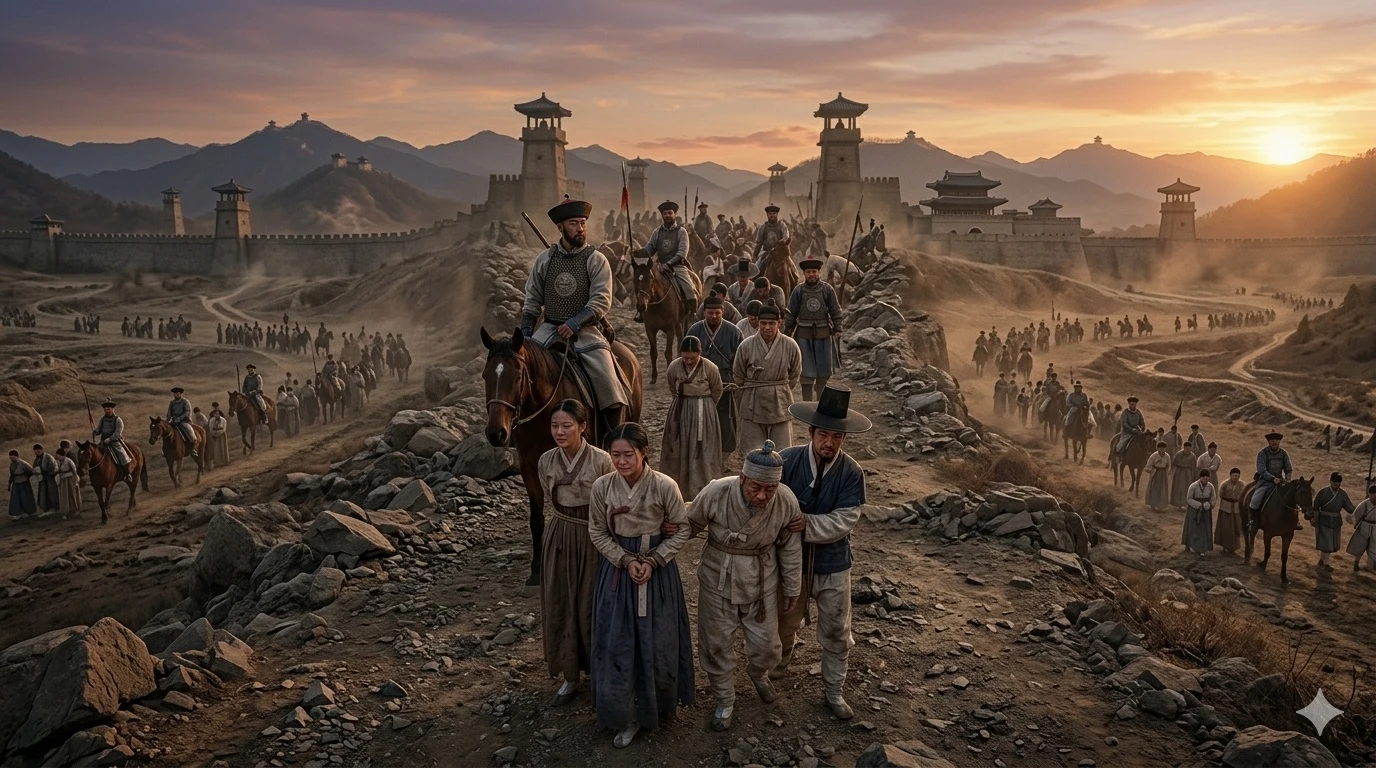
The prisoner question adds another layer. Estimates of the number of people taken to Qing territory range widely; some works cite figures as high as 500,000, but that number is best read as an upper-end estimate of the war’s demographic shock rather than a settled count — the Injo sillok itself records no national total. What the annals do record is vivid: in the days after the surrender, captives lining the roadside cried out to the departing king — “Are you abandoning us?” — the wailing, one entry says, “numbering in the tens of thousands.” What is not disputed is that the scale was large and the social consequences severe. Women who eventually returned to Joseon were stigmatized as hwanhyangnyo (還鄕女), a form of social exclusion addressed from a different angle in the K-drama My Dearest (연인, 2023).
An important correction: The film’s framing can suggest a simple moral arithmetic — Kim Sang-heon wrong, Choi Myeong-gil right, or vice versa. The historical reality is more uncomfortable. Kim’s resistance position rested in part on an expectation of Ming relief that never came; Choi’s pragmatism required accepting terms that imposed real suffering on real people for decades. Both men were working with incomplete information under extreme pressure, within a value system that made the choice agonizing by design.
Drama vs. real history — what The Fortress gets right and compresses
| In The Fortress (2017) | In real history |
|---|---|
| Injo is trapped in Namhansanseong by a faster-than-expected Qing advance | The advance’s speed preventing the Ganghwa evacuation is historically documented |
| Court is split between Kim Sang-heon (resist) and Choi Myeong-gil (negotiate) | Both figures and their factional positions are historical; the debate’s intensity is attested in the annals |
| Kim Sang-heon tears up Choi’s draft letter to the Qing | Recorded in the Injo sillok (1st lunar month, 1637); only the dramatic quoted line is a later embellishment |
| The Samjeondo ceremony ends the film | The ceremony occurred in the first lunar month of 1637; the film’s ritual depiction follows the historical record |
| The scale of suffering inside the fortress | Food shortages and civilian hardship during the siege are documented in contemporary records |
In short: The Fortress compresses a 47-day constitutional crisis into a chamber drama, but its bones are accurate — the failed Ganghwa evacuation, the cheokwa–juhwa split, the annals-documented tearing of the letter, and the Samjeondo ritual all rest on the historical record.
Key terms. Byeongjahoran (병자호란) — the Manchu (Qing) invasion of Joseon, 1636–1637. Samjeondo (삼전도) — the sandbar on the Han River where King Injo performed his submission; present-day Songpa-gu, Seoul. Sambaegugo-du (삼배구고두) — three bows with nine prostrations, the highest degree of submission in the East Asian tributary system. Cheokwa / Juhwa (척화/주화) — the pro-resistance and pro-negotiation factions respectively. Kim Sang-heon (김상헌) — cheokwa faction leader, arguing resistance from Confucian principle. Choi Myeong-gil (최명길) — juhwa faction leader, arguing negotiation from political realism. Hwanhyangnyo (환향녀) — the stigmatizing term applied to women who returned to Joseon after captivity in Qing.
How does the Samjeondo humiliation compare with other historic acts of submission?
Korea (Joseon) — the double structure. What followed Samjeondo was not simply subjugation. For roughly two centuries after 1637, Joseon operated in a psychological and political double structure: formal tribute to Qing on the surface, and an intense inner culture of sungmyeong bancheon — “venerating Ming, opposing Qing” — beneath it. Joseon scholars maintained the Ming calendar long after the dynasty collapsed; the court continued to refer to the Ming founding emperor in terms of ongoing legitimacy. External compliance and internal defiance coexisted — a coping mechanism that shaped Korean political culture in ways that persisted for generations.
East Asia — the Chanyuan parallel and the Macartney mission. The tribute-investiture system that governed Sino-centric East Asian international relations managed hierarchy through ritual rather than permanent occupation. Samjeondo was an extreme expression of that system’s logic. Interestingly, the same kowtow was at issue when the British Macartney mission reached the Qing court — dispatched over 1792–94, with the audience before the Qianlong Emperor in 1793. By British accounts, Macartney declined the full sambaegugo-du and offered instead the single bent-knee bow used before his own king; the ritual standoff is often cited as a proximate cause of the mission’s failure to win any trade concessions (Chinese and British records frame the encounter differently) (Encyclopaedia Britannica, Macartney Embassy). The same ritual that broke Joseon’s court became a flashpoint for the opening of the Sino-Western confrontation.
The West — the Walk to Canossa (1077). The closest structural parallel in European history is the Walk to Canossa: Holy Roman Emperor Heinrich IV, excommunicated by Pope Gregory VII, stood barefoot in the snow outside Canossa Castle for three days in January 1077 to beg absolution. Like Samjeondo, Canossa was a submission staged as a public performance, intended to confirm a hierarchy. But the structural difference is significant: Canossa was a conflict within a shared civilization over which institution held supremacy (secular crown vs. church). Samjeondo was a coerced entry into a different civilizational order — making the shame different in kind, not just in degree.
The modern West — the grammar of defeat. Modern international law largely replaced ritual bodily submission with document signing as the grammar of surrender. The 1918 Armistice was signed in a railway carriage at Compiègne; Japan’s 1945 surrender was signed on the USS Missouri in Tokyo Bay. But the choice of where and how such signings happen still carries political message — Hitler’s deliberate use of the same Compiègne railway carriage for France’s 1940 surrender was humiliation-by-citation. The form of submission changed; the politics of it did not.
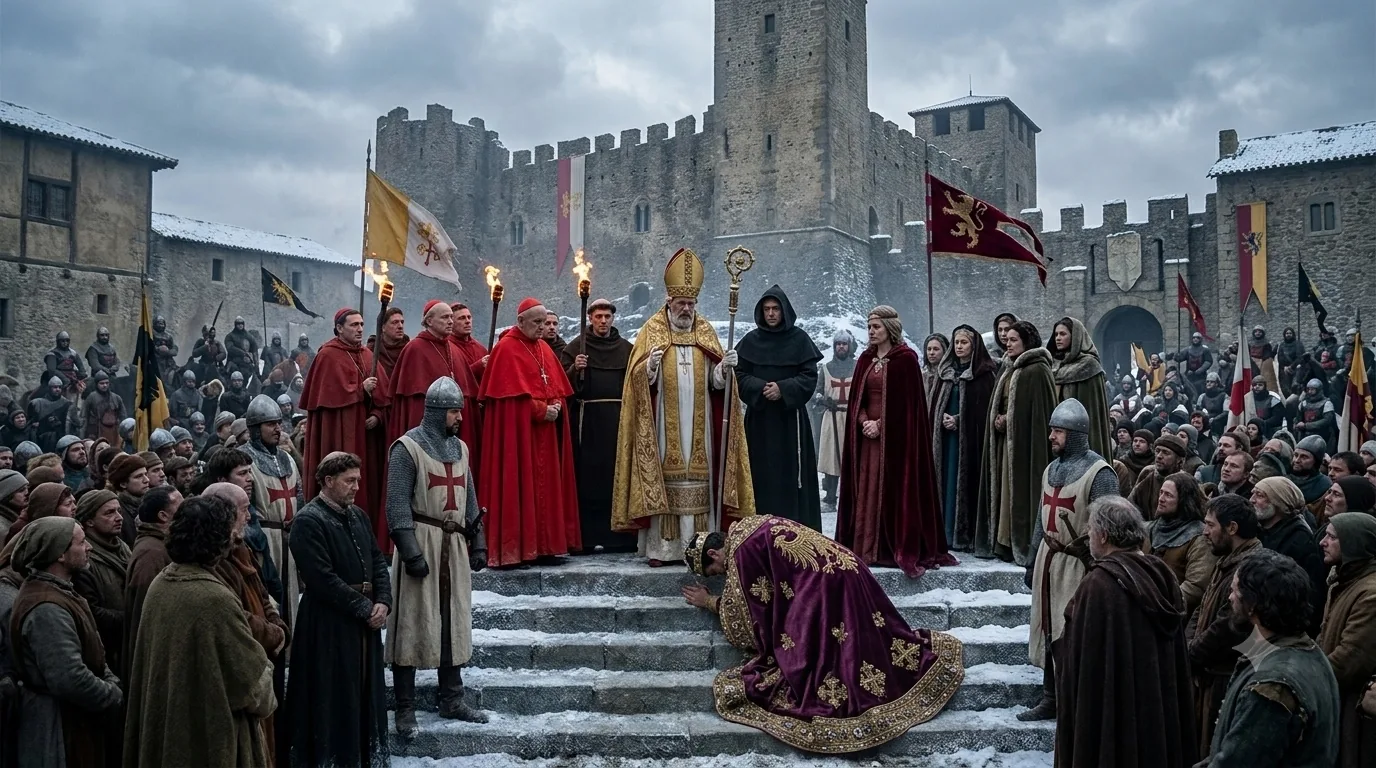 The Walk to Canossa (1077): Emperor Heinrich IV submits to Pope Gregory VII — a staged submission within one civilization, unlike Samjeondo’s forced entry into another. (AI illustration)
Coming up next
Forty-seven days of debate, one minute of ceremony, two centuries of double consciousness. The Fortress distills a Joseon constitutional crisis into a character study. The history it rests on is equally rich: an invasion that reshaped the dynasty’s self-understanding, a stele that still stands on the Han riverbank, and a ritual of submission that the British Empire would refuse to perform 150 years later before a different Qing emperor.
Next in the series, we step back before the invasions and ask who was reading faces and mapping grave sites — and why the Korean state employed them as official scientists.
Thanks for reading — see you in the next one.
Frequently asked questions
What is The Fortress (남한산성) about? The Fortress (2017, CJ Entertainment) is a Korean historical film based on Kim Hoon’s 2007 novel. It depicts the 47-day siege of Namhansanseong during the Manchu invasion of 1636–1637, centering on the ideological debate between the pro-resistance adviser Kim Sang-heon and the pro-negotiation adviser Choi Myeong-gil. The film culminates at the Samjeondo ceremony of submission.
What was the Byeongjahoran? The Byeongjahoran (1636–1637) was the Qing (Manchu) invasion of Joseon, launched after Joseon refused to recognize Hong Taiji’s imperial title. The Qing advance moved too fast for the royal court to reach its island refuge at Ganghwa, trapping King Injo in Namhansanseong mountain fortress instead.
What was the sambaegugo-du ceremony? The sambaegugo-du (三拜九叩頭) was the highest ritual of deference in the East Asian tributary system: three full bows, each with three prostrations touching the forehead to the ground. At Samjeondo in early 1637, King Injo performed it before Hong Taiji — a staged public declaration of Joseon’s entry into the Qing cosmological order. It was not a document signature but a performed confirmation of hierarchy.
Who were Choi Myeong-gil and Kim Sang-heon, and what did they argue? Kim Sang-heon led the pro-resistance (cheokwa) faction, arguing from Confucian moral principle that Joseon’s duty to Ming required fighting regardless of outcome. Choi Myeong-gil led the pro-negotiation (juhwa) faction, arguing that survival of the state and its people required accepting Qing terms however humiliating. The famous scene of Kim tearing up the diplomatic letter (gukseo) Choi had drafted for the Qing is recorded in the Injo sillok (1st lunar month, 1637); only the theatrical quoted line attached to it is a later embellishment.
What happened to Crown Prince Sohyeon after the surrender? Sohyeon and Prince Bongnim were taken to Shenyang as Qing hostages. Sohyeon spent roughly eight years there, reportedly encountering Western ideas through Jesuit contacts. He died in 1645, months after returning to Joseon. The Injo sillok’s official record attributes the death to illness and mishandled treatment; the poisoning theory — sometimes implicating Injo — is a later suspicion grown from the politics around it, not a documented fact. Natural illness is the better-supported reading.
Does the Samjeondo stele still exist? Yes. The Daecheong Hwangje Gongdeokbi, praising Hong Taiji in text composed under compulsion by Joseon scholars, was reportedly sunk or buried around 1895 as the Qing-centered order collapsed after the First Sino-Japanese War, re-erected by the Japanese colonial authorities in 1913, buried again after Liberation, and later restored. It stands today in Songpa-gu, Seoul, as a designated historic site (1963), its inscription cut in Classical Chinese, Manchu, and Mongolian. (A common shorthand that the stele was “buried during the colonial period” is imprecise — the colonial-era act was its re-erection.)
How many Joseon people were taken captive to Qing? Estimates vary widely; some works cite figures as high as 500,000, but that is an upper-end estimate rather than a settled count, and historians debate methodology and definitions. The scale was large by any measure. Women who returned were stigmatized as hwanhyangnyo — a form of social exclusion depicted in the K-drama My Dearest (연인, 2023).
How does Samjeondo compare with the Walk to Canossa? Both were public rituals of submission staged to confirm a hierarchy. But Canossa (1077) was a power struggle within a shared civilization — a Holy Roman Emperor submitting to a pope within Christendom. Samjeondo was a coerced entry into a different civilizational order, making the structural shame different in kind. The Macartney mission (dispatched 1792–94, with the audience in 1793) and its refusal — by British accounts — to perform the full sambaegugo-du before the Qianlong Emperor shows how the very same ritual had become a flashpoint for a new East-West civilizational encounter.
Was King Injo personally cowardly, or was the surrender unavoidable? The surrender was not simply a matter of personal cowardice. By the time Ganghwa Island fell and the royal family was in Qing hands, Joseon had lost its strategic alternatives. The humiliation at Samjeondo was personal, but the crisis was structural: ideology, diplomacy, the speed of the Qing advance, winter siege conditions, and hostage politics had converged. Injo’s earlier foreign-policy choices are open to criticism — but the Byeongjahoran was not caused by one king’s character.
Sources & further reading
This piece was written from the historical script and fact-check of 사뚱샘의 역사방 (SaDDungSam), drawing on primary records and established scholarship:
- Byeongjahoran and the Samjeondo ceremony — Joseon wangjo sillok, Injo sillok; National History Compilation Committee (Guksa pyeonchan wiwonhoe) Korean History Database.
- Choi Myeong-gil and Kim Sang-heon — Encyclopedia of Korean Culture (Hanguk minjok munhwa daebaekkwa sajeon) entries on byeongjahoran, cheokwapa, juhwapa, Choi Myeong-gil, and Kim Sang-heon.
- The Samjeondo stele — Encyclopedia of Korean Culture entry on the Daecheong Hwangje Gongdeokbi (삼전도비); Cultural Heritage Administration of Korea designation records.
- Prisoner numbers (500,000 estimate) — Noted as a contested figure in Korean historiography; range and debate referenced from Korean History Database scholarship and academic discussions of Byeongjahoran demographic impact.
- Crown Prince Sohyeon’s death — Injo sillok entries; scholarly debate summarized in Korean historical encyclopedia sources. No consensus on cause of death established in the literature reviewed.
- The Macartney mission and the kowtow refusal (1793) — Encyclopaedia Britannica entry on the Macartney mission; standard diplomatic history of early Sino-British relations.
- The Walk to Canossa (1077) — Encyclopaedia Britannica entry on Heinrich IV and Gregory VII; standard medieval European history scholarship.
- Surrender ceremonies in modern history (1918, 1945) — Standard diplomatic and military history sources.
- Kim Hoon, Namhansanseong (Changbi Publishers, 2007) — the source novel for the film; a work of literary fiction drawing on historical records and the scholarly edition’s notes.
- Martina Deuchler, The Confucian Transformation of Korea — background on Joseon Neo-Confucian ideology and its political implications for dynastic legitimacy.
Thanks for reading — see you in the next one.
This article was researched and written by K-Drama History. Source: Samjeondo Humiliation, Explained: Why King Injo Submitted to the Qing Emperor — K-Drama History