Exhuma, Explained: A Baekje King Bought His Burial Plot From the Powers Below — and the Deed Survived 1,500 Years
Theme: Belief, Death & the Uncanny
From the research behind Pause the Drama.
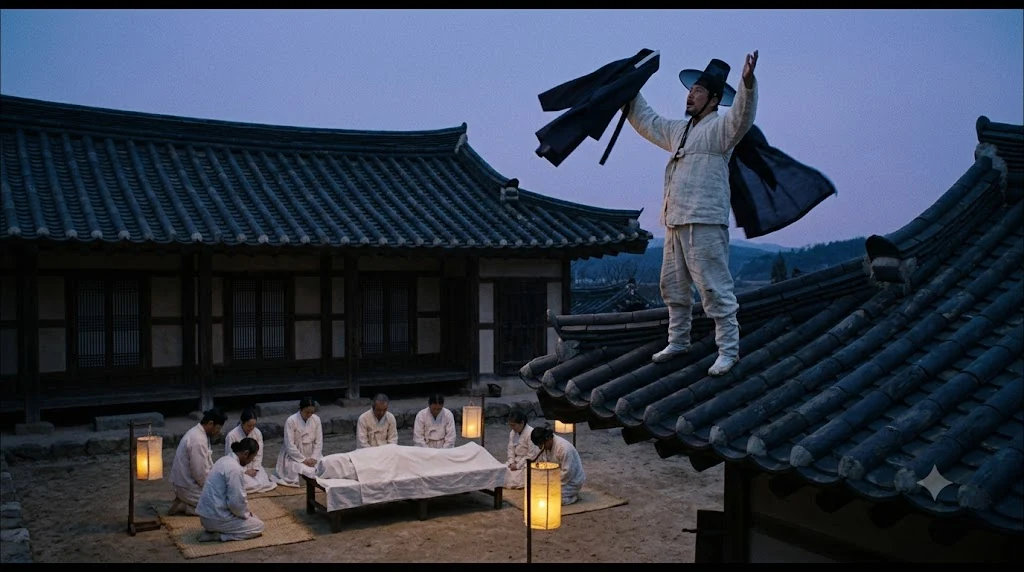
When the grave in Exhuma is finally opened, it begins with noise. Before anyone breaks the soil, the workers shout at the ground — a warning to the dead not to be startled. The geomancer picks up a handful of earth and tastes it, reading what is in the ground and what kind of place this is. Through the film, the living keep addressing the land and the dead directly, out loud.
Fifteen centuries earlier, a Baekje king handled the same problem differently.
He did it in writing.
The most remarkable object recovered from his tomb is not a gold ornament. It is a stone slab bearing a maejigwon (買地券) — a funerary deed that borrows the form of a land sale. It names a price, names the other party, specifies the plot and its intended use, and closes with a clause stating that a certificate is therefore established as proof.
And the money was in there with it.
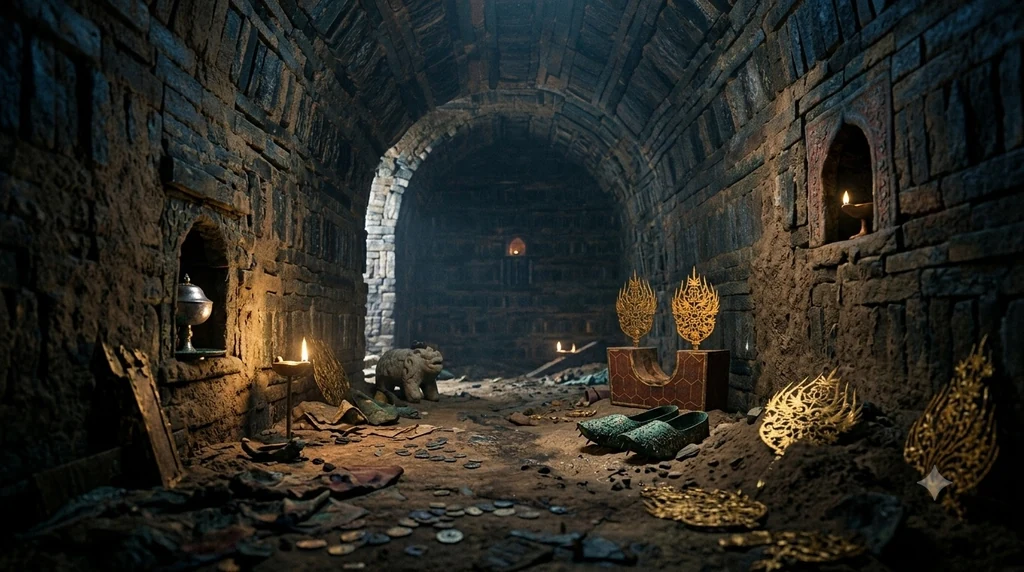
The chamber was built of brick in the manner of the southern Chinese dynasties. The stone guardian stood in the passage; the deed and the coins lay in front of it. (AI illustration)
1971: what came out of the ground was a document
In July 1971, drainage work was under way at the Songsan-ri tomb cluster in Gongju, South Chungcheong Province. The aim was modest — to stop water seeping into Tomb No. 6. In the course of that work the entrance of a tomb nobody had recorded came to light: a brick arch.
This mattered because of what had happened to the other tombs. Several of the Songsan-ri burials had already been investigated or damaged during the Japanese colonial period. This one had not been recognised as a separate tomb at all, and so it had been left alone.
Inside the entrance passage stood a jinmyosu (鎭墓獸) — a horned stone beast, a guardian form adopted into Korean tombs from Chinese practice, understood to protect the burial and guide the spirit of the dead. In front of it lay two stone slabs, set down neatly side by side.
The slabs carried writing. One line settled a question that no other Three Kingdoms royal tomb has ever settled:
寧東大將軍 百濟斯麻王 — Yeongdong Daejanggun, King Sama of Baekje
Sama was King Muryeong’s personal name. For the first and so far only time, a royal tomb of Korea’s Three Kingdoms announced who was inside it.
The two slabs use four faces in total. One stone carries the king’s epitaph on one face and a diagram of the directions on the other. The second stone carries the maejigwon and the queen’s epitaph on its two faces.
Institutions label those two faces differently — some number the deed first, others treat the queen’s epitaph as the front — and it is easy to read that as a factual dispute. It is not. The stones date themselves: the king’s deed carries 525, the queen’s epitaph 529. The physical arrangement — the queen’s face turned upward, the coins resting on it — strongly suggests the slab was turned over and reused at her interment, and that is how Gongju National Museum reads it.
Reading the deed, line by line
What makes the maejigwon strange is how procedural it is. Scholars differ over a few characters in the reading, but the structure is unmistakable.
| Element | What the deed records |
|---|---|
| Price | 錢一萬文 — ten thousand mun |
| Quantity | 右一件 — one item, as above |
| Date | The eulsa year (525), eighth lunar month, twelfth day |
| Purchaser | Yeongdong Daejanggun, King Sama of Baekje |
| Other party | 土王, 土伯, 土父母 — earth deities; and 土下衆官二千石 — the many officials below, of the two-thousand-seok rank |
| Object | 申地 — sinji, land to the southwest |
| Use | 墓 — a tomb |
| Closing | 故立券爲明 — therefore a certificate is established as proof |
| Final clause | 不從律令 — bujong yullyeong, disputed (see below) |
Three things in that table deserve care.
First, the parties are not all the same kind of being. It is tempting to gather them up as “the earth gods,” and the first three — towang, tobaek, tobumo — are indeed read as deities of the soil. But tohajunggwan icheonseok is different in kind. “Two thousand seok” was a salary grade in the Han Chinese bureaucracy, and the phrase points to officials of the underworld imagined in the language of an administration. The document populates the world below with a civil service and then addresses it. It is also worth noting that while these figures are generally read as the sellers, some scholars read them instead as witnesses to the transaction.
Second, the date is not the date of death. The twelfth day of the eighth lunar month in 525 is the day of interment. By the time the document was drawn up, the man named as purchaser had been dead for more than two years. The deed does not record a decision made by a living king; it sets out the dead king as the party to a ritual purchase.
Third, the last line does not say what it is often quoted as saying. Bujong yullyeong has been translated as a declaration that the laws of this world do not reach this transaction — a very quotable sentence, and one we removed from this article during checking. The phrase has at least four competing readings in Korean scholarship, including one in which yullyeong is a conventional closing formula of Chinese ritual documents rather than a substantive statement about jurisdiction. A single line cannot carry an argument when specialists cannot agree on what it says.
The money was really there
The film’s shamans say plainly that dealing with a grave costs money. In the actual excavation, the payment was still sitting where it had been left.
A bundle of roughly ninety iron wushu coins (五銖錢) lay on the stone. Gongju National Museum identifies them as iron coins cast in the Liang dynasty under Emperor Wu in 523 — coins of a type then circulating in Liang, rather than tokens made for the grave. That is not the same as saying such coins served as ordinary currency across the peninsula; the evidence for that is thin. The museum explains their purpose directly: they were placed in the tomb in order to buy the burial ground from the earth deity.
One correction to the picture most retellings give. The coins were not resting on the deed’s lettering. They lay on the other face of the same slab — the side bearing the queen’s epitaph, which faced upward when the chamber was opened. The museum’s reading is that the slab was turned over in 529, the queen’s epitaph cut into the newly exposed surface, and the coins replaced on top.
And the arithmetic does not balance. The document says ten thousand mun; the bundle holds about ninety coins. Gongju National Museum’s explanation is that the figure can be read as a symbolic expression for a bundle of money rather than a literal sum. Which is the clearest signal of what kind of object this is: every formal element of a transaction is present, and the number itself is conventional.
Where the film and the history part company
In Exhuma, land is auspicious or it is cursed. Choosing well is an expert’s craft; choosing badly brings ruin down on descendants.
The maejigwon is not built on that question. Its concern is whether the right to use the ground was properly acquired — not possession by default, but purchase, with a price paid and a document left behind.
It would be easy to overstate this contrast, and we did in an earlier draft. Korean burial culture is often explained wholesale through geomancy, and the deed is a useful corrective to that — but it does not show that ideas about siting and orientation were absent. The same set of stones includes a diagram of the directions, and the deed itself specifies land to the southwest. The two frameworks sit in the same tomb without cancelling each other. What the deed adds is a second question layered on top of the first: not only is this a good place, but was it obtained properly.
There is a second gap between film and history. Exhuma is about opening a grave. Baekje’s funerary process was long before the grave was ever closed.
The king died in 523 and was interred in 525. The queen died in the eleventh lunar month of 526 — the stone gives the month, not the day — and was interred in 529. (Older transcriptions, and some encyclopedia entries still in circulation, read that character as 十二月, the twelfth month; more recent re-examination of the stone reads 十一月, the eleventh. We follow the newer reading.) Each interval is roughly two years and three months.
What filled that interval is debated. The word used on the stone, geosang (居喪), has been read as the temporary lying-in-state of the body, as the mourning observance of the surviving family, and as temporary burial followed by later reinterment. The Jeongjisan site in Gongju has been proposed as the place where the queen’s rites were conducted, on the basis that her epitaph records the mourning taking place at yuji (酉地), to the west. That proposal has also drawn objections concerning the site’s date, orientation and character. It is a live argument, not a settled identification.
Four things that surprise readers from outside Korea
One. Two registers of rank are cut into the same stone. The epitaph records the title Yeongdong Daejanggun, conferred by the Liang court — the vocabulary of a subordinate inside the Chinese investiture system. Yet the king’s death is written with the character 崩 (bung), which in East Asian ritual convention marked the death of a Son of Heaven, where a vassal lord would take 薨 (hung). The National Institute of Korean History discusses this alongside the choice of a sexagenary date instead of a Chinese reign era.
The safe formulation is this: Baekje accepted the external order of investiture while representing its own kingship in elevated terms at home. Not two legal identities — one stone on which both registers are visible.
Two. Baekje announced that it had become a strong state again. The Book of Liang records that in 521 Baekje submitted a memorial to the Liang court stating that it had repeatedly defeated Goguryeo and had once more become a strong state (累破句麗 更爲强國). The wording reaches us through that Chinese history and the later Samguk Sagi, not as a surviving document in the king’s own hand. What makes it striking is the timing: Hanseong had fallen in 475 and the capital had been moved south to Ungjin. This was a declaration made half a century into a recovery.
Three. A craftsman signed his work. A silver bracelet found at the queen’s wrist carries an inscription on the inside stating that a person named Dari (多利) made it in the second lunar month of the gyeongja year, 520, for the great lady — that is, for the queen. The Encyclopedia of Korean Culture rates Dari the foremost figure among Three Kingdoms artisans whose names are known. The object was made six years before the queen died and was buried at her wrist.
Four. One of the greatest archaeological discoveries in modern Korea became one of its most notoriously rushed excavations. The tomb was found intact — undisturbed by looters, which is close to unheard of for a Baekje royal burial. Official sources record roughly 2,906 objects in 108 categories (later inventories give higher totals on different counting bases). Then the site was overwhelmed by press competition and crowds, control was lost, and the team pushed through: the tomb entrance came to light in early July 1971, the main internal survey began on 8 July, and the principal objects were lifted by the following morning. Accounts differ on the exact day of first discovery, but not on the compression. Kim Won-yong, then director of the National Museum, later reflected on the haste of that night with deep regret.
Why one tomb was a matter of state
In Exhuma, the client is the eldest son of a wealthy Korean-American family, and a single ancestral grave is enough to shake the whole household.
In Baekje, the unit was not a household.
When Goguryeo took Hanseong in 475, the court fled south to Ungjin — present-day Gongju. Kings were killed by their own officials in the years that followed, and Muryeong came to the throne out of that instability. The tomb he left behind is a brick-chamber tomb in the manner of the southern Chinese dynasties, and it is full of objects of Chinese type.
The temptation here is to read the architecture as a political announcement — Baekje declaring itself the civilizational equal of the Liang. There is no direct evidence for that intent. What the tomb does demonstrate is that the Baekje court actively adopted southern-dynasty funerary culture and technique and was in close contact with it.
The same applies to the deed. It observes a form, identifies a counterparty, states a price and an object, and closes with a proof clause. That is not something a group unfamiliar with documentary convention produces. But one funerary document does not measure a kingdom’s administrative capacity. What it shows is a court fluent in Chinese documentary form and in the Chinese-derived conception of a bureaucratic afterlife.
The legend: was the king born on an island?
There is a story about Muryeong’s birth that cannot be confirmed, and it comes from a later source — the Japanese chronicle Nihon Shoki.
In that account, a royal kinsman named Konji was travelling to Wa when a woman in his party gave birth on Kakarashima (各羅島), an island off Kyushu, and the child was named Sama (斯麻) because he had been born on an island. The name cut into the epitaph really is Sama, and the coincidence has kept the story in circulation.
The genealogy itself varies by source. The Samguk Sagi and Samguk Yusa make Muryeong a son of King Dongseong; the Nihon Shoki tradition makes him a son of Konji. We are not choosing between them.
Kakarashima today has a site and a marker commemorating the king’s birth. Whether the event happened is not established.
Three civilizations that sent the dead away with money
This section is comparison, and it needs a warning label before it starts: only the first of these three is connected to Baekje by descent. The others are placed alongside for readers, not behind Baekje in a line.
China — where the form came from. The maejigwon is a Chinese funerary practice. A substantial number survive from the Later Han period, and they are described as documents that secure a burial plot for the dead in the world below by borrowing the form of an actual land-purchase contract. Baekje’s deed belongs to the broader Six Dynasties deed tradition rather than to any one court, adapted during the kingdom’s close contact with the southern dynasties, Liang among them. The elements do not all point the same way: the earth deities sit closest to southern usage, while the language of ranked officials below ground draws on a bureaucratic afterlife found in northern Chinese deeds as well. This is the one case here of genuine lineage.
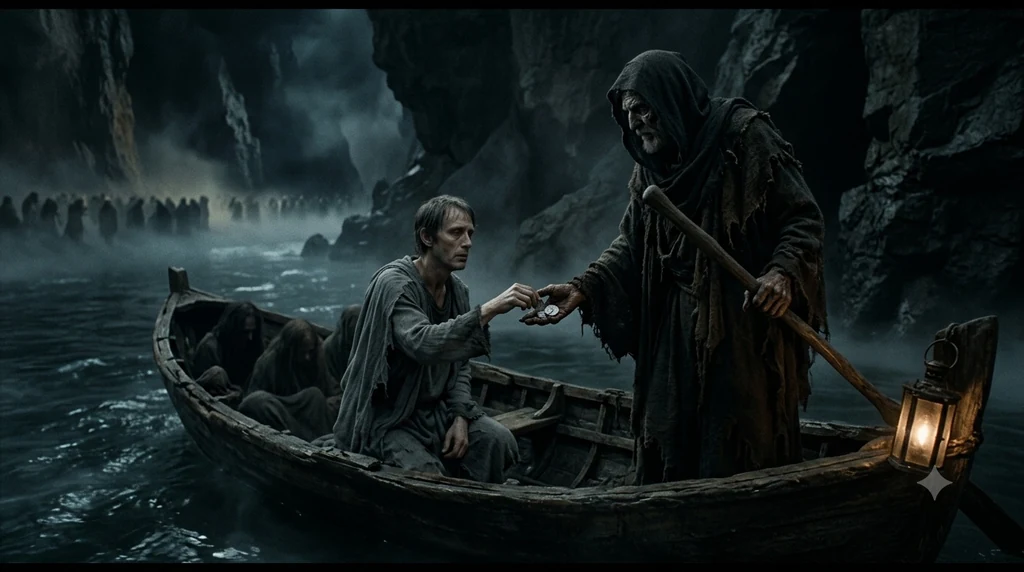
The obol placed with the Greek and Roman dead was a fare, not a purchase price — there is nothing bought and no one selling. (AI illustration)
Greece and Rome — money, but for a different job. Around the Mediterranean, coins were placed in or near the mouth of the dead. The practice is popularly explained as the fare for Charon, the ferryman of the underworld — “Charon’s obol.” Archaeology complicates the literary account: the coin is not always in the mouth, and there is not always only one, so the story handed down in texts does not describe the whole of the custom. What can be said is narrower. In the literary model the coin is a fare, not a purchase price — nothing is bought, and there is no counterparty who sells. Recent scholarship is clear that coins found in graves cannot all be reduced to Charon’s fare, so what follows contrasts two documented ideas, not two civilizations’ entire practice.
Rome — a document, but no gods on the other side. Romans treated tombs as a matter of law. Funerary markers record the plot’s frontage and depth in measured feet and carry the clause hoc monumentum heredem non sequitur — this monument does not pass to the heir — which kept a burial plot out of ordinary inheritable property. A near-contractual sentence cut into stone: that much is like Baekje. But the Romans were addressing heirs and the law. Baekje was addressing the powers below.
What is distinctive about the Baekje case is the combination: a document, a named counterparty, an object and a price, coins actually deposited. That is a comparison worth making, not evidence that Baekje merged three traditions — it inherited one and can be read against the others.
Back to Exhuma
The people in the film shout at the ground, taste the soil, and hold a rite before they dig. They are asking the dead and the land for permission.
King Muryeong’s tomb shows something adjacent to that, though not its ancestor. The film’s pamyo is the opening of a grave already made; the maejigwon belongs to the making of one. They are not the same rite and there is no line of descent between them — but both are ways of refusing to treat ground and the dead as things one may simply take.
Exhuma is an occult film. The instinct it works with, though — that land has an owner, and that using it without settling accounts has a cost — is not an invention of the screenplay.
What Baekje did with that instinct was to give it a form. Not mysticism in place of procedure, and not procedure in place of belief: a religious rite concerning earth deities and the officials of the world below, set down in the shape of a document and a bureaucratic process — and then cut into stone, where it lasted fifteen hundred years.
This article was researched and written by K-Drama History. Source: Exhuma, Explained: A Baekje King Bought His Burial Plot From the Powers Below — and the Deed Survived 1,500 Years — K-Drama History