Wicked World, Explained: Why Joseon Koreans Believed a Dead Person Split in Two
Theme: Belief, Death & the Uncanny
From the research behind Pause the Drama.
The first thing Wicked World (멋진 신세계) does is kill its heroine, and it takes its time.
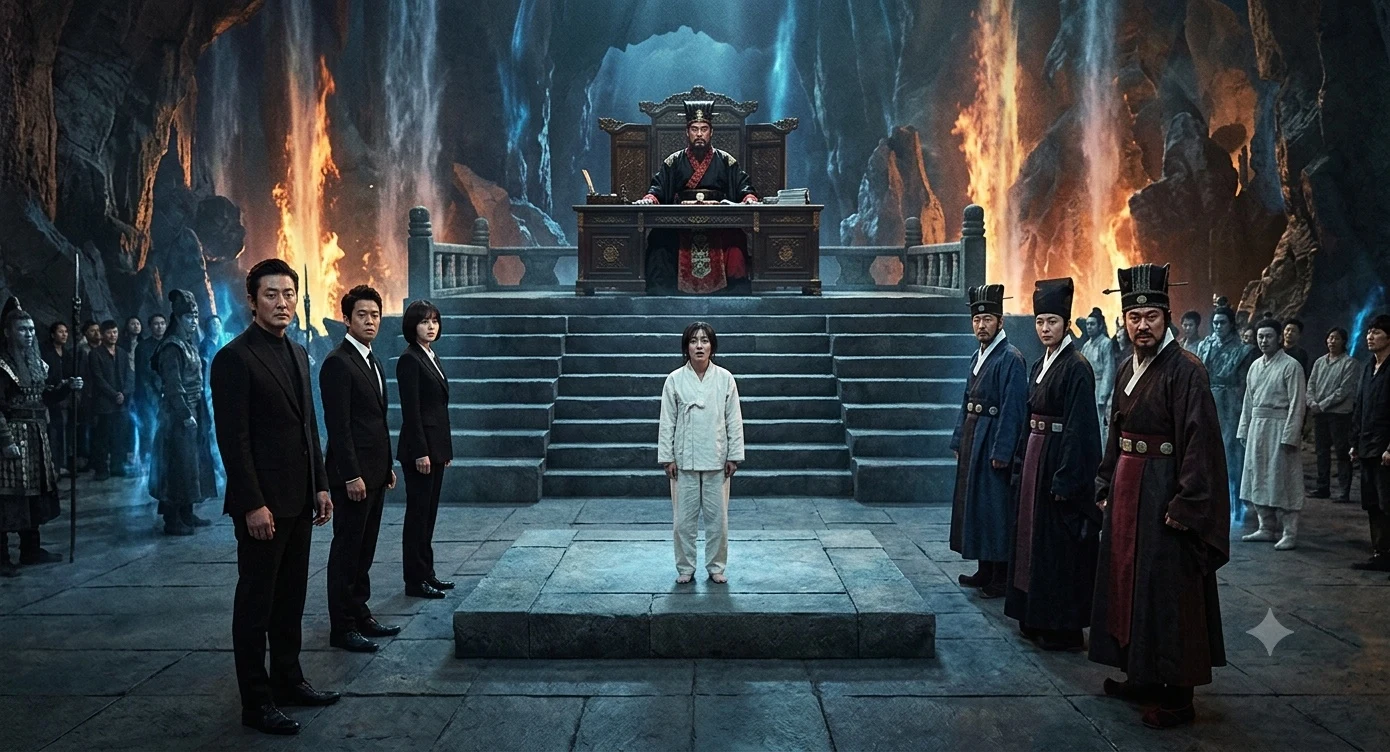
SBS aired it from May 8 to June 20, 2026 — fourteen episodes, IM Ji-yeon in a double role. In the opening, Kang Dan-sim walks out of the palace with a composure that does not last. She sees the cup. The king has sent sayak (사약), royal poison. She goes to her knees, raises her eyes, lets one tear fall — and then hurls the cup away. Four court ladies cannot easily hold her down. She drinks, brings up blood, and dies.
Centuries later she opens her eyes in the body of Shin Seo-ri, a nobody actress who was, at that exact moment, filming a scene about a woman being handed royal poison.
It is a fantasy device. But it leans on something that was not fantasy at all: a specific, official, state-endorsed account of what a person is made of and what comes apart when they die. Joseon’s Confucian funeral system did not treat death as one soul departing. It treated a person as coming apart in two, and gave each part a different ritual destination.
Quick answer: Joseon’s official Confucian funeral framework did not describe death as a soul going somewhere. It described a person coming apart. The hon (혼, 魂) — the light, breath-like, conscious part — rose; the baek (백, 魄) — the heavy, bodily part — stayed down with the corpse and the grave. Together they were honbaek (혼백, 魂魄). Much of the Confucian funeral apparatus follows from that split: shouting on the roof to call the hon back, folding a strip of silk to give it somewhere to sit, carving a chestnut tablet as its permanent address, and holding a separate state rite for the halves nobody was feeding. (This was not the only way Koreans thought about death — Buddhist afterlife courts, shamanic neok, the black-hatted reaper all ran alongside it.) The drama’s possession plot is invented. The idea that a person is divisible was not.
What did Joseon Koreans think actually left the body?
Korean has an unusually crowded field of words here. The native term neok (넋) sits alongside a cluster of Sino-Korean ones — hon (혼, 魂), hollyeong (혼령), honbaek (혼백, 魂魄), yeonghon (영혼), eol (얼) — overlapping enough in ordinary use to be treated as synonyms. But the encyclopedia is careful about one distinction inside that cluster, and this essay turns on it (Encyclopedia of Korean Culture, 넋). Hon is used of both the living and the dead. Baek is not: it refers primarily to the deified spirit of someone already dead — an ancestral spirit is a baek. The two halves of the compound are not interchangeable.
Keep those two registers apart, because the word does double duty. Ordinary Korean usage and classical hon–baek cosmology do not use baek in quite the same way: the first points at a deified spirit of the dead, the second at the yin, body-bound component paired with the ascending hon. Both are in play in what follows, and they are not the same claim.
The underlying physics, borrowed from Chinese cosmology and thoroughly domesticated, is a yin-yang sorting. The hon is yang: airy, tied to breath, the seat of consciousness, and it ascends. The baek is yin: heavy, bound to flesh, and it sinks into the ground with the body. A living person is these two held in working combination. Death is the combination failing.
The consequence is easy to miss and hard to overstate. Death here is not primarily a journey. It is a decomposition. The question a Confucian ritualist faced was not “where has the deceased gone?” but “these two things have separated — where does each one now belong, and who is responsible for putting it there?”
The split wasn’t reserved for the dead, either. Folk tradition treated the soul as able to leave and re-enter a living body, usually through the nose or mouth, which is how it explained dreams, fainting and delirium. The encyclopedia’s entry on Korean conceptions of the soul distinguishes saengnyeong (생령, 生靈), the soul of a living person, from saryeong (사령, 死靈), that of a dead one, and explains clouded consciousness in grave illness as the soul going in and out (Encyclopedia of Korean Culture, 영혼관). Idioms preserve it: neok-ppajin saram, “a person whose neok has fallen out,” is still ordinary Korean for someone dazed.
A cosmology in which the soul routinely exits a living body and returns is not one where Wicked World’s premise is an alien import. It’s an extrapolation.
Why did a Joseon funeral begin with someone climbing onto the roof and shouting?
Because if death is a separation, the first reasonable thing to try is putting the pieces back.
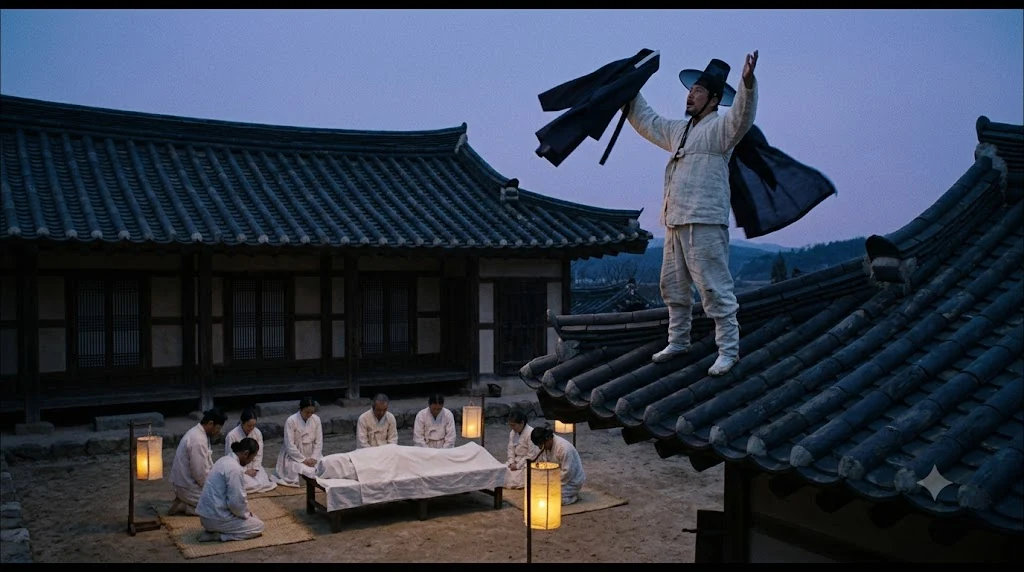
The opening act of a traditional funeral was chohon (초혼, 招魂), also called gobok (고복, 皐復) — calling the soul. The procedure was exact. Someone took a garment the deceased had worn in life, climbed onto the roof or went out into the courtyard, gripped the collar in the left hand and the garment’s waist in the right, faced north, waved it, called out the dead person’s address and full name, then cried in a long voice: “Bok! Bok! Bok!” (National Institute of Korean History, 우리역사넷).
Every element has a stated reason, and they are all honbaek reasons. You climb onto the roof because the soul-energy is above — you go up because that is where it went. You face north because the deity governing the dead was held to reside there. You call three times because ritual propriety derives from three, each call aimed differently: one upward, praying the honbaek descends from heaven; one downward, praying the hon returns from the earth; one northward, praying it comes from any direction. The Book of Rites is the cited authority, and Confucius is invoked for the proposition that calling the soul is a petition for the person’s revival.
Then the line that shows this was not symbolism: only if chohon failed was the person accepted as dead. The rite was a genuine attempt at revival, and death was a verdict rendered after it failed.
Local practice added texture, and it is worth keeping the localities apart. In Yeoncheon, the caller added “Sir So-and-so, take your clothes” after the three cries — and there, calling was feared: falter or break off partway through and you might die yourself, so people avoided the job. (Yeoncheon also found roof-climbing troublesome and took to calling from outside the gate, leaving the garment on the gatepost.) In Guri, the caller was someone who had not seen the body, and because a botched calling was thought to kill or curse the caller, the task went to a person known to do it well. The garment was afterward laid over the body, thrown on the roof, later placed in the coffin, or used to make the honbaek.
Which brings us to the strangest object in the system.
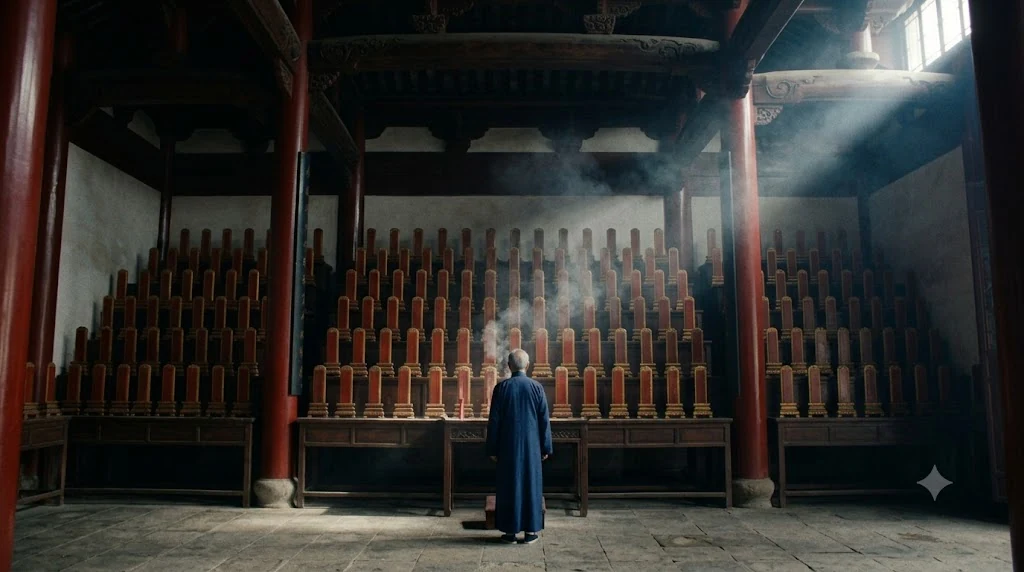
If the hon came back, where was it supposed to sit?
Confucian ritual set itself a problem. You have called the hon. Suppose it is present in some attenuated sense. It has no body — the body is going into the ground with the baek. So it needs somewhere to be.
Joseon’s answer was to build it a seat.
After the corpse was washed and dressed — the stage called seup (습, 襲) — the rite ended with two acts performed together: setting up the yeongjwa (영좌, 靈座), the spirit seat, and installing the honbaek (혼백, 魂帛) on it (Encyclopedia of Korean Culture, 습). Read the hanja carefully: this is a different honbaek — 魂帛, “soul-silk,” not 魂魄, “hon-and-baek.” It was a strip of silk or folded paper bound with coloured thread, arranged to suggest a seated human figure, kept in a small box. A provisional body, made of cloth, for the half of the person that no longer had one.
That object sat on a table — the honbaeksang (혼백상, 魂魄床) — and was served. Not commemorated: served. Three meals a day, laid out as if the person were alive, in a practice called sangsik. The Encyclopedia of Korean Culture’s entry on the honbaeksang describes households of particular devotion going further: adding liquor and even a lit pipe, and setting shoes beneath the table, turned three times a day toward the outhouse. The arrangement was generally kept for three years (Encyclopedia of Korean Culture, 혼백상). That entry is written by a folklorist of Jeju and draws heavily on Jeju material, so it is safer to read these details as recorded practice than as a uniform national rule.
Read that with the dualism in mind and the logic snaps into focus. The baek is in the ground, and the grave is its address. The hon is here, in a folded piece of silk on a table in the house, and it eats.
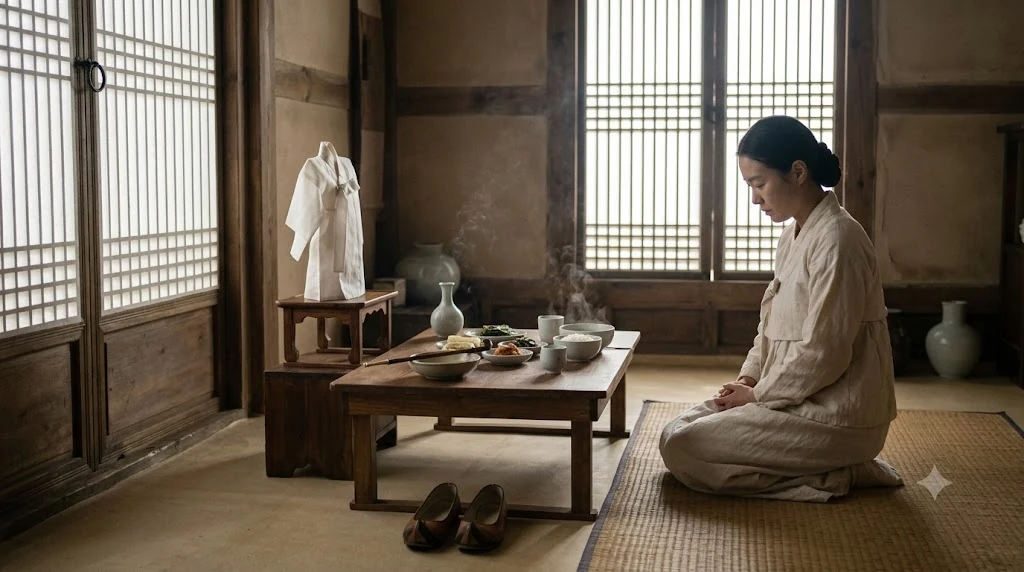
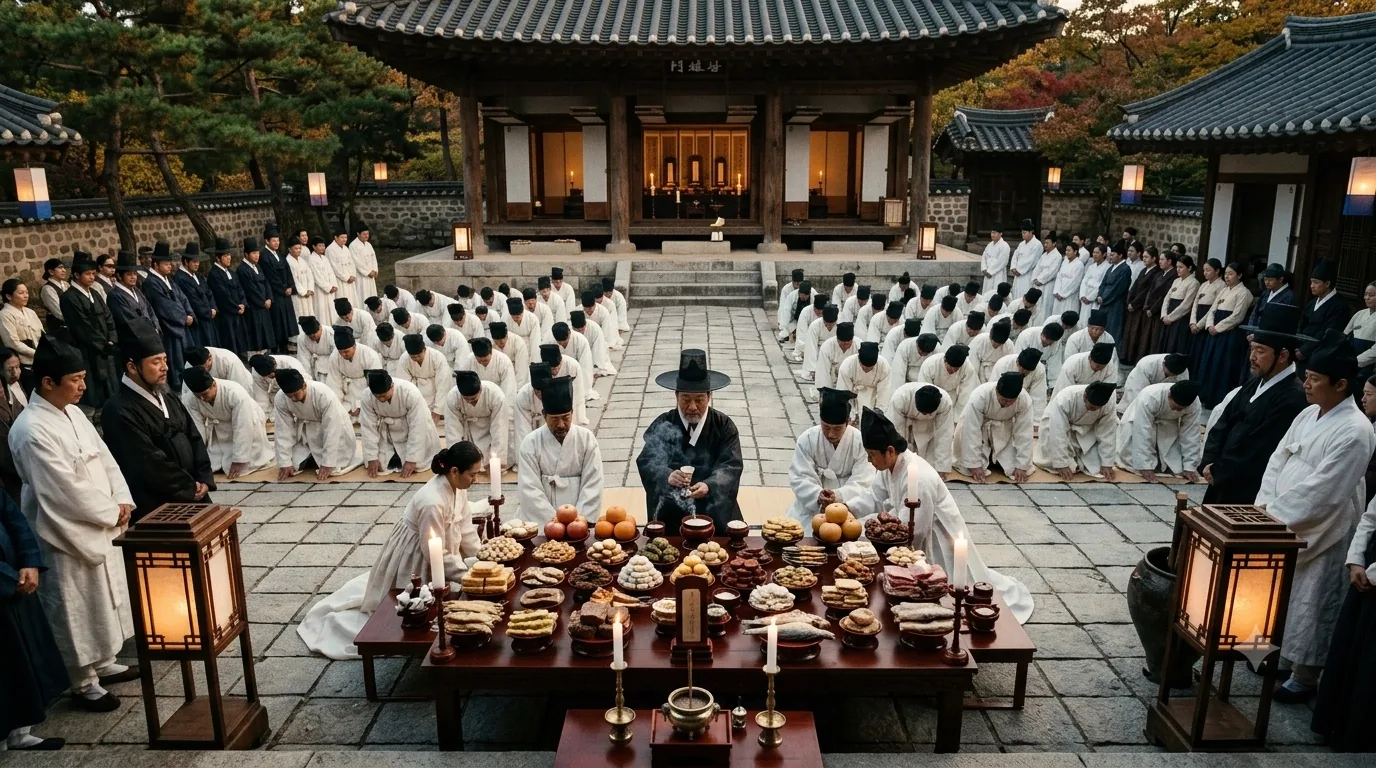
The silk was eventually superseded. The permanent seat was the sinju (신주, 神主), a chestnut-wood tablet inscribed with the name and titles, the full formal name written inside a hollowed cavity in the back — understood not as a symbol of the ancestor but as the vessel the spirit occupied during a rite. Households without one used a paper jibang (지방, 紙榜) (Encyclopedia of Korean Culture, 신주). This site has covered the tablet and its ritual grammar in a full account of jesa; what matters here is what it is for. It is an address.
The tablets needed a building. The sadang (사당, 祠堂), also called gamyo (가묘), was the household shrine, holding four generations in four compartments arranged west to east. Confucian prescription put it east of the main hall and held it should be built before the house itself (Encyclopedia of Korean Culture, 사당). For a dead monarch there was an interim institution, the honjeon (혼전, 魂殿) or “soul hall,” where the royal tablet stayed until the three-year mourning ended and it entered Jongmyo — maintained separately from the mourning chamber, under an office whose director was ordinarily the sitting Chief State Councillor (Encyclopedia of Korean Culture, 혼전).
A state that assigns its prime minister to manage a soul’s residential arrangements means it literally.
So was jesa remembering the dead — or calling them?
Within its ritual grammar, jesa is more than remembrance: it invites the ancestor to be present. (It is also filial practice, and a periodic restatement of who belongs to whom — those are not in competition with each other.)
The clearest evidence is a change of vocabulary buried in the funeral sequence. After burial came uje (우제, 虞祭), whose stated purpose was to settle the departed honbaek, performed in three stages: chou on the burial day, jaeu on the next soft day, samu the day after. And here is the tell: before uje, offerings to the deceased were called jeon (전, 奠), not je (제, 祭) — and from uje onward the dead person began to be treated as a sinmyeong (신명, 神明), a divine being (Encyclopedia of Korean Culture, 우제).
That is not a change of mood. It is a change of category, marked in the vocabulary, at a datable point: uje marks the ritual transition from treating the deceased as newly dead to treating them as an ancestral spirit. The rite is the hinge.
Everything downstream inherits it. The tablet is not a photograph. Incense at the start of a rite is not atmosphere — it is the summons, smoke rising toward the hon that went up, paired with libation poured onto the ground toward the baek that went down.
The three-year mourning belongs in the same picture, but for a different reason than the neat one. Its traditional justification is filial: repayment for the roughly three years a child is carried and nursed. In modern accounts it also reads as a graduated passage — the dead person becoming an ancestor, the mourner returning to ordinary life. What it was not is a timetable for how long a hon takes to settle, and the Yesong disputes that consumed the seventeenth-century court were not an argument about that either. They were about kinship and royal succession: which mourning garment the queen dowager owed, for how long, and what that implied about legitimacy.
A housing system has an obvious failure mode: what about the ones with no house?
What happened to the dead nobody was feeding?
The whole apparatus assumes descendants. Someone must carve the tablet, keep the shrine, and turn up on the anniversary. Strip that away — die childless, violently, far from home, unrecorded, in a war — and the hon has no seat and no meals. Korean tradition had a dense vocabulary for the result: muju gohon (무주고혼, 無主孤魂), “masterless orphan souls”; yeogwi (여귀, 厲鬼), malevolent unattended spirits; gaekgwi (객귀, 客鬼), the guest-ghost that died away from home.
These were treated as a public-safety problem. Wandering spirits were held to seek somewhere to settle and someone through whom to discharge a grievance, and the victim could be an individual or a whole community; war, drought, flood and epidemic were all attributed at times to the unattended dead (Encyclopedia of Korean Culture, 넋). Where an ancestral spirit was reliably a “soul of blessing,” an unhoused one was a “soul of calamity” — and the boundary was permeable in both directions. A benevolent ancestral spirit neglected long enough could turn.
So the state built a rite for them. Yeoje (여제, 厲祭) was performed twice yearly, on the fifteenth of the seventh and tenth months, at an altar called the yeodan (여단, 厲壇) in Seoul’s northern outskirts. The Ministry of Rites dispatched officiants; the presiding officer was the Governor of Hanseong. Offerings went to one tutelary city deity and fifteen unsacrificed spirits, in two ranks: an eastern seating of six for those who died in robbery or wrongdoing, a western seating of nine for the unlucky dead — the war-slain, and those who left no descendants (Encyclopedia of Korean Culture, 여제).
It could also be convened off-schedule. On the second day of the third month of 1438, the State Council reported to King Sejong that a virulent epidemic had erupted in Hwanghae Province, beginning in Hwangju and Bongsan and spreading to Jaeryeong, Sincheon, Munhwa and Jangyeon with heavy loss of life. Citing the precedent that the ancients sacrificed when disaster struck, they asked that local magistrates conduct yeoje in person. The king approved.
The prayer text entered into the record that day names both halves of the person, separately, in the voice of the state. Rendered from the original: “This must surely be that there are wronged hon and stagnant baek, whose vital energy has not dispersed and has become malignant” — 是必冤魂與滯魄兮, 氣未散而爲妖 (Veritable Records of King Sejong, vol. 80, Sejong year 20, 3rd month, 2nd day, second of six entries: “황해도에 악질이 전염되어 각 고을에 여제를 지내게 하다”).
One note for anyone checking. The standard modern Korean translation of this passage renders 冤魂與滯魄 as “wronged hon” alone and does not carry 滯魄 across. The dualism is in the classical Chinese — 冤魂 and 滯魄, one word each — so it is the original, not the translation, that has to be read here.
Not a folk saying. A memorial prayer composed by the court and entered into the dynastic record, naming the two halves of the person separately and diagnosing each as failing to disperse.
Be precise about what that is. It is one official ritual response to an epidemic, in the register such prayers are written in — not the whole of what the Joseon state thought caused disease. Read at that scale it is still remarkable: faced with a province full of dying people, the court’s formal answer invoked wronged hon and stagnant baek whose vital energy had not dispersed.
Where does possession fit into all this?
Korean tradition did not treat possession as a category violation, but as a predictable outcome. If souls can leave living bodies, and unhoused souls roam looking for somewhere to settle, then a roaming soul settling in an occupied body is two established premises meeting.
There was even procedural vocabulary. A spirit attaching itself temporarily to a person before departing for the underworld was a heoju (허주, 虛主); driving it off was heoju-beotgim, the paired opposite of gwisin-ssuim, “being seized by a ghost.” And the fork mattered: whether a spirit that had entered a person was soothed into staying or expelled was what determined whether that person became a mudang, a shaman (Encyclopedia of Korean Culture, 넋). Possession was a career path as much as an affliction. This site treats the shamanic tradition itself, and Joseon’s uneasy official relationship with it, separately.
So Wicked World’s premise is invented — no record describes a condemned woman reappearing centuries later in another body. But the drama isn’t reaching for a foreign shelf. Every assumption it needs was already there: souls detach, persist, travel, occupy bodies not their own — and a soul that died badly is exactly the kind that doesn’t stay put.
| In Wicked World | In Joseon belief and practice |
|---|---|
| Kang Dan-sim dies and she — a single, intact self — relocates to another body | A person came apart at death into hon (ascending, conscious) and baek (staying with body and grave), each needing separate ritual handling |
| Death is instantaneous and unambiguous — the cup is drunk, the scene ends | Death was declared only after chohon failed: a garment waved from the roof, facing north, the name called three times, in a genuine attempt at revival |
| The dead woman simply persists, needing no one’s maintenance | A hon needed a physical seat — first a folded silk honbaek served three meals a day, later a chestnut sinju tablet in the household shrine |
| Her afterlife is a private, personal event | Housing the dead was a state matter: a royal soul hall run by an office headed by the Chief State Councillor, and a biannual state rite for spirits with no descendants |
| Possession is a supernatural exception to the normal order | Possession was an expected outcome of the ordinary rules, with its own vocabulary and its own remedies |
In short: Wicked World moves one whole person from Joseon to 2026 Seoul, but Joseon Korea did not think in whole persons — it thought in halves, and spent enormous public and private effort making sure each half had somewhere to be.
Key terms. Honbaek (혼백, 魂魄) — the paired soul-components of a person: hon, the light ascending part, and baek, the heavy part that stays with the body. Chohon (초혼, 招魂) / gobok (고복, 皐復) — the opening funeral rite of calling the dead person’s name three times from the roof to summon the hon back. Honbaek (혼백, 魂帛) — a distinct term, “soul-silk”: the folded silk figure that served as the hon’s temporary seat before the wooden tablet. Sinju (신주, 神主) — the chestnut-wood ancestral tablet, the spirit’s permanent seat. Yeoje (여제, 厲祭) — the state rite for unattended spirits, held twice yearly at the yeodan altar north of Seoul.
How the neighbours divided the soul
Korea’s hon–baek model came out of a wider East Asian inheritance, and the neighbours did different things with it. China generally counted the components — three hun and seven po — where Korea used honbaek as a two-part compound. Some Jeju traditions spoke of three souls with three destinations. Shintō households divided a spirit into functional aspects rather than sending pieces to different places. And the Greek and Christian inheritance runs the other way entirely: one soul, one journey.
Set against those, what is distinctive about the Korean arrangement is not that it split the person. It is where the halves were sent — and that the state took responsibility for the addresses.
→ The full comparison: three hun, seven po, and four mitama
That is why the Joseon state kept a soul hall with a cabinet minister at its head, and an altar in the northern suburbs for the dead who had nobody — not because it was unusually superstitious, but because it had adopted a model of the person in which death leaves two objects to house rather than one soul to see off, and followed that model down into its budget and its bureaucracy.
Kang Dan-sim drinks a cup of poison, administered through a real Joseon legal mechanism, and wakes in another century. That much is invention. What isn’t is the idea underneath — that a person is the kind of thing that can come apart, and that some part of them, unhoused and unfed, might turn up somewhere it was never meant to be.
Coming up next
We began with a fantasy body-swap and ended at an altar in Seoul’s northern suburbs, funded by the Ministry of Rites, feeding fifteen spirits nobody else would feed. Along the way: a man on a roof shouting a name three times into the north, a strip of silk folded into the shape of a seated person, and a state prayer diagnosing an epidemic as hon and baek that failed to disperse.
In the next essay, we’ll take another K-drama premise that looks like pure invention — and find the Korean idea it was quietly standing on the whole time.
Frequently asked questions
What is honbaek in Korean belief? Honbaek (혼백, 魂魄) is the paired term for the two components a person was believed to consist of. The hon (혼, 魂) is the airy, ascending part associated with breath and consciousness; the baek (백, 魄) is the heavier part that stays with the body and the grave. The two words are not symmetrical in Korean usage — hon is used of both the living and the dead, while baek most often refers to the deified spirit of someone already dead, as in the case of an ancestral spirit.
What was chohon, the Korean rite of calling back the dead? Chohon (초혼, 招魂), also called gobok (고복, 皐復), was the first act of a traditional Korean funeral. Someone took a garment the dying person had worn, climbed onto the roof or went into the courtyard, gripped the collar in the left hand and the waist in the right, faced north, and called the person’s address and name followed by a long cry of bok, three times. Only if the soul failed to return was the person treated as actually dead.
Was jesa about remembering ancestors or actually summoning them? Within its ritual grammar it is more than remembrance: it invites the ancestor to be present. It is also filial practice and a periodic restatement of kinship — those do not compete. The rites after burial were designed to settle the departed spirit and install it in a physical seat — first a folded silk or paper honbaek, later a wooden sinju tablet in the family shrine. Encyclopedia of Korean Culture notes that before the post-burial uje rite the offerings were called jeon rather than je, and that from uje onward the dead person began to be treated as a divine being. The tablet was the place the spirit occupied during the rite, not a memento of them.
What was yeoje, and why did the Joseon state perform it? Yeoje (여제, 厲祭) was a state rite for yeogwi — spirits receiving no sacrifices because they had no descendants, or had died violently, in war, or unrecorded. The court sent officiants twice a year, on the fifteenth of the seventh and tenth months, to an altar called the yeodan in the northern outskirts of Seoul. It could also be ordered off-schedule during epidemics and disasters, which were sometimes attributed to exactly these unattended dead.
Does Wicked World’s body-swap reflect any real Joseon belief? The specific premise — a woman executed in Joseon waking in a 2026 body — is invented for the drama. The underlying assumption is not modern. Korean folk belief held that the soul could leave and re-enter the body through the nose or mouth, that dreams and comas were the soul travelling, and that a wandering spirit could attach itself to a living person. Possession had a recognized vocabulary and recognized remedies. What the drama borrows is not the plot device but the worldview that made such a device thinkable.
Sources & further reading
This piece was written from the historical script and fact-check of 사뚱샘의 역사방 (SaDDungSam). Key sources are cited inline above. For broader reading:
- Neok (넋) — the core entry on Korean soul vocabulary, the hon/baek asymmetry, wandering spirits and possession. (Encyclopedia of Korean Culture, Academy of Korean Studies)
- Calling the soul back at death (다시 살아나기를 비는 초혼) — the fullest account of the chohon/gobok procedure and its reasoning, by Jeong Jong-su. (National Institute of Korean History, 우리역사넷)
- Sejong year 20 (1438), 3rd month, 2nd day — the primary record ordering yeoje during the Hwanghae epidemic, including the prayer naming wronged hon and stagnant baek. (Veritable Records of the Joseon Dynasty)
- Ancient Theories of Soul — the Homeric psyche and the single-soul model that makes the Korean split legible by contrast. (Stanford Encyclopedia of Philosophy)
Thanks for reading — see you in the next one.
This article was researched and written by K-Drama History. Source: Wicked World, Explained: Why Joseon Koreans Believed a Dead Person Split in Two — K-Drama History