From the research behind Pause the Drama.
If you’ve watched the 2013 MBC epic Empress Ki (기황후), you know the arc: a Goryeo woman, sent to the Yuan court as a tribute woman, claws her way up to become empress of a Mongol empire. It’s one of Korean television’s grandest rise-to-power stories. And it leaves a natural question hanging in the air — where did she end up? When the empire fell, did the empress come home?
There’s a site in Yeoncheon, Gyeonggi Province, that locals have long called Empress Ki’s tomb — though no clearly identifiable burial mound has actually been confirmed there. The story is irresistibly dramatic: an empire’s empress, wishing to rest at last in the soil of her homeland. But here’s the line a careful history has to draw — “a place said to be her tomb” and “her actual tomb” are two completely different things.
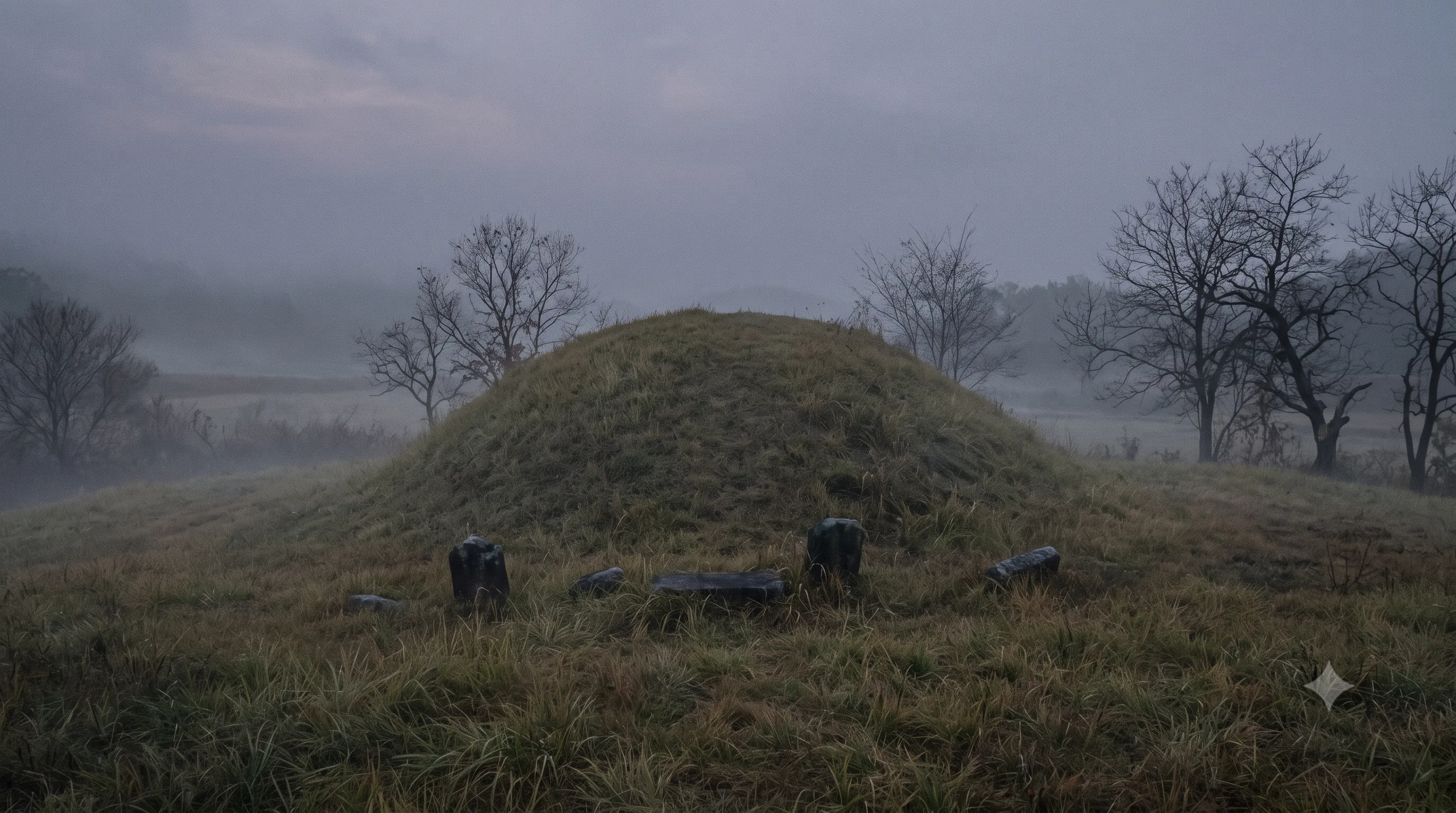 Conceptual illustration — the Yeoncheon site is locally associated with Empress Ki’s tomb, though no identifiable burial mound survives there. (AI illustration)
Quick answer: Yeoncheon, Korea, has a site traditionally identified as Empress Ki’s burial place, but no clearly identifiable tomb mound or excavated burial has confirmed it. Joseon-era local records show the tradition is several centuries old, and roof-tile fragments and stone animal figures were found nearby — but none identifies the occupant. Empress Ki is last securely recorded fleeing north with the Yuan emperor in 1368; the court first reached Shangdu, then moved to Yingchang in 1369. Her death and actual burial place remain unknown.
Let’s unpack it.
Is there really a “tomb of Empress Ki”?
A site exists, and the tradition attaching it to Empress Ki is genuinely old. What’s missing is proof that any burial there is hers — or that an identifiable tomb survives at all.
In Yeoncheon, a site has been passed down as Empress Ki’s burial place, and the association shows up in Joseon-era geographical gazetteers and local lore — a late-19th-century county gazetteer records the tradition that she wished to be buried in her homeland. Roof-tile fragments and two stone animal figures have been found nearby. Korea’s National Institute of Korean History notes plainly that while a site known as Empress Ki’s tomb exists in Yeoncheon, its authenticity cannot be confirmed (National Institute of Korean History / 우리역사넷 — Empress Ki).
That distinction is everything. Gazetteer entries generally sit at the level of “this is what is popularly said” — they record a tradition, not a verified fact. The roof-tile fragments and stone figures suggest a significant historical complex may once have stood nearby, but without an excavated burial, an inscription, or a securely documented archaeological context, they cannot identify either a tomb or its occupant. An old story about a grave is evidence that the story is old — not evidence of who lies in it.
Where did Empress Ki actually die?
This is the crux — because her real ending is a blank in the record, and blanks are where legends grow.
Empress Ki was unmistakably real: a Goryeo woman sent to the Yuan court, who rose to become the primary empress of Emperor Toghon Temür and the mother of the heir, Ayushiridara. But her final years are genuinely uncertain. The Yuan Shi (元史), the official history compiled in the early Ming, follows her only as far as 1368, when she withdrew north with the emperor after Ming forces took the Yuan capital — and it records no death date (Yuan Shi, vol. 114, Empress Consorts — Chinese Text Project). A later history, the Xin Yuanshi, dates her death to 1369, while the Encyclopedia of Korean Culture treats her end as simply unknown and does not fix a date (Encyclopedia of Korean Culture — Empress Ki).
Her last confirmed movement points away from Korea, not toward it. When Ming troops took Dadu (Beijing) in 1368, she retreated with Toghon Temür to Yingchang, in what is now Inner Mongolia. After that, her trail — and her final resting place — goes cold. A story that her body was then carried all the way to Yeoncheon is an evocative tradition, but it is not something the main histories confirm.
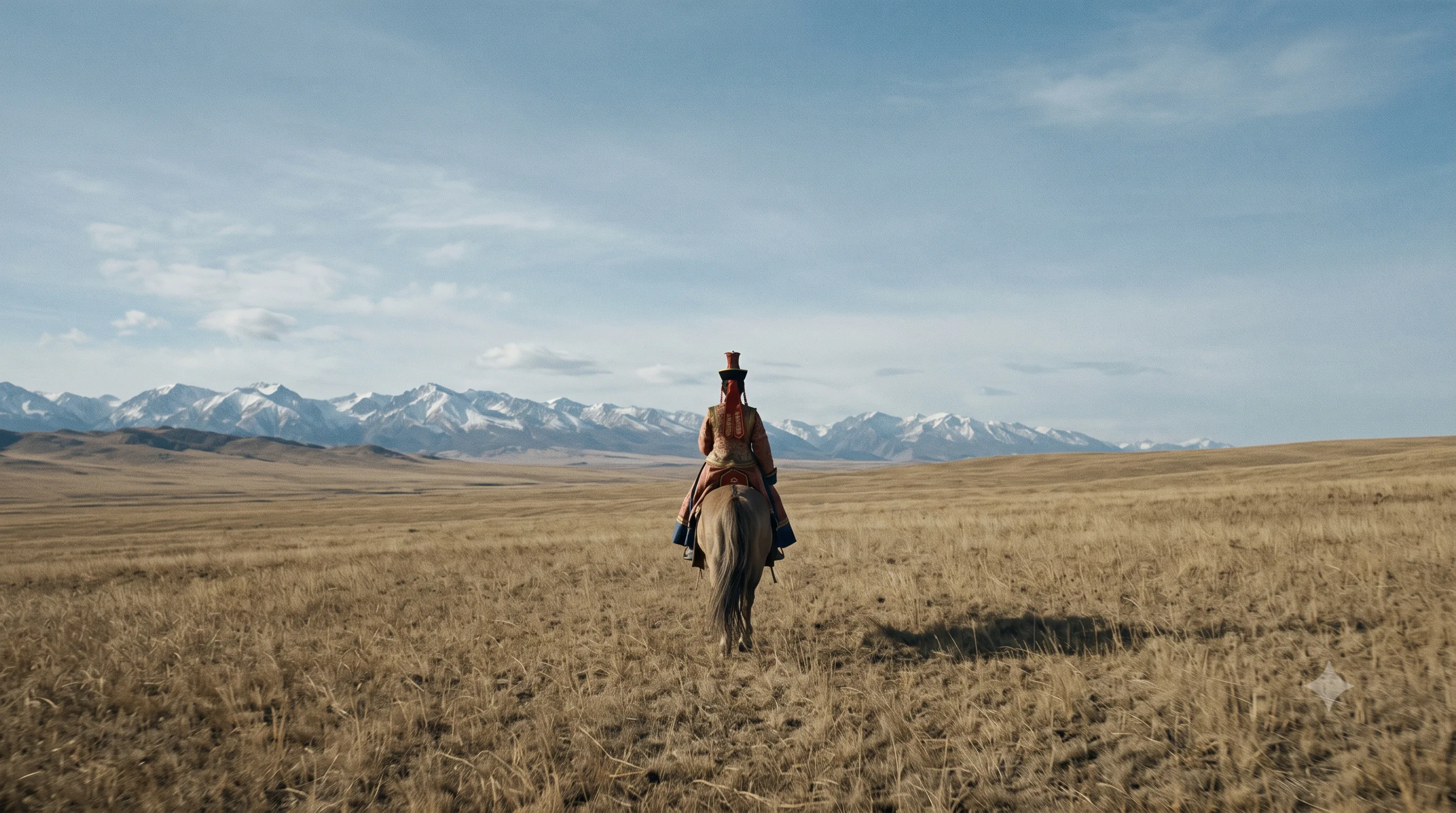 Empress Ki’s last confirmed move was north, into the Mongolian steppe — not home to Korea. (AI illustration)
Why historians doubt the Yeoncheon tomb
Beyond the missing death record, two strong reasons make scholars cautious about accepting the Yeoncheon site as her actual tomb.
First, the silence of the Goryeosa. Empress Ki was not a minor figure in Korea; through her family she shook Goryeo politics for years. If she had truly returned home and been buried in Yeoncheon, one might expect some mark in the Goryeosa (고려사), Korea’s main dynastic history — yet the major sources do not clearly record any repatriation or Korean burial. That silence weakens the tradition, though on its own it cannot disprove a private or later burial.
Second, the politics make a quiet homecoming unlikely. Her clan, the Kis, were purged by King Gongmin in his anti-Yuan reforms, and Empress Ki was tied to the failed 1361 attempt to depose Gongmin and install Deokheung-gun on the Goryeo throne (Encyclopedia of Korean Culture — Deokheung-gun). She was, in other words, an adversary of the ruling Goryeo court in its final Yuan-era struggles. The idea that this same court would receive her body and bury her with honors is hard to credit — though a quiet, unofficial burial by kin or retainers can’t be ruled out on those grounds alone. Her hostility toward Gongmin’s court makes an officially sponsored return unlikely, not impossible.
Put the two together with the geography — her last confirmed steps leading north into Mongolia, not south to Korea — and the Yeoncheon tomb becomes hard to accept as literal fact. It is better understood as a later tradition filling a gap the histories left open.
Key terms. Empress Ki (기황후) — a Goryeo tribute woman who became primary empress of the Yuan (Mongol) empire. Yuan Shi (元史) — the official Ming-compiled history of the Yuan; it records Empress Ki only to her 1368 retreat, with no death date. Goryeosa (고려사) — Korea’s main dynastic history, which does not clearly record her return or Korean burial. Yingchang (응창) — the northern site, in today’s Inner Mongolia, to which she retreated in 1368.
Here’s the mystery laid out plainly:
| The claim | What the record actually supports |
|---|---|
| “Empress Ki’s tomb is in Korea” | A Yeoncheon site is traditioned as hers; no burial mound or occupant is confirmed |
| “She came home to be buried” | The Yuan Shi and Goryeosa don’t record any return or Korean burial |
| “We know when and where she died” | The Yuan Shi gives no death date; her last confirmed move was north into Mongolia |
| “The gazetteers prove it” | Gazetteers record a tradition (“popularly said to be”), not a verified fact |
When a powerful ruler’s grave goes missing
Empress Ki isn’t alone. History is full of powerful figures whose final resting places dissolved into mystery — and it’s revealing which company she keeps.
The Mongol parallel — Genghis Khan. The most fitting comparison sits at the heart of her own empire. Genghis Khan, founder of the Mongol world she married into, was buried in 1227 in a location kept deliberately secret — and it has never been definitively found, despite centuries of searching (National Geographic). Genghis Khan’s own grave was never located, so uncertainty about where a figure of the Mongol empire came to rest is, if anything, familiar territory. Seen this way, the open question around Empress Ki’s resting place fits the Mongol world far better than a tidy homecoming to Yeoncheon does.
That’s the real point of the Yeoncheon site. Its value isn’t as a settled address for a body. It’s a window into how a person is remembered — a Goryeo tribute woman who became a Mongol empress and rattled two courts, her memory condensed into a single contested hillside said to be hers. The tradition is genuinely old, but the burial remains archaeologically unverified. The story tells you she’s still standing, even now, somewhere between history and legend.
Coming up next
One contested hillside — and we’ve traveled from a Goryeo tribute woman’s rise to a Mongol throne, to a 1368 flight into the steppe, to the hidden grave of Genghis Khan himself. That’s the quiet gift of a good historical drama: a single unanswered question is a doorway.
In the next essay, we’ll take another K-drama scene that looks like pure fiction — and trace the real Korean history hiding underneath it.
Frequently asked questions
Is Empress Ki’s tomb really in Korea? There is a site in Yeoncheon, Gyeonggi Province, traditionally identified as Empress Ki’s tomb — but no clearly identifiable burial mound has been confirmed there. The main histories — the Yuan Shi and the Goryeosa — do not record her returning to Korea or being buried there, and Korea’s National Institute of Korean History notes that the tradition cannot be verified. It’s safest to say “a site is traditionally associated with her burial,” not “her tomb is in Korea.”
Where did Empress Ki actually die? It isn’t certain. Her last confirmed movement is fleeing north with the Yuan emperor in 1368, when Ming forces took the capital: the court first reached Shangdu, then moved farther north to Yingchang in 1369. The Yuan Shi records her only up to that retreat without giving a death date; a later history dates her death to 1369; and the Encyclopedia of Korean Culture treats her end as unknown.
Was Empress Ki a real person? Yes. She was a Goryeo woman sent to the Yuan (Mongol) court as tribute, who rose to become the primary empress of Emperor Toghon Temür and mother of the heir, Ayushiridara. She became a major power at the Yuan court and a heavy influence on Goryeo politics — which is exactly why a quiet burial in Korea would be surprising. (For how tribute women like her were sent to the Yuan in the first place, see our companion piece on Empress Ki and Goryeo’s tribute women.)
Is there a visible tomb mound in Yeoncheon today? No clearly identifiable tomb mound or burial structure has been confirmed at the site. It is officially described as a place traditionally associated with Empress Ki’s tomb, where roof-tile fragments and two stone animal figures were found nearby — none of which identifies an occupant.
Sources & further reading
This piece was written from the historical script and fact-check of 사뚱샘의 역사방 (SaDDungSam). Key sources are cited inline above. For broader reading:
- Empress Ki (기황후) — the Goryeo woman who became Yuan empress. (Encyclopedia of Korean Culture / 한국민족문화대백과)
- Empress Ki & the Yeoncheon tomb tradition — “a site known as her tomb exists, but its authenticity cannot be confirmed.” (National Institute of Korean History / 우리역사넷)
- Yuan Shi (元史), vol. 114, Empress Consorts — the Yuan history recording her only to the 1368 retreat, with no death date. (Chinese Text Project)
- Deokheung-gun (덕흥군) — the 1361 attempt to depose King Gongmin, tied to Empress Ki. (Encyclopedia of Korean Culture)
- Genghis Khan’s hidden tomb — the Mongol parallel of a deliberately concealed, still-unfound grave. (National Geographic)
Thanks for reading — see you in the next one.
This article was researched and written by K-Drama History. Source: Is Empress Ki Buried in Korea? The Mystery of the Yeoncheon Tomb Site — K-Drama History