From the research behind Pause the Drama.
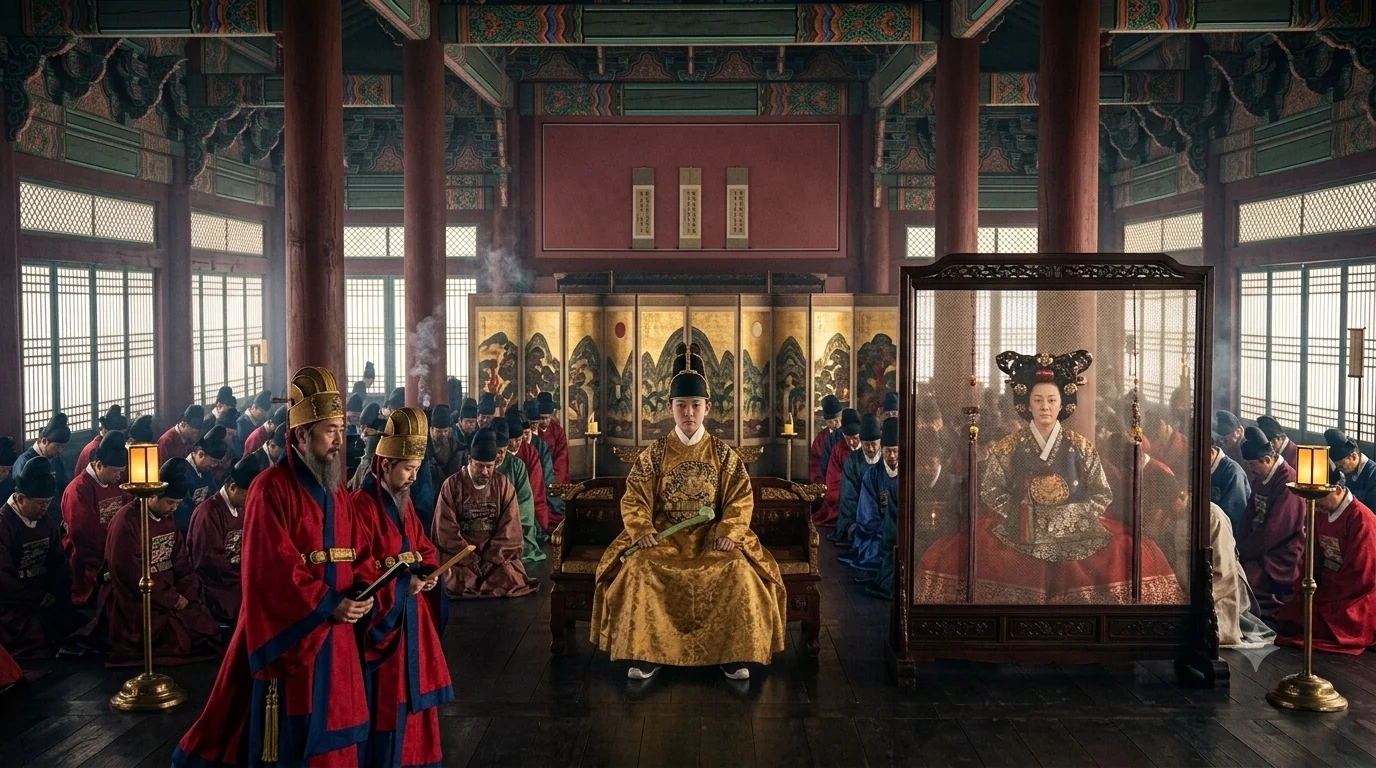
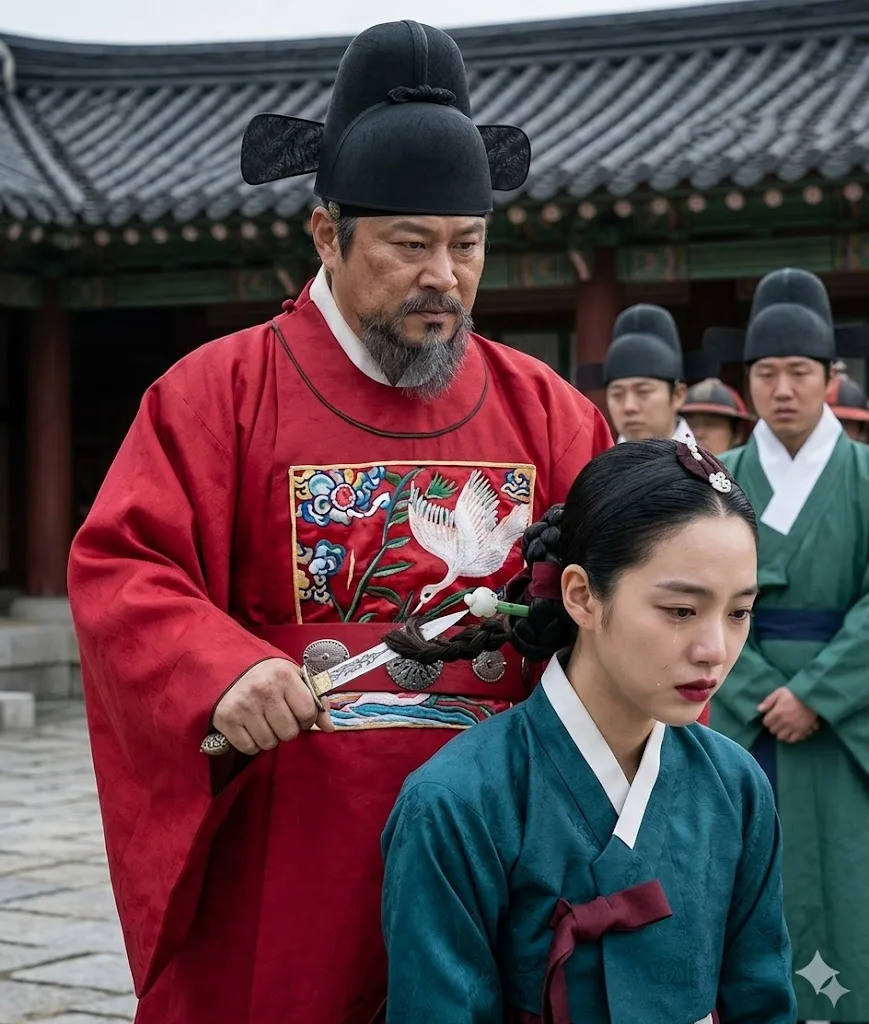
If you’ve watched Netflix’s Mr. Queen (철인왕후) — the body-swap comedy where a brash modern chef wakes up inside the body of a Joseon queen — you remember the heroine mostly for her chaos. But the show keeps dropping a detail it never fully explains to international viewers: she is a Kim. An Andong Kim. And in 19th-century Korea, that was not a small thing. It was the name of the clan that effectively ran the country.
Which raises a question almost every K-drama fan eventually asks: why are there so many Kims in Korea — and why does the show treat one particular Kim family like royalty behind the throne?
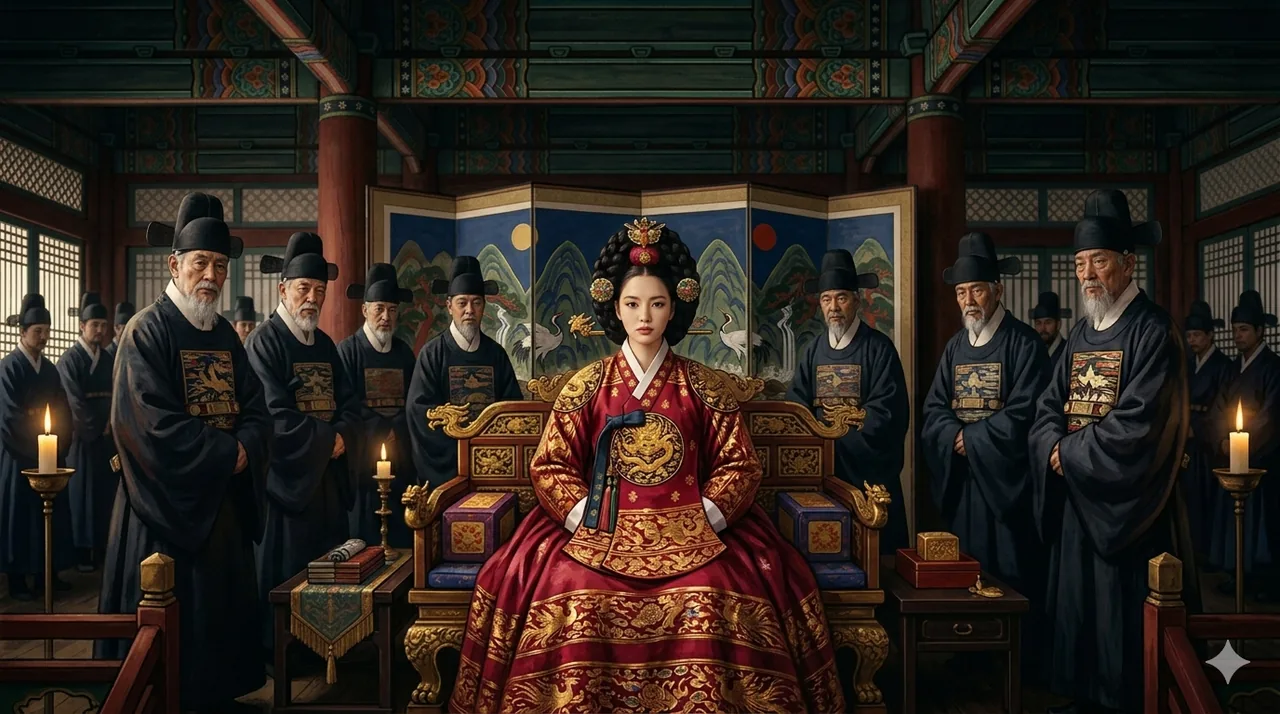 In Mr. Queen, the heroine’s clan — the Andong Kim — held the real power behind the throne. (AI illustration)
Quick answer: In Mr. Queen, the heroine is an Andong Kim, one of the in-law clans that dominated late-Joseon Korea through “sedo politics” — placing their daughters on the throne to control boy-kings. Korea has so many Kims because surnames began as an elite privilege and spread to everyone over centuries, so a few prestigious names became enormously common. But “Kim” is only half a name: the bon-gwan (본관), or ancestral clan seat, is what tells two Kims apart. A Korean surname is less a label than a map of where you come from.
Let’s unpack it.
Why does the queen’s clan matter so much in Mr. Queen?
Because in the 1800s, Joseon was not really ruled by its kings. It was ruled, in large part, by their in-laws.
Historians call the system sedo jeongchi (세도정치) — “in-law politics,” or rule by a royal affinal clan. After a series of kings died young or took the throne as children, a handful of clans seized the vacuum by marrying their daughters to the kings and packing the government with their kinsmen. The most dominant of them was the Andong Kim (안동 김씨), the very clan Mr. Queen gives its heroine (Encyclopedia of Korean Culture, 한국민족문화대백과 — “sedo politics” / 세도정치).
So when the show surrounds Queen Kim So-yong with scheming relatives who treat the king as a piece to be managed, that isn’t comic exaggeration. A Joseon queen was the human link between the throne and a clan’s ambitions — which is exactly why a body-swap comedy set in this period keeps circling back to the question of whose daughter the queen really is.
So why are there so many Kims?
Here’s the part that surprises outsiders: roughly one in five Koreans is a Kim, and Kim, Lee (Yi), and Park together cover close to half the population (Beom Jun Kim et al., “Distribution of Korean Family Names,” Physica A, 2005).
That lopsidedness is historical, not coincidental. In early Korea, surnames were a privilege of the elite — royalty, aristocrats, and powerful lineages. Most ordinary people had no fixed, registered surname at all. Over the centuries, as the state grew and household registration expanded, surnames spread downward — and when commoners and formerly enslaved people took or were assigned surnames, they tended to adopt prestigious, established names rather than invent new ones. A handful of high-status surnames, Kim chief among them, multiplied far beyond the original families that bore them.
So “there are many Kims” really means: many separate families came to share a small set of prestigious names. Which is why, to a Korean, the surname alone tells you almost nothing.
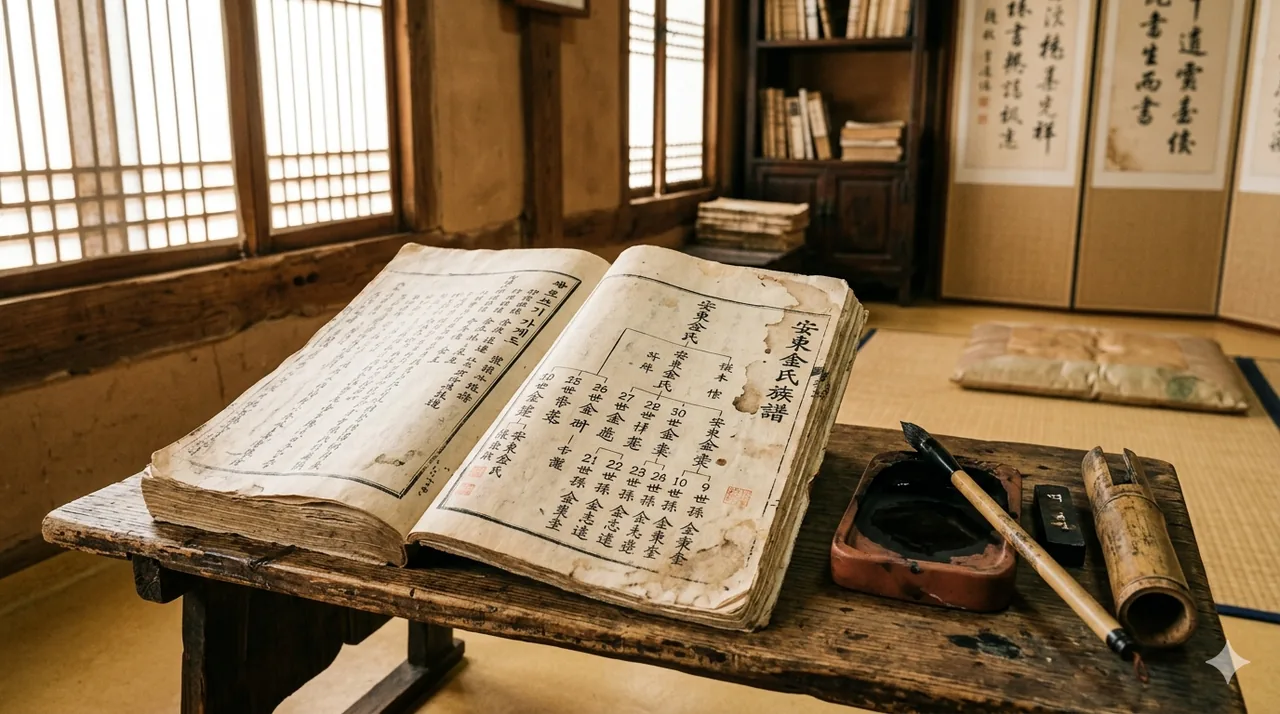 A Korean name points to a clan and a place — here, the genealogy (jokbo) of the Andong Kim clan, recorded by generation. (AI illustration)
What a Korean surname actually carries: the bon-gwan
If “Kim” is only half a name, the other half is the bon-gwan (본관) — the ancestral seat of the clan.
The bon-gwan is a place: the home region tied to a clan’s founding ancestor. It pairs with the surname to pick out a specific lineage. So the right question in Korea is never just “Are you a Kim?” but “Which Kim?” — the Gimhae Kim, the Andong Kim, the Gyeongju Kim? These are different clans, with different origins, who simply share a syllable (Encyclopedia of Korean Culture, 한국민족문화대백과 — “bon-gwan” / 본관).
This is why Mr. Queen can lean so hard on a single clan name. “Andong Kim” isn’t a surname plus a hometown; it’s an identity — a position in a web of genealogy, ancestral rites, marriage rules, and status. In the Joseon world a surname was, in effect, “surname + ancestral seat,” a far more precise coordinate than a Western family name. It told you who your ancestors were, whom you could marry, and where you stood.
Are all Korean Kims related?
No — and this is the part that surprises outsiders most. Many Koreans share the surname Kim, but two Kims may belong to completely different bon-gwan, or ancestral clan seats. A Gimhae Kim and an Andong Kim are not the same family with different hometowns; they are separate lineages with different founding ancestors — historically distinct enough that the two could marry each other precisely because they were unrelated. So when someone asks whether all Korean Kims are related, the honest answer is: no. The surname is shared; the lineage is not. That gap is exactly what the bon-gwan exists to record.
Here is the drama beside the history:
| In Mr. Queen | In real history |
|---|---|
| The heroine is “an Andong Kim,” and her relatives wield enormous influence | The Andong Kim were a real in-law clan that dominated the court through sedo politics in the 1800s |
| The queen’s family seems to outrank the king himself | A royal in-law clan could control boy-kings and staff the government with kinsmen |
| Everyone fixates on which house the queen comes from | Surname + bon-gwan determined marriage, status, and political alliance |
| “Kim” is treated as a marker of a specific powerful family | “Kim” alone is shared by many unrelated clans; the bon-gwan is what distinguishes them |
In short: Mr. Queen runs on a fact of Korean life that the comedy never spells out — that a surname is a clan, a clan has a seat, and in late Joseon one such clan, the Andong Kim, turned marriage into a machine for ruling the state.
Key terms. Bon-gwan (본관) — the ancestral seat of a clan, paired with the surname to identify a specific lineage (e.g. Andong Kim vs. Gimhae Kim). Sedo jeongchi (세도정치) — late-Joseon “in-law politics,” rule by a royal affinal clan that controlled the throne by supplying queens. Jokbo (족보) — the genealogical record that tracks a clan’s generations. Sageuk (사극) — Korean historical drama, a genre whose plots often turn on clan, marriage, and lineage.
Surnames around the world: the same idea, a different memory
What makes Korea’s system clearer is to set it beside others. Across civilizations, surnames solved the same two problems — remembering family and letting the state count people — but each culture remembers something different in the name.
China — lineage, written deep. Chinese surname culture is ancient; early on it even split xìng (姓, the broader bloodline) from shì (氏, the branch), a distinction that faded as centralized empires formed. What remained is an enormous, lineage-centered system in which a handful of surnames — Wang, Li, Zhang — are shared by vast numbers of people as a sign of common ancestry and civilization. China’s surname culture shaped the whole Sinographic world, Korea and Vietnam included (Du Ruofu et al., “Chinese Surnames and the Genetic Differences between North and South China,” Journal of Chinese Linguistics Monograph Series 5, 1992).
Japan — surnames by state decree. Ancient Japan had uji (氏) clans and kabane (姓) titles, and later warrior society produced many myōji (苗字). But for most commoners, the right to use a surname publicly was restricted until the modern state intervened: in 1870 commoners were permitted surnames, and in 1875 they were required to have one. Many Japanese surnames come from landscape and place — Yamamoto (“base of the mountain”), Tanaka (“middle of the rice field”) — a record of where a family stood when the state came counting (National Archives of Japan — Meiji surname edicts).
Europe — trades, fathers, and places. European surnames feel domestic and concrete. As medieval towns grew and church, tax, and land records multiplied, one John was no longer enough: he became John the Smith, William the Baker, Peter Johnson (John’s son), Thomas Hill. These bynames hardened into inherited surnames, which is why English-language names still carry occupations (Smith, Miller), patronymics (Johnson, MacDonald), and features (Brown, Short) (Oxford Dictionary of Family Names in Britain and Ireland · Encyclopaedia Britannica, “surname”).
The Islamic world — a name like a sentence. Traditional names across the Islamic world resist a single “surname.” A name could chain a personal name, a father’s name (nasab), an origin or affiliation (nisba), an honorific (laqab), and a parent-of relation (kunya) — together a compact biography of lineage, place, and reputation. Modern states later pushed these toward fixed family names for passports and registries (Annemarie Schimmel, Islamic Names: An Introduction).
South Asia — caste, religion, region. South Asian surnames are unusually layered: a single name can encode caste, religious community, language region, occupation, or village. Colonial and modern administration pressed this variety into standardized legal names, leaving surnames that sit exactly where traditional status order meets modern paperwork.
The Slavic world — the father, carried along. Russian and other Slavic names typically run given name + patronymic + surname, where the patronymic is built from the father’s name (Ivan → Ivanovich / Ivanovna). Surname suffixes like -ov, -ev, -in, -sky mark whose house, or which place, a person belongs to — the father and the family travel inside the name itself.
Set against all of these, Korea’s choice stands out: it remembers the clan and its seat with unusual precision. A European name might tell you a great-ancestor’s trade; a Korean name, through surname and bon-gwan, tries to tell you the lineage itself — which is exactly the knowledge Mr. Queen’s court runs on.
Coming up next
A body-swap comedy about a chef in a queen’s body turns out to open onto a thousand years of how a people decided to remember itself — through clans, seats, and the quiet machinery of marriage and power. That’s the gift of a good sageuk: a throwaway line about “the Andong Kim” is a door into how an entire civilization wrote down who it was.
In the next essay, we’ll take another K-drama scene that looks like pure fiction — and trace the real Korean history hiding underneath it.
Frequently asked questions
Why does Korea have so many people named Kim? Kim, Lee, and Park together account for nearly half of all Koreans. Surnames in Korea began as a privilege of royalty and aristocrats; over centuries, as household registration spread to commoners and formerly enslaved people, prestigious names like Kim were adopted far more widely than the original families that bore them. A few high-status surnames became enormously common.
Are all Kims in Korea related? No. Two Kims can belong to entirely different lineages. The distinguishing mark is the bon-gwan (ancestral clan seat): the Gimhae Kim and the Andong Kim are separate clans with separate origins. “Kim” alone is only half the name.
What is a bon-gwan (본관)? The ancestral seat of a clan — the home region tied to its founding ancestor. It pairs with the surname to identify a specific lineage (e.g. Andong Kim), and historically governed genealogy, ancestral rites, and marriage. A Korean surname is closer to “surname + ancestral seat” than to a Western family name.
Who were the Andong Kim in Mr. Queen? One of the most powerful clans of the late Joseon dynasty. In the 1800s they dominated the court through sedo politics — rule by a royal in-law clan — by repeatedly placing their daughters on the throne. Mr. Queen’s Queen Kim So-yong is written as an Andong Kim, which is why her family’s influence shadows the series.
Why did one clan have so much power in Joseon? Through sedo politics: in the 1800s a few in-law clans, above all the Andong Kim, controlled boy-kings and the government by supplying queens and filling offices with kinsmen. A single clan could effectively run the state — an arrangement widely blamed for late-Joseon corruption and decline.
Do other countries have clan seats like the bon-gwan? Not in the same way. China has deep lineage memory but no systematic seat-pairing; Japanese surnames became universal only with the Meiji state; European surnames grew from trades, fathers, and places. Korea’s surname-plus-bon-gwan system is unusually precise about locating a person on a family tree.
When did ordinary Koreans get surnames? Surnames began among royalty and aristocrats and spread downward over centuries. Many commoners and formerly enslaved people lacked fixed, registered surnames until the late Joseon and modern era, when household registration extended names to everyone — part of why a few prestigious surnames became so common.
Why do K-dramas talk about clans and family trees so much? Because a surname and its bon-gwan determined marriage, status, ancestral duty, and political alliance. “Which house are you from?” had real stakes. Court marriages, in-law power, genealogies, and clan rivalries — the engine of countless sageuk plots — all run on this surname culture.
Is Andong Kim the same as Gimhae Kim? No. They share the surname Kim, but the bon-gwan (ancestral clan seat) identifies separate lineages with different founding ancestors. Andong Kim and Gimhae Kim are different clans — not the same family from different towns.
Why was Queen Kim So-yong’s family powerful in Mr. Queen? Because she belongs to the Andong Kim, one of the royal in-law clans that dominated late-Joseon politics through sedo jeongchi — placing their daughters on the throne to control boy-kings and filling the government with kinsmen.
Sources & further reading
This piece was written from the historical script and fact-check of 사뚱샘의 역사방 (SaDDungSam). Key claims are sourced inline; for broader reading:
- Korean surname distribution (why Kim, Lee, Park dominate). Beom Jun Kim et al., studies on the statistical distribution of Korean family names.
- Korean clan seats (bon-gwan), genealogy, and sedo politics. Encyclopedia of Korean Culture (한국민족문화대백과, Academy of Korean Studies) · National Institute of Korean History (우리역사넷).
- Comparative surname history. Du Ruofu, “Surnames in China,” Journal of Chinese Linguistics; Oxford Dictionary of Family Names in Britain and Ireland; Encyclopaedia Britannica, “surname”; Annemarie Schimmel, Islamic Names: An Introduction; National Archives of Japan (Meiji surname edicts).
Thanks for reading — see you in the next one.
This article was researched and written by K-Drama History. Source: Netflix's Mr. Queen, Explained: Why Does Korea Have So Many Kims? — K-Drama History