MBC's The King's Doctor, Explained: Why a Grand Queen Dowager's Mourning Dress Triggered Two Political Battles 15 Years Apart in Joseon Korea
Theme: Confucian Life & Ritual
From the research behind Pause the Drama.
If you’ve made it to the final stretch of MBC’s sprawling 50-episode epic The King’s Doctor (마의, also released as Horse Doctor, 2012–13) — the one about Baek Gwang-hyeon, the real-life horse doctor who clawed his way up to become one of Joseon’s most celebrated royal physicians — you’ll remember where it leaves him: at the peak of his career, treating the reigning King Hyeonjong and rising to serve as a physician of the royal court.
The drama stops there. What it never pauses to explain is the crisis quietly convulsing that very reign. Just beyond the show’s medical storyline, the court of King Hyeonjong was consumed by one of the strangest, longest-running political crises in Korean history — a fifteen-year fight that was, on paper, about nothing more than how long the king’s stepmother should wear her mourning clothes.
The King’s Doctor never stages that fight directly. But it’s one of the very few popular sageuk set squarely in Hyeonjong’s reign — which makes it a rare window onto the era. So let’s step through it.
Quick answer: MBC’s The King’s Doctor is set in the reign of King Hyeonjong — the king Baek Gwang-hyeon serves by the drama’s end. That reign was defined by the Yesong (禮訟, “ritual disputes”): a fight over exactly how long Grand Queen Dowager Jaui should wear mourning clothes for the late King Hyojong — one year, or three. Behind that technical question was something explosive: whether Hyojong, Injo’s second son, should hold the full ritual status of an eldest-line heir. The two rounds of debate, in 1659 and 1674, twice reshaped the balance of power at the Joseon court.
Let’s unpack it.
What actually happens when a Joseon parent — or a king — dies?
In Confucian Korea, death didn’t end a family relationship. It started a multi-year ritual project.
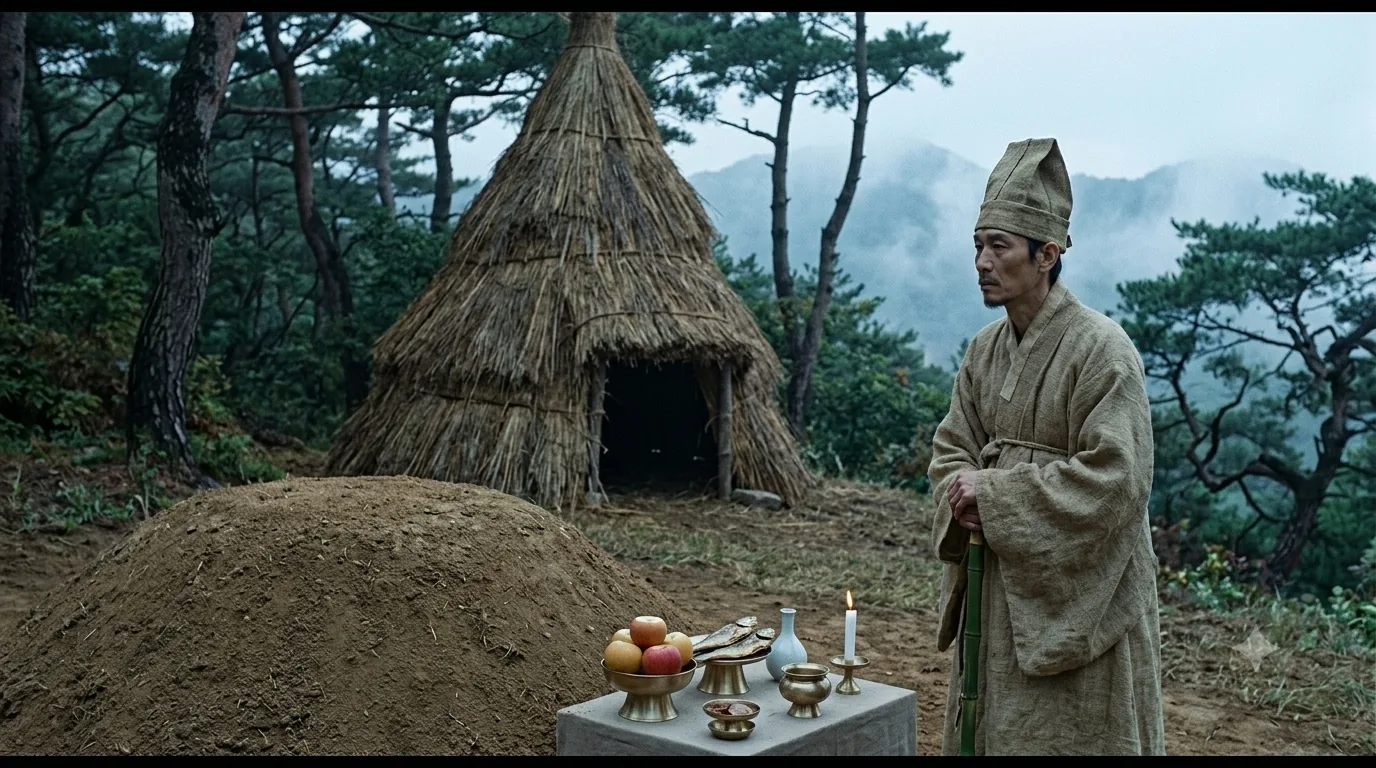
The core framework, called sangnye (상례, 喪禮), was a years-long sequence for turning a dead parent into a properly venerated ancestor, imported from China but reworked into a distinctly Korean practice (Encyclopedia of Korean Culture, 상례). Its centerpiece was the samnyeonsang (三年喪), the “three-year mourning” for a parent — nominally three years, though in actual practice usually calculated as somewhere between twenty-five and twenty-seven months (Journal of Confucian Philosophy and Culture, Sungkyunkwan University). The most demanding version of it was simyo-sari (侍墓살이): building a hut beside the parent’s grave and living there for the full mourning period, abstaining from meat, alcohol, and marital life. It was prized as an extraordinary act of filial devotion rather than a required part of the funeral rites. The practice is often associated with the Goryeo scholar Jeong Mong-ju, who mourned his own parents this way in the late 14th century and became a celebrated model for Joseon’s scholar-official class — though he was not the first Korean to do it; records trace individual cases back at least to Choe Ru-baek in 1137 (Encyclopedia of Korean Culture, 시묘).
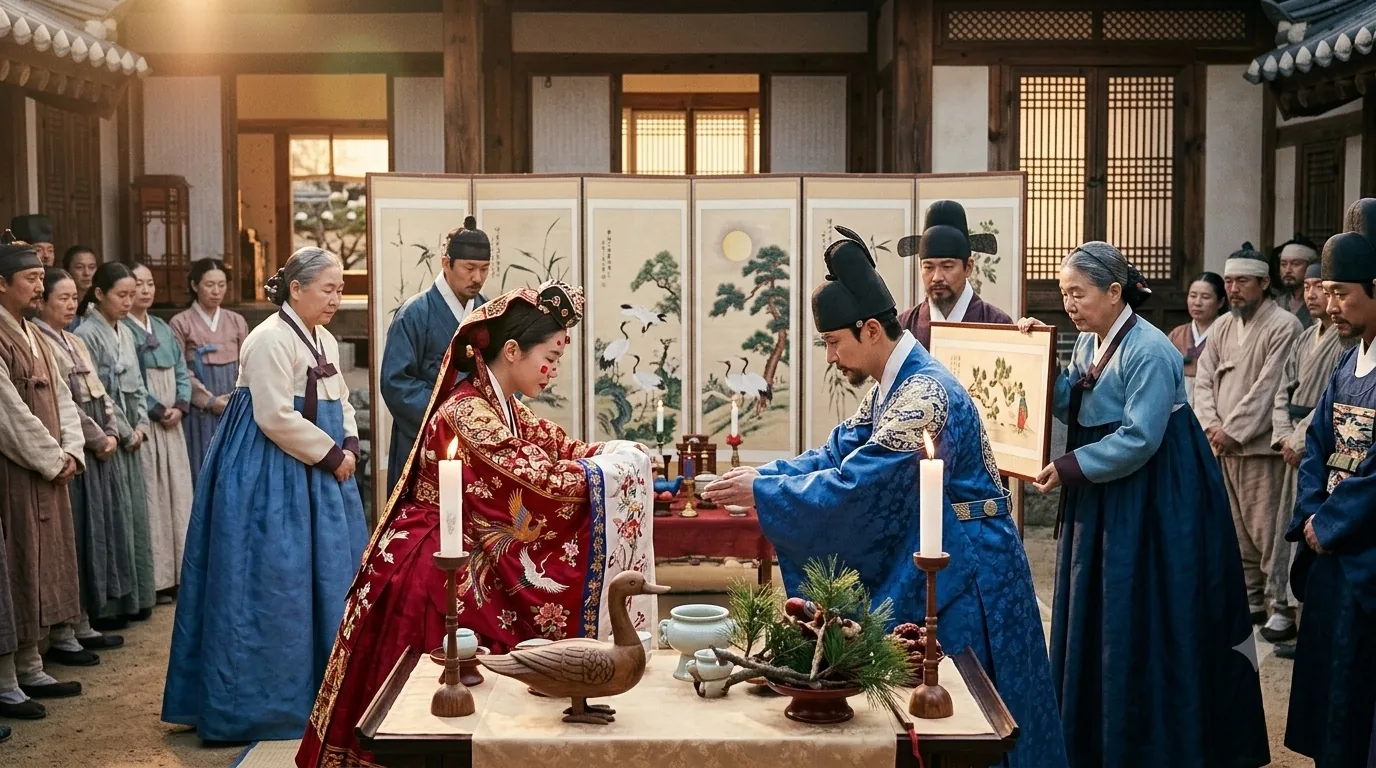
Around that core sat obokje (五服制), a five-grade mourning-dress code — chamchoe, jaechoe, daegong, sogong, and sima — that assigned a specific garment, stitching style, and mourning length (from three years down to three months) to every possible degree of kinship to the deceased. It was far older than Zhu Xi, rooted in ancient Chinese ritual classics like the Yili (儀禮) and the Book of Rites. What Zhu Xi’s Family Rituals (朱子家禮, Zhuzi Garye) did in the 12th century was organize these inherited rules into a manual a household could actually follow — and Joseon made that manual a foundational reference for coming-of-age, weddings, funerals, and ancestral rites — adapting it over time through state law, Korean custom, and its own later ritual scholarship (Encyclopedia of Korean Culture, 오복; Britannica, Zhu Xi). In effect, obokje was Joseon’s official chart of exactly how much any two relatives owed each other — in cloth, in months, and in law.
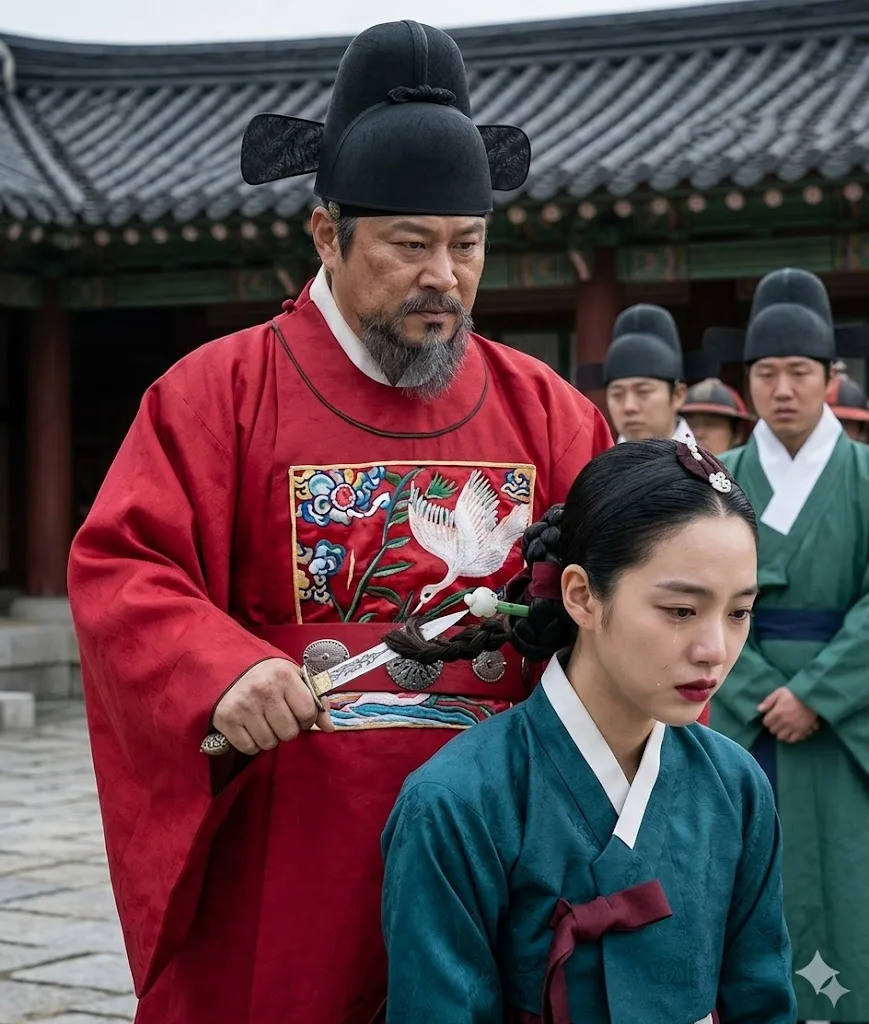
All of this ran on hyo (孝), filial piety — devotion to one’s parents that didn’t stop at death but simply changed form. It’s the same value behind the outrage in The King’s Affection’s hair-cutting scene: in Confucian Korea, what you owed your parents was never just a feeling. It was a precisely measured obligation, and everyone was expected to know exactly where they stood on the chart.
So why did a queen’s mourning dress become a national emergency?
Because when the person who died was a king, “exactly where he stood on the chart” was not a settled question — and getting the ritual classification wrong could be read as diminishing the standing of his succession.
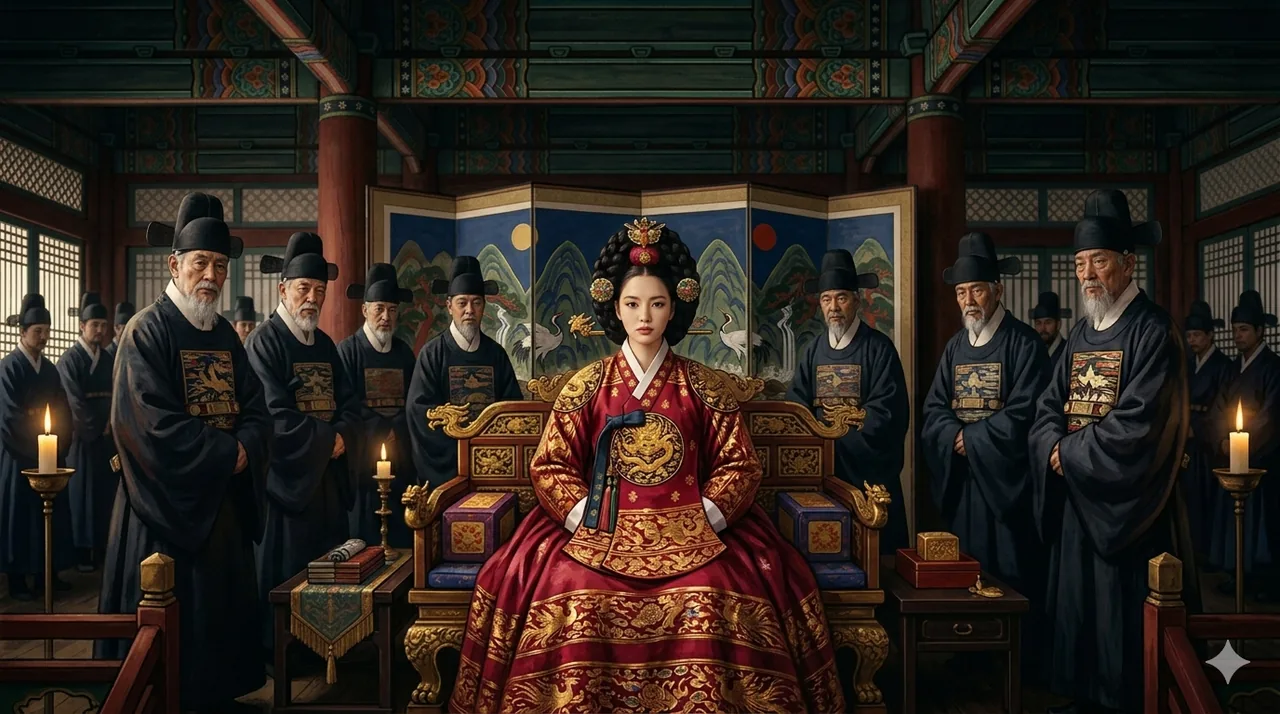
King Hyojong (r. 1649–1659) had not been born to inherit the throne — he was King Injo’s second son. His elder brother, Crown Prince Sohyeon, died suddenly in 1645, and Injo, bypassing Sohyeon’s own son, named the future Hyojong crown prince instead. When Hyojong himself died in 1659, his stepmother — Grand Queen Dowager Jaui (慈懿大妃, Jaui Daebi), Injo’s much younger second wife — was, by the ritual code, obligated to wear mourning for him. The only question was for how long.
That question detonated into the first of two national crises, collectively remembered as the Yesong (禮訟, “ritual disputes”): the Gihae Yesong of 1659, over Hyojong’s own mourning, and the Gapin Yesong of 1674, when the argument reopened after the death of his wife, Queen Inseon (Encyclopedia of Korean Culture, 예송; National Institute of Korean History, 예송 1659~1674).
What was the Gihae Yesong (1659) — and why did a “second son” matter so much?
Under the ritual code, a parent mourned an eldest son who died for the full three years, but a younger son for only one year (gi-nyeon, 期年). Hyojong was, biologically, a younger son. But he was also the reigning king. So which rule applied?
The Seoin (西人, “Westerners”) faction, led by the towering scholar-official Song Si-yeol, argued for one year. Their technical basis was an exception recognized in the classical ritual commentaries, sometimes rendered cheibujeong (體而不正) — roughly, “of the [parent’s] body, but not the correct [eldest] line” — one of a handful of scenarios in which even an heir who inherits the family headship does not receive the full three-year mourning. Politically, the Seoin also argued for a principle they called cheonha dongnye (天下同禮, “the same ritual for all under heaven”): a king, in their view, was not ritually exempt from the ordinary rules that applied to any second son.
The Namin (南人, “Southerners”), led by scholars including Yun Hyu and Heo Mok, argued for three years. Their case: Hyojong might have been born second, but by becoming king he had inherited the entire royal line — so ritually, he should be treated as if he were the eldest son. The Namin position implied something the Seoin found dangerous: that a king’s ritual status was categorically different from an ordinary aristocrat’s, simply because he was king.
The court ultimately held to one year — but this was not, at the time, a formal ruling that Hyojong counted as a mere “second son.” The official basis was the gukje (國制), the one-year mourning period prescribed by Joseon’s own royal-state precedent and put forward by chief state councillor Jeong Tae-hwa. Song Si-yeol’s cheibujeong theory was not itself enshrined as the verdict; it only became the explicit rationale for the one-year camp during a renewed push for three-year mourning in 1660. The outcome favored the Seoin politically and kept them dominant at court — though, notably, Hyeonjong did not remove the Namin’s Heo Jeok from his post, apparently wary of letting the Seoin consolidate too much power (Encyclopedia of Korean Culture, 예송).
What was the Gapin Yesong (1674) — and why did the outcome flip?
Fifteen years later, the argument came back from a different angle — and this time, it went the other way.
In 1674, Hyojong’s widow, Queen Inseon, died. Grand Queen Dowager Jaui — still alive, and by now mourning a second member of the same family — again had to decide how long to wear mourning clothes, this time for her daughter-in-law. The court first set nine months, following the same logic as before (Hyojong was “not the correct line,” so his wife inherited a lesser ritual status too). Then a Namin-aligned provincial scholar, Do Sin-jing, protested that nine months was inconsistent with the one year worn for Hyojong in 1659 — and reopened the whole question.
Notably, the leading Namin ritualists of 1659 — Heo Mok, Yun Hyu — took no direct part this time; the decisive confrontation was largely between King Hyeonjong and the Seoin officials defending the nine-month ruling. Hyeonjong revised the period back to one year, dismissed the Seoin’s Kim Su-heung from the premiership, and the political balance subsequently shifted toward the Namin (Encyclopedia of Korean Culture, 갑인예송). In a detail almost too on-the-nose for the subject matter, Hyeonjong himself died only about a month after handing down that ruling — meaning the king who spent his entire adult life adjudicating exactly how the state should ritually process death barely lived to see how his own would be handled.
Here’s the whole fifteen-year argument at a glance:
| Round | Died | Seoin position | Namin position | Result |
|---|---|---|---|---|
| Gihae Yesong (1659) | King Hyojong | 1 year | 3 years | One year, under the state precedent (gukje) — politically favorable to the Seoin |
| Gapin Yesong (1674) | Queen Inseon | 9 months | 1 year | Nine months revised to one year; leading Seoin punished, advantage shifts to the Namin |
Did the argument actually end there?
Not even close — and this is where the story stops being about ritual at all.
Hyeonjong’s son, Sukjong, inherited a court already tilted toward the Namin, who dominated for the next several years. That didn’t last. In 1680, in a purge remembered as the Gyeongsin hwanguk (庚申換局) — the first in a series of abrupt hwanguk reversals of factional power that would define Sukjong’s reign — the Seoin struck back: Namin leaders including Heo Jeok and Yun Hyu were accused of treason and executed. Historians are cautious about drawing a straight line from a fifteen-year-old ritual argument to a treason purge — Joseon court politics had layered on other grievances by then — but the two events are widely read as one long arc: a fight that began over the exact wording of a mourning-dress code ended with executions.
Key terms. Samnyeonsang (三年喪) — the Confucian “three-year mourning” for a parent, observed in practice over roughly 25–27 months. Obokje (五服制) — Joseon’s five-grade mourning-dress code, prescribing garment and duration by exact kinship distance. Yesong (禮訟) — the two rounds of “ritual disputes,” in 1659 and 1674, over how long Grand Queen Dowager Jaui should mourn for King Hyojong and Queen Inseon. Zhuzi Garye (朱子家禮) — Zhu Xi’s Family Rituals, the imported Chinese manual that structured Joseon’s entire ritual calendar.
Why The King’s Doctor’s “boring” ritual dispute was really a fight over what a king is
It’s tempting to read the Yesong as an almost comic overreaction — grown men reshaping a government over nine months versus a year of cloth. But what made it explosive was specific to Joseon: Confucian mourning law offered no separate category for “monarch.” The same kinship logic that placed any two relatives on the obokje chart applied, in principle, to the king himself — even though, in practice, mourning duration and enforcement varied sharply by status, office, and state regulation. So when Song Si-yeol’s Seoin insisted on cheonha dongnye (“the same ritual for all under heaven”), the claim had teeth: that Hyojong’s kingship did not exempt his family from the ordinary rules of birth order. The Namin’s answer — that a king’s rites necessarily differ — was a claim about how far a throne can bend reality around itself. Joseon never fully closed that question.
It’s a distinctively Joseon way for that tension to surface — not because other societies lacked mourning rules, but because they channeled the same Confucian inheritance differently. Ming and Qing China let the emperor invoke duoqing (奪情) to suspend an official’s mourning leave for state needs; Joseon had its own version, gibok (起復), which recalled the general Kim Jong-seo from mourning to the northern frontier in 1435. Edo Japan folded Neo-Confucian filial piety into a warrior code of loyalty and Shinto notions of ritual purity, so mourning never reduced to a single fixed measure. And Victorian Britain built an elaborate mourning culture of its own — Queen Victoria wore black for the forty years after Prince Albert’s death — yet no throne’s succession hinged on the exact length of it.
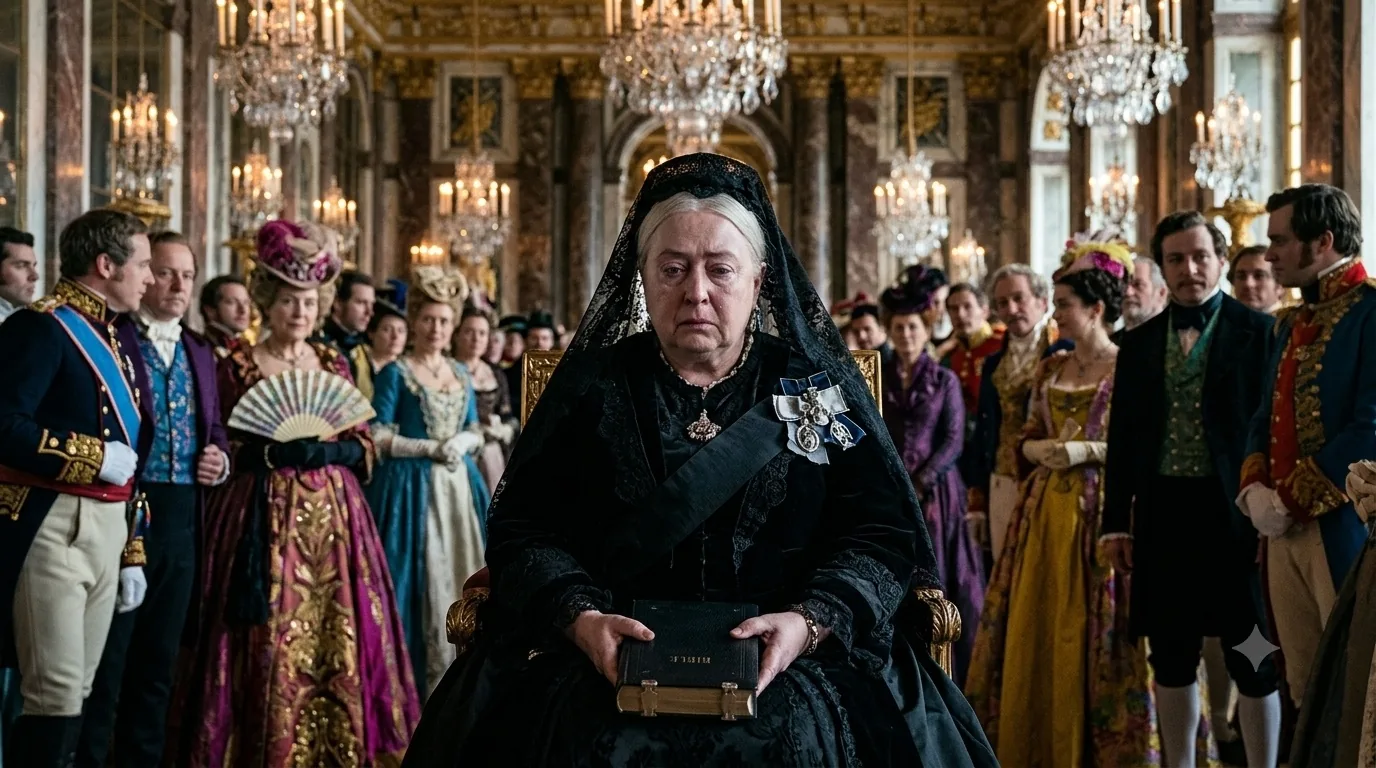
The difference wasn’t that only Joseon regulated grief. It was that in the Yesong, the ritual code was turned on the royal house itself — the length of a dowager’s sleeve became a public argument about the standing of the throne’s own succession, in a culture where the dead never fully left the family but became ancestors honored through jesa for generations. That is the quarrel unfolding just past the edge of The King’s Doctor’s frame.
Look again at where The King’s Doctor leaves Baek Gwang-hyeon — at the court of King Hyeonjong — and it’s not just the close of one doctor’s story. It’s a doorway into an argument about what a king actually is — one that Joseon Korea, in its own intensely ritualized political culture, fought over for fifteen years.
Coming up next
One contested reign, glimpsed at the edge of a medical drama’s final act — and we’ve traveled from a hut beside a grave, to a five-grade chart of mourning cloth, to a teenage king ruling on his own stepmother’s obligations, to an emperor overruling grief itself in Ming China, to Queen Victoria’s forty black years. That’s the quiet gift of a great historical drama: even the scene it doesn’t dwell on is a doorway.
In the next essay, we’ll take another K-drama scene that looks like pure fiction — and trace the real Korean history hiding underneath it.
Frequently asked questions
Is The King’s Doctor based on a true story? Its main character, the physician Baek Gwang-hyeon, was a real Joseon doctor (1625–1697), and the drama is set against the real reigns of King Hyojong and King Hyeonjong. But the show itself is a medical drama built around his fictionalized personal story; the surrounding political history — Hyojong’s death in 1659 and Hyeonjong’s succession — is real, and it’s exactly what triggered the Yesong mourning-rite disputes.
What was the Yesong debate actually about? Yesong (禮訟, “ritual disputes”) were two rounds of political conflict, in 1659 and 1674, over how long Grand Queen Dowager Jaui should wear mourning clothes for King Hyojong and then for his wife, Queen Inseon. On the surface it was a technical Confucian ritual question; underneath, it was a fight over whether Hyojong — Injo’s second son, not his firstborn — fully held the ritual status of an eldest-line heir.
Why did the length of a mourning-dress period matter so much in Joseon Korea? Confucian ritual law tied mourning length directly to a person’s exact place in the family line, so the “correct” number of months was itself a public statement about that person’s status. For a king, the ritual math about his stepmother’s mourning clothes doubled as a public argument about his own legitimacy.
What is obokje, Joseon’s five-grade mourning system? Obokje (五服制) was a five-tier mourning-dress code — chamchoe, jaechoe, daegong, sogong, and sima — each with its own fabric, stitching, and duration, from three years down to three months, assigned by exact kinship distance. Rooted in ancient Chinese ritual classics and codified for Joseon through Zhu Xi’s Family Rituals, it functioned as Joseon’s chart of how close, both legally and socially, any two relatives were.
Did every Joseon person really mourn a parent for three years? No — that ideal was mainly upheld by the yangban scholar-official class. Joseon’s law code, the Gyeongguk Daejeon, officially capped commoners’ and soldiers’ formal mourning at 100 days — though soldiers who wished to observe the full three years were permitted to — and Joseon scholars themselves debated for decades whether the three-year rite could even extend below the gentry.
Sources & further reading
This piece was written from the historical script and fact-check of 사뚱샘의 역사방 (SaDDungSam). Key sources are cited inline above. For broader reading:
- Yesong (예송) — the core encyclopedia entry on both rounds of the ritual disputes. (Encyclopedia of Korean Culture, Academy of Korean Studies)
- “The Validity of the Confucian Three-Year Mourning Ritual System and Its Contemporary Adaptation” — a scholarly treatment of samnyeonsang’s origins and afterlife. (Journal of Confucian Philosophy and Culture, Sungkyunkwan University)
- Zhu Xi’s Family Rituals — background on the Chinese ritual manual behind Joseon’s entire mourning code. (Encyclopædia Britannica, Zhu Xi)
Thanks for reading — see you in the next one.
This article was researched and written by K-Drama History. Source: MBC's The King's Doctor, Explained: Why a Grand Queen Dowager's Mourning Dress Triggered Two Political Battles 15 Years Apart in Joseon Korea — K-Drama History