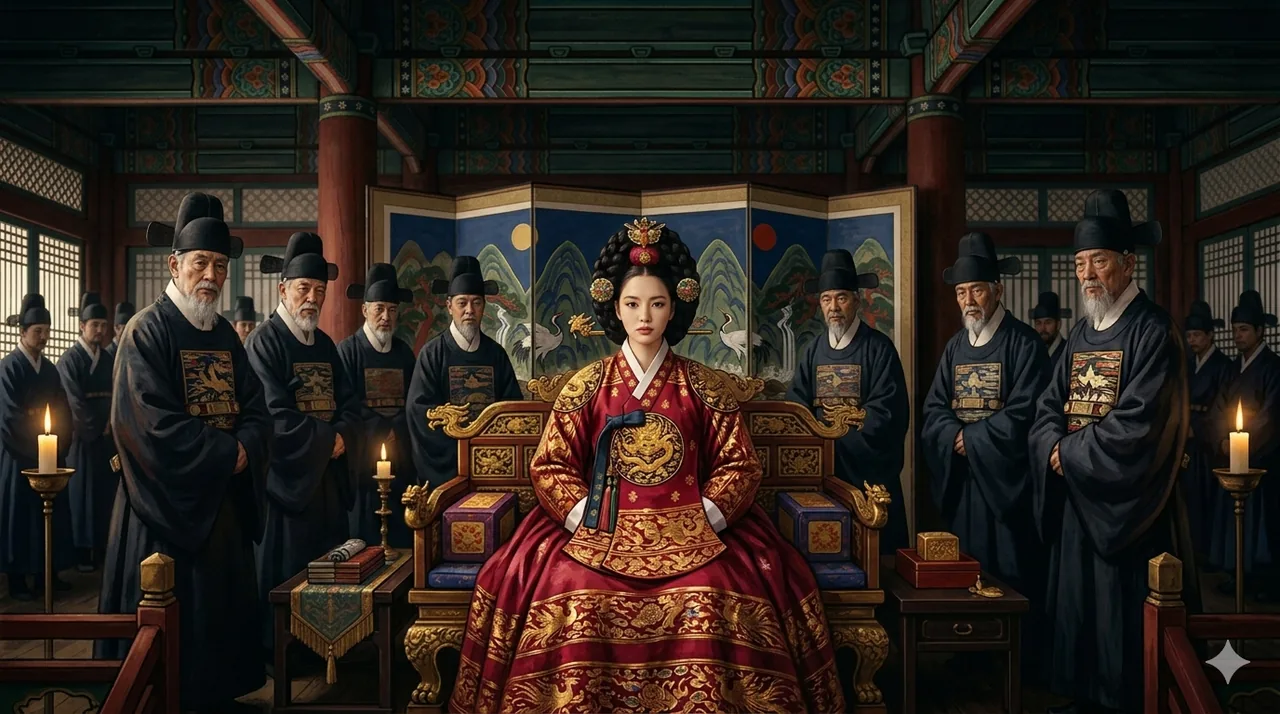
Netflix's Mr. Queen, Explained: Why Did Joseon's Queen Dowagers Rule From Behind a Screen?
Theme: Power & Politics
From the research behind Pause the Drama.
If you’ve watched Netflix’s Mr. Queen (철인왕후) — the body-swap comedy where a modern chef’s soul wakes up inside the body of a Joseon queen — you know the king she’s married to isn’t really running his own court. He’s Cheoljong, plucked from obscurity on Ganghwa Island and put on the throne with almost no warning. What the show doesn’t pause to explain is that this wasn’t palace intrigue operating outside the system. It was the system itself. For the first years of his reign, Cheoljong heard the business of state alongside a senior royal woman seated behind a screen a few feet away — an arrangement with written regulations, a fixed seating chart, and an entry in the national Annals recording the exact day she took the screen down.
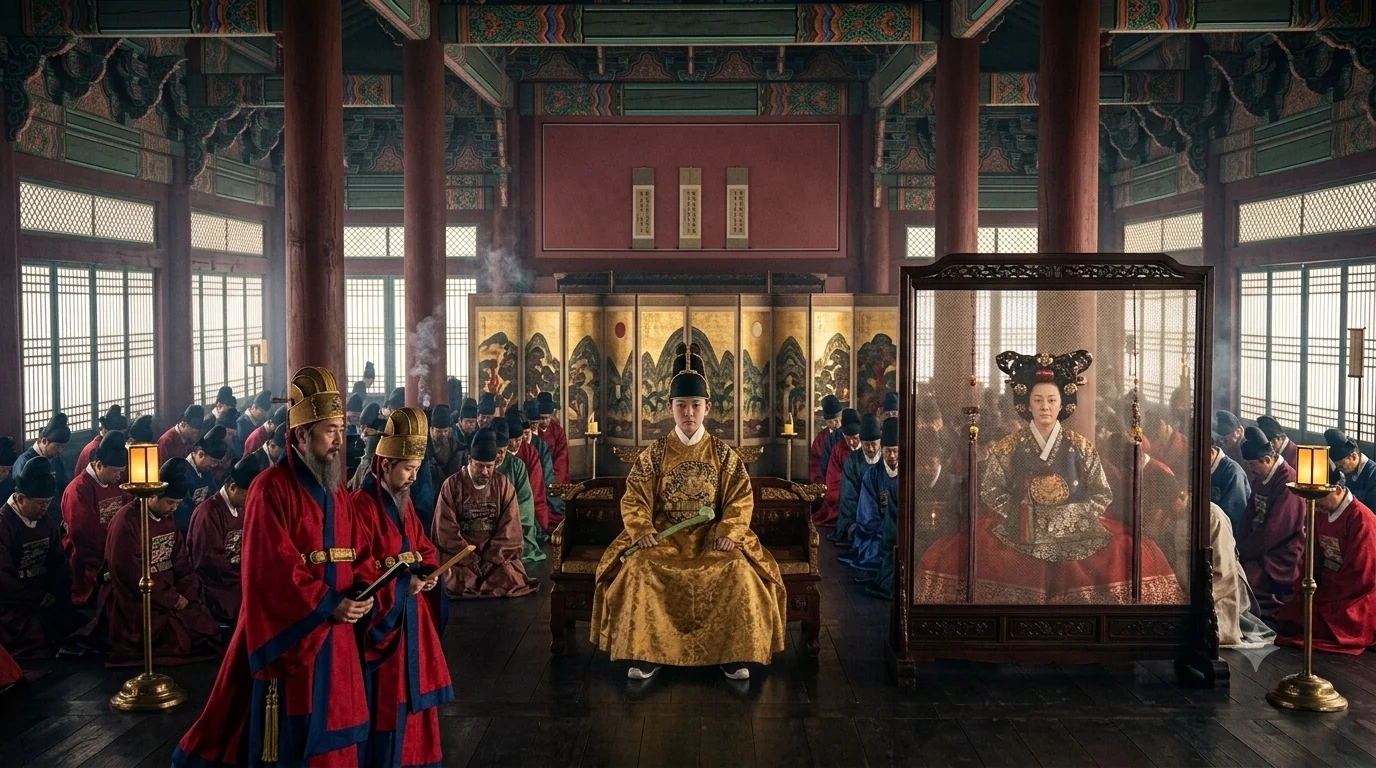 The screen was the whole institution in one object: the senior royal woman took part in government without meeting the assembled male officials face-to-face.
Quick answer: Suryeom cheongjeong (수렴청정, “hang a curtain, listen to government”) was Joseon’s official way of running the state when a king took the throne too young or without a king’s training. It is short for suryeom dong-cheongjeong (垂簾同聽政) — “hang a curtain and hear government together with the king” — and the senior royal elder, normally the grand queen dowager, sat behind a screen at court because Neo-Confucian propriety kept her from conducting business face-to-face with male officials. Joseon recorded seven such regencies. Queen Dowager Sunwon is the only woman who held one twice — the second for Cheoljong, the king of Mr. Queen’s own era.
Let’s unpack it.
Why does the dowager behind the screen matter so much in Mr. Queen?
Because in the world the show is set in, deference to a senior royal woman wasn’t Confucian courtesy dressed up as drama. It was constitutional machinery.
Mr. Queen takes place in the reign of King Cheoljong, a young man with almost no preparation for kingship, surrounded by ministers and elder relatives who clearly carry more weight in the room than he does. That’s not exaggeration for comic effect. Cheoljong came to the throne in 1849 under a formally recognized arrangement: suryeom cheongjeong, in which the royal family’s most senior elder — his adoptive grandmother, Queen Dowager Sunwon — sat behind a screen during court sessions and took part in the decisions issued in his name. For the first years of the show’s own historical backdrop, the most powerful figure in that room was a woman, and everybody in it knew that officially.
That’s the detail worth sitting with. Everyone in Mr. Queen’s court defers past the king before a decision lands — because in the history underneath the comedy, that deference was written into the rules.
What was suryeom cheongjeong, exactly?
Start with the phrase itself, because it’s the load-bearing image of the whole institution: 수렴청정 (垂簾聽政) literally means “hang [a] curtain, listen to government” — not a metaphor, an actual woven screen, hung in the room, with the business of state conducted through it.
But the full form of the term carries the part that’s easy to miss. Suryeom cheongjeong is short for suryeom dong-cheongjeong (수렴동청정, 垂簾同聽政) — “hang a curtain and hear government together with the king.” That word does real work. This was not a dowager replacing the throne with a rival throne of her own; it was the royal family’s senior elder handling state business alongside a king who wasn’t yet able to handle it alone, until he could. Joseon ran seven of these regencies over five centuries (Encyclopedia of Korean Culture — suryeom cheongjeong; 우리역사넷 — 수렴청정). Here they are, all seven:
| King | Regent | Why a regency |
|---|---|---|
| Seongjong | Queen Dowager Jeonghui | King was 13 |
| Myeongjong | Queen Dowager Munjeong | King was 12 |
| Seonjo | Queen Dowager Insun (왕대비) | Unprepared 16-year-old successor |
| Sunjo | Queen Dowager Jeongsun | King was 11 |
| Heonjong | Queen Dowager Sunwon | King was 8 |
| Cheoljong | Queen Dowager Sunwon (again) | Adult — but with no royal training |
| Gojong | Queen Dowager Sinjeong | King was 12 |
In short: seven regencies, and only one woman — Sunwon — held the screen-seat twice. Only one, Insun, held it as a queen dowager rather than a grand queen dowager. And only once, for Cheoljong, was the king a grown man.
The physical arrangement was written into formal regulations, the suryeom cheongjeong jeolmok (수렴청정절목), promulgated on the 4th day of the 7th lunar month of 1800 — the day the eleven-year-old Sunjo held his accession ceremony and then performed the regency rite with Queen Dowager Jeongsun. Those regulations became the template for every 19th-century regency that followed. Business was conducted in the pyeonjeon, the king’s working hall: the grand queen dowager sat on the inner side of the screen, toward the east, facing south; the king sat outside the screen, toward the west, also facing south. Audiences were held about six times a month. Memorials, censorate reports, agency filings and provincial dispatches all went to the king as a matter of principle — he could rule on them himself, or inform the dowager and issue his answer after. So the honest description isn’t “the paperwork went to the king but every decision was really hers.” It’s narrower and more interesting: the documents went to the king, and the regulations gave the dowager deep, formal involvement in how they were decided (우리역사넷 — 수렴청정; Academy of Korean Studies, Sillokwiki — “suryeom cheongjeong”).
Which brings us to the screen itself, and why a curtain was load-bearing enough to name an institution after. Joseon drew a hard line between male and female space — the naeoe (내외) principle — and a royal woman conducting business face-to-face with an assembly of male officials sat badly against it. The screen resolved the tension. It let the royal family’s senior elder take part in government without ever meeting the officials face-to-face: not a woman “pretending” to observe propriety while secretly ruling, but a compromise device that held Neo-Confucian ritual intact and made her political participation possible. The system meant both halves of that sentence.
Precedence was strict. As a rule the seat went to the grand queen dowager (대왕대비), the royal family’s most senior elder. There is exactly one special case worth knowing: at King Seonjo’s accession in 1567, the regency went to Queen Dowager Insun (인순왕후), King Myeongjong’s widow — a queen dowager (왕대비), not a grand queen dowager. Insun’s peer Queen Dowager Inseong held the same formal rank and had held it longer, but Insun acted as the representative dowager in that succession, and at the urging of Chief State Councillor Yi Jun-gyeong she took the screen-seat — the only queen dowager in Joseon to do so. She stepped down after about eight months (Encyclopedia of Korean Culture — Queen Dowager Insun). What doesn’t exist in the record is a reigning queen consort holding the regency. The seat belonged to the elders, not to the king’s own wife.
None of this happened off the books, either. Both of Joseon’s great state archives — the Annals of the Joseon Dynasty (조선왕조실록) and the Seungjeongwon ilgi (승정원일기, the Diary of the Royal Secretariat) — recorded suryeom cheongjeong proceedings in the same bureaucratic language applied to any king’s rule. A dowager’s regency wasn’t a footnote to “real” kingship. It was the government of record, for as long as it lasted — which is also why we can date its beginnings and endings to the day.
This wasn’t invented for the 19th century. Two centuries earlier, dowagers had already taken the screen-seat for boy-kings Seongjong and Myeongjong. But the case worth lingering on, right before Sunwon’s, is Queen Dowager Jeongsun (정순왕후, 1745–1805), second consort of King Yeongjo. When King Jeongjo died in 1800 and his eleven-year-old son Sunjo took the throne, Jeongsun, as grand queen dowager, took the regency — the one for which the jeolmok regulations were drawn up. Her years behind the screen were bound up with the bitter factional war between the Noron Sipa and Byeokpa, a wholesale reworking of the political order Jeongjo had built, and the crushing of Southerners and Catholic converts alike; the harsh Catholic persecution of 1801 happened inside that politics (Encyclopedia of Korean Culture — Queen Dowager Jeongsun; 우리역사넷 — Queen Dowager Jeongsun’s regency). Saying she “undid all of Jeongjo’s reforms” overshoots; saying she redrew the political settlement he had spent a reign assembling does not.
Her regency ended on a date the Annals give precisely: the 28th day of the 12th lunar month of Sunjo’s 3rd year, when the Sunjo sillok records that “the grand queen dowager withdrew the screen and returned government [to the king]” (Annals of the Joseon Dynasty — Sunjo sillok). You’ll see that rendered as both 1803 and 1804, and it’s worth being clear about why: the archive labels it 1803, but a date at the very end of the 12th lunar month falls in early 1804 on the modern solar calendar. That’s a calendar-conversion gap, not a scholarly dispute.
Queen Dowager Sunwon (순원왕후 김씨, 1789–1857), daughter of Kim Jo-sun of the Andong Kim clan and consort of King Sunjo, is the only woman in Joseon’s history recorded as performing suryeom cheongjeong twice.
The first time was for her own grandson. Sunjo died in 1834 and the eight-year-old Heonjong took the throne; Sunwon took the screen-seat, and held it until 1841, when Heonjong began ruling in his own name (우리역사넷 — Queen Dowager Sunwon’s regency under Heonjong; Encyclopedia of Korean Culture, “Heonjong”).
The second time is Mr. Queen’s own backdrop. Heonjong died in 1849 without an heir. Sunwon — by then grand queen dowager and the unquestioned senior of the royal family — chose the successor herself: Yi Won-beom, a distant royal relation living on Ganghwa Island in circumstances barely distinguishable from a commoner’s, the “Ganghwa Doryeong” story the drama loosely borrows from. She had him adopted as her and Sunjo’s son, and he became King Cheoljong.
Here’s the detail that makes this regency unusual. Cheoljong was nineteen — not a child. But he had never been given a prince’s title, had never gone through the capping ceremony that marked a royal adult, and had received none of the education a king was supposed to have. The regency wasn’t triggered by his age. It was triggered by the fact that a man had been placed on the throne with no training to sit on it — which is precisely the situation the phrase “hear government together with the king” was built for.
Sunwon lifted the screen on the 28th day of the 12th lunar month of Cheoljong’s 2nd year — the Cheoljong sillok records her instruction, “from today I withdraw the screen” — so Cheoljong’s personal rule dates from 1852 (the archive labels the entry 1851; same lunar-to-solar gap as before) (Annals of the Joseon Dynasty — Cheoljong sillok; Encyclopedia of Korean Culture — Queen Dowager Sunwon).
Was Queen Sunwon still regent during Mr. Queen?
Yes — but only during the earliest part of Queen Cheorin’s marriage.
The historical Queen Cheorin was invested as queen on the 25th day of the 9th lunar month of Cheoljong’s 2nd year — 1851 — only a few months before the screen came down. So the drama’s court isn’t the whole three years of Sunwon’s regency. It’s the tail end of it: the months when a new queen from the Andong Kim clan had just entered the palace, the dowager’s formal regency was about to close, and the clan’s grip on the government was tightening rather than loosening.
That grip is the long shadow of these two regencies. Sunwon’s turns behind the screen were an important backdrop to the entrenchment of sedo jeongchi (세도정치) — in-law politics, the concentration of state power in a single royal in-law clan, here her own Andong Kim — and the frequent 19th-century regencies did go hand in hand with weakened royal authority and swollen in-law power (우리역사넷 — 수렴청정; Lee Gi-dae, “Queen Dowager Sunwon’s Regency and Political Orientation in Her Hangul Letters,” Kukje Emun 47, 2009). But it would be too neat to hang sedo politics on one woman, or on one institution. Repeated child accessions, unstable succession, a weakened throne, swelling in-law clans and a wider reshuffle of central power all pushed in the same direction. Sunwon, notably, tried to hold a balance between the Andong Kim and the Pungyang Jo — and the balance did not hold.
Was this just a Korean thing? What China and France did instead
Korea did not invent the idea. Joseon drew on Chinese terminology and earlier East Asian regency precedents, then developed them into a system of its own — one shaped by the naeoe separation of male and female space and by the strict hierarchy of the royal family.
China’s chuílián tīngzhèng. The Chinese phrase chuílián tīngzhèng is written with the exact same characters as the Korean term — 垂簾聽政 — and China had a long line of powerful imperial women behind it, running from dowager regencies (Empress Lü of the Han, dowagers of the Song) to something Joseon never saw at all: Wu Zetian of the Tang, who did not rule from behind a curtain on a child’s behalf but took the imperial throne herself. Worth keeping those apart — the traditions rhyme; they are not one institution.
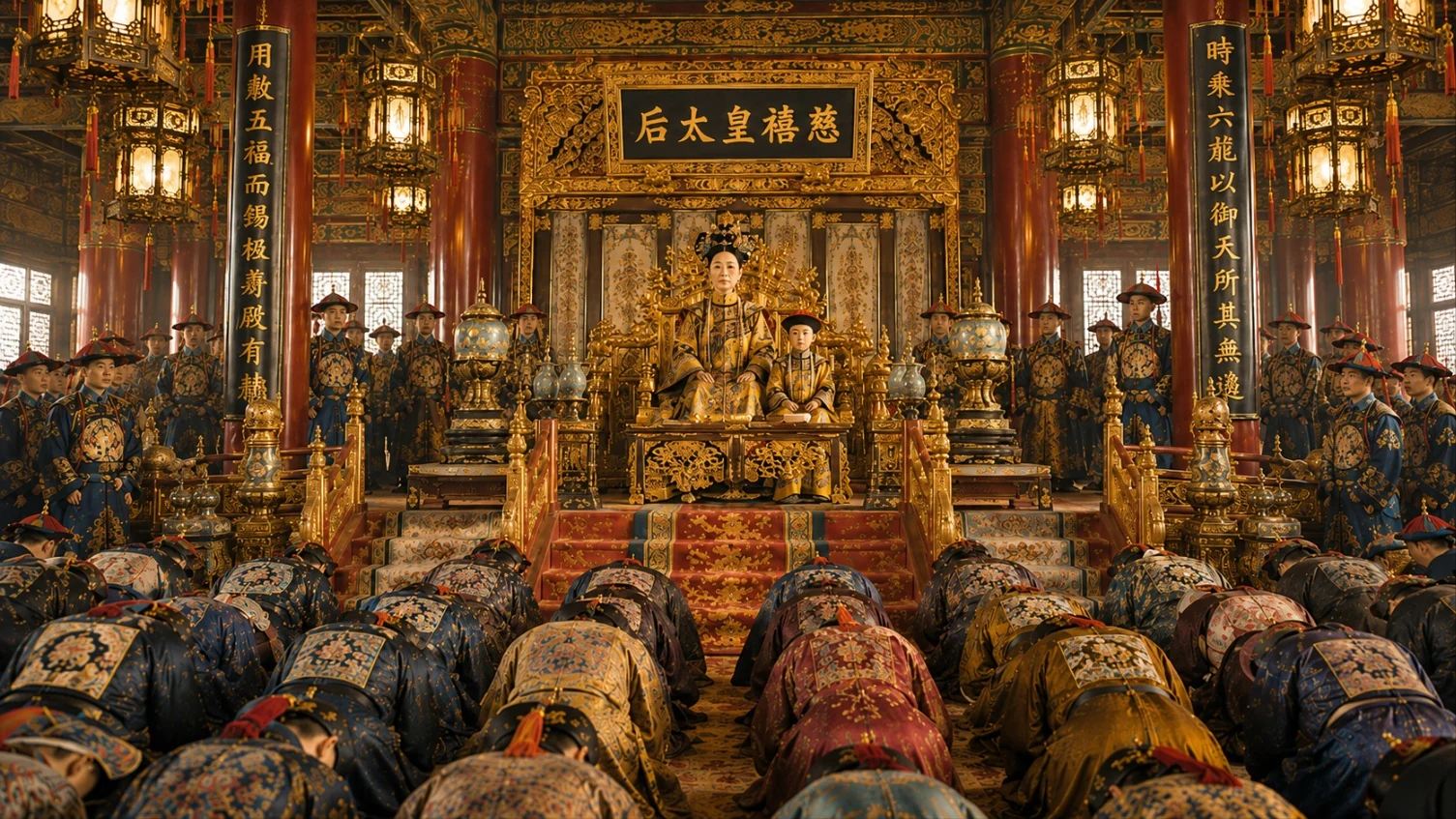 Qing China’s version of the same problem, solved with far less procedure: Empress Dowager Cixi’s power ran through regency, imperial majority, renewed regency and a coup — not one continuous curtain.
The most famous practitioner by far is Empress Dowager Cixi (慈禧太后) of the late Qing. But it’s worth resisting the tidy version of her story — “she ruled from behind the curtain from 1861 until she died in 1908, with a brief interruption.” Her actual grip moved in stages: she seized power in 1861 after her five-year-old son became the Tongzhi Emperor; 1873, Tongzhi began ruling personally; late 1874, she resumed the regency during his fatal illness; 1875, she took the regency again for her young nephew, the Guangxu Emperor; 1889, Guangxu began his own rule; 1898, after the Hundred Days’ Reform ended in a coup, she took power back and held it until her death in 1908 (EBSCO Research Starters — “Cixi’s Coup”; Encyclopaedia Britannica — Cixi). Regent, then not, then regent, then not, then ruler again — a political process, not a fixed office.
That difference is the real Korea–China contrast. Joseon’s suryeom cheongjeong was comparatively codified: a precedence ladder, a written jeolmok, a rite to install the screen and a recorded instruction to withdraw it. Cixi’s power was a far more improvised affair of co-regencies, imperial majorities and a coup.
France’s Catherine de Medici — no curtain required. Cross to 16th-century France and the same problem shows up wearing different clothes. When her elder son Francis II died in 1560, Catherine de Medici became regent for her ten-year-old second son, Charles IX; formal regency and later influence should be kept distinct, but she stayed at the center of French politics until Charles’s death in 1574 (Encyclopaedia Britannica — Catherine de’ Medici). She, too, ruled through a son, because Salic law barred a woman from the throne itself. But she never needed a screen. She sat in council, negotiated with nobles and ambassadors face-to-face, and acted openly as queen mother — resented and contested by rivals, but never required to be hidden from view for her authority to be procedurally acceptable.
That contrast is the point of setting these three side by side.
| In Mr. Queen | In history |
|---|---|
| Cheoljong seems like a young, unprepared king surrounded by scheming elders | Cheoljong was nineteen, but had no princely title, no capping ceremony and no royal schooling — so the regency was triggered by his unreadiness, not his age; Sunwon lifted the screen and he began personal rule in 1852 |
| The queen at the center of the show sits at the heart of the court’s power struggle | The historical Queen Cheorin was invested in 1851, months before the screen came down — the drama sits at the tail end of Sunwon’s regency, as Andong Kim power tightened |
| An elder dowager’s quiet opinion can outweigh a minister’s objection | Suryeom cheongjeong gave the senior dowager deep formal involvement in state decisions — recorded in the Annals like any other government business |
| Korea’s court intrigue feels like a uniquely elaborate kind of formality | China used the identical characters, 垂簾聽政 — but Cixi’s power was an improvised sequence of regencies and a coup, where Joseon’s was written into regulations |
| No queen in the show simply rules in her own right | Neo-Confucian Joseon needed an actual screen to make a royal woman’s participation proper; Catherine de Medici’s France needed no such device — resented, but never concealed |
In short: the boy-king-and-powerful-dowager shape running under Mr. Queen’s comedy isn’t generic sageuk atmosphere — it’s a specific, written, recorded office, shared down to the very characters used to write it with imperial China, and it is precisely because Joseon wrote the rules down that we can say what the drama gets right and where it compresses. Its rough Western mirror, Catherine de Medici, shows the same workaround for the same restriction, solved without the one detail Neo-Confucian Joseon couldn’t do without: the literal curtain.
Coming up next
A body-swap comedy about a chef trapped in a queen’s body sits on top of a real constitutional office — a screen, a fixed order of precedence, two archives logging a dowager’s rulings as ordinary state business. That’s the pattern with a good sageuk: the joke on the surface is doing real historical work underneath, if you know where to look for the curtain.
In the next essay, we’ll take another K-drama scene that looks like pure fiction — and trace the real Korean history hiding underneath it.
Frequently asked questions
What was suryeom cheongjeong? Suryeom cheongjeong (수렴청정, 垂簾聽政, literally “hang a curtain, listen to government”) was Joseon’s official way of running the state when a king took the throne too young, or without the training a king was supposed to have. It is short for suryeom dong-cheongjeong (수렴동청정) — “hang a curtain and hear government together with the king” — and that word “together” matters: the senior royal woman sat behind a screen at court and handled state business alongside the king, not as a separate throne replacing him. Joseon recorded seven such regencies.
Why did the queen have to sit behind a literal screen? Neo-Confucian Joseon kept male and female space sharply separated, so a royal woman conducting business face-to-face with assembled male officials carried real ritual difficulty. The screen was the device that resolved it: it let the senior royal woman take part in government without meeting the officials face-to-face — a compromise that preserved ritual propriety while making her political participation possible.
Could any queen perform suryeom cheongjeong? No. As a rule the seat went to the most senior royal elder, the grand queen dowager (대왕대비). There is one special case: at King Seonjo’s accession, Queen Dowager Insun — a queen dowager (왕대비), not a grand queen dowager — held the regency for about eight months, the only queen dowager in Joseon to do so. No case of a reigning queen consort holding suryeom cheongjeong is attested.
Who was Queen Dowager Sunwon, and how many regencies did she hold? Queen Dowager Sunwon (순원왕후 김씨, 1789–1857), daughter of Kim Jo-sun of the Andong Kim clan and consort of King Sunjo, is the only woman in Joseon’s history recorded as performing suryeom cheongjeong twice — first for her grandson King Heonjong from 1834, and again for King Cheoljong from 1849.
Is Mr. Queen’s king connected to Queen Dowager Sunwon’s regencies? Yes. Mr. Queen is set in the reign of King Cheoljong, who took the throne in 1849 with no preparation for court life and began his reign under Sunwon’s second regency. The Annals record her lifting the screen on the 28th day of the 12th lunar month of Cheoljong’s 2nd year, so Cheoljong began ruling in his own name from 1852. The historical Queen Cheorin was invested as queen in 1851, which places the drama’s setting at the late stage of that regency rather than across all of it.
Did suryeom cheongjeong cause sedo jeongchi, the in-law politics of late Joseon? It’s too strong to say the institution simply caused it. Sunwon’s two regencies were an important backdrop to the entrenchment of her own Andong Kim clan, and the frequent 19th-century regencies did coincide with weakened royal authority and swollen in-law power. But sedo politics also grew out of repeated child accessions, unstable succession, and a broader reshuffling of central power.
Did China have the same institution? China used the identical characters — chuílián tīngzhèng (垂簾聽政) — and had a long line of female regents, from Empress Lü of Han to Wu Zetian of Tang to Song-dynasty dowagers. The most famous case is Empress Dowager Cixi of the late Qing, but her power was not one continuous curtain-regency from 1861 to 1908: it moved through the Tongzhi regency, his personal rule in 1873, a renewed regency during his final illness, the Guangxu regency from 1875, Guangxu’s own rule from 1889, and her return to power after the 1898 coup.
How is this different from a Western regent like Catherine de Medici? Both women exercised power through a son in a system that barred women from the throne itself, but the form differed. Joseon’s dowagers heard government from behind a screen. Catherine de Medici, who became regent for her ten-year-old son Charles IX in 1560 and remained at the center of French politics until his death in 1574, sat in council and negotiated with nobles and ambassadors in the open — no screen, no concealment.
Sources & further reading
This piece was written from the historical script and fact-check of 사뚱샘의 역사방 (SaDDungSam). Specific dates and figures are sourced inline, cross-checked against the Encyclopedia of Korean Culture (Academy of Korean Studies), 우리역사넷 (National Institute of Korean History), the Academy of Korean Studies’ Sillokwiki, and the official Annals of the Joseon Dynasty archive. Regency start- and end-dates are given as the Annals record them, in lunar-calendar reign years, with the modern solar equivalent noted where the two fall in different years. For broader reading:
- Suryeom cheongjeong’s mechanics, the jeolmok regulations and precedence rules. 우리역사넷 (National Institute of Korean History) · Encyclopedia of Korean Culture (한국민족문화대백과, Academy of Korean Studies) · Academy of Korean Studies Sillokwiki.
- The regencies themselves. Sunjo sillok and Cheoljong sillok, Annals of the Joseon Dynasty · Encyclopedia of Korean Culture, “Queen Dowager Jeongsun,” “Queen Dowager Sunwon,” “Queen Dowager Insun,” “Heonjong,” “Cheoljong,” “Queen Cheorin.”
- Sunwon’s politics in her own hand. Lee Gi-dae, “Queen Dowager Sunwon’s Regency and Political Orientation in Her Hangul Letters,” Kukje Emun 47 (2009).
- China’s comparable institution. EBSCO Research Starters, “Cixi’s Coup” · Encyclopaedia Britannica, “Cixi.”
- A Western regency compared. Encyclopaedia Britannica, “Catherine de’ Medici.”
Thanks for reading — see you in the next one.
This article was researched and written by K-Drama History. Source: Netflix's Mr. Queen, Explained: Why Did Joseon's Queen Dowagers Rule From Behind a Screen? — K-Drama History